DRIDarden Restaurants
- Headquarters
- Orlando, FL
- CEO
- Ricardo Cardenas
- Next results
- around Dec 17, 2026
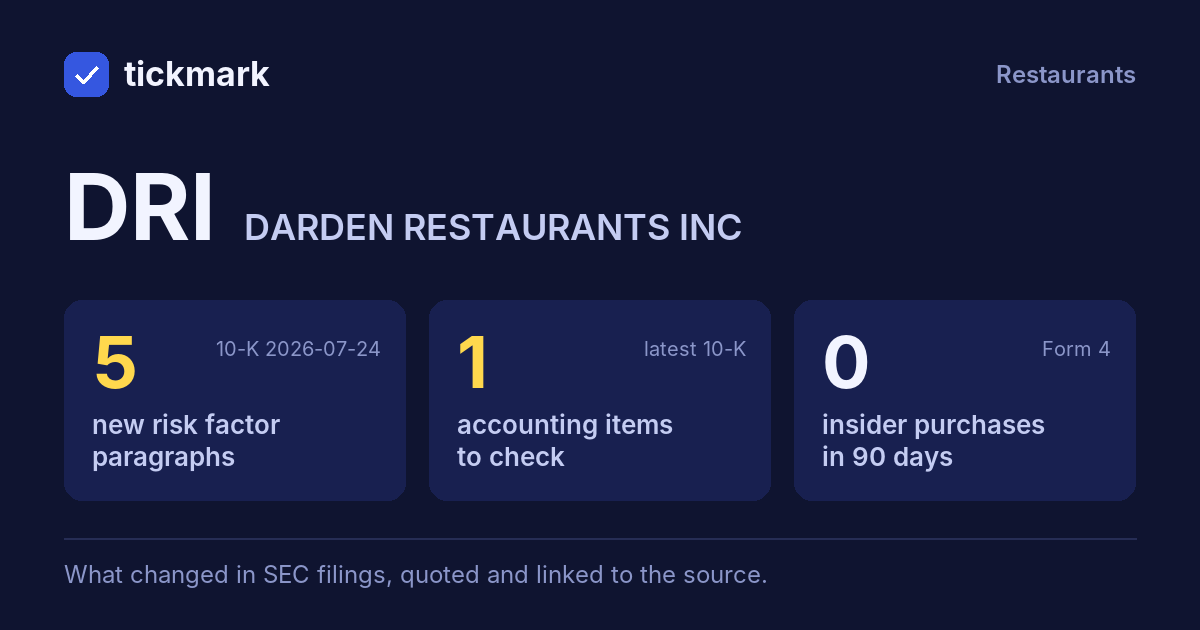
What the 10-K filed 2026-07-24 says about risks that are not on the face of the balance sheet, from the notes to the financial statements, Legal Proceedings and the MD&A (and, for big customers and key suppliers, Business and Risk Factors). Tickdelta picks sentences with specifics (amounts, accruals, covenant ratios) and quotes them as filed. New marks a sentence with nothing like it in the 10-K filed 2025-07-18.
Big customers
Customers the company names as a large share of revenue or receivables (it must name any worth 10% of revenue).
No specific sentence about this in the 10-K.
Key suppliers
Parts or manufacturing that depend on one or a few suppliers.
“We have a limited number of suppliers and distributors for certain of our products and services.”
Read it in the 10-K ↗
Lawsuits and legal claims
Pending cases, settlements and what the company has set aside for them.
No specific sentence about this in the 10-K.
Guarantees and indemnities
Promises to pay someone else's debts or losses if they cannot.
“Standby letters of credit (6) $ 88.6 $ 88.6 $ — $ — $ —”
Read it in the 10-K ↗
“These amounts represent the maximum potential amount of future payments under the guarantees.”
Read it in the 10-K ↗
Debt covenants
Conditions in loan agreements that, if broken, can make debt due early.
“affirmative and negative covenants (including limitations on liens and subsidiary debt and a maximum consolidated lease adjusted total debt to total capitalization ratio of 0.75 to 1.00) and events of default usual for credit facilities of this type.”
Read it in the 10-K ↗
“On September 16, 2024, we entered into Amendment No. 1 (the “Amendment”) to the Revolving Credit Agreement, which replaced a prior financial covenant (which provided for a maximum consolidated total debt to total capitalization ratio) with a new financial covenant requiring us to maintain, measured as of the end of each fiscal quarter, a maximum consolidated leverage ratio of 3.50 to 1.00 (which may be temporarily increased to 4.00 to 1.00 upon the election as a result of a covered acquisition, subject to customary limitations set forth in the Revolving Credit Agreement).”
Read it in the 10-K ↗
“Per the Amendment, our adjusted debt to adjusted EBITDAR ratio must be 3.50 to 1.00 or lower to comply with our financial covenants.”
Read it in the 10-K ↗
“The Revolving Credit Agreement is a senior unsecured credit commitment to the Company and contains customary representations and affirmative and negative covenants (including limitations on liens and subsidiary debt and a maximum consolidated lease adjusted total debt to total capitalization ratio of 0.75 to 1.00) and events of default usual for credit facilities of this type, and consistent with our prior Revolving Credit Agreement.”
Read it in the 10-K ↗
“On September 16, 2024, we entered into the Amendment to the Revolving Credit Agreement, which replaced the prior financial covenant (which provided for a maximum consolidated total debt to total capitalization ratio) with a new financial covenant requiring us to maintain, measured as of the end of each fiscal quarter, a maximum consolidated leverage ratio of 3.50 to 1.00 (which may be temporarily increased to 4.00 to 1.00 upon the election as a result of a covered acquisition, subject to customary limitations set forth in the Revolving Credit Agreement).”
Read it in the 10-K ↗
Commitments off the balance sheet
Contracts the company must pay for later: purchase obligations, take-or-pay deals.
No specific sentence about this in the 10-K.
Sentences are chosen by their words, not read by AI, so some can be off topic. Always check the filing. Open the 10-K ↗
Work on DRI in a spreadsheet:
Excel workbook (a sheet per section, ten years by column, charts, links to the filings) ·
CSV.
For a Google Sheet that stays up to date, paste =IMPORTDATA("https://tickdelta.com/company/DRI/export.csv") into a cell.