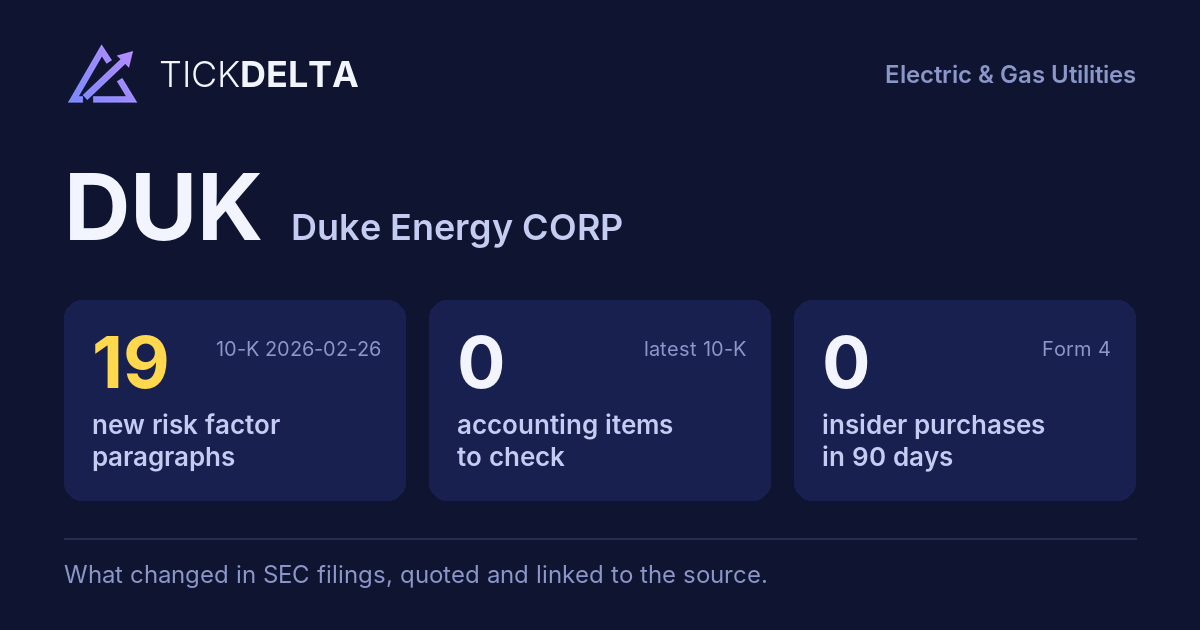
10-K 0001326160-26-000014 (2026-02-26) vs 10-K 0001326160-25-000072 (2025-02-27)
| Section | Compared text | Words now | Changed |
|---|
| Risk Factors | Item 1A | 10,151 |
14.3% |
| MD&A | Item 7 | 21,443 |
28.8% |
| Legal Proceedings | Item 3 | 589 |
33.0% |
| Accounting Policies | Item 8, Note 1 – SUMMARY OF SIGNIFICANT ACCOUNTING POLICIES | 5,333 |
4.3% |
The redline: what was cut and what was added
In each section, the paragraph that changed most, marked against last year's 10-K:
cut words struck through, new words highlighted and underlined.
Risk Factors 265 words changed in this paragraph; it is 34% similar to last year's version.
Duke Energy’s long-term strategy requires the extensive capital investment in generation and transmission facilities. The construction of new projects, either wholly owned or partially owned, which such projects involve a number of risks, including construction delays, delays in or failure to receive required regulatory approvals and/or sitting siting or environmental permits, nonperformance by equipment and other third-party suppliers, and increases in equipment and labor costs. To limit costs beyond expectations. Uncertainty in long-term customer usage patterns or lower than anticipated load growth could impact the risks nature, timing or magnitude of these construction projects, the Company’s investments, and consequently, the achievement of the Company’s growth objectives. Additionally, to support expected demand growth, Duke Energy Registrants enter into equipment purchase orders will have compounding risks due to the simultaneous development and construction contracts and incur engineering and design service costs in advance of receiving necessary regulatory approvals and/or siting or environmental permits. If any multiple facilities. Completion of these types of large projects are canceled is subject to substantial delay or cost overrun risks that have, or may occur again, in the future, including those related to labor costs, availability of materials, productivity of workforce/equipment; as well as supply chain issues including, quality, availability, disruptions and potential tariff impacts; weather related delays; start up issues; public and regulatory support; transmission grid interconnection issues; and potential for any reason, increased financing costs as a result of interest rates and impact of delays including failure to receive necessary regulatory approvals and/or siting or environmental permits, loss of otherwise available tax credits and incentives. Project cancellations may result in significant cancellation penalties under the equipment purchase orders and construction contracts could occur. In addition, if any or impairment charges. If a construction work or investments have been recorded as an asset, an impairment may need to be recorded in the event the project is canceled. completed, the total costs may be higher than estimated or deemed imprudent and may be disallowed or otherwise not recoverable through regulated rates.
Source: Item 1A, 10-K 0001326160-26-000014 vs Item 1A, 10-K 0001326160-25-000072
MD&A 238 words changed in this paragraph; it is 40% similar to last year's version.
Operational Excellence. The reliable and safe operation of our power generating facilities, electric transmission and distribution systems and natural gas infrastructure in our communities continues to be foundational to serving our customers, our financial results and our credibility with stakeholders. Operational excellence is especially critical to successfully navigate effective storm response and to efficiently provide the continuity of service our customers demand, regardless of weather or circumstance. Our workforce and contract partners work hard to prepare for storm season through drills, material planning, call center readiness, contingency planning and customer communications. In such extreme circumstances, our immediate priority is, and always will be, executing the extensive storm preparation and response work to ensure the safe, timely, timely and efficient restoration of service to impacted customers as quickly as possible. Around-the-clock power restoration efforts continued following the historic damage inflicted by these storms with lineworkers, tree trimmers and removal experts, state department of transportation workers and countless others, working to repair and, in certain areas, completely rebuild, the critical electricity infrastructure that powers and supports the communities we serve. Our operations teams worked diligently, restoring power to approximately 5.5 million customers. We've also seen the benefits of ongoing grid hardening investments, leveraging self-healing technologies and remote restoration capabilities to automate the rerouting of power, more effectively deploy resources, resources and reduce the frequency or duration of outages for many of our customers during severe weather events. Our ability to effectively handle all facets of storm response efforts while making ongoing investments to enhance the reliability and physical security of the grid is a testament to our team’s extensive preparation and coordination, applying lessons learned from previous storms, and on-the-ground management throughout the restoration efforts. Duke Energy is proud to have received 22 Emergency Response Awards since EEI began recognizing storm response in 1998 (including 11 for assisting other utilities), including for the severe storm season of 2024.
Source: Item 7, 10-K 0001326160-26-000014 vs Item 7, 10-K 0001326160-25-000072
Legal Proceedings 123 words changed in this paragraph; it is 73% similar to last year's version.
On December 4, 2024, the town of Carrboro, North Carolina, filed a lawsuit against Duke Energy in the North Carolina Superior Court, Orange County, alleging that Duke Energy and its predecessor companies knew since the late 1960s that fossil-fuel fossil fuel emissions could cause global climate changes and engaged in a campaign to conceal the dangers of fossil fuel emissions from the public, regulators, legislators, and others, resulting in a delayed transition away from fossil fuel emissions and worsening climate change. The lawsuit also alleges that Duke Energy misled the public regarding Duke Energy’s support for, and actions toward, transitioning its fossil fuel portfolio to renewable energy. The damages alleged range from road and stormwater-system impacts to increased electricity costs and recurring invasions and interferences from extreme weather events. The lawsuit asserts state-law claims for public nuisance, private nuisance, trespass, negligence, and gross negligence, and is seeking an unspecified amount of monetary damages. The case has been transferred to the North Carolina Business Court. Duke Energy cannot predict filed a motion to dismiss the outcome litigation based on lack of this matter. subject-matter jurisdiction on March 17, 2025, and filed a motion to dismiss based on failure to state a claim on which relief can be granted on May 9, 2025. Oral argument regarding Duke Energy's motions to dismiss was held on September 25, 2025. As requested by the court, supplemental briefing addressing various aspects of causation, including traceability and proximate cause, was filed on October 25, 2025. On February 12, 2026, the court granted Duke Energy's motion to dismiss the litigation based on lack of subject-matter jurisdiction. In light of the dismissal, the court denied the motion to dismiss for failure to state a claim as moot.
Source: Item 3, 10-K 0001326160-26-000014 vs Item 3, 10-K 0001326160-25-000072
Accounting Policies 86 words changed in this paragraph; it is 48% similar to last year's version.
Duke Energy, through a nonregulated subsidiary, was the winner of the Carolina Long Bay offshore wind auction in May 2022 and recorded an asset 2022. The historical cost of the rights acquired from the auction, totaling $150 million related to the contract is recorded in Other within Other noncurrent assets on the Duke Energy's Consolidated Balance Sheets as of December 31, 2024 2025, and 2023. The asset is recorded at historical cost and is subject to impairment testing should circumstances indicate the carrying value may not be recoverable. In November 2022, Duke Energy committed to a plan to sell the Commercial Renewables business segment, excluding the offshore wind contract for Carolina Long Bay, which was moved to the EU&I segment. See Notes 2 and 3 for further information. 2024.
Source: Item 8, Note 1 – SUMMARY OF SIGNIFICANT ACCOUNTING POLICIES, 10-K 0001326160-26-000014 vs Item 8, Note 1 – SUMMARY OF SIGNIFICANT ACCOUNTING POLICIES, 10-K 0001326160-25-000072
Every change, by type
Sentences and paragraphs of DUK's Risk Factors and MD&A, 10-K 2026-02-26 against 10-K 2025-02-27.
Each links to the text at sec.gov.
Quiet changes are sentences kept from last year with one to four words changed, at least one of them a hedge, a modal or a qualifier
(may, could, will, not, significant, material…). A year or date rolling forward is not counted.
The full word list
adverse, adversely, all, although, anticipate, anticipates, any, approximately, believe, believes, can, cannot, certain, could, expect, expects, generally, however, if, intend, intends, largely, likely, many, material, materially, may, might, most, must, never, no, not, possible, primarily, probable, should, significant, significantly, some, substantial, substantially, unlikely, will, would
AddedRisk Factors
The Duke Energy Registrants may also face heightened competitive pressures arising from other utilities and energy suppliers that construct or install generation facilities directly for customers, as well as from customers who develop their own generation capabilities. Additionally, the establishment of municipal utilities within Duke Energy's service territories could further intensify competition. These developments have the potential to materially and adversely affect the Duke Energy Registrants' results of operations, financial position or cash flows.
Read it in 10-K 2026-02-26 at sec.gov ↗
AddedRisk Factors
The Duke Energy Registrants are subject to numerous environmental laws and regulations affecting many aspects of their present and future operations, including CCR, air emissions, water quality, wastewater discharges, solid waste and hazardous waste. For example, new EPA rules issued in April 2024, among other things, impose stringent GHG emissions limitations on existing coal plants and new natural gas plants and more stringent air toxic limits on existing coal plants, increase limitations on wastewater discharge, and impose groundwater monitoring and corrective action requirements on previously unregulated coal ash sources at regulated facilities (CCR Management Units) and inactive surface impoundments at retired generating facilities (Legacy CCR Surface Impoundments). Potential legal challenges to such rules or actions to repeal or modify requirements may not be successful, and adherence to these rules may increase the cost of compliance, impact generation resource mix, force carbon reductions or negatively impact customer reliability and perceived value. For example, EPA Rule 111 as issued imposes stringent GHG emissions limitations and reliance on carbon capture technologies that are not yet adequately demonstrated at utility scale. These and other environmental laws and regulations can result in increased capital, operating and other costs. Additionally, new state legislation in response to such regulations could impose carbon reduction objectives that are more aggressive than the Company's plans. These regulations may require the Duke Energy Registrants to make additional capital expenditures or increase operating and maintenance costs.
Read it in 10-K 2026-02-26 at sec.gov ↗
AddedRisk Factors
The Duke Energy Registrants are exposed to financial and operational risks associated with growth including volatility in sales, supply and demand forecasts, and customer usage changes which could negatively impact the Duke Energy Registrants' results of operations.
Read it in 10-K 2026-02-26 at sec.gov ↗
AddedRisk Factors
•weather variability such as extreme seasonal conditions, storm-related outages, or drought impacting generation economics;
Read it in 10-K 2026-02-26 at sec.gov ↗
AddedRisk Factors
•transmission or transportation constraints, purchased power availability and competitive alternative energy sources;
Read it in 10-K 2026-02-26 at sec.gov ↗
AddedRisk Factors
•customer-owned generation, energy efficiency adoption and technological advances reducing demand; and
Read it in 10-K 2026-02-26 at sec.gov ↗
AddedRisk Factors
•fuel procurement challenges for coal, natural gas, crude oil and uranium and capacity limitations for transmission services.
Read it in 10-K 2026-02-26 at sec.gov ↗
AddedRisk Factors
At times, demand can exceed available generation capacity and emerging large loads – such as hyperscale data centers and industrial facilities – present unique risks due to their high demand, rapid fluctuations, and unpredictable operational profiles, which can further strain bulk power system reliability and grid stability. Meeting these requirements may necessitate substantial investments in generation, transmission and advanced grid infrastructure, while early termination of service agreements or stranded assets could result if investments are not fully recovered. Additionally, failure to comply with evolving regulatory requirements and reliability standards, including those established or those that may be established in the future by the NERC and regional entities, could result in penalties, operational restrictions or reputational harm. Compliance obligations related to interconnection processes, system planning and reliability performance for large loads may require significant resources and could impact project timelines and costs.
Read it in 10-K 2026-02-26 at sec.gov ↗
AddedRisk Factors
Risks Related to Supply Chain Disruptions, Inflation, Tariffs and Foreign Export Restrictions
Read it in 10-K 2026-02-26 at sec.gov ↗
AddedRisk Factors
Duke Energy’s operations and capital projects are exposed to supply chain disruptions, inflation, tariffs and export restrictions. These factors may increase costs, extend lead times for critical equipment and/or delay construction and maintenance activities. Rising demand for electric infrastructure and international trade developments, including potential export controls on certain rare earth materials and technologies used in electric utility infrastructure, may further constrain supply availability. These risks may result in higher costs than estimated or than allowed under approved regulatory mechanisms and could impact our financial results, capital plan execution or our ability to deliver on system modernization goals.
Read it in 10-K 2026-02-26 at sec.gov ↗
AddedRisk Factors
The Duke Energy Registrants have incurred, and may incur additional costs or delays in the construction of new plants or facilities and may not be able to recover their investments in whole or in part.
Read it in 10-K 2026-02-26 at sec.gov ↗
AddedRisk Factors
Duke Energy’s long-term strategy requires extensive capital investment in generation and transmission facilities. The construction of such projects involve a number of risks, including construction delays, delays in or failure to receive required regulatory approvals and/or siting or environmental permits, nonperformance by equipment and other third-party suppliers, and increases in equipment and labor costs beyond expectations. Uncertainty in long-term customer usage patterns or lower than anticipated load growth could impact the nature, timing or magnitude of the Company’s investments, and consequently, the achievement of the Company’s growth objectives. Additionally, to support expected demand growth, Duke Energy Registrants will have compounding risks due to the simultaneous development and construction of multiple facilities. Completion of these types of large projects is subject to substantial delay or cost overrun risks that have, or may occur again, in the future, including those related to labor costs, availability of materials, productivity of workforce/equipment; as well as supply chain issues including, quality, availability, disruptions and potential tariff impacts; weather related delays; start up issues; public and regulatory support; transmission grid interconnection issues; and potential for increased financing costs as a result of interest rates and impact of delays including loss of otherwise available tax credits and incentives. Project cancellations may result in significant cancellation penalties under the equipment purchase orders and construction contracts or impairment charges. If a construction project is completed, the total costs may be higher than estimated or deemed imprudent and may be disallowed or otherwise not recoverable through regulated rates.
Read it in 10-K 2026-02-26 at sec.gov ↗
RemovedRisk Factors
The Duke Energy Registrants are subject to numerous environmental laws and regulations affecting many aspects of their present and future operations, including CCRs, air emissions, water quality, wastewater discharges, solid waste and hazardous waste. For example, new EPA
Read it in 10-K 2025-02-27 at sec.gov ↗
RemovedRisk Factors
rules issued in April 2024, among other things, impose stringent GHG emissions limitations on existing coal plants and new natural gas plants
Read it in 10-K 2025-02-27 at sec.gov ↗
RemovedRisk Factors
and more stringent air toxic limits on existing coal plants, increase limitations on wastewater discharge, and impose groundwater monitoring and
Read it in 10-K 2025-02-27 at sec.gov ↗
RemovedRisk Factors
corrective action requirements on previously unregulated coal ash sources at regulated facilities (CCR Management Units) and inactive surface
Read it in 10-K 2025-02-27 at sec.gov ↗
RemovedRisk Factors
impoundments at retired generating facilities (Legacy CCR Surface Impoundments). Potential legal challenges to such rules may not be
Read it in 10-K 2025-02-27 at sec.gov ↗
RemovedRisk Factors
successful, and adherence to these rules may increase the cost of compliance, impact generation resource mix and carbon-reduction targets,
Read it in 10-K 2025-02-27 at sec.gov ↗
RemovedRisk Factors
and negatively impact customer reliability and affordability due to such rules' imposition of stringent GHG emissions limitations and reliance on
Read it in 10-K 2025-02-27 at sec.gov ↗
RemovedRisk Factors
carbon capture technologies that are not yet adequately demonstrated at utility scale. These and other environmental laws and regulations can result in increased capital, operating and other costs.
Read it in 10-K 2025-02-27 at sec.gov ↗
RemovedRisk Factors
The EPA has issued or proposed federal regulations, including the new rules issued in April 2024, governing the management of wastewater, CCR management units and CO2 emissions. New state legislation in response to such regulations could impose carbon reduction goals that are more aggressive than the Company's plans. These regulations may require the Duke Energy Registrants to make additional capital expenditures and increase operating and maintenance costs.
Read it in 10-K 2025-02-27 at sec.gov ↗
RemovedRisk Factors
•weather conditions, including extreme winter or summer weather that could cause significantly lower or higher demand for energy or natural gas usage for heating or cooling purposes, as applicable, storm-related customer outages resulting in lower usage, or periods of low rainfall that decrease the ability to operate facilities in an economical manner;
Read it in 10-K 2025-02-27 at sec.gov ↗
RemovedRisk Factors
•supply of and demand for energy commodities, including potential usage of electricity by data centers;
Read it in 10-K 2025-02-27 at sec.gov ↗
RemovedRisk Factors
•availability of competitively priced alternative energy sources, which are preferred by some customers over electricity produced from coal, nuclear or natural gas plants, and customer usage of energy-efficient equipment that reduces energy demand;
Read it in 10-K 2025-02-27 at sec.gov ↗
RewordedRisk Factors
Such events can and in the past, have, negatively impacted sales volume such as in the case of storm-related customer outages resulting in lower usage, and costs Costs to restore service and rebuild assets after such events may be, and in the case of hurricanes Helene and Milton experienced in 2024, have been, be material and did could impact the results of operations, financial position or cash flows of the Duke Energy Registrants, and such events may do so in the future, until complete and timely cost recovery is approved and occurs under existing relevant regulatory mechanisms across our jurisdictions.
Read it in 10-K 2026-02-26 at sec.gov ↗
RewordedRisk Factors
Delays in obtaining any required environmental regulatory approvals, failure to obtain and comply with them or changes in environmental laws or regulations to more stringent compliance levels could, and are likely to, result in additional costs of operation for existing facilities or development of new facilities being prevented, delayed or subject to additional costs.
Read it in 10-K 2026-02-26 at sec.gov ↗
RewordedRisk Factors
Duke Energy’s future results could be adversely affected if it is unable to implement its business strategy to reliably provide reliable energy while maintaining low costs and affordably serve its customers while also balancing its grid and fleet energy modernization objectives and carbon emissions reduction goals. reductions.
Read it in 10-K 2026-02-26 at sec.gov ↗
RewordedRisk Factors
These federal Federal and state laws, regulations and other legal requirements requirements, including those related to the 2015 CCR Rule and 2024 CCR Rule, may require or result in additional expenditures, including increased operating and maintenance costs, which could affect the results of operations, financial position and or cash flows of the Duke Energy Registrants.
Read it in 10-K 2026-02-26 at sec.gov ↗
RewordedRisk Factors
Over time, customer adoption of these technologies or adoption of net metering regulatory structures could result in Duke Energy not being able to fully recover the costs and investment in generation. of its investments.
Read it in 10-K 2026-02-26 at sec.gov ↗
RewordedRisk Factors
In addition, regulatory authorities also review whether natural gas fuel and purchased power costs are prudently incurred and can disallow the recovery of a portion of natural gas these costs that the Duke Energy Registrants seek to recover from customers, which would adversely impact earnings. earnings and cash flows.
Read it in 10-K 2026-02-26 at sec.gov ↗
RewordedRisk Factors
Deregulation or restructuring in the electric industry may result in increased Increased competition and unrecovered costs that could adversely affect the Duke Energy Registrants’ results of operations, financial position or cash flows and their utility businesses.
Read it in 10-K 2026-02-26 at sec.gov ↗
RewordedRisk Factors
Regulatory changes and/or uncertainty of applicability of such legislative and regulatory initiatives could also result in generation facilities to be retired earlier than planned to meet our achieve net-zero 2050 goal. carbon emissions from electricity generation by 2050.
Read it in 10-K 2026-02-26 at sec.gov ↗
RewordedRisk Factors
Because of the critical nature of the infrastructure, increased connectivity to the internet internet, external networks, mandatory reliability and safety obligations, and technology systems’ inherent vulnerability to disability or failures due to hacking, viruses, acts of war or terrorism or other types of data security breaches, the Duke Energy Registrants face a heightened risk of cyberattacks from foreign foreign, nation-state or domestic sources and have been subject, and will likely continue to be subject, to cyberattacks designed to gain unauthorized access to information and/or information systems or to disrupt utility operations through computer viruses and phishing attempts either directly or indirectly through its material vendors or related third parties.
Read it in 10-K 2026-02-26 at sec.gov ↗
RewordedRisk Factors
The Duke Energy Registrants that operate designated critical pipelines that transport natural gas are also subject to security directives issued by the Department of Homeland Security's Transportation Security Administration (TSA) TSA requiring such registrants to implement specific cybersecurity mitigation measures.
Read it in 10-K 2026-02-26 at sec.gov ↗
RewordedRisk Factors
Duke Energy is working to meet growing and evolving customer energy needs while balancing customer reliability and affordability, reliability, costs and other priorities including the need to modernize its fleet and the regulatory construct. constructs.
Read it in 10-K 2026-02-26 at sec.gov ↗
RewordedRisk Factors
Certain events, such as an employee strike or work stoppage, an aging workforce, mismatch of skill set or complement to future needs, or unavailability of contract resources may lead to operating challenges and or increased costs.
Read it in 10-K 2026-02-26 at sec.gov ↗
AddedMD&A
This is a transformative period for the utility industry propelled by energy modernization in support of load growth acceleration and the ongoing shift to more efficient and resilient energy infrastructure. Through our strategic investments and initiatives, we have maintained a key role in this transition, as we strengthen the energy system for our customers. In 2025, we advanced key policy and regulatory activities, executed strategic transactions to support growth and delivered safe and reliable utility services to our customers and communities. We also made progress advancing through the preliminary stages of the approval and construction for significant new generation investments. We continue to operate and maintain our infrastructure in a manner that extends the useful lives for critical assets, while executing a disciplined approach in the prioritization and deployment of capital for new investments. We are proud of the constructive regulatory outcomes that we advocated for our customers as we prepare for growth in energy demand driven by ongoing migration into our attractive service territories, continued electrification and onshoring from domestic industries, data center growth and other investments, including those related to support the broader utilization of AI.
Read it in 10-K 2026-02-26 at sec.gov ↗
AddedMD&A
The fundamentals of our business remain strong and allow us to deliver earnings growth and pay common stock dividends in a low-risk, predictable and transparent way. We achieved our 2025 financial commitments by delivering earnings growth above the midpoint of our adjusted earnings guidance range. Duke Energy also paid a cash dividend on its common stock for the 99th consecutive year. We are committed to manage a business portfolio that delivers a reliable and growing dividend and our company remains focused on maintaining reliability, providing value and keeping costs as low as possible to deliver on the commitments made to our customers, communities, employees, investors and other stakeholders.
Read it in 10-K 2026-02-26 at sec.gov ↗
AddedMD&A
Acting on Investment Opportunities. We operate in some of the most attractive jurisdictions in the country and our service territories continue to experience accelerating investment opportunities driven by a deepening economic development pipeline and significant customer growth. The reliable, low-cost power we provide plays a key role in continuing to bring business and job growth to our region. To efficiently fund this growth and the related capital required in the coming years, we entered into two strategic transactions in the third quarter of 2025. In July 2025, we announced the sale of Piedmont’s Tennessee business to Spire Inc. for $2.48 billion. Subject to regulatory approvals, we expect to complete the Piedmont transaction on March 31, 2026. In August 2025, we entered into an investment agreement to receive $6 billion in exchange for an eventual anticipated 19.7% indirect investment in Duke Energy Florida. The transaction is expected to be completed through a series of closings starting in March 2026 through mid-2028. Proceeds from both transactions will support Duke Energy’s expanded capital plan and replaces certain originally planned long-term debt and common equity issuances. Both of these transactions, along with our unwavering focus on operational excellence and value creation, demonstrate our continued ability to meet the unprecedented long-term growth anticipated across our service territories. See Note 2 to the Consolidated Financial Statements, "Dispositions," for further information.
Read it in 10-K 2026-02-26 at sec.gov ↗
AddedMD&A
In 2025, we continued to utilize these regulatory structures across most of our service territories including PBR and MYRP in North Carolina, MYRP in Florida, and grid investment riders in the Midwest. Additionally, new legislation was finalized this year in Ohio, South Carolina and North Carolina that is expected to provide additional customer benefits and further modernize recovery mechanisms, including an opportunity for a three-year rate plan with forward-looking test periods (HB15 in Ohio), the establishment of an electric rate stabilization mechanism that provides for annual adjustments to electric base rates (Act 41 in South Carolina) and more timely recovery of fuel costs and baseload generation financing costs (SB266 in North Carolina), among other provisions and regulatory recovery enhancements. All of these legislative initiatives are a testament to the strong jurisdictions in which we operate and will help continue to position us to reliably serve our customers in a cost-effective manner while making the needed investments to support our growing communities.
Read it in 10-K 2026-02-26 at sec.gov ↗
AddedMD&A
•New rates were effective in January 2025 for Duke Energy Florida's new three-year rate plan. Also in January, Piedmont and Duke Energy Indiana received constructive general rate case orders from the NCUC and IURC, respectively. Duke Energy Kentucky received a constructive order on its electric base rate case with new rates effective in July and also filed a natural gas base rate case, receiving a constructive order in December, with new rates effective in January 2026. Also in December, both Duke Energy Progress and Duke Energy Carolinas received constructive orders from the PSCSC on their South Carolina base rate cases. New rates were effective in February 2026 for Duke Energy Progress and will be effective in March 2026 for Duke Energy Carolinas. In November, Duke Energy Carolinas and Duke Energy Progress filed PBR applications in North Carolina, which includes proposed cost recovery over a two-year MYRP period. Evidentiary hearings are scheduled to commence in the third quarter of 2026.
Read it in 10-K 2026-02-26 at sec.gov ↗
AddedMD&A
•In October 2025, Duke Energy Progress received an order from the NCUC granting the CPCN for the second CC unit in Person County and Duke Energy Indiana received an order from the IURC granting the CPCN for the Cayuga CC project. Also in October 2025, Duke Energy Carolinas filed for a CECPCN with the PSCSC for a new CC unit in Anderson County, South Carolina. In November 2025, Duke Energy Carolinas filed for a CPCN for two new CTs at the existing Buck CC station. These advanced natural gas plants, along with our other planned CTs, will provide critical generation as we continue to modernize our energy infrastructure in the coming years.
Read it in 10-K 2026-02-26 at sec.gov ↗
AddedMD&A
•As highlighted above, we reached key milestones to recover costs related to critical storm restoration activities from the 2024 historic storm season while also seeking to minimize customer bill impacts resulting from hurricanes Debby, Helene and Milton. In February 2025, the FPSC voted to approve Duke Energy Florida's storm cost recovery over 12 months beginning in March 2025. In the Carolinas, Duke Energy Carolinas and Duke Energy Progress reached constructive settlements and financing orders were issued by both the NCUC and PSCSC. We issued North Carolina storm recovery bonds in September 2025 and South Carolina storm recovery bonds in November 2025, fully recovering these unprecedented storm costs in an efficient and cost-effective manner for our customers under existing regulatory mechanisms.
Read it in 10-K 2026-02-26 at sec.gov ↗
AddedMD&A
•Our nuclear sites continue to positively impact the customers we serve by safely producing clean, reliable and low-cost electricity, as well as providing economic benefits for our local communities with thousands of well-paying jobs and significant tax benefits. During 2025, our advocacy efforts were critical to ensure the OBBBA preserved nuclear PTCs and related transferability markets and we continued to sell nuclear PTCs to further reduce the cost of electricity for our customers. In March 2025, the NRC issued a subsequent license renewal for Oconee that allows an additional 20 years of operation through 2054. Oconee is the first Duke Energy nuclear facility to reach this significant approval milestone to permit extension of its operations to 80 years. In April 2025, we submitted an application to the NRC for Robinson to extend the plant's operations an additional 20 years through 2050.
Read it in 10-K 2026-02-26 at sec.gov ↗
AddedMD&A
•In July 2025, Duke Energy Carolinas filed a license application with the FERC to extend the operating license for the Bad Creek Pumped Storage Hydroelectric Station. Located in South Carolina, Bad Creek is designed to produce significant amounts of energy when our customers need it most, performing a vital role on the company's system since 1991. If approved, the application would extend plant operations for an additional 50 years through 2077.
Read it in 10-K 2026-02-26 at sec.gov ↗
AddedMD&A
•In August 2025, we filed applications to combine our utilities that operate in the Carolinas by which Duke Energy Progress will merge into Duke Energy Carolinas. If approved, the proposed transaction would result in a single electric utility serving our North Carolina and South Carolina service territories. The single utility’s ability to plan, execute and operate resources more efficiently is expected to result in substantial cost savings to benefit customers by reducing the overall costs to serve. We received FERC approval in January 2026 and the targeted effective date of the transaction is January 1, 2027, subject to remaining regulatory approvals from both the NCUC and PSCSC.
Read it in 10-K 2026-02-26 at sec.gov ↗
AddedMD&A
As we move forward to the year 2050, further technological advancement will be necessary to continue our progress. We will advocate and be actively involved in the research and development of new technologies to advance the deployment of new carbon-free dispatchable resources. This includes advanced nuclear technologies, longer-duration energy storage, carbon capture and zero-carbon fuels. As it relates to advanced nuclear, we intend to preserve flexibility through the review of various technologies including both small modular reactors and large-scale nuclear options. Our plan for energy modernization will continue to focus on delivering cleaner energy in a manner that protects grid reliability and maintains low costs for our customers while also meeting the growing energy demands of the economically vibrant communities we serve.
Read it in 10-K 2026-02-26 at sec.gov ↗
AddedMD&A
In August 2025, Duke Energy, Progress Energy and Florida Progress entered into an investment agreement with an investor pursuant to which Florida Progress agreed to issue up to 19.7% of its issued and outstanding membership interests following a series of closings for an aggregate investment of $6 billion. The first closing is expected to occur in March 2026. Termination of the investment agreement under certain specified circumstances prior to the first closing would require the investor to pay Progress Energy a $240 million termination fee and could result in Duke Energy to seek alternative funding sources such as additional long-term debt and common equity issuances. For additional information, see Note 2 to the Consolidated Financial Statements, “Dispositions.”
Read it in 10-K 2026-02-26 at sec.gov ↗
RemovedMD&A
This is a dynamic and exciting time for our industry and our company in particular as we move further into the energy transition. While 2024 presented unprecedented challenges as it relates to a historic storm season, we are now in the early stages of the approval and planned construction of significant new generation investments and anticipate growing energy demands in the coming decades from continued migration into our attractive service territories, onshoring of domestic industries, electrification, and data centers and other investments from the expected artificial intelligence revolution. At Duke Energy, we remain focused on continuing to advance our energy transition, maintaining reliability and affordability for our customers while providing cleaner energy and delivering on our commitments to our communities, employees, investors, and other stakeholders. The fundamentals of our business remain strong, allowing us to deliver growth in earnings and dividends in a low-risk, predictable and transparent way.
Read it in 10-K 2025-02-27 at sec.gov ↗
RemovedMD&A
In 2024, we responded to the most significant hurricane season in our company's history. While several historic, back-to-back hurricanes challenged our operations and required incremental financing costs, we met our near-term financial commitments and continued to make progress, generating positive regulatory and strategic outcomes, advancing key actions related to our energy transition and continuing to provide the safe and reliable service that our communities depend on. We continue to rebuild the most heavily damaged infrastructure impacted by storms in our service territories, engage with our customers and make critical investments to support our ongoing energy transition and a business portfolio that delivers a reliable and growing dividend, with 2024 representing the 98th consecutive year Duke Energy paid a cash dividend on its common stock.
Read it in 10-K 2025-02-27 at sec.gov ↗
RemovedMD&A
In 2024, with three consecutive major hurricanes Debby, Helene and Milton, this preparation was critical as we responded to several unprecedented and catastrophic weather events across our service territories. The historic nature of these storms required a new level of coordination and teamwork across every organization at our company. In August 2024, Hurricane Debby made landfall in Florida as a Category 1 storm, impacting the Duke Energy Florida territory as well as the Duke Energy Carolinas and Duke Energy Progress territories in North Carolina and South Carolina and causing approximately 700,000 customer outages. In late September 2024, Hurricane Helene made landfall in Florida as a Category 4 storm and subsequently impacted all of Duke Energy's service territories as the storm moved inland, with the most severe damage occurring in Florida and the Carolinas. Approximately 3.5 million customers were impacted by Hurricane Helene across Duke Energy's system, the largest number of companywide outages from a single event on our system ever reported. Then, in October 2024, Hurricane Milton made landfall in Florida as a Category 3 storm, causing severe damage across our Florida service territory as a result of high winds, rain and flooding and resulting in more than 1 million customer outages.
Read it in 10-K 2025-02-27 at sec.gov ↗
RemovedMD&A
In such extreme circumstances, our immediate priority is, and always will be, executing the extensive storm preparation and response work to ensure the safe, timely, and efficient restoration of service to impacted customers as quickly as possible. Around-the-clock power restoration efforts continued following the historic damage inflicted by these storms with lineworkers, tree trimmers and removal experts, state department of transportation workers and countless others, working to repair and, in certain areas, completely rebuild, the critical electricity infrastructure that powers and supports the communities we serve. Our operations teams worked diligently, restoring power to approximately 5.5 million customers. We've also seen the benefits of ongoing grid hardening investments, leveraging self-healing technologies and remote restoration capabilities to automate the rerouting of power, more effectively deploy resources, and reduce the frequency or duration of outages for many of our customers during severe weather events.
Read it in 10-K 2025-02-27 at sec.gov ↗
RemovedMD&A
•In January 2024, Duke Energy Carolinas filed a South Carolina rate case. In May 2024, we reached a constructive comprehensive settlement with certain parties and in July 2024, the PSCSC issued an order approving the settlement and revising recovery of certain environmental compliance costs. New rates were effective August 1, 2024.
Read it in 10-K 2025-02-27 at sec.gov ↗
RemovedMD&A
•In April 2024, we filed formal requests for new base rates across several jurisdictions including Duke Energy Florida, Duke Energy Indiana and Piedmont.
Read it in 10-K 2025-02-27 at sec.gov ↗
RemovedMD&A
◦Duke Energy Florida filed a three-year rate plan to begin in January 2025. In August 2024, the FPSC approved our constructive comprehensive settlement with certain parties and new rates were effective January 1, 2025.
Read it in 10-K 2025-02-27 at sec.gov ↗
RemovedMD&A
◦Duke Energy Indiana filed a general rate case with the IURC and received a constructive order in January 2025. New rates are expected to be effective by March 2025.
Read it in 10-K 2025-02-27 at sec.gov ↗
RemovedMD&A
◦Piedmont filed a general rate case with the NCUC and reached a constructive comprehensive settlement with certain parties in September 2025. Revised interim rates were effective November 1, 2024, subject to refund and pending NCUC approval of the settlement and a final order, which was received in January 2025.
Read it in 10-K 2025-02-27 at sec.gov ↗
RemovedMD&A
•Also, in April 2024, Duke Energy Progress issued $177 million of storm recovery bonds, our first issuance under South Carolina's 2022 securitization legislation, which provided the necessary framework for us to lower the bill impacts on our customers related to critical storm restoration activities. In December 2024, we initiated securitization filings in North Carolina related to the unprecedented back-to-back hurricanes of 2024 and are also pursuing timely recovery of storm costs under existing regulatory mechanisms in Florida.
Read it in 10-K 2025-02-27 at sec.gov ↗
RemovedMD&A
•In December 2024, Duke Energy Kentucky filed an electric base rate case and new rates are anticipated to go into effect in July 2025.
Read it in 10-K 2025-02-27 at sec.gov ↗
RemovedMD&A
In 2024, we also began to sell nuclear PTCs as allowed under the Inflation Reduction Act. These proceeds are expected to have significant benefits to customers and lower the cost of the energy transition as the sales proceeds, net of associated costs, are flowed back to customers through lower rates under regulatory mechanisms in applicable jurisdictions.
Read it in 10-K 2025-02-27 at sec.gov ↗
RewordedMD&A
Years Results of OperationsYears Ended December 31, (in millions) 2025 2024 2023 Variance Operating Revenues $ 9,718 3,544 $ 8,288 3,040 $ 1,430 504 Operating Expenses Fuel used in electric generation and purchased power 3,251 2,524 727 1,065 964 101 Operation, maintenance and other 1,740 1,774 (34) 811 671 140 Depreciation and amortization 1,768 1,593 175 823 676 147 Property and other taxes 346 320 26 Impairment of assets and other charges 31 44 (13) 61 50 11 Total operating expenses 7,136 6,255 881 Gains on Sales of Other Assets and Other, net 2 26 (24) 2,760 2,361 399 Operating Income 2,584 2,059 525 784 679 105 Other Income and Expenses, net 247 238 9 61 62 (1) Interest Expense 722 686 36 243 229 14 Income Before Income Taxes 2,109 1,611 498 602 512 90 Income Tax Expense 226 141 85 82 71 11 Net Income $ 1,883 520 $ 1,470 441 $ 413 79
Read it in 10-K 2026-02-26 at sec.gov ↗
RewordedMD&A
Years Ended December 31, (in millions) 2025 2024 2023 Variance Operating Revenues $ 13,633 7,105 $ 13,544 6,595 $ 89 510 Operating Expenses Fuel used in electric generation and purchased power 4,755 5,026 (271) 1,749 2,346 (597) Operation, maintenance and other 2,463 2,636 (173) 1,865 1,055 810 Depreciation and amortization 2,393 2,151 242 1,137 1,057 80 Property and other taxes 617 644 (27) Impairment of assets and other charges 6 28 (22) 486 440 46 Total operating expenses 10,234 10,485 (251) 5,237 4,898 339 Gains on Sales of Other Assets and Other, net 27 27 3 3 — Operating Income 3,426 3,086 340 1,871 1,700 171 Other Income and Expenses, net 235 201 34 90 86 4 Interest Expense 1,064 954 110 479 457 22 Income Before Income Taxes 2,597 2,333 264 1,482 1,329 153 Income Tax Expense 426 377 49 289 268 21 Net Income $ 2,171 1,193 $ 1,956 1,061 $ 215 132
Read it in 10-K 2026-02-26 at sec.gov ↗
RewordedMD&A
Years Ended December 31, (in millions) 2025 2024 2023 Variance Operating Revenues $ 13,633 7,386 $ 13,544 7,017 $ 89 369 Operating Expenses Fuel used in electric generation and purchased power 4,755 5,026 (271) 2,518 2,409 109 Operation, maintenance and other 2,463 2,636 (173) 1,455 1,388 67 Depreciation and amortization 2,393 2,151 242 1,406 1,336 70 Property and other taxes 617 644 (27) 172 177 (5) Impairment of assets and other charges 2 6 28 (22) (4) Total operating expenses 10,234 10,485 (251) 5,553 5,316 237 Gains on Sales of Other Assets and Other, net 27 27 2 2 — Operating Income 3,426 3,086 340 1,835 1,703 132 Other Income and Expenses, net 235 201 34 196 143 53 Interest Expense 1,064 954 110 526 493 33 Income Before Income Taxes 2,597 2,333 264 1,505 1,353 152 Income Tax Expense 426 377 49 223 189 34 Net Income $ 2,171 1,282 $ 1,956 1,164 $ 215 118
Read it in 10-K 2026-02-26 at sec.gov ↗
RewordedMD&A
Years Ended December 31, (in millions) 2025 2024 2023 Variance Operating Revenues Regulated electric $ 2,045 $ 1,905 $ 1,868 $ 37 140 Regulated natural gas 752 640 639 1 112 Total operating revenues 2,797 2,545 2,507 38 252 Operating Expenses Fuel used in electric generation and purchased power 626 538 608 (70) 88 Cost of natural gas 199 142 163 (21) 57 Operation, maintenance and other 490 485 478 7 5 Depreciation and amortization 466 403 367 36 63 Property and other taxes 432 400 364 36 Impairment of assets and other charges — 3 (3) 32 Total operating expenses 2,213 1,968 1,983 (15) 245 Gains on Sales of Other Assets and Other, net 1 1 — Operating Income 585 578 525 53 7 Other Income and Expenses, net 24 19 41 (22) 5 Interest Expense 203 192 169 23 11 Income Before Income Taxes 406 405 397 8 1 Income Tax Expense 68 64 63 1 4 Net Income $ 338 $ 341 $ 334 $ 7 (3)
Read it in 10-K 2026-02-26 at sec.gov ↗
RewordedMD&A
Results of OperationsYears Ended December 31, (in millions) 2025 2024 2023 Variance Operating Revenues $ 2,237 $ 1,729 $ 1,628 $ 101 508 Operating Expenses Cost of natural gas 784 423 430 (7) 361 Operation, maintenance and other 408 359 344 15 49 Depreciation and amortization 282 261 237 24 21 Property and other taxes 67 55 59 (4) Impairment of assets and other charges — (4) 4 12 Total operating expenses 1,541 1,098 1,066 32 443 Operating Income 696 631 562 69 65 Other Income and Expenses, net 49 62 66 (4) (13) Interest Expense 193 185 165 20 8 Income Before Income Taxes 552 508 463 45 44 Income Tax Expense 112 95 84 11 17 Net Income $ 440 $ 413 $ 379 $ 34 27
Read it in 10-K 2026-02-26 at sec.gov ↗
RewordedMD&A
Years Ended December 31, (in millions) 2025 2024 2023 Variance Operating Revenues $ 9,713 $ 9,718 $ 8,288 $ 1,430 (5) Operating Expenses Fuel used in electric generation and purchased power 2,649 3,251 2,524 727 (602) Operation, maintenance and other 2,002 1,740 1,774 (34) 262 Depreciation and amortization 1,903 1,768 1,593 175 135 Property and other taxes 349 346 320 26 3 Impairment of assets and other charges (11) 31 44 (13) (42) Total operating expenses 6,892 7,136 6,255 881 (244) Gains on Sales of Other Assets and Other, net 6 2 26 (24) 4 Operating Income 2,827 2,584 2,059 525 243 Other Income and Expenses, net 258 247 238 9 11 Interest Expense 783 722 686 36 61 Income Before Income Taxes 2,302 2,109 1,611 498 193 Income Tax Expense 194 226 141 85 (32) Net Income $ 2,108 $ 1,883 $ 1,470 $ 413 225
Read it in 10-K 2026-02-26 at sec.gov ↗
RewordedMD&A
Years Ended December 31, (in millions) 2025 2024 2023 Variance Operating Revenues $ 29,357 $ 28,093 $ 26,921 $ 1,172 1,264 Operating Expenses Fuel used in electric generation and purchased power 8,138 9,285 9,164 121 Operations, (1,147) Operation, maintenance and other 6,414 5,185 5,309 (124) 1,229 Depreciation and amortization 5,605 5,128 4,684 444 477 Property and other taxes 1,418 1,305 1,320 (15) 113 Impairment of assets and other charges (9) 37 75 (38) (46) Total operating expenses 21,566 20,940 20,552 388 626 Gains on Sales of Other Assets and Other, net 22 3 28 (25) 19 Operating Income 7,813 7,156 6,397 759 657 Other Income and Expenses, net 622 528 517 11 94 Interest Expense 2,132 2,006 1,850 156 126 Income Before Income Taxes 6,303 5,678 5,064 614 625 Income Tax Expense 862 820 742 78 42 Less:
Read it in 10-K 2026-02-26 at sec.gov ↗
RewordedMD&A
Years Ended December 31, (in millions) 2025 2024 2023 Variance Operating Revenues $ 14,509 $ 13,633 $ 13,544 $ 89 876 Operating Expenses Fuel used in electric generation and purchased power 4,267 4,755 5,026 (271) (488) Operation, maintenance and other 3,335 2,463 2,636 (173) 872 Depreciation and amortization 2,543 2,393 2,151 242 150 Property and other taxes 657 617 644 (27) 40 Impairment of assets and other charges 2 6 28 (22) (4) Total operating expenses 10,804 10,234 10,485 (251) 570 Gains on Sales of Other Assets and Other, net 27 27 — Operating Income 3,732 3,426 3,086 340 306 Other Income and Expenses, net 287 235 201 34 52 Interest Expense 1,119 1,064 954 110 55 Income Before Income Taxes 2,900 2,597 2,333 264 303 Income Tax Expense 485 426 377 49 59 Net Income $ 2,415 $ 2,171 $ 1,956 $ 215 244
Read it in 10-K 2026-02-26 at sec.gov ↗
RewordedMD&A
Years Ended December 31, (in millions) 2025 2024 2023 Variance Operating Revenues $ 3,003 $ 2,390 $ 2,266 $ 124 613 Operating Expenses Cost of natural gas 983 565 593 (28) 418 Operation, maintenance and other 518 478 455 23 40 Depreciation and amortization 435 400 349 51 35 Property and other taxes 164 149 129 20 Impairment of assets and other charges — (4) 4 15 Total operating expenses 2,100 1,592 1,522 70 508 Operating Income 903 798 744 54 105 Other income and expenses, net 68 10 106 (96) 58 Interest Expense 267 256 217 39 11 Income Before Income Taxes 704 552 633 (81) 152 Income Tax Expense 146 99 116 (17) 47 Less:
Read it in 10-K 2026-02-26 at sec.gov ↗
RewordedMD&A
Although our path will not be linear as we retire integrate new resources, evaluate coal generation and bring new generation resources online, meet the rising energy needs driven by economic and hyperscale load growth, we have already made strong progress to date in reducing carbon emissions from electricity generation (a 44% with a 43% reduction from 2005) and have established goals to do more (50% reduction by 2030, 80% by 2040, and net zero by 2050). 2005 levels.
Read it in 10-K 2026-02-26 at sec.gov ↗
RewordedMD&A
The Company continues to monitor the ongoing stability of markets for key materials and public Public policy outcomes, including the potential impacts from possible new tariffs tariffs, changes in existing tariffs, or other actions from the new presidential administration that federal executive orders, federal legislation or other rulemakings, could disrupt or impact Duke Energy's supply chain, future financial results, capital plan execution or the achievement of its ability to execute on the Company's vision for a smarter energy transition. future.
Read it in 10-K 2026-02-26 at sec.gov ↗
RewordedMD&A
While customer satisfaction across our industry continues to be impacted by the macroeconomic environment inflationary pressures and the impacts impact of inflationary pressures including higher fuel prices and interest rates ongoing rate case activity on customer bills, our work continues to be recognized by our customers, with customers through strong customer satisfaction scores in our several jurisdictions including Piedmont, which was ranked No. 1 in customer satisfaction Duke Energy Carolinas, Duke Energy Progress, Duke Energy Florida and Piedmont as measured by J.D.
Read it in 10-K 2026-02-26 at sec.gov ↗
Quiet changesMD&A
Additionally, Duke Energy monitors all relevant events and circumstances during the year to determine if an interim impairment test is required.
Read it in 10-K 2026-02-26 at sec.gov ↗
Quiet changesMD&A
The withdrawal from the Paris Agreement will become became official one year after the submission of the letter.
Read it in 10-K 2026-02-26 at sec.gov ↗