Duolingo, Inc. DUOL
New risk paragraphs, branching off last year
Each branch is a paragraph in Risk Factors with nothing like it in the 10-K filed Feb 28, 2025. A box jumps to the paragraph as filed, below.
Paragraphs with nothing like them in last year's 10-K
14 paragraphs in Risk Factors of the 10-K filed Feb 27, 2026 with nothing like them in the 10-K filed Feb 28, 2025. Quoted exactly. Paragraphs that were only edited are under 10-K change.
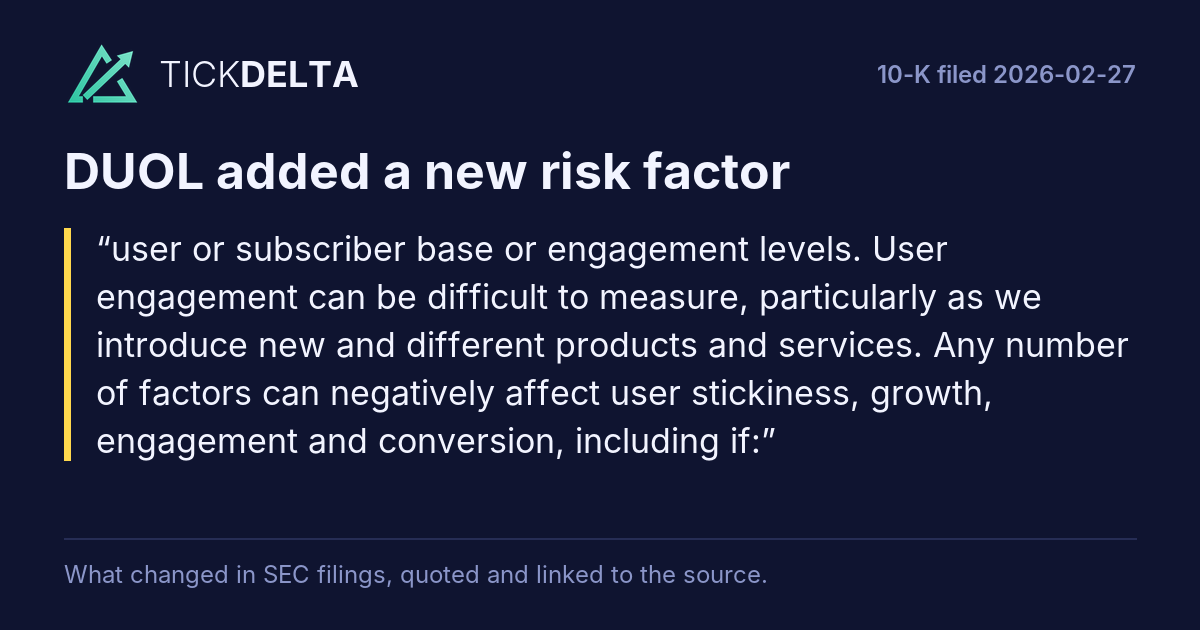
user or subscriber base or engagement levels. User engagement can be difficult to measure, particularly as we introduce new and different products and services. Any number of factors can negatively affect user stickiness, growth, engagement and conversion, including if:
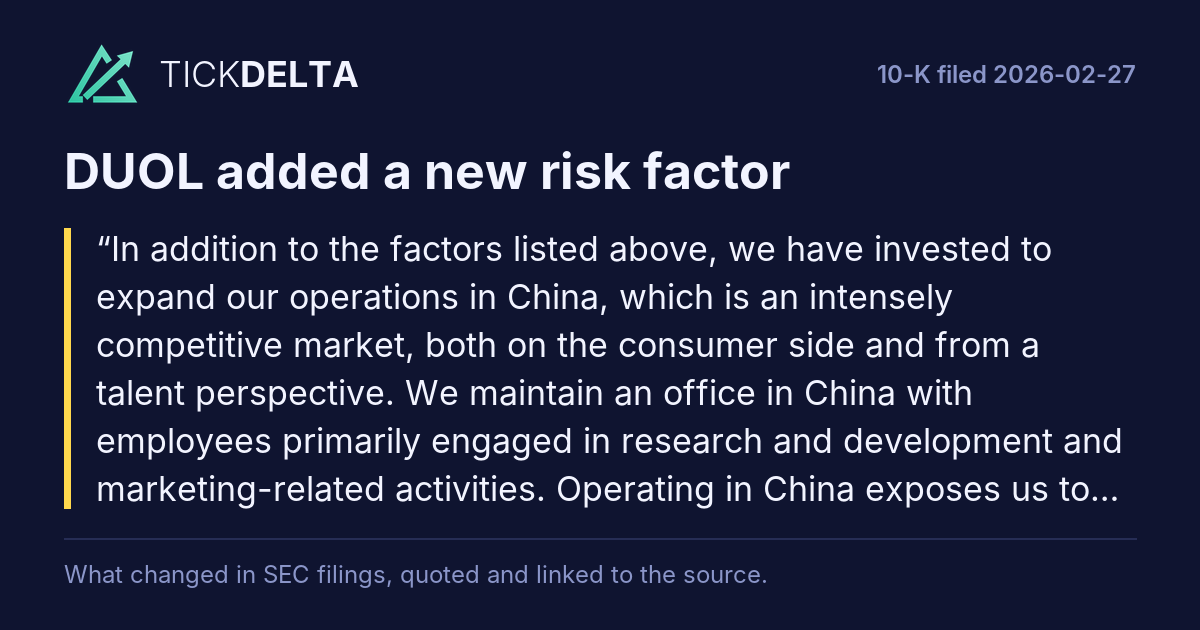
In addition to the factors listed above, we have invested to expand our operations in China, which is an intensely competitive market, both on the consumer side and from a talent perspective. We maintain an office in China with employees primarily engaged in research and development and marketing-related activities. Operating in China exposes us to additional risks, including heightened regulatory scrutiny, evolving data security and privacy requirements, restrictions on cross-border data transfers, and increased compliance costs. Regulatory authorities in China may also seek access to user data or impose requirements that conflict with our practices or with laws and regulations in other jurisdictions, which could limit our ability to operate our services consistently across markets.
In addition, changes in geopolitical conditions, government policies toward foreign-owned or foreign-affiliated technology companies, or broader political or economic developments could disrupt our operations, affect our workforce, or require us to make changes to how our products and internal systems operate in China. While we have previously experienced temporary disruptions to the availability of our applications in China, similar actions could occur in the future.
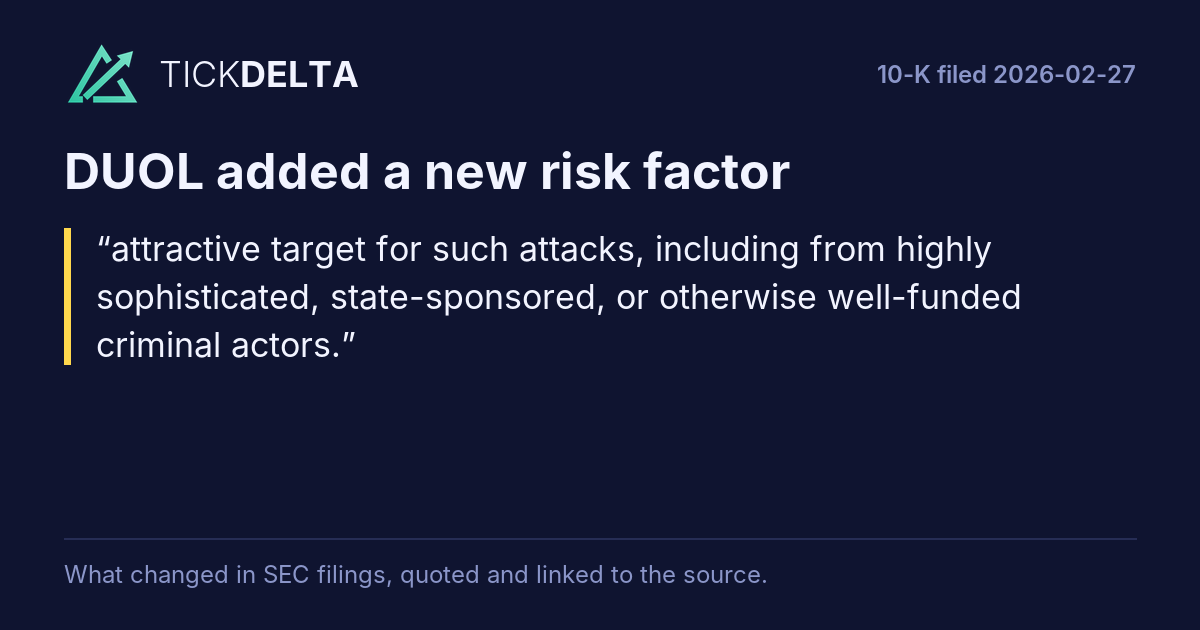
attractive target for such attacks, including from highly sophisticated, state-sponsored, or otherwise well-funded criminal actors.
banks and the payment card industry, including PCI-DSS, we may be subject to fines, restrictions and expulsion from card acceptance programs, which could materially and adversely affect our business.
•fully identify potential risks and liabilities associated with acquired businesses; or
Show the other 7
technology to, or otherwise transact or deal with, certain countries, territories, governments, and persons, absent U.S. government permissions or exemptions.
the processing of personal data, enforcement notices, and/ or assessment notices (for a compulsory audit). We may also face civil claims including representative actions and other class action type litigation (where individuals have suffered harm), potentially amounting to significant compensation or damages liabilities, as well as associated costs and diversion of internal resources.
At the state-level, numerous states have enacted laws regulating AI. For example, California has enacted various AI-related laws and regulations, including related to safety protocols, reporting, and transparency. In addition, Colorado’s Artificial Intelligence Act will require developers and deployers of “high-risk” AI systems to implement certain safeguards against algorithmic discrimination (among other requirements), and the Texas Responsible Artificial Intelligence Governance Act prohibits the development and deployment of AI systems for certain purposes while establishing a regulatory sandbox. Moreover, state
vesting requirements, compliance by affiliates with Rule 144, and other restrictions provided under the terms of the applicable plan or the award agreements entered into with participants.
Our income tax expense and effective tax rate may fluctuate due to changes in tax laws, operating results and the realizability of deferred tax assets.
Recent U.S. tax legislation has modified the rules governing the treatment of research and development expenditures under Internal Revenue Code Section 174, including allowing for immediate expensing of certain domestic research and development costs, which we have implemented. Any further changes or uncertainty in the application of these rules could materially impact our results of operations and cash flows.
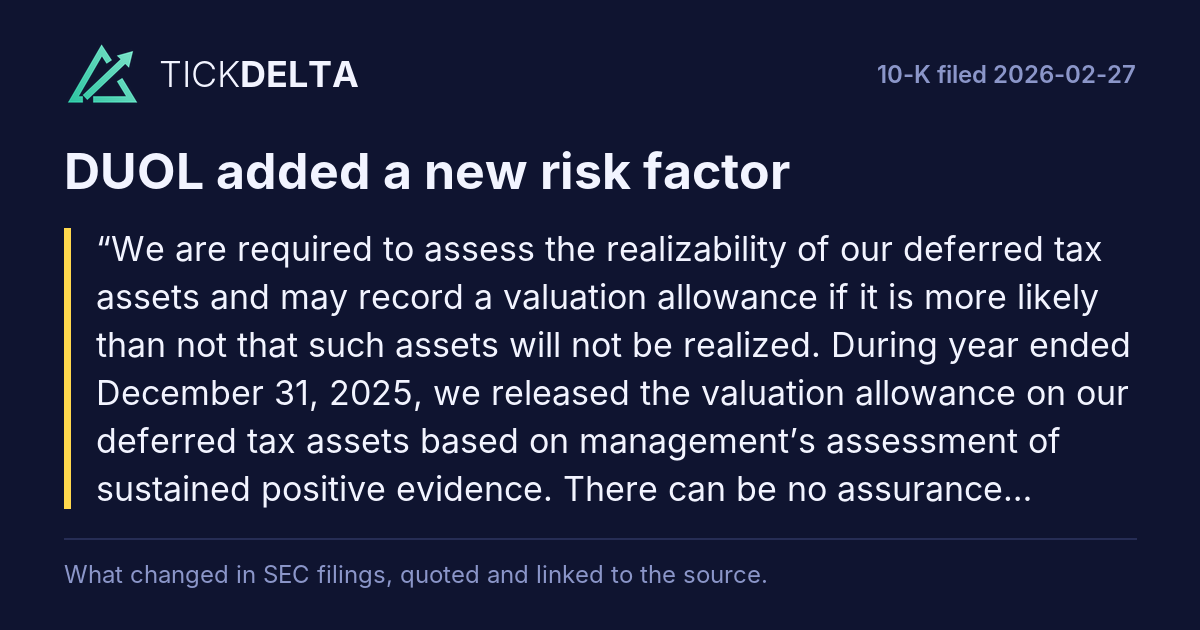
We are required to assess the realizability of our deferred tax assets and may record a valuation allowance if it is more likely than not that such assets will not be realized. During year ended December 31, 2025, we released the valuation allowance on our deferred tax assets based on management’s assessment of sustained positive evidence.
There can be no assurance, however, that we will continue to generate sufficient taxable income to realize our deferred tax assets in future periods. If our operating results were to decline, if our forecasts of future taxable income were not achieved, or if other negative evidence were to arise, we may be required to record a valuation allowance against some or all of our deferred tax assets. Any such determination could result in a material increase in income tax expense and could materially adversely affect our results of operations, financial position, and cash flows.
Paragraphs in the 10-Q filed Nov 4, 2026 that were not in the one before
New in the latest 10-Q
21 paragraphs in the 10-Q filed Nov 4, 2026 with nothing like them in the 10-Q filed Aug 6, 2026 (at least half the words must differ; new numbers alone do not count). Quoted exactly, grouped by the item heading above them. This is text that changed, not a judgement of how serious it is.
Financial statements and notes
Adjustments to reconcile net income to net cash provided by operating activities:
Read in the 10-Q
Capitalized software development costs and purchases of intangible assets (8,718) (6,484)
Read in the 10-Q
Taxes paid related to net-share settlement of share-based compensation awards (18,799) —
Read in the 10-Q
Cash, cash equivalents and restricted cash - Beginning of period 1,039,124 788,526
Read in the 10-Q
Cash, cash equivalents and restricted cash - End of period $ 1,242,342 $ 1,014,277
Read in the 10-Q
Show the other 16
On August 11, 2026, the Company completed the acquisition of certain assets of Animade Group Limited. Animade was a London-based animation and motion design studio. The acquisition expands Duolingo's Design Studio by adding an established and experienced animation and motion design team.
Read in the 10-Q
The total aggregate transaction-related payments are expected to be $ 5.5 million, consisting of $ 5.0 million of purchase consideration paid in cash upon closing and $ 0.5 million of additional payments to certain employees contingent upon one year of continued service. The $ 5.0 million purchase consideration has been preliminarily allocated to goodwill. The service-contingent payments will be
Read in the 10-Q
The purchase price allocation remains preliminary and is subject to finalization.
Read in the 10-Q
The following table represents the changes to goodwill during the nine months ended September 30, 2026:
Read in the 10-Q
Carrying amount Balance as of December 31, 2025 $35,335 Acquisitions 5,006 Balance as of September 30, 2026 $40,341
Read in the 10-Q
As of September 30, 2026 and December 31, 2025, $16.8 million and $17.7 million, respectively, of goodwill is deductible for tax purposes.
Read in the 10-Q
For the three and nine months ended September 30, 2026, discrete items include tax expense related to stock-based compensation awards that vested at market prices below grant prices.
Read in the 10-Q
In the prior-year period, the effective tax rate was primarily impacted by the release of the valuation allowance on the Company’s federal and state deferred tax assets and other discrete tax benefits.
Read in the 10-Q
The Company’s income before taxes, income tax provision or benefit and effective tax rates were as follows. The large variance in the effective tax rate between periods primarily reflects the recognition of the valuation-allowance release and other discrete tax benefits in the three and nine months ended September 30, 2025. Three Months Ended September 30, Nine Months Ended September 30, (In thousands, except percentages) 2026 2025 2026 2025 ─────────────────────────────────────────────────────────────────────────────────────────────────────────────────────────────────────────────────────────────────────────────────────────────────── Income before income taxes $ 35,567 $ 46,449 $ 136,485 $ 127,909 Provision for (benefit from) income taxes 8,402 (245,746) 32,702 (244,202) Effective tax rate 23.6 % nm 24.0 % nm
Read in the 10-Q
On October 7, 2026, a putative shareholder class action was filed in the United States District Court for the Western District of Pennsylvania captioned City of Dearborn Heights Act 345 Police & Fire Retirement System v. Duolingo, Inc., et al., Case No. 26-cv-02197 (W.D. Pa.) (the “Securities Class Action”). The complaint names the Company and certain of its current and former executive officers as defendants and alleges violations of Sections 10(b) and 20(a) of the Exchange Act. The complaint seeks unspecified damages, as well as attorneys’ fees and costs. Motions to be appointed lead plaintiff are due December 7, 2026. The Company intends to defend against the claims in the Securities Class Action vigorously.
Read in the 10-Q
The results of any current or future litigation cannot be predicted with certainty, and regardless of the outcome, any litigation could have an adverse impact on the Company as a result of defense costs, settlement, judgments, the diversion of management resources, and other factors. The Company has not recorded any accrual for a contingent liability associated with these legal proceedings.
Read in the 10-Q
(2) During the three months ended September 30, 2025, the Company released the valuation allowance previously recorded against its federal and state deferred tax assets, resulting in a one-time income-tax benefit, net of a return-to-provision adjustment, in the period of $222.7 million.
Read in the 10-Q
(1) During the three months ended September 30, 2025, the Company released the valuation allowance previously recorded against its federal and state deferred tax assets, resulting in a one-time income-tax benefit, net of a return-to-provision adjustment, in the period of $222.7 million.
Read in the 10-Q
capital expenditures more than offset the change in operating cash flows for the three-month period and partially offset it for the nine-month period.
Read in the 10-Q
expenses related to equity awards of $7.9 million, as well as increased software and third-party AI costs of $3.2 million.
Read in the 10-Q
September 30, 2025, was primarily related to the release of our U.S. valuation allowance on certain deferred tax assets and other discrete tax items.
Read in the 10-Q
The 10-Q's risk factors against the 10-K
Item 1A of the 10-Q filed Nov 4, 2026 against Item 1A of the 10-K filed Feb 27, 2026.
A 10-Q repeats only the risks that changed, so a 10-K paragraph that is missing from it is not counted as removed.
Added is a paragraph with nothing like it in the 10-K, Reworded a sentence that is in both with several words changed,
Quiet changes a sentence in both where one to four words changed and one is a hedge or a modal
(cut words struck through, new words highlighted).
Text on the page, not a score; each links to the filing at sec.gov.
What the 10-Q itself says about its risk factors:The Company's risk factors are described in Part I, Item 1A, "Risk Factors" of the Annual Report on Form 10-K. These factors could materially adversely affect our business, financial condition, and results of operations, and could cause our actual results to differ materially from our historical results or the results contemplated by any forward-looking statements contained in this Quarterly Report on Form 10-Q. There have been no material changes from the risk factors previously disclosed under the heading “Risk Factors” in the Annual Report on Form 10-K.
Read in the 10-Q
1 paragraph in the 10-Q's Item 1A, and none of them adds, rewords or quietly edits a paragraph of the 10-K's.
Phrases used for the first time
Two-word phrases in Risk Factors of the 10-K filed Feb 27, 2026 that are in none of the 1 earlier 10-Ks stored, back to Feb 28, 2025
Where each one is used
- enacted laws: In addition, internet-connected devices and operating systems controlled by third parties increasingly contain features that allow device users to disable functionality that allows for the delivery of advertising on their devices or reduce the ability to provide personalized or targeted advertising, which results...
- genai technologies: We incorporate GenAI, including AI that can produce and output new content, software code, data and information based on inferences from the data it receives, features into our solutions, such as Duolingo Max. GenAI technologies can be subject to accuracy issues in the output, introduce unintended biases, be...
- trump administration’s: As the regulatory framework for machine learning technology and AI evolves, our business, financial condition, and results of operations may be adversely affected. We may not always be able to anticipate how to respond to such rapidly evolving AI-specific laws or regulations. New laws regulating AI have been...
- automated decision: AI laws like Colorado’s Artificial Intelligence Act and various state privacy laws, including the CCPA, regulate the use of automated decision making technology that results in legal or similarly significant effects on individuals and provide rights to individuals in respect of automated decision making. Such...
- decision making: AI laws like Colorado’s Artificial Intelligence Act and various state privacy laws, including the CCPA, regulate the use of automated decision making technology that results in legal or similarly significant effects on individuals and provide rights to individuals in respect of automated decision making. Such...
- side-by-side package: The Organization for Economic Co-operation and Development ("OECD"), an international association of 38 countries including the U.S., has proposed changes to numerous long-standing tax principles, including a global minimum tax initiative. On December 12, 2022, the European Union member states agreed to implement...
- record valuation: We are required to assess the realizability of our deferred tax assets and may record a valuation allowance if it is more likely than not that such assets will not be realized. During year ended December 31, 2025, we released the valuation allowance on our deferred tax assets based on management’s assessment of...
- taxable income: There can be no assurance, however, that we will continue to generate sufficient taxable income to realize our deferred tax assets in future periods. If our operating results were to decline, if our forecasts of future taxable income were not achieved, or if other negative evidence were to arise, we may be required...
Used at least twice, small words left out. Counted, not picked: a phrase can be new because the company renamed something.
What was taken out
28 paragraphs of last year's Risk Factors with nothing like them now. The longest are quoted.
Sources
Item 1A of each 10-K and 10-Q on EDGAR, quoted exactly. Each paragraph links to the filing at sec.gov.
Also
10-K change: what was reworded or cut, section by section.
Work with it
Excel workbook · CSV. Google Sheet that stays up to date: paste =IMPORTDATA("https://tickdelta.com/company/DUOL/export.csv") into a cell.