Form 10-K for the fiscal year ended December 31, 2024
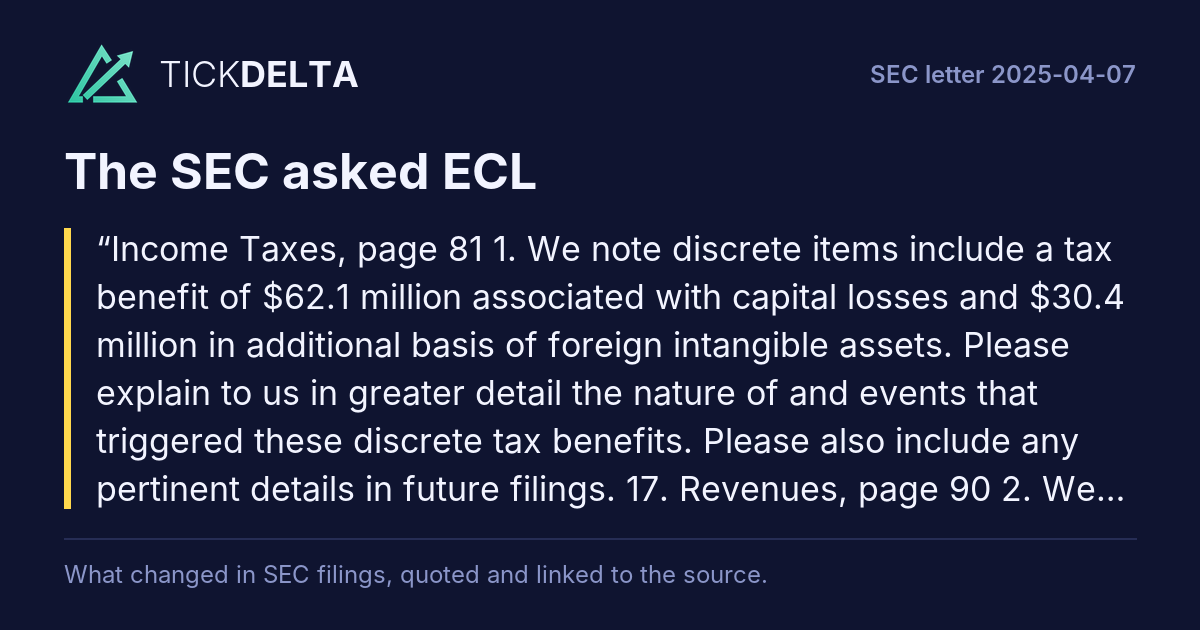
Income Taxes, page 81 1. We note discrete items include a tax benefit of $62.1 million associated with capital losses and $30.4 million in additional basis of foreign intangible assets. Please explain to us in greater detail the nature of and events that triggered these discrete tax benefits. Please also include any pertinent details in future filings. 17. Revenues, page 90 2.Rest of the question
We note on pages 28 and 61 that other estimates used in recognizing revenue include allocating variable consideration to customer programs and incentive offerings, including pricing arrangements, promotions and other volume-based incentives at the time the sale is recorded. Please tell us how you have considered the relevant disclosure requirements of ASC 606 as it relates to your accounting for variable consideration, as set forth in ASC 606-10-50-1, 50-1(b), 50-17(b), and 50-20. 3. Please tell us how you applied the guidance in paragraphs ASC 606-10-55-89 through 55-91 when selecting the categories to use to disaggregate revenues. In closing, we remind you that the company and its management are responsible for the accuracy and adequacy of their disclosures, notwithstanding any review, comments, action or absence of action by the staff.
The two discrete tax benefits relate to separate, unrelated events in 2024. The Company will include incremental disclosure in future filings where such transactions have a material impact to the consolidated financial statements.
Capital Losses
The Company recognized a $62.1 million discrete tax benefit as a result of an elective change to its U.S. tax classification of a wholly-owned non-US subsidiary. The election was effective on December 31, 2024. One result of making the election was the realization of a U.S.Read in the reply ↗Rest of the answer
tax capital loss.
Prior to making this election, the Company was prohibited under ASC 740-30-25-9 from recognizing a deferred tax asset associated with the built-in tax loss in this foreign investment because it was not apparent that the temporary difference would reverse in the foreseeable future until the Company committed to making the change in classification in Q4 2024.
The Company concluded the benefit of the tax loss was an unusual or infrequently occurring event and outside of ordinary income. As such, the benefit was recognized as a discrete item under ASC 740 principles.
Foreign Intangible Basis
The Company recognized a deferred tax benefit of $30.4 million due to an increase in the tax basis of its foreign intangible assets. The Company owns a Swiss subsidiary that was subject to Swiss tax law changes enacted in 2019 and effective beginning in 2020. Under the relevant tax law changes, the Company was entitled to a one-time “step-up” of tax goodwill that will be amortizable from 2025-2029 for local tax purposes. The Company recognized an estimated deferred tax asset in Q4 2019 based on estimates of future amortization deductions in conjunction with the change in tax law.
In November 2020, the Company initiated a ruling request with the Swiss Tax Authorities and subsequently received a tax ruling confirmation in Q4 2024. As a result of the ruling, the Company recorded a $30.4 million discrete adjustment to the prior deferred tax asset estimate in Q4 2024. The adjusted deferred tax asset corresponds with the Swiss ruling received and the expected amortization in 2025-2029.
17. Revenues, page 90
2. We note on pages 28 and 61 that other estimates used in recognizing revenue include allocating variable consideration to customer programs and incentive offerings, including pricing arrangements, promotions and other volume-based incentives at the time the sale is recorded. Please tell us how you have considered the relevant disclosure requirements of ASC 606 as it relates to your accounting for variable consideration, as set forth in ASC 606-10-50-1, 50-1(b), 50-17(b), and 50-20.
Response
In the referenced disclosures, variable consideration pertains primarily to volume-based sales rebate programs with distributors and key customers, that are estimated and recorded as a reduction to revenue in the same period as the corresponding sale.
Minimal judgment is required to accrue these incentives due to their non-complex nature and the limited use of assumptions in calculating their value based on current contractual requirements, reported actual sales volumes and recent historical trends. Incentive payments occur periodically throughout the year (monthly in many cases), reducing the reliance on assumptions and the level of uncertainty inherent in the Company’s reserve estimate. Consequently, the Company does not have a history of making material changes to its estimates related to these programs.
The Company considered the disclosure requirements of ASC 606-10-50-1, 50-1(b), 50-17(b), and 50-20 and in future filings, beginning with our 2025 quarterly report on Form 10-Q for the quarter ended March 31, 2025, the paragraph on page 61 in Footnote 2 – Significant Accounting Policies referring to variable consideration and the use of estimates in revenue recognition will be updated in a substantially similar format as the following:
Other estimates used in recognizing revenue include allocating variable consideration related to customer programs and incentive offerings, including pricing arrangements, promotions and other volume-based incentives at the time the sale is recorded. These estimates are non-complex in nature and are based primarily on historical experience and anticipated performance over the contract period. In addition, timely sales data is available, limiting estimation uncertainty. Based on the certainty in estimating these amounts, they are included in the transaction price of the contracts and the associated remaining performance obligations.
The Company recognizes revenue when collection of the consideration expected to be received in exchange for transferring goods or providing services is probable.
Consideration of Critical Accounting Estimates
The Company has also reevaluated its disclosure of revenue recognition as a critical accounting estimate on page 28 within the MD&A section of our Form 10-K. As defined by the SEC in Regulation S-K, Item 303, critical accounting estimates are those estimates made in accordance with generally accepted accounting principles that involve a significant level of estimation uncertainty and have had or are reasonably likely to have a material impact on the financial condition or results of operations of the registrant.
Upon reevaluation, the Company has determined that the material estimates used in our revenue recognition do not meet the criteria for being deemed critical. As noted above, these estimates do not require significant judgment nor rely on assumptions about highly uncertain matters. Further, the Company expects that any reasonable adjustments to these estimates would not have a material impact on our financial statements, given their straightforward nature and minimal level of uncertainty in the assumptions used to calculate their value at the time of recognition.
In future filings, beginning with our 2025 annual report on Form 10-K for the year ended December 31, 2025, the Company will remove the revenue recognition disclosures from the Critical Accounting Estimates section within MD&A.
3. Please tell us how you applied the guidance in paragraphs ASC 606-10-55-89 through 55-91 when selecting the categories to use to disaggregate revenues.
Response
In determining the appropriate categories of disaggregation to present in accordance with ASC 606-10-50-5, the Company has assessed the nature, amount, timing and uncertainty of revenue and cash flows affected by the economic factors impacting revenue recognized. Based on this analysis, the Company has concluded that the objectives in ASC 606-10-50-5 and ASC 606-10-55-89 through 55-91 are met by disaggregating revenue in the following ways: (1) reportable segment and product and equipment sales or service and lease sales; and (2) reportable segment and geographical regions.
In reaching this conclusion, the Company has considered information provided in earnings releases, information provided to the chief operating decision maker (the “CODM”), as well as any other level of disaggregation that is used in the financial review process. Specifically, information provided to the CODM primarily includes revenue disaggregated by operating segment and by geographic region as the primary two lines of delineation. Additionally, revenue disaggregated by segment and by product and equipment sales and service and lease sales is intended to convey the timing of revenue recognition as product and equipment sales are recognized at a point in time and service and lease sales are recognized over time. Further, presentation of revenue by reportable segment and geography best depicts the uncertainty of such revenue and cash flows as each geography has similar economic environments (or economic factors impacting revenue).
The Company has assessed the factors listed in ASC 606-10-55-90, including the examples listed in ASC 606-10-55-91, and concluded that our revenue disaggregation as outlined above is appropriate. It is also consistent with the disclosures included within the Company’s earnings releases and the regular internal reporting provided to, and reviewed by, the Company’s CODM. The CODM regularly reviews disaggregated data and financial results predominantly by operating segment and by region.
***
On behalf of the Company, I thank you for your consideration of our responses. Should the Staff have further questions or comments or need any further information or clarification, please do not hesitate to contact me.
First report after the company's reply of 2025-04-17: 10-Q filed 2025-05-08 ↗, against the 10-Q filed 2024-10-31 ↗.
Tickdelta does not hold the text of both reports, so they are not compared here.
Revenues, page 90 We have reviewed your response to comment 3. Please provide us further information and analysis as it relates to your consideration of disaggregation of revenues attributable to individual operating segments.Rest of the question
For example, please evaluate in further detail under ASC 606-10-55-90 your presentation of separate narrative discussions of your operating segment sales, including a reference to sales growth percentage as a header, in your Fourth Quarter 2024 Supplemental, and your presentation of discussions of operating segment revenues in MD&A. Please also provide us the actual company specific information you considered as part of your overall assessment under ASC 606-10-50-5 and 55-89 through 55-91, including the break-out of product and sold equipment revenue and service and lease equipment 1. revenue, by operating segment, for the periods presented. Lastly, please describe to us any other disaggregated revenue information regularly reviewed by the CODM, not otherwise referenced in the response, and provide us an example of this information from 2024.
ASC 606-10-50-5 requires an entity to “disaggregate revenue recognized from contracts with customers into categories that depict how the nature, amount, timing, and uncertainty of revenue and cash flows are affected by economic factors.” The Company’s revenue recognition and nature of our customer contracts are similar across our product and equipment sales and service and lease sales categories for three of our four reportable segments – Global Industrial, Global Institutional & Specialty and Global Healthcare & Life Sciences.Read in the reply ↗Rest of the answer
In our fourth reportable segment, Global Pest Elimination, our contracts with our customers are all service-based. As disclosed within our significant accounting policies disclosure, we recognize product and equipment sales at a point in time when the product or equipment is transferred to the customer and we recognize service and lease sales over time as the services are provided or the customer receives the benefit from the leased equipment. Based on the nature and size of the customer, the related contracts can span segments or markets, however customer contract terms and conditions do not vary by segment or market.
Within each of our reportable segments, the nature and timing of the revenues are similar when further disaggregated by product and equipment sales or service and lease sales. Further, the nature, timing and uncertainty and how those are impacted by economic factors are similar within our reportable segments when further disaggregated by geographic region. We believe that geographic region is the most meaningful category to consider when assessing how revenue and cash flows are affected by economic factors. Our operating segments are affected by economic factors in a similar manner, including the nature of our customer contracts, the nature of our customer relationships, and the timing of revenue recognition (inclusive of the point in time vs over time recognition pattern discussed above) and therefore are not required to be disaggregated at the operating segment level for purposes of the requirements in ASC 606-10-50-5 and any further disaggregation would not provide decision-useful information about the nature, timing and uncertainty of the cash flows.
ASC 606-10-55-90 provides various factors to consider when selecting the type of category used to disaggregate revenue and ASC 606-10-55-91 further provides examples of categories that may be appropriate. The Company specifically considered the disclosures presented outside of the financial statements, including the organic and fixed currency sales growth rates by operating segment in our Fourth Quarter 2024 Supplemental and the organic sales growth rates by operating segment provided in our MD&A. This information on organic and fixed currency sales growth rates by operating segment is non-GAAP in nature and thus does not fall into the scope of ASC 606. Additionally, such data points are provided to investors in order to contextualize the sales growth and overall results by reportable segment and consolidated revenue growth drivers. Any references to specific industries or market segments are not intended to indicate that there are different economic factors that regularly impact the nature, amount, timing, and uncertainty of revenue and cash flows. In the short term, different operating segments may be growing at different rates, however the long-term trajectory for the operating segments that are aggregated into a reportable segment is similar and thus the growth rates included within the above-referenced materials is important to facilitate contextual understanding of the broader environment that we operate in.
We also considered other information regularly reviewed by the chief operating decision maker (“CODM”). Revenue information reviewed by our CODM on a regular basis primarily encompasses operating segment level revenues and revenues by geographic region. There is not significant other information reviewed by the CODM outside of the bounds of those delineations on a regular basis. As discussed, the Company has provided an example from our Executive Committee review presentation for December 2024 as supplemental information pursuant to Rule 12b-4 of the Securities and Exchange Act of 1934, which will be permanently deleted following the conclusion of this review process. Note that sales information at the operating segment level provided within the example is exclusively organic sales growth and thus is non-GAAP in nature.
In our analysis of other disclosures presented outside of the financial statements pursuant to ASC 606-10-55-90, the Company confirmed it primarily provides revenue data at the reportable segment and geographic market levels. Aside from the non-GAAP information on organic revenue growth rates for operating segments discussed above, the Company does not provide quantitative disaggregated information on revenue below the reportable segment level on a regular basis. The Company does provide qualitative discussion on drivers within a given operating or reportable segment, however, similar to the non-GAAP information discussed above, such information is provided simply to contextualize overall reportable segment and company sales growth.
Accordingly, the Company believes our disclosure of disaggregated revenues by (1) reportable segment and product and equipment sales and service and lease sales; and (2) reportable segment and geographic region is sufficient to meet the requirements of ASC 606-10-50-5 and 55-89 through 55-91.
***
On behalf of the Company, I thank you for your consideration of our responses. Should the Staff have further questions or comments or need any further information or clarification, please do not hesitate to contact me.
Revenues, page 90 1. We have reviewed your response to comment 1 and have the following additional comments. Please provide us the full and complete 2024 Executive Committee review presentation used for evaluating the performance of operating segments. 2.Rest of the question
Please provide us a further break-out of revenue between (i) product revenue, (ii) sold equipment revenue, (iii) service revenue, and (iv) lease equipment revenue, for each of the Water, Food & Beverage, and Paper operating segments, for the Form 10-K periods presented. 3. Please provide us revenue by geographic region for each of the Water, Food & Beverage, and Paper operating segments, for the Form 10-K periods presented. 4. Separately for each of the Water, Food & Beverage, and Paper operating segments, please provide us the following information: • The amount of revenue attributable to the operating segment's largest customer for 2024; • For each of the three customers, identify and describe to us any multi-year agreement provisions related to their contracts; • For each of the three customers, identify and describe to us the pricing mechanisms contained in their contracts; and • For each of the three customers, the stand-alone selling price for the product or service that contributed the largest amount of revenue for 2024, the amount of such 2024 revenue, and a description of the product or service.
As described in our prior response letter, we previously provided the pages with revenue data that was disaggregated beyond a total company level. The remaining portions of the deck do not contain revenue data broken out at a level other than total consolidated sales with drivers of volume and pricing to understand non-GAAP organic sales in the quarter.Read in the reply ↗Rest of the answer
The Company has now provided the 2024 Executive Committee review presentation in its entirety as supplemental information pursuant to Rule 12b-4 of the Securities and Exchange Act of 1934 (“Rule 12b-4”), which we respectfully request be permanently deleted following the conclusion of this review process.
ecolab.com
Ecolab | Page 2
2. Please provide us a further break-out of revenue between (i) product revenue, (ii) sold equipment revenue, (iii) service revenue, and (iv) lease equipment revenue, for each of the Water, Food & Beverage, and Paper operating segments, for the Form 10-K periods presented.
Response
The Company has provided a further breakout of revenue between (i) product revenue, (ii) sold equipment revenue, (iii) service revenue, and (iv) lease equipment revenue, for each of the Water, Food
& Beverage, and Paper operating segments, for the Form 10-K periods presented as supplemental information pursuant to Rule
12b-4, which we respectfully request be permanently deleted following the conclusion of this review process. The data shows that the primary revenues for each operating segment are product sales, which consist of approximately 80% or more of total sales for each operating segment, followed by service sales, then equipment sales and lease sales. Therefore, in our judgment, there are no significant or meaningful delineations across the operating segments to provide to users of our financial statements. Further, the proportion of sales in each category for each individual operating segment is materially consistent with the proportion of total
Global Industrial sales in each category and each operating segment’s trends by category are materially consistent with the reportable segment’s trends by category. Accordingly, we have concluded that this data indicates consistency across the operating segments and thus, in our judgment, we concluded that this more detailed breakout would not provide material information about how the nature, amount, timing, and uncertainty of revenue and cash flows are affected by economic factors, considering the guidance in ASC 606-10-50-5 and 55-89.
3. Please provide us revenue by geographic region for each of the Water, Food & Beverage, and Paper operating segments, for the
Form 10-K periods presented.
Response
The Company has provided a further breakout of revenue by geographic region for each of the Water, Food & Beverage, and Paper operating segments, for the Form 10-K periods presented as supplemental information pursuant to Rule 12b-4, which we respectfully request be permanently deleted following the conclusion of this review process. The data shows that the majority of revenues for each operating segment are generated in the US, with Europe being the second largest geographic region for each of the operating segments. The proportion of sales in each geographic market for each individual operating segment is materially consistent with the proportion of total Global Industrial sales in each geographic market. While there are small amounts of variability in the proportion of sales in each market (for instance, our Food & Beverage operating segment has a larger proportion of its sales in Europe than the Water and Paper operating segments), each operating segment’s trends by market are materially consistent with the reportable segment’s trends by market that is already disclosed. Given that, in our judgment the proportion of sales within each market by operating segment is consistent with the proportion of sales in each market in totality, we concluded that further breakout would not provide material information about how the nature, amount, timing, and uncertainty of revenue and cash flows are affected by economic factors considering the guidance in ASC 606-10-55-89 through 91.
Ecolab | Page 3
4. Separately for each of the Water, Food & Beverage, and Paper operating segments, please provide us the following information:
· The amount of revenue attributable to the operating segment's largest customer for 2024;
· For each of the three customers, identify and describe to us any multi-year agreement provisions related to their contracts;
each of the three customers, identify and describe to us the pricing mechanisms contained in their contracts; and each of the three customers, the stand-alone selling price for the product or service that contributed the largest amount of revenue for 2024, the amount of such 2024 revenue, and a description of the product or service.
Response
The Company employs a consistent approach to contracting with customers across the operating segments included within its Global Industrial reportable segment and many customers have contracts with the Company that span more than one operating segment to provide our products and services. At its core, our business is relatively simple – we sell chemistry to our customers, along with selling or leasing some equipment to dispense the chemistry and providing relevant support services. Our offerings within Global Industrial are primarily sold directly to customers by our corporate account and field sales employees.
The customers within our Global Industrial reportable segment are primarily industrial companies and the differentiation within the product and service offerings we have across our operating segments primarily relates to the area within a given Industrial customer’s processes the products are used in. Accordingly, while some products are used in different areas of the industrial plant for a given customer, our product and service offerings are generally consistent across the different operating segments within Global Industrial, which provides for a high degree of consistency amongst the Global Industrial operating segments as it relates to how the nature, amount, timing and uncertainty of revenue and cash flows are affected by economic factors (ASC 606-10-55-89).
As it relates to the Company’s contracts with its customers, each of our operating segments in the Global Industrial reportable segment includes both large and smaller customers. For large, global and regional customers, multi-year master supply agreements are typically executed, providing the Company with sole source or preferred vendor status across multiple customer locations. For smaller customers, a commercial supply agreement, which may be less complex and renewed annually, is typically used. Customers then subsequently issue purchase orders to purchase specific quantities of a given product.
The Company has provided a summary of key commercial terms included in customer contracts as well as key contract provisions related to the largest customers in each of the Water, Food & Beverage and
Paper operating segments as supplemental information pursuant to Rule 12b-4, which we respectfully request be permanently deleted following the conclusion of this review process. The data shows the consistency in the structure of key commercial terms across the Industrial operating segments as outlined above.
Ecolab | Page 4
The Company has also specifically considered our customer contracts with respect to the example categories of potential disaggregation of revenue within ASC 606-10-55-91 as follows:
a. Type of good or service – The majority of the Company’s sales consist of product sales (primarily of chemicals), lending itself to a high degree of consistency in product and service offerings across the operating segments within Global Industrial.
b. Geographical region – The Company currently provides a disaggregation of revenue by geographic market and reportable segment.
As discussed previously, the proportion of sales within each geographic market for each individual operating segment is materially consistent with the proportion of total Global Industrial sales in each category.
c. Market or type of customer – Each of the Company’s operating segments is comprised of both large and small customers and our contracts with such customers follows the information described above. While our Global Industrial customers operate within different sub-sectors of the market, demand for our products and services is highly influenced by industrial production rates and thus our operating segments are generally impacted by broader macroeconomic conditions in a similar manner.
d. Type of contract – While our customer contracts may have different pricing arrangements, the overall economics of the customer arrangements that aggregate into a given reportable segment are similar. The timing of transfer within the operating segments of our Global
Industrial reportable segment are similar for the same types of products regardless of the pricing arrangement included in the customer contract (i.e., leased equipment and services are recognized over time while shipments of product are recognized at a point in time).
The differences in pricing arrangements across our customers are similar at both the operating and reportable segment level, demonstrating the consistency in economics between the two levels.
e. Contract duration – Each of our operating segments have contracts that are both shorter and longer in duration resulting in consistent impacts across the operating segments within Global Industrial. There are no substantial differences in the nature, amount, timing and uncertainty of revenue and cash flows as it relates to our contracts that are shorter vs longer term in nature.
f. Timing of transfer of goods or services – The Company currently provides a disaggregation of revenue by timing of transfer of goods and services and reportable segment. As discussed previously, the proportion of sales within each category for each individual operating segment is materially consistent with the proportion of total Global Industrial sales in each category.
g. Sales channels – Each of the operating segments within Global Industrial primarily use direct distribution channels with customers and accordingly, have similar economic impacts.
The customer contract is the basis for revenue recognition, and consistent structure in commercial terms drives consistent revenue recognition practices. As noted above, sales from more than one operating segment can be governed by the same contract with customers, as evidenced in the data provided. For these reasons, it has been concluded that disaggregating revenue by operating segment would not provide relevant or useful information on the nature, amount, timing and uncertainty of revenue and cash flows beyond what is already disclosed by reportable segment and geographic region in accordance with ASC 606-10-50-5 and 55-89 through 91.
Ecolab | Page 5
***
On behalf of the Company, I thank you for your consideration of our responses. Should the Staff have further questions or comments or need any further information or clarification, please do not hesitate to contact me.
Also in this review: closing letter, 2025-07-01