Form 10-K for the Fiscal Year ended December 31, 2023
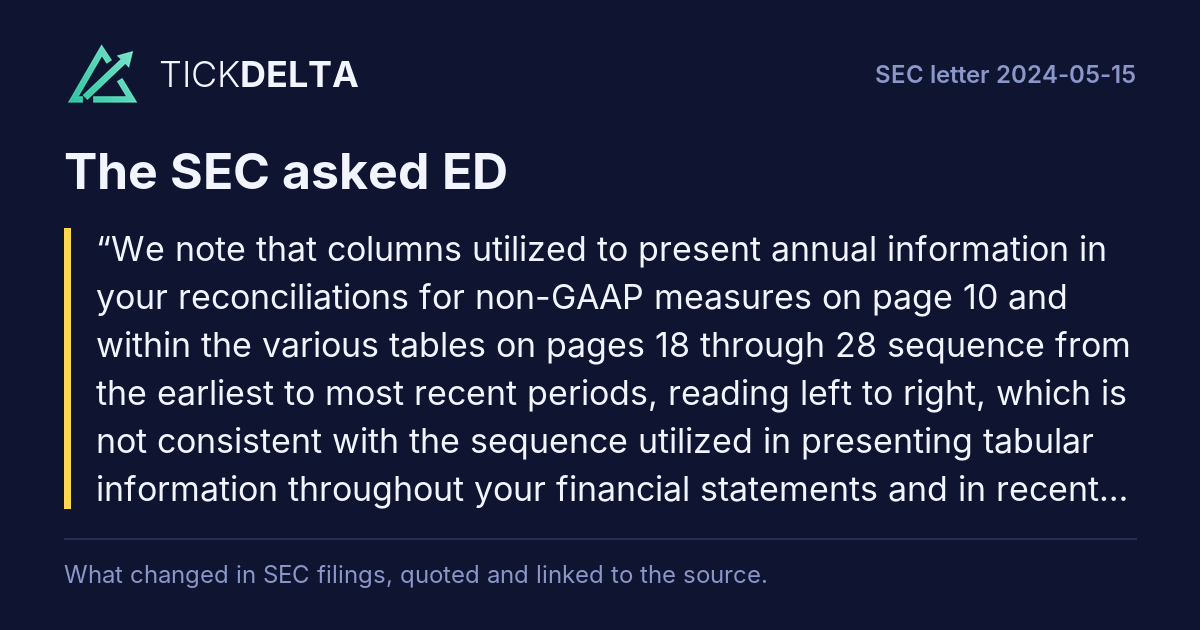
We note that columns utilized to present annual information in your reconciliations for non-GAAP measures on page 10 and within the various tables on pages 18 through 28 sequence from the earliest to most recent periods, reading left to right, which is not consistent with the sequence utilized in presenting tabular information throughout your financial statements and in recent earnings releases.Rest of the question
Please modify your tabulations of numerical data either within the financial statements or outside of the financial statements as necessary to utilize a consistent chronological ordering of data to adhere to the guidance in SAB Topic 11:E.
In future filings, we will present the financial statements and other numerical data contained in tabular form outside of the financial statements consistently from left to right in the same chronological order. Read in the reply ↗
First report after the company's reply of 2024-05-29: 10-Q filed 2024-08-01 ↗, against the 10-Q filed 2024-05-02 ↗.
Tickdelta does not hold the text of both reports, so they are not compared here.
We note your disclosure regarding the inadvertent understatement of federal income tax expense for ratemaking purposes, indicating the Utilities accumulated significant income tax regulatory assets that were not reflected in rate plans for various periods and therefore reduced the amount of revenue collected from customers.Rest of the question
You disclose that the regulatory asset was $1,113 million and $18 million for CECONY and O&R, respectively, as of December 31, 2023, and that the Utilities have not accrued any liability related to this matter. Please expand your disclosures as necessary to address the following points. • Indicate the extent to which the understatement for ratemaking purposes correlates with an understatement in your calculation of federal income taxes due; • Provide management's view on the likelihood of recovering the understatement of federal income tax expense through higher future rates; • Explain how the understatement is reflected in the regulatory assets for CECONY and O&R, referenced from your disclosure above; • Describe the circumstances that would cause you to record a liability or impair any portion of the regulatory assets associated with the understatement; • Clarify whether the understatement for ratemaking purposes is encompassed within any of the uncertain tax positions disclosed on page 152.
For your convenience, we have set forth each comment followed by our response. Also, for illustrative purposes, we have included below an example of our updated disclosure in Note B in future filings to address your comments, marked against the applicable disclosure in the 2023 Form 10-K.
Comment: Indicate the extent to which the understatement for ratemaking purposes correlates with an understatement in your calculation of federal income taxes due:
Response: There is no understatement of the Utilities’ current federal income taxes due.Read in the reply ↗Rest of the answer
The Utilities have properly calculated and paid their federal income taxes. The matter disclosed relates to the compensation to the Utilities in rates for federal income tax expense. For ratemaking purposes, the understatement reduced the amount recovered from customers relative to what it should have been. Under Accounting Standards Codification 740, the Utilities recorded an unfunded deferred federal income tax liability (with a gross-up amount) and a corresponding regulatory asset.
Comment: Provide management's view on the likelihood of recovering the understatement of federal income tax expense through higher future rates:
Response: Management’s assessment is that the income tax regulatory assets as of December 31, 2023 ($1,113 million and $18 million for CECONY and O&R, respectively) are probable of collection through future rates. The IRS provides safe harbor relief for inadvertent normalization violations through the jurisdictional rate setting process of including in rates adequate revenue to fully recover the deferred tax balance, a practice known as “curing.” The Utilities’ rate plans have reflected the correct amount of federal income taxes recoverable from customers, including a proportionate recovery of the regulatory asset, in O&R’s rate plans subsequent to 2014, CECONY’s electric and gas rate plans subsequent to 2015 and 2016, respectively, and CECONY’s steam plan subsequent to November 2023.
Comment: Explain how the understatement is reflected in the regulatory assets for CECONY and O&R, referenced from your disclosure above:
Response: The income tax regulatory assets of $1,113 million and $18 million for CECONY and O&R, respectively, are netted against the related regulatory liability for future income tax (primarily from the excess deferred federal income taxes attributable to the federal corporate tax rate reduction established by the Tax Cuts and Jobs Act of 2017) and are shown in the line “Future income tax” in the “Regulatory Assets and Liabilities” table in Note B and on the Companies' consolidated balance sheet in the line "Regulatory Liabilities."
Comment: Describe the circumstances that would cause you to record a liability or impair any portion of the regulatory assets associated with the understatement:
Response: Although Management’s assessment is that the income tax regulatory assets are probable of collection through future rates, the Utilities would record a liability or impair a portion of the regulatory assets associated with this understatement if the New York State Public Service Commission were to issue an order that required the Utilities to write off all or a portion of their existing regulatory asset. Such an order, however, would also require the discontinuation of accelerated depreciation of the Utilities’ property under the Internal Revenue Code. Management's assessment is that such an action by the New York State Public Service Commission is remote because of the higher impact to customers' rates from the loss of accelerated depreciation by the Utilities.
Comment: Clarify whether the understatement for ratemaking purposes is encompassed within any of the uncertain tax positions disclosed on page 152:
Response: The Utilities’ inadvertent understatement of prior years’ income tax expense is not an uncertain tax position. It is an under-recovery of revenues from customers in prior rate years that misaligns revenue with recoverable tax expense. As such, it constitutes a normalization violation that can be cured through an increase in future years’ revenue requirements until such time as the regulatory asset is fully recovered in rates, and not through a write-down of all or a portion of the Utilities’ regulatory asset.
Example of Updated Note B Disclosure in Future Filings:
NOTE B REGULATORY MATTERS
OTHER REGULATORY MATTERS, PAGE 128
In January 2018, the NYSPSC issued an order initiating a focused operations audit of the Utilities’ financial accounting for income taxes. The audit is investigating the Utilities’ inadvertent understatement of a portion, the amount of which may be material, of their calculation of total federal income tax expense for ratemaking purposes. The understatement was related to the calculation of plant retirement-related cost of removal. As a result of such understatement, the Utilities accumulated significant income tax regulatory assets that were not reflected in O&R’s rate plans prior to 2014, CECONY’s electric and gas rate plans prior to 2015 and 2016, respectively, CECONY's steam plans prior to November 2023. This($1,113 million and $18 million for CECONY and O&R, respectively, as of December 31, 2023 and $1,150 million and $22 million for CECONY and O&R, respectively, as of December 31, 2022 and which is not earning a return). While the Utilities have properly calculated and paid their federal income taxes and there is no uncertain tax position related to this matter, this understatement of historical income tax expense materially reduced the amount of revenue collected from the Utilities' customers in the past relative to what it should have been. The Utilities’ rate plans have reflected the correct amount of federal income taxes recoverable from customers, including a proportionate recovery of the regulatory asset, in O&R’s rate plans subsequent to 2014, CECONY’s electric and gas rate plans subsequent to 2015 and 2016, respectively, and CECONY’s steam plan subsequent to November 2023. As part of the audit, the Utilities plan to pursue a private letter ruling from the Internal Revenue Service (IRS) confirming that the Utilities’ inadvertent understatement of prior years’ income tax expense constitutes a normalization violation that can be cured through an increase in future years’ revenue requirements until such time as the regulatory asset is fully recovered in rates, and not through a write-down of all or a portion of the Utilities’ regulatory asset. Under Accounting Standards Codification 740, the Utilities recorded an unfunded deferred federal income tax liability (with a gross-up amount) and a corresponding regulatory asset. The income tax regulatory assets are netted against the related regulatory liability for future income tax and are shown in the line “Future income tax” in the following table of Regulatory Assets and Liabilities and on the Companies’ consolidated balance sheet in the line “Regulatory liabilities.” Management’s assessment is that the income tax regulatory assets as of December 31, 2023 are probable of collection through future rates. The IRS provides safe harbor relief for inadvertent normalization violations through the jurisdictional rate setting process of including in rates adequate revenue to fully recover the deferred tax balance. However, the Utilities would record a liability or impair a portion of the regulatory assets associated with this understatement if the NYSPSC were to issue an order that required the Utilities to write off all or a portion of their existing regulatory asset. The regulatory asset ($1,113 million and $18 million for CECONY and O&R, respectively, as of December 31, 2023 and $1,150 million and $22 million for CECONY and O&R, respectively, as of December 31, 2022 and which is not earning a return) is netted against the future income tax regulatory liability on the Capital Companies' consolidated balance sheet. The Utilities are unable to estimate the amount or range of their possible loss, if any, related to this matter. At December 31, 2023, the Utilities had not accrued a liability related to this matter.
Your prompt consideration of our responses will be appreciated.
We are available to discuss our responses to your comments at any time. You may reach the undersigned at 212-460-3440 (hoglundr@coned.com) or Joseph Miller, Vice President and Controller at 212-460-2884 (millerjo@coned.com).
First report after the company's reply of 2024-05-29: 10-Q filed 2024-08-01 ↗, against the 10-Q filed 2024-05-02 ↗.
Tickdelta does not hold the text of both reports, so they are not compared here.
Also in this review: closing letter, 2024-06-05