Euronet Worldwide, Inc. EEFT
New risk paragraphs, branching off last year
Each branch is a paragraph in Risk Factors with nothing like it in the 10-K filed Feb 25, 2025. A box jumps to the paragraph as filed, below.
Paragraphs with nothing like them in last year's 10-K
15 paragraphs in Risk Factors of the 10-K filed Feb 26, 2026 with nothing like them in the 10-K filed Feb 25, 2025. Quoted exactly. Paragraphs that were only edited are under 10-K change.
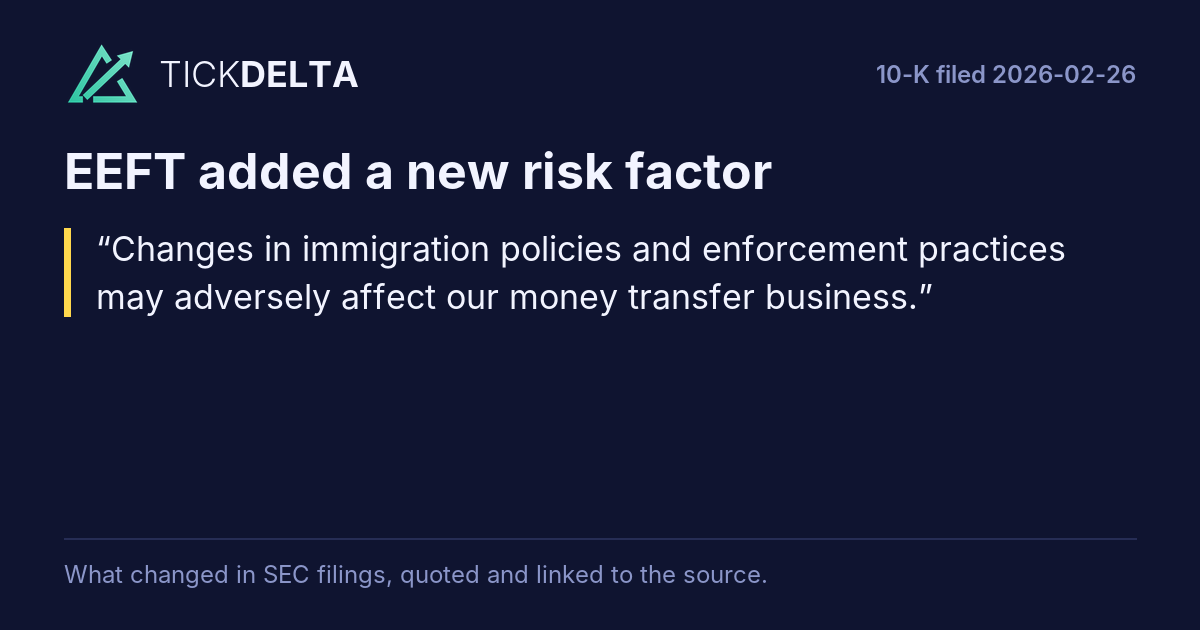
Changes in immigration policies and enforcement practices may adversely affect our money transfer business.
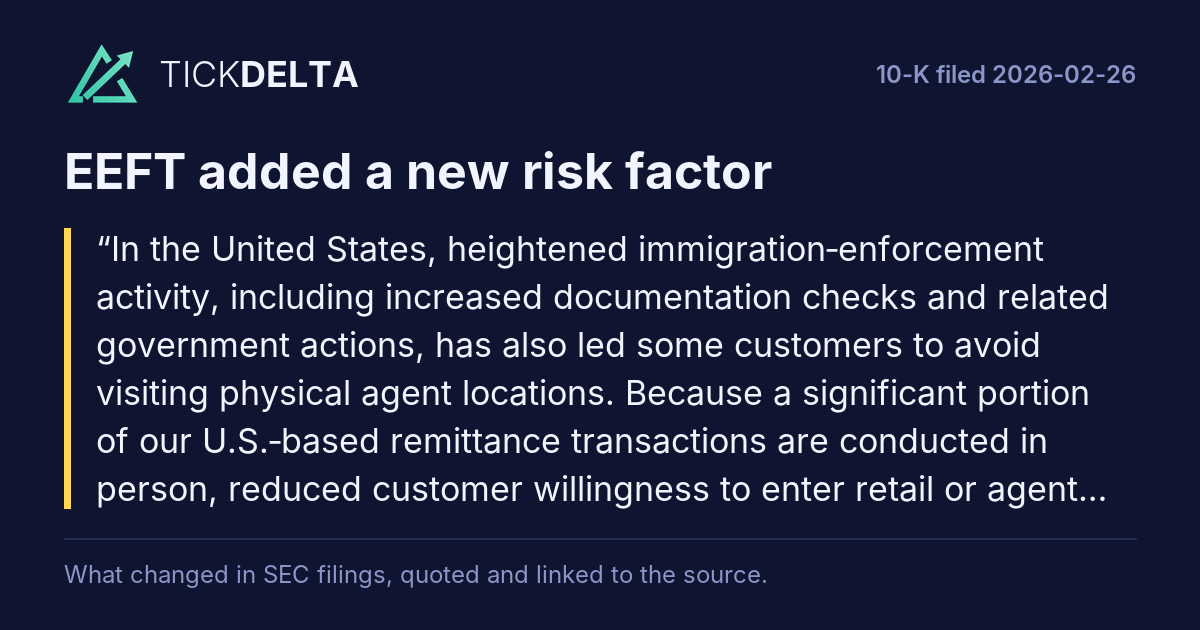
In the United States, heightened immigration‑enforcement activity, including increased documentation checks and related government actions, has also led some customers to avoid visiting physical agent locations. Because a significant portion of our U.S.‑based remittance transactions are conducted in person, reduced customer willingness to enter retail or agent locations may decrease transaction volumes. If such customer behavior persists or expands, our revenues and earnings from physical corridors could be adversely affected.
Additionally, proposed or enacted migration reforms in key host countries—such as caps on visa categories, enhanced verification requirements, or limitations on family reunification—may create uncertainty or reduce labor mobility for migrant workers. Policy changes affecting remittance behavior, including remittance‑specific taxes, reporting obligations, fees, or incentives to use alternative channels, may shift flows between corridors, increase compliance costs, or disrupt distribution relationships. Broader macroeconomic factors, including changes in labor demand and employment conditions in destination markets, may further influence remittance activity.
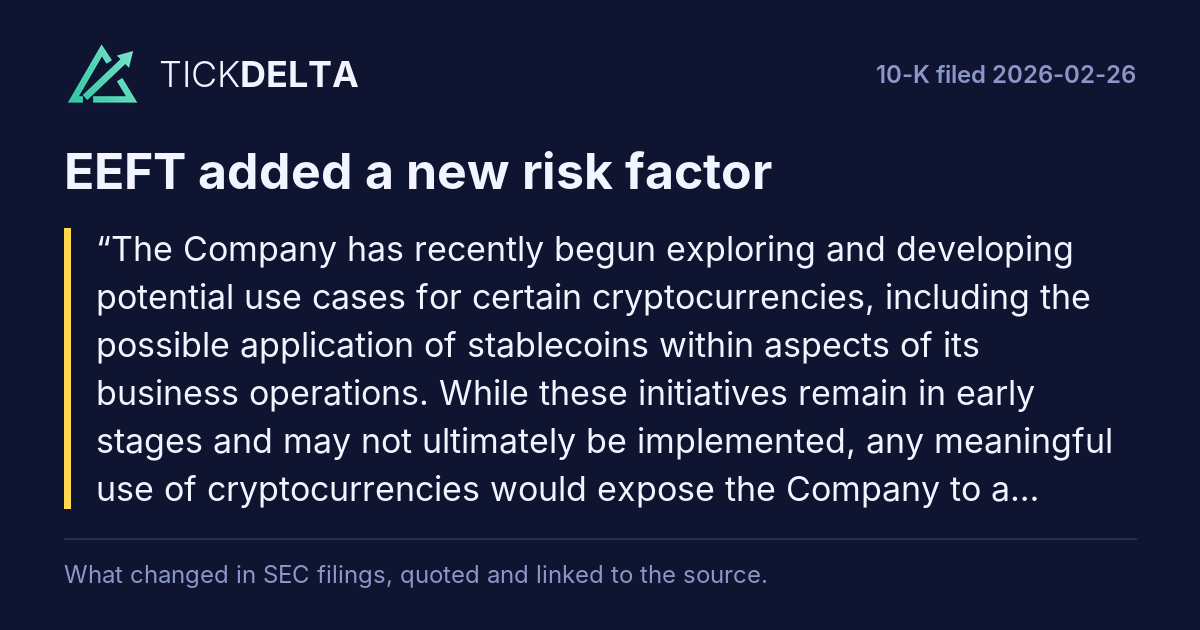
The Company has recently begun exploring and developing potential use cases for certain cryptocurrencies, including the possible application of stablecoins within aspects of its business operations. While these initiatives remain in early stages and may not ultimately be implemented, any meaningful use of cryptocurrencies would expose the Company to a range of internal and external risks that could adversely impact its operations, regulatory obligations, financial condition, or relationships with key partners. These risks include, but are not limited to, the following:
Regulatory Scrutiny: U.S. banking and financial regulators have cautioned that crypto‑asset safekeeping, transaction processing, and related activities present unique fraud, operational, supervisory, and legal risks that require enhanced risk‑management controls.
Rising Fraud Activity: Cryptocurrency‑related scams—particularly those involving the misuse of crypto ATMs and other consumer‑facing channels—have increased, prompting regulatory interventions, customer‑protection initiatives, and litigation activity that could affect digital‑asset adjacent services.
State‑Level Regulations: Several U.S. states have adopted or proposed digital‑asset rules such as transaction caps, enhanced identity‑verification standards, fee limitations, and mandatory fraud disclosures, which could complicate or restrict the Company’s ability to offer or support certain services involving digital assets.
AML and Illicit‑Finance Exposure: Digital‑asset transactions can elevate anti‑money‑laundering and counter‑terrorist‑financing risks due to their speed, pseudonymity, and cross‑border characteristics, potentially increasing compliance requirements and regulatory expectations for financial intermediaries.
Fragmented Global Regulation: Digital‑asset oversight continues to evolve inconsistently across jurisdictions. Divergent or rapidly changing regulatory frameworks may raise compliance costs, create operational uncertainty, affect relationships with financial institutions, or require modifications to existing processes.
Indirect Business Impact: Even if the Company does not ultimately introduce crypto‑related products, broader industry developments, supervisory expectations, or third‑party risk assessments associated with digital assets may influence the Company’s compliance obligations, availability of banking partners, operational risk standards, or the regulatory posture applied to its products and services.
The increasing use of artificial intelligence (“AI”), including machine learning and generative AI, in our internal systems, vendor tools, customer-facing applications, and fraud‑detection processes exposes us to emerging technology, operational, and regulatory risks. A growing number of public companies now disclose AI as a material enterprise risk due to concerns related to cybersecurity, data privacy, model accuracy, regulatory uncertainty, competition, and reputational exposure.
AI systems—whether developed internally or provided by third parties—may produce incorrect, biased, or unreliable outputs, which could adversely affect our operations, decision‑making, compliance programs, and customer interactions. As AI expands the potential attack surface for cyber threats, it may increase the likelihood or severity of data breaches and unauthorized access to sensitive information.
Regulatory scrutiny is rapidly increasing. Emerging frameworks such as the EU Artificial Intelligence Act and new U.S. state‑level AI laws may impose additional compliance obligations, restrict certain uses of AI, or require costly system changes. The SEC has also warned against “AI washing,” increasing the risk of enforcement actions if disclosures regarding AI capabilities are inaccurate or misleading.
AI-related operational risks include potential failures or outages in AI‑enabled tools—such as fraud‑prevention models or transaction‑monitoring systems—that could disrupt services or impair accuracy. Competitors leveraging AI more effectively may gain efficiency or product advantages. In addition, reliance on third‑party AI models exposes us to data‑quality issues, intellectual‑property risks, and vendor performance failures. Perceived or actual misuse of AI, including algorithmic bias or consumer harm, could result in reputational damage, litigation, or regulatory action.
As AI regulations and stakeholder expectations evolve, we may incur additional costs to strengthen governance, oversight, testing, and monitoring of AI systems. Despite these efforts, we cannot guarantee that our use of AI—or the use of AI by our vendors—will not materially adversely affect our business, results of operations, or financial condition.
Paragraphs in the 10-Q filed Nov 4, 2026 that were not in the one before
New in the latest 10-Q
4 paragraphs in the 10-Q filed Nov 4, 2026 with nothing like them in the 10-Q filed Aug 4, 2026 (at least half the words must differ; new numbers alone do not count). Quoted exactly, grouped by the item heading above them. This is text that changed, not a judgement of how serious it is.
Financial statements and notes
On October 7, 2026, the Company loaned an additional $8.0 million to Koin Mobile, LLC under a convertible promissory note bearing paid-in-kind interest at 2% per annum and maturing October 6, 2031. Following conversion of the 2028 Note issued by Koin Mobile, LLC, the note is convertible at the Company’s option into Class A common units that would result in the Company holding 51% of the fully diluted voting power of Koin Mobile, LLC. However, currently the Company does not any voting rights or any other significant influence. The note is secured by the assets of Koin Mobile, LLC.
Read in the 10-Q
(13) SEGMENT INFORMATION Euronet's Chief Executive Officer (CEO) is the Chief Operating Decision Maker (CODM) and is responsible for assessing performance and making resource allocation decisions across the Company's operating segments. The CODM evaluates segment performance primarily based on financial metrics such as revenue, operating income, and other key performance indicators. In making resource allocation decisions, the CODM reviews segment operating income and revenue on a monthly basis to assess profitability and efficiency across segments. Additionally, the CODM considers forecast-to-actual variances in revenue, operating income, and key performance indicators as part of the forecasting process. These measures are used to guide decisions related to capital investments, personnel allocation, and strategic initiatives across the Company’s segments. The CODM also evaluates segment-level profitability and return on assets when making long-term investment decisions and assessing segment performance relative to strategic goals. The accounting policies of the segments are the same as those described in the summary of significant accounting policies. During 2026, the Company updated the names of its reportable operating segments to better align with its current business strategy and external communications. The changes were limited to the segment names and did not affect the composition of the reportable operating segments, the manner in which the Chief Operating Decision Maker evaluates segment performance, or the presentation of previously reported segment information. The Company has changed the name of its EFT Processing Segment to Payments Infrastructure and the name of its Money Transfer Segment to Cross-Border Payments. These name changes more accurately reflect the products and services provided by these segments. Euronet's reportable operating segments have been determined in accordance with ASC Topic 280, Segment Reporting ("ASC 280"). The Company currently operates in the following three reportable operating segments: 1) Through the Payments Infrastructure Segment (formerly EFT Processing Segment), the Company processes transactions for a network of ATMs and POS terminals across Europe, the Middle East, Africa, Asia Pacific and the United States. Euronet provides comprehensive electronic payment solutions consisting of ATM cash withdrawal and deposit services, ATM network participation, outsourced ATM and POS management solutions, credit, debit and prepaid card outsourcing, dynamic currency conversion, domestic and international surcharges and other value added services. Through this segment, the Company also offers a suite of integrated electronic financial transaction software solutions for electronic payment and transaction delivery systems. 2) Through the epay Segment, Euronet provides distribution, processing and collection services for electronic payment products, and prepaid mobile airtime through a network of POS terminals in Europe, the Middle East, Asia Pacific, North America and South America. The epay Segment also provides vouchers and physical gift fulfillment services in Europe. 3) Through the Cross-Border Payments Segment (formerly Money Transfer Segment), Euronet provides global money transfers and currency exchange information in retail stores, apps, and websites through Ria, Xe and the Dandelion cross-border real-time payments network. Cross-Border Payments offers real-time, cross-border payments to consumers and businesses across more than 200 countries and territories, enabling banks, fintechs and big tech platforms to integrate an international payments solution into their own platforms. Ria offers real-time international money transfers with a special focus on emerging markets. In addition, Ria offers safe and affordable money transfers through a global network of cash locations and online, serving over 20 million customers annually. Xe offers web and app-based currency information and industry-leading consumer and business cross-border money transfer services. Customers can send money, buy property overseas, and execute other international payments via the Xe website or app. Dandelion offers consumer and business transaction processing and fulfillment with alternative payout channels like bank accounts, cash pick-up and mobile wallets. Dandelion powers cross-border payments for Xe and Ria, as well as third party banks, fintechs, and big tech platforms. In addition, the Company accounts for non-operating activity, share-based compensation expense, certain intersegment eliminations and the costs of providing corporate and other administrative services in the administrative division, "Corporate Services, Eliminations and Other." These services are not directly identifiable with the Company’s reportable operating segments. The following tables present the Company's reportable segment results for the three months ended September 30, 2026 and 2025: Three Months Ended September 30, 2026 (in millions) Payments Infrastructure epay Cross-Border Payments Corporate Services, Eliminations and Other Consolidated ───────────────────────────────────────────────────────────────────────────────────────────────────────────────────────────────────────────────────────────────────────────────────────────────────────── Total revenues $437.9 $294.7 $431.0 $(2.5) $1,161.1 Operating expenses: Direct operating costs, exclusive of depreciation 210.0 222.3 227.2 (2.5) 657.0 Salaries and benefits 51.0 29.0 92.0 22.0 194.0 Selling, general and administrative 17.3 10.0 68.2 3.5 99.0 Depreciation and amortization 31.4 1.6 6.3 0.2 39.5 Total operating expenses 309.7 262.9 393.7 23.2 989.5 Operating income (loss) $128.2 $31.8 $37.3 $(25.7) $171.6 Three Months Ended September 30, 2025 (in millions) Payments Infrastructure epay Cross-Border Payments Corporate Services, Eliminations and Other Consolidated ───────────────────────────────────────────────────────────────────────────────────────────────────────────────────────────────────────────────────────────────────────────────────────────────────────── Total revenues $409.4 $286.5 $452.4 $(2.6) $1,145.7 Operating expenses: Direct operating costs, exclusive of depreciation 194.4 216.3 235.8 (2.6) 643.9 Salaries and benefits 46.6 28.0 92.6 20.2 187.4 Selling, general and administrative 13.7 9.7 58.1 3.1 84.6 Depreciation and amortization 26.6 1.5 6.6 0.1 34.8 Total operating expenses 281.3 255.5 393.1 20.8 950.7 Operating income (loss) $128.1 $31.0 $59.3 $(23.4) $195.0
Read in the 10-Q
Revenue for the Three Months Ended Year-over-Year Change Revenue for the Nine Months Ended Year-over-Year Change
Read in the 10-Q
Average Translation Rate Three Months Ended September 30, Average Translation Rate Nine Months Ended September 30, Currency (dollars per foreign currency) 2026 2025 Increase (Decrease) Percent 2026 2025 Increase (Decrease)
Read in the 10-Q
The 10-Q's risk factors against the 10-K
Item 1A of the 10-Q filed Nov 4, 2026 against Item 1A of the 10-K filed Feb 26, 2026.
A 10-Q repeats only the risks that changed, so a 10-K paragraph that is missing from it is not counted as removed.
Added is a paragraph with nothing like it in the 10-K, Reworded a sentence that is in both with several words changed,
Quiet changes a sentence in both where one to four words changed and one is a hedge or a modal
(cut words struck through, new words highlighted).
Text on the page, not a score; each links to the filing at sec.gov.
What the 10-Q itself says about its risk factors:Except as otherwise described herein, there were no material changes to the risk factors previously disclosed in our Annual Report on Form 10-K for the year ended December 31, 2025, as filed with the SEC.
Read in the 10-Q
1 paragraph in the 10-Q's Item 1A, and none of them adds, rewords or quietly edits a paragraph of the 10-K's.
Phrases used for the first time
Two-word phrases in Risk Factors of the 10-K filed Feb 26, 2026 that are in none of the 1 earlier 10-Ks stored, back to Feb 25, 2025
Where each one is used
- digital asset: Rising Fraud Activity: Cryptocurrency‑related scams—particularly those involving the misuse of crypto ATMs and other consumer‑facing channels—have increased, prompting regulatory interventions, customer‑protection initiatives, and litigation activity that could affect digital‑asset adjacent services.
- agent locations: In the United States, heightened immigration‑enforcement activity, including increased documentation checks and related government actions, has also led some customers to avoid visiting physical agent locations. Because a significant portion of our U.S.‑based remittance transactions are conducted in person, reduced...
- compliance costs: Additionally, proposed or enacted migration reforms in key host countries—such as caps on visa categories, enhanced verification requirements, or limitations on family reunification—may create uncertainty or reduce labor mobility for migrant workers. Policy changes affecting remittance behavior, including...
- regulatory scrutiny: Regulatory Scrutiny: U.S. banking and financial regulators have cautioned that crypto‑asset safekeeping, transaction processing, and related activities present unique fraud, operational, supervisory, and legal risks that require enhanced risk‑management controls.
- state level: State‑Level Regulations: Several U.S. states have adopted or proposed digital‑asset rules such as transaction caps, enhanced identity‑verification standards, fee limitations, and mandatory fraud disclosures, which could complicate or restrict the Company’s ability to offer or support certain services involving...
- digital assets: State‑Level Regulations: Several U.S. states have adopted or proposed digital‑asset rules such as transaction caps, enhanced identity‑verification standards, fee limitations, and mandatory fraud disclosures, which could complicate or restrict the Company’s ability to offer or support certain services involving...
- compliance obligations: Indirect Business Impact: Even if the Company does not ultimately introduce crypto‑related products, broader industry developments, supervisory expectations, or third‑party risk assessments associated with digital assets may influence the Company’s compliance obligations, availability of banking partners,...
- artificial intelligence: The increasing use of artificial intelligence (“AI”), including machine learning and generative AI, in our internal systems, vendor tools, customer-facing applications, and fraud‑detection processes exposes us to emerging technology, operational, and regulatory risks. A growing number of public companies now...
Used at least twice, small words left out. Counted, not picked: a phrase can be new because the company renamed something.
Sources
Item 1A of each 10-K and 10-Q on EDGAR, quoted exactly. Each paragraph links to the filing at sec.gov.
Also
10-K change: what was reworded or cut, section by section.
Work with it
Excel workbook · CSV. Google Sheet that stays up to date: paste =IMPORTDATA("https://tickdelta.com/company/EEFT/export.csv") into a cell.