Paragraph 115 · 46% changed
Every version of it
Screener
/
SEC EDGAR
/CIK 0000785161
/10-K filed Feb 26, 2026, compared with Feb 28, 2025
/Numbers from the XBRL of the 10-Ks
NYSE
Health care · Hospitals
Encompass Health Corp EHC
The 10-K against last year's
115 changes: 13 added, 11 removed, 89 reworded, 2 quiet changes
10-K Feb 26, 2026 vs Feb 28, 2025
Risk Factors
13.5%
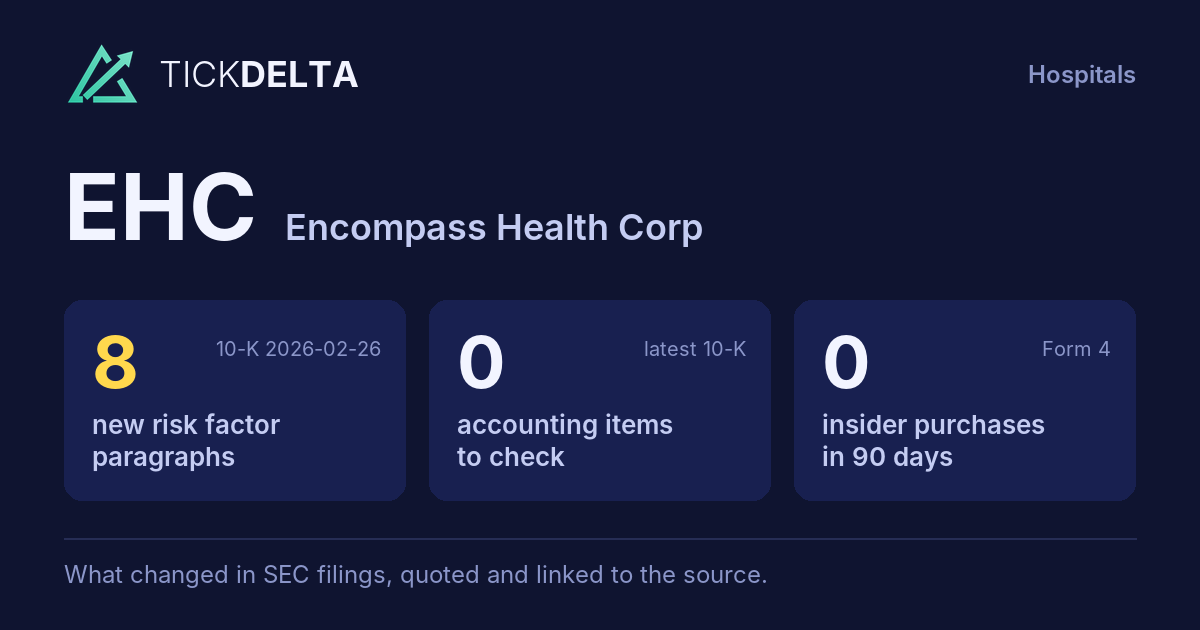
of the text changed · 20,562 words now · 8 new paragraphs, 7 gone
MD&A
16.0%
of the text changed · 10,154 words now · 5 new paragraphs, 4 gone
Legal Proceedings
0.0%
of the text changed · 291 words now
Accounting Policies
11.5%
of the text changed · 8,464 words now
10-K 0000785161-26-000081 (Feb 26, 2026) vs 10-K 0000785161-25-000009 (Feb 28, 2025)
Every paragraph, and how much of it changed
One bar per paragraph, in the order of the 10-K. Height and colour show the share of its words not in the closest paragraph a year earlier; the tallest bars are new paragraphs.
Risk Factors
193 paragraphs · 8 new · 72 reworded · 7 gone · 10-K Feb 26, 2026 against Feb 28, 2025
New paragraph
Reworded (5% of its words or more)
Same or nearly
Paragraph 13 · 43% changed
Every version of it
We cannot predict what alternative or additional deficit reduction initiatives, including significant staffing reductions at HHS, Medicare payment reductions, or post-acute care reforms, if any, will be adopted or enacted into law, or the timing or effect of any initiatives or reductions. Since taking office However, given the uncertainty in January 2025, President Trump has taken a number the funding of executive actions, including those associated with recommendations of the Department of Government Efficiency, intended to reduce federal spending, including Medicare and Medicaid. Those initiatives, reductions, or actions would be Medicaid spending in addition to many ordinary course reimbursement rate changes that CMS adopts each year as part of the market basket update rulemaking process for various provider categories. While we do not expect the drive toward integrated payment models, value-based purchasing, and unified post-acute payment systems in Medicare reimbursement to subside, future, there will almost certainly be new or alternative proposals for healthcare reforms in the future which may change these initiatives and other healthcare laws and regulations. We cannot predict the nature or timing of any changes to the laws, regulations, or the operations of governmental agencies that either currently affect, or may in the future affect, will affect our government reimbursement or business. There can be no assurance future governmental action will not result in substantial changes to, or material reductions in, our reimbursements, including through Medicaid and related state directed and supplemental payment programs.
Paragraph 161 · 40% changed
Every version of it
Paragraph 188 · 39% changed
Every version of it
Paragraph 12 · 38% changed
Every version of it
In a June 2018 2023 report mandated by the IMPACT Act, MedPAC reiterated its recommendation that reviewed the considerations associated with Congress adopt designing and adopting a unified payment system for all Medicare post-acute care (a “PAC-PPS”) in lieu of separate systems for inpatient rehabilitation facilities (“IRFs”), skilled nursing facilities, long-term acute-care hospitals, and home health agencies. A PAC-PPS would reimburse providers for care based primarily on patients’ medical conditions and other clinical factors rather than the costs associated with care settings. MedPAC found a PAC-PPS to be feasible and desirable but also suggested many existing regulatory requirements, including, for IRFs, policymakers may want to consider other “smaller scale site-neutral policies” given the 60% rule discussed below considerable resources required to develop and the requirement for a minimum of three hours of therapy per day, should be waived or modified as part of implementing implement a PAC-PPS. MedPAC previously estimated, although we cannot verify the methodology or the accuracy of that estimate, a PAC-PPS would result in a 15% reduction in IRF reimbursements. As a precursor to a PAC-PPS, MedPAC discussed in November 2017 a potential recommendation to change the case-mix weights in each post-acute setting for 2019 reimbursements and 2020 to a blend of the current setting specific weight and the proposed PAC-PPS weight, which MedPAC suggested would shift money aggregate reimbursements from for-profit and freestanding IRFs to non-profit and hospital-based IRFs. MedPAC has also called for aligning Medicare regulatory requirements across post-acute providers, although the agency has acknowledged it could take years to complete this effort. MedPAC issued another report on the PAC-PPS in June 2023. In that report, MedPAC concluded the design of a PAC-PPS is “relatively straight-forward” but noted “developing companion policies could take many years; implementing them would be complex and possibly controversial.” Additionally, MedPAC previously suggested that Medicare should ultimately move from fee-for-service reimbursement to more integrated payment models.
Paragraph 171 · 37% changed
Every version of it
Paragraph 81 · 36% changed
Every version of it
Because Medicare comprises a significant portion of our Net operating revenues, failure to comply with the laws and regulations governing the Medicare program and related matters, including anti-kickback and anti-fraud requirements, could materially and adversely affect us. Our ability to operate in a compliant manner impacts the claims denials, compliance enforcement, and regulatory processes discussed in other risks above. The federal government’s reliance on sub-regulatory guidance, such as handbooks, FAQs, internal memoranda, and press releases, presents a unique challenge to compliance efforts. Such sub-regulatory guidance purports to explain validly promulgated regulations but often expands or supplements existing regulations without constitutionally and statutorily required notice and comment and other procedural protections. Without procedural protections, sub-regulatory guidance poses a risk above and beyond reasonable efforts to follow validly promulgated regulations, particularly when the agency or MAC seeking to enforce such sub-regulatory guidance is not the agency or MAC issuing the guidance and therefore not as familiar with the substance and nature of the underlying regulations or even clinical issues involved.
Paragraph 139 · 34% changed
Every version of it
Paragraph 115 · 46% changed
Every version of it
10-K Feb 28, 2025The federal No Surprises Act imposes additional price transparency requirements, including requiring hospitals to send uninsured or self-pay patients a good faith estimate of the expected charges for treatments, including for attending physicians billing separately, prior to the scheduled stay or upon request. If an uninsured or self-pay patient receives a bill that is substantially greater than the expected charges in the estimate or the provider furnishes an item or service that was not included in the estimate, the patient may initiate a patient-provider dispute resolution process established by regulation. Additionally, HHS may impose penalties of up to $10,000 per violation of the No Surprises Act.
10-K Feb 26, 2026
in the estimate, the patient may initiate a patient-provider dispute resolution process established by regulation. Additionally, HHS may impose penalties of up to $10,000 per violation of the No Surprises Act.
Paragraph 13 · 43% changed
Every version of it
10-K Feb 28, 2025
We cannot predict what alternative or additional deficit reduction initiatives, including significant staffing reductions at HHS, Medicare payment reductions, or post-acute care reforms, if any, will be adopted or enacted into law, or the timing or effect of any initiatives or reductions. Since taking office in January 2025, President Trump has taken a number of executive actions, including those associated with recommendations of the Department of Government Efficiency, intended to reduce federal spending, including Medicare and Medicaid. Those initiatives, reductions, or actions would be in addition to many ordinary course reimbursement rate changes that CMS adopts each year as part of the market basket update rulemaking process for various provider categories. While we do not expect the drive toward integrated payment models, value-based purchasing, and unified post-acute payment systems in Medicare reimbursement to subside, there will almost certainly be new or alternative healthcare reforms in the future which may change these initiatives and other healthcare laws and regulations. We cannot predict the nature or timing of any changes to the laws, regulations, or the operations of governmental agencies that either currently affect, or may in the future affect, our government reimbursement or business.
10-K Feb 26, 2026
We cannot predict what alternative or additional deficit reduction initiatives, including significant staffing reductions at HHS, Medicare payment reductions, or post-acute care reforms, if any, will be adopted or enacted into law, or the timing or effect of any initiatives or reductions. However, given the uncertainty in the funding of Medicare and Medicaid spending in the future, there will almost certainly be new proposals for healthcare reforms and other changes to the laws, regulations, or the operations of governmental agencies that will affect our government reimbursement or business. There can be no assurance future governmental action will not result in substantial changes to, or material reductions in, our reimbursements, including through Medicaid and related state directed and supplemental payment programs.
Paragraph 161 · 40% changed
Every version of it
10-K Feb 28, 2025The proper function, availability, and security of our information systems are critical to our business and failure to maintain proper function, availability, or security of our information systems or protect our data against unauthorized access could have a material adverse effect on our business, financial position, results of operations, and cash flows.
10-K Feb 26, 2026
have a significant impact on our staffing costs. Our failure to recruit and retain qualified clinical personnel, or to control our staffing costs, could have a material adverse effect on our business, financial position, results of operations, and cash flows.
Paragraph 188 · 39% changed
Every version of it
10-K Feb 28, 2025As of December 31, 2024, approximately 66% of our consolidated Property and equipment, net was held by our Company and its guarantor subsidiaries under its credit agreement. See Note 9, Long-term Debt, to the accompanying consolidated financial statements, the “Liquidity and Capital Resources” section of Item 7, Management’s Discussion and Analysis of Financial Condition and Results of Operations, and Item 2, Properties.
10-K Feb 26, 2026
In addition, our credit agreement requires us to maintain specified financial ratios and satisfy certain financial condition tests. See the “Liquidity and Capital Resources” section of Item 7, Management’s Discussion and Analysis of Financial Condition and Results of Operations, and Note 8, Long-term Debt, to the accompanying consolidated financial statements. Although we remained in compliance with the financial ratios and financial condition tests as of December 31,
Paragraph 12 · 38% changed
Every version of it
10-K Feb 28, 2025
In a June 2018 report mandated by the IMPACT Act, MedPAC reiterated its recommendation that Congress adopt a unified payment system for all post-acute care (a “PAC-PPS”) in lieu of separate systems for inpatient rehabilitation facilities (“IRFs”), skilled nursing facilities, long-term acute-care hospitals, and home health agencies. A PAC-PPS would reimburse providers for care based primarily on patients’ medical conditions and other clinical factors rather than the care settings. MedPAC found a PAC-PPS to be feasible and desirable but also suggested many existing regulatory requirements, including, for IRFs, the 60% rule discussed below and the requirement for a minimum of three hours of therapy per day, should be waived or modified as part of implementing a PAC-PPS. MedPAC previously estimated, although we cannot verify the methodology or the accuracy of that estimate, a PAC-PPS would result in a 15% reduction in IRF reimbursements. As a precursor to a PAC-PPS, MedPAC discussed in November 2017 a potential recommendation to change the case-mix weights in each post-acute setting for 2019 and 2020 to a blend of the current setting specific weight and the proposed PAC-PPS weight, which MedPAC suggested would shift money from for-profit and freestanding IRFs to non-profit and hospital-based IRFs. MedPAC has also called for aligning Medicare regulatory requirements across post-acute providers, although the agency has acknowledged it could take years to complete this effort. MedPAC issued another report on the PAC-PPS in June 2023. In that report, MedPAC concluded the design of a PAC-PPS is “relatively straight-forward” but noted “developing companion policies could take many years; implementing them would be complex and possibly controversial.” Additionally, MedPAC previously suggested that Medicare should ultimately move from fee-for-service reimbursement to more integrated payment models.
10-K Feb 26, 2026
In a June 2023 report mandated by the IMPACT Act, MedPAC reviewed the considerations associated with Congress designing and adopting a unified payment system for all Medicare post-acute care (a “PAC-PPS”) in lieu of separate systems for inpatient rehabilitation facilities (“IRFs”), skilled nursing facilities, long-term acute-care hospitals, and home health agencies. A PAC-PPS would reimburse providers for care based primarily on patients’ medical conditions and other clinical factors rather than the costs associated with care settings. MedPAC found a PAC-PPS to be feasible and desirable but also suggested policymakers may want to consider other “smaller scale site-neutral policies” given the considerable resources required to develop and implement a PAC-PPS. MedPAC previously estimated, although we cannot verify the methodology or the accuracy of that estimate, a PAC-PPS would result in a 15% reduction in IRF reimbursements and shift aggregate reimbursements from for-profit and freestanding IRFs to non-profit and hospital-based IRFs.
Paragraph 171 · 37% changed
Every version of it
10-K Feb 28, 2025Additionally, we operate in states in which the litigation environment may pose a significant business risk to us. For instance, we have been involved in lawsuits, including putative class actions, brought under California’s Private Attorneys General Act (“PAGA”). Under PAGA, individuals, including aggrieved employees, can bring individual or class-action claims alleging regulatory violations, including alleged violations of employment regulations. Additionally, judges and juries in California have demonstrated a willingness to grant large verdicts to plaintiffs in connection with employment and labor related cases. In 2017, the California Supreme Court held that plaintiffs bringing suit under PAGA are generally entitled to request and receive a significant amount of information from the employer early in the litigation, which creates pressure for employers to settle early to avoid substantial litigation burdens and which has resulted in a significant increase in PAGA claims in recent years.
10-K Feb 26, 2026
cases. In 2017, the California Supreme Court held that plaintiffs bringing suit under PAGA are generally entitled to request and receive a significant amount of information from the employer early in the litigation, which creates pressure for employers to settle early to avoid substantial litigation burdens and which has resulted in a significant increase in PAGA claims in recent years.
Paragraph 81 · 36% changed
Every version of it
10-K Feb 28, 2025
Because Medicare comprises a significant portion of our Net operating revenues, failure to comply with the laws and regulations governing the Medicare program and related matters, including anti-kickback and anti-fraud requirements, could materially and adversely affect us. Our ability to operate in a compliant manner impacts the claims denials, compliance enforcement, and regulatory processes discussed in other risks above. The federal government’s reliance on sub-regulatory guidance, such as handbooks, FAQs, internal memoranda, and press releases, presents a unique challenge to compliance efforts. Such sub-regulatory guidance purports to explain validly promulgated regulations but often expands or supplements existing regulations without constitutionally and statutorily required notice and comment and other procedural protections. Without procedural protections, sub-regulatory guidance poses a risk above and beyond reasonable efforts to follow validly promulgated regulations, particularly when the agency or MAC seeking to enforce such sub-regulatory guidance is not the agency or MAC issuing the guidance and therefore not as familiar with the substance and nature of the underlying regulations or even clinical issues involved.
10-K Feb 26, 2026
Because Medicare comprises a significant portion of our Net operating revenues, failure to comply with the laws and regulations governing the Medicare program and related matters, including anti-kickback and anti-fraud requirements, could materially and adversely affect us. Our ability to operate in a compliant manner impacts the claims denials, compliance enforcement, and regulatory processes discussed in other risks above. The federal government’s reliance on sub-regulatory
Paragraph 139 · 34% changed
Every version of it
10-K Feb 28, 2025In the inpatient rehabilitation industry, the costs of constructing new hospitals are increasing faster than reimbursement rates and the general inflation rate. In many states, the need to obtain governmental approvals, such as a CON or an approval of a change in ownership, may represent a significant obstacle to completing transactions. Additionally, in states with CON laws, it is not unusual for third-party providers to challenge the initial awards of CONs, the increase in the number of approved beds in an existing CON, or the expansion of the area served, and the adjudication of those challenges and related appeals may take many years.
10-K Feb 26, 2026
it is not unusual for third-party providers to challenge the initial awards of CONs, the increase in the number of approved beds in an existing CON, or the expansion of the area served, and the adjudication of those challenges and related appeals may take many years.
MD&A
131 paragraphs · 5 new · 53 reworded · 4 gone · 10-K Feb 26, 2026 against Feb 28, 2025
New paragraph
Reworded (5% of its words or more)
Same or nearly
Paragraph 93 · 50% changed
Paragraph 33 · 44% changed
Paragraph 77 · 39% changed
See the “Results of Operations” section above for information related to our estimated cash tax savings in 2025 resulting from the OBBBA. See Item 1A, Risk Factors, for a discussion of risks and uncertainties facing us.
Paragraph 54 · 37% changed
General and administrative expenses increased during 2024 compared to 2023 primarily due to higher salaries, benefits, in terms of dollars and software expenses partially offset by lower incentive compensation costs. General and administrative expenses decreased as a percent of Net operating revenues during 2024 2025 compared to 2023 2024 primarily due to higher volumes. incentive compensation and costs associated with our transition to a new enterprise resource planning system, Oracle Fusion, in 2025.
Paragraph 26 · 37% changed
Paragraph 52 · 36% changed
Supplies increased during 2024 2025 compared to 2023 2024 primarily due to higher costs for medical supplies, pharmaceuticals, and food. resulting from our development activities.
Paragraph 7 · 33% changed
•began operating our new 40-bed 60-bed inpatient rehabilitation hospital in Atlanta, Georgia Fort Myers, Florida with our joint venture partner Piedmont Lee Healthcare Holdings, LLC in May 2024; May;
Paragraph 70 · 33% changed
Consistent with these objectives, in August and November 2024, September 2025, we redeemed $150 the remaining $100 million and $100 million, respectively, of the outstanding principal balance of our 5.75% Senior Notes due 2025 (the “2025 Notes”) at maturity using cash on hand. Pursuant to the terms of the 2025 Notes, these optional redemptions were made at a price of par. As a result of these redemptions, we recorded a $0.6 million Loss on early extinguishment of debt during 2024. hand and capacity under our revolving credit facility. See Note 9, 8, Long-term Debt, to the accompanying consolidated financial statements, for additional information.
Paragraph 93 · 50% changed
10-K Feb 28, 2025On October 28, 2013, we announced our board of directors authorized the repurchase of up to $200 million of our common stock, which has been amended from time to time. Most recently, on July 24, 2024, our board approved resetting the aggregate common stock repurchase authorization to $500 million. As of December 31, 2024, approximately $489 million remained under this authorization. The repurchase authorization does not require the repurchase of a specific number of shares, has an indefinite term, and is subject to termination at any time by our board of directors. Subject to certain terms and conditions, including a maximum price per share and compliance with federal and state securities and other laws, the repurchases may be made from time to time in open market transactions, privately negotiated transactions, or other transactions, including trades under a plan established in accordance with Rule 10b5-1 under the Securities Exchange Act of 1934, as amended. During 2024, we repurchased 0.4 million shares of our common stock in the open market for $31.1 million under this repurchase authorization using cash on hand. There were no repurchases of our common stock during 2023 or 2022. Future repurchases under this authorization generally are expected to be funded using a combination of cash on hand and availability under our $1 billion revolving credit facility.
10-K Feb 26, 2026
open market for $31.1 million under this repurchase authorization using cash on hand. There were no repurchases of our common stock during 2023. Future repurchases under this authorization generally are expected to be funded using a combination of cash on hand and availability under our $1 billion revolving credit facility.
Paragraph 33 · 44% changed
10-K Feb 28, 2025•Maintaining Strong Volume Growth. Various factors, including competition and increasing regulatory and administrative burdens, may impact our ability to maintain and grow our hospital volumes. In any particular market, we may encounter competition from local or national entities with longer operating histories or other competitive advantages, such as acute-care hospitals who provide post-acute services similar to ours or other post-acute providers with relationships with referring acute-care hospitals or physicians. Aggressive payment review practices by Medicare contractors, aggressive enforcement of regulatory policies by government agencies, and restrictive or burdensome rules, regulations or statutes governing admissions practices may lead us to not accept patients who would be appropriate for and would benefit from the services we provide. In addition, from time to time, we must get regulatory approval to expand our services and locations in states with certificate of need laws. This approval may be withheld or take longer than expected. In the case of new-store volume growth, the addition of hospitals to our portfolio also may be difficult and take longer than expected.
10-K Feb 26, 2026
services we provide. In addition, from time to time, we must get regulatory approval to expand our services and locations in states with certificate of need laws. This approval may be withheld or take longer than expected. In the case of new-store volume growth, the addition of hospitals to our portfolio also may be difficult and take longer than expected.
Paragraph 77 · 39% changed
10-K Feb 28, 2025
See Item 1A, Risk Factors, for a discussion of risks and uncertainties facing us.
10-K Feb 26, 2026
See the “Results of Operations” section above for information related to our estimated cash tax savings in 2025 resulting from the OBBBA. See Item 1A, Risk Factors, for a discussion of risks and uncertainties facing us.
Paragraph 54 · 37% changed
10-K Feb 28, 2025
General and administrative expenses increased during 2024 compared to 2023 primarily due to higher salaries, benefits, and software expenses partially offset by lower incentive compensation costs. General and administrative expenses decreased as a percent of Net operating revenues during 2024 compared to 2023 primarily due to higher volumes.
10-K Feb 26, 2026
General and administrative expenses increased in terms of dollars and as a percent of Net operating revenues during 2025 compared to 2024 primarily due to higher incentive compensation and costs associated with our transition to a new enterprise resource planning system, Oracle Fusion, in 2025.
Paragraph 26 · 37% changed
10-K Feb 28, 2025other payment policy changes. The Budget Control Act of 2011 provides for an automatic 2% reduction, or “sequestration,” of Medicare program payments for all healthcare providers. Sequestration took effect April 1, 2013 and, as a result of subsequent legislation, will continue through mid-fiscal year 2032 unless Congress and the President take further action. Additional Medicare payment reductions are also possible under the Statutory Pay-As-You-Go Act of 2010 (“Statutory PAYGO”). Statutory PAYGO requires, among other things, that mandatory spending and revenue legislation not increase the federal budget deficit over a 5- or 10-year period. If the Office of Management and Budget (the “OMB”) finds there is a deficit in the federal budget, Statutory PAYGO requires OMB to order sequestration of Medicare, which could result in Medicare program payments reductions of up to four percent. There can be no assurance that future federal rulemaking and legislation will not result in reimbursement freezes or reductions, or reimbursement increases that are less than the increases we experience in our costs of operation.
10-K Feb 26, 2026
there is a deficit in the federal budget, Statutory PAYGO requires OMB to order sequestration of Medicare, which could result in Medicare program payments reductions of up to four percent. There can be no assurance that future federal rulemaking and legislation will not result in reimbursement freezes or reductions, or reimbursement increases that are less than the increases we experience in our costs of operation.
Paragraph 52 · 36% changed
10-K Feb 28, 2025
Supplies increased during 2024 compared to 2023 primarily due to higher costs for medical supplies, pharmaceuticals, and food.
10-K Feb 26, 2026
Supplies increased during 2025 compared to 2024 primarily due to higher costs resulting from our development activities.
Paragraph 7 · 33% changed
10-K Feb 28, 2025
•began operating our new 40-bed inpatient rehabilitation hospital in Atlanta, Georgia with our joint venture partner Piedmont in May 2024;
10-K Feb 26, 2026
•began operating our new 60-bed inpatient rehabilitation hospital in Fort Myers, Florida with our joint venture partner Lee Healthcare Holdings, LLC in May;
Paragraph 70 · 33% changed
10-K Feb 28, 2025
Consistent with these objectives, in August and November 2024, we redeemed $150 million and $100 million, respectively, of the outstanding principal balance of our 5.75% Senior Notes due 2025 (the “2025 Notes”) using cash on hand. Pursuant to the terms of the 2025 Notes, these optional redemptions were made at a price of par. As a result of these redemptions, we recorded a $0.6 million Loss on early extinguishment of debt during 2024. See Note 9, Long-term Debt, to the accompanying consolidated financial statements, for additional information.
10-K Feb 26, 2026
Consistent with these objectives, in September 2025, we redeemed the remaining $100 million of the outstanding principal balance of our 5.75% Senior Notes due 2025 at maturity using cash on hand and capacity under our revolving credit facility. See Note 8, Long-term Debt, to the accompanying consolidated financial statements, for additional information.
A paragraph is matched with the one last year that shares the most of its words; under half in common makes it new. The paragraphs shown are the 8 reworded the most in each section.
The paragraph that changed most in each section
The redline
Marked against last year's 10-K: cut words struck through, new words highlighted.
Risk Factors238 words changed in this paragraph; it is 36% similar to last year's version.
In addition, our credit agreement requires us to maintain specified financial ratios and satisfy certain financial condition tests. See the “Liquidity and Capital Resources” section of Item 7, Management’s Discussion and Analysis of Financial Condition and Results of Operations, and Note 9, 8, Long-term Debt, to the accompanying consolidated financial statements. Although we remained in compliance with the financial ratios and financial condition tests as of December 31, 2024, we cannot provide assurance we will continue to do so. Events beyond our control, including changes in general economic and business conditions, may affect our ability to meet those financial ratios and financial condition tests. A severe downturn in earnings, failure to realize anticipated earnings from acquisitions, or, if we have outstanding borrowings under our credit facility at the time, a rapid increase in interest rates could impair our ability to comply with those financial ratios and financial condition tests and we may need to obtain waivers from the required proportion of the lenders to avoid being in default. If we try to obtain a waiver or other relief from the required lenders, we may not be able to obtain it or such relief might have a material cost to us or be on terms less favorable than those in our existing debt. If a default occurs, the lenders could exercise their rights, including declaring all the funds borrowed (together with accrued and unpaid interest) to be immediately due and payable, terminating their commitments or instituting foreclosure proceedings against our assets, which, in turn, could cause the default and acceleration of the maturity of our other indebtedness. A breach of any other restrictive covenants contained in our credit agreement or the indentures governing our senior notes would also (after giving effect to applicable grace periods, if any) result in an event of default with the same outcome.
Source: Item 1A, 10-K 0000785161-26-000081 vs Item 1A, 10-K 0000785161-25-000009
MD&A150 words changed in this paragraph; it is 39% similar to last year's version.
The OBBBA contained a broad range of tax reform provisions affecting businesses. While tax changes in the OBBBA did not have a material impact on our effective tax rate, certain tax provisions in the OBBBA, namely the provision that permanently extended bonus depreciation for certain assets placed in service after January 19, 2025 and the provision allowing for immediate expensing of certain research and development costs, resulted in current deductions that yielded lower cash income tax for 2025. We currently estimate these provisions produced an additional approximately $84 million in current deductions resulting in approximately $22 million in cash tax savings in 2025. Our cash payments for income taxes approximated $164 $124 million and $107 $164 million, net of refunds, in 2024 2025 and 2023, 2024, respectively. These payments were based on estimates of taxable income. We estimate we will pay approximately $155 million to $175 million of cash income taxes, net of refunds, in 2025. These The 2025 payments are expected to primarily result from federal and state income tax expenses based on included estimates of taxable income for 2025. the tax provisions contained in the OBBBA. In 2024 2025 and 2023, 2024, current income tax expense was $139.5 $170.6 million and $128.3 $139.5 million, respectively.
Source: Item 7, 10-K 0000785161-26-000081 vs Item 7, 10-K 0000785161-25-000009
Accounting Policies148 words changed in this paragraph; it is 30% similar to last year's version.
Source: 10-K text, Note 1 – Summary of Significant Accounting Policies:, 10-K 0000785161-26-000081 vs 10-K text, Note 1 – Summary of Significant Accounting Policies:, 10-K 0000785161-25-000009
Sentences and paragraphs added, removed or reworded
Every change, by type
Sentences and paragraphs of EHC's Risk Factors and MD&A, 10-K Feb 26, 2026 against 10-K Feb 28, 2025. Each links to the text at sec.gov.
Quiet changes are sentences kept from last year with one to four words changed, at least one of them a hedge, a modal or a qualifier (may, could, will, not, significant, material…). A year or date rolling forward is not counted.
The full word list
adverse, adversely, all, although, anticipate, anticipates, any, approximately, believe, believes, can, cannot, certain, could, expect, expects, generally, however, if, intend, intends, largely, likely, many, material, materially, may, might, most, must, never, no, not, possible, primarily, probable, should, significant, significantly, some, substantial, substantially, unlikely, will, would
AddedRisk Factors
We receive state directed and supplemental payments in connection with several state Medicaid programs. In 2025, those payments totaled approximately $148 million. We also pay provider taxes to fund, in part, state Medicaid programs, and in 2025 those payments totaled approximately $127 million. In May 2024, CMS issued a final rule related to Medicaid managed care programs that addresses state directed payment programs and imposes new requirements for these programs. The various elements of the rule take effect between its issuance and early 2028. Ultimately, this rule could result in significant changes to state directed and supplemental payment programs from which we receive payments. However, a federal district court recently vacated portions of this rule following a legal challenge by the state of Texas. CMS appealed the decision, but the court enjoined enforcement of this rule while the appeal is pending. The OBBBA also contains provisions limiting states’ ability to assess provider taxes to increase federal matching Medicaid funds and make directed payments to providers. Most of these provisions take effect in 2027 or later and likely require additional federal and state regulatory action to implement.
Read it in 10-K Feb 26, 2026 at sec.gov
AddedRisk Factors
It is possible that additional rulemaking could result in significant restructurings of existing state Medicaid programs, including provider tax and related directed and supplemental payment programs. State authorities design the structures and operations of these programs to promote access to acute-care hospitals for Medicaid patients by supplementing acute-care
Read it in 10-K Feb 26, 2026 at sec.gov
AddedRisk Factors
reimbursement. Historically, we are not aware of any IRFs playing a significant role in the design given the limited number of IRF Medicaid patients, so we are uncertain what attention state authorities will give to the effects of additional rulemaking on IRFs. We are unable to estimate the financial impact that structural modifications and other program changes, if any, may have on our Medicaid provider tax expenses or directed and supplemental payments. We cannot be certain that changes to state directed and supplemental payment programs will directly correspond to changes in the related provider taxes. CMS periodically assesses the compliance of these programs, and CMS’s determination that a state’s program fails to comply may result in a decrease in state directed and supplemental payments and recoupment of prior payments under that state’s noncompliant program.
Read it in 10-K Feb 26, 2026 at sec.gov
AddedRisk Factors
Under CMS’s Targeted Probe and Educate (“TPE”) program, MACs use data analysis to identify healthcare providers with unusual billing practices, high claim error rates, and items and services that have high national error rates. Once a MAC
Read it in 10-K Feb 26, 2026 at sec.gov
AddedRisk Factors
Medicare Advantage plans may use overly restrictive coverage determinations in the pre-authorization process to limit participating members’ access to needed inpatient rehabilitative care. Medicare Advantage plans must provide coverage for inpatient rehabilitative care to the extent conventional Medicare does. However, in our experience, Medicare Advantage plans frequently deny coverage for inpatient rehabilitative care when the patients would have qualified for that care under conventional Medicare rules. Additionally, large Medicare Advantage plans have acquired home health operators. Those Medicare Advantage plans may attempt to shift patients who would benefit from intensive inpatient rehabilitation to home health in order to reduce costs to the plans in the near term.
Read it in 10-K Feb 26, 2026 at sec.gov
AddedRisk Factors
security worldwide is continuously evolving and developing and, as a result, interpretation and implementation standards and enforcement practices are likely to remain uncertain for the foreseeable future.
Read it in 10-K Feb 26, 2026 at sec.gov
AddedRisk Factors
privacy or security-related concerns, even if unfounded, or to comply with applicable laws, regulations, standards and other obligations relating to data privacy and security and the use of artificial intelligence, could result in additional cost and liability to us, damage our relationships with patients and business partners and have a material adverse effect on our business.
Read it in 10-K Feb 26, 2026 at sec.gov
AddedRisk Factors
our systems, particularly in light of the number of well-funded and organized threat actors working to attack healthcare providers and the possibility of zero-day vulnerabilities and exploits yet to be identified.
Read it in 10-K Feb 26, 2026 at sec.gov
Show the other 42
RemovedRisk Factors
RemovedRisk Factors
RemovedRisk Factors
RemovedRisk Factors
RemovedRisk Factors
RemovedRisk Factors
RemovedRisk Factors
RewordedRisk Factors
RewordedRisk Factors
We monitor legal developments in data privacy and security regulations at the local, state and federal level, however, the regulatory framework for data privacy and security worldwide is continuously evolving and developing and, as a result, interpretation and implementation standards and enforcement practices are likely to remain uncertain for the foreseeable future.
Read it in 10-K Feb 26, 2026 at sec.gov
RewordedRisk Factors
For example, the ACA provides for the expansion of expanded the federal Anti-Kickback Law and the False Claims Act (the “FCA”) that, when combined with other recent federal initiatives, are likely to increase investigation and enforcement efforts increasing compliance scrutiny in the healthcare industry generally.
Read it in 10-K Feb 26, 2026 at sec.gov
RewordedRisk Factors
See Note 9, Long-term Debt, to the accompanying consolidated financial statements, the “Liquidity and Capital Resources” section of Item 7, Management’s Discussion and Analysis of Financial Condition and Results of Operations, and Item 2, Properties. Note 8, Long-term Debt, to the accompanying consolidated financial statements.
Read it in 10-K Feb 26, 2026 at sec.gov
RewordedRisk Factors
Certain state laws may be more stringent or broader in scope, or offer greater individual rights, with respect to confidential, sensitive and personal information than federal, international or other state laws, and such laws may conflict with each other, which significantly complicates compliance efforts.
Read it in 10-K Feb 26, 2026 at sec.gov
RewordedRisk Factors
In accordance with Medicare laws and federal statutes, CMS makes market an annual adjustment to Medicare reimbursement rates, commonly known as a “market basket updates update,” by provider type in an effort to compensate providers for rising operating costs.
Read it in 10-K Feb 26, 2026 at sec.gov
RewordedRisk Factors
RewordedRisk Factors
Substantial damages, fines, or other remedies assessed against us or agreed to in settlements could have a material adverse effect on our business, financial position, results of operations, and cash flows, including indirectly as a result of the covenant defaults under our credit agreement or debt instruments or other claims such as those in securities actions.
Read it in 10-K Feb 26, 2026 at sec.gov
RewordedRisk Factors
However, CMS holds the acute-care hospital where a joint replacement takes place accountable for the quality and costs of care for the entire episode of care — from the time of the original admission through 90 days after discharge.
Read it in 10-K Feb 26, 2026 at sec.gov
RewordedRisk Factors
RewordedRisk Factors
In a June 2018 2023 report mandated by the IMPACT Act, MedPAC reiterated its recommendation that reviewed the considerations associated with Congress adopt designing and adopting a unified payment system for all Medicare post-acute care (a “PAC-PPS”) in lieu of separate systems for inpatient rehabilitation facilities (“IRFs”), skilled nursing facilities, long-term acute-care hospitals, and home health agencies.
Read it in 10-K Feb 26, 2026 at sec.gov
RewordedRisk Factors
MedPAC previously estimated, although we cannot verify the methodology or the accuracy of that estimate, a PAC-PPS would result in a 15% reduction in IRF reimbursements. reimbursements and shift aggregate reimbursements from for-profit and freestanding IRFs to non-profit and hospital-based IRFs.
Read it in 10-K Feb 26, 2026 at sec.gov
Quiet changesRisk Factors
Some adverse consequences are may not be insurable, such as reputational harm and third-party business interruption.
Read it in 10-K Feb 26, 2026 at sec.gov
Quiet changesRisk Factors
Our employees are also may be at greater risk of contracting contagious diseases due to their increased exposure to vulnerable patients.
Read it in 10-K Feb 26, 2026 at sec.gov
AddedMD&A
On July 4, 2025, President Trump signed into law the One Big Beautiful Bill Act (“OBBBA”). The OBBBA contains a range of healthcare-related provisions impacting coverage, financing, and provider reimbursement in state Medicaid programs. These provisions include enrollee work requirements, limitations on states’ ability to assess provider taxes to increase federal matching Medicaid funds, and limitations on states’ directed payments to providers. Most of these provisions take effect in 2027 or later and likely require additional federal and state regulatory action to implement. The OBBBA includes other non-healthcare specific, tax-related items. For further discussion of these items, see Note 14, Income Taxes, to the accompanying consolidated financial statements of this report, and the “Results of Operations” section of this Item.
Read it in 10-K Feb 26, 2026 at sec.gov
AddedMD&A
The OBBBA contained a broad range of tax reform provisions affecting businesses. While tax changes in the OBBBA did not have a material impact on our effective tax rate, certain tax provisions in the OBBBA, namely the provision that permanently extended bonus depreciation for certain assets placed in service after January 19, 2025 and the provision allowing for immediate expensing of certain research and development costs, resulted in current deductions that yielded lower cash income tax for 2025. We currently estimate these provisions produced an additional approximately $84 million in current deductions resulting in approximately $22 million in cash tax savings in 2025. Our cash payments for income taxes approximated $124 million and $164 million, net of refunds, in 2025 and 2024, respectively. These payments were based on estimates of taxable income. The 2025 payments included estimates of the tax provisions contained in the OBBBA. In 2025 and 2024, current income tax expense was $170.6 million and $139.5 million, respectively.
Read it in 10-K Feb 26, 2026 at sec.gov
AddedMD&A
We continue to evaluate the tax and other provisions of the OBBBA and the potential effects on our financial position, results of operations, and cash flows. The OBBBA includes other non-tax specific, healthcare-related items. For further discussion of the OBBBA, see Item 1, Business, and Item 1A, Risk Factors, “Reimbursement Risks.”
Read it in 10-K Feb 26, 2026 at sec.gov
AddedMD&A
recognizing that these actions may increase our leverage ratio. See also the “Authorizations for Returning Capital to Stakeholders” section of this Item.
Read it in 10-K Feb 26, 2026 at sec.gov
AddedMD&A
events and their effects cannot be determined with certainty, actual results could differ from our assumptions and estimates, and such differences could be material.
Read it in 10-K Feb 26, 2026 at sec.gov
RemovedMD&A
RemovedMD&A
RemovedMD&A
RemovedMD&A
RewordedMD&A
Discharge growth from new stores during 2024 2025 compared to 2023 2024 resulted from our joint ventures in Knoxville, Tennessee (March 2023), Owasso, Oklahoma (March 2023), Bowie, Maryland (June 2023), Columbus, Georgia (September 2023), Atlanta, Georgia (May 2024), and Louisville, Kentucky (June 2024), Athens, Georgia (March 2025), and Fort Myers, Florida (May 2025), as well as our wholly owned hospitals in Clermont, Florida (April 2023), Prosper, Texas (November 2023), Fitchburg, Wisconsin (November 2023), Kissimmee, Florida (May 2024), Johnston, Rhode Island (July 2024), and Fort Mill, South Carolina (September 2024). 2024), Houston, Texas (November 2024), and Daytona Beach, Florida (July 2025).
Read it in 10-K Feb 26, 2026 at sec.gov
RewordedMD&A
For the Year Ended December 31, 2025 2024 2023 2022 Net cash provided by operating activities $ 1,175.6 $ 1,002.8 $ 850.8 $ 705.8 Interest expense and amortization of debt discounts and fees 123.2 137.4 143.5 175.7 Gain (loss) on sale of investments, excluding impairments 5.9 2.7 4.6 (15.5) Equity in net income of nonconsolidated affiliates 4.3 3.0 3.2 2.9 Net income attributable to noncontrolling interests in continuing operations (192.9) (140.9) (111.0) (93.6) Amortization of debt-related items (9.6) (9.7) (9.5) (9.7) Distributions from nonconsolidated affiliates (4.1) (4.0) (1.6) (4.0) Current portion of income tax expense 170.6 139.5 128.3 72.2 Change in assets and liabilities (4.3) (21.9) (50.3) 30.4 Cash used in (provided by) operating activities of discontinued operations 1.4 3.1 16.0 (52.3) Asset impairment impact on noncontrolling interests — (7.3) — — State regulatory change impact on noncontrolling interests — — (2.2) — Change in fair market value of equity marketable securities (2.5) (1.0) (0.7) 7.4 Other 0.3 — — Adjusted EBITDA $ 1,267.9 $ 1,103.7 $ 971.1 $ 819.3
Read it in 10-K Feb 26, 2026 at sec.gov
RewordedMD&A
For the Year Ended December 31, 2025 2024 2023 2022 Net income $ 759.1 $ 596.6 $ 463.0 $ 365.9 Loss (income) from discontinued operations, net of tax, attributable to Encompass Health 1.0 2.8 12.0 (15.2) Net income attributable to noncontrolling interests included in continuing operations (192.9) (140.9) (111.0) (93.6) Provision for income tax expense 192.9 150.2 132.2 100.1 Interest expense and amortization of debt discounts and fees 123.2 137.4 143.5 175.7 Loss on early extinguishment of debt — 0.6 — 1.4 Loss on disposal or impairment of assets 2.7 17.4 9.8 4.8 Depreciation and amortization 327.9 299.6 273.9 243.6 Stock-based compensation 56.5 48.3 50.6 29.2 State regulatory change impact on noncontrolling interests — — (2.2) — Change in fair market value of equity marketable securities (2.5) (1.0) (0.7) 7.4 Asset impairment impact on noncontrolling interests — (7.3) — — Adjusted EBITDA $ 1,267.9 $ 1,103.7 $ 971.1 $ 819.3
Read it in 10-K Feb 26, 2026 at sec.gov
RewordedMD&A
Salaries and benefits decreased as a percent of Net operating revenues during 2024 2025 compared to 2023 2024 primarily due to higher volumes a decline in EPOB and provider tax revenues decreases in both contract labor and lower revenue reserves related to bad debt as discussed above. sign-on and shift bonuses.
Read it in 10-K Feb 26, 2026 at sec.gov
RewordedMD&A
General and administrative expenses decreased increased in terms of dollars and as a percent of Net operating revenues during 2024 2025 compared to 2023 2024 primarily due to higher volumes. incentive compensation and costs associated with our transition to a new enterprise resource planning system, Oracle Fusion, in 2025.
Read it in 10-K Feb 26, 2026 at sec.gov
RewordedMD&A
The increase in Net income attributable to noncontrolling interests during 2024 2025 compared to 2023 2024 primarily resulted from increased profitability from certain existing joint venture hospitals partially offset by the ramp up of new joint venture hospitals and the impact from the impairment related to the closure of our joint venture hospital in Eau Claire, Wisconsin in February 2024, as discussed above. hospitals.
Read it in 10-K Feb 26, 2026 at sec.gov
RewordedMD&A
RewordedMD&A
The increase in Net cash used in financing activities of continuing operations during 2024 2025 compared to 2023 2024 primarily resulted from lower Contributions from noncontrolling interests of consolidated affiliates and higher net debt payments and repurchases of common stock partially offset by higher Contributions from noncontrolling interests of consolidated affiliates. lower net debt payments.
Read it in 10-K Feb 26, 2026 at sec.gov
RewordedMD&A
Consistent with these objectives, in August and November 2024, September 2025, we redeemed $150 the remaining $100 million and $100 million, respectively, of the outstanding principal balance of our 5.75% Senior Notes due 2025 (the “2025 Notes”) at maturity using cash on hand. hand and capacity under our revolving credit facility.
Read it in 10-K Feb 26, 2026 at sec.gov
RewordedMD&A
Other operating expenses decreased increased in terms of dollars and as a percent of Net operating revenues during 2024 2025 compared to 2023 2024 primarily due to increased provider tax expense, as discussed above, and higher volumes. costs resulting from development activities.
Read it in 10-K Feb 26, 2026 at sec.gov
RewordedMD&A
The decrease in Interest expense and amortization of debt discounts and fees in 2024 2025 compared to 2023 2024 primarily resulted from the September 2025, November 2024, and August and November 2024 redemptions of $100 million, $100 million, and $150 million and $100 million, respectively, in outstanding principal amount of the Company’s 5.75% Senior Notes due 2025. 2025 (the “2025 Notes”).
Read it in 10-K Feb 26, 2026 at sec.gov
RewordedMD&A
See Note 9, Long-term Debt, 1, Summary of Significant Accounting Policies, “Noncontrolling Interests in Consolidated Affiliates,” to the accompanying consolidated financial statements, for additional information related to our debt. on this transaction.
Read it in 10-K Feb 26, 2026 at sec.gov
Sources
The two latest 10-Ks on EDGAR, section by section. Each change links to the text at sec.gov.
Also
New risk factors: paragraphs with nothing like them last year, quoted in full.
Work with it
Excel workbook · CSV. Google Sheet that stays up to date: paste =IMPORTDATA("https://tickdelta.com/company/EHC/export.csv") into a cell.