ELEstée Lauder Companies
The Estée Lauder Companies Inc., founded in 1946 by Estée and Joseph Lauder, is one of the world’s leading manufacturers, marketers and sellers of quality skin care, makeup, fragrance and hair care products. 10-K, Item 1
- Headquarters
- New York, NY
- CEO
- la Faverie Stephane de
- Next results
- around Feb 4, 2027
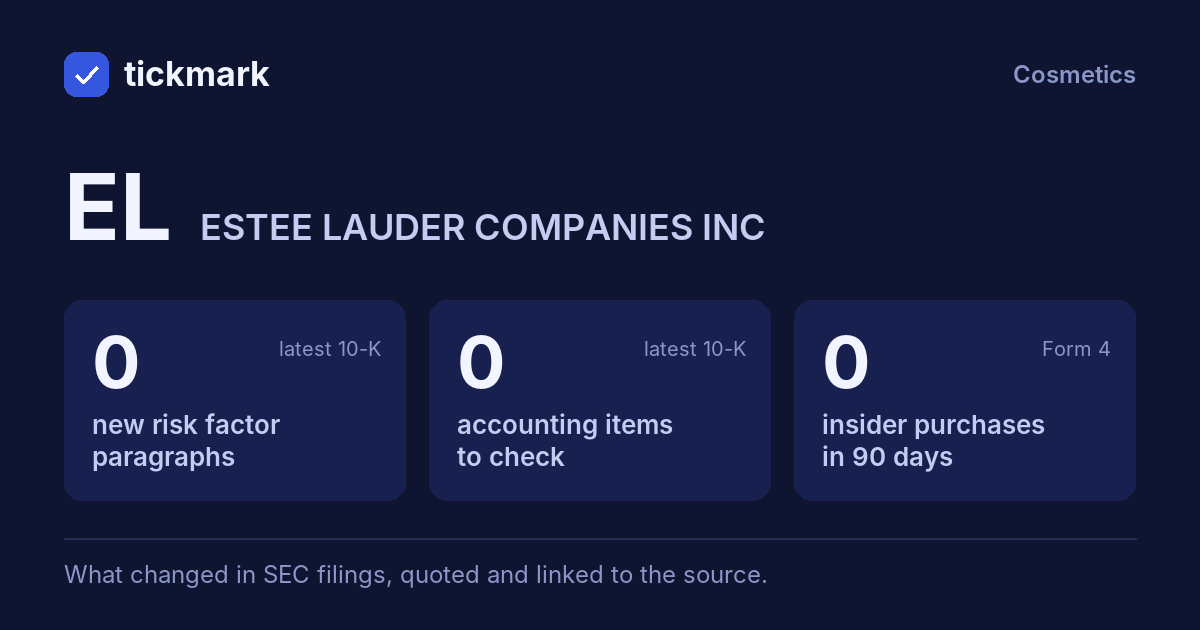
No new paragraphs in Risk Factors, or fewer than two 10-Ks to compare.
New in the latest 10-Q
21 paragraphs in the 10-Q filed Nov 2, 2026 with nothing like them in the 10-Q filed May 1, 2026 (at least half the words must differ; new numbers alone do not count). Quoted exactly, grouped by the item heading above them. This is text that changed, not a judgement of how serious it is.
Financial statements and notes
Adjustments to reconcile net earnings to net cash flows from operating activities:
Read in the 10-Q ↗
The effective rate for income taxes was 32.5 % and 56.9 % for the three months ended September 30, 2026 and 2025, respectively, a 2,440 basis point decrease period over period. The extent of the period-over-period change was broadly impacted by the lower earnings before taxes for the three months ended September 30, 2025. The decrease in the effective tax rate was primarily attributable to a more favorable estimated full year geographical mix of earnings partially offset by the estimated increase in unrecognized tax benefits primarily related to transfer pricing matters impacting multiple tax jurisdictions.
Read in the 10-Q ↗
In May 2026, the FASB issued authoritative guidance establishing requirements for the recognition, measurement, presentation and disclosure of environmental credits and environmental credit obligations. Environmental credit assets should be recognized and measured, including both initial and subsequent measurement, based on their intended use as well as how the credits are obtained. Costs for environmental credits that do not meet the asset recognition criteria are expensed as incurred. Environmental credit obligation liabilities are measured based on the carrying amount of the environmental credit owned that are considered probable of being used to settle the obligation (funded portion), with any excess liability measured based on the fair value of the environmental credits necessary to settle that portion of the liability (unfunded portion) at the reporting date, with certain exceptions. Environmental credit assets and environmental credit obligations should be presented separately within an entity’s consolidated balance sheet. Entities are required to provide several quantitative and qualitative disclosures for their environmental credits and environmental obligations in annual reporting periods.
Read in the 10-Q ↗
Included in the Carrying Amount of the Hedged Liability September 30, 2026 September 30, 2026 Long-term debt $ 1,416 $ (175) Intercompany debt $ — $ (7)
Read in the 10-Q ↗
The aggregate transaction price allocated to remaining performance obligations that are unsatisfied (or partially unsatisfied) as of September 30, 2026 was $ 779 million, of which approximately $ 351 million is expected to be recognized within the next 12 months, with the remainder thereafter. These amounts are comprised of deferred revenue and future royalty revenue from the Company's license arrangements.
Read in the 10-Q ↗
The royalty revenue associated with TOM FORD is included within the other category and within The Americas region.
Read in the 10-Q ↗
During the fiscal 2026 fourth quarter, the parties to the securities class action litigation (alleging violations of Sections 10(b) and 20(a) of the Securities Exchange Act of 1934 based on alleged materially false and misleading statements) reached an agreement in principle to settle. As of June 30, 2026, the total settlement amount was funded, which includes the amounts paid by the insurance carriers. As such there are no amounts related to this matter reflected in the accompanying consolidated balance sheets as of September 30, 2026 or June 30, 2026. On August 20, 2026, the Company received final approval of the settlement amount from the Court. A minimal number of reported class members opted out of the settlement. At this time, no complaints have been filed by these members, and the Company believes it is not possible at this time to reasonably assess the outcome of any potential complaints or to estimate the loss or range of losses, if any. There is no impact to the fiscal 2027 consolidated financial statements for the securities class action litigation.
Read in the 10-Q ↗
While amounts recorded (outside the Talcum litigation settlement agreements) for the three months ended September 30, 2026 and 2025, respectively, to either settle cases, or accrue for probable losses, are not material, adverse outcomes on pending or future claims could be material. The Company cannot reasonably estimate the range of reasonably possible losses in excess of accrued amounts for these or future matters. The assessment of the Company’s current cases is ongoing and could change in light of the discovery of additional facts with respect to these cases not presently known to the Company, further legal analysis, or determinations by courts, juries or other finders of fact or deciders of law that vary from the Company’s evaluation of the probable liability or outcome of such cases. The number of new cases filed against the Company has increased in recent periods, consistent with broader trends in litigation involving talcum products generally, and the Company expects that the number of new cases filed against it, and the number of cases pending against it, may continue to increase in future periods.
Read in the 10-Q ↗
September 30, (In millions, except per share data) 2026 2025 ─────────────────────────────────────────────────────────────────────────────────────────────────────────────────────────────────────────── Common stock, beginning of the period $ 6 $ 6 Stock-based compensation — — Common stock, end of the period 6 6 Paid-in capital, beginning of the period 7,378 7,012 Common stock dividends 2 3 Stock-based compensation 117 126 Paid-in capital, end of the period 7,497 7,141 Retained earnings, beginning of the period 11,341 11,672 Common stock dividends (129) (128) Net earnings 233 47 Retained earnings, end of the period 11,445 11,591 Accumulated other comprehensive loss, beginning of the period (1,153) (1,127) Other comprehensive earnings (loss) 10 (14) Accumulated other comprehensive loss, end of the period (1,143) (1,141) Treasury stock, beginning of the period (13,766) (13,698) Stock-based compensation (1) (9) Treasury stock, end of the period (13,767) (13,707) Total equity $ 4,038 $ 3,890 Cash dividends declared per common share $ .35 $ .35
Read in the 10-Q ↗
On October 5, 2026, the Company completed the acquisition of the remaining equity interest in Mountain Valley Springs India Private Limited, the owner of the Forest Essentials brand ("Forest Essentials"), an India-based beauty brand grounded in the science of modern Luxurious Ayurveda. The acquisition is expected to further strengthen the Company's portfolio and expand the global reach of the Forest Essentials brand. Prior to the acquisition, the Company held a 49 % equity interest in Forest Essentials that was accounted for under the equity method. The transaction will be accounted for as a business combination.
Read in the 10-Q ↗
The purchase price for the remaining 51 % equity interest of $ 160 million was funded from cash on hand, and is subject to customary post-closing adjustments. In connection with obtaining a controlling interest in Forest Essentials, the Company expects to recognize a gain in the fiscal 2027 second quarter of approximately $ 94 million resulting from the remeasurement of its previously held 49 % equity interest to fair value. Additionally, the Company paid $ 37 million related to a one-time inducement payment, which is excluded from the consideration transferred, and will be recognized as an operating expense in the fiscal 2027 second quarter.
Read in the 10-Q ↗
Given the limited time since the acquisition date, the initial accounting of the transaction remains incomplete as of the date these consolidated financial statements were issued, as well as consideration of certain required disclosures.
Read in the 10-Q ↗
September 30, (In millions) 2026 2025 ─────────────────────────────────────────────────────────────────────────────────────────────────────────────────────────────────────────── NET SALES By Product Category: Skin Care $ 1,651 $ 1,575 Makeup 1,048 1,030 Fragrance 861 721 Hair Care 128 129 Other 28 25 3,716 3,480 Returns associated with restructuring and other activities(1) (1) 1 Net sales $ 3,715 $ 3,481 By Geographic Region(2): The Americas $ 1,227 $ 1,174 Europe, the United Kingdom and Ireland and Emerging Markets ("EUKEM") 923 901 Asia/Pacific 952 873 Mainland China 614 532 3,716 3,480 Returns associated with restructuring and other activities(1) (1) 1 Net sales $ 3,715 $ 3,481 OPERATING INCOME (LOSS) By Product Category: Skin Care $ 262 $ 187 Makeup 3 (15) Fragrance 166 86 Hair Care 5 (12) Other 13 9 449 255 Charges associated with restructuring and other activities(1) (41) (86) Operating income $ 408 $ 169 By Geographic Region(2): The Americas $ 114 $ 87 EUKEM 44 6 Asia/Pacific 259 150 Mainland China 32 12 449 255 Charges associated with restructuring and other activities(1) (41) (86) Operating income $ 408 $ 169
Read in the 10-Q ↗
Partially offsetting the makeup net sales increase were lower net sales, primarily from Estée Lauder, Too Faced and Bobbi Brown Cosmetics, combined, of approximately $20 million. Estée Lauder net sales decreased, reflecting lower net sales in the face subcategory, including the impact from the timing of new product innovation, partially offset by incremental sales from the next-generation of Double Wear Stay-in-Place Longwear Matte Foundation that launched in the second half of fiscal 2026. The decrease in net sales from Too Faced reflected the impact of closures of certain specialty-multi retailer-operated shop-in-shop doors. Bobbi Brown Cosmetics net sales decreased, driven by lower net sales within the department store channel, which included the impact from the strategic exit from certain retailers.
Read in the 10-Q ↗
The decrease in net sales from Aveda reflected lower shipments primarily due to brand-specific supply chain logistical challenges.
Read in the 10-Q ↗
The increase in net sales from The Ordinary benefitted from the Multi-Peptide Serum for Hair Density, as well as targeted expanded consumer reach.
Read in the 10-Q ↗
The increase in net sales in our travel retail business was led by Asia travel retail, primarily driven by (i) net sales growth from the Beijing and Shanghai airports, reflecting an increase in replenishment orders amid continued stabilization following changes in duty-free retailers, including the related online businesses, that began in the fiscal 2026 second quarter and (ii) Hainan travel retail, driven by the improvement in online retail sales.
Read in the 10-Q ↗
(1) Consumer-facing operating expenses in this table and within the operating expense margin discussion below do not include the impact of co-operative advertising expenses that are recorded as a reduction of revenue, however, our references to consumer-facing investments throughout the remainder of Item 7. Management's Discussion and Analysis of Financial Condition and Results of Operations include the consumer-facing operating expenses noted above as well as the impact of co-operative advertising expenses that are recorded as a reduction of revenue.
Read in the 10-Q ↗
The effective rate for income taxes was 32.5% and 56.9% for the three months ended September 30, 2026 and 2025, respectively, a 2,440 basis point decrease period over period. The extent of the period-over-period change was broadly impacted by the lower earnings before income taxes for the three months ended September 30, 2025. The decrease in the effective tax rate was primarily attributable to a more favorable estimated full year geographical mix of earnings partially offset by the estimated increase in unrecognized tax benefits primarily related to transfer pricing matters impacting multiple tax jurisdictions.
Read in the 10-Q ↗
On October 5, 2026, we completed the acquisition of the remaining equity interest in Mountain Valley Springs India Private Limited, the owner of the Forest Essentials brand, an India-based beauty brand grounded in the science of modern Luxurious Ayurveda, and paid $160 million for the purchase of the remaining 51% equity interest and $37 million related to a one-time inducement payment which is excluded from the consideration transferred, using cash on hand. For further information related to the acquisition, refer to Note 14 - Subsequent Events.
Read in the 10-Q ↗
Other information
During the fiscal 2027 first quarter, the Company made payments of eighty-seven U.S. dollars to maintain its intellectual property rights in Iran, as part of its intellectual property protection efforts, under a specific license granted by the U.S. Department of Treasury’s Office of Foreign Asset Control (OFAC). The Company does not generate any revenues or profits from this activity, and plans to continue these activities, as authorized under the specific license. These trademarks are registered with the Intellectual Property Center of the Islamic Republic of Iran (IPC) through intellectual property counsel and service providers located in the United Arab Emirates and Iran. The payments were made to IPC at its account at the Central Bank of Iran, which was designated by OFAC as sanctioned under its counterterrorism authority pursuant to Executive Order 13224 on September 20, 2019.
Read in the 10-Q ↗
The 10-Q's risk factors against the 10-K
Item 1A of the 10-Q filed Nov 2, 2026 against Item 1A of the 10-K filed Aug 19, 2026.
A 10-Q repeats only the risks that changed, so a 10-K paragraph that is missing from it is not counted as removed.
Added is a paragraph with nothing like it in the 10-K, Reworded a sentence that is in both with several words changed,
Quiet changes a sentence in both where one to four words changed and one is a hedge or a modal
(cut words struck through, new words highlighted and underlined).
Text on the page, not a score; each links to the filing at sec.gov.
This 10-Q has no Item 1A (Risk Factors) text of its own, so there is nothing to compare. Many companies leave it out when their risks have not changed.
Work on EL in a spreadsheet:
Excel workbook (a sheet per section, ten years by column, charts, links to the filings) ·
CSV.
For a Google Sheet that stays up to date, paste =IMPORTDATA("https://tickdelta.com/company/EL/export.csv") into a cell.