Added10-Q Nov 5, 2026 vs 10-K May 21, 2026
• engage in activities or employment practices that may harm our reputation; and
Each branch is a paragraph in Risk Factors with nothing like it in the 10-K filed May 29, 2025. A box jumps to the paragraph as filed, below.
8 paragraphs in Risk Factors of the 10-K filed May 21, 2026 with nothing like them in the 10-K filed May 29, 2025. Quoted exactly. Paragraphs that were only edited are under 10-K change.
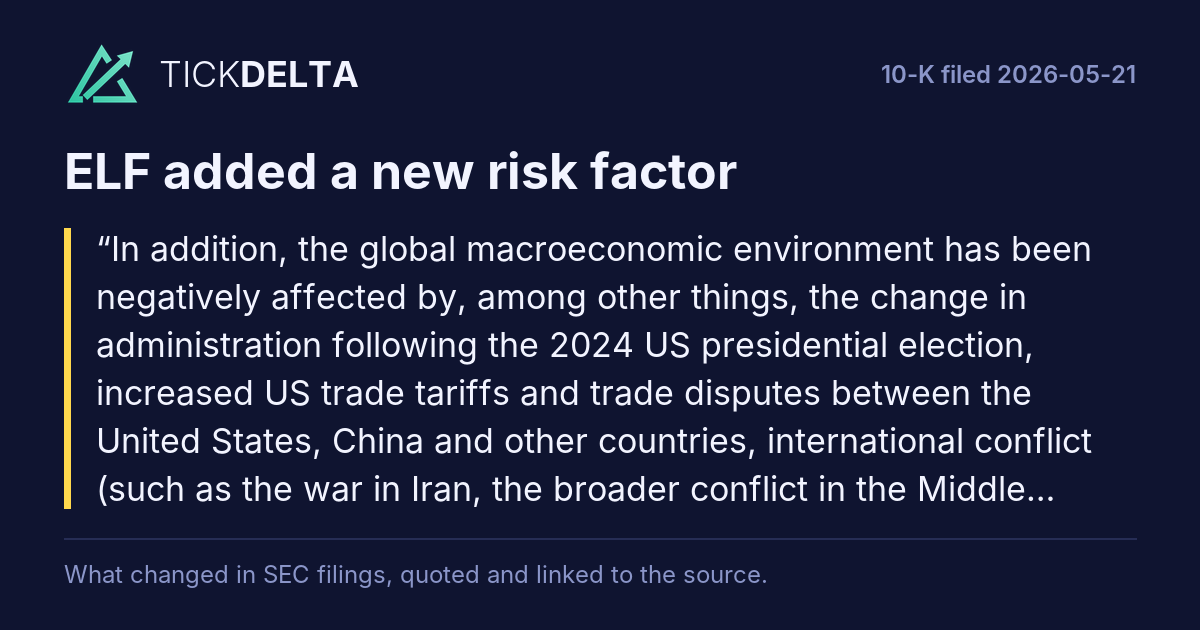
In addition, the global macroeconomic environment has been negatively affected by, among other things, the change in administration following the 2024 US presidential election, increased US trade tariffs and trade disputes between the United States, China and other countries, international conflict (such as the war in Iran, the broader conflict in the Middle East and Russia's invasion of Ukraine), the Houthi attacks on marine vessels in the Red Sea, political tensions between Taiwan and China, political demonstrations, and foreign governmental debt concerns which have caused, and are likely to continue to cause, uncertainty and instability in local economies and in global financial markets. For example, we have a retail partner located in certain Middle-Eastern countries. In February 2026, Israel and the United States initiated a coordinated military operation in Iran. In response, Iran launched counter-attacks against Israel and other countries in the region, including Bahrain. During these attacks, our retail partner had to shutter its stores in Bahrain temporarily, thus impacting our retail sales in the region. Additionally, the conflicts in the Middle East have led to higher oil prices and created supply imbalances in the global market for oil and natural gas. The extent and duration of these effects cannot be reliably predicted, and these conflicts may have other adverse effects on the global economy. If these conflicts continue or expand further into other countries, not only could they further adversely affect our sales with our retail partner in Middle-Eastern countries, but they could also lead to increased shipping costs, transportation delays, embargos, and other supply chain concerns, all of which could have a material adverse effect on our business, financial condition, results of operations, and cash flows.
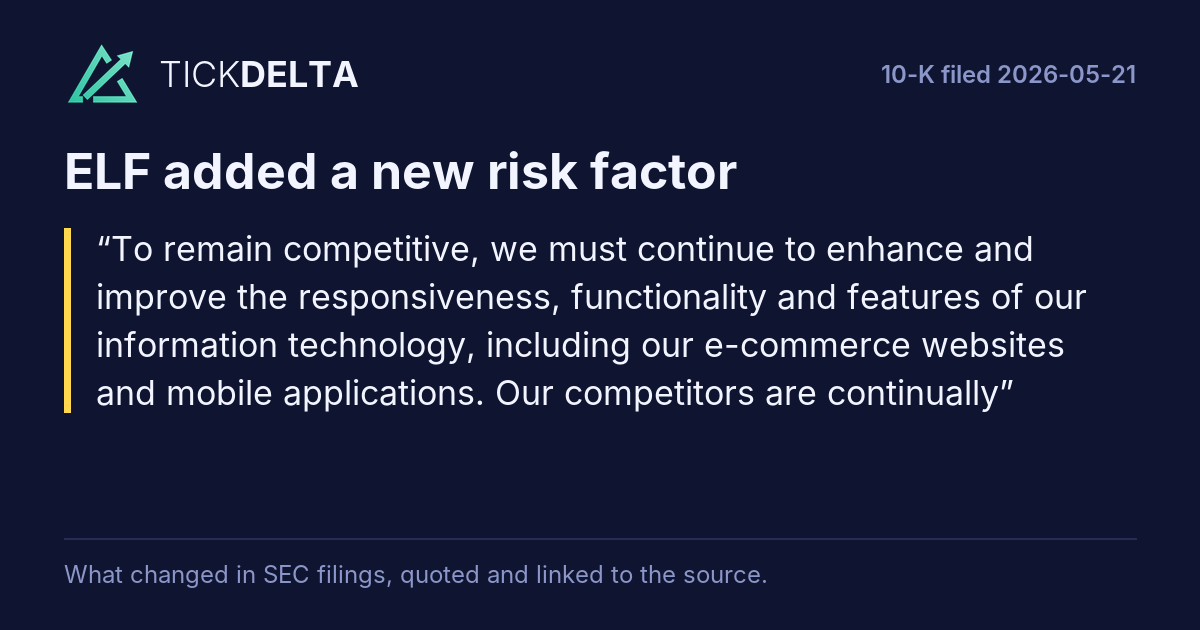
To remain competitive, we must continue to enhance and improve the responsiveness, functionality and features of our information technology, including our e-commerce websites and mobile applications. Our competitors are continually
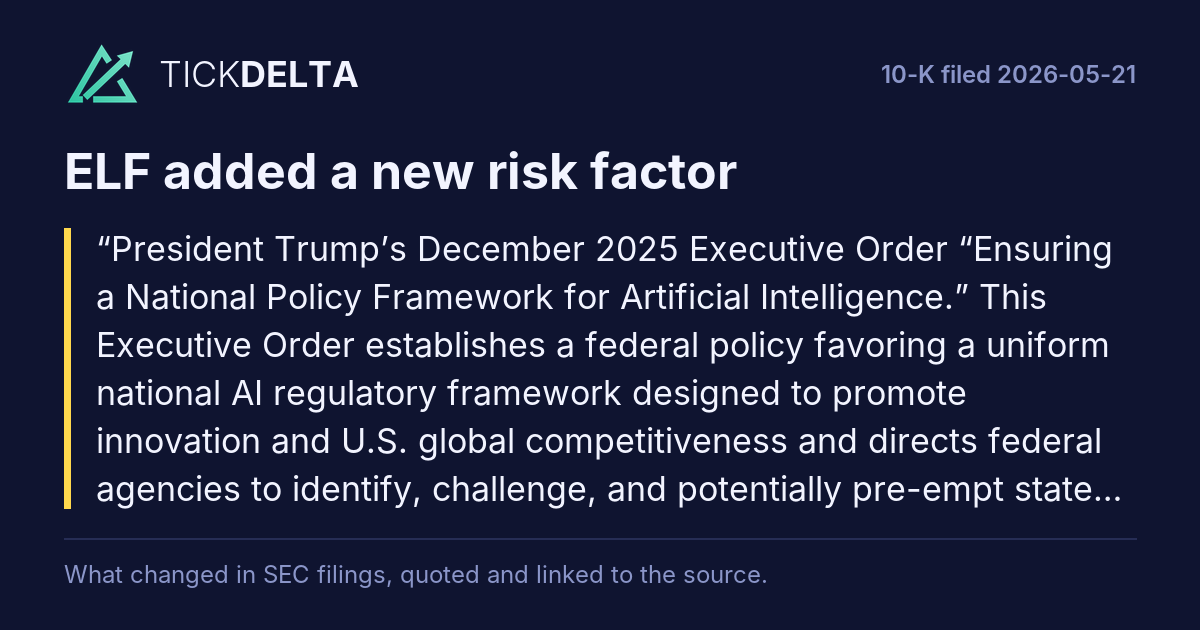
President Trump’s December 2025 Executive Order “Ensuring a National Policy Framework for Artificial Intelligence.” This Executive Order establishes a federal policy favoring a uniform national AI regulatory framework designed to promote innovation and U.S. global competitiveness and directs federal agencies to identify, challenge, and potentially pre-empt state and local AI laws that are viewed as inconsistent with or burdensome to this national approach. The White House also released a National Policy Framework for Artificial Intelligence in March 2026 that calls for broad federal preemption of existing state AI laws while taking a “light-touch” regulatory approach using existing agencies. The release of this framework follows the release of a discussion draft of Senator Marsha Blackburn’s TRUMP AMERICA AI Act, which would represent the most comprehensive piece of federal AI legislation proposed in the U.S. It remains to be seen how agencies will effectuate these directives, and how states will approach AI legislation moving forward. Any or all of the foregoing regulatory developments could affect our use of AI and our ability to provide, improve or commercialize our services, require changes to our operations and processes, and materially adversely affect our business, results of operations, and financial condition. Further, any failure or perceived failure by us to comply with existing or newly enacted laws, regulations and other requirements relating to AI technologies could result in legal claims or proceedings (including class actions), regulatory investigations or enforcement actions.
fraudulently use consumer information for their own gain or facilitate the fraudulent use of such information. Overall, we may have little recourse if we process a criminally fraudulent transaction.
•military conflicts (such as the war in Iran, the broader conflict in the Middle East and Russia's invasion of Ukraine).
Further, in 2024, the National Security Division of the U.S. Department of Justice (DOJ) issued a new rule—referred to as the “Data Security Program” (DSP)—to implement Executive Order 14117 aimed at preventing access to “bulk U.S. sensitive personal data” and “government-related data” by “countries of concern” (including China, Russia, Iran, North Korea, Cuba, and Venezuela) and “covered persons” (as all such terms are defined in the DSP). Effective as of April 8, 2025, and fully enforceable as of July 9, 2025, the DSP imposes stringent obligations on companies within its scope and prohibits or restricts “covered data transactions” that grant countries of concern or covered persons access to bulk U.S. sensitive personal data or any amount of government-related data. The DSP is new, complex and has yet to be enforced, and as such, there is a risk that our interpretation of its applicability, scope, and requirements is incorrect, incomplete, or misapplied. Compliance with the DSP may require us to invest heavily in data security and compliance measures, such as implementing and complying with the Cybersecurity and Infrastructure Security Agency’s guidelines and other burdensome recordkeeping, reporting, and auditing requirements. It may also require us to implement new processes, stop or restrict certain data transfers, alter the geographic scope of our operations, cease doing business with certain third parties or using certain tools or vendors, or change how data flows throughout our business, any of which could materially impact our business operations or hinder our ability to grow our business. Finally, non-compliance with the DSP could result in significant civil or criminal penalties, which could materially adversely affect our business, results of operations, and financial condition.
In addition, the UK General Data Protection Regulation and Data Protection Act 2018 (collectively, the “UK GDPR”) and the EU’s General Data Protection Regulation (the “EU GDPR”) (the EU GDPR and UK GDPR together referred to as the “GDPR”) impose comprehensive data privacy compliance obligations in relation to the collection, processing, sharing, disclosure,
enhance long-term stockholder value or may not prove to be the best use of our cash. Share repurchases could have an impact on our share trading prices, increase the volatility of the price of our common stock, or reduce our available cash balance such that we will be required to seek financing to support our operations.
New in the latest 10-Q
7 paragraphs in the 10-Q filed Nov 5, 2026 with nothing like them in the 10-Q filed Aug 6, 2026 (at least half the words must differ; new numbers alone do not count). Quoted exactly, grouped by the item heading above them. This is text that changed, not a judgement of how serious it is.
Restricted cash amounting to $ 5.0 million as of September 30, 2025, included in prepaid expenses and other current assets on the accompanying unaudited condensed consolidated balance sheets, represents part of the purchase consideration held in escrow for the settlement of general representation and warranty provisions in connection with the Company’s acquisition of rhode. The Company determines current or non-current classification of restricted cash based on the expected duration of the restriction.
Read in the 10-Q
The reconciliation of cash, cash equivalents and restricted cash recorded in the condensed consolidated balance sheets to amounts reported in the condensed consolidated statements of cash flows are as follows (in thousands):
Read in the 10-Q
The following table summarizes the preliminary allocation of purchase price to the assets acquired and liabilities assumed (in thousands):
Read in the 10-Q
Since the acquisition date, the results of operations for rhode of $ 52.4 million of net sales and $ 15.1 million of net income for the three months ended September 30, 2025, have been included within the accompanying condensed consolidated statements of operations.
Read in the 10-Q
The following table presents the net sales and net income of the combined companies on an unaudited pro forma basis, had the rhode acquisition date been April 1, 2024. The unaudited pro forma financial information includes, where applicable, adjustments for (i) amortization expense related to acquired intangible assets, (ii) additional interest expense for borrowings related to funding the rhode Acquisition, and (iii) associated tax-related impacts of adjustments. These pro forma adjustments are based on the available information as of the date hereof and upon assumptions that the Company believes are reasonable to reflect the impact of the rhode Acquisition with the Company's historical financial information on a pro forma basis. Adjustments do not include costs related to integration activities, cost savings, or synergies that have been or may be achieved by the combined business. The net sales and net income of the combined companies on an unaudited pro forma basis, are as follows (in thousands):
Read in the 10-Q
The unaudited pro forma financial information shown in the table above is presented for informational purposes only and is not indicative of the results of operations that would have been achieved if the rhode Acquisition had taken place at April 1, 2024 (the beginning of the comparable prior annual reporting period presented in the period of acquisition).
Read in the 10-Q
As of September 30, 2026, the Company paid approximately $ 60.3 million of IEEPA Tariffs. Of this amount, the Company received tariff refunds of approximately $ 51.7 million ($ 1.7 million and $ 51.7 million recognized as a reduction in cost of sales during the three and six months ended September 30, 2026, respectively) plus $ 2.1 million in applicable interest ($ 30.2 thousand and $ 2.1 million recognized as interest income during the three and six months ended September 30, 2026, respectively). As of September 30, 2026, the Company has not recorded a receivable related to potential additional refunds for the remaining IEEPA Tariffs paid by the Company. The ultimate resolution of this matter, including the potential outcome of the administration’s appeal of the CIT’s order, the extent and manner in which costs previously incurred and paid may be recoverable through the CBP, and the timing of any potential recovery of the remaining IEEPA Tariffs paid by the Company remains uncertain.
Read in the 10-Q
Item 1A of the 10-Q filed Nov 5, 2026 against Item 1A of the 10-K filed May 21, 2026.
A 10-Q repeats only the risks that changed, so a 10-K paragraph that is missing from it is not counted as removed.
Added is a paragraph with nothing like it in the 10-K, Reworded a sentence that is in both with several words changed,
Quiet changes a sentence in both where one to four words changed and one is a hedge or a modal
(cut words struck through, new words highlighted).
Text on the page, not a score; each links to the filing at sec.gov.
The first 17 of 44 are shown (at most 12 of each type).
Two-word phrases in Risk Factors of the 10-K filed May 21, 2026 that are in none of the 1 earlier 10-Ks stored, back to May 29, 2025
Used at least twice, small words left out. Counted, not picked: a phrase can be new because the company renamed something.
2 paragraphs of last year's Risk Factors with nothing like them now. The longest are quoted.
Item 1A of each 10-K and 10-Q on EDGAR, quoted exactly. Each paragraph links to the filing at sec.gov.
10-K change: what was reworded or cut, section by section.
Excel workbook · CSV. Google Sheet that stays up to date: paste =IMPORTDATA("https://tickdelta.com/company/ELF/export.csv") into a cell.