Added10-Q Oct 27, 2026 vs 10-K Feb 18, 2026
• equity repurchases by us, or the perception that such repurchases may occur, through the Company’s stock repurchase program, including the funding sources for those repurchases;
Each branch is a paragraph in Risk Factors with nothing like it in the 10-K filed Feb 25, 2025. A box jumps to the paragraph as filed, below.
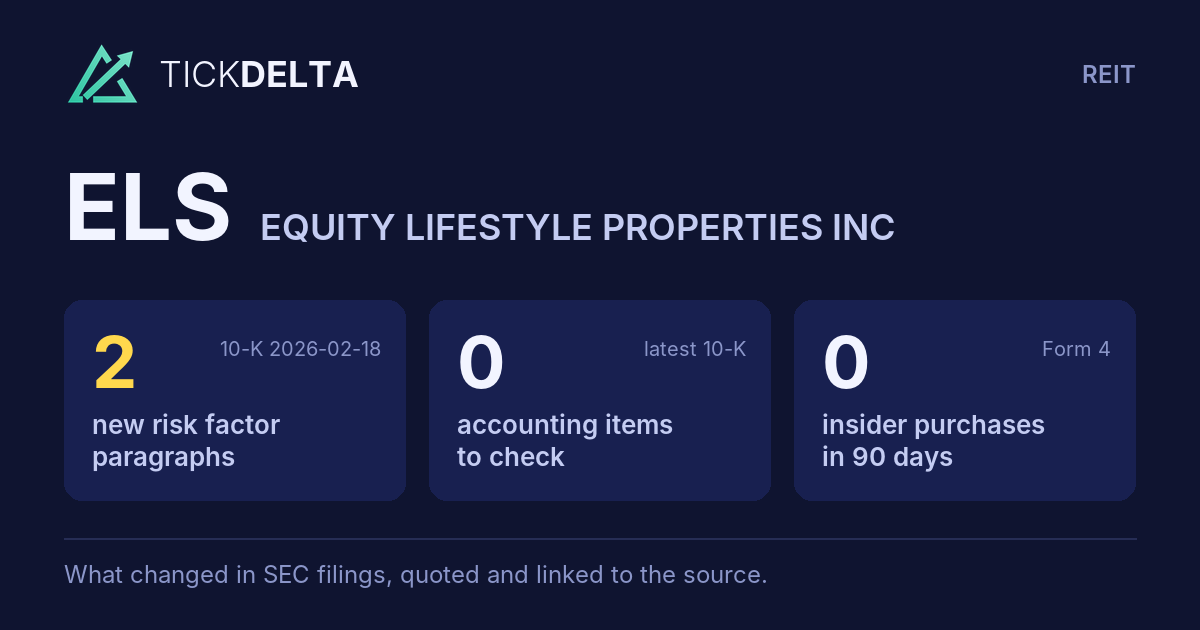
2 paragraphs in Risk Factors of the 10-K filed Feb 18, 2026 with nothing like them in the 10-K filed Feb 25, 2025. Quoted exactly. Paragraphs that were only edited are under 10-K change.
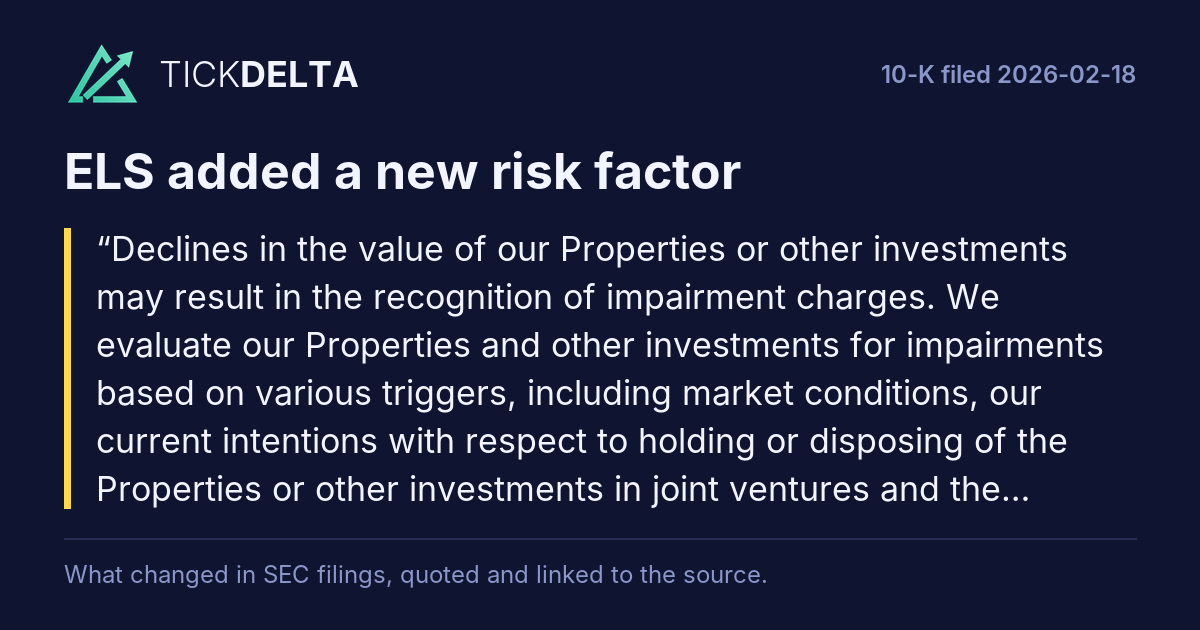
Declines in the value of our Properties or other investments may result in the recognition of impairment charges. We evaluate our Properties and other investments for impairments based on various triggers, including market conditions, our current intentions with respect to holding or disposing of the Properties or other investments in joint ventures and the expected future undiscounted cash flows from the Properties or other investments. Impairments are based on estimates and assumptions that are inherently uncertain, may increase or decrease in the future and may not represent or reflect the ultimate value of, or loss that we ultimately realize with respect to, the relevant Properties or other investments. Any such impairment could have an adverse impact on our results of operations and financial condition.
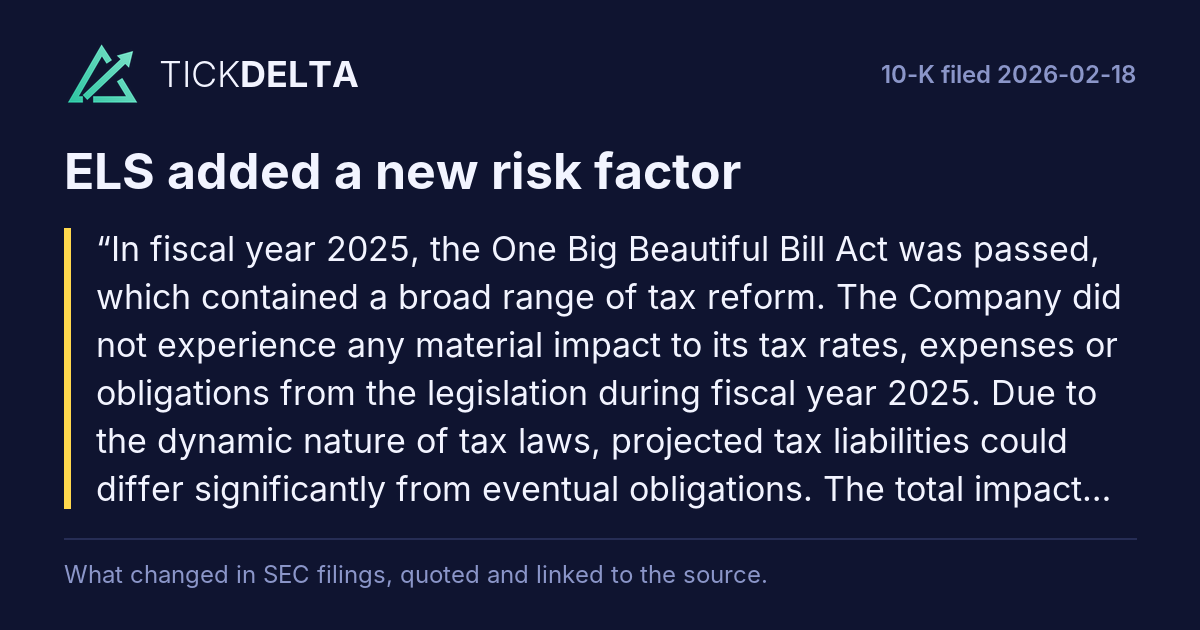
In fiscal year 2025, the One Big Beautiful Bill Act was passed, which contained a broad range of tax reform. The Company did not experience any material impact to its tax rates, expenses or obligations from the legislation during fiscal year 2025. Due to the dynamic nature of tax laws, projected tax liabilities could differ significantly from eventual obligations. The total impact and interpretation of the legislation remain uncertain, and misapplication of the new laws could lead to adverse results.
New in the latest 10-Q
29 paragraphs in the 10-Q filed Oct 27, 2026 with nothing like them in the 10-Q filed Jul 28, 2026 (at least half the words must differ; new numbers alone do not count). Quoted exactly, grouped by the item heading above them. This is text that changed, not a judgement of how serious it is.
(3) As of September 30, 2026, our LOC had a remaining borrowing capacity of $352.9 million, which is net of a standby letter of credit of $9.0 million provided to our insurer as collateral for workers’ compensation and automobile claims.
Read in the 10-Q
Due to our structure as a REIT, the Consolidated Statements of Income and Comprehensive Income contain no provision for U.S. federal income taxes for the REIT. In addition, we own certain taxable REIT subsidiaries (TRSs), which are subject to federal and state income taxes at regular corporate tax rates and have federal net operating loss carryforwards. During the quarter and nine months ended September 30, 2026, we recorded a full valuation allowance against deferred tax assets of our TRSs of $ 12.1 million, which is presented in Income tax (expense)/benefit in the Consolidated Statements of Income and Comprehensive Income.
Read in the 10-Q
(1) Prior period amounts have been reclassified to conform to the current period presentation.
Read in the 10-Q
(1) Prior period amounts have been reclassified to conform to the current period presentation.
Read in the 10-Q
2. Includes a $12.1 million deferred tax valuation allowance recorded during the quarter and nine months ended September 30, 2026.
Read in the 10-Q
1. Prior period amounts have been reclassified to conform to the current period presentation.
Read in the 10-Q
2. Includes a $12.1 million deferred tax valuation allowance recorded during the quarter and nine months ended September 30, 2026.
Read in the 10-Q
(1) Prior period amounts have been reclassified to conform to the current period presentation.
Read in the 10-Q
During the quarter ended September 30, 2026, we recognized a full valuation allowance against deferred tax assets of our taxable REIT subsidiaries (TRSs) of $12.1 million.
Read in the 10-Q
(1) Prior period amounts have been reclassified to conform to the current period presentation.
Read in the 10-Q
During the nine months ended September 30, 2026, we recognized a full valuation allowance against deferred tax assets of our TRSs of $12.1 million.
Read in the 10-Q
On October 27, 2026, our Board of Directors (the “Board”) approved a stock repurchase program for the repurchase of up to $500.0 million of our outstanding common stock, par value $0.01 per share (the “2026 Stock Repurchase Program”). Repurchases under the 2026 Stock Repurchase Program may be made from time to time, on the open market, through privately negotiated transactions or otherwise, in each case in accordance with Rule 10b-18 and 10b5-1 promulgated under the Securities Exchange Act of 1934 and other applicable legal requirements. Under the 2026 Stock Repurchase Program, the Chief Executive Officer and Chief Financial Officer may cause the Company to repurchase outstanding common stock until the earliest of October 31, 2027, the repurchase of the aggregate value of the common stock authorized or a determination by the Board to discontinue such repurchases. The timing and actual number of common stock repurchased will depend on a variety of factors including, price, corporate and regulatory requirements and other business and market conditions. The 2026 Stock Repurchase Program does not obligate us to repurchase any specific number of common stock, and we may initiate, suspend or discontinue purchases under the 2026 Stock Repurchase Program at any time.
Read in the 10-Q
• repurchases by us of our securities or the dilutive effects of issuing additional securities;
Read in the 10-Q
Our Share Price Could Be Volatile and Could Decline, Resulting in A Substantial or Complete Loss on Our Stockholders’ Investment.
Read in the 10-Q
We list our common stock on the New York Stock Exchange (the “NYSE”) and our common stock could experience significant price and volume fluctuations. Investors in our common stock may experience a decrease in the value of their shares, including decreases unrelated to our operating performance or prospects. The price of our common stock could be subject to wide fluctuations in response to a number of factors, including:
Read in the 10-Q
• issuances of other equity securities in the future, including new series or classes of preferred stock;
Read in the 10-Q
• our ability to maintain compliance with covenants contained in our debt facilities;
Read in the 10-Q
• actual or anticipated variations in our operating results, funds from operations, cash flows or liquidity;
Read in the 10-Q
• changes in expectations of future financial performance or changes in our earnings estimates or those of analysts;
Read in the 10-Q
• publication of research reports about us or the real estate industry generally;
Read in the 10-Q
• increases in market interest rates that lead purchasers of our common stock to demand a higher dividend yield;
Read in the 10-Q
• adverse market reaction to the amount of our debt outstanding at any time, the amount of our debt maturing in the near-term and medium-term and our ability to refinance our debt, or our plans to incur additional debt in the future;
Read in the 10-Q
• additions or departures of key employees, management, Directors and other key personnel;
Read in the 10-Q
• equity issuances by us, or share resales by our stockholders or the perception that such issuances or resales may occur;
Read in the 10-Q
• equity repurchases by us, or the perception that such repurchases may occur, through the Company’s stock repurchase program, including the funding sources for those repurchases;
Read in the 10-Q
• addition to, or removal from, market indexes used by investors to make investment decisions;
Read in the 10-Q
Many of the factors listed above are beyond our control. Those factors may cause the market price of our common stock to decline significantly, regardless of our financial condition, results of operations and prospects. It is impossible to provide any assurance that the market price of our common stock will not fall in the future, and it may be difficult for holders to resell shares of our common stock at prices they find attractive, or at all. In the past, securities class action litigation has often been instituted against companies following periods of volatility in their stock price. This type of litigation could result in substantial costs and divert our management’s attention and resources.
Read in the 10-Q
On October 27, 2026, our Board of Directors (the “Board”) approved a stock repurchase program for the repurchase of up to $500.0 million of our outstanding common stock, par value $0.01 per share (the “2026 Stock Repurchase Program”). Repurchases under the 2026 Stock Repurchase Program may be made from time to time, on the open market, through privately negotiated transactions or otherwise, in each case in accordance with Rule 10b-18 and 10b5-1 promulgated under the Securities Exchange Act of 1934 and other applicable legal requirements. Under the 2026 Stock Repurchase Program, the Chief Executive Officer and Chief Financial Officer may cause the Company to repurchase outstanding common stock until the earliest of October 31, 2027, the repurchase of the aggregate value of the common stock authorized or a determination by the Board to discontinue such repurchases. The timing and actual number of common stock repurchased will depend on a variety of factors including, price, corporate and regulatory requirements and other business and market conditions. The 2026 Stock Repurchase Program does not obligate us to repurchase any specific number of common stock, and we may initiate, suspend or discontinue purchases under the 2026 Stock Repurchase Program at any time.
Read in the 10-Q
(a) Included as an exhibit to our Report on Form 10-Q for the quarter ended June 30, 2026
Read in the 10-Q
Item 1A of the 10-Q filed Oct 27, 2026 against Item 1A of the 10-K filed Feb 18, 2026.
A 10-Q repeats only the risks that changed, so a 10-K paragraph that is missing from it is not counted as removed.
Added is a paragraph with nothing like it in the 10-K, Reworded a sentence that is in both with several words changed,
Quiet changes a sentence in both where one to four words changed and one is a hedge or a modal
(cut words struck through, new words highlighted).
Text on the page, not a score; each links to the filing at sec.gov.
What the 10-Q itself says about its risk factors:A description of the risk factors associated with our business are discussed in Item 1A. Risk Factors in our 2025 Form 10-K and in our Quarterly Report on Form 10-Q for the quarter ended March 31, 2026. We have updated our risk factors disclosed in Part I. Item 1A. Risk Factors in our 2025 Form 10-K with the risk factor description below.
Read in the 10-Q
Two-word phrases in Risk Factors of the 10-K filed Feb 18, 2026 that are in none of the 1 earlier 10-Ks stored, back to Feb 25, 2025
Used at least twice, small words left out. Counted, not picked: a phrase can be new because the company renamed something.
1 paragraph of last year's Risk Factors with nothing like them now. The longest are quoted.
Item 1A of each 10-K and 10-Q on EDGAR, quoted exactly. Each paragraph links to the filing at sec.gov.
10-K change: what was reworded or cut, section by section.
Excel workbook · CSV. Google Sheet that stays up to date: paste =IMPORTDATA("https://tickdelta.com/company/ELS/export.csv") into a cell.