Enbridge Inc ENB
New risk paragraphs, branching off last year
Each branch is a paragraph in Risk Factors with nothing like it in the 10-K filed Feb 14, 2025. A box jumps to the paragraph as filed, below.
Paragraphs with nothing like them in last year's 10-K
34 paragraphs in Risk Factors of the 10-K filed Feb 13, 2026 with nothing like them in the 10-K filed Feb 14, 2025. Quoted exactly. Paragraphs that were only edited are under 10-K change.
Our business is dependent upon information systems and other digital technologies to control our plants, pipelines and other assets, process transactions, and summarize and report results of operations.
New and changing cybersecurity legislation, regulations and orders have been implemented or are proposed, resulting in additional regulatory oversight and compliance requirements, which require internal and external resources and increase costs. The potential impacts of future cybersecurity-related legislation, regulations or orders on our business remain uncertain and cannot be reliably predicted.
Advancements in AI and the speed at which we can implement them or not increases our cybersecurity risks discussed above and also have the potential to negatively affect our business, operations, reputation or financial results.
Secure processing, maintenance and transmission of information are critical to our business. This includes the integration of AI to enhance both efficiency and safety. For example, Enbridge utilizes cloud-based platforms and internal AI assistants to make workflows and data analysis more efficient.
As AI adoption and integration accelerates in our day-to-day operations, the associated technology and cybersecurity risks are also intensifying, increasing the potential for system vulnerabilities and exposure to malicious threats. The continuous evolution and increasing use of generative AI systems both by Enbridge and third parties, as well as the embedding of AI technologies into software, systems and other tools currently used or being considered for use by Enbridge pose a number of risks to Enbridge’s technology, information systems and data privacy. This is due to its potential for user misuse, decision-making based on biased or incorrect models or information, unauthorized exposure of sensitive data, unauthorized use of intellectual property and other risks, all of which potentially compromise safety, productivity and profitability. AI tools have the potential to provide advantages to Enbridge if successfully used, developed and implemented with the proper governance, but those benefits may require significant expenditures and may never materialize, which could adversely affect our business, financial condition and results of operations.
We are subject to risks relating to the integrity of our systems and infrastructure, as well as affiliate and third-party computer systems, computer networks and other communication systems.
System interruption and the lack of integration and redundancy in the information systems and infrastructure, both of our own websites and other computer systems and of affiliate and third-party software, computer networks and other communications systems service providers on which we rely, could adversely affect our ability to conduct our operations. Such interruptions could occur as the result of natural disaster, malicious actions, such as hacking or acts of terrorism or war, human error or other causes, such as break-downs in technology or other malfunctions. With respect to third-party software or systems, there are certain arrangements that are not covered by long-term agreements. In addition, the loss of some or all of certain key personnel could require us to expend additional resources to continue to maintain our software and systems and could subject us to systems interruptions.
While we have backup systems, offsite and cloud-based data centers, and service redundancy for certain aspects of our operations, disaster recovery planning by its nature cannot account for all eventualities. In addition, we may not have adequate insurance coverage to compensate for any or all losses from a major interruption. If any of these adverse events were to occur, it could adversely affect our business, financial condition and results of operations.
We are subject to various climate change and emissions-related laws and regulations in the jurisdictions where we operate, including at the federal, state/provincial, and local levels, and these continue to evolve and change with shifting government policy and public sentiment. Key carbon-related policies and regulations that impact us are described in Part I, Item 1. Business - Regulation - Environmental Regulation. Carbon pricing in the form of carbon charges, carbon levies, or other carbon pricing frameworks poses risks to our business, including potential reduced demand for our services and decreased economic viability for our projects. We are also subject to anti-greenwashing legislation and are impacted by climate-related disclosure requirements in development in certain jurisdictions where we operate. Such evolving policy, legislation and regulation could influence commodity demand, and the overall energy mix we deliver and has already led to increased compliance risk and costs, including higher costs for our customers. Stakeholder opposition to parts of our business and the energy industry, particularly fossil fuels, continues to pose risks to our business such as climate-related protests, complaints, litigation and regulatory actions, including against Enbridge. In addition, anti-ESG activism has grown, creating competing stakeholder priorities, fragmented regulatory regimes, and greater uncertainty. We have faced, and expect to continue to face, climate-related legal challenges. Defending and resolving these claims has resulted in increased costs and will likely lead to additional expenses, and could affect our reputation, strategy, and financial performance.
Achieving our emissions reduction goals depends partly on technological improvements, innovation, and modernization of our existing assets. Advances in technologies such as renewable power, carbon capture and storage, and other lower-carbon energy infrastructure can help reduce our emissions, extend the life of our assets, and diversify our business. However, relying on these technologies also carries risks, including the pace of technological development, uncertain regulatory requirements, and potentially high costs that could make the use of such technologies uneconomical. If emerging technologies do not materialize as expected, meeting our emissions reduction goals could become more difficult.
Energy companies, including Enbridge, continue to face negative perceptions about fossil fuels and pipelines, which can lead to stakeholder opposition to our operations and infrastructure projects, as well as investor, stakeholder or regulatory concerns about stranded assets. Such factors may impact our ability to secure capital or complete new projects.
Show the other 7
If we encounter challenges or perceived challenges in achieving our climate-related goals, fail to comply with climate-related regulatory or reporting requirements, or fall short of stakeholder expectations, it could negatively impact our reputation, reduce demand for our services or securities, and expose us to enforcement actions or litigation, which could impact our business, operations or financial results.
There are utilization risks with respect to our assets, across all business segments.
Competition in all of our businesses, including competition for new project development opportunities, could have a negative impact on our business, financial condition or results of operations.
Our Liquids Pipelines business faces competition from existing and proposed pipelines serving Canadian, US and international markets, including those that may advance through inter-provincial and federal agreements or collaboration. Key competitive factors include transportation costs, access to supply, service quality and reliability, contract carrier alternatives, and proximity to markets. Commodities transported in our pipelines increasingly compete with emerging alternatives for end-users, such as electricity and electric batteries. We also compete with alternative storage facilities.
Our Gas Transmission business competes with similar facilities that serve the same supply and market areas. Natural gas also competes with other energy sources, including electricity, coal, propane, fuel oils, and renewables.
Our Gas Distribution and Storage business competes with other forms of energy available to customers and end-users, including electricity, coal, propane and fuel oils.
Our Renewable Power Generation business faces competition in securing long-term power purchase agreements and from other fuel sources in the markets in which we operate.
The announcement and imposition of tariffs by the US, together with potential, announced or implemented retaliatory tariffs by other governments on imports from the US, and other potential measures, including duties, fees, economic sanctions or other trade measures, as well as the potential impacts of these tariffs and trade measures, present significant risks to our business operations and financial results. Tariffs announced by the US (which are in addition to any pre-existing tariffs) which may impact our business operations include, among others:
•tariff on Canadian goods that are non-compliant under the United States-Mexico-Canada Agreement (USMCA) (excludes crude oil, natural gas, and natural gas liquids);
Any of the foregoing could significantly adversely impact our business, operations or financial results.
Unexpected shifts in energy demands, including those driven by climate change concerns, could reduce revenue through, for example, reduced throughput volumes on our pipeline systems.
Maintaining and meeting any sustainability-related goals we have set or may set in the future, including any related to emissions reduction, involve significant costs and uncertainty, including as a result of changes in regulatory, technological, financial and operational conditions. We may not be able to, or may be perceived as being unable to, achieve such goals, either in a timely manner or at all, may need to adjust or rescind such goals as a result of changing circumstances, or expected benefits of achieving such goals may not materialize. If we experience challenges, or perceived challenges, in achieving our sustainability-related goals, regulatory or reporting requirements (which continue to change and diverge across different jurisdictions), or stakeholder expectations, it could harm our reputation, affect investor confidence, or expose us to enforcement actions or litigation, which may impact our business, operations or financial results.
In the US, the current administration has declared an energy emergency, and this directive shaped the rulemaking and guidance efforts across federal agencies in 2025 resulting in significant policy changes from the prior administration:
•Formed the National Energy Dominance Council designed to bolster energy production and minimize regulatory roadblocks to building energy infrastructure projects and energy development;
•Proposed to modify the EPA rules to reduce and report methane emissions from the oil and gas sector and to streamline the process for states and tribes to assume authority over the Clean Water Act's section 404 permitting program for discharges of dredge and fill material;
•Repealed the Council for Environmental Quality (CEQ) regulations implementing the National Environmental Policy Act (NEPA);
•Enacted the One Big Beautiful Bill Act that includes measures to streamline reviews under NEPA and the US Supreme Court narrowed the scope of NEPA review in a pivotal decision referred to as Seven County Infrastructure;
•CEQ issued guidance and a template to streamline NEPA reviews, and many federal agencies have implemented new agency-specific procedures seeking to streamline NEPA environmental reviews;
•FERC rescinded its draft GHG and draft Updated Certificate policy statements concerning the development of natural gas infrastructure projects and consideration of climate change and environmental justice when reviewing natural gas projects. FERC further eliminated an order that slowed project construction timelines and temporarily raised the cost limits for projects that qualify under the Blanket Certificate Program while considering permanent changes; and
•PHMSA issued rules updating requirements for sustainable and safe pipeline operation and refocused its efforts to safety regulation.
Some actions by the current US administration are being challenged in the courts, and further legal challenges to the US administration and/or agency actions may occur. The current US administration may take further action to promulgate new regulations and/or modify or reverse regulations that were promulgated by the prior US administration. These actions may significantly change environmental reviews for energy projects.
In Canada, the federal and provincial governments are undertaking various regulatory streamlining initiatives, including the passage of the Building Canada Act and the establishment of the Major Projects Office, with a mandate to advance major projects in Canada and streamline regulatory project approvals, including potentially with respect to a crude oil pipeline from Alberta to the west coast of Canada. Such legislative and regulatory actions may significantly change regulatory review processes and the competitive landscape for new pipeline projects in Canada and may increase the risk of legal challenges to project approvals from parties opposed to these legislative and regulatory changes specifically and to fossil fuels generally.
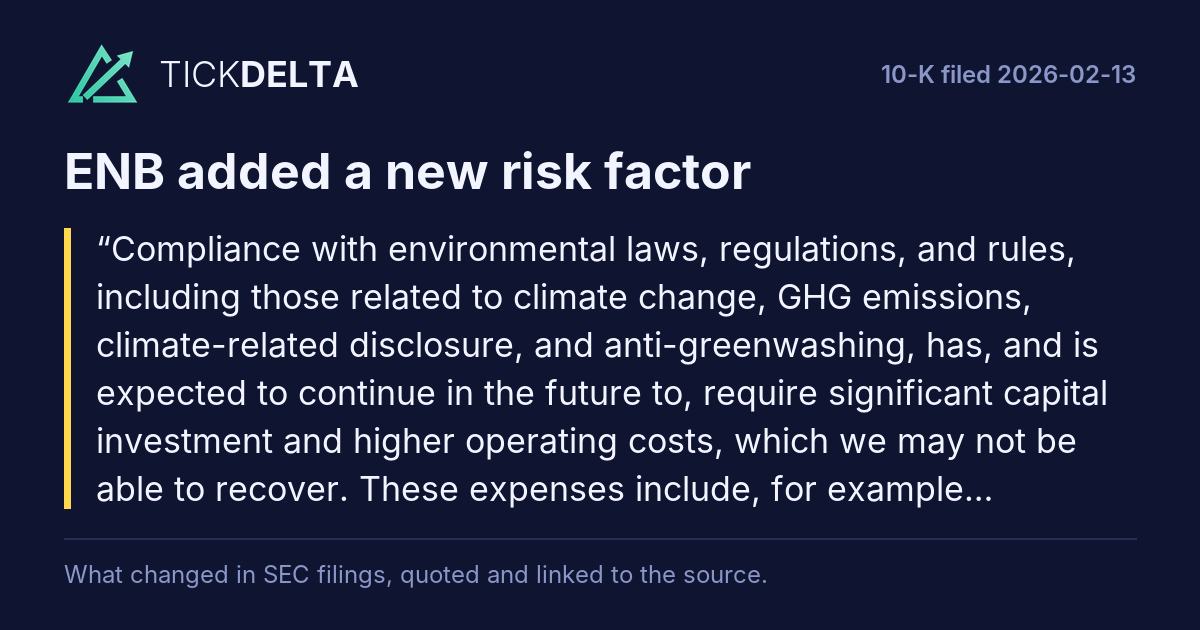
Compliance with environmental laws, regulations, and rules, including those related to climate change, GHG emissions, climate-related disclosure, and anti-greenwashing, has, and is expected to continue in the future to, require significant capital investment and higher operating costs, which we may not be able to recover. These expenses include, for example, emissions monitoring and reporting, equipment replacements or modernization, and third-party verification or assurance of environmental data.
Paragraphs in the 10-Q filed Nov 6, 2026 that were not in the one before
New in the latest 10-Q
44 paragraphs in the 10-Q filed Nov 6, 2026 with nothing like them in the 10-Q filed Jul 31, 2026 (at least half the words must differ; new numbers alone do not count). Quoted exactly, grouped by the item heading above them. This is text that changed, not a judgement of how serious it is.
10-Q
The registrant had 2,228,888,088 common shares outstanding as at October 30, 2026.
Read in the 10-Q
weather; and customer, government, court and regulatory approvals on construction and in-service schedules and cost recovery regimes.
Read in the 10-Q
Financial statements and notes
noncontrolling interest Balance at end of period (21,162) (19,064) (21,162) (19,064) Accumulated other comprehensive income (Note 10) Balance at beginning of period 6,733 4,244 4,681 7,115 Other comprehensive income/(loss) attributable to common 112 1,108 2,164 (1,763)
Read in the 10-Q
shareholders, net of tax Balance at end of period 6,845 5,352 6,845 5,352 Total Enbridge Inc. shareholders' equity 67,572 65,182 67,572 65,182 Noncontrolling interests Balance at beginning of period 2,760 2,910 2,855 2,993 Earnings attributable to noncontrolling interests 31 43 74 211 Other comprehensive income/(loss) attributable to noncontrolling
Read in the 10-Q
We account for acquisitions using the acquisition method as prescribed by ASC 805 Business Combinations. In accordance with valuation methodologies described in ASC 820 Fair Value Measurement, acquired assets and assumed liabilities are recorded at their estimated fair values as at the date of acquisition.
Read in the 10-Q
Show the other 39
On October 9, 2026, through a wholly-owned subsidiary, we acquired from Salt Creek Midstream (Salt Creek) all of the membership interests of FS Crude Holdings, LLC (FS Crude) for total cash consideration of approximately $892 million (US$625 million) (the Salt Creek Crude Acquisition). FS Crude owns 100% of the Orla and Wink North systems and 50% of the Delaware Crossing system, which combined include approximately 500 miles of crude oil gathering infrastructure located in the Delaware Basin. The Salt Creek Crude Acquisition is expected to strengthen our crude oil value chain in the Permian Basin by providing a strategic connection between crude oil production and our Gray Oak and Cactus II Pipeline systems, as well as our Enbridge Ingleside Energy Center.
Read in the 10-Q
The purchase price for the Salt Creek Crude Acquisition was preliminarily allocated to the assets acquired and liabilities assumed based on their estimated fair values at acquisition date. The acquisition resulted in the recognition of approximately $0.6 billion of Property, plant and equipment and $0.3 billion of other net assets acquired.
Read in the 10-Q
FS Crude's property, plant and equipment constitute crude oil gathering systems, comprised of pipelines, a terminal, land and right-of-ways. The depreciated replacement cost approach was adopted as the primary valuation methodology to determine the fair value of property, plant and equipment. In determining replacement cost, both indirect costing using relevant inflation indices and direct costing using relevant market quotes were utilized.
Read in the 10-Q
The purchase price allocation for the Salt Creek Crude Acquisition was prepared on a preliminary basis and is subject to change as additional information becomes available regarding the fair values and tax bases of assets and liabilities acquired. Any adjustments to the purchase price allocation will be made as soon as practicable, but no later than one year from the date of acquisition.
Read in the 10-Q
On September 14, 2026, we closed a public offering of 44,735,000 common shares of Enbridge at a price of $66.85 per share for gross proceeds of $3.0 billion. Net proceeds from the sale of common shares were used to partially fund the Salt Creek Crude Acquisition, with the remaining proceeds available to fund future growth opportunities.
Read in the 10-Q
On July 30, 2026, Westcoast Energy LP Inc. (WELP), our wholly-owned subsidiary, transferred certain of its non-participating Class C units in Westcoast Energy Limited Partnership (Westcoast LP) to a newly formed limited partnership, Westcoast Expansion Financing Limited Partnership (Westcoast Expansion), in exchange for Class I and Class II units. The remaining Class C units were retained by WELP to meet our obligations to Stonlasec8 Indigenous Investments Limited Partnership (the First Nations Partnership), an entity representing 38 First Nations in British Columbia (BC), under the Class C purchase option.
Read in the 10-Q
The Class C unitholders fund designated capital programs within Westcoast LP, which owns and operates our Westcoast Energy Inc. (Westcoast) BC Pipeline system. Westcoast Expansion has committed to invest in our Aspen Point and Sunrise Expansion Programs (the Expansions) in exchange for additional non-participating Class C units in Westcoast LP.
Read in the 10-Q
On September 3, 2026, KKR & Co. Inc. (KKR), in collaboration with funds and affiliates managed by Apollo, invested $729 million for all of the Class II units of Westcoast Expansion, resulting in an interest in the partnership. In addition to the initial cash consideration, KKR has committed to contribute approximately $2.0 billion to fund the Expansions in exchange for additional Class II units.
Read in the 10-Q
The cash consideration of $729 million and a respective redeemable NCI based on the consideration received less transaction costs were recorded in the Consolidated Statements of Financial Position on close, to reflect the interest held by KKR in Westcoast Expansion. Refer to Note 7 - Variable Interest Entities and Note 9 - Redeemable Noncontrolling Interests.
Read in the 10-Q
On July 1, 2025, Westcoast completed a reorganization in which substantially all of the property and assets relating to the BC Pipeline system were transferred to a newly formed partnership, Westcoast LP. On July 2, 2025, the First Nations Partnership invested approximately $736 million to subscribe for all of the Class A units of Westcoast LP, resulting in a 12.50% interest in the partnership. The cash consideration of $736 million and a respective redeemable NCI based on the consideration received less transaction costs were recorded in the Consolidated Statements of Financial Position on close, to reflect the interest held by the First Nations Partnership.
Read in the 10-Q
Following the transactions discussed above, we continue to manage and operate the BC Pipeline system through our ownership interest in Westcoast LP. Refer to Note 9 - Redeemable Noncontrolling Interests.
Read in the 10-Q
7. VARIABLE INTEREST ENTITIES CONSOLIDATED VARIABLE INTEREST ENTITIES Our consolidated variable interest entities (VIEs) consist of legal entities of which we are the primary beneficiary. We are the primary beneficiary when our variable interest(s) provide(s) us with (i) the power to direct the activities of the VIE that most significantly impact the entity's economic performance and (ii) the obligation to absorb losses, or the right to receive benefits, from the VIE that could potentially be significant to the VIE. We determine whether we are the primary beneficiary of a VIE by considering qualitative and quantitative factors, including, but not limited to: decision-making responsibilities, the VIE capital structure, risk and reward sharing, contractual agreements with the VIE, voting rights and level of involvement of other parties. Westcoast Expansion Financing Limited Partnership Westcoast Expansion is a BC limited partnership which holds an ownership interest in Westcoast LP for the purpose of funding construction costs associated with the Expansions. The limited partners, WELP and Tuscan Issuer Ltd. (an affiliate of KKR), hold 19.99% and 80.0% interests in Westcoast Expansion, respectively. The remaining 0.01% general partner interest is held by Westcoast Expansion Financing GP Inc., our wholly-owned subsidiary. Westcoast Expansion is considered a VIE as it does not have sufficient equity at risk to finance its activities without additional subordinated financial support and its limited partners lack substantive participating rights and kick-out rights. In addition to having the obligation to absorb losses and the right to expected returns, we, through WELP's direct interests and the provisions of the limited partnership agreement, have the ability to direct the activities of Westcoast Expansion's principal operations, thereby making us the primary beneficiary of the VIE. Westcoast Expansion is a consolidated VIE of Enbridge. The assets of Westcoast Expansion primarily consist of its investment in Westcoast LP, which eliminates upon Enbridge's consolidation. We did not provide any additional financial support to Westcoast Expansion during the period ended September 30, 2026.
Read in the 10-Q
9. REDEEMABLE NONCONTROLLING INTERESTS The following table provides additional information regarding Redeemable NCI as presented in our Consolidated Statements of Financial Position: September 30, December 31,
Read in the 10-Q
2026 2025 ─────────────────────────────────────────────────────────────────────────────────────────────────────────────── (millions of Canadian dollars) Westcoast Expansion Financing Limited Partnership1 697 - Westcoast Energy Limited Partnership2 736 736 1,433 736 1 Represents the Class II units held by KKR. 2 Represents the Class A units held by the First Nations Partnership.
Read in the 10-Q
The changes in our Redeemable NCI were as follows: Nine months ended September 30, 2026 2025 ───────────────────────────────────────────────────────────────────────────────────────────────────── (millions of Canadian dollars) Class A units Balance at beginning of period 736 - Proceeds from investment by redeemable noncontrolling interest in subsidiary - 736 Transaction costs, net of tax benefit - (27) Earnings attributable to redeemable noncontrolling interest 41 16 Distributions declared to unitholder (51) (17) Contributions from unitholder 16 - Redemption value adjustment (6) 28 736 736 Class II units Balance at beginning of period - - Proceeds from investment by redeemable noncontrolling interest in subsidiary 729 - Transaction costs, net of tax benefit (22) - Other (10) - 697 - Balance at end of period 1,433 736 Westcoast Expansion Financing Limited Partnership In addition to funding the Expansions, Westcoast Expansion has committed to make contributions to Westcoast LP for capital costs for other than designated capital programs in exchange for Class B units. These contributions would be funded by WELP and KKR through additional investments in Westcoast Expansion in exchange for additional Class I and Class II units, respectively. The Class II units entitle KKR to receive contingently required distributions if certain events occur, including delays in the Expansions commencing commercial operations, force majeure and regulatory disallowances. WELP may also repurchase KKR's Class II units under certain circumstances or during designated call periods, with the repurchase price determined in accordance with the terms of the limited partnership agreement. As a result of these contingently required distributions, we have classified KKR's Class II units as Redeemable NCI within the mezzanine equity section of the Consolidated Statements of Financial Position. As at September 30, 2026, the Redeemable NCI was recognized at its carrying value as redemption is not probable. Westcoast Energy Limited Partnership As at September 30, 2026, the First Nations Partnership held a 12.58% redeemable noncontrolling interest in Westcoast LP, which increased from 12.47% as at December 31, 2025 as a result of their minimum required contribution amount exceeding their pro-rata share of total capital costs for other than designated capital programs.
Read in the 10-Q
On September 9, 2026, Enbridge announced that, through a wholly-owned subsidiary, we entered into a definitive agreement with wholly-owned subsidiaries of Tallgrass Energy, LP (Tallgrass) to acquire its crude oil business for total cash consideration of approximately $3.62 billion (US$2.55 billion), subject to customary closing adjustments (the Tallgrass Crude Acquisition). The business comprises a 75% interest in Pony Express Pipeline (Pony Express), a 51% interest in the Powder River Gateway system, approximately 8.4 million barrels of crude oil storage capacity across nine terminals and 100% of Stanchion Energy, a crude marketing business. The transaction includes the PXP2 growth project, an approximately $0.4 billion (US$0.3 billion) expansion of Pony Express expected to increase the system's transportation capacity. The PXP2 project is expected to enter service in 2027. The Tallgrass Crude Acquisition will expand our presence in the Bakken, Powder River and Denver-Julesburg basins through Cushing, Oklahoma, complementing our Express-Platte and Seaway pipeline systems. The transaction is expected to close in the fourth quarter of 2026, subject to regulatory approvals and customary closing conditions.
Read in the 10-Q
On October 9, 2026, through a wholly-owned subsidiary, we acquired from Salt Creek Midstream (Salt Creek) all of the membership interests of FS Crude Holdings, LLC (FS Crude) for total cash consideration of approximately $892 million (US$625 million) (the Salt Creek Crude Acquisition). FS Crude owns 100% of the Orla and Wink North systems and 50% of the Delaware Crossing system, which combined include approximately 500 miles of crude oil gathering infrastructure located in the Delaware Basin. The Salt Creek Crude Acquisition is expected to strengthen our crude oil value chain in the Permian Basin by providing a strategic connection between crude oil production and our Gray Oak and Cactus II Pipeline systems, as well as our Enbridge Ingleside Energy Center.
Read in the 10-Q
On August 25, 2026, we entered into a definitive agreement to acquire substantially all of the assets of Laramie Energy, LLC (Laramie) for cash consideration of approximately $689 million (US$485 million) plus up to approximately $92 million (US$65 million) in contingent payments. The acquisition will expand Wexpro's natural gas production platform and provide stable, cost-of-service natural gas supply for Enbridge Gas Utah. Upon closing, the transaction is expected to increase Wexpro's contribution to Enbridge Gas Utah's supply portfolio and support long-term customer affordability and reliability. The transaction is expected to close in the fourth quarter of 2026, subject to regulatory approvals and customary closing conditions.
Read in the 10-Q
On September 3, 2026, KKR & Co. Inc. (KKR), in collaboration with funds and affiliates managed by Apollo, invested $729 million in Westcoast Expansion Financing Limited Partnership (Westcoast Expansion) in respect of expenditures previously funded by Westcoast Energy LP Inc. Westcoast Expansion holds an ownership interest in Westcoast Energy Limited Partnership, which owns and operates our Westcoast Energy Inc. British Columbia (BC) Pipeline system. In addition to the initial cash consideration, KKR has committed to contribute approximately $2.0 billion to fund the Aspen Point and Sunrise Expansion Programs.
Read in the 10-Q
Subsequent to this investment, we hold a controlling interest in these assets, which are included in our Gas Transmission segment, and continue to manage and operate the pipeline system. Upon the Sunrise Expansion Program entering service, KKR and Apollo are expected to hold a 29% indirect, cumulative interest in the BC Pipeline system.
Read in the 10-Q
The 2022-2026 toll settlement agreement for our BC Pipeline system is expiring in December 2026. We anticipate a settlement will be finalized early in 2027. We expect to file interim tolls for our BC Pipeline system with the Canada Energy Regulator (CER) in the fourth quarter of 2026, with interim tolls effective January 1, 2027, pending regulatory approval.
Read in the 10-Q
In September 2026, Enbridge Gas Ohio filed a stipulation addressing the issues raised in its December 2025 rate case, which proposed a rate increase to recover Enbridge Gas Ohio's investment in distribution infrastructure and other costs to serve. The stipulation provides for a revised annual revenue increase of US$145 million, with a return on equity of 9.59% and equity thickness of 52.87%. The stipulation supports continued investment in the safety, reliability and modernization of our system. It also provides an increased contribution to the low-income energy assistance fund and contains multiple commitments to expand Enbridge Gas Ohio’s customer outreach and affordability support initiatives.
Read in the 10-Q
A decision on the filing is expected in or before the first quarter of 2027, with new rates expected to be effective on March 1, 2027.
Read in the 10-Q
During our annual renewal process, we renewed and extended approximately $22.3 billion of our credit facilities with maturities ranging from 2027-2031.
Read in the 10-Q
On September 14, 2026, we closed a public offering of 44,735,000 common shares of Enbridge at a price of $66.85 per share for gross proceeds of $3.0 billion. Net proceeds from the sale of common shares will be used to partially fund the Tallgrass Crude and Salt Creek Crude Acquisitions, with the remaining proceeds available to fund future growth opportunities. Refer to Part I. Item 1. Financial Statements - Note 6 - Acquisitions and Dispositions.
Read in the 10-Q
September 30, September 30, 2026 2025 2026 2025 ────────────────────────────────────────────────────────────────────────────────────────────────────────────────────────────────────────────────────────────────────── (millions of Canadian dollars, except per share amounts) Segment earnings/(loss) before interest, income taxes and depreciation and amortization1 Liquids Pipelines 2,133 2,283 6,713 7,207 Gas Transmission 1,458 1,270 4,461 4,185 Gas Distribution and Storage 665 560 3,252 2,670 Renewable Power Generation 113 89 419 421 Eliminations and Other 49 (379) (571) 828 Earnings before interest, income taxes and depreciation and amortization1 4,418 3,823 14,274 15,311 Depreciation and amortization (1,490) (1,398) (4,352) (4,197) Interest expense (1,049) (1,262) (3,666) (3,777) Income tax expense (438) (316) (1,467) (1,679) Earnings attributable to noncontrolling interests and redeemable noncontrolling interests (46) (59) (115) (227) Preference share dividends (107) (106) (319) (311) Earnings attributable to common shareholders 1,288 682 4,355 5,120 Earnings per common share attributable to common shareholders 0.59 0.30 2.00 2.34 Diluted earnings per common share attributable to common shareholders 0.59 0.30 1.99 2.33
Read in the 10-Q
• higher depreciation and amortization expense due to projects and capital placed into service since the third quarter of 2025.
Read in the 10-Q
• higher depreciation and amortization expense due to projects and capital placed into service since the third quarter of 2025;
Read in the 10-Q
• lower contributions from Market Access due to underutilized contracts to the US Gulf Coast; partially offset by
Read in the 10-Q
• higher allowance for equity funds used during construction from increased spend on growth projects; and
Read in the 10-Q
• higher allowance for equity funds used during construction from increased spend on growth projects; partially offset by
Read in the 10-Q
EBITDA was positively impacted by $24 million, largely driven by contributions from Sequoia Solar Phase 1, which was placed in service in December 2025.
Read in the 10-Q
• T-North Expansion (Birch Grove) - The project received CER approval in September 2026. Construction is expected to begin in the first quarter of 2027 following the satisfaction of pre-construction conditions.
Read in the 10-Q
In July 2026, we renewed our committed credit facilities. Refer to Financing Update.
Read in the 10-Q
Nine months ended September 30, 2026 ───────────────────────────────────────────────────────────────────── (millions of Canadian dollars) Operating income 76 Earnings 1,440 Earnings attributable to common shareholders 1,121
Read in the 10-Q
On July 30, 2026, the Seventh Circuit issued its decision in this litigation. The Seventh Circuit confirmed that Enbridge is trespassing on the Bad River allotted parcels but rejected the Band's nuisance claim and an immediate shutdown of Line 5. The Seventh Circuit remanded the trespass damages and injunction issues back to the Court for further proceedings, directing it to recalculate any restitution and develop a remedy that provides Enbridge a reasonable opportunity to complete the Line 5 reroute around the Bad River Reservation. In overturning the Band's nuisance claim, the Seventh Circuit vacated the related monitoring and shutdown requirements, finding that pipeline safety matters fall within the jurisdiction of federal regulators under the Pipeline Safety Act.
Read in the 10-Q
On September 14, 2026, Enbridge filed a petition for rehearing to the Seventh Circuit, which was denied on September 30, 2026. The Court set a scheduling conference for December; we expect legal proceedings to continue through 2027.
Read in the 10-Q
On October 8, 2026, the Standing Rock Sioux Tribe filed a new complaint in District Court against the Army Corps and the PHMSA, seeking vacatur of the Army Corps and PHMSA approvals, and requesting the shutdown of DAPL. Unless extended, the Army Corps and PHMSA have 60 days to respond to the complaint.
Read in the 10-Q
Item 6
104 Cover Page Interactive Data File - the cover page XBRL tags are embedded within the Inline XBRL document (included in Exhibit 101)
Read in the 10-Q
The 10-Q's risk factors against the 10-K
Item 1A of the 10-Q filed Nov 6, 2026 against Item 1A of the 10-K filed Feb 13, 2026.
A 10-Q repeats only the risks that changed, so a 10-K paragraph that is missing from it is not counted as removed.
Added is a paragraph with nothing like it in the 10-K, Reworded a sentence that is in both with several words changed,
Quiet changes a sentence in both where one to four words changed and one is a hedge or a modal
(cut words struck through, new words highlighted).
Text on the page, not a score; each links to the filing at sec.gov.
What the 10-Q itself says about its risk factors:In addition to the other information set forth in this report, careful consideration should be given to the factors discussed in Part I. Item 1A. Risk Factors of our annual report on Form 10-K for the year ended December 31, 2025, as updated by Part II. Item 1A. Risk Factors of our interim report on Form 10-Q for the quarters ended March 31, 2026 and June 30, 2026, which could materially affect our financial condition or future results. There have been no material modifications to those risk factors.
Read in the 10-Q
1 paragraph in the 10-Q's Item 1A, and none of them adds, rewords or quietly edits a paragraph of the 10-K's.
Phrases used for the first time
Two-word phrases in Risk Factors of the 10-K filed Feb 13, 2026 that are in none of the 1 earlier 10-Ks stored, back to Feb 14, 2025
Where each one is used
- stakeholder relationships: Our assets and operations are vulnerable to damage or disruption from these events, which could result in reduced revenue from business interruptions or reduced capacity and may also increase costs for repairs, remediation or adaptation measures. Such events have led to, and could again lead to, ruptures or product...
- fossil fuels: We are subject to various climate change and emissions-related laws and regulations in the jurisdictions where we operate, including at the federal, state/provincial, and local levels, and these continue to evolve and change with shifting government policy and public sentiment. Key carbon-related policies and...
- regulatory actions: We are subject to various climate change and emissions-related laws and regulations in the jurisdictions where we operate, including at the federal, state/provincial, and local levels, and these continue to evolve and change with shifting government policy and public sentiment. Key carbon-related policies and...
- sustainability-related goals: Enbridge’s climate-related activities, goals, commitments, and plans are based on various assumptions, estimates, judgments, risks, and uncertainties. Rules, standards, and methodologies for setting climate-related goals and for measuring and reporting climate-related information are still developing. As such, our...
- security incidents: These operational risks include accidents, third-party damage to assets or systems, equipment failure, process breakdowns, human error, major power disruptions, curtailment or limitations of commodity supply, operational incidents, failure of information technology or operational technology systems, security...
- among others: These operational risks include accidents, third-party damage to assets or systems, equipment failure, process breakdowns, human error, major power disruptions, curtailment or limitations of commodity supply, operational incidents, failure of information technology or operational technology systems, security...
- snowfall extreme: Operational risk is also intensified by exposure to severe weather conditions and natural disasters, including those related to climate change. Events such as heavy snowfall, extreme precipitation, floods, landslides, wildfires, hurricanes, cyclones, tornadoes, tropical storms, storm surges, ice storms, and extreme...
- extreme precipitation: Operational risk is also intensified by exposure to severe weather conditions and natural disasters, including those related to climate change. Events such as heavy snowfall, extreme precipitation, floods, landslides, wildfires, hurricanes, cyclones, tornadoes, tropical storms, storm surges, ice storms, and extreme...
Used at least twice, small words left out. Counted, not picked: a phrase can be new because the company renamed something.
What was taken out
14 paragraphs of last year's Risk Factors with nothing like them now. The longest are quoted.
Sources
Item 1A of each 10-K and 10-Q on EDGAR, quoted exactly. Each paragraph links to the filing at sec.gov.
Also
10-K change: what was reworded or cut, section by section.
Work with it
Excel workbook · CSV. Google Sheet that stays up to date: paste =IMPORTDATA("https://tickdelta.com/company/ENB/export.csv") into a cell.