Form 10-K for the Fiscal Year Ended March 31, 2022
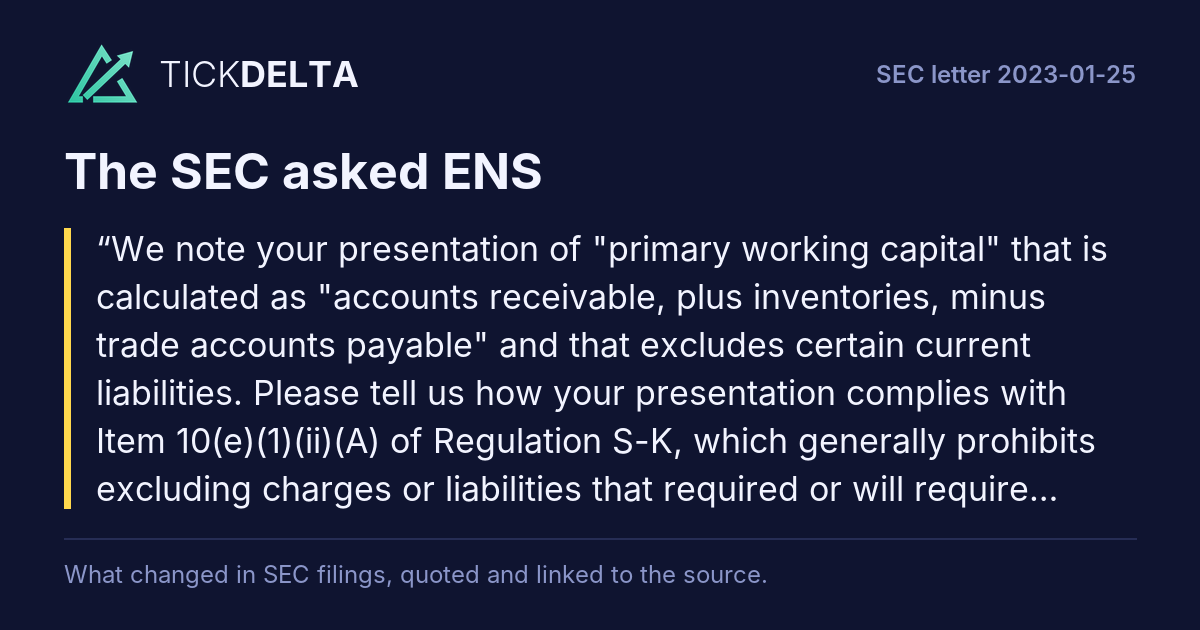
We note your presentation of "primary working capital" that is calculated as "accounts receivable, plus inventories, minus trade accounts payable" and that excludes certain current liabilities. Please tell us how your presentation complies with Item 10(e)(1)(ii)(A) of Regulation S-K, which generally prohibits excluding charges or liabilities that required or will require cash settlement from non-GAAP liquidityRest of the question
measures. Also see the third bullet of Question 102.10(a) of the Compliance and Disclosure Interpretations on Non-GAAP Financial Measures.
We have reviewed Item 10(e)(1)(ii)(A) of Regulation S-K and the third bullet of Question 102.10(a) of the Compliance and Disclosure Interpretations on Non-GAAP Financial Measures. Our use of the “primary working capital” metric is more appropriately categorized as a key performance indicator (KPI) used to measure the asset intensity and operating efficiency of our business on a company-wide basis that management can monitor and analyze over time.Read in the replyRest of the answer
We will revise our description to this effect in future filings, cease referring to the term as a liquidity measure based on the guidance provided under Item 10(e)(1)(ii)(A) of Regulation S-K and remove any discussion of primary working capital from the “Liquidity and Capital Resources” section of the Company’s MD&A. To the extent that we use this KPI in future filings, we will identify it as “primary operating capital” and will discuss its importance in our summary section before the “Results of Operations” section of the Company’s MD&A. We will provide a summary of the components used to calculate this KPI along with the reasons why the metric provides useful information to investors, and how management uses the metric in managing or monitoring the performance of the business.
First report after the company's reply of Feb 8, 2023: 10-K filed May 24, 2023 ↗, against the 10-K filed May 25, 2022 ↗.
Tickdelta does not hold the text of both reports, so they are not compared here.
When you present or discuss non-GAAP measures, please ensure that the corresponding GAAP measures are presented or discussed with equal or greater prominence. We note the following items in your press release: • An introductory bullet mentions "Adj GM" movements without a corresponding GAAP reference. • The table on the first page includes EBITDA and Adjusted EBITDA but not net income.Rest of the question
• The "Message from the CEO" discusses adjusted gross margin and adjusted diluted EPS without corresponding GAAP discussions. See Item 10(e)(1)(i)(A) of Regulation S-K and Questions 102.10(a) and Question 103.01 of the Compliance and Disclosure Interpretations on Non-GAAP Financial Measures.
We have reviewed Item 10(e)(1)(i)(A) of Regulation S-K and Questions 102.10(a) and Question 103.01 of the Compliance and Disclosure Interpretations on Non-GAAP Financial Measures. In connection with future earnings releases, we will ensure that, when we present or discuss non-GAAP financial measures, the corresponding GAAP financial measures are presented or discussed with equal or greater prominence.Read in the reply
First report after the company's reply of Feb 8, 2023: 10-K filed May 24, 2023 ↗, against the 10-K filed May 25, 2022 ↗.
Tickdelta does not hold the text of both reports, so they are not compared here.
We note that you quantify a range of forward-looking adjusted diluted earnings per share for the subsequent quarter. To the extent available without unreasonable efforts, please revise future filings to provide a reconciliation to the most directly comparable GAAP measure. If relying on the unreasonable efforts exception, please disclose as such and identify the information that is not available.Rest of the question
See Item 10(e)(1)(i)(B) of Regulation S-K and Question 102.10(b) of the Compliance and Disclosure Interpretations on Non-GAAP Financial Measures.
We have reviewed Item 10(e)(1)(i)(B) of Regulation S-K and Question 102.10(b) of the Compliance and Disclosure Interpretations on Non-GAAP Financial Measures. In response to the Staff’s comment, we intend in future filings, as applicable, to add certain additional disclosures to clarify the fact that the Company is relying on the “unreasonable efforts” exception in Item 10(e)(1)(i)(B) of Regulation S-K and to identify more specifically any information that is unavailable and its probable significance.Read in the replyRest of the answer
The Company anticipates that these additional disclosures will include the following:
•Add the following disclosure to the lead in paragraphs under the heading “Reconciliations of GAAP to Non-GAAP Financial Measures” of the Company’s earnings release:
EnerSys does not provide a quantitative reconciliation of the company’s projected range for adjusted diluted earnings per share for the x quarter of fiscal 20xx to diluted earnings per share, which is the most directly comparable GAAP measure, in reliance on the unreasonable efforts exception provided under Item 10(e)(1)(i)(B) of Regulation S-K. EnerSys' adjusted diluted earnings per share guidance for the x quarter of fiscal 20xx excludes certain items, including but not limited to certain non-cash, large and/or unpredictable charges and benefits, charges from restructuring and exit activities, impairment of goodwill and indefinite-lived intangibles, acquisition and disposition activities, legal judgments, settlements, or other matters, and tax positions, that are inherently uncertain and difficult to predict, can be dependent on future events that are less capable of being controlled or reliably predicted by management and are not part of the Company's routine operating activities can be dependent on future events that are less capable of being controlled or reliably predicted by management and are not part of the Company's routine operating activities. Due to the uncertainty of the occurrence or timing of these future excluded items, management cannot accurately forecast many of these items for internal use and therefore cannot create a quantitative adjusted diluted earnings per share for the x quarter of fiscal 20xx to diluted earnings per share reconciliation without unreasonable efforts.
•Revise the lead in sentences to the historical non-GAAP adjusted Net earnings reconciliation under the heading “Reconciliations of GAAP to Non-GAAP Financial Measures” of the Company’s earnings release as follows (with the new language underlined):
Included below is a reconciliation of historical non-GAAP adjusted Net earnings to reported amounts. Non-GAAP adjusted operating earnings and historical Net earnings are calculated excluding restructuring and other highlighted charges and credits. The following tables provide additional information regarding certain non-GAAP measures:
First report after the company's reply of Feb 8, 2023: 10-K filed May 24, 2023 ↗, against the 10-K filed May 25, 2022 ↗.
Tickdelta does not hold the text of both reports, so they are not compared here.
We note your response to comment 1 indicates that your "use of the 'primary working capital' metric is more appropriately categorized as a key performance indicator (KPI)." It is our understanding that primary working capital is a non-GAAP measure and, therefore, it needs to comply with applicable rules that generally prohibit excluding charges or liabilities that required or will require cash settlement fromRest of the question
non-GAAP liquidity measures. Accordingly, please revise future filings to ensure the measure complies with Item 10(e)(1)(ii)(A) of Regulation S-K.
We have reviewed Item 10(e)(1)(ii)(A) of Regulation SK. We believe Working Capital is a GAAP term intended to convey the short-term liquidity of a company and is not the same as “Primary Operating Capital” (POC).Read in the reply
Working Capital is calculated by subtracting current liabilities from current assets. Positive Working Capital generally indicates that a company can fund its current operations and other priorities such as future growth.Rest of the answer
Working Capital is fundamentally different than the Company’s POC Key Performance Indicator (KPI) that is used by the Company to measure asset intensity rather than liquidity. The POC KPI metric is defined as the level of POC, and its ratio to net sales. The Company defines POC as accounts receivable, plus inventories, minus accounts payable. The resulting net amount is divided by the trailing three-month net sales (annualized) to derive a POC percentage. We believe these three elements included in POC are most operationally driven, and this performance measure provides the Company with information about the asset intensity and operating efficiency of the business on a company-wide basis that management can monitor and analyze trends over time. The Company made the change to POC from PWC to provide clarity that it is not intended to be similar to GAAP Working Capital.
The contrast between Working Capital as a liquidity measure and POC can be illustrated using an example of two companies that are identical except that one recently raised cash by issuing long-term debt. That company would be in a much better short-term liquidity position and Working Capital would capture that difference. However, the POC metric would be the same for both companies.
POC is used by the Company and investors as a KPI and is important to include in our filings. POC is used by the company in the following manner:
•Compare/benchmark trends over time to understand/incentivize more efficient financial results (e.g., increase sales but without taking on risky/long paying accounts, negotiate better vendor prices but without agreeing to less favorable/advanced payments, maintain efficient levels of inventory)
•Limiting to three accounts enables more focused efforts on the most significant operational balance sheet accounts which can be influenced by management
•POC as a % of sales is used to set management incentive plans and is also discussed in company monthly segment meetings and our financial close meetings
•Changes in POC efficiency levels can be used to flag/point to issues outside management’s control (e.g., supply chain hurdles, economic market conditions, etc.)
First report after the company's reply of Mar 30, 2023: 10-K filed May 24, 2023 ↗, against the 10-K filed May 25, 2022 ↗.
Tickdelta does not hold the text of both reports, so they are not compared here.
Also in this review: closing letter, 2023-04-13