Screener / SEC EDGAR /CIK 0001529864 /10-K filed Feb 20, 2026, compared with Feb 18, 2025 /Numbers from the XBRL of the 10-Ks
NYSE Financials · Personal Credit Institutions

Enova International, Inc. ENVA

Compare with peers Embed
New in the 10-K 20 paragraphs with nothing like them in the 10-K filed Feb 18, 2025 New in the 10-Q 11 paragraphs not in the 10-Q filed Jul 23, 2026 10-Q against the 10-K 6 risk factor paragraphs and sentences added or reworded

New risk paragraphs, branching off last year

Each branch is a paragraph in Risk Factors with nothing like it in the 10-K filed Feb 18, 2025. A box jumps to the paragraph as filed, below.

20 new

Paragraphs with nothing like them in last year's 10-K

Quoted exactly

20 paragraphs in Risk Factors of the 10-K filed Feb 20, 2026 with nothing like them in the 10-K filed Feb 18, 2025. Quoted exactly. Paragraphs that were only edited are under 10-K change.

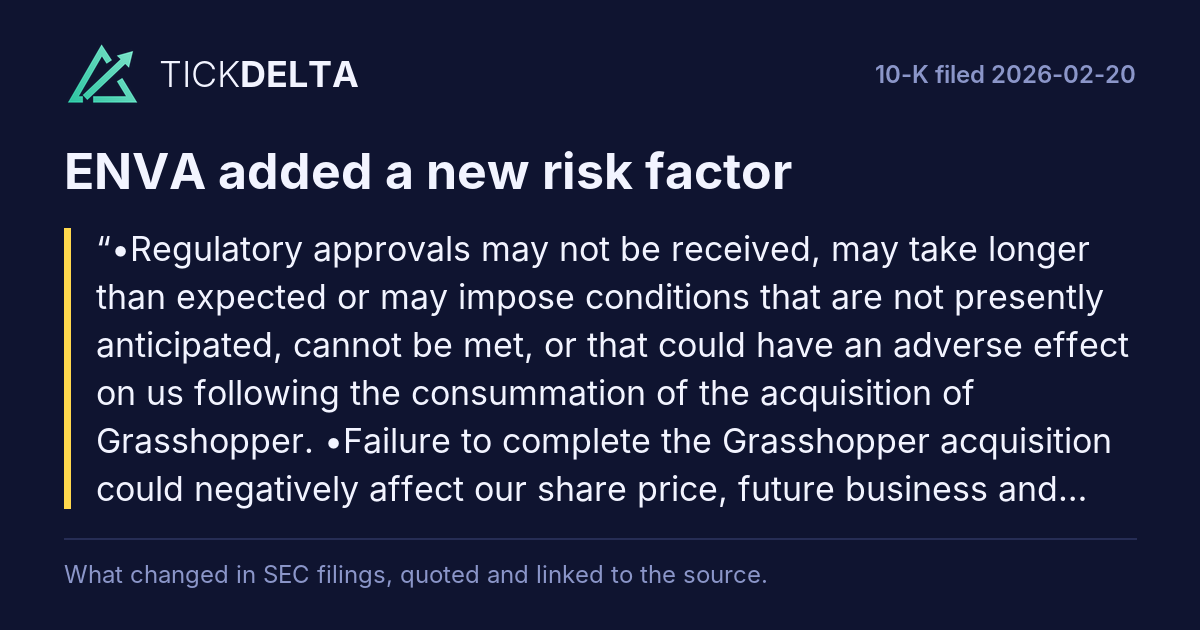
•Regulatory approvals may not be received, may take longer than expected or may impose conditions that are not presently anticipated, cannot be met, or that could have an adverse effect on us following the consummation of the acquisition of Grasshopper.

•Failure to complete the Grasshopper acquisition could negatively affect our share price, future business and financial results.

•Potential litigation relating to the Grasshopper mergers could result in significant costs, management distraction, and/or a delay of or injunction against the Grasshopper acquisition.

Read in the 10-K

In October 2017, the CFPB issued its final rule entitled “Payday, Vehicle Title, and Certain High-Cost Installment Loans” (the “Small Dollar Rule”), which covers certain consumer loans that we offer. While the ability to repay provisions were rescinded in 2020, the payment provisions remain in effect. These provisions require that if a consumer has two consecutive failed payment attempts, the lender must obtain the consumer’s new and specific authorization to make further withdrawals from the consumer’s bank account. Additionally, lenders must provide certain notices to consumers before attempting a first payment withdrawal or an unusual withdrawal and after two consecutive failed withdrawal attempts. Following a series of constitutional challenges, the Supreme Court upheld the constitutionality of the funding structure of the CFPB and the Fifth Circuit upheld the Small Dollar Rule. On March 28, 2025, the CFPB issued a press release entitled “CFPB Offers Regulatory Relief for Small Loan Providers” indicating that the CFPB “will not prioritize enforcement or supervision actions with regard to any penalties or fines associated with the Payment Withdrawal provisions and the Payment Disclosure provisions once they become operative on March 30, 2025.” The CFPB also indicated that it is contemplating issuing a notice of proposed rulemaking to narrow the scope of the Small Dollar Rule. If the CFPB elects to prioritize enforcement and we are not able to execute payment process and customer notification changes effectively because of unexpected complexities, costs or otherwise, we cannot guarantee that the Small Dollar Rule will not have a material adverse impact on our business, prospects, results of operations, financial condition and cash flows.

Read in the 10-K

Restrictions on our third-party debt collectors or that apply to our attempts to collect debt originated by other lenders may have an adverse impact on our U.S. products and services.

Read in the 10-K

costly to implement and may lead to widespread negative publicity, which may cause customers to lose confidence in the effectiveness of our data security measures.

Read in the 10-K

Regulatory approvals may not be received, may take longer than expected or may impose conditions that are not presently anticipated, cannot be met, or that could have an adverse effect on us following the consummation of the acquisition of Grasshopper.

Before the transactions contemplated by the Grasshopper merger agreement may be completed, various approvals, consents and/or non-objections must be obtained from bank regulatory authorities. In determining whether to grant these approvals, the applicable regulatory authorities consider a variety of factors, including the regulatory standing of each party. These approvals could be delayed or not obtained at all, including due to an adverse development in either party’s regulatory standing or in any other factors considered by regulators in granting such approvals; governmental, political or community group inquiries, investigations or opposition; or changes in legislation or the political or regulatory environment generally. The approvals that are granted may impose terms and conditions, limitations, obligations or costs, or place restrictions on the conduct of the combined company’s business or require changes to the terms of the transactions contemplated by the merger agreement. There can be no assurance that regulators will not impose any such conditions, limitations, obligations or restrictions and that such conditions, limitations, obligations or restrictions will not have the effect of delaying the completion of the mergers of Grasshopper Bancorp and Grasshopper Bank (collectively, the “mergers”) and the other transactions contemplated by the merger agreement, imposing additional material costs on or materially limiting the revenues of the combined company following the mergers or otherwise reduce the anticipated benefits of the mergers if the mergers were consummated successfully within the expected timeframe. In addition, there can be no assurance that any such conditions, terms, obligations or restrictions will not result in the delay or abandonment of the mergers. The completion of the transactions contemplated by the merger agreement are conditioned on the receipt of the requisite regulatory approvals without the imposition of any burdensome condition and the expiration of all statutory waiting periods. Additionally, the completion of the transactions contemplated by the merger agreement are conditioned on the absence of any law or order (whether temporary, preliminary or permanent) by any court or regulatory authority of competent jurisdiction prohibiting, restricting or making illegal the consummation of the transactions contemplated by the merger agreement.

In order to obtain the requisite regulatory approvals, we may need to develop business and financial plans appropriate for a bank holding company and enhance our governance, compliance, controls and management infrastructure and capabilities to be compliant with all applicable regulations and supervisory expectations to the satisfaction of the Federal Reserve and other banking regulators before the consummation of the mergers, which may require substantial time, monetary and human resource commitments. If we are not successful in developing appropriate business and financial plans or enhancing, as needed, our governance, compliance, controls and management infrastructure and capabilities, our ability to close the mergers and obtain a bank charter and/or bank functionality through other avenues may be jeopardized.

If the consummation of the mergers is delayed, including by a delay in receipt of necessary regulatory approvals, a denial of a regulatory application, or the imposition of a burdensome condition, our ongoing business and financial results may also be adversely affected.

Failure to complete the Grasshopper acquisition could negatively affect our share price, future business and financial results.

The completion of the Grasshopper mergers is subject to a number of customary conditions that may not be fulfilled and, accordingly, the mergers may not be completed. In addition, if the mergers are not consummated by the termination date, either we or Grasshopper may choose to terminate the merger agreement at any time after the termination date, subject to certain exceptions and conditions as provided in the merger agreement.

If the Grasshopper mergers are not consummated, our ongoing business and financial results may be adversely affected. If the mergers are not consummated due to failure to obtain the necessary regulatory approvals, and we are unable to find an alternative pathway to obtaining a bank charter and/or bank functionality, then our ability to offer a broader range of products and services, and our stock price, may be adversely affected. We could also be subject to significant declines in our market price to the extent that the current market price reflects an assumption by the market that the Grasshopper mergers will be completed as well as any litigation related to any failure to complete the mergers. If the consummation of the mergers is delayed, our business, financial condition and results of operations may be adversely affected.

In addition, we have incurred and will incur substantial expenses in connection with the negotiation and completion of the transactions contemplated by the merger agreement. If the mergers are not completed, we must recognize these expenses without realizing the expected benefits of the mergers. Any of the foregoing, or other risks arising in connection with the failure of or delay in consummating the mergers, including the diversion of management attention from pursuing other opportunities and the constraints in the merger agreement on the ability to make significant changes to our ongoing business during the pendency of the mergers, could have an adverse effect on our business, financial condition and results of operations.

Potential litigation relating to the Grasshopper mergers could result in significant costs, management distraction, and/or a delay of or injunction against the Grasshopper acquisition.

While we believe that any claims that may be asserted by purported stockholder plaintiffs related to the Grasshopper acquisition would be without merit, the results of any such potential legal proceedings are difficult to predict and could delay or prevent the mergers from being completed in a timely manner or at all. Moreover, any litigation could be time consuming and expensive and divert management’s attention away from their regular business. Further, any lawsuit adversely resolved against Grasshopper, us or members of our or Grasshopper’s boards of directors, could have an adverse effect on our business, financial condition and results of operations.

If any action remains unresolved, it could prevent or delay the completion of the mergers. One of the conditions to the consummation of the mergers is that no court or regulatory authority of competent jurisdiction has enacted, issued, promulgated, enforced or entered any law or order (whether temporary, preliminary or permanent) or taken any other action which prohibits, restricts or makes illegal the consummation of the transactions contemplated by the merger agreement. Consequently, if a settlement or other resolution is not reached in any lawsuit that is filed or any regulatory proceeding and a claimant secures injunctive or other relief or a regulatory authority issues an order or other directive restricting, prohibiting or making illegal the consummation of the transactions contemplated by the merger agreement, then such injunctive or other relief may delay or prevent the mergers from becoming effective in a timely manner or at all.

We expect to incur substantial expenses in connection with consummation of the mergers and combining the business, operations, networks, systems, technologies, policies and procedures of the two companies, particularly given the potentially transformational nature of the transaction. The success of the mergers will depend on, among other things, our ability to combine our and Grasshopper’s businesses. If we are not able to successfully achieve this objective, the anticipated benefits of the mergers may not be realized fully, or at all, or may take longer to realize than expected.

There are a number of factors beyond our control that could affect the total amount or the timing of anticipated business combination expenses. Many of the expenses that will be incurred, by their nature, are difficult to estimate accurately at the present time. Due to these factors, the transaction and combination expenses associated with the mergers could, particularly in the near term, exceed the anticipated benefits that we expect to achieve from the combination of the businesses following the consummation of the mergers. As a result of these expenses, we have taken and expect to take additional charges against our earnings before and after the completion of the mergers, which may be significant. There can be no assurance that the anticipated benefits related to the integration of the businesses will be realized to offset these transaction and integration expenses over time.
Read in the 10-K
Show the other 1

reasonable terms or at all, would materially and adversely affect our financial condition, liquidity, results of operations and cash flows and our ability to satisfy our obligations under our indebtedness.

Read in the 10-K

Paragraphs in the 10-Q filed Oct 22, 2026 that were not in the one before

New in the latest 10-Q

11 paragraphs in the 10-Q filed Oct 22, 2026 with nothing like them in the 10-Q filed Jul 23, 2026 (at least half the words must differ; new numbers alone do not count). Quoted exactly, grouped by the item heading above them. This is text that changed, not a judgement of how serious it is.

10-Q

• potential adverse consequences related to the withdrawal of the regulatory approval applications related to the proposed acquisition of Grasshopper Bancorp, Inc. and Grasshopper Bank N.A. and the subsequent mutual termination of the merger agreement with Grasshopper Bancorp, Inc., which may negatively impact our reputation, result in litigation, divert management’s attention, adversely affect the market price of our common stock and/or cause us to incur substantial costs, including as a result of litigation;

Read in the 10-Q

• litigation risk related to acquisitions, including as a result of the mutual termination of the Grasshopper merger agreement; and

Read in the 10-Q

Financial statements and notes

9. Subsequent Events Subsequent events have been reviewed through the date these financial statements were issued. Grasshopper Termination Agreement As previously disclosed, on December 10, 2025, the Company entered into the Agreement and Plan of Merger, as amended on December 18, 2025 (as amended, the “Merger Agreement”), by and between the Company and Grasshopper Bancorp, Inc. (“Grasshopper”), a Delaware corporation and the parent holding company of Grasshopper Bank N.A. (“Grasshopper Bank”), a national bank and wholly-owned subsidiary of Grasshopper, pursuant to which, and subject to the terms and conditions therein, (i) Grasshopper was to merge with and into the Company (the “Merger”), and (ii) immediately following the Merger, an interim national bank and wholly-owned subsidiary of the Company was to merge with and into Grasshopper Bank. On October 16, 2026, the Company and Grasshopper entered into the

Read in the 10-Q

Mutual Termination Agreement and Release (the “Termination Agreement”) pursuant to which the parties agreed to mutually terminate the Merger Agreement effective as of such date. Under the terms of the Termination Agreement, the Company made a $4.0 million cash payment to Grasshopper. Neither party will pay any other fees or have any other liabilities to each other related to the Merger Agreement. NCR 2022 Securitization Facility On October 13, 2026, the NCR 2022 Securitization Facility was amended to, among other changes, extend the revolving period end and final maturity date to October 2028 and October 2030, respectively, decrease the commitment amount from $275.0 million to $200.0 million, decrease the borrowing rate from SOFR plus 4.25% to SOFR plus 4.00% and increase the advance rate from 85% to 90%.

Read in the 10-Q

On September 14, 2026, we announced that we withdrew our applications with the Office of the Comptroller of the Currency and the Board of Governors of the Federal Reserve System related to the proposed acquisition of Grasshopper. On October 16, 2026, we and Grasshopper entered into the Mutual Termination Agreement and Release (the “Termination Agreement”) pursuant to which we and Grasshopper agreed to mutually terminate the Merger Agreement effective as of such date. Under the terms of the Termination Agreement, we made a $4.0 million cash payment to Grasshopper. Neither we nor Grasshopper will pay any other fees or have any other liabilities to each other related to the Merger Agreement.

Read in the 10-Q
Show the other 6

THREE MONTHS ENDED SEPTEMBER 30, 2026 COMPARED TO THREE MONTHS ENDED SEPTEMBER 30, 2025

Read in the 10-Q

NINE MONTHS ENDED SEPTEMBER 30, 2026 COMPARED TO NINE MONTHS ENDED SEPTEMBER 30, 2025

Read in the 10-Q

Risk Factors

The mutual termination of the merger agreement with Grasshopper, including the prior withdrawal of our applications with the applicable regulatory authorities related to the Grasshopper merger, may negatively affect our share price, business and financial results.

Read in the 10-Q

On October 16, 2026, we and Grasshopper entered into the Mutual Termination Agreement and Release (the “Termination Agreement”) pursuant to which, among other things, we and Grasshopper agreed to mutually terminate the merger agreement with Grasshopper effective as of such date. The mutual termination of the merger agreement with Grasshopper, together with the previously announced withdrawal of our applications with the applicable regulatory authorities related to the mergers on September 14, 2026, may negatively affect the market price of our common stock, our ongoing business and financial results. Because of the mutual termination of the merger agreement, unless we seek and find an alternative pathway to obtaining a bank charter and/or bank functionality, our ability to offer a broader range of products and services, and our stock price, may be adversely affected. We could be subject to significant fluctuations in our market price as a result of future developments with respect to the acquisition of Grasshopper and the mutual termination of the merger agreement, and the reaction of financial markets to those developments.

Read in the 10-Q

In addition, we have incurred substantial expenses in connection with the negotiation and completion of the transactions contemplated by the merger agreement, including with respect to obtaining necessary regulatory approvals for the mergers, and the mutual termination of the merger agreement. Because of the mutual termination, the mergers will not be completed and we must recognize these expenses without realizing the previously anticipated benefits of the mergers. Any of the foregoing, or other risks arising in connection with the termination, including the diversion of management attention from pursuing other opportunities, negative publicity and impact to our reputation, and/or potential litigation we may face related to the potential transaction with Grasshopper and/or the mutual termination of the merger agreement, could have an adverse effect on our business, financial condition and results of operations.

Read in the 10-Q

It cannot be assured that we will seek an alternative pathway to obtaining a bank charter and/or bank functionality or another merger or acquisition or, if we do seek a bank charter, bank functionality or another merger or acquisition, that we will be successful in obtaining such bank charter or functionality or be able to find a party willing to engage in a transaction at all or on terms substantially similar to or more attractive than the terms offered under the merger agreement with Grasshopper.

Read in the 10-Q

The 10-Q's risk factors against the 10-K

Item 1A of the 10-Q filed Oct 22, 2026 against Item 1A of the 10-K filed Feb 20, 2026. A 10-Q repeats only the risks that changed, so a 10-K paragraph that is missing from it is not counted as removed. Added is a paragraph with nothing like it in the 10-K, Reworded a sentence that is in both with several words changed, Quiet changes a sentence in both where one to four words changed and one is a hedge or a modal (cut words struck through, new words highlighted). Text on the page, not a score; each links to the filing at sec.gov.

Added10-Q Oct 22, 2026 vs 10-K Feb 20, 2026
As discussed below and elsewhere in this Quarterly Report on Form 10-Q, as a result of the mutual termination of the merger agreement with Grasshopper Bancorp, Inc. (“Grasshopper”), many of the risks related to the merger agreement and the consummation of the transactions contemplated thereby described in Item 1A. “Risk Factors - Risks Related to our Pending Acquisition of Grasshopper” of our Annual Report on Form 10-K for the fiscal year ended December 31, 2025 no longer apply. Subject to the foregoing and except with respect to the following additional risk factor, there have been no material changes from the Risk Factors described in Item 1A. “Risk Factors” of our Annual Report on Form 10-K for the fiscal year ended December 31, 2025.

Read it in the 10-Q at sec.gov

Added10-Q Oct 22, 2026 vs 10-K Feb 20, 2026
On October 16, 2026, we and Grasshopper entered into the Mutual Termination Agreement and Release (the “Termination Agreement”) pursuant to which, among other things, we and Grasshopper agreed to mutually terminate the merger agreement with Grasshopper effective as of such date. The mutual termination of the merger agreement with Grasshopper, together with the previously announced withdrawal of our applications with the applicable regulatory authorities related to the mergers on September 14, 2026, may negatively affect the market price of our common stock, our ongoing business and financial results. Because of the mutual termination of the merger agreement, unless we seek and find an alternative pathway to obtaining a bank charter and/or bank functionality, our ability to offer a broader range of products and services, and our stock price, may be adversely affected. We could be subject to significant fluctuations in our market price as a result of future developments with respect to the acquisition of Grasshopper and the mutual termination of the merger agreement, and the reaction of financial markets to those developments.

Read it in the 10-Q at sec.gov

Added10-Q Oct 22, 2026 vs 10-K Feb 20, 2026
It cannot be assured that we will seek an alternative pathway to obtaining a bank charter and/or bank functionality or another merger or acquisition or, if we do seek a bank charter, bank functionality or another merger or acquisition, that we will be successful in obtaining such bank charter or functionality or be able to find a party willing to engage in a transaction at all or on terms substantially similar to or more attractive than the terms offered under the merger agreement with Grasshopper.

Read it in the 10-Q at sec.gov

Reworded10-Q Oct 22, 2026 vs 10-K Feb 20, 2026
Any of the foregoing, or other risks arising in connection with the failure of or delay in consummating the mergers, termination, including the diversion of management attention from pursuing other opportunities opportunities, negative publicity and impact to our reputation, and/or potential litigation we may face related to the constraints in potential transaction with Grasshopper and/or the mutual termination of the merger agreement on the ability to make significant changes to our ongoing business during the pendency of the mergers, agreement, could have an adverse effect on our business, financial condition and results of operations.

Read it in the 10-Q at sec.govThe 10-K sentence

Reworded10-Q Oct 22, 2026 vs 10-K Feb 20, 2026
In addition, we have incurred and will incur substantial expenses in connection with the negotiation and completion of the transactions contemplated by the merger agreement, including with respect to obtaining necessary regulatory approvals for the mergers, and the mutual termination of the merger agreement.

Read it in the 10-Q at sec.govThe 10-K sentence

Show the other 1

Phrases used for the first time

Two-word phrases in Risk Factors of the 10-K filed Feb 20, 2026 that are in none of the 1 earlier 10-Ks stored, back to Feb 18, 2025

merger agreement ×12transactions contemplated ×9regulatory approvals ×6grasshopper acquisition ×5grasshopper mergers ×5take longer ×3prioritize enforcement ×3conditions limitations ×3limitations obligations ×3regulatory authority ×3impose conditions ×2presently anticipated ×2anticipated cannot ×2share price ×2potential litigation ×2litigation relating ×2
Where each one is used
  • merger agreement: Before the transactions contemplated by the Grasshopper merger agreement may be completed, various approvals, consents and/or non-objections must be obtained from bank regulatory authorities. In determining whether to grant these approvals, the applicable regulatory authorities consider a variety of factors,...
  • transactions contemplated: Before the transactions contemplated by the Grasshopper merger agreement may be completed, various approvals, consents and/or non-objections must be obtained from bank regulatory authorities. In determining whether to grant these approvals, the applicable regulatory authorities consider a variety of factors,...
  • regulatory approvals: •Regulatory approvals may not be received, may take longer than expected or may impose conditions that are not presently anticipated, cannot be met, or that could have an adverse effect on us following the consummation of the acquisition of Grasshopper.
  • grasshopper acquisition: •Failure to complete the Grasshopper acquisition could negatively affect our share price, future business and financial results.
  • grasshopper mergers: •Potential litigation relating to the Grasshopper mergers could result in significant costs, management distraction, and/or a delay of or injunction against the Grasshopper acquisition.
  • take longer: •Regulatory approvals may not be received, may take longer than expected or may impose conditions that are not presently anticipated, cannot be met, or that could have an adverse effect on us following the consummation of the acquisition of Grasshopper.
  • prioritize enforcement: If the CFPB elects to prioritize enforcement of a new rule that impacts the consumer lending industry, this rule could have a material adverse effect on our U.S. consumer lending business.
  • conditions limitations: Before the transactions contemplated by the Grasshopper merger agreement may be completed, various approvals, consents and/or non-objections must be obtained from bank regulatory authorities. In determining whether to grant these approvals, the applicable regulatory authorities consider a variety of factors,...

The 10-K at sec.gov

Used at least twice, small words left out. Counted, not picked: a phrase can be new because the company renamed something.

What was taken out

10 paragraphs of last year's Risk Factors with nothing like them now. The longest are quoted.

Across all companies
Effective November 30, 2021, CFPB rules went into effect that apply to third-party debt collectors covered by the FDCPA. The rules (a) clarify the times and places at which a debt collector may communicate with a consumer; (b) require collectors to provide a channel-specific opt-out mechanism for debtors in all text messages and emails; (c) provide that a debt collector is presumed to violate the rule if it places a telephone call to a person more than 7 times within a 7-day period or within 7 days after a telephone conversation with the debtor; (d) include prohibitions against taking or...
In the 10-K filed Feb 18, 2025
Dollar Rule remained in place. In April 2018, an action was filed against the CFPB making a constitutional challenge to the Small Dollar Rule. After appeals to the Fifth Circuit and Supreme Court and a stay of the compliance date, on May 16, 2024, the Supreme Court upheld the constitutionality of the funding structure of the CFPB and remanded the case back to the Fifth Circuit. On June 19, 2024, the Fifth Circuit declared that the CFPB’s funding structure and Small Dollar Rule are constitutional. On July 3, 2024, the CFSA filed a petition for rehearing en banc that was denied by the Court....
In the 10-K filed Feb 18, 2025
In October 2017, the CFPB issued the Small Dollar Rule, which covers certain consumer loans that we offer. The Small Dollar Rule initially required that lenders who make short-term loans and longer-term loans with balloon payments reasonably determine consumers’ ability to repay the loans according to their terms before issuing the loans. The Small Dollar Rule also introduced new limitations on repayment processes for those lenders as well as lenders of other longer-term loans with an annual percentage rate greater than 36 percent that include an ACH authorization or similar payment...
In the 10-K filed Feb 18, 2025
On November 15, 2023, we consented to the issuance of a Consent Order by the CFPB (the “2023 Consent Order”) pursuant to which we agreed, without admitting or denying any of the facts or conclusions, to pay a civil money penalty of $15 million. The 2023 Consent Order supersedes a prior January 2019 CFPB consent order in which we agreed, without admitting or denying any of the facts or conclusions, to pay a civil money penalty of $3.2 million. The 2023 Consent Order relates to issues, the majority of which were self-disclosed, including payment processing and debiting errors. We will remain...
In the 10-K filed Feb 18, 2025

Sources

Item 1A of each 10-K and 10-Q on EDGAR, quoted exactly. Each paragraph links to the filing at sec.gov.

Also

10-K change: what was reworded or cut, section by section.

Work with it

Excel workbook · CSV. Google Sheet that stays up to date: paste =IMPORTDATA("https://tickdelta.com/company/ENVA/export.csv") into a cell.

Next:10-K change
Esc

Type a ticker such as AAPL, a name, an investor such as Buffett, or a topic such as tariffs. ↑ ↓ to move, Enter to open.