Screener / SEC EDGAR /CIK 0001828318 /10-K filed Feb 25, 2026, compared with Feb 25, 2025 /Numbers from the XBRL of the 10-Ks
Nasdaq Technology · Miscellaneous Electrical Machinery, Equipment & Supplies

Enovix Corp ENVX

Compare with peers Embed
New in the 10-K 16 paragraphs with nothing like them in the 10-K filed Feb 25, 2025 New in the 10-Q 38 paragraphs not in the 10-Q filed Aug 12, 2026 10-Q against the 10-K 39 risk factor paragraphs and sentences added or reworded

New risk paragraphs, branching off last year

Each branch is a paragraph in Risk Factors with nothing like it in the 10-K filed Feb 25, 2025. A box jumps to the paragraph as filed, below.

16 new

Paragraphs with nothing like them in last year's 10-K

Quoted exactly

16 paragraphs in Risk Factors of the 10-K filed Feb 25, 2026 with nothing like them in the 10-K filed Feb 25, 2025. Quoted exactly. Paragraphs that were only edited are under 10-K change.

Changes in global trade policies, tariffs, export controls and other cross-border restrictions could materially adversely affect our revenues, operating results and ability to source materials and equipment.

Due to our international operations, we face heightened risks relating to trade policies and disputes that result in increased tariffs, trade barriers, retaliatory tariffs and other trade restrictions and protectionist measures, including export controls, licensing requirements and other regulatory restrictions on cross-border trade. For example, the United States has recently imposed or proposed significant new tariffs on a large number of products and components imported into the U.S. and could propose additional tariffs or increases to those already in place. It is unknown whether and to what extent these tariffs will remain in place or whether other new laws or regulations will be adopted. While there is currently a trade pact with China, additional or new tariffs may be imposed reciprocally. It is difficult to predict what further trade-related actions governments may take, including the extent of retaliatory actions, and our business may be negatively impacted if we are unable to quickly and effectively react to any such actions.

The overall tension in U.S.-China trade relations and the possibility of additional tariffs has created uncertainty in our industry and may negatively affect certain of our suppliers, as well as our ability to source components or raw materials. In particular, our facilities are located in Malaysia, India and South Korea and our products require materials

and equipment manufactured outside these countries, including China. If such materials and equipment do not fall under any exemption to the newly imposed tariffs or reciprocal tariffs, or are subject to other trade barriers or restrictions, such as China’s Regulation on Export Control of Dual-Use Items, it could materially impact our ability to obtain materials and equipment, or effective alternative sources of such items, on commercially reasonable terms or at all.

Due to the broad uncertainty regarding the timing, content and extent of global trade policy changes in the U.S. and internationally, we cannot accurately predict the full extent to which these changes will affect our business, financial condition and results of operations. We believe the direct impact of tariffs on our business is currently manageable given the location of our international operations; however, the indirect effects of U.S. tariffs on products containing our batteries could be significant. Any failure by us to adapt quickly to changes in global trade policy could materially and adversely affect our business, financial condition and results of operations.

We rely on third-party suppliers for critical components and equipment, and disruptions in these relationships could delay production and harm our business, results of operations, financial condition and cash flows.

Read in the 10-K

Increases in raw material costs and supply disruptions resulting from global market and geopolitical conditions could increase our product costs and adversely affect our business and results of operations.

Read in the 10-K

Reduced availability of these materials or significant price increases could raise the cost of our components and consequently, the cost of our products. We may be unable to negotiate favorable supply terms or pass through increased costs to customers, which could negatively affect our margins and operating results. In addition, certain materials and components may be produced internally or treated as proprietary by large battery manufacturers, limiting their availability to third parties.

Finally, global economic, political and regulatory developments may further constrain the availability of these raw materials or increase procurement and logistics costs. Because our facilities are located in Malaysia, India and South Korea and our products depend on materials and equipment sourced from multiple countries, disruptions affecting upstream suppliers or transportation networks could have a disproportionate impact on our cost structure. Any disruption

Read in the 10-K

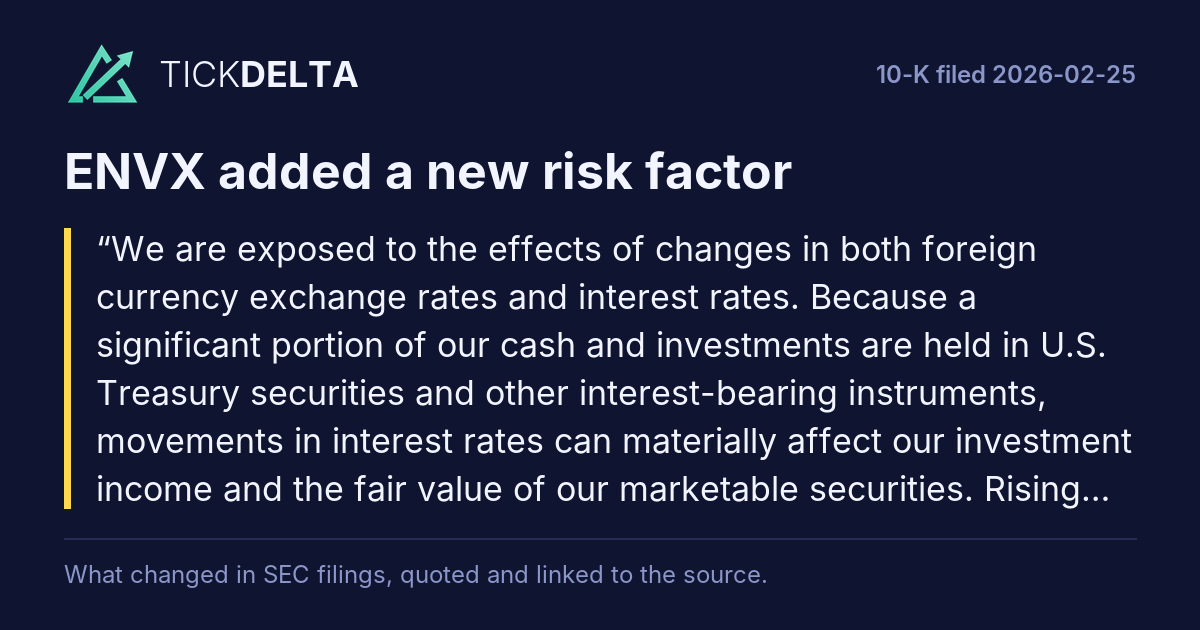
We are exposed to the effects of changes in both foreign currency exchange rates and interest rates. Because a significant portion of our cash and investments are held in U.S. Treasury securities and other interest-bearing instruments, movements in interest rates can materially affect our investment income and the fair value of our marketable securities. Rising rates generally increase interest income on new investments, while falling rates could reduce interest income. In addition, we conduct a material portion of our operations outside of the United States, including South Korea, Malaysia and other countries in Asia. Fluctuations in foreign currency exchange rates, particularly for the Korean won, Indian rupee, and Malaysian ringgit, could have an adverse impact our financial condition and results of operations.

Read in the 10-K

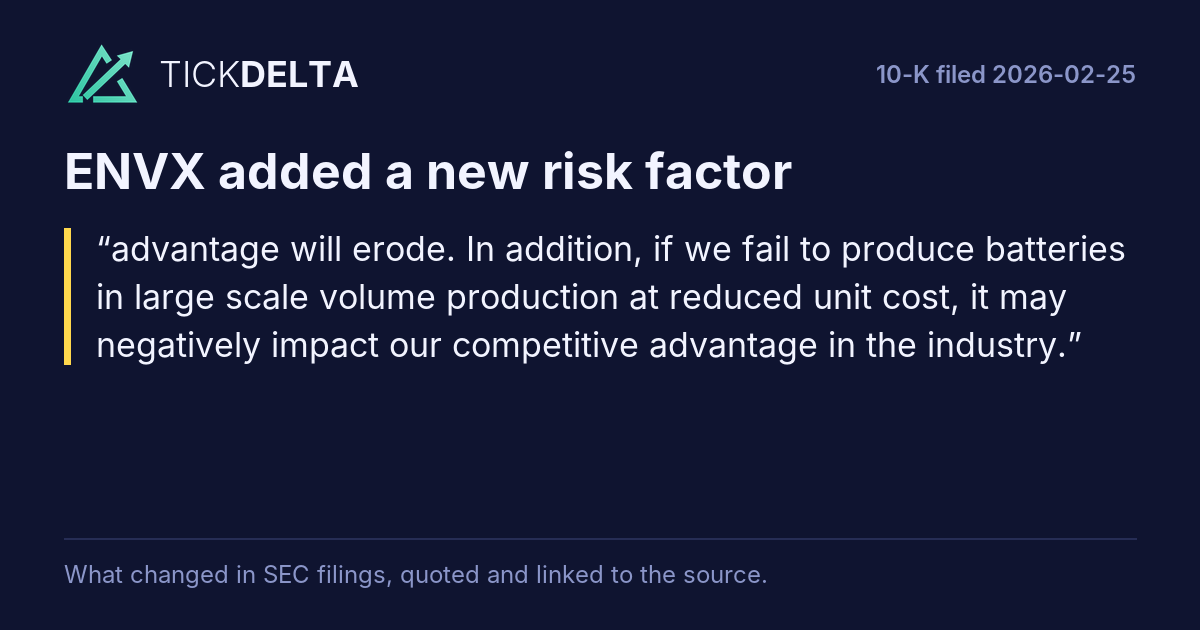
advantage will erode. In addition, if we fail to produce batteries in large scale volume production at reduced unit cost, it may negatively impact our competitive advantage in the industry.

Read in the 10-K
Show the other 3

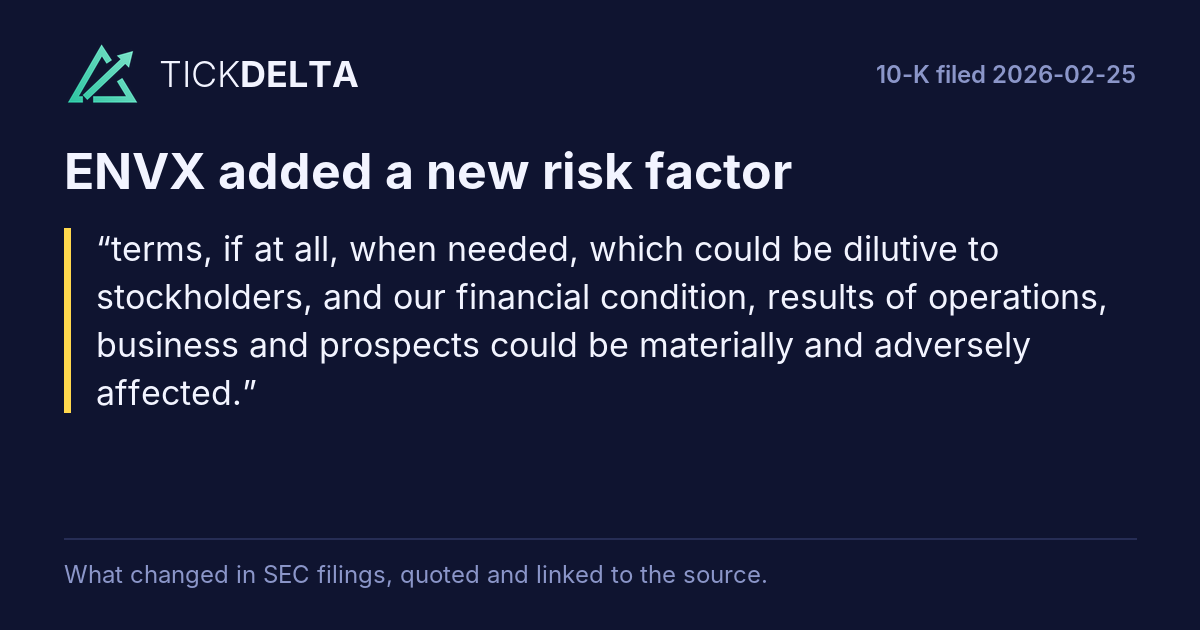
terms, if at all, when needed, which could be dilutive to stockholders, and our financial condition, results of operations, business and prospects could be materially and adversely affected.

Read in the 10-K

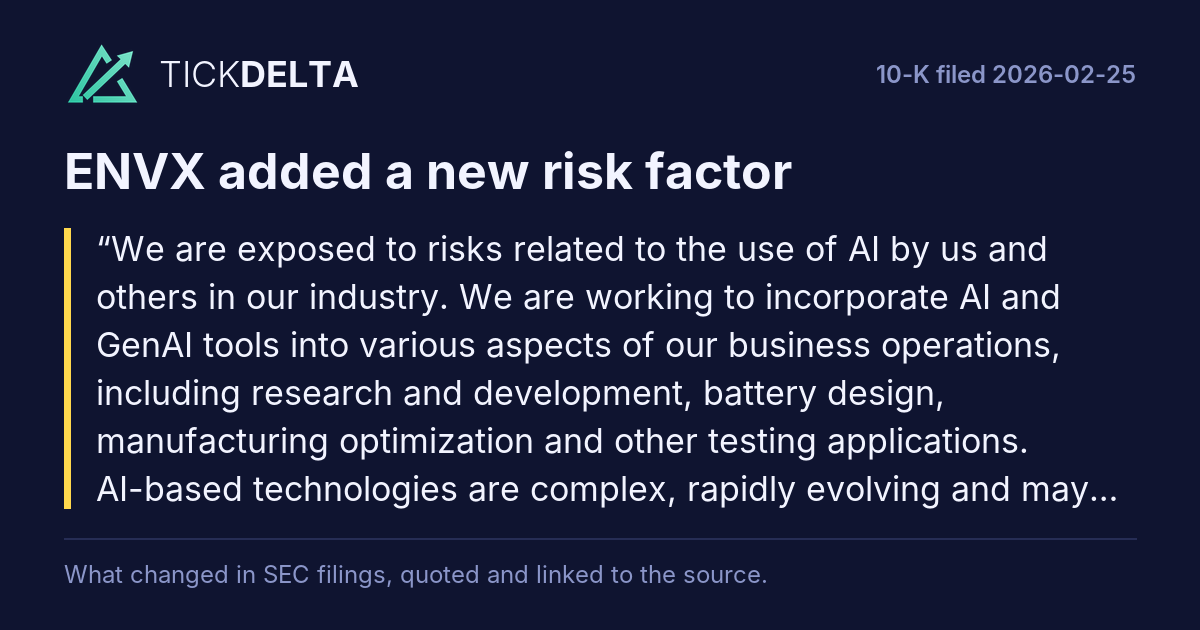
We are exposed to risks related to the use of AI by us and others in our industry.

We are working to incorporate AI and GenAI tools into various aspects of our business operations, including research and development, battery design, manufacturing optimization and other testing applications. AI-based technologies are complex, rapidly evolving and may not produce the intended benefits. Algorithms, models or training data may be flawed, biased or incomplete, which could result in inaccurate analyses or design decisions. If AI-assisted outputs are relied upon in product development, performance modeling, safety analysis or manufacturing processes and prove to be incorrect, our product performance, reliability, safety profile or regulatory compliance could be adversely affected, potentially resulting in delays, increased costs, product liability exposure or reputational harm.

The use of AI may also increase the risk of intellectual property infringement, trade secret exposure or unauthorized disclosure of confidential information, including proprietary battery designs and manufacturing processes. In addition, our suppliers, partners or competitors may more effectively leverage AI technologies, which could impair our competitive position. The evolving regulatory landscape governing AI may impose additional compliance obligations or restrict our ability to deploy AI tools. Any of these risks could adversely affect our business, financial condition and results of operations.

Read in the 10-K

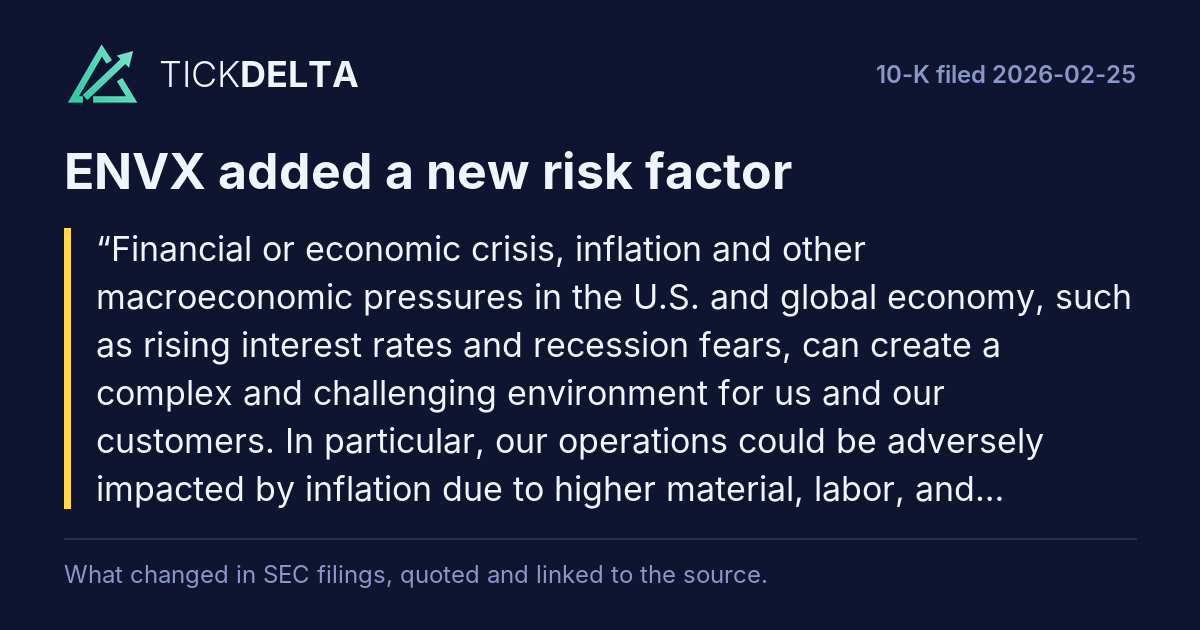
Financial or economic crisis, inflation and other macroeconomic pressures in the U.S. and global economy, such as rising interest rates and recession fears, can create a complex and challenging environment for us and our customers. In particular, our operations could be adversely impacted by inflation due to higher material, labor, and construction costs. Even in instances where the U.S. and foreign governments may take actions intended to address and rectify extreme market and economic conditions, such as by providing liquidity and stability to the financial markets, these actions may not be successful.

Read in the 10-K

Paragraphs in the 10-Q filed Nov 13, 2026 that were not in the one before

New in the latest 10-Q

38 paragraphs in the 10-Q filed Nov 13, 2026 with nothing like them in the 10-Q filed Aug 12, 2026 (at least half the words must differ; new numbers alone do not count). Quoted exactly, grouped by the item heading above them. This is text that changed, not a judgement of how serious it is.

10-Q

• ability to successfully transition the Chief Executive Officer role and/or attract a permanent successor for such role;

Read in the 10-Q

• ability to consummate the anticipated warrant dividend and the impact of the warrant dividend on our capital structure and indebtedness;

Read in the 10-Q

• expectations regarding repurchases of our Convertible Senior Notes and common stock and the resulting effects on our liquidity and capital structure;

Read in the 10-Q

Financial statements and notes

Proceeds from issuance of convertible senior notes and loan borrowing 2,419 360,000

Read in the 10-Q

Payments of issuance costs related to common stock and warrant dividends — (5,995)

Read in the 10-Q
Show the other 33

As of October 4, 2026, we had three customers, who had accounts receivable greater than 10% of our total accounts receivables. Customer A, B, and C accounted for approximately 41 %, 13 %, and 21 %, respectively, of our total accounts

Read in the 10-Q

receivable. As of December 28, 2025, we had three customers, who had accounts receivable greater than 10% of our total accounts receivable. Customer A, B, and D accounted for approximately 43 %, 12 %, and 23 %, respectively, of our total accounts receivables.

Read in the 10-Q

Operating leases 2026 (remaining three months) $ 1,229 2027 3,767 2028 2,138 2029 1,856 2030 1,269 Thereafter 5 Total 10,264 Less: imputed interest (1,104) Present value of lease liabilities $ 9,160

Read in the 10-Q

In August 2026, the Company executed a financing agreement with an insurance provider to finance certain insurance policies for $ 1.1 million. As of October 4, 2026, the total principal amount outstanding was $ 1.0 million, which is included in short-term debt on the Condensed Consolidated Balance Sheet.

Read in the 10-Q

In October and November 2026, the Company repurchased $ 128.0 million aggregate principal amount of its 2030 Convertible Senior Notes for an aggregate cash consideration of approximately $ 81.4 million, representing an approximately 36 % discount to par, as part of its ongoing efforts to strengthen its capital structure.

Read in the 10-Q

On October 28, 2026, the Company’s Board of Directors declared a special dividend in the form of warrants to purchase shares of the Company’s common stock (the “2026 Warrants”) to holders of record of the Company’s common stock. The 2026 Warrants are expected to be distributed on or about November 18, 2026 to holders of record of the Company’s common stock as of the close of business on November 13, 2026 (the “Record Date”). Stockholders will receive one (1) warrant for every four (4) shares of common stock held, rounded down to the nearest whole warrant. Additionally, each holder of the Company’s 2028 Convertible Senior Notes and 2030 Convertible Senior Notes (collectively, the “Convertible Notes”) as of the Record Date will also receive, at the same time and on the same terms as holders of common stock, 2026 Warrants, without having to convert such holder’s Convertible Notes, as if such holder held a number of shares of common stock, equal to the product of (i) the conversion rate applicable to the Convertible Notes in effect on the Record Date and (ii) the aggregate principal amount of Convertible Notes held by such holder on such date. Under the terms of the 2026 Warrants, holders may pay the exercise price, which shall initially be $ 3.00, in cash or by surrendering 2028 Convertible Senior Notes, which will be credited at their principal amount, in lieu of cash. Any 2028 Convertible Senior Notes surrendered upon exercise of the 2026 Warrants will be cancelled. The 2026 Warrants will expire on April 28, 2028, unless certain early expiration conditions are met. The Company is currently evaluating the accounting for the 2026 Warrants.

Read in the 10-Q

In November 2026, the Company began to implement a restructuring plan and eliminated approximately 220 of 946 employee and contract direct-labor positions globally, primarily in Malaysia, with smaller reductions in the United States, India and China. The Company expects to recognize restructuring charges of approximately $ 1.5 million in the fourth quarter of fiscal 2026, consisting primarily of severance and other employee-related costs.

Read in the 10-Q

We also manufacture conventional lithium-ion and silicon-blended graphite battery products for drone, defense and industrial applications. Our MX-1 platform supports applications requiring high discharge rates and high gravimetric energy density. We are prioritizing growth in these markets through our South Korea operations, including an approximately $19 million capacity expansion expected to double our drone battery manufacturing capacity in mid-2027.

Read in the 10-Q

Subsequent to the third quarter of 2026, we implemented a cost reduction and restructuring plan, repurchased a portion of our 2030 Convertible Senior Notes and additional shares of our common stock, and declared a dividend of warrants to our stockholders. These actions are described below under “Key Trends, Opportunities and Uncertainties.”

Read in the 10-Q

In August 2026, our former Chief Executive Officer, President and member of the Company’s Board of Directors, Raj Talluri, resigned and Ryan Benton, our Chief Financial Officer, was appointed Interim Chief Executive Officer.

Read in the 10-Q

In October 2026, we received an initial purchase order for 100,000 batteries from a multinational provider of dual-use drone systems, with deliveries scheduled in the first half of 2027. In November 2026, we received our first production purchase order for the MX1-B01, our high-energy aerial drone cell, from a U.S. drone manufacturer, with initial deliveries scheduled to begin in the first quarter of 2027.

Read in the 10-Q

During the third fiscal quarter of 2026, we shipped approximately 8,600 silicon-anode AI-1 batteries, and recognized smart eyewear product revenue under a customer order for 50,000 packs. Shipments in the third quarter of 2026 were below our expectations as a result of a manufacturing process excursion, for which we have taken corrective action. As a result, we now expect to complete shipments under this order in the first half of 2027 rather than in the fourth quarter of 2026 as we previously expected. We continue to sample our AI-2 battery with smart eyewear customers. The timing and volume of future smart eyewear revenue will depend on our ability to complete current deliveries, manufacture at acceptable yields and obtain additional customer orders.

Read in the 10-Q

During 2026, our smartphone development efforts have primarily focused on qualifying our AI-1 silicon-anode cells with our lead smartphone original equipment manufacturer (“OEM”) customer. This work has included an accelerated cycle-life testing program developed in collaboration with the customer to evaluate our cells under a range of charge and discharge conditions. The final accelerated cycle-life test has passed our internal testing, and we expect the customer to verify that result in the fourth quarter of 2026. We believe these results demonstrate the cycle life and safety of our 100% active silicon-anode architecture in a smartphone-sized cell. However, our current qualification efforts were based on an earlier version of our silicon-anode technology, which now does not meet current customer energy density requirements. Accordingly, we have decided not to proceed with system-level field testing.

Read in the 10-Q

We have reduced AI-1 smartphone development spending and shifted our silicon-anode development focus to smaller cells for smart eyewear and similar devices, where development costs are substantially lower and will be directly supported by the smart eyewear production orders we are already shipping against. We expect our next energy density gains, including those from the AI-2 cells we are sampling, to reach smart eyewear customers first. The application of our AI-2 technology for smartphones requires further development to meet customer requirements and be competitive in the marketplace. At this time, we cannot be certain whether our AI-2 technology, when applied to a smartphone-sized cell, will be able to satisfy customer energy density requirements. Smartphones remain a long-term opportunity, and we expect to re-engage when our next-generation cells restore a clear energy density advantage and the economics justify applying those improvements to larger smartphone cells.

Read in the 10-Q

In Malaysia, Fab2 remains in production at existing volumes, with near-term activities focused on completing our current smart eyewear order, sampling AI-2 and developing our next-generation small cells. Any broader increase in production will depend on product performance, manufacturing readiness and customer demand. We are concentrating our research and development and manufacturing engineering resources on a narrower set of priorities that we believe offer the greatest nearer-term return. Certain process improvement initiatives, including mechanical dicing, are behind

Read in the 10-Q

their original schedules, and the timing and expected benefits of these initiatives remain subject to manufacturing and operational risks. Achieving the yield, throughput and cost levels necessary to support manufacturing at scale remains an important execution priority. Our technology roadmap for products manufactured in South Korea continues to include MX-2, the next generation of our MX-1 drone cell, which remains targeted for 2027.

Read in the 10-Q

In November 2026, we began to implement a restructuring plan and eliminated approximately 220 of 946 employee and contract direct-labor positions globally, primarily in Malaysia, with smaller reductions in the United States, India and China. We expect annualized savings of approximately $8.5 million in compensation and benefits and will record restructuring charges of approximately $1.5 million in the fourth quarter of 2026, consisting primarily of severance and other employee-related costs.

Read in the 10-Q

During the third quarter of 2026, we repurchased approximately $6.2 million of our common stock under our stock repurchase program. In October 2026, subsequent to quarter end, we repurchased an additional $15.5 million of our common stock under the program.

Read in the 10-Q

In October 2026, subsequent to quarter-end, we repurchased $100.0 million aggregate principal amount of our 2030 Convertible Senior Notes for approximately $63.1 million in cash, plus accrued interest. In November 2026, we repurchased an additional $28.0 million aggregate principal amount for approximately $18.3 million in cash, plus accrued interest. In total, we repurchased $128.0 million aggregate principal amount for approximately $81.4 million, leaving $232.0 million aggregate principal amount outstanding of 2030 Convertible Senior Notes.

Read in the 10-Q

Also, on October 28, 2026, we declared a dividend of one warrant for every four shares of our common stock, to stockholders of record as of November 13, 2026. Each warrant is exercisable for one share at $3.00, payable in cash or by tendering 2028 Convertible Senior Notes at face value, and expires on April 28, 2028, subject to earlier expiration under specified conditions. Holders of our 2028 Convertible Senior Notes and 2030 Convertible Senior Notes as of the record date will also receive warrants, at the same time and on the same terms as our common stockholders and without converting their notes, based on the number of shares into which their notes were convertible on the record date. We cannot predict whether or when holders will exercise the warrants, and exercises would increase the number of shares outstanding, and holders who do not exercise or sell their warrants would experience dilution.

Read in the 10-Q

We use cash to fund operations, meet working capital requirements and fund our capital expenditures. Our near-term cash priorities include supporting operations, expanding capacity in South Korea and funding selected product development activities. In November 2026, the Company began to implement a restructuring plan to reduce our annualized cost structure and eliminated approximately 220 of 946 employee and contract direct-labor positions globally, primarily in Malaysia, with smaller reductions in the United States, India and China. We expect annualized savings of approximately $8.5 million in compensation and benefits and will record restructuring charges of approximately $1.5 million in the fourth quarter of 2026, consisting primarily of severance and other employee-related costs. The timing and extent of cash savings will depend on implementation of the plan.

Read in the 10-Q

In October 2026, we repurchased $100.0 million aggregate principal amount of our 2030 Convertible Senior Notes for an aggregate cash consideration of approximately $63.1 million, plus accrued interest. In November 2026, we repurchased an additional $28.0 million aggregate principal amount for approximately $18.3 million in cash, plus accrued interest. In total, we repurchased $128.0 million aggregate principal amount for approximately $81.4 million, leaving $232.0 million aggregate principal amount outstanding of 2030 Convertible Senior Notes.

Read in the 10-Q

Subsequent to October 4, 2026, the note repurchases and October common stock repurchases used approximately $96.9 million of cash in aggregate, excluding accrued interest on the November note repurchase. These expenditures are not reflected in our October 4, 2026 liquidity balances.

Read in the 10-Q

On October 28, 2026, our Board of Directors declared a special dividend in the form of warrants to purchase shares of our common stock (the “2026 Warrants”) to holders of record of our common stock. The 2026 Warrants are expected to be distributed on or about November 18, 2026 to holders of record of our common stock as of the close of business on November 13, 2026 (the “Record Date”). Stockholders will receive one (1) warrant for every four (4) shares of common stock held, rounded down to the nearest whole warrant. Additionally, each holder of our 2028 Convertible Senior Notes and 2030 Convertible Senior Notes (collectively, the “Convertible Notes”) as of the Record Date will also receive, at the same time and on the same terms as holders of Common Stock, warrants to purchase common stock, without having to convert such holder’s Convertible Notes, as if such holder held a number of shares of common stock, equal to the product of (i) the conversion rate applicable to the Convertible Notes in effect on the Record Date and (ii) the aggregate principal amount of Convertible Notes held by such holder on such date. Under the terms of the 2026 Warrants, holders may pay the exercise price, which shall initially be $3.00, in cash or by surrendering 2028 Convertible Senior Notes, which will be credited at their principal amount, in lieu of cash. Any 2028 Convertible Senior Notes surrendered upon exercise of the 2026 Warrants will be cancelled. The 2026 Warrants will expire on April 28, 2028, unless certain early expiration conditions are met.

Read in the 10-Q

Our cash flows used in operating activities to date have been primarily comprised of operating expenses supporting product development and manufacturing activities. Future operating cash requirements will depend on revenue growth, working capital needs, manufacturing activity and the timing and extent of restructuring savings. Our overall cash requirements will also reflect planned capacity investments in South Korea and selected product development activities.

Read in the 10-Q

Risk Factors

• The 2026 Warrant Distribution may not achieve its intended objectives, and the amount of cash we receive and the amount of debt we retire, if any, will depend on decisions made by holders of the 2026 Warrants that are outside our control.

Read in the 10-Q

The 2026 Warrant Distribution may not achieve its intended objectives, and the amount of cash we receive and the amount of debt we retire, if any, will depend on decisions made by holders of the 2026 Warrants that are outside our control.*

Read in the 10-Q

On October 28, 2026, our Board of Directors declared the distribution of 2026 Warrants to holders of record of our common stock and our Convertible Senior Notes as of November 13, 2026. We expect to distribute approximately 61.0 million 2026 Warrants on or about November 18, 2026.

Read in the 10-Q

Holders are under no obligation to exercise and may hold, sell or exercise their 2026 Warrants in their sole discretion. Even if 2026 Warrants are exercised, the benefit to us will depend on if the exercised are made for cash or in exchange for 2028 Notes. We cannot predict how many 2026 Warrants may be exercised, including for 2028 Notes, or the impact on our balance sheet or existing stockholders of this dividend. To the extent that 2028 Notes are not surrendered, the remaining principal amount of the 2028 Notes will mature on May 1, 2028, three days after the scheduled expiration of the 2026 Warrants, and we would need to repay or refinance this indebtedness.

Read in the 10-Q

The 2026 Warrant Distribution is subject to conditions and uncertainties, including approval of the listing of the 2026 Warrants on Nasdaq, effectiveness of the registration statement covering the shares issuable on exercise, and our discretion to modify certain terms and designations under the warrant agreement. It may be delayed, modified or not completed as described, and exercise rights may be suspended if the registration statement is not available. See Note 12 “Subsequent Events” of our Condensed Consolidated Financial Statements in this Quarterly Report on Form 10-Q for further details.

Read in the 10-Q

We are required, pursuant to Section 404 of the Sarbanes-Oxley Act of 2002, to furnish a report by management on, among other things, the effectiveness of our internal control over financial reporting. This assessment includes disclosure

Read in the 10-Q

restated certificate of incorporation to be inapplicable or unenforceable in an action, we may incur further significant additional costs associated with resolving the dispute in other jurisdictions, all of which could harm our business.

Read in the 10-Q

which could cause the loss or corruption of data or malfunctions of software or hardware as well as adversely affect our ability to provide services.

Read in the 10-Q

The 10-Q's risk factors against the 10-K

Item 1A of the 10-Q filed Nov 13, 2026 against Item 1A of the 10-K filed Feb 25, 2026. A 10-Q repeats only the risks that changed, so a 10-K paragraph that is missing from it is not counted as removed. Added is a paragraph with nothing like it in the 10-K, Reworded a sentence that is in both with several words changed, Quiet changes a sentence in both where one to four words changed and one is a hedge or a modal (cut words struck through, new words highlighted). Text on the page, not a score; each links to the filing at sec.gov.

Added10-Q Nov 13, 2026 vs 10-K Feb 25, 2026
Below is a summary of material factors that make an investment in our securities speculative or risky. Importantly, this summary does not address all of the risks and uncertainties that we face. Additional discussion of the risks and uncertainties summarized in this risk factor summary, as well as other risks and uncertainties that we face, can be found under Part II, Item 1A of this Quarterly Report on Form 10-Q below.

Read it in the 10-Q at sec.gov

Added10-Q Nov 13, 2026 vs 10-K Feb 25, 2026
• The 2026 Warrant Distribution may not achieve its intended objectives, and the amount of cash we receive and the amount of debt we retire, if any, will depend on decisions made by holders of the 2026 Warrants that are outside our control.

Read it in the 10-Q at sec.gov

Added10-Q Nov 13, 2026 vs 10-K Feb 25, 2026
We also lease our Fab2 manufacturing facility from an affiliate of YBS under a lease that was originally scheduled to expire in July 2026. In April 2026, we signed a one-year renewal extending the expiration to July 31, 2027. We regularly evaluate alternatives, including facility purchase, alternative manufacturing site options and further extension of the lease to support long-term operational continuity and future growth. However, if we fail to secure further lease extensions or otherwise timely implement alternatives with respect to our Fab2 manufacturing facility, we may experience disruptions in the operation of Fab2.

Read it in the 10-Q at sec.gov

Added10-Q Nov 13, 2026 vs 10-K Feb 25, 2026
The 2026 Warrant Distribution may not achieve its intended objectives, and the amount of cash we receive and the amount of debt we retire, if any, will depend on decisions made by holders of the 2026 Warrants that are outside our control.*

Read it in the 10-Q at sec.gov

Added10-Q Nov 13, 2026 vs 10-K Feb 25, 2026
On October 28, 2026, our Board of Directors declared the distribution of 2026 Warrants to holders of record of our common stock and our Convertible Senior Notes as of November 13, 2026. We expect to distribute approximately 61.0 million 2026 Warrants on or about November 18, 2026.

Read it in the 10-Q at sec.gov

Show the other 16
Added10-Q Nov 13, 2026 vs 10-K Feb 25, 2026
Holders are under no obligation to exercise and may hold, sell or exercise their 2026 Warrants in their sole discretion. Even if 2026 Warrants are exercised, the benefit to us will depend on if the exercised are made for cash or in exchange for 2028 Notes. We cannot predict how many 2026 Warrants may be exercised, including for 2028 Notes, or the impact on our balance sheet or existing stockholders of this dividend. To the extent that 2028 Notes are not surrendered, the remaining principal amount of the 2028 Notes will mature on May 1, 2028, three days after the scheduled expiration of the 2026 Warrants, and we would need to repay or refinance this indebtedness.

Read it in the 10-Q at sec.gov

Added10-Q Nov 13, 2026 vs 10-K Feb 25, 2026
The 2026 Warrant Distribution is subject to conditions and uncertainties, including approval of the listing of the 2026 Warrants on Nasdaq, effectiveness of the registration statement covering the shares issuable on exercise, and our discretion to modify certain terms and designations under the warrant agreement. It may be delayed, modified or not completed as described, and exercise rights may be suspended if the registration statement is not available. See Note 12 “Subsequent Events” of our Condensed Consolidated Financial Statements in this Quarterly Report on Form 10-Q for further details.

Read it in the 10-Q at sec.gov

Added10-Q Nov 13, 2026 vs 10-K Feb 25, 2026
We are required, pursuant to Section 404 of the Sarbanes-Oxley Act of 2002, to furnish a report by management on, among other things, the effectiveness of our internal control over financial reporting. This assessment includes disclosure

Read it in the 10-Q at sec.gov

Reworded10-Q Nov 13, 2026 vs 10-K Feb 25, 2026
For example, during the third quarter of 2025, we declared and issued a special dividend in the Warrant form of publicly-traded common stock warrants (the “2025 Warrants”), which were distributed on or about July 21, 2025 and raised gross proceeds of $232.1 million from the exercise of Warrants (see Note 12 “Treasury Stock, Warrant Dividend and Warrants” of our Consolidated Financial Statements in this Annual Report for further details), 2025 Warrants, and we issued 26,526,344 shares of our common stock in connection with the exercise of the 2025 Warrants.

Read it in the 10-Q at sec.govThe 10-K sentence

Reworded10-Q Nov 13, 2026 vs 10-K Feb 25, 2026
It could take us longer than we anticipate to incorporate these new materials, materials or we might not be able to achieve certain cell performance specifications required by customers. customers, particularly in instances where legacy battery testing methods may not adequately reflect real-world usage conditions for silicon-anode batteries, such as cycle life.

Read it in the 10-Q at sec.govThe 10-K sentence

Reworded10-Q Nov 13, 2026 vs 10-K Feb 25, 2026
We incurred net loss attributable to Enovix of approximately $156.7 $41.9 million and $222.2 $53.7 million, respectively, for the fiscal years quarters ended December October 4, 2026 and September 28, 2025 and December 29, 2024 2025, and had an accumulated deficit of approximately $977.8 million $1.10 billion as of December 28, 2025. October 4, 2026.

Read it in the 10-Q at sec.govThe 10-K sentence

Reworded10-Q Nov 13, 2026 vs 10-K Feb 25, 2026
Moreover, the terms and conditions of contracts with these key customers may not provide us with sufficient protection against fluctuations in demand, changes in pricing, or competitive pressures, which could have a material adverse impact on our business, financial condition, and results of operations.

Read it in the 10-Q at sec.govThe 10-K sentence

Reworded10-Q Nov 13, 2026 vs 10-K Feb 25, 2026
We are subject to anti-corruption, anti-bribery, anti-money laundering, import and export controls, financial and economic sanctions and similar laws, and non-compliance with such laws can subject us to administrative, civil and criminal fines and penalties, collateral consequences, remedial measures and legal expenses, all of which could adversely affect our business, results of operations, financial condition and reputation.

Read it in the 10-Q at sec.govThe 10-K sentence

Reworded10-Q Nov 13, 2026 vs 10-K Feb 25, 2026
For example, in addition to turnover of key executive positions in 2023, our Chief Financial Officer stepped down in December 2024, we created a new role and appointed a Chief Accounting Officer at the end of December 2024, appointed a new Chief Financial Officer in April 2025 2025, and our Chief Operating Officer announced his retirement, effective February 2026, after which we appointed a new Chief Operating Officer in the third quarter of fiscal 2026.

Read it in the 10-Q at sec.govThe 10-K sentence

Reworded10-Q Nov 13, 2026 vs 10-K Feb 25, 2026
This exclusive-forum provision would not apply to suits brought to enforce a duty or liability created by the Securities and Exchange Act of 1934, as amended (the “Exchange Act”) or any other claim for which the federal courts have exclusive jurisdiction, or the Securities Act of 1933, as amended (the “Securities Act”). Act.

Read it in the 10-Q at sec.govThe 10-K sentence

Reworded10-Q Nov 13, 2026 vs 10-K Feb 25, 2026
As discussed elsewhere in these risk factors and in the consolidated financial statements, Condensed Consolidated Financial Statements in Part II, Item 8 of this Annual Quarterly Report on Form 10-K, 10-Q, we are not profitable and have incurred losses in each year since our inception.

Read it in the 10-Q at sec.govThe 10-K sentence

The first 21 of 39 are shown (at most 12 of each type).

Phrases used for the first time

Two-word phrases in Risk Factors of the 10-K filed Feb 25, 2026 that are in none of the 1 earlier 10-Ks stored, back to Feb 25, 2025

ai-powered devices ×2second manufacturing ×2new tariffs ×2alternative sources ×2trade policy ×2critical components ×2price increases ×2furthermore government ×2interest income ×2trade disruptions ×2
Where each one is used
  • ai-powered devices: The work required to develop these manufacturing processes and integrate equipment into the production of our lithium-ion battery cells, including achieving our goals for throughput and yield, is time intensive and requires us to work closely with numerous equipment and tooling providers to ensure that the...
  • second manufacturing: Over the last three years, we have expanded our global footprint through acquisitions as well as a restructuring of our manufacturing operations. Namely, in South Korea, we acquired a battery manufacturer in 2023, Routejade, as well as a second manufacturing facility and certain other related assets in 2025. During...
  • new tariffs: Due to our international operations, we face heightened risks relating to trade policies and disputes that result in increased tariffs, trade barriers, retaliatory tariffs and other trade restrictions and protectionist measures, including export controls, licensing requirements and other regulatory restrictions on...
  • alternative sources: and equipment manufactured outside these countries, including China. If such materials and equipment do not fall under any exemption to the newly imposed tariffs or reciprocal tariffs, or are subject to other trade barriers or restrictions, such as China’s Regulation on Export Control of Dual-Use Items, it could...
  • trade policy: Due to the broad uncertainty regarding the timing, content and extent of global trade policy changes in the U.S. and internationally, we cannot accurately predict the full extent to which these changes will affect our business, financial condition and results of operations. We believe the direct impact of tariffs...
  • critical components: We rely on third-party suppliers for critical components and equipment, and disruptions in these relationships could delay production and harm our business, results of operations, financial condition and cash flows.
  • price increases: Reduced availability of these materials or significant price increases could raise the cost of our components and consequently, the cost of our products. We may be unable to negotiate favorable supply terms or pass through increased costs to customers, which could negatively affect our margins and operating...
  • furthermore government: In addition, we rely on a single supplier for components to manufacture products for our defense customers and any disruption in the supply of components would negatively impact our ability to perform under such contracts and significantly negatively impact our revenues and profit margin. Should we have to replace...

The 10-K at sec.gov

Used at least twice, small words left out. Counted, not picked: a phrase can be new because the company renamed something.

What was taken out

14 paragraphs of last year's Risk Factors with nothing like them now. The longest are quoted.

Across all companies
Currency fluctuations, trade barriers, trade sanctions, export restrictions, tariffs, embargoes or shortages and other general economic or political conditions may limit our ability to obtain key components for our lithium-ion batteries or significantly increase freight charges, raw material costs and other expenses associated with our business, which could further materially and adversely affect our results of operations, financial condition and prospects. For example, the recent tension in U.S.-China trade relations and the possibility of additional tariffs has created uncertainty in our...
In the 10-K filed Feb 25, 2025
Changes in the value of foreign currencies relative to the U.S. dollar and related changes in interest rates have adversely affected our results of operations and financial position and could continue to do so. In recent periods, as the value of the U.S. dollar has strengthened in comparison to certain foreign currencies, such as Malaysia, and in particular, South Korea, where we derived a substantial portion of our revenue for fiscal years 2023 and 2024, our reported international revenue has been reduced or costs associated with manufacturing increased, because foreign currencies...
In the 10-K filed Feb 25, 2025
material enters U.S. commerce. While there are certain benefits associated with foreign trade zone status, such as a reduction in duty and tariff costs, there are increased compliance and personnel costs with maintaining this qualification. Following the 2024 relocation of our manufacturing operations to Malaysia, we are evaluating whether to continue with our foreign trade zone qualification at our Fremont location. To the extent our U.S. location no longer benefits from this qualification, we may be obligated to continue incurring certain compliance costs for a period of time, which...
In the 10-K filed Feb 25, 2025
We may not be able to source or establish supply relationships for necessary components and raw materials, or we may be required to pay costs for components and raw materials that are more expensive than anticipated, including as a result of trade barriers, trade sanctions, export restrictions, tariffs, embargoes or shortages and other general economic or political conditions, which could delay the introduction of our products and negatively impact our business.
In the 10-K filed Feb 25, 2025

Sources

Item 1A of each 10-K and 10-Q on EDGAR, quoted exactly. Each paragraph links to the filing at sec.gov.

Also

10-K change: what was reworded or cut, section by section.

Work with it

Excel workbook · CSV. Google Sheet that stays up to date: paste =IMPORTDATA("https://tickdelta.com/company/ENVX/export.csv") into a cell.

Next:10-K change
Esc

Type a ticker such as AAPL, a name, an investor such as Buffett, or a topic such as tariffs. ↑ ↓ to move, Enter to open.