Screener / SEC EDGAR /CIK 0001045450 /10-K filed Feb 26, 2026, compared with Feb 27, 2025 /Numbers from the XBRL of the 10-Ks
NYSE Real estate · REIT

EPR Properties EPR

Compare with peers Embed
SEC comment letters, last 20 years

3 reviews of EPR's filings by SEC staff

UPLOAD and CORRESP
Reviews 3 latest letter Jan 4, 2017
Questions asked 10 each answered in the company's own letter
No closing letter 1 reviews without a letter saying the staff completed it

When the SEC's staff reviews a filing, it writes to the company with numbered questions, and the company answers each one in a letter. SEC publishes the exchange once the review is over, at least 20 business days later. A question is not an accusation; most reviews end with the company adding detail to its next filing.

How the reviews went

Every review on EDGAR, from the first staff letter to the letter that closes it

  1. 1. Staff letters 5 UPLOAD
  2. 2. Questions in them 10 numbered comments
  3. 3. Company replies 5 CORRESP
  4. 4. Reviews closed 2 of 3 closing letter

Half the closed reviews took 89 days or less from the first letter to the closing letter.

Form S-4

2017-01-04 to 2017-01-09 · 3 questions · 1 letter from the SEC, 1 from the company
No closing letter
Liquidity and cash
Opinion of the Financial Advisor to the Special Committee · Summary of Materials Considered, page 79
SEC asked (1)
We note your disclosure on page 79 that in arriving at its opinion, Stanger, among other things, reviewed a five-year cash flow projection for CLP’s properties prepared by CLP and CLP’s Advisor. Please revise your disclosure to provide additional disclosure about these financial forecasts and estimates or tell us why such disclosure is not necessary.
EPR answered
On behalf of EPR Properties (the “Company”), this letter responds to the letter dated January 4, 2017 (the “Comment Letter”) from the staff (the “Staff”) of the Securities and Exchange Commission (the “Commission”) regarding the Registration Statement on Form S-4 filed by the Company on December 14, 2016 (the “Registration To aid in your review, we have repeated the Staff’s comments followed by the Company’s responses and indicated where the Registration Statement has been revised in response to such comments.
Rest of the letter

To facilitate the Staff’s review, we have also provided, on a supplemental basis, a blackline of the changed pages in the Registration Statement marked against the Registration Statement as filed on December 14, 2016, reflecting the changes to the Registration Statement. Opinion of the Financial Advisor to the Special Committee We note your disclosure on page 79 that in arriving at its opinion, Stanger, among other things, reviewed a five-year cash flow projection for CLP’s properties prepared by CLP and CLP’s Advisor. Please revise your disclosure to provide additional disclosure about these financial forecasts and estimates or tell us why such disclosure is not necessary. We have confirmed with Stanger that its discounted cash flow analysis was based on the EBITDA and Adjusted EBITDA projections already included in the table on page 78 for the CLP Projections. We have modified the disclosures on pages 79 and 83 to indicate that Stanger’s discounted cash flow analysis was based on those projections. We note the disclaimer by CLP and Stanger relating to certain of the information used in Stanger’s analyses, which your disclosure states is inherently subject to substantial uncertainty. While it may be acceptable to include qualifying language concerning subjective analyses, it is inappropriate to disclaim responsibility for statements made in the document. Please revise your disclosure accordingly. The Summary of Analysis disclosure has been revised in response to this comment. We note the limitation on reliance by shareholders in the fourth full paragraph on page C-3 of the opinion, which states that Stanger’s opinion “is for the exclusive use and benefit of the Special Committee.” (Emphasis added). Because it is inconsistent with the disclosures relating to the opinion, the limitation should be deleted. Alternatively, disclose the basis for Stanger’s belief that shareholders cannot rely upon the opinion to support any claims against Stanger arising under applicable state law (e.g., the inclusion of an express disclaimer in Stanger’s engagement letter with the Special Committee). Describe any applicable state-law authority regarding the availability of such a potential defense. In the absence of applicable state-law authority, disclose that the availability of such a defense will be resolved by a court of competent jurisdiction. Also disclose that resolution of the question of the availability of such a defense will have no effect on the rights and responsibilities of the Special Committee or the board of directors under applicable state law. Further disclose that the availability of such a state-law defense to Stanger would have no effect on the rights and responsibilities of Stanger, the Special Committee or the board of directors under the federal securities laws. Annex C—Opinion of Robert A. Stanger & Co., Inc. has been revised in response to this comment. We believe the foregoing is responsive to the Staff’s comments. Should you have any questions, please do not hesitate to contact the undersigned at (816) 691-3263.

One letter for all the questions, without numbered answers. Read the reply
Summary of Analysis, page 81
SEC asked (2)
We note the disclaimer by CLP and Stanger relating to certain of the information used in Stanger’s analyses, which your disclosure states is inherently subject to substantial uncertainty. While it may be acceptable to include qualifying language concerning subjective analyses, it is inappropriate to disclaim responsibility for statements made in the document. Please revise your disclosure accordingly.
EPR answered

See the reply above.

Annex C – Opinion of Robert A. Stanger & Co., Inc., page C-1
SEC asked (3)
We note the limitation on reliance by shareholders in the fourth full paragraph on page C3 of the opinion, which states that Stanger’s opinion “is for the exclusive use and benefit of the Special Committee.” (Emphasis added). Because it is inconsistent with the disclosures relating to the opinion, the limitation should be deleted.
Rest of the question

Alternatively, disclose the basis for Stanger’s belief that shareholders cannot rely upon the opinion to support any claims against Stanger arising under applicable state law (e.g., the inclusion of an express disclaimer in Stanger’s engagement letter with the Special Committee). Describe any applicable state-law authority regarding the availability of such a potential defense. In the absence of applicable state-law authority, disclose that the availability of such a defense will be resolved by a court of competent jurisdiction. Also disclose that resolution of the question of the availability of such a defense will have no effect on the rights and responsibilities of the Special Committee or the board of directors under applicable state law. Further disclose that the availability of such a state-law defense to Stanger would have no effect on the rights and responsibilities of Stanger, the Special Committee or the board of directors under the federal securities laws.

EPR answered

See the reply above.

Form 10-K for the Year Ended December 31, 2015

2016-05-11 to 2016-05-24 · 1 question · 1 letter from the SEC, 1 from the company
Review closed 2016-05-24
Non-GAAP measures
Non – GAAP Financial Measures · EBITDA and Adjusted EBITDA, page 43
SEC asked
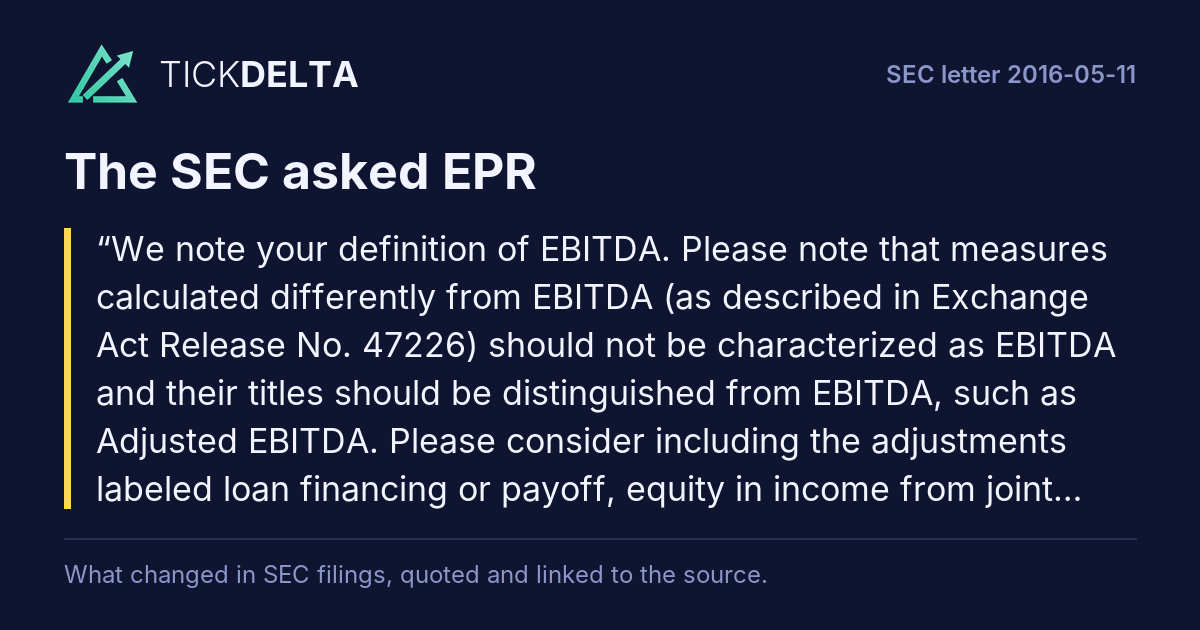
We note your definition of EBITDA. Please note that measures calculated differently from EBITDA (as described in Exchange Act Release No. 47226) should not be characterized as EBITDA and their titles should be distinguished from EBITDA, such as Adjusted EBITDA.
Rest of the question

Please consider including the adjustments labeled loan financing or payoff, equity in income from joint ventures, gain on sale of real estate and preferred dividend requirements in your calculation of adjusted EBITDA in future filings. Reference is also made to Question 103.01 of the Compliance and Disclosure Interpretations on Non-GAAP Financial Measures.

EPR answered
In response to the Staff's comment, the Company confirms that in future filings it will not use the term EBITDA to describe measures that are calculated differently from EBITDA as described in Exchange Act Release No. 47226 and Question 103.01 of the Compliance and Disclosure Interpretations on Non-GAAP Financial Measures, and that the Company will properly define and reconcile the Adjusted EBITDA measure used by management.

Subject to future developments which may occur, we intend to revise our disclosure of this measure in future filings as follows:

Adjusted EBITDA

Management uses
Rest of the answer

Adjusted EBITDA in its analysis of the performance of the business and operations of the Company. Management believes Adjusted EBITDA is useful to investors because it excludes various items that management believes are not indicative of operating performance, and that it is an informative measure to use in computing various financial ratios to evaluate the Company. We define Adjusted EBITDA as net income available to common shareholders excluding costs associated with loan refinancing or payoff, interest expense (net), depreciation and amortization, equity in (income) loss from joint ventures, (gain) loss on the sale of real estate, income tax expense (benefit), preferred dividend requirements, the effect of non-cash impairment charges, retirement severance expense, the provision for loan losses and transaction costs (benefits), and which is then multiplied by four to get an annual amount.

Our method of calculating Adjusted EBITDA may be different from methods used by other REITs and, accordingly, may not be comparable to such other REITs. Adjusted EBITDA is not a measure of performance under GAAP, does not represent cash generated from operations as defined by GAAP and is not indicative of cash available to fund all cash needs, including distributions. This measure should not be considered as an alternative to net income for the purpose of evaluating the Company’s performance or to cash flows as a measure of liquidity.

Subject to future developments which may occur, we intend to provide a reconciliation of this measure in future filings as follows:

Three Months Ended March 31,

2016

2015

Adjusted EBITDA:

Net income available to common shareholders of EPR Properties

$

48,228

36,869

Costs associated with loan refinancing or payoff

552

—

Interest expense, net

23,289

18,587

Depreciation and amortization

25,955

19,355

Equity in income from joint ventures

(212

)

(164

Gain on sale of real estate

(23,924

Income tax expense (benefit)

(144

8,426

Preferred dividend requirements

5,952

Retirement severance expense

18,578

Transaction costs

444

1,606

Adjusted EBITDA (for the quarter)

104,064

85,285

Adjusted EBITDA (1)

416,256

341,140

(1) Adjusted EBITDA for the quarter is multiplied by four to calculate an annual amount.

Any other remaining references to EBITDA will be deleted.

* * * * * * * * *

The Company acknowledges that:

• the Company is responsible for the adequacy and accuracy of the disclosure in the filing;

Staff comments or changes to disclosure in response to Staff comments do not foreclose the Commission from taking any action with respect to the filing; and the Company may not assert Staff comments as a defense in any proceeding initiated by the Commission or any person under the federal securities laws of the United States.

Read in the reply
In its next report

First report after the company's reply of May 20, 2016: 10-Q filed Aug 4, 2016 ↗, against the 10-Q filed Apr 29, 2016 ↗.

Tickdelta does not hold the text of both reports, so they are not compared here.

Also in this review: closing letter, 2016-05-24

Form 10-K for the fiscal year ended December 31, 2012

2013-05-23 to 2013-08-20 · 6 questions · 3 letters from the SEC, 3 from the company
Review closed 2013-08-20
AcquisitionsLegal and contingenciesLeases
Form 10-K for the year ended December 31, 2012 · General, page 5
SEC asked (1)
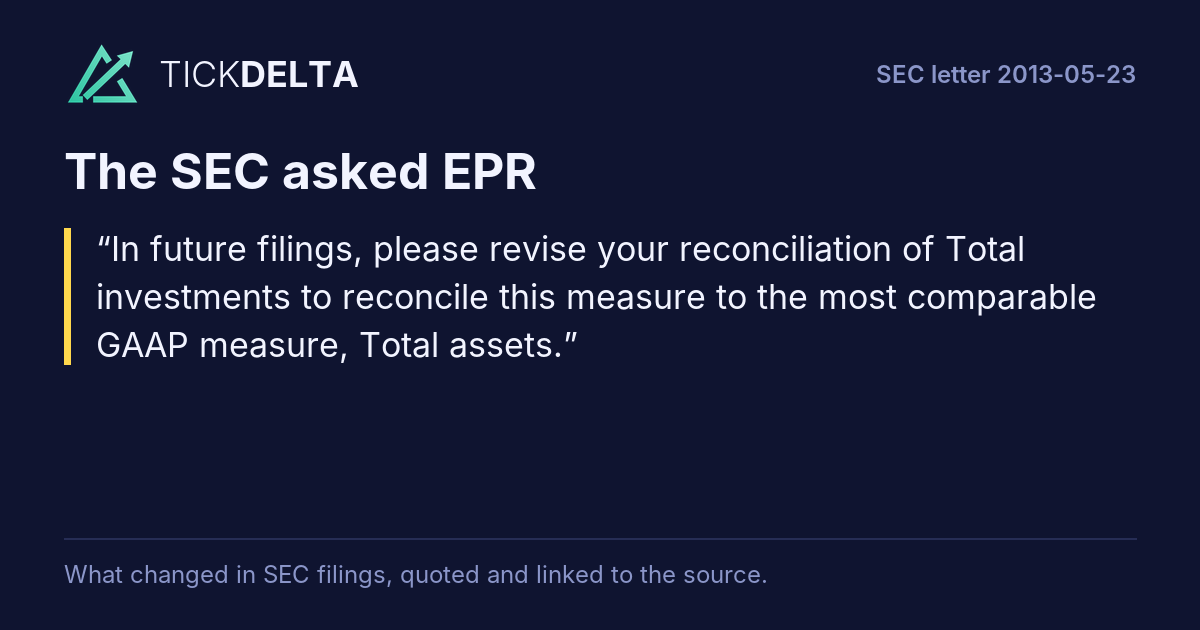
In future filings, please revise your reconciliation of Total investments to reconcile this measure to the most comparable GAAP measure, Total assets.
EPR answered
In future periodic filings, we will provide a reconciliation of Total investments to Total assets.
Read in the reply
Consolidated Statements of Income, page 56
SEC asked (2)
Although you do not participate in traditional lending and deposit activities, we note that you earn interest income from mortgage related investments. Tell us what consideration you gave to using a net interest income presentation consistent with Article 9 and SAB 11-K (FASB ASC 942-10-S99-4).
EPR answered
We have considered Article 9 and SAB 11-K (FASB ASC 942-10-S99-4) and have determined that a net interest income presentation is not relevant to an understanding of our operations.

The Company is a property REIT that executes primarily long-term triple net leases of property with tenants. In select cases, we use mortgage notes receivable, most of which are structured in a manner similar to our long-term triple net leases.
Rest of the answer

As such, mortgage notes receivable represent a smaller portion of our investments (approximately 16% of our total assets at March 31, 2013) and interest income from mortgage notes receivable (excluding direct financing lease income related to owned assets) represents a smaller portion of our revenue (approximately 13% of our total revenue for the three months ended March 31, 2013). We do not hold investment securities (such as treasury notes or other government securities), are not involved with traditional lending and deposit activities, generally do not charge loan origination fees and none of the mortgage notes receivable to date have been issued at a discount or a premium. We incur interest expense on long-term debt; however, our secured long-term debt is not secured by any of our mortgage notes receivable. Rather, certain of the entities that hold the mortgage notes receivable are included as guarantor borrowers for our unsecured long-term debt.

Accordingly, our operations are not similar in nature to bank holding companies or savings and loans, and we do not believe that a net interest income presentation would be meaningful. Furthermore, such presentation is not typical in our industry and would likely confuse investors. We do note that we currently disclose our accounting policies with respect to mortgage notes receivable as well as provide detail of all our mortgage notes receivable (including key terms) in the footnotes to our financial statements.

Read in the reply
In its next report

First report after the company's reply of Jun 17, 2013: 10-Q filed Jul 26, 2013 ↗, against the 10-Q filed May 1, 2013 ↗.

Tickdelta does not hold the text of both reports, so they are not compared here.

Accounting for Acquisitions, page 63
SEC asked (3)
Please tell us how you have determined the acquisition of real property not subject to an in-place lease is a business combination rather than an asset acquisition. 8. Cappelli Litigation and Sullivan County Planned Casino and Resort Development, page 73
EPR answered
We analyze each real estate acquisition to determine if it meets the criteria to be accounted for as a business combination set forth in FASB ASC 805 Topic on Business Combinations or as an asset acquisition set forth in FASB ASC subtopic 805-10. At this time, most of our property acquisitions do not meet the criteria to be a business combination and are accounted for as asset acquisitions because: (i) they are typically structured as long-term triple net leases with one tenant; and (ii) we do not operate the properties in any manner.
Rest of the answer

However, we may from time to time, enter into a property acquisition that qualifies as a business combination, and in these instances, the property typically includes in-place leases. We will clarify our disclosure on Accounting for Acquisitions to explain the difference between the accounting for asset acquisitions versus business combinations in our next Annual Report on Form 10-K. Included below are the two proposed paragraphs that would replace the first two existing paragraphs:

Accounting for Acquisitions

Upon acquisitions of real estate properties, the Company determines if the acquisition meets the criteria to be accounted for as a business combination set forth in FASB ASC Topic 805 on Business Combinations (Topic 805). If the transaction is determined not to be a business combination, it is accounted for as an asset acquisition. Costs incurred for asset acquisitions and development properties, including transaction costs, are capitalized. For asset acquisitions, the Company allocates the purchase price and other related costs incurred to the real estate assets acquired based on recent independent appraisals and management judgment.

If the acquisition is determined to be a business combination, the Company records the fair value of acquired tangible assets (consisting of land, building, tenant improvements, and furniture, fixtures and equipment) and identified intangible assets and liabilities (consisting of above and below market leases, in-place leases, tenant relationships and assumed financing that is determined to be above or below market terms) as well as any noncontrolling interest in accordance Topic 805. In addition, in accordance with Topic 805, acquisition-related costs in connection with business combinations are expensed as incurred, rather than capitalized. Costs related to such transactions, as well as costs associated with terminated transactions, are included in the accompanying Consolidated Statements of Income as transaction costs. Transaction costs expensed totaled $[X] million, $0.4 million and $1.7 million for the years ended December 31, 2013, 2012 and 2011, respectively.

The remainder of the disclosure in this section is expected to remain the same.

8. Cappelli Litigation and Sullivan County Planned Casino and Resort Development, page 73

Read in the reply
In its next report

First report after the company's reply of Jun 17, 2013: 10-Q filed Jul 26, 2013 ↗, against the 10-Q filed May 1, 2013 ↗.

Tickdelta does not hold the text of both reports, so they are not compared here.

Accounting for Acquisitions, page 63
SEC asked (4)
In future filings, please revise to disclose the amount of reasonably possible losses or range of losses in excess of amounts accrued for all legal proceedings and other contingencies or, where applicable, to state that such an estimate of the possible loss or range of loss cannot be made. Refer to ASC 450-20-50. Please provide us with your proposed disclosure.
EPR answered
In accordance with FASB ASC 450-20-50, the Company discusses in its commitments and contingencies footnote those matters for which it believes that the likelihood of a material loss is at least reasonably possible. If there is at least a reasonable possibility that a loss exceeding amounts already recognized may be incurred, the Company includes additional disclosure.
Rest of the answer

For matters where the loss can be reasonably estimated, the Company discloses (either individually or in the aggregate) an estimate or range of possible loss in excess of amounts accrued, if any (or, if applicable, state that the estimated possible loss is immaterial in lieu of providing quantified amounts). In future periodic filings, if the loss cannot be reasonably estimated, the Company will state that an estimate of the additional loss or range of loss cannot be made.

Accordingly, in future periodic filings, we propose revising the disclosure included in Note 8 to the Consolidated Financial Statements in our Annual Report on Form 10-K regarding the litigation involving Louis Cappelli, Concord Associates, L.P., Concord Resort, LLC and Concord Kiamesha LLC to clarify the application of this policy as follows (marked to reflect changes, which also include clarifications included in our Quarterly Report on Form 10-Q for the quarter ended March 31, 2013):

On June 7, 2011, affiliates of Louis Cappelli, Concord Associates, L.P., Concord Resort, LLC and Concord Kiamesha LLC (the "Cappelli Group"), filed a complaint with the Supreme Court of the State of New York, County of Sullivan, against a subsidiarytwo subsidiaries of the Company seeking (i) a declaratory judgment on certain of one of the subsidiary's obligations under a previously disclosed settlement agreement involving these entities, (ii) an order that the Company subsidiary execute the golf course lease and the “Racino Parcel” lease subject to the settlement agreement, and (iii) an extension of the restrictive covenant against ownership or operation of a casino on the Concord resort property under the settlement agreement, which covenant was set to expire on December 31, 2011. The Company subsidiaries filed counterclaims seeking related relief. The Cappelli Group subsequently obtained leave to discontinue its claims, but the counterclaims remain pending. On October 20, 2011, the Cappelli Group filed a complaint with the Supreme Court of the State of New York, County of Westchester against the Company and certain of its subsidiaries alleging breach of contract and breach of the duty of good faith and fair dealing with respect to a casino development agreement relating to a planned casino and resort development in Sullivan County, New York. Plaintiffs are seeking specific performance with respect to such agreement and money damages of $800.0 million, plus interest and attorneys' fees. On March 7, 2012, Concord Associates, L.P. and sevensix other companies affiliated with Mr. Cappelli and Concord Associates, L.P. filed a new complaint against the Company and certain of its subsidiaries, as well as Empire Resorts, Inc. and its subsidiary Monticiello Raceway Management, Inc. (the “Empire Resorts Parties”), in the United States District Court for the Southern District of New York. On June 25, 2012, an amended complaint was served against the same parties as well as Kien Huat Realty III Limited and Genting New York, LLC (the “Genting Parties”). The amended complaint alleges unlawful restraint of trade, conspiracy to monopolize and unlawful monopolization, against the Company, the Empire Resorts partiesParties and the Genting Parties as well as tortious interference against the Empire Resorts partiesParties and the Genting Parties, in relation to a proposed development transaction on the same Sullivan County, New York resort property. Plaintiffs seek damages of $1.5 billion, plus interest and attorneys' fees.

The Company has not determined that losses related to these matters are probable. Because these matters are in the early stages of discovery, together with the inherent difficulty of predicting the outcome of litigation generally, the Company does not have sufficient information to determine the amount or range of reasonably possible loss with respect to these matters. The Company's assessments are based on estimates and assumptions that have been deemed reasonable by management, but that may prove to be incomplete or inaccurate, and unanticipated events and circumstances may occur that might cause the Company to change those estimates and assumptions. The Company intends to vigorously defend the claims asserted against the Company and certain of its subsidiaries by the Concord entitiesCappelli Group, for which itthe Company believes it has meritorious defenses, but it is too early to assess thethere can be no assurances as to its outcome.

If relevant facts and circumstances were to change in the future, the Company will consider the guidance in FASB ASC 450-20-50 and provide appropriate updated disclosures in its future filings.

* * * * * * * * *

The Company acknowledges that:

• the Company is responsible for the adequacy and accuracy of the disclosure in the filing;

Staff comments or changes to disclosure in response to Staff comments do not foreclose the Commission from taking any action with respect to the filing; and the Company may not assert Staff comments as a defense in any proceeding initiated by the Commission or any person under the federal securities laws of the United States.

Read in the reply
In its next report

First report after the company's reply of Jun 17, 2013: 10-Q filed Jul 26, 2013 ↗, against the 10-Q filed May 1, 2013 ↗.

Tickdelta does not hold the text of both reports, so they are not compared here.

Form 10-K for the year ended December 31, 2012 · Accounting for Acquisitions, page 63
SEC asked
We have reviewed your response to comment 3. Please provide us with additional details about your criteria for determining when an acquisition is a business combination. Please specify each of the key criteria you evaluate for your typical acquisition types, and tell us why you believe each acquisition type does or does not meet the definition of a business.
Rest of the question

Please revise your accounting policy related to acquisitions in future filings to disclose these criteria, and show us your intended disclosure in your response.

EPR answered
EPR reviews the provisions of FASB Accounting Standards Codification Topic 805 on Business Combinations ("Topic 805") to determine whether an acquisition should be treated as a business combination or an asset acquisition and applies the definition of the term "business" and related guidance set forth in Topic 805 to the transaction. If the assets acquired do not meet the definition of a business under Topic 805, EPR accounts for the transaction as an asset acquisition.
Rest of the answer

If the assets acquired meet the definition of a business under Topic 805, thereby making the acquisition a business combination, EPR applies the acquisition method for a business combination as provided for in Topic 805.

Topic 805 defines the term "business" as "[a]n integrated set of activities and assets that is capable of being conducted and managed for the purpose of providing a return in the form of dividends, lower costs, or other economic benefits directly to investors or other owners, members, or participants." Topic 805 sets forth additional guidance on what constitutes a business and provides that a business is comprised of three elements: input; process; and output. Topic 805 defines the first element, input, as "[a]ny economic resource that creates, or has the ability to create, outputs when one or more processes are applied to it." Topic 805 defines the second element, process, as "[a]ny system, standard, protocol, convention, or rule that when applied to an input or inputs, creates or has the ability to create outputs." Topic 805 provides examples of what constitutes a process, which include "strategic management processes, operational processes, and resource management processes," but which typically exclude "[a]ccounting, billing, payroll, and other administrative systems." With respect to the third element, output, Topic 805 provides that outputs are created by the combination of the first two elements (i.e., inputs and processes applied to those inputs), but are not required for an integrated set to qualify as a business.

In conducting an analysis of the application of Topic 805, EPR reviews the detailed definitions of inputs, processes and outputs for each acquisition. Typically, EPR acquires single occupancy, special purpose properties that are leased under long-term triple-net leases. Under a triple-net lease, the lessee is responsible for paying all expenses associated with operating and maintaining the property in addition to rent. These expenses include taxes, insurance, utilities and maintenance expense. The lessee under a triple-net lease is also generally responsible for maintenance capital expenditures. If EPR acquires multiple properties in one transaction (for example, a portfolio of several theatres), these properties are usually leased to one tenant under a long-term master triple-net lease or if separate leases are entered into, each lease generally contains a cross-default provision pursuant to which a default under one lease would result in a default under each other lease with that operator. In each of these cases, EPR is not operating such properties in any way.

Accordingly, in applying Topic 805 to these types of acquisitions, we believe the first element necessary to qualify as a business under Topic 805 is satisfied in that it consists of an economic resource, a property or multiple properties, which would provide an input or inputs needed to produce outputs. However, in our typical case, where EPR has a single master triple-net lease or multiple cross-defaulted triple-net leases covering all of the properties in the transaction, EPR conducts no operations at the properties necessary to produce the outputs and, therefore, the second element necessary to qualify as a business under Topic 805 is not met. As a result of the second element not being satisfied (i.e., EPR does not complete any processes at the properties to produce outputs), these types of transactions are accounted for as asset acquisitions.

Alternatively, we do from time to time, enter into property acquisitions with shorter term in-place leases that are not triple-net. An example of this is a multi-tenant entertainment retail center. In these cases, the leases require EPR to be involved in processes such as administering common area maintenance ("CAM"), allocating and billing such CAM by tenant according to the underlying lease provisions and providing frequent leasing activities. In addition, EPR is generally responsible for planning and executing maintenance capital expenditures under these leases. In these cases, the acquisitions would satisfy each element of the definition of a business under Topic 805 as there are inputs, processes and outputs, and such acquisitions are accounted for by EPR as business combinations.

We will clarify our disclosure on Accounting for Acquisitions to explain the difference between the accounting for asset acquisitions versus business combinations in our next Annual Report on Form 10-K. Included below are the three proposed paragraphs that would replace the first two existing paragraphs:

Accounting for Acquisitions

Upon acquisitions of real estate properties, the Company determines if the acquisition meets the criteria to be accounted for as a business combination set forth in FASB ASC Topic 805 on Business Combinations (Topic 805). The Company evaluates the acquisition to determine if it meets the definition of a business as set forth in Topic 805, including analyzing the inputs, processes and outputs. The Company typically enters into transactions with single-tenants under long-term triple-net leases which do not meet the definition of a business as the Company is not involved in the processes of maintaining or operating the properties. Generally, a transaction meets the criteria of a business combination when it includes multiple tenants with frequent leasing activities and common area maintenance processes that the Company is required to manage.

If the transaction is determined not to be a business combination, it is accounted for as an asset acquisition. Costs incurred for asset acquisitions and development properties, including transaction costs, are capitalized. For asset acquisitions, the Company allocates the purchase price and other related costs incurred to the real estate assets acquired based on recent independent appraisals and management judgment.

If the acquisition is determined to be a business combination, the Company records the fair value of acquired tangible assets (consisting of land, building, tenant improvements, and furniture, fixtures and equipment) and identified intangible assets and liabilities (consisting of above and below market leases, in-place leases, tenant relationships and assumed financing that is determined to be above or below market terms) as well as any noncontrolling interest in accordance Topic 805. In addition, in accordance with Topic 805, acquisition-related costs in connection with business combinations are expensed as incurred, rather than capitalized. Costs related to such transactions, as well as costs associated with terminated transactions, are included in the accompanying Consolidated Statements of Income as transaction costs. Transaction costs expensed totaled $[X] million, $0.4 million and $1.7 million for the years ended December 31, 2013, 2012 and 2011, respectively.

The remainder of the disclosure in this section is expected to remain the same.

* * * * * * * * *

The Company acknowledges that:

• the Company is responsible for the adequacy and accuracy of the disclosure in the filing;

Staff comments or changes to disclosure in response to Staff comments do not foreclose the Commission from taking any action with respect to the filing; and the Company may not assert Staff comments as a defense in any proceeding initiated by the Commission or any person under the federal securities laws of the United States.

Read in the reply
In its next report

First report after the company's reply of Jul 2, 2013: 10-Q filed Jul 26, 2013 ↗, against the 10-Q filed May 1, 2013 ↗.

Tickdelta does not hold the text of both reports, so they are not compared here.

Form 10-K for the year ended December 31, 2012 · Accounting for Acquisitions, page 63
SEC asked
We have reviewed your response to our comment and your proposed disclosure. Please provide us with an analysis of the acquisitions you have made in the past three years, and whether or not those acquisitions were treated as asset acquisitions or business combinations.
Rest of the question

For each of these transactions, tell us whether properties were purchased vacant, partially leased, fully leased or whether you entered into a lease in conjunction with the purchase, and what impact this had on your accounting. For the transactions accounted as asset acquisitions, please tell us if you allocate any value to in-place leases, and tell us the amount of transaction costs you have capitalized.

EPR answered
The attached schedule contains the requested information.

Please note that, EPR reviews the provisions of FASB Accounting Standards Codification Topic 805 on Business Combinations ("Topic 805") to determine whether an acquisition should be treated as a business combination or an asset acquisition and applies the definition of the term "business" and related guidance set forth in Topic 805 to the transaction. If the assets acquired do not meet the definition of a business under Topic 805, EPR accounts for the transaction as an asset acquisition.
Rest of the answer

If the assets acquired meet the definition of a business under Topic 805, thereby making the acquisition a business combination, EPR applies the acquisition method for a business combination as provided for in Topic 805. In accordance with our policies, we account for (1) acquired vacant properties, (2) acquired single tenant properties when we sign a new lease or leases at the time of acquisition, and (3) acquired single tenant properties that have an existing long-term triple-net lease or leases (greater than 7 years) as asset acquisitions. Acquisitions of properties with shorter-term leases or properties with multiple tenants that require business-related activities to manage and maintain the properties (i.e. those properties that involve a process) are treated as business combinations.

As previously stated, Topic 805 defines the term "business" as "[a]n integrated set of activities and assets that is capable of being conducted and managed for the purpose of providing a return in the form of dividends, lower costs, or other economic benefits directly to investors or other owners, members, or participants." Topic 805 sets forth additional guidance on what constitutes a business and provides that a business is comprised of three elements: input; process; and output. Topic 805 defines the first element, input, as "[a]ny economic resource that creates, or has the ability to create, outputs when one or more processes are applied to it." Topic 805 defines the second element, process, as "[a]ny system, standard, protocol, convention, or rule that when applied to an input or inputs, creates or has the ability to create outputs." Topic 805 provides examples of what constitutes a process, which include "strategic management processes, operational processes, and resource management processes," but which typically exclude "[a]ccounting, billing, payroll, and other administrative systems." With respect to the third element, output, Topic 805 provides that outputs are created by the combination of the first two elements (i.e. inputs and processes applied to those inputs), but are not required for an integrated set to qualify as a business.

EPR reviews the detailed definitions of inputs, processes and outputs for each acquisition. Typically, EPR acquires single occupancy, special purpose properties that are leased at the time of property acquisition under new long-term triple-net leases that lack a process. Under a triple-net lease, the lessee is responsible for paying all expenses associated with operating and maintaining the property in addition to rent. These expenses include taxes, insurance, utilities and maintenance expense. The lessee under a triple-net lease generally is also responsible for maintenance capital expenditures. If EPR acquires multiple properties in one transaction, these properties are usually leased to one tenant under a long-term master triple-net lease or if separate leases are entered into, each lease generally contains a cross-default provision pursuant to which a default under one lease would result in a default under each other lease with that operator. In each of these cases, EPR is not operating such properties and there is no process.

Accordingly, when we (1) acquire vacant properties, (2) acquire single tenant properties when we sign a new lease or leases at the time of acquisition, and (3) acquire single tenant properties that have an existing long-term triple-net lease or leases (greater than 7 years), EPR acquires no operations at the properties and there is no process. Therefore, the criteria to qualify as a business under Topic 805 are not met. Separately, as demonstrated in the accompanying schedule, our property acquisitions do not typically involve the acquisition of in-place leases.

We will clarify our disclosure on Accounting for Acquisitions to explain the difference between the accounting for asset acquisitions versus business combinations in our next Annual Report on Form 10-K. Included below are the three proposed paragraphs that would replace the first two existing paragraphs:

Accounting for Acquisitions

Upon acquisition of real estate properties, the Company determines if the acquisition meets the criteria to be accounted for as a business combination. Accordingly, the Company accounts for (1) acquired vacant properties, (2) acquired single tenant properties when a new lease or leases are signed at the time of acquisition, and (3) acquired single tenant properties that have an existing long-term triple-net lease or leases (greater than 7 years) as asset acquisitions. Acquisitions of properties with shorter-term leases or properties with multiple tenants that require business related activities to manage and maintain the properties (i.e. those properties that involve a process) are treated as business combinations.

Costs incurred for asset acquisitions and development properties, including transaction costs, are capitalized. For asset acquisitions, the Company allocates the purchase price and other related costs incurred to the real estate assets acquired based on recent independent appraisals and management judgment.

If the acquisition is determined to be a business combination, the Company records the fair value of acquired tangible assets (consisting of land, building, tenant improvements, and furniture, fixtures and equipment) and identified intangible assets and liabilities (consisting of above and below market leases, in-place leases, tenant relationships and assumed financing that is determined to be above or below market terms) as well as any noncontrolling interest. In addition, acquisition-related costs in connection with business combinations are expensed as incurred. Costs related to such transactions, as well as costs associated with terminated transactions, are included in the accompanying Consolidated Statements of Income as transaction costs. Transaction costs expensed totaled $[X] million, $0.4 million and $1.7 million for the years ended December 31, 2013, 2012 and 2011, respectively.

The remainder of the disclosure in this section is expected to remain the same.

* * * * * * * * *

The Company acknowledges that:

• the Company is responsible for the adequacy and accuracy of the disclosure in the filing;

Staff comments or changes to disclosure in response to Staff comments do not foreclose the Commission from taking any action with respect to the filing; and the Company may not assert Staff comments as a defense in any proceeding initiated by the Commission or any person under the federal securities laws of the United States.

Read in the reply
In its next report

First report after the company's reply of Jul 31, 2013: 10-Q filed Nov 6, 2013 ↗, against the 10-Q filed May 1, 2013 ↗.

Tickdelta does not hold the text of both reports, so they are not compared here.

Also in this review: closing letter, 2013-08-20

Letters without questions

Other letters

UPLOAD and CORRESP
3 other letters: notices that a filing will not be reviewed, requests to declare a registration effective, and the like

From the SEC's correspondence on EDGAR: staff letters (form UPLOAD) and company letters (form CORRESP), 15 letters filed since 2012-05-16. Questions and answers are matched by their numbers; topics come from words in each question. The reports are compared word for word (same form, before the first SEC letter against the first report after the company's reply). No AI.

Sources

The SEC's correspondence on EDGAR: staff letters (form UPLOAD) and company letters (form CORRESP), matched question by question. No AI.

Also

Filings: the letters in the filing list.

Work with it

Excel workbook · CSV. Google Sheet that stays up to date: paste =IMPORTDATA("https://tickdelta.com/company/EPR/export.csv") into a cell.

Next in Owners and insiders:Insider trades
Esc

Type a ticker such as AAPL, a name, an investor such as Buffett, or a topic such as tariffs. ↑ ↓ to move, Enter to open.