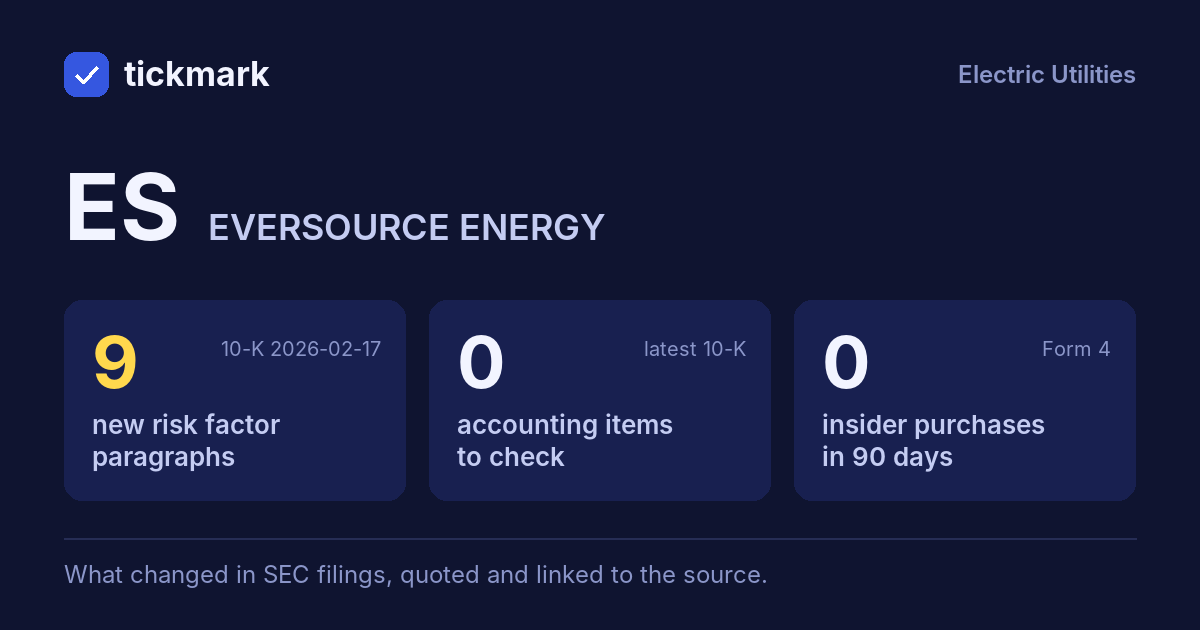
Sentences and paragraphs of ES's Risk Factors and MD&A, 10-K 2026-02-17 against 10-K 2025-02-14.
Each links to the text at sec.gov.
AddedRisk Factors
We deploy AI tools and models in areas such as weather forecasting, grid planning, asset management, customer service and internal support functions. This deployment is overseen by an internal governance and oversight committee, which has established policies and procedures and reviews and approves the use of AI throughout the organization. AI systems may produce inaccurate, biased or otherwise unreliable forecasts or recommendations due to flawed algorithms, limited training data or unforeseen conditions which could result in service disruptions, regulatory penalties and reputational harm. Evolving AI regulations may impose new compliance and reporting obligations or restrict usage and stakeholders may raise concerns about transparency, bias, and accountability. Despite implementing a governance framework and policies and controls in place related to AI use, including human oversight of critical decisions and outputs, these risks could negatively affect operations, expose us to litigation or regulatory penalties or fines, increase costs and impair our ability to meet customer expectations, which could have a material adverse impact on our financial position, results of operations, and cash flows.
Read it in 10-K 2026-02-17 at sec.gov ↗
AddedRisk Factors
Our electric, natural gas, and water utility companies are subject to regulation by federal and state agencies and each is required to engage in regulatory approval proceedings as a part of the process of establishing the terms and rates for service. Our regulated companies are entitled to charge rates that are sufficient to recover prudently incurred costs and a reasonable return on investment on invested capital. Regulatory decisions may require us to cancel, delay, or reduce planned investments or incur costs we cannot recover. Rates are subject to prudency reviews, refunds or disallowances and may not align with the timing of costs incurred. Adverse outcomes, including reductions in allowed rate of return, disallowance of costs or delays in rate adjustment, could adversely affect our financial position, results of operations and cash flows.
Read it in 10-K 2026-02-17 at sec.gov ↗
AddedRisk Factors
Customer affordability concerns, driven by volatility in energy supply costs, evolving public policy mandates and inflationary pressures, may limit our ability to recover costs or fund infrastructure upgrades. Regulators may respond by imposing stricter cost recovery standards, delaying or denying rate increases or cost recovery or requiring alternative funding mechanisms increasing financial uncertainty. Heightened political and public scrutiny of rate-setting processes may also lead to additional compliance obligations or reputational risk. These factors could adversely affect our financial position, results of operations and cash flows.
Read it in 10-K 2026-02-17 at sec.gov ↗
AddedRisk Factors
State commissions regulate rates, operations, accounting and certain financing activities. Rates are set in comprehensive base rate proceedings based on an analysis of invested capital, expenses and other factors, subject to periodic review and adjustments. Regulatory proceedings typically involve multiple parties who have differing concerns and can challenge our current or future rates, and these proceedings can be contentious, lengthy, and subject to appeal. This may lead to uncertainty as to the ultimate result of those proceedings.
Read it in 10-K 2026-02-17 at sec.gov ↗
AddedRisk Factors
Regulatory approval is also required for certain dispositions of property and plant, mergers and consolidations and issuances of long-term securities, and construction and operation of facilities. Failure to obtain required approvals on a timely basis, or at all, could result in increased costs, the postponement or cancellation of planned transactions or projects, changes in financing strategies, and an adverse effect on our financial condition, results of operations, and ability to implement our business strategy.
Read it in 10-K 2026-02-17 at sec.gov ↗
AddedRisk Factors
New processes and planning frameworks, including ISO-NE’s Longer-Term Transmission Planning (LTTP) competitive solicitation process and advisory role as asset condition reviewer, introduce uncertainty around project timing, scope and cost recovery. Competitive solicitations for certain transmission projects may require us to compete against non-incumbent developers, rather than relying on traditional cost-of-service recovery. Failure to secure projects through these processes could reduce transmission investment opportunities and associated incentives, adversely affecting our financial position, results of operations and cash flows.
Read it in 10-K 2026-02-17 at sec.gov ↗
AddedRisk Factors
Our electric, natural gas and water utility subsidiaries serve large customer bases and are subject to adverse publicity regarding service safety, reliability and response times to outages, leaks or other interruptions, including those related to storms or climate change. Negative publicity can harm our reputation, influence legislative and regulatory bodies, and result in unfavorable outcomes, such as stricter operational standards, vegetation management requirements, fines, penalties or other sanctions.
Read it in 10-K 2026-02-17 at sec.gov ↗
Show the other 13
AddedRisk Factors
We also depend on third-party suppliers for power and natural gas. Factors such as inflation, tariffs, geopolitical conflicts, rising energy demand, supply costs, and public policy charges contribute to high customer bills in New England. In extreme cases, ISO-NE may require load shed if regional power capacity is insufficient. High customer bills or failure to meet energy needs could reduce customer satisfaction adversely affecting our business, reputation, financial position, results of operations, and cash flows.
Read it in 10-K 2026-02-17 at sec.gov ↗
AddedMD&A
•On July 25, 2025, the NHPUC issued its decision in the PSNH distribution rate case and approved a permanent rate increase of $100.7 million, effective August 1, 2025, inclusive of the temporary rate increase that went into effect in August 2024. The order established an authorized regulatory ROE of 9.5 percent with a 50 percent common equity ratio for PSNH’s capital structure. The NHPUC approved an alternative regulatory framework that authorizes formulaic annual revenue adjustments on August 1st of 2026, 2027 and 2028.
Read it in 10-K 2026-02-17 at sec.gov ↗
AddedMD&A
•On November 3, 2025, EGMA, NSTAR Electric, and the Massachusetts Office of the Attorney General reached a joint settlement agreement that resolved outstanding issues in multiple open Pension Adjustment Mechanism (PAM) dockets and open Resiliency Tree Work (RTW) dockets at NSTAR Electric and allows recovery of transaction and integration costs related to Eversource’s acquisition of EGMA. The settlement agreement was approved by the DPU on December 1, 2025. The settlement resulted in a net pre-tax benefit to earnings of $64.8 million on the Eversource income statement in the fourth quarter of 2025.
Read it in 10-K 2026-02-17 at sec.gov ↗
AddedMD&A
•On November 5, 2025, PURA issued a final decision in the Yankee Gas distribution rate case that included a distribution rate increase of $95.7 million, which excluded a previously recorded non-firm margin rate credit of $13.5 million to be refunded annually over three years, effective November 1, 2025. The final decision also established an authorized net regulatory ROE of 9.32 percent and a 53 percent common equity ratio for Yankee Gas’ capital structure. Yankee Gas filed motions to request PURA reconsider the disallowances of certain capitalized overhead costs, certain computational errors, and other issues identified in its final decision. A final decision on the reconsideration is expected from PURA by March 15, 2026.
Read it in 10-K 2026-02-17 at sec.gov ↗
AddedMD&A
•On November 19, 2025, PURA denied an application to approve the sale of the Aquarion Water Company, finding that the transaction did not meet managerial suitability and responsibility requirements due to concerns with governance and oversight structure over Aquarion and its consumer advocate. On January 15, 2026, the Connecticut Superior Court issued a decision on the appeal of PURA’s denial, sustaining the appeal and remanding back to PURA. A final decision is expected by PURA on March 25, 2026.
Read it in 10-K 2026-02-17 at sec.gov ↗
AddedMD&A
•On December 30, 2025, NSTAR Gas and the Massachusetts Office of the Attorney General reached a joint settlement agreement that allowed for the reinstatement of a rate base reset of $45.0 million increase to base distribution rates effective January 1, 2026 and for continuation of NSTAR Gas’ PBR program through November 1, 2030. The settlement agreement also required NSTAR Gas to provide credits to customers and a concession to the Office of the Attorney General, among other items. The DPU approved the settlement agreement on January 16, 2026. The settlement agreement resulted in a pre-tax charge to earnings of $12.2 million in the fourth quarter of 2025.
Read it in 10-K 2026-02-17 at sec.gov ↗
AddedMD&A
•On January 30, 2026, the New Hampshire Department of Energy filed a notice of appeal with the New Hampshire Supreme Court challenging certain aspects of the PSNH distribution rate case decision approved by the NHPUC on July 25, 2025, including the alternative regulatory framework and the revenue requirement. On February 6, 2026, the Office of the Consumer Advocate filed a notice of cross-appeal challenging other aspects of the rate case decision. Eversource is currently evaluating the appeals.
Read it in 10-K 2026-02-17 at sec.gov ↗
AddedMD&A
The impact of higher shares outstanding resulted in $0.17 earnings per share dilution in 2025, as compared to 2024.
Read it in 10-K 2026-02-17 at sec.gov ↗
AddedMD&A
Eversource Parent and Other Companies: Eversource parent and other companies’ losses decreased $425.8 million in 2025, as compared to 2024, due primarily to an after-tax charge of $524.0 million recorded in 2024 resulting from the sale of Eversource parent’s offshore wind investments, as compared to an aggregate net after-tax charge of $75.0 million recorded in 2025 resulting from an increase to the offshore wind contingent liability, net of tax benefits associated with the tax losses on the sales of its offshore wind investments.
Read it in 10-K 2026-02-17 at sec.gov ↗
AddedMD&A
Excluding these charges, Eversource parent and other companies losses increased $23.2 million due to higher interest expense from the absence in 2025 of capitalized interest as a result of the sale of our offshore wind projects in the third quarter of 2024 and higher interest costs from short-term debt, partially offset by the allowed recovery of previously expensed acquisition-related and integration costs of EGMA as part of the joint settlement agreement approved in Massachusetts on December 1, 2025.
Read it in 10-K 2026-02-17 at sec.gov ↗
AddedMD&A
In the third quarter of 2025, Eversource received an updated report from GIP on the construction status of Revolution Wind, which included revised projections of total construction costs. The revised cost projections reflected known and quantifiable cost increases, including those associated with the impacts of damage to the wind turbine installation vessel, insurance costs, tariff impacts, and costs incurred as a result of the stop-work order for Revolution Wind received on August 22, 2025 from the Bureau of Ocean Energy Management that halted all offshore wind construction activities through September 22, 2025. Based on those developments, Eversource recognized a pre-tax charge of $284.0 million in the third quarter of 2025 as a result of the aggregate impact of these items to increase the liability for purchase price adjustments associated with the offshore wind projects.
Read it in 10-K 2026-02-17 at sec.gov ↗
AddedMD&A
Payments made in 2025 reduced the contingent liability and are reflected within investing activities on the statement of cash flows. These payments included cost overruns for the Revolution Wind project paid to GIP, insurance payments, and the purchase price adjustment payment related to the South Fork Wind project paid to GIP.
Read it in 10-K 2026-02-17 at sec.gov ↗
AddedMD&A
Eversource continually evaluates the contingent liability and will reassess the balance as new information becomes available. Based on most recent updates from GIP on the construction status of Revolution Wind, factoring in estimated costs incurred as a result of a second stop-work order for Revolution Wind received on December 22, 2025 and removed on January 12, 2026, revised insurance costs, and other information currently available, Eversource believes that the contingent liability balance as of December 31, 2025 is a reasonable estimate to cover this contingent liability for purchase price adjustments. As of December 31, 2025, the contingent liability totaled $448.2 million and is recorded as a current liability on Eversource’s balance sheet, based upon the timing of expected payments to GIP. The contingent liability totaled $365.0 million as of December 31, 2024.
Read it in 10-K 2026-02-17 at sec.gov ↗