Paragraph 38 · 49% changed
Every version of it
Screener
/
SEC EDGAR
/CIK 0001877322
/10-K filed Feb 20, 2026, compared with Feb 20, 2025
/Numbers from the XBRL of the 10-Ks
NYSE
Industrials · Industrial Machinery
ESAB Corp ESAB
The 10-K against last year's
96 changes: 10 added, 8 removed, 77 reworded, 1 quiet changes
10-K Feb 20, 2026 vs Feb 20, 2025
Risk Factors
9.0%
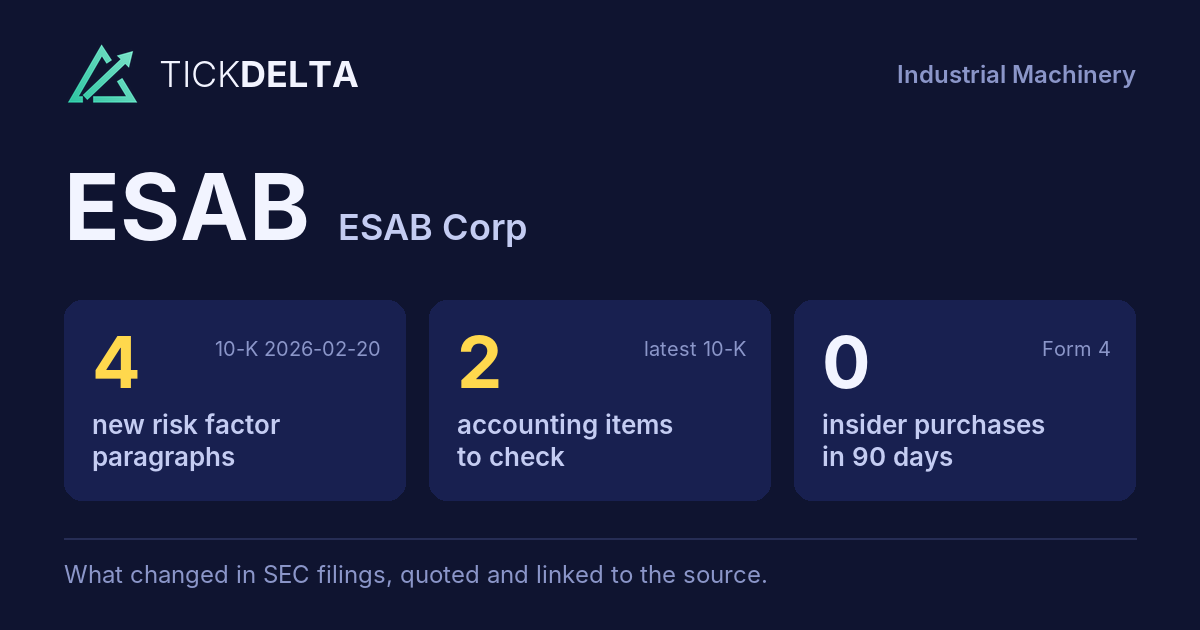
of the text changed · 11,874 words now · 4 new paragraphs, 0 gone
MD&A
16.0%
of the text changed · 7,871 words now · 6 new paragraphs, 8 gone
Legal Proceedings
7.4%
of the text changed · 1,073 words now
Accounting Policies
10.6%
of the text changed · 3,571 words now
10-K 0001877322-26-000007 (Feb 20, 2026) vs 10-K 0001877322-25-000021 (Feb 20, 2025)
Every paragraph, and how much of it changed
One bar per paragraph, in the order of the 10-K. Height and colour show the share of its words not in the closest paragraph a year earlier; the tallest bars are new paragraphs.
Risk Factors
129 paragraphs · 4 new · 40 reworded · 0 gone · 10-K Feb 20, 2026 against Feb 20, 2025
New paragraph
Reworded (5% of its words or more)
Same or nearly
Paragraph 78 · 48% changed
Every version of it
Paragraph 9 · 44% changed
Every version of it
Additionally, changes in United States policy regarding international trade, including import and export regulation and international trade agreements, could also negatively impact our business. In 2018, For example, in 2025, the United States imposed expanded and increased existing tariffs on steel and aluminum, imposing 50% tariffs on steel, aluminum as well as and products containing steel and aluminum from a range of United States trading partners. The United States has also announced other significant tariffs on goods imported imports from China and certain other a wide range of countries, including China, which resulted in was followed by retaliatory tariffs by China and other countries. In addition, a number of countries and a cycle of further retaliatory tariff announcements and trade actions. While certain of the new Trump administration has proposed tariffs on imports from have been and may be delayed, others have taken or may take effect. Further, tariffs announced or imposed by the United States could be altered or delayed through presidential actions, bilateral negotiations, judicial orders or congressional action, and tariffs announced or imposed by other countries can be affected by similar developments. These and other future changes to United States policy regarding international trade. Additional in tariffs imposed and trade policies by the United States on imports from China or other countries, or retaliatory trade measures in response, could have resulted and may continue to result in an increase in additional costs and pricing pressures, supply chain costs disruptions, volatile or unpredictable customer spending patterns and increased economic or geopolitical risk that we may not be able to offset or otherwise otherwise, any or all of which could adversely impact our business and relative competitive position, financial condition and results of operations. operations, perhaps materially or in ways that we cannot predict.
Paragraph 8 · 43% changed
Every version of it
restrictive than in the United States; changes in laws and regulations, including taxation policies, or in how such provisions are interpreted or administered; difficulties in enforcing our rights outside the United States, including intellectual property rights; difficulties in hiring and maintaining qualified staff and managing geographically diverse operations; the disruption of operations from natural or man-made disasters or adverse weather conditions (including events that may be caused or exacerbated by climate change), world health events, labor or political disturbances, terrorist activities, insurrection or war; the imposition of additional foreign governmental controls or regulations on the sale of our products; increased costs of transportation or shipping; and uncertainties arising from local business practices and cultural considerations.
Paragraph 93 · 42% changed
Every version of it
Paragraph 44 · 24% changed
Every version of it
On April 4, 2022, the Company entered into a credit agreement (as amended and restated from time-to-time, the “Credit Agreement”). On October 16, 2025, the Company entered into an Amended and Restated Credit Agreement (the “A&R Credit Agreement”). The A&R Credit Agreement, which governs our term loan and revolving credit facility, contain contains restrictive covenants covenants, including for example, earnings before interest, taxes, depreciation and amortization (“EBITDA”) based leverage and interest coverage ratios, that limit our ability to engage in activities that may be in our long-term interest, including for example EBITDA-based leverage and interest coverage ratios. interest. If we breach any of these restrictions and cannot are unable to obtain a waiver from the lenders on favorable terms, subject to applicable cure periods, the outstanding indebtedness (and any other indebtedness with cross-default provisions) could be declared immediately due and payable, which would adversely affect our liquidity and financial statements. On April 9, 2024, the Company issued $700.0 million in aggregate principal amount of 6.25% senior notes due 2029 (the “Senior Notes”) governed by an indenture (the “Indenture”). The Indenture also includes certain restrictive covenants. In addition, any failure to obtain and maintain credit ratings from independent rating agencies would adversely affect our cost of funds and could adversely affect our liquidity and access to the capital markets. See “Liquidity and Capital Resources.”
Paragraph 66 · 21% changed
Every version of it
Our future effective income tax rates could be unfavorably affected by various factors, including, among others, changes in tax rates, changes in mix of earnings and losses and changes in rules and regulations in jurisdictions in which we generate income. A number of the countries where we operate have implemented, and are considering implementing, changes in relevant tax, accounting and other laws, regulations and interpretations. Additionally, longstanding international tax norms that determine each country’s jurisdiction to tax cross-border international trade are subject to potential evolution. For example, many countries have enacted, proposed, or are considering enacting changes to their legislation to implement the adoption of the Organization for Economic Co-operation and Development’s (“OECD”) model rules for the global minimum corporate tax of 15% for companies with global revenues and profits above certain thresholds (commonly referred to as Pillar Two). While the United States has not yet adopted Pillar Two, and the Group of Seven countries have proposed to exempt United States multinational companies from Pillar Two by adopting a “side-by-side” system between Pillar Two and the existing United States global minimum tax provisions, various other jurisdictions in which we operate around the world have enacted legislation and the OECD continues to release additional guidance. Based upon existing legislation and OECD guidance, Pillar Two could increase our future tax obligations in the countries in which we operate. As these and other tax laws, regulations and norms change or evolve, our financial results could be materially impacted. Given the unpredictability of these possible changes, we currently cannot assess whether the overall effect of such potential tax changes could adversely impact our financial results. We are continuing to evaluate and monitor the impacts of Pillar Two legislation or other tax initiatives in the jurisdictions where we operate. do business. On July 4, 2025, the One Big Beautiful Bill Act (the “Act”) was signed into law. The Act makes permanent key elements of the Tax Cuts and Jobs Act, including 100 percent bonus depreciation and domestic research cost expensing, and modifications to the international tax framework. The Act also makes modifications to the interest limitation rules that may result in a material increase in the amount of carryforward interest expense under Section 163(j) and our ability to utilize the carryforward would depend on the Company’s United States EBITDA in future years. The Act includes multiple effective dates, with certain provisions effective in 2025 and others phased-in through 2027. We continue to evaluate the impact of the Act's provisions that take effect in future years.
Paragraph 54 · 18% changed
Every version of it
The market for many of our products is, in part, dependent upon patent, trademark, copyright and trade secret laws, agreements with employees, customers and other third parties including confidentiality agreements, invention assignment agreements and proprietary information agreements, to establish and maintain our intellectual property rights. The protection and enforcement of these intellectual property rights is therefore material to our business. The failure to protect these rights may have a material adverse effect on our business, financial condition and results of operations. Litigation may be required to enforce our intellectual property rights, protect our trade secrets or determine the validity and scope of proprietary rights of others. It may be particularly difficult to enforce our intellectual property rights in countries where such rights are not highly developed or protected. Any action we take to protect or enforce our intellectual property rights could be costly and could absorb significant management time and attention. As a result of any such litigation, we could lose our proprietary rights.
Paragraph 38 · 49% changed
Every version of it
10-K Feb 20, 2025We have outstanding debt and other financial obligations and unused borrowing capacity and may incur or assume more debt in the future. As of December 31, 2024, we have $1.1 billion of outstanding indebtedness. We also have the ability to incur an additional $50.0 million of indebtedness pursuant to certain uncommitted credit lines, access up to $750.0 million under our revolving credit facility under our Credit Agreement (as defined below), and in the future we may incur additional indebtedness. See “Liquidity and Capital Resources.” Our existing and any future debt could have important, adverse consequences to us and our investors, including:
10-K Feb 20, 2026
additional indebtedness. See “Liquidity and Capital Resources.” Our existing and any future debt could have important, adverse consequences to us and our investors, including:
Paragraph 78 · 48% changed
Every version of it
10-K Feb 20, 2025We have entered into derivatives to manage our exposure to interest rate and currency movements. If we do not accurately forecast our results of operations, execute contracts that do not effectively mitigate our economic exposure to interest rates, elect to not apply hedge accounting, or fail to comply with the complex accounting requirements for hedging, our results of operations and cash flows could be volatile, as well as negatively impacted. Additionally, some of our hedging activity addresses long-term exposures, such as our net investment in our subsidiaries. If we fail to comply with hedge accounting requirements, the gains or losses on those hedges could be recognized before the offsetting exposure materializes to offset them, potentially causing volatility in our earnings, cash or debt balances and therefore our leverage.
10-K Feb 20, 2026
requirements, the gains or losses on those hedges could be recognized before the offsetting exposure materializes to offset them, potentially causing volatility in our earnings, cash or debt balances and therefore our leverage.
Paragraph 9 · 44% changed
Every version of it
10-K Feb 20, 2025
Additionally, changes in United States policy regarding international trade, including import and export regulation and international trade agreements, could also negatively impact our business. In 2018, the United States imposed tariffs on steel and aluminum as well as on goods imported from China and certain other countries, which resulted in retaliatory tariffs by China and other countries. In addition, the new Trump administration has proposed tariffs on imports from other countries and other changes to United States policy regarding international trade. Additional tariffs imposed by the United States on imports from China or other countries, or retaliatory trade measures in response, could result in an increase in supply chain costs that we may not be able to offset or otherwise adversely impact our results of operations.
10-K Feb 20, 2026
Additionally, changes in United States policy regarding international trade, including import and export regulation and international trade agreements, could also negatively impact our business. For example, in 2025, the United States expanded and increased existing tariffs on steel and aluminum, imposing 50% tariffs on steel, aluminum and products containing steel and aluminum from a range of United States trading partners. The United States has also announced other significant tariffs on imports from a wide range of countries, including China, which was followed by retaliatory tariffs by China and a number of countries and a cycle of further retaliatory tariff announcements and trade actions. While certain of the tariffs have been and may be delayed, others have taken or may take effect. Further, tariffs announced or imposed by the United States could be altered or delayed through presidential actions, bilateral negotiations, judicial orders or congressional action, and tariffs announced or imposed by other countries can be affected by similar developments. These and future changes in tariffs and trade policies by the United States on imports from China or other countries, or retaliatory trade measures in response, have resulted and may continue to result in additional costs and pricing pressures, supply chain disruptions, volatile or unpredictable customer spending patterns and increased economic or geopolitical risk that we may not be able to offset or otherwise, any or all of which could adversely impact our business and relative competitive position, financial condition and results of operations, perhaps materially or in ways that we cannot predict.
Paragraph 8 · 43% changed
Every version of it
10-K Feb 20, 2025
health events, labor or political disturbances, terrorist activities, insurrection or war; the imposition of additional foreign governmental controls or regulations on the sale of our products; increased costs of transportation or shipping; and uncertainties arising from local business practices and cultural considerations.
10-K Feb 20, 2026
restrictive than in the United States; changes in laws and regulations, including taxation policies, or in how such provisions are interpreted or administered; difficulties in enforcing our rights outside the United States, including intellectual property rights; difficulties in hiring and maintaining qualified staff and managing geographically diverse operations; the disruption of operations from natural or man-made disasters or adverse weather conditions (including events that may be caused or exacerbated by climate change), world health events, labor or political disturbances, terrorist activities, insurrection or war; the imposition of additional foreign governmental controls or regulations on the sale of our products; increased costs of transportation or shipping; and uncertainties arising from local business practices and cultural considerations.
Paragraph 93 · 42% changed
Every version of it
10-K Feb 20, 2025foreign subsidiaries engaged in certain transactions, a limited number of which included United States origin goods, either directly or indirectly through distributors, involving sales to specially designated nationals and/or to the Crimea region of Ukraine, which may have been made in violation of relevant trade sanctions or export control laws. We submitted a voluntary disclosure report to relevant United States government agencies regarding these transactions. On March 26, 2021 and August 26, 2021, the Former Parent received letters from BIS and OFAC, respectively, warning the Former Parent against future violations, and closing their respective matters without further action. No further communications from any other relevant United States government agencies have been received.
10-K Feb 20, 2026
26, 2021, the Former Parent received letters from BIS and OFAC, respectively, warning the Former Parent against future violations, and closing their respective matters without further action. No further communications from any other relevant United States government agencies have been received.
Paragraph 44 · 24% changed
Every version of it
10-K Feb 20, 2025
On April 4, 2022, the Company entered into a credit agreement (as amended and restated from time-to-time, the “Credit Agreement”). The Credit Agreement, which governs our term loan and revolving credit facility, contain restrictive covenants that limit our ability to engage in activities that may be in our long-term interest, including for example EBITDA-based leverage and interest coverage ratios. If we breach any of these restrictions and cannot obtain a waiver from the lenders on favorable terms, subject to applicable cure periods, the outstanding indebtedness (and any other indebtedness with cross-default provisions) could be declared immediately due and payable, which would adversely affect our liquidity and financial statements. In addition, any failure to obtain and maintain credit ratings from independent rating agencies would adversely
10-K Feb 20, 2026
On April 4, 2022, the Company entered into a credit agreement (as amended and restated from time-to-time, the “Credit Agreement”). On October 16, 2025, the Company entered into an Amended and Restated Credit Agreement (the “A&R Credit Agreement”). The A&R Credit Agreement, which governs our term loan and revolving credit facility, contains restrictive covenants, including for example, earnings before interest, taxes, depreciation and amortization (“EBITDA”) based leverage and interest coverage ratios, that limit our ability to engage in activities that may be in our long-term interest. If we breach any of these restrictions and are unable to obtain a waiver from the lenders on favorable terms, subject to applicable cure periods, the outstanding indebtedness (and any other indebtedness with cross-default provisions) could be declared immediately due and payable, which would adversely affect our liquidity and financial statements. On April 9, 2024, the Company issued $700.0 million in aggregate principal amount of 6.25% senior notes due 2029 (the “Senior Notes”) governed by an indenture (the “Indenture”). The Indenture also includes certain restrictive covenants. In addition, any failure to obtain and maintain credit ratings from independent rating agencies would adversely affect our cost of funds and could adversely affect our liquidity and access to the capital markets. See “Liquidity and Capital Resources.”
Paragraph 66 · 21% changed
Every version of it
10-K Feb 20, 2025
Our future effective income tax rates could be unfavorably affected by various factors, including, among others, changes in tax rates, changes in mix of earnings and losses and changes in rules and regulations in jurisdictions in which we generate income. A number of the countries where we operate have implemented, and are considering implementing, changes in relevant tax, accounting and other laws, regulations and interpretations. Additionally, longstanding international tax norms that determine each country’s jurisdiction to tax cross-border international trade are subject to potential evolution. For example, many countries have enacted, proposed, or are considering enacting changes to their legislation to implement the adoption of the Organization for Economic Co-operation and Development’s (“OECD”) model rules for the global minimum corporate tax of 15% for companies with global revenues and profits above certain thresholds (commonly referred to as Pillar Two). While the United States has not yet adopted Pillar Two, various other jurisdictions in which we operate around the world have enacted legislation and the OECD continues to release additional guidance. Based upon existing legislation and OECD guidance, Pillar Two could increase our future tax obligations in the countries in which we operate. As these and other tax laws, regulations and norms change or evolve, our financial results could be materially impacted. Given the unpredictability of these possible changes, we currently cannot assess whether the overall effect of such potential tax changes could adversely impact our financial results. We are continuing to evaluate and monitor the impacts of Pillar Two legislation in the jurisdictions we operate.
10-K Feb 20, 2026
Our future effective income tax rates could be unfavorably affected by various factors, including, among others, changes in tax rates, changes in mix of earnings and losses and changes in rules and regulations in jurisdictions in which we generate income. A number of the countries where we operate have implemented, and are considering implementing, changes in relevant tax, accounting and other laws, regulations and interpretations. Additionally, longstanding international tax norms that determine each country’s jurisdiction to tax cross-border international trade are subject to potential evolution. For example, many countries have enacted, proposed, or are considering enacting changes to their legislation to implement the adoption of the Organization for Economic Co-operation and Development’s (“OECD”) model rules for the global minimum corporate tax of 15% for companies with global revenues and profits above certain thresholds (commonly referred to as Pillar Two). While the United States has not adopted Pillar Two, and the Group of Seven countries have proposed to exempt United States multinational companies from Pillar Two by adopting a “side-by-side” system between Pillar Two and the existing United States global minimum tax provisions, various other jurisdictions in which we operate around the world have enacted legislation and the OECD continues to release additional guidance. Based upon existing legislation and OECD guidance, Pillar Two could increase our future tax obligations in the countries in which we operate. As these and other tax laws, regulations and norms change or evolve, our financial results could be materially impacted. Given the unpredictability of these possible changes, we currently cannot assess whether the overall effect of such potential tax changes could adversely impact our financial results. We are continuing to evaluate and monitor the impacts of Pillar Two legislation or other tax initiatives in the jurisdictions where we do business. On July 4, 2025, the One Big Beautiful Bill Act (the “Act”) was signed into law. The Act makes permanent key elements of the Tax Cuts and Jobs Act, including 100 percent bonus depreciation and domestic research cost expensing, and modifications to the international tax framework. The Act also makes modifications to the interest limitation rules that may result in a material increase in the amount of carryforward interest expense under Section 163(j) and our ability to utilize the carryforward would depend on the Company’s United States EBITDA in future years. The Act includes multiple effective dates, with certain provisions effective in 2025 and others phased-in through 2027. We continue to evaluate the impact of the Act's provisions that take effect in future years.
Paragraph 54 · 18% changed
Every version of it
10-K Feb 20, 2025
is therefore material to our business. The failure to protect these rights may have a material adverse effect on our business, financial condition and results of operations. Litigation may be required to enforce our intellectual property rights, protect our trade secrets or determine the validity and scope of proprietary rights of others. It may be particularly difficult to enforce our intellectual property rights in countries where such rights are not highly developed or protected. Any action we take to protect or enforce our intellectual property rights could be costly and could absorb significant management time and attention. As a result of any such litigation, we could lose our proprietary rights.
10-K Feb 20, 2026
The market for many of our products is, in part, dependent upon patent, trademark, copyright and trade secret laws, agreements with employees, customers and other third parties including confidentiality agreements, invention assignment agreements and proprietary information agreements, to establish and maintain our intellectual property rights. The protection and enforcement of these intellectual property rights is therefore material to our business. The failure to protect these rights may have a material adverse effect on our business, financial condition and results of operations. Litigation may be required to enforce our intellectual property rights, protect our trade secrets or determine the validity and scope of proprietary rights of others. It may be particularly difficult to enforce our intellectual property rights in countries where such rights are not highly developed or protected. Any action we take to protect or enforce our intellectual property rights could be costly and could absorb significant management time and attention. As a result of any such litigation, we could lose our proprietary rights.
MD&A
114 paragraphs · 6 new · 54 reworded · 8 gone · 10-K Feb 20, 2026 against Feb 20, 2025
New paragraph
Reworded (5% of its words or more)
Same or nearly
Paragraph 93 · 49% changed
Paragraph 28 · 43% changed
(3) Includes transaction expenses, transaction, diligence and integration expenses totaling $31.5 million and amortization of acquired intangibles, intangibles and fair value charges on acquired inventories and integration expenses. totaling $40.5 million for the year ended December 31, 2025, respectively.
Paragraph 33 · 43% changed
(3) Includes transaction expenses, transaction, diligence and integration expenses totaling $4.2 million and amortization of acquired intangibles, intangibles and fair value charges on acquired inventories and integration expenses. totaling $30.3 million for the year ended December 31, 2024, respectively.
Paragraph 52 · 43% changed
Paragraph 55 · 42% changed
Selling, general and administrative expense increased $28.6 million during 2025 in comparison to 2024 primarily driven by incremental costs from acquisitions partially offset by benefits from lower employee costs and EBXai driven savings. Restructuring and other related charges increased $17.6 million during 2025 in comparison to 2024 primarily driven by strategic initiatives to improve margins in the Americas for future years and integrate the recent EWM acquisition. During the year ended December 31, 2024, the Company recognized a non-cash Pension settlement loss of $12.2 million related to the transfer of plan assets to a third party as part of externalizing the risk associated with a foreign defined benefit plan. No such settlement occurred during the year ended December 31, 2025. Interest expense and other, net, increased in comparison to 2024, primarily driven by a higher Debt balance related to acquisitions.
Paragraph 67 · 39% changed
Paragraph 10 · 39% changed
Paragraph 9 · 37% changed
We face a number of challenges and opportunities, including the successful integration of acquired businesses, the application and expansion of our EBX EBXai tools to improve business performance and the rationalization of assets and costs. For additional information about these challenges We expect AI investment and opportunities, refer infrastructure to Part I, Item 1A. “Risk Factors” in contribute to supporting our Form 10-K. margin expansion through initiatives such as operational
Paragraph 93 · 49% changed
10-K Feb 20, 2025A sustained decline in our end-markets and geographic markets could increase the risk of impairments in future years. Actual results could differ from our estimates and projections, which would also affect the assessment of impairment. As of December 31, 2024, we have Goodwill of $1,652.0 million and indefinite-lived trade names of $173.9 million that are subject to at least annual review for impairment. See Note 9, “Goodwill and Intangible Assets” in the accompanying Notes for further information.
10-K Feb 20, 2026
to at least annual review for impairment. See Note 9, “Goodwill and Intangible Assets” in the accompanying Notes for further information.
Paragraph 28 · 43% changed
10-K Feb 20, 2025
(3) Includes transaction expenses, amortization of acquired intangibles, fair value charges on acquired inventories and integration expenses.
10-K Feb 20, 2026
(3) Includes transaction, diligence and integration expenses totaling $31.5 million and amortization of intangibles and fair value charges on acquired inventories totaling $40.5 million for the year ended December 31, 2025, respectively.
Paragraph 33 · 43% changed
10-K Feb 20, 2025
(3) Includes transaction expenses, amortization of acquired intangibles, fair value charges on acquired inventories and integration expenses.
10-K Feb 20, 2026
(3) Includes transaction, diligence and integration expenses totaling $4.2 million and amortization of intangibles and fair value charges on acquired inventories totaling $30.3 million for the year ended December 31, 2024, respectively.
Paragraph 52 · 43% changed
10-K Feb 20, 2025(3) Includes transaction expenses, amortization of acquired intangibles, fair value charges on acquired inventories and integration expenses.
10-K Feb 20, 2026
(2) Includes transaction, diligence and integration expenses totaling $31.5 million and $4.2 million and amortization of intangibles and fair value charges on acquired inventories totaling $40.5 million and $30.3 million for the years ended December 31, 2025 and 2024, respectively.
Paragraph 55 · 42% changed
10-K Feb 20, 2025
During the year ended December 31, 2024, the Company recognized a non-cash Pension settlement loss of $12.2 million related to the transfer of plan assets to a third party as part of externalizing the risk associated with a foreign defined benefit plan.
10-K Feb 20, 2026
Selling, general and administrative expense increased $28.6 million during 2025 in comparison to 2024 primarily driven by incremental costs from acquisitions partially offset by benefits from lower employee costs and EBXai driven savings. Restructuring and other related charges increased $17.6 million during 2025 in comparison to 2024 primarily driven by strategic initiatives to improve margins in the Americas for future years and integrate the recent EWM acquisition. During the year ended December 31, 2024, the Company recognized a non-cash Pension settlement loss of $12.2 million related to the transfer of plan assets to a third party as part of externalizing the risk associated with a foreign defined benefit plan. No such settlement occurred during the year ended December 31, 2025. Interest expense and other, net, increased in comparison to 2024, primarily driven by a higher Debt balance related to acquisitions.
Paragraph 67 · 39% changed
10-K Feb 20, 2025On August 13, 2024, the Board of Directors authorized and approved a stock repurchase program to repurchase up to five million shares of the Company’s common stock, par value $0.001 per share, from time-to-time on the open market, in privately negotiated transactions or as may otherwise be determined by the Company’s management in its discretion. No repurchases of the Company’s common stock have been made through the year ended December 31, 2024. The timing and amount of any shares repurchased will be determined by the Company’s management based on its evaluation of market conditions, applicable legal requirements and other factors. There is no term associated with the remaining repurchase authorization.
10-K Feb 20, 2026
and amount of any shares repurchased will be determined by the Company’s management based on its evaluation of market conditions, applicable legal requirements and other factors. There is no term associated with the remaining repurchase authorization.
Paragraph 10 · 39% changed
10-K Feb 20, 2025We face a number of challenges and opportunities, including the successful integration of acquired businesses, the application and expansion of our EBX tools to improve business performance and the rationalization of assets and costs. For additional information about these challenges and opportunities, refer to Part I, Item 1A. “Risk Factors” in our Form 10-K.
10-K Feb 20, 2026
efficiencies. For additional information about these challenges and opportunities, refer to Part I, Item 1A. “Risk Factors” of this Form 10-K.
Paragraph 9 · 37% changed
10-K Feb 20, 2025
We face a number of challenges and opportunities, including the successful integration of acquired businesses, the application and expansion of our EBX tools to improve business performance and the rationalization of assets and costs. For additional information about these challenges and opportunities, refer to Part I, Item 1A. “Risk Factors” in our Form 10-K.
10-K Feb 20, 2026
We face a number of challenges and opportunities, including the successful integration of acquired businesses, the application and expansion of our EBXai tools to improve business performance and the rationalization of assets and costs. We expect AI investment and infrastructure to contribute to supporting our margin expansion through initiatives such as operational
A paragraph is matched with the one last year that shares the most of its words; under half in common makes it new. The paragraphs shown are the 8 reworded the most in each section.
The paragraph that changed most in each section
The redline
Marked against last year's 10-K: cut words struck through, new words highlighted.
Risk Factors208 words changed in this paragraph; it is 45% similar to last year's version.
Additionally, changes in United States policy regarding international trade, including import and export regulation and international trade agreements, could also negatively impact our business. In 2018, For example, in 2025, the United States imposed expanded and increased existing tariffs on steel and aluminum, imposing 50% tariffs on steel, aluminum as well as and products containing steel and aluminum from a range of United States trading partners. The United States has also announced other significant tariffs on goods imported imports from China and certain other a wide range of countries, including China, which resulted in was followed by retaliatory tariffs by China and other countries. In addition, a number of countries and a cycle of further retaliatory tariff announcements and trade actions. While certain of the new Trump administration has proposed tariffs on imports from have been and may be delayed, others have taken or may take effect. Further, tariffs announced or imposed by the United States could be altered or delayed through presidential actions, bilateral negotiations, judicial orders or congressional action, and tariffs announced or imposed by other countries can be affected by similar developments. These and other future changes to United States policy regarding international trade. Additional in tariffs imposed and trade policies by the United States on imports from China or other countries, or retaliatory trade measures in response, could have resulted and may continue to result in an increase in additional costs and pricing pressures, supply chain costs disruptions, volatile or unpredictable customer spending patterns and increased economic or geopolitical risk that we may not be able to offset or otherwise otherwise, any or all of which could adversely impact our business and relative competitive position, financial condition and results of operations. operations, perhaps materially or in ways that we cannot predict.
Source: Item 1A, 10-K 0001877322-26-000007 vs Item 1A, 10-K 0001877322-25-000021
Accounting Policies180 words changed in this paragraph; it is 31% similar to last year's version.
When a quantitative impairment test is needed, performed, the Company measures fair value of reporting units based on a present value combination of future discounted cash flows. The the income approach and market approach. Under the income approach, the Company uses a discounted cash flow models indicate model that calculates the fair value of the reporting units based on as the present value of the cash flows that of the reporting units units. Under the market approach, the fair value of the business based on comparison against certain market information. Determining the fair value of a reporting unit is judgmental in nature and involves the use of significant estimates and assumptions. These estimates and assumptions include revenue growth rates and operating margins used to calculate projected future cash flows, risk-adjusted discount rates, value of net operating losses, future economic and market conditions and determination of appropriate market comparables. Management bases fair value estimates on assumptions it believes to be reasonable but that are expected unpredictable and inherently uncertain. Actual future results may differ from these estimates and the estimate is inherently sensitive to generate in any material changes to the future. Significant estimates in inputs noted above; these changes could potentially impact the discounted cash flow models include the weighted-average cost fair value of capital, net sales and profitability of our business. reporting units.
Source: Item 8, Note 2 – Summary of Significant Accounting Policies, 10-K 0001877322-26-000007 vs Item 8, Note 2 – Summary of Significant Accounting Policies, 10-K 0001877322-25-000021
MD&A155 words changed in this paragraph; it is 32% similar to last year's version.
The invasion of Ukraine by Russia and the sanctions and other actions taken by governments in response to the this crisis have increased the level of economic and political uncertainty. For Refer to Note 1, “Organization and Basis of Presentation” in the year ended December 31, 2024, Russia represented approximately 5% of the Company’s total revenue, and approximately $13 million of its Net income. Excluding any goodwill allocation, Russia has approximately 4% of the Company’s total net assets accompanying Notes contained elsewhere as of December 31, 2024, including approximately $30 million of Cash and cash equivalents that may be subject to delays well as in withdrawing from Russia, based upon the current environment at that time. In case of the disposition of the Russia business, a portion of goodwill would need to be allocated and disposed of at the relative fair value attributable to the Russia business. Russia has a cumulative translation loss of approximately $130 million as of December 31, 2024, which could be realized upon a transition out. For additional information of the associated risks, refer to the Part I, Item 1A. “Risk Factors” section. section in this Form 10-K.
Source: Item 7, 10-K 0001877322-26-000007 vs Item 7, 10-K 0001877322-25-000021
Legal Proceedings81 words changed in this paragraph; it is 32% similar to last year's version.
The Company has classified asbestos-related activity in Loss from discontinued operations in the Consolidated and Combined Statements of Operations. This is consistent with the Former Parent’s classification on the basis that, pursuant to the purchase agreement from the Former Parent’s Fluid Handling business divestiture, the Former Parent retained its asbestos-related contingencies and insurance coverages. However, as the Former Parent did not retain an interest in the ongoing operations of the business subject to the contingencies, asbestos-related activity was classified as part of Loss from discontinued operations, net of taxes in the Consolidated Statements of Operations of the Former Parent. Operations.
Source: Item 3, via Note 19 – Commitments and Contingencies, 10-K 0001877322-26-000007 vs Item 3, via Note 19 – Commitments and Contingencies, 10-K 0001877322-25-000021
Sentences and paragraphs added, removed or reworded
Every change, by type
Sentences and paragraphs of ESAB's Risk Factors and MD&A, 10-K Feb 20, 2026 against 10-K Feb 20, 2025. Each links to the text at sec.gov.
Quiet changes are sentences kept from last year with one to four words changed, at least one of them a hedge, a modal or a qualifier (may, could, will, not, significant, material…). A year or date rolling forward is not counted.
The full word list
adverse, adversely, all, although, anticipate, anticipates, any, approximately, believe, believes, can, cannot, certain, could, expect, expects, generally, however, if, intend, intends, largely, likely, many, material, materially, may, might, most, must, never, no, not, possible, primarily, probable, should, significant, significantly, some, substantial, substantially, unlikely, will, would
AddedRisk Factors
Acquisitions involve numerous risks, including difficulties in the assimilation of the operations, systems, compliance and reporting controls, including internal control over financial reporting, technologies, personnel, services and products of the
Read it in 10-K Feb 20, 2026 at sec.gov
AddedRisk Factors
Failure to successfully integrate new technologies, including artificial intelligence and machine learning, could limit our ability to grow and maintain our competitive position and adversely affect our financial condition, results of operations and cash flow.
Read it in 10-K Feb 20, 2026 at sec.gov
AddedRisk Factors
The continued creation, development, and advancement of new technologies, such as artificial intelligence and machine learning, amongst others, as well as other technologies in the future that are not foreseen today, continue to transform the Company’s processes, products, and services. In order to remain competitive, the Company will need to stay abreast of such technologies, require its employees to continue to learn and adapt to new technologies and be able to integrate them into its current and future business models, products, services and processes and also guard against disruptions to its business by existing and new competitors using such technologies. The Company’s strategy, operating model, and new product innovation pipeline all have important technological elements and many of the Company’s products and services are based on technological advances. In addition, the Company will need to compete for talent that is familiar with such technologies, including upskilling its workforce. There can be no assurance that the Company will continue to compete effectively with its industry peers as new technology evolves, which could result in a material adverse effect on the Company's business and results of operations.
Read it in 10-K Feb 20, 2026 at sec.gov
AddedRisk Factors
current operations, including historic operations at properties we acquire from third parties, which have resulted or will result in contamination.
Read it in 10-K Feb 20, 2026 at sec.gov
RewordedRisk Factors
These risks include: economic or political instability; partial or total expropriation of international assets; limitations on ownership or participation in local enterprises; trade protection measures by the United States or other nations, including tariffs or import-export restrictions or licensing requirements and other changes in trade relations; currency exchange rate fluctuations and restrictions on currency repatriation; inflation; labor, employment and environmental, health and safety laws and regulations that may be more restrictive than in the United States; changes in laws and regulations, including taxation policies, or in how such provisions are interpreted or administered; difficulties in enforcing our rights outside the United States, including intellectual property rights; difficulties in hiring and maintaining qualified staff and managing geographically diverse operations; the disruption of operations from natural or man-made disasters or adverse weather conditions (including events that may be caused or exacerbated by climate change), world
Read it in 10-K Feb 20, 2026 at sec.gov
RewordedRisk Factors
RewordedRisk Factors
We declared and paid a quarterly cash dividend of $0.06 per share of ESAB’s common stock to our stockholders of record for the first quarter of 2024 and a quarterly cash dividend of $0.08 per share of ESAB’s common stock to our stockholders of record for the first quarter of 2025 and a quarterly cash dividend of $0.10 per share of ESAB’s common stock to our stockholders of record for the second, third and fourth quarters of 2024. 2025.
Read it in 10-K Feb 20, 2026 at sec.gov
RewordedRisk Factors
Although we believe our current estimates are reasonable, a change in the time period used for forecasting liability costs, the actual number of future claims brought, the cost of resolving these claims, the likelihood of payment by, and the solvency of, insurers and the amount of remaining insurance available could be substantially different than the estimates, and future revaluation of liabilities and insurance recoveries could result in material adjustments to these estimates, any of which could materially and adversely affect our business, financial condition and results of operations.
Read it in 10-K Feb 20, 2026 at sec.gov
Show the other 35
RewordedRisk Factors
While the United States has not yet adopted Pillar Two, and the Group of Seven countries have proposed to exempt United States multinational companies from Pillar Two by adopting a “side-by-side” system between Pillar Two and the existing United States global minimum tax provisions, various other jurisdictions in which we operate around the world have enacted legislation and the OECD continues to release additional guidance.
Read it in 10-K Feb 20, 2026 at sec.gov
RewordedRisk Factors
The A&R Credit Agreement, which governs our term loan and revolving credit facility, contain contains restrictive covenants covenants, including for example, earnings before interest, taxes, depreciation and amortization (“EBITDA”) based leverage and interest coverage ratios, that limit our ability to engage in activities that may be in our long-term interest, including for example EBITDA-based leverage and interest coverage ratios. interest.
Read it in 10-K Feb 20, 2026 at sec.gov
RewordedRisk Factors
Certain subsidiaries of our subsidiaries, which were contributed by the Former Parent Parent, Colfax Corporation now known as Enovis Corporation (“Former Parent”), immediately prior to the consummation of the Separation separation from the Former Parent (the “Separation”) and pursuant to the terms of the separation agreement entered into with the Former Parent in connection with the Separation are one of among the many defendants named in a large number of lawsuits that claim personal injury as a result of exposure to asbestos from products manufactured or used with components that are alleged to have contained asbestos.
Read it in 10-K Feb 20, 2026 at sec.gov
RewordedRisk Factors
These provisions include, among others, the inability of our stockholders to call a special meeting or to act by written consent, rules regarding how stockholders may present proposals or nominate directors for election at stockholder meetings, the right of the Board BOD to issue preferred stock without stockholder approval, the division of the Board into three classes of directors, with each class serving a staggered three-year term, provision that stockholders may only remove directors with cause and the ability of our directors, and not stockholders, to fill vacancies (including those resulting from an enlargement of the Board) BOD) on the Board. BOD.
Read it in 10-K Feb 20, 2026 at sec.gov
RewordedRisk Factors
We expect to continue to confront efforts by hackers and other third parties unauthorized parties, including criminal threat actors, nation-states, or insiders (including associates or third-party contractors engaged in fraudulent or malicious activities), to gain unauthorized access or deny access to, or otherwise disrupt, our information systems and those of third parties upon which we rely.
Read it in 10-K Feb 20, 2026 at sec.gov
RewordedRisk Factors
Any detrimental change in any of the above factors described in the preceding paragraph is likely to worsen the funding position of each of the relevant plans, and this would which could likely require the plans’ sponsoring employers employers, including one or more of our subsidiaries, to increase the contributions currently made to the plans to satisfy our obligations.
Read it in 10-K Feb 20, 2026 at sec.gov
RewordedRisk Factors
We could be subject to environmental liabilities in the future as a result of historic or current operations, including historic operations at properties we acquire from third parties, which have resulted or will result in contamination.
Read it in 10-K Feb 20, 2026 at sec.gov
RewordedRisk Factors
Our inability to effectively address customer concerns manage the rapidly evolving, varied and potentially confusing expectations with respect to products and services implicated by climate change and related sustainability matters considerations could similarly impact customer demand for our products and services and adversely affect our business.
Read it in 10-K Feb 20, 2026 at sec.gov
Quiet changesRisk Factors
If we breach any of these restrictions and cannot are unable to obtain a waiver from the lenders on favorable terms, subject to applicable cure periods, the outstanding indebtedness (and any other indebtedness with cross-default provisions) could be declared immediately due and payable, which would adversely affect our liquidity and financial statements.
Read it in 10-K Feb 20, 2026 at sec.gov
AddedMD&A
On January 31, 2026, the Company entered into an agreement to acquire Eddyfi, a global leader in advanced inspection and monitoring technologies headquartered in Quebec, Canada, for approximately $1.45 billion. The acquisition is expected to be funded with a combination of cash on hand, debt and approximately $318 million of fully committed equity. 2026 Eddyfi projected annual revenue is approximately $270 million. This acquisition is expected to be completed in mid-2026, subject to the receipt of applicable regulatory approvals and customary closing conditions.
Read it in 10-K Feb 20, 2026 at sec.gov
AddedMD&A
The invasion of Ukraine by Russia and the sanctions and other actions taken by governments in response to this crisis have increased the level of economic and political uncertainty. Refer to Note 1, “Organization and Basis of Presentation” in the accompanying Notes contained elsewhere as well as in Part I, Item 1A. “Risk Factors” section in this Form 10-K.
Read it in 10-K Feb 20, 2026 at sec.gov
AddedMD&A
The Company continues to actively monitor changes in United States policy regarding international trade, including the recent progress in reaching or progressing international trade agreements with major counterparties. As reflected in the discussions that follow, the United States policy regarding international trade and actions taken in response to it have had a variety of impacts on our results of operations during 2025, including decreased sales levels and increased raw material costs.
Read it in 10-K Feb 20, 2026 at sec.gov
AddedMD&A
For additional information on risks to the Company’s operations related to United States policy regarding international trade, refer to the Part I, Item 1A. “Risk Factors” section of this Form 10-K.
Read it in 10-K Feb 20, 2026 at sec.gov
AddedMD&A
Repayments of borrowings on revolving credit facilities and other (217.1) (237.0)
Read it in 10-K Feb 20, 2026 at sec.gov
AddedMD&A
•Operating cash flow for the year ended December 31, 2025 decreased compared to the prior year period due to higher working capital, higher interest expenses and transaction costs associated with acquisition activity.
Read it in 10-K Feb 20, 2026 at sec.gov
RemovedMD&A
RemovedMD&A
RemovedMD&A
RemovedMD&A
RemovedMD&A
RemovedMD&A
RemovedMD&A
RemovedMD&A
RewordedMD&A
Restructuring and other related charges(2) 6.5 17.6 24.1 11.6 16.1 27.8 Acquisition-amortization and other related charges(3) 20.9 15.9 36.9 29.2 42.9 72.1 Depreciation and other amortization 14.8 21.2 36.0 16.7 31.0 47.7 Adjusted EBITDA (non-GAAP) $ 224.7 $ 276.4 $ 501.1 225.4 334.3 559.7 Adjusted EBITDA attributable to Russia (non-GAAP)(4) — 18.4 18.4 19.7 19.7 Core adjusted EBITDA (non-GAAP) $ 224.7 225.4 $ 258.0 314.7 $ 482.7 540.0 Adjusted EBITDA margin (non-GAAP) 18.5 19.9 % 17.7 19.5 % 18.1 19.7 % Core adjusted EBITDA margin (non-GAAP)(5) 18.5 19.9 % 18.4 20.0 % 18.4 20.0 %
Read it in 10-K Feb 20, 2026 at sec.gov
RewordedMD&A
Net sales from existing businesses increased $32.3 decreased $31.4 million during the year ended December 31, 2024 2025 compared to the prior year period, due to customer pricing increases of $19.9 million and increased decreased sales volumes of $12.4 million. $60.8 million driven primarily by lower volumes in Russia and the impact of tariffs in the Americas partially offset by $29.4 million of customer pricing increases.
Read it in 10-K Feb 20, 2026 at sec.gov
RewordedMD&A
Core sales from existing businesses increased $24.6 decreased $5.1 million during the year ended December 31, 2024, 2025, compared to the prior year period due to customer pricing increases of $15.4 million and increased decreased sales volumes of $9.2 million. $33.6 million driven primarily by the impact of tariffs in the Americas partially offset by $28.5 million of customer pricing increases.
Read it in 10-K Feb 20, 2026 at sec.gov
RewordedMD&A
Year Ended December 31, 2025 2024 2023 (Dollars in millions) Gross profit $ 1,048.3 $ 1,037.5 $ 1,015.8 Gross profit margin 36.9 % 37.9 % 36.6 % Selling, general and administrative expense $ 575.6 608.4 $ 587.5 579.8 Net income from continuing operations $ 259.1 $ 293.1 $ 223.4 Net income margin from continuing operations 9.1 % 10.7 % 8.0 % Adjusted EBITDA (non-GAAP) $ 559.7 $ 528.8 $ 501.1 Adjusted EBITDA margin (non-GAAP) 19.7 % 19.3 % 18.1 % Core adjusted EBITDA (non-GAAP) $ 540.0 $ 510.7 $ 482.7 Core adjusted EBITDA margin (non-GAAP) 20.0 % 19.7 % 18.4 % Items excluded from Adjusted EBITDA:
Read it in 10-K Feb 20, 2026 at sec.gov
RewordedMD&A
Gross profit increased $21.7 $10.8 million during 2024 2025 in comparison to 2023, 2024, which was primarily attributable to accretion from acquisitions, foreign currency impact and benefits from price increases, lower material costs, productivity gains and accretion from acquisitions, increases partially offset by unfavorable foreign currency higher material costs, decreases in sales volume and tariff impacts.
Read it in 10-K Feb 20, 2026 at sec.gov
RewordedMD&A
(3) Includes transaction expenses, transaction, diligence and integration expenses totaling $31.5 million and amortization of acquired intangibles, intangibles and fair value charges on acquired inventories and integration expenses. totaling $40.5 million for the year ended December 31, 2025, respectively.
Read it in 10-K Feb 20, 2026 at sec.gov
RewordedMD&A
(3) Includes transaction expenses, transaction, diligence and integration expenses totaling $4.2 million and amortization of acquired intangibles, intangibles and fair value charges on acquired inventories and integration expenses. totaling $30.3 million for the year ended December 31, 2024, respectively.
Read it in 10-K Feb 20, 2026 at sec.gov
RewordedMD&A
Existing businesses (organic sales growth)(2) 32.3 1.2% Acquisitions(3) 23.5 0.8% sales)(1) (31.4) (1.1)% Acquisitions(2) 115.9 4.2% Foreign currency translation(4) (89.7) (3.2)% translation(3) 17.3 0.6% Total Net sales decline (34.0) (1.2)% growth 101.8 3.7% For the year ended December 31, 2024 2025 $ 2,740.8 2,842.6
Read it in 10-K Feb 20, 2026 at sec.gov
RewordedMD&A
Existing businesses (core organic sales growth)(2) 24.6 0.9% sales)(2) (5.1) (0.2)% Acquisitions(3) 23.5 0.9% 115.9 4.5% Foreign Currency translation(4) (77.9) (3.0)% (1.5) (0.1)% Total Core sales decline(5) (29.8) (1.1)% growth(5) 109.2 4.2% For the year ended December 31, 2024 2025 $ 2,591.2 2,700.4
Read it in 10-K Feb 20, 2026 at sec.gov
RewordedMD&A
Selling, general and administrative expense decreased compared with the prior year period primarily due to favorable foreign currency impacts benefits from lower employee costs and EBXai driven savings from restructuring initiatives partially offset by growth initiatives and acquisitions.
Read it in 10-K Feb 20, 2026 at sec.gov
RewordedMD&A
Net sales from existing business increased decreased by $23.0 $43.0 million primarily due to customer price increases reduced sales volumes primarily driven by tariffs and related impacts partially offset by lower sales volume. pricing increases.
Read it in 10-K Feb 20, 2026 at sec.gov
RewordedMD&A
As of December 31, 2024, 2025, the Company’s Term A-1 senior term loan A facility and Senior Notes had principal amounts outstanding of $385.0 $350.0 million and $700.0 million, respectively. respectively, as well as $185.0 million drawn on the Revolving Facility.
Read it in 10-K Feb 20, 2026 at sec.gov
Sources
The two latest 10-Ks on EDGAR, section by section. Each change links to the text at sec.gov.
Also
New risk factors: paragraphs with nothing like them last year, quoted in full.
Work with it
Excel workbook · CSV. Google Sheet that stays up to date: paste =IMPORTDATA("https://tickdelta.com/company/ESAB/export.csv") into a cell.