Form 10-K for the fiscal year ended December 31, 2016
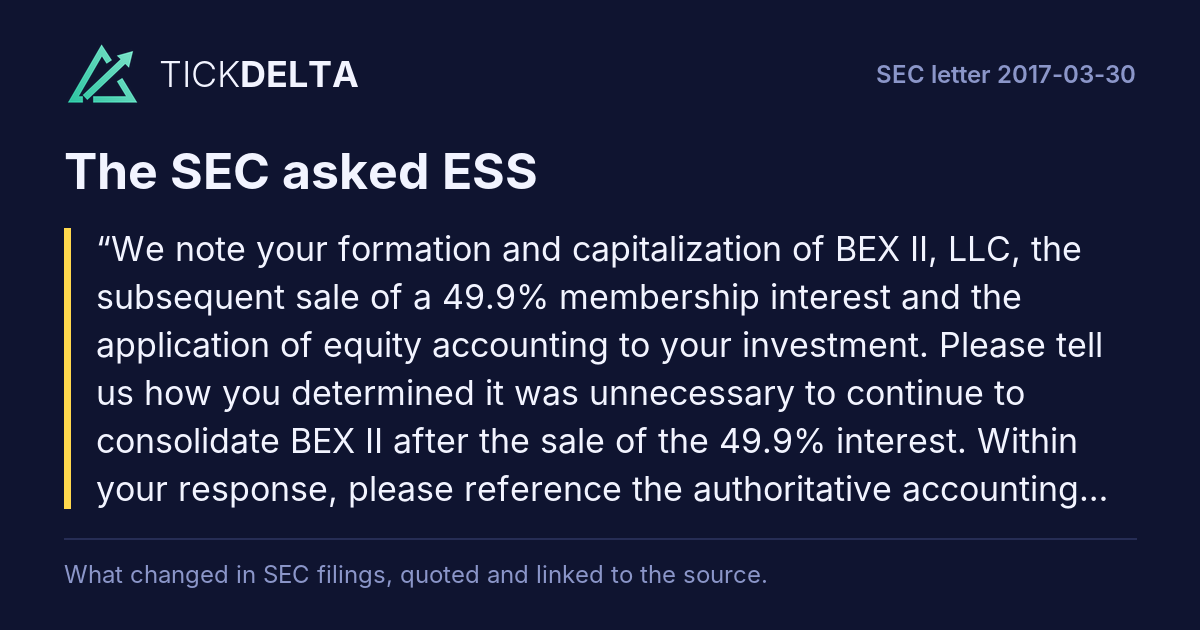
We note your formation and capitalization of BEX II, LLC, the subsequent sale of a 49.9% membership interest and the application of equity accounting to your investment. Please tell us how you determined it was unnecessary to continue to consolidate BEX II after the sale of the 49.9% interest. Within your response, please reference the authoritative accounting literature management relied upon.
The Company concluded that this co-investment with another member is not a variable interest entity based on the definition of variable interest entities included in ASC 810-10. This co-investment has sufficient equity at risk to permit the co-investment to finance its activities without additional subordinated financial support.Read in the reply ↗Rest of the answer
The equity holders, as a group, do not lack any of the following three characteristics:
a.
The power, through voting rights or similar rights, to direct the activities of the co-investment that most significantly impact the co-investment’s economic performance.
b.
The obligation to absorb the expected losses of the co-investment.
c.
The right to receive the expected residual returns of the co-investment.
For this co-investment, the Company and the other member jointly have the power to direct the activities that most significantly impact the co-investment’s economic performance. The co-investment agreement requires that capital, operating and other expenditures on behalf of the co-investment must have previously been approved in writing by all members. While the Company, as managing member, is the day-to-day manager of the co-investment, the Company is only permitted to make decisions and payments based on approval by both the Company and the other member.
Disagreements between the Company and the other member are to be jointly resolved by the four designated senior executives, two from the Company and two from the other member. No one party has the right to break any deadlock on major decisions. No one party has the right to “kick-out” another member.
Each of the members in the co-investment has the obligation to absorb any losses of the co-investment. None of the members are protected from any losses nor are there any guaranteed returns. Each of the members has the right to receive the residual returns of the co-investment. There are no caps on returns to the members.
Based on the substantive participating rights and 50.0% voting rights held by each member, the Company concluded that no single member controls the co-investment. Therefore, the Company does not consolidate the co-investment and applies the equity method of accounting to its membership interest.
We note you provide certain non-GAAP guidance. In future filings, please reconcile your non-GAAP guidance to the most directly comparable GAAP guidance. Please refer to Question 102.10 of the C&DIs on Non-GAAP financial measures and Item 10(e)(1)(i)(B) of Regulation S-K.
In accordance with the Staff’s comment, the Company will present a reconciliation of its non-GAAP guidance to the most directly comparable GAAP guidance with equal or greater prominence in future filings. Read in the reply ↗
First report after the company's reply of 2017-04-06: 10-Q filed 2017-05-01 ↗, against the 10-Q filed 2016-10-31 ↗.
Tickdelta does not hold the text of both reports, so they are not compared here.
Also in this review: closing letter, 2017-04-10