tickdelta
Sign in

Tickdelta is free for now. Sign up and get Pro free

← Screener

ESSEssex Property Trust

Real estate · REIT · NYSE

Essex Property Trust, Inc. (“Essex”), a Maryland corporation, is an S&P 500 company that operates as a self-administered and self-managed real estate investment trust (“REIT”). 10-K, Item 1

Employees
1,689
Headquarters
San Mateo, CA
CEO
Angela L. Kleiman
Next results
around Feb 3, 2027
Compare with peers → Embed

When the SEC's staff reviews a filing, it writes to the company with numbered questions, and the company answers each one in a letter. SEC publishes the exchange once the review is over, at least 20 business days later. Below: what the staff asked ESS, and the company's answer to each question, quoted from the letters. A question is not an accusation; most reviews end with the company adding detail to its next filing.

Form 10-K for the fiscal year ended December 31, 2016

2017-03-30 to 2017-04-10 · 2 questions · 1 letter from the SEC, 1 from the company
Review closed 2017-04-10
Non-GAAP measures
SEC asked (1)
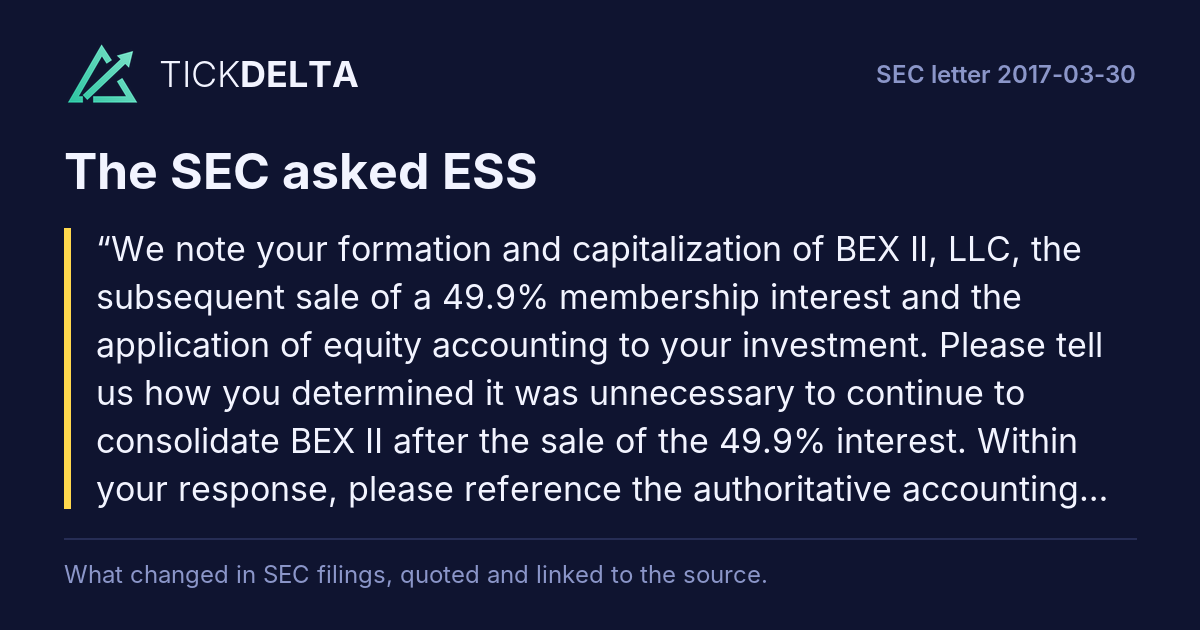
We note your formation and capitalization of BEX II, LLC, the subsequent sale of a 49.9% membership interest and the application of equity accounting to your investment. Please tell us how you determined it was unnecessary to continue to consolidate BEX II after the sale of the 49.9% interest. Within your response, please reference the authoritative accounting literature management relied upon.
ESS answered
The Company concluded that this co-investment with another member is not a variable interest entity based on the definition of variable interest entities included in ASC 810-10. This co-investment has sufficient equity at risk to permit the co-investment to finance its activities without additional subordinated financial support.
Rest of the answer

The equity holders, as a group, do not lack any of the following three characteristics:

a.

The power, through voting rights or similar rights, to direct the activities of the co-investment that most significantly impact the co-investment’s economic performance.

b.

The obligation to absorb the expected losses of the co-investment.

c.

The right to receive the expected residual returns of the co-investment.

For this co-investment, the Company and the other member jointly have the power to direct the activities that most significantly impact the co-investment’s economic performance. The co-investment agreement requires that capital, operating and other expenditures on behalf of the co-investment must have previously been approved in writing by all members. While the Company, as managing member, is the day-to-day manager of the co-investment, the Company is only permitted to make decisions and payments based on approval by both the Company and the other member.

Disagreements between the Company and the other member are to be jointly resolved by the four designated senior executives, two from the Company and two from the other member. No one party has the right to break any deadlock on major decisions. No one party has the right to “kick-out” another member.

Each of the members in the co-investment has the obligation to absorb any losses of the co-investment. None of the members are protected from any losses nor are there any guaranteed returns. Each of the members has the right to receive the residual returns of the co-investment. There are no caps on returns to the members.

Based on the substantive participating rights and 50.0% voting rights held by each member, the Company concluded that no single member controls the co-investment. Therefore, the Company does not consolidate the co-investment and applies the equity method of accounting to its membership interest.

Read in the reply ↗
Exhibit 99.2 · Assumptions for 2017 FFO Guidance Range, page S-14
SEC asked (2)
We note you provide certain non-GAAP guidance. In future filings, please reconcile your non-GAAP guidance to the most directly comparable GAAP guidance. Please refer to Question 102.10 of the C&DIs on Non-GAAP financial measures and Item 10(e)(1)(i)(B) of Regulation S-K.
ESS answered
In accordance with the Staff’s comment, the Company will present a reconciliation of its non-GAAP guidance to the most directly comparable GAAP guidance with equal or greater prominence in future filings. Read in the reply ↗
In its next report

First report after the company's reply of 2017-04-06: 10-Q filed 2017-05-01 ↗, against the 10-Q filed 2016-10-31 ↗.

Tickdelta does not hold the text of both reports, so they are not compared here.
Also in this review: closing letter, 2017-04-10
Form 10-K for the fiscal year ended December 31, 2014

2015-04-28 to 2015-05-14 · 1 question · 1 letter from the SEC, 2 from the company
Review closed 2015-05-14
Form 10-K for the fiscal year ended December 31, 2014 for each of the Companies · Item 6. Selected Financial Data, pages 32 – 36
SEC asked
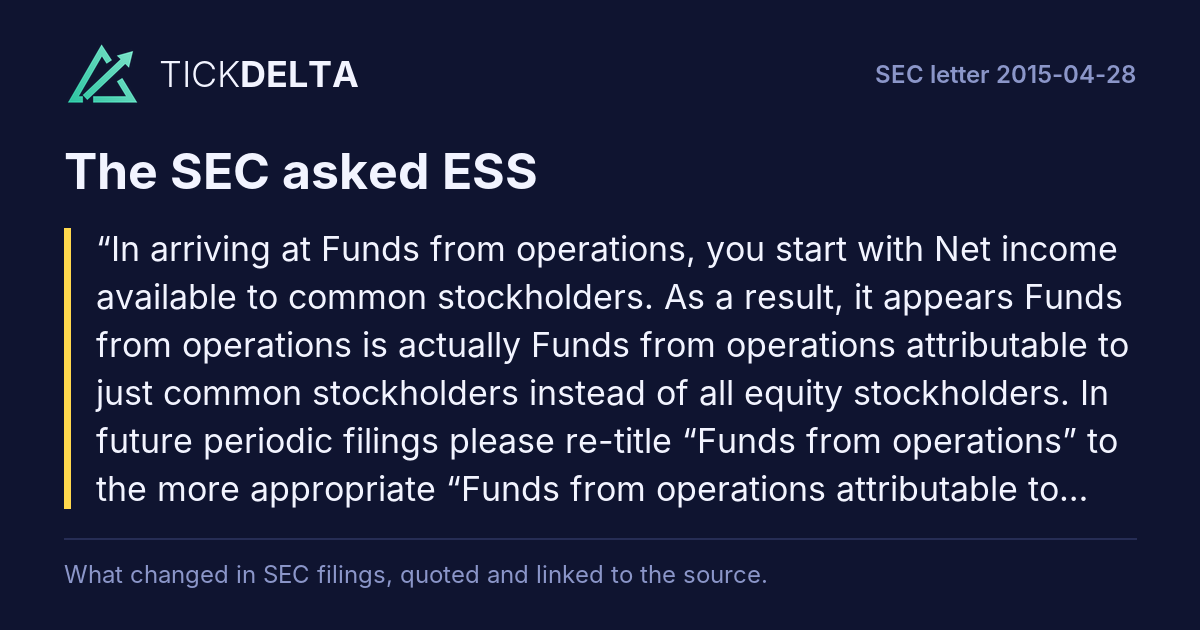
In arriving at Funds from operations, you start with Net income available to common stockholders. As a result, it appears Funds from operations is actually Funds from operations attributable to just common stockholders instead of all equity stockholders. In future periodic filings please re-title “Funds from operations” to the more appropriate “Funds from operations attributable to common stockholders”.
ESS answered
In calculating Funds from operations, or “FFO”, we add back the net income attributable to the noncontrolling interest of the limited partner unit holders of the Company’s operating partnership, Essex Portfolio, L.P. (the “Operating Partnership”). This noncontrolling interest add back is included within the line item "Depreciation add back from unconsolidated co-investments and other, net" in the "Other Data" table on page 34 of the Form 10-K for the year ended December 31, 2014.
Rest of the answer

By adding this amount back, it converts the “net income available to common stockholders” to an amount attributable to both the common stockholders and the Operating Partnership limited partners. Accordingly, the weighted average numbers of shares outstanding, diluted, used to calculate FFO and Core FFO per diluted share includes both common shares and Operating Partnership units outstanding for the year.

As the FFO amount also includes net income attributable to the noncontrolling interest of limited partner unit holders, we respectfully submit that it would not be appropriate to re-title "Funds from operations" as "Funds from operations attributable to common stockholders."

We acknowledge that the adjustment for non-controlling interest was included, without specificity, as an "other" adjustment in the line item "Depreciation add back from unconsolidated co-investments, and other, net" and that our FFO table does not clearly set forth that the FFO amount also includes that noncontrolling interest adjustment. Accordingly, in future periodic filings, we will set forth in a separate line item the add back of net income allocated to such noncontrolling interest.

* * *

The Company hereby acknowledges that:

• the Company is responsible for the adequacy and accuracy of the disclosure in the filing;

Staff comments or changes to disclosure in response to Staff comments do not foreclose the Commission from taking action with respect to the filing; and the Company may not assert Staff comments as a defense in any proceeding initiated by the Commission or any person under the federal securities laws of the United States.

Read in the reply ↗
In its next report

First report after the company's reply of 2015-05-08: 10-Q filed 2015-05-11 ↗, against the 10-Q filed 2014-11-06 ↗.

Tickdelta does not hold the text of both reports, so they are not compared here.

Also in this review: company letter, 2015-05-13, closing letter, 2015-05-14

Form 10-K

2014-09-08 to 2014-10-01 · 1 question · 1 letter from the SEC, 1 from the company
Review closed 2014-10-01
SEC asked
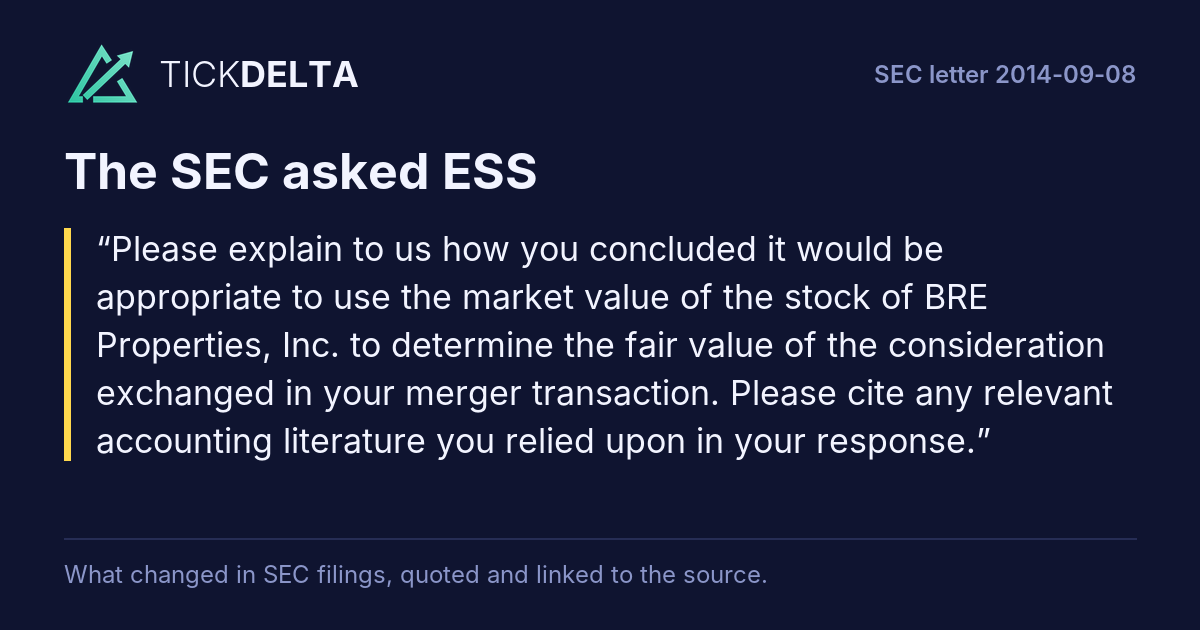
Please explain to us how you concluded it would be appropriate to use the market value of the stock of BRE Properties, Inc. to determine the fair value of the consideration exchanged in your merger transaction. Please cite any relevant accounting literature you relied upon in your response.
ESS answered
Essex Property Trust, Inc. (the “Company” or “Essex”), submits this letter in response to comments from the staff (the “Staff’) of the U.S. Securities and Exchange Commission (the “SEC”) received by a letter, dated September 8, 2014, related to the above filing.

In this letter, we have recited the comment from the Staff in italicized, bold type, and have followed the Staff comment with the Company’s response in regular type.

Form 10-Q for the quarterly period ended June 30, 2014

Financial Statements

Organization and Basis of Presentation, page 12

Please explain to us how you concluded it
Rest of the answer

would be appropriate to use the market value of the stock of BRE Properties, Inc. to determine the fair value of the consideration exchanged in your merger transaction. Please cite any relevant accounting literature you relied upon in your response.

Background

On December 19, 2013, the Company entered into a definitive merger agreement with BRE Properties, Inc. (BRE). The terms of the merger provided for Essex to issue .2971 shares of common stock and $12.33 in cash for each share of BRE common stock. The merger closed on April 1, 2014. The cash paid by Essex to close the merger was reduced to $7.18 per BRE share after BRE paid a special dividend of $5.15 per share to holders of BRE common stock on April 1, 2014. Holders of BRE common stock after close of market on April 1, 2014 received the Essex common stock. After the closing of the merger, BRE ceased trading and was delisted from the NYSE.

On March 26, 2014, S&P announced the addition of Essex into the S&P 500 index commencing on April 1, 2014. Essex common stock closed at $174 per share on April 1, 2014 and experienced an increase in stock price predominately attributable to the increase in demand for the Essex stock by index funds that track the S&P 500. BRE stock closed at $61 per share on April 1, 2014 and did not experience a similar spike in demand. Please see detailed discussion below regarding quantitative evidence used in our analysis.

On March 28, 2014, both Essex and BRE shareholders approved the merger, and the BRE shares traded with almost 100% correlation to the equivalent value in Essex shares over the period from March 28th to March 31st. On April 1st this correlation was not evident as almost 7 million BRE shares traded at $61 per share and not at the Essex equivalent value of $64 per share. This lack of correlation on April 1st is another indicator that Essex common shares experienced demand for its common stock that was not attributable to the value of BRE, otherwise, the two companies would have continued to trade in correlation.

There were no trading restrictions on either BRE or Essex common stock that would have impacted trading volume.

The Company worked with investment bankers and prepared an analysis comparing Essex stock price and volumes to other REIT’s and all 60 companies that were added to the S&P 500 since the beginning of 2011. There is approximately $5 trillion invested in funds that are linked to the S&P 500 index. Inclusion into the index creates a supply and demand imbalance over the days in-between announcement and inclusion to the S&P 500, which results in a significant increase in trading volumes and share price.

The analysis demonstrated that public companies added to the S&P 500 experienced an exponential increase in volume which led to stock price performance exceeding its closest peer group. The analysis compared two periods, the first representing the 5 trading days prior to S&P 500 inclusion, and the second period representing the 25 trading days prior to the aforementioned 5 day window. When comparing the 2 periods, the volume-weighted average price (VWAP) on average, increased by 3.1% (Essex increased 3.4%) and the average daily trading volume increased by an average of 370% (Essex increased by 977%). Given that BRE was not being added to the index, its shares traded in a more normal VWAP/price range, even though volumes were elevated on March 31st and April 1st due to the merger.

The Company also noted there was a significant drop in trading volume in Essex common stock on the day after the S&P admission (from approximately 19 million to 2 million) and the closing stock price dropped from $174 per share to $172.30 per share and continued to decline to $167.09 by April 15, 2014. This further supports the conclusion that the increased demand and higher share price on April 1, 2014 was due to the S&P 500 inclusion.

Accounting literature

Accounting Standards Codification paragraph 805-30-30-2 indicates that in business combinations involving the exchange of equity interests, the acquisition-date fair value of the acquiree’s equity interests may be more reliably measurable than the acquisition-date fair value of the acquirer’s equity interests. If so, the acquirer shall determine the amount of goodwill by using the acquisition-date fair value of the acquiree’s equity interests instead of the acquisition-date fair value of the equity interests transferred. The equity interests issued by Essex represent approximately 89% of the purchase price. Given the large majority of the purchase price representing equity interests, the Company considered whether BRE’s equity interests is a more reliable measure than Essex’s equity issued. The Company considered this guidance and concluded that BRE’s equity interests to be a more reliable measure of acquisition date fair value as summarized below in our conclusion.

Conclusion

The Company believes the trading in Essex stock related to the S&P 500 inclusion on April 1, 2014, and for the days prior to and following that date, were influenced by additional buying demand typically associated with inclusion in the S&P 500 and not representative of the fair value of the consideration paid to acquire the BRE business. Essex management concluded that acquisition-date fair value of the acquiree’s equity interests, in this case the BRE closing stock price of $61 per share as adjusted for the special dividend and the cash consideration, is a more reliable measure than Essex’s closing stock price and should be used to measure the equity component of the purchase price.

***

The Company hereby acknowledges that:

·

The Company is responsible for the adequacy and the accuracy of the disclosure in the filing;

Staff comments or changes to disclosure in response to Staff comments do not foreclose the Commission from taking any action with respect to the filings; and

The Company may not assert Staff comments as a defense in any proceeding initiated by the Commission or any other person under the federal securities laws of the United States.

Read in the reply ↗

Also in this review: closing letter, 2014-10-01

Form 10-K for the Fiscal Year Ended December 31, 2012

2013-05-14 to 2013-06-24 · 1 question · 1 letter from the SEC, 2 from the company
Review closed 2013-06-24
Development Pipeline, page 3
SEC asked
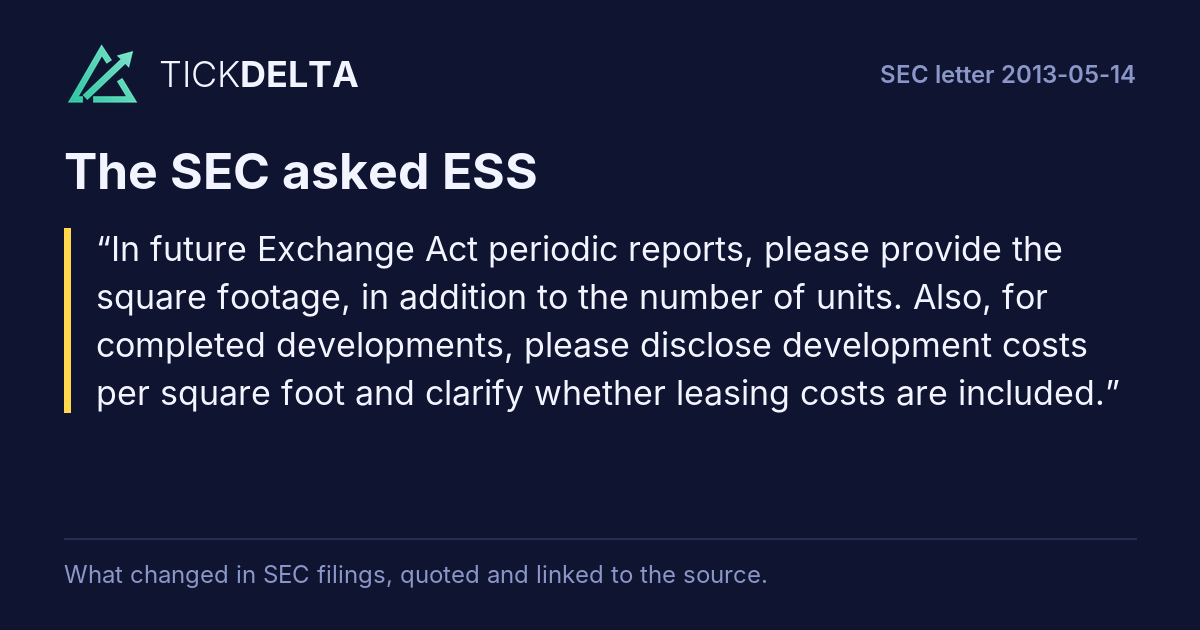
In future Exchange Act periodic reports, please provide the square footage, in addition to the number of units. Also, for completed developments, please disclose development costs per square foot and clarify whether leasing costs are included.
ESS answered
Essex Property Trust, Inc., a Maryland corporation ("Essex"), respectfully requests additional time to respond to the comment letter, dated May 14, 2013, from the staff of the Securities and Exchange Commission, related to the above filing. Essex plans to submit its response on or before June 12, 2013. Please contact me if this schedule is in any way a problem. Read in the reply ↗
In its next report

First report after the company's reply of 2013-05-29: 10-Q filed 2013-08-05 ↗, against the 10-Q filed 2013-05-06 ↗.

Tickdelta does not hold the text of both reports, so they are not compared here.

Also in this review: company letter, 2013-06-12, closing letter, 2013-06-24

Form S-4

2013-02-20 to 2013-03-29 · 1 question · 1 letter from the SEC, 2 from the company
No closing letter
General
SEC asked
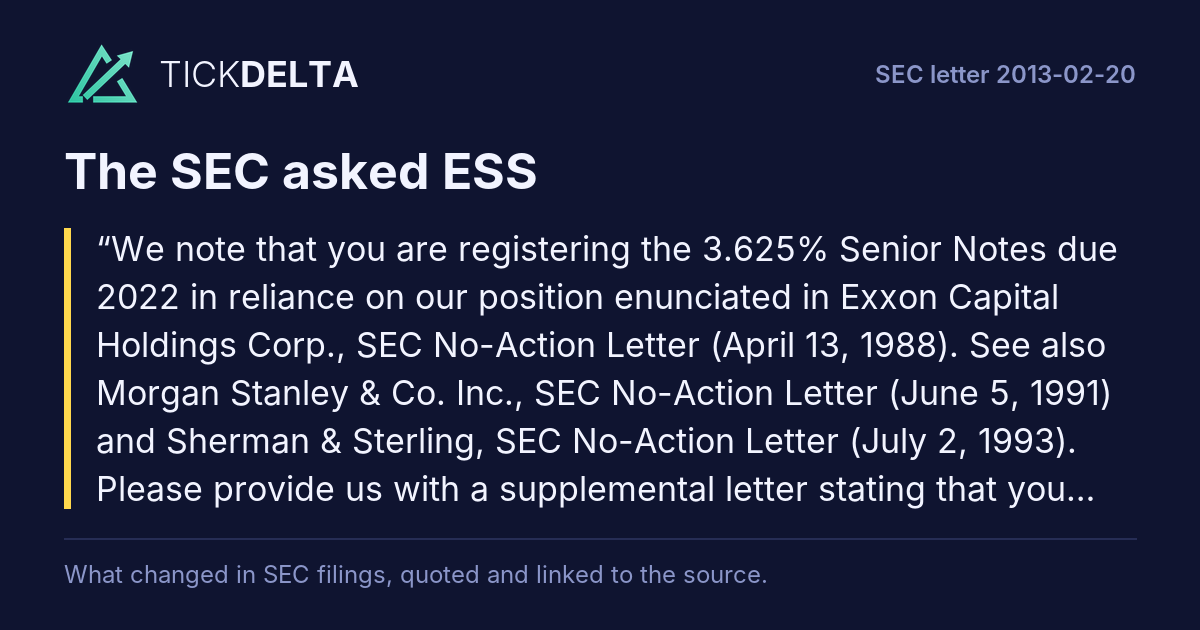
We note that you are registering the 3.625% Senior Notes due 2022 in reliance on our position enunciated in Exxon Capital Holdings Corp., SEC No-Action Letter (April 13, 1988). See also Morgan Stanley & Co. Inc., SEC No-Action Letter (June 5, 1991) and Sherman & Sterling, SEC No-Action Letter (July 2, 1993).
Rest of the question

Please provide us with a supplemental letter stating that you are registering the exchange offer in reliance on our position contained in these letters and include the representations contained in the Morgan Stanley and Sherman & Sterling no-action letters.

ESS answered
The General Partner and the Operating Partnership are registering the Exchange Notes through a Registration Statement on Form S-4 (the “ Registration Statement”) in reliance on the Staff’s position enunciated in Exxon Capital Holdings Corporation (dated May 13, 1988) (the “Exxon Capital Letter ”), Morgan Stanley & Co. Incorporated (dated June 5, 1991) (the “Morgan Stanley Letter ”), Shearman & Sterling (dated July 2, 1993) (the “Shearman & Sterling Letter”) and other interpretive letters to similar effect. Read in the reply ↗

Also in this review: company letter, 2013-03-29

From the SEC's correspondence on EDGAR: staff letters (form UPLOAD) and company letters (form CORRESP), 17 letters filed since 2013-02-20. Questions and answers are matched by their numbers; topics come from words in each question. The reports are compared word for word (same form, before the first SEC letter against the first report after the company's reply). No AI.

Work on ESS in a spreadsheet: Excel workbook (a sheet per section, ten years by column, charts, links to the filings) · CSV. For a Google Sheet that stays up to date, paste =IMPORTDATA("https://tickdelta.com/company/ESS/export.csv") into a cell.