Form 10-K for the Fiscal Year ended December 31, 2023
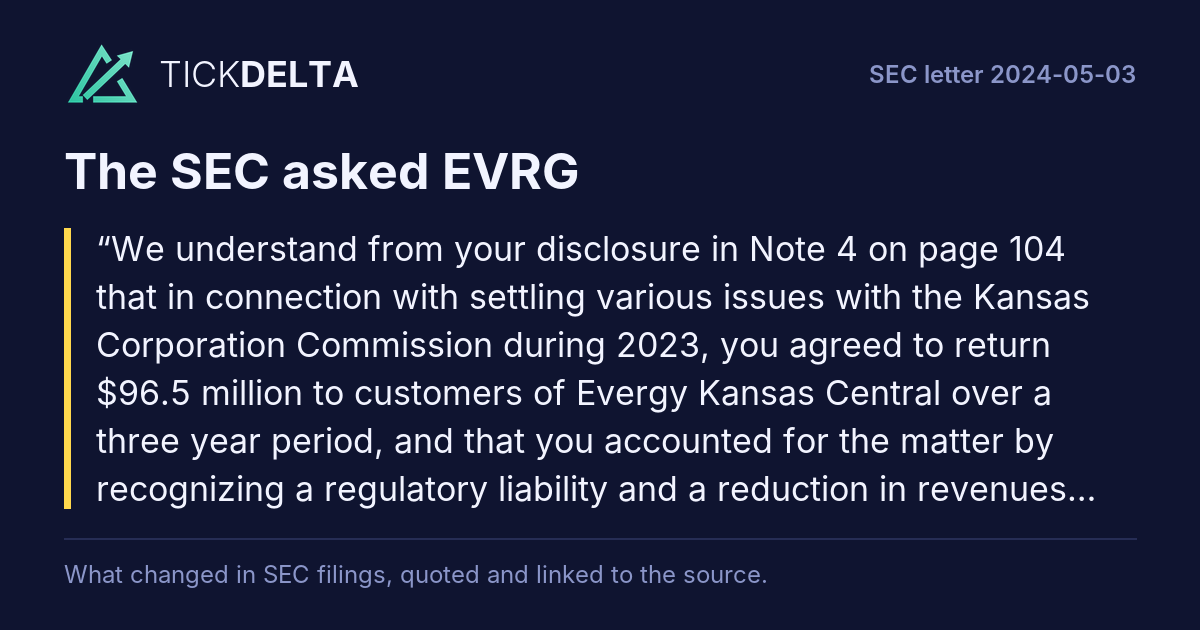
We understand from your disclosure in Note 4 on page 104 that in connection with settling various issues with the Kansas Corporation Commission during 2023, you agreed to return $96.5 million to customers of Evergy Kansas Central over a three year period, and that you accounted for the matter by recognizing a regulatory liability and a reduction in revenues in corresponding amounts.Rest of the question
In Note 2 on page 99, you refer to a similar accounting event in 2022 regarding Sibley Station, involving a rate case amended final order to return $68.0 million to customers of Evergy Missouri West over a four-year period, although disclosures on pages 108 and 110 indicate the regulatory liability was $108.0 million, while disclosure on page 40 indicates it was $51.4 million. We note that your reconciliation shows that in compiling your non-GAAP Adjusted Earnings measure you have adjustments pertaining to each of these matters, including an add-back of $96.5 million to net income for 2023, and an add-back of $51.4 million to net income in 2022, both of which appear to effectively reverse the accounting that was required and applied under generally accepted accounting principles. You explain that you believe the resulting measure provides a meaningful basis for evaluating operations because it excludes items that you do not believe are indicative of your ongoing performance, or that have created earnings volatility. However, you do not explain how excluding the adverse effects of these economic accounting events in compiling your non-GAAP performance measure would yield a measure that could be fairly characterized as providing a meaningful basis for evaluating operations. As the funds will be returned to customers over several future periods, it is also unclear how you would fairly characterize recognition of the adverse effects as not indicative of your ongoing performance, or how you would otherwise advise investors of the adverse effects in such future periods. For example, we note that you have not included an adjustment in compiling the 2023 non-GAAP measure for any portion of the reduction to the regulatory liability pertaining to Sibley Station. We also note that you have not provided commentary regarding earlier disclosures of the non-GAAP measures that reflected the favorable effects of the revenues that have now been reversed. Given that these adjustments appear to effectively change the recognition and measurement principles that are required to be applied under generally accepted accounting principles, unless you are able to show how these would not be contrary to the guidance in the answer to Question 100.04 of our Compliance & Disclosure Interpretations regarding non-GAAP measures, it appears that you would need to amend your filing to revise your computations of the non-GAAP measures. You may view this guidance at: https://www.sec.gov/corpfin/non-gaap-financial-measures.htm. Please also revise your disclosures on pages 38, 47, and 58 that characterize recognition of the $96.5 million regulatory liability as a "deferral of revenues" to utilize terminology or descriptions that are representationally faithful of this accounting event. In closing, we remind you that the company and its management are responsible for the accuracy and adequacy of their disclosures, notwithstanding any review, comments, action or absence of action by the staff. Please contact Jenifer Gallagher at 202-551-3706 or Yong Kim at 202-551-3323 with any questions.
The Company respectfully acknowledges the Staff’s comment regarding its non-Generally Accepted Accounting Principles (“GAAP”) adjustments of $96.5 million in 2023 related to its Corporate-Owned Life Insurance (“COLI”) program and $51.4 million in 2022 related to the Sibley Station retirement. Accordingly, the Company has organized its response to the Staff in the following order:
a.
Background Information b.
Why the Company’s non-GAAP adjustments for the COLI program and the Sibley Station retirement presented within Evergy’s Form 10-K for the fiscal year ended December 31, 2023, areRead in the reply ↗Rest of the answer
appropriate, including sections denoting:
i.
Why excluding amounts associated with the COLI program and the Sibley Station retirement refunds in compiling the Company’s non-GAAP Adjusted Earnings measure provides a meaningful basis for evaluating its ongoing operations;
ii.
the Sibley Station retirement refunds do not change the recognition and measurement principles required under GAAP and are not contrary to the guidance in Question 100.04 of the Commission’s Compliance & Disclosure Interpretations
(“C&DIs”); and iii.
Why the Company is not including any non-GAAP adjustments for the
COLI program and the Sibley Station retirement refunds in future periods as customer rate refunds begin.
c.
The Company’s agreement with the Staff’s comment regarding the “deferral of revenues” terminology
Regulated Operations Accounting: The Company’s regulatory liabilities for the COLI program and the Sibley Station retirement were both recognized in accordance with ASC 980-405-25-1(a) and ASC 450-20-25-2. The recognition of both regulatory liabilities resulted in a corresponding reduction to revenues in the applicable current periods because both regulatory liabilities were related to revenues previously collected from customers both in the applicable current and prior periods. The subsequent reduction of these regulatory liabilities, when the amounts are refunded to customers in rates, does not affect future earnings.
COLI Program: The COLI program was initiated in the mid-1980’s following the inclusion of Wolf Creek Nuclear Generating Station (“Wolf Creek”) in Evergy Kansas Central, Inc’s (“Evergy Kansas Central”) retail rates. Evergy Kansas
Central is a wholly-owned subsidiary of Evergy. The COLI program was designed to generate income that would reduce the impacts to customer rates related to the construction of Wolf Creek. The reduction to customer rates under this program was accomplished through the establishment of agreed-upon annual reductions to Evergy Kansas Central’s revenue requirement to be charged to customers (“COLI rate credits”), throughout the life of the COLI program.
In April 2023, Evergy Kansas Central filed a rate case application with the Kansas Corporation Commission (“KCC”). Evergy Kansas
Central’s request included a proposed resolution to terminate the COLI program. In September 2023, Evergy Kansas Central, KCC staff and other intervenors reached a unanimous settlement agreement to settle all rate case issues, including the termination of the COLI program. The settlement agreement included a refund to Evergy Kansas Central customers of $96.5 million by reducing customer rates over the three year period 2024-2026 to account for the difference between the originally expected cumulative amount of COLI rate credits approved at the inception of the COLI program and the actual amount of COLI rate credits received by customers from 1987 through December 31, 2023. As a result of the settlement agreement, Evergy
Kansas Central recorded a $96.5 million regulatory liability with a corresponding reduction to revenues in 2023 for the obligation to refund amounts of revenues previously collected from customers related to the COLI program.
Sibley Station Retirement: In November 2018, Evergy Missouri West, Inc. (“Evergy Missouri West”), a wholly-owned subsidiary of Evergy, retired Sibley Station, a coal-fired generating station. Subsequent to Sibley Station’s retirement, Evergy Missouri West continued to collect amounts in rates from customers for Sibley Station related to (i) non-fuel operation and maintenance costs and other costs, and (ii) return on investment. In October 2019, the Public Service Commission of the State of Missouri (“MPSC”) issued an Accounting
Authority Order (“AAO”) requiring Evergy Missouri West to record as a regulatory liability the amounts in rates from customers for Sibley Station related to (i) non-fuel operation and maintenance costs and other costs, and (ii) return on investment. After receiving the AAO in 2019, Evergy Missouri West recorded a Sibley Station regulatory liability for non-fuel operations and maintenance costs and other costs still being collected in rates from customers with a corresponding reduction to revenues as Evergy Missouri West determined them to be probable of refund since these costs were no longer being incurred by the Company. Evergy Missouri West, however, did not at that time record a regulatory liability for amounts collected in rates for the return on investment component of Sibley Station still being collected in rates from customers as it determined that the return on investment was not probable of refund because (i) the retirement of Sibley Station was prudent and economically beneficial to ratepayers, (ii) the Sibley Station AAO did not prescribe customer rate treatment for the return on investment component (only that it needed to be separately tracked for future MPSC regulatory determination), and (iii) there was no prior regulatory precedent for the refund of return on investment revenues associated with a retired generating station in Missouri.
In 2022, the MPSC issued an amended final rate order settling the treatment of Evergy Missouri West’s unrecovered investment in Sibley
Station. The order required Evergy Missouri West to refund to customers, over the years 2023-2026, the revenues collected related to both non-fuel operations and maintenance costs and other costs as well as the return on investment associated with Sibley Station following its retirement.
As a result of the 2022 amended final rate order, in
2022, Evergy Missouri West recorded a $68.0 million reduction to operating revenues and a corresponding increase to its Sibley Station regulatory liability for revenues collected from customers for return on investment in Sibley Station since
December 2018. Within the 2022 amended final rate order, the MPSC agreed with Evergy Missouri West’s regulatory liability balance for non-fuel operations and maintenance costs and other costs and as such, no additional reduction to operating revenues was recorded in 2022 related to these amounts apart from what Evergy Missouri West had already recognized for amounts collected in rates.
In order to aid the Staff’s understanding of the amount of the Company’s non-GAAP adjustment for the Sibley Station return on investment refund on page 40 of Evergy’s Form 10-K and to reconcile that amount with other related figures that appear on pages 99, 108 and 110 of Evergy’s Form 10-K, please see the following table:
Sibley Station
Retirement
Year of
Recognition
(Regulatory
Liability)
Regulatory
Liability
Balance
(12/31/2022)
2022
Earnings
Impact(a)(b)
(Pre-Tax)
(millions)
Return on Investment
$
68.0
51.4
Non-Fuel Operations and Maintenance Costs and Other
Costs
2019 - 2022
40.0
—
Total
108.0 a
The $51.4 million earnings impact for return on investment consists of the $68.0 million reduction to revenues for recognition of a regulatory liability for amounts collected from customers since December 2018 for return on investment in Sibley Station less the $16.6 million of revenues from customers recognized in 2022 for return on investment.
b
The non-fuel operations and maintenance costs and other costs item does not have a 2022 earnings impact because the revenues from customers were offset by the concurrent reduction to revenues of an equal amount for recognition of a regulatory liability.
Computation of the Company’s non-GAAP adjustments for the COLI Program and the
Sibley Station Retirement: The non-GAAP adjustment amount of $96.5 million in 2023 related to the refund of amounts for the COLI program is the earnings impact included in the Company’s 2023 GAAP earnings. The non-GAAP adjustment of $51.4 million in 2022 related to the refund of amounts for the Sibley Station retirement is the earnings impact included in the
Company’s 2022 GAAP earnings. These amounts were recorded in accordance with GAAP and excluded from the GAAP amount of earnings and Earnings Per Share (“EPS”) to determine the Company’s non-GAAP measure of Adjusted Earnings and Adjusted EPS.
The adjustment for the Sibley Station retirement was inclusive of both the positive impact of the revenues from customers in addition to the negative impact of the reduction to revenues recorded for the initial accrual of the regulatory liability for future refund to customers and was consistently applied for all periods presented for
Adjusted Earnings and Adjusted EPS. The Company would respectfully refer the Staff to page 40 of its Form 10-K for the fiscal year ended December 31, 2022, where it adjusted out the $12.4 million positive impact of revenues collected from customers for Sibley Station’s return on investment in its calculation of 2021 Adjusted Earnings and Adjusted EPS.
Regarding the Company’s calculation of its non-GAAP adjustment of the COLI program refund, the
Company did not adjust out the impact of revenues from customers in 2023 and 2022 related to the COLI program. The impact to 2023 and 2022 Adjusted Earnings and Adjusted EPS would have been $2.7 million (or $0.01 per share) and
$1.9 million (or $0.01 per share), respectively. These amounts represent less than 1% of 2023 and 2022 Adjusted Earnings and Adjusted EPS of $815.6 million ($3.54 per share) and $853.8 million ($3.71 per share), respectively, and are immaterial to the relevant interim and annual periods.
Why the Company’s non-GAAP adjustments for the COLI program and the Sibley Station retirement presented within Evergy’s Form 10-K for the fiscal year ended December 31, 2023, are appropriate, including sections denoting:
compiling the Company’s non-GAAP Adjusted Earnings measure provides a meaningful basis for evaluating its ongoing operations In response to the Staff’s comment regarding “you do not explain how excluding the adverse effects of these economic accounting events in compiling your non-GAAP performance measure would yield a measure that could be fairly characterized as providing a meaningful basis for evaluating operations”, the Company believes its current non-GAAP presentation is useful and relevant as it is aligned with how operating results are reviewed, both internally by management and the board of directors and externally by lenders and investors, and because it assists investors with their evaluation of the Company’s earnings on an ongoing basis. To provide a useful and relevant non-GAAP presentation of Adjusted Earnings and Adjusted EPS, the Company excludes items that it believes are non-recurring or infrequent in nature and not correlated with the Company’s ongoing operations from an earnings perspective. Before excluding items, the Company carefully evaluates the nature and effect of the potentially excluded items, specifically examining how the charges or gains correlate to the Company’s ongoing operations.
As discussed further below, the COLI program and the Sibley Station retirement refunds are clearly representative of non-recurring events that are unique in both their nature and the financial magnitude of their impact on the Company’s earnings. As such, the
Company’s non-GAAP adjustments to Adjusted Earnings and Adjusted EPS for these items are meaningful to investors because they exclude the total earnings impacts of these transactions for all periods presented in order to reflect the Company’s ongoing operations.
Detailed COLI Rationale: As discussed in greater detail above, in
September 2023 as part of a KCC rate case settlement agreement, Evergy Kansas Central recorded a $96.5 million regulatory liability with a corresponding reduction to revenues for the recognition of refunds to customers for amounts of revenues previously collected from customers since the inception of the program related to COLI rate credits. Upon evaluation of the nature and effect of the refund related to the COLI program, the Company determined that it would be appropriate to make a non-GAAP adjustment to exclude the earnings impact of the COLI program refund from the Company’s Adjusted Earnings.
This conclusion is supported by the unique and non-recurring nature of the COLI program and the large cumulative magnitude of the refund related to the COLI program. Specifically, the Company considered the following facts in reaching this conclusion:
•
The COLI rate credits were associated with the cumulative effect of the termination of a nearly 40-year old distinct COLI program (for which the Company has no other similar programs);
There will not be a recurring impact from the refund on earnings as the subsequent refunds to customers in 2024 through 2026 does not affect the Company’s earnings (see section b(iii) below for further details); and
As mentioned above, although the over-collection of revenues related to COLI rate credits occurred over a nearly 40-year time period, the excluded amount from Adjusted Earnings (i.e., $96.5 million) was related to a one-time impact of the reduction in revenues on the Company’s 2023 earnings.
Detailed Sibley Station Rationale: As discussed in greater detail above, in 2022 as part of an MPSC rate order, Evergy Missouri West recorded a $68.0 million reduction to operating revenues with a corresponding increase to its Sibley Station regulatory liability for revenues collected from customers for return on investment in Sibley Station since December 2018. Within Adjusted Earnings and in compliance with Question 100.03 of the Commission’s C&DIs, the Company excluded both the $68.0 million reduction to operating revenues for recording the accrual for the refund to customers in 2022 and the $16.6 million favorable impact from revenues from customers recognized in 2022 (i.e., net exclusion of a $51.4 million impact recorded in GAAP earnings). Furthermore, in order to present Adjusted
Earnings and Adjusted EPS consistently across all periods presented, the Company also excluded the $12.4 million favorable impact of revenues from customers recognized in 2021 GAAP earnings for the Sibley Station return on investment in its calculation of 2021 Adjusted Earnings and Adjusted EPS in its Form 10-K for the fiscal year ending December 31, 2022. Upon evaluation of the nature and effect of the Sibley Station retirement refund, the
Company determined that it would be appropriate to make a non-GAAP adjustment to exclude the earnings impact for the return on investment of the Sibley Station refund from the Company’s Adjusted Earnings.
This conclusion is supported by the unique and non-recurring nature of the Sibley Station retirement and the large magnitude of the refund related to the Sibley Station return on investment. Specifically, the Company considered the following facts in reaching this conclusion:
The retirement of a generating station (and events associated with that retirement) are inherently infrequent due to the long useful lives of generating stations (often in excess of 50 years) and the finite number of facilities that the Company operates;
Prior to the Sibley Station retirement, the Company was not aware of any Missouri utility (including Evergy
Missouri West) that was required to refund to customers amounts previously collected related to the return on investment for a generating station;
There will not be a recurring impact from the refund on earnings as the subsequent refunds to customers in 2023
As mentioned above, although the over-collection of revenues related to the Sibley Station return on investment occurred over a nearly 4-year time period, the excluded amount from Adjusted Earnings (i.e., $51.4 million) was related to a one-time impact of the reduction in revenues on the Company’s 2022 earnings.
the Sibley Station retirement refunds do not change the recognition and measurement principles required under GAAP and are not contrary to the guidance in Question 100.04 of the Commission’s C&DIs
Question 100.04 of the Commission’s C&DIs notes that a non-GAAP measure can violate Rule
100(b) of Regulation G if the recognition and measurement principles used to calculate the measure are individually tailored and inconsistent with GAAP, resulting in the presentation of a non-GAAP measure that could be misleading. The Company believes that its non-GAAP adjustments for the COLI program and the Sibley Station retirement refunds are not contrary to the guidance in Question 100.04. As discussed more fully in the section herein titled “Background - Computation of the Company’s non-GAAP adjustments for the COLI Program and the Sibley Station Retirement”, the Company’s non-GAAP adjustments exclude the total earnings impact of these events for all periods presented for its Adjusted Earnings and Adjusted EPS calculation. Neither adjustment changed the underlying recognition and measurement principles required to be applied in accordance with GAAP (e.g., changing the pattern of recognition, the basis of accounting, etc.). Further, to support the conclusion that its non-GAAP adjustments are not contrary to the guidance in Question 100.04, the Company has evaluated and answered the following questions included in Chapter 4.3.3 “Individually Tailored Accounting Principles” in Deloitte’s Non-GAAP Financial Measures and Metrics Roadmap (January 2023) which provides supplemental guidance on C&DI Question 100.04 from the SEC staff at a 2018 American Institute of Certified Public Accountants
(“AICPA”) conference. Deloitte noted in this supplemental guidance that the SEC staff acknowledged that entities often face challenges in identifying tailored accounting principles and provided examples of questions to which affirmative responses may be indicators of adjustments that could result in tailored accounting:
Deloitte’s Questions
Deloitte’s
Examples
Company
Answers
Does the adjustment shift the measure from an accrual basis of accounting to a cash or modified basis of accounting?
Presenting cash receipts or billings as a proxy for revenue for a subscription-based business that recognized revenue over time
No; the adjustments exclude the total earnings impact of the events for all periods presented and do not shift or alter the Company’s use of accrual accounting.
Does the adjustment include transactions that are also reportable in another company’s financial statements?
Presenting adjustments to consolidate financial results for an entity that is accounted for under the equity method Presenting revenue, gross, as the principal in a transaction when the company is required to report revenue, net, as an agent
No; this question is not applicable for the relevant adjustments.
Does the adjustment reflect part, but not all, of an accounting concept?
Adjusting a performance measure for the cash portion of income tax expense but not the noncash portion
No; the adjustments exclude the total earnings impact of the events for all periods presented and do not reflect partial accounting concepts.
Does the adjustment render the measure inconsistent with the underlying economics or ignore certain aspects of the economics?
Adjusting revenues for sales-type or direct financing leases to account for them as if they were operating leases, thus ignoring the economics of the lease agreements
No; the adjustments exclude the total GAAP earnings impact of the events for all periods presented and do not result in Adjusted Earnings and Adjusted EPS that are inconsistent with the underlying economics.
Upon evaluation of each of the questions above, the Company believes that both non-GAAP adjustments do not result in individually tailored accounting principles and thus are not contrary to the guidance in Question 100.04 of the Commission’s C&DIs.
Why the Company is not including non-GAAP adjustments for the COLI program and the Sibley Station retirement refunds in future periods as customer rate refunds begin In response to the Staff’s comment questioning how the Company will fairly characterize recognition “as the funds will be returned to customers over several future periods”, the Company advises the Staff that the Company considered the future earnings impact of the refund of the COLI program and the Sibley Station retirement when preparing its non-GAAP adjustments; however, the refund to customers of regulatory liabilities in customer rates does not impact the Company’s future earnings but results in lower future cash receipts and as a result, an adjustment would not be appropriate.
The Company respectfully acknowledges the Staff’s comment and view regarding the “deferral of revenues” terminology use. In future filings, the Company will refer to the recognition of the $96.5 million as “the recognition of a regulatory liability for the refund to customers for amounts of revenues previously collected related to COLI rate credits in accordance with a September 2023 KCC rate case unanimous settlement agreement”.
*****
We will be pleased to respond promptly to any requests for additional information or material that we may provide in order to facilitate your review. If you have any questions, or require clarification on any of the responses provided, please do not hesitate to contact me at kirk.andrews@evergy.com or Steven Busser, Vice President and Chief
Accounting Officer at steve.busser@evergy.com.
First report after the company's reply of 2024-05-17: 10-Q filed 2024-08-09 ↗, against the 10-Q filed 2023-11-07 ↗.
Tickdelta does not hold the text of both reports, so they are not compared here.
Also in this review: closing letter, 2024-06-05