Form 10-K for the year ended December 31, 2023
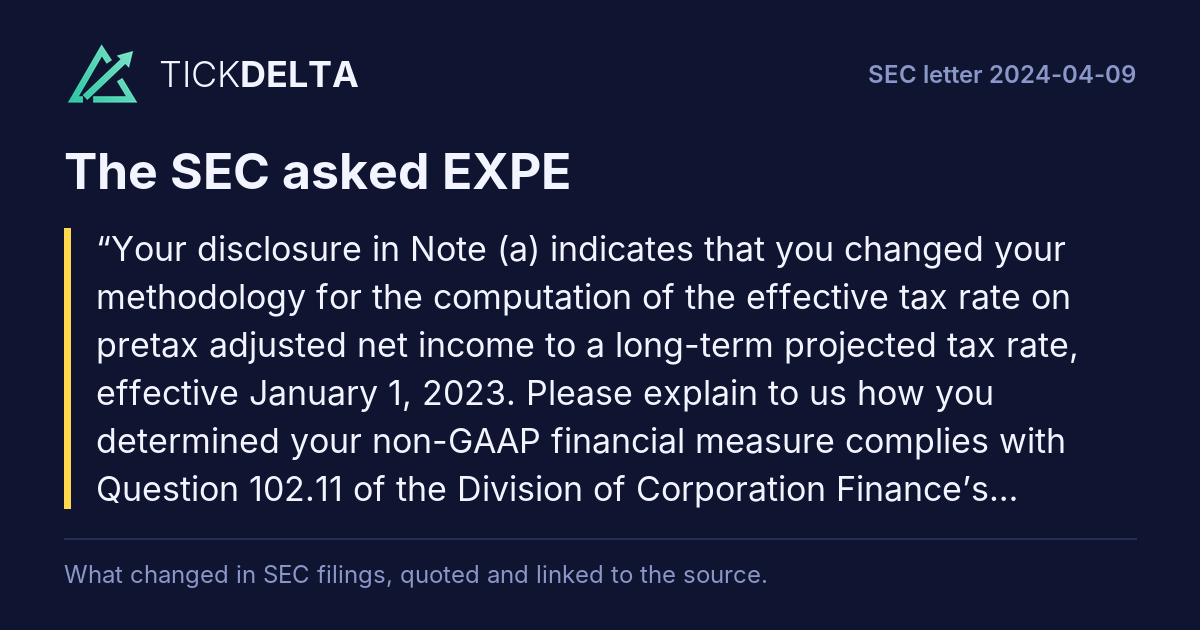
Your disclosure in Note (a) indicates that you changed your methodology for the computation of the effective tax rate on pretax adjusted net income to a long-term projected tax rate, effective January 1, 2023. Please explain to us how you determined your non-GAAP financial measure complies with Question 102.11 of the Division of Corporation Finance’s Compliance & Disclosure Interpretations on Non-GAAP FinancialRest of the question
Measures. In this regard, Question 102.11 states, in part, that “If a measure is a performance measure, the registrant should include current and deferred income tax expense commensurate with the non-GAAP measure of profitability.”
We respectfully acknowledge the comment above and provide clarification. Beginning in 2023, we changed our methodology for computing the effective tax rate used in the calculation of Adjusted Net Income, our non-GAAP performance measure of profitability, from a “pro-forma” rate to a long-term projected tax rate which we believe better reflects our long-term tax structure and will provide consistency across reporting periods.
We respectfully advise the Staff that our non-GAAP long-term projected tax rate is computed inclusive of both current and deferred income taxes consistent with QuestionRead in the reply ↗Rest of the answer
102.11 for a performance measure. The non-GAAP long-term projected rate is based on our GAAP forecasts, adjusted to account for items excluded from Adjusted Net Income, as well as the effects of significant non-recurring and period specific tax items which vary in size and frequency. Thus, the long-term projected rate used in the calculation of Adjusted Net Income is computed as a total tax rate inclusive of both current and deferred tax expense, consistent with a GAAP effective tax rate.
To provide additional clarity about the long-term projected rate, we will modify our disclosure as follows (emphasis added for clarifications):
Effective January 1, 2023, we changed our methodology for the computation of the effective tax rate used in the calculation of adjusted net income to a long-term projected tax rate as we believe this tax rate provides better consistency across reporting periods and produces results that are reflective of Expedia Group’s long-term effective tax rate. This projected effective tax rate is a total tax rate and eliminates the effects of non-recurring and period specific income tax items which can vary in size and frequency. We apply this tax rate to pretax income, as adjusted commensurate with our Adjusted Net Income definition. Based on our current long-term projections in 2023, we are using a 21.5% effective tax rate to compute Adjusted Net Income.
First report after the company's reply of 2024-04-18: 10-Q filed 2024-05-03 ↗, against the 10-Q filed 2023-11-03 ↗.
Tickdelta does not hold the text of both reports, so they are not compared here.
Please provide a reconciliation of the per share Adjusted earnings per share attributable to Expedia Group, Inc. to per share GAAP diluted earnings per share. Refer to Item 10(e)(1)(i)(B) of Regulation S-K and Question 102.05 of the Compliance and Disclosure Interpretations on Non-GAAP Financial Measures.
We acknowledge the Staff's comment and in response the Company will revise the presentation in future filings, beginning with our next Form 8-K furnished to present first quarter of 2024 financial results, to include a reconciliation of the per share Adjusted earnings per share attributable to Expedia Group, Inc. to per share GAAP diluted earnings per share. Read in the reply ↗
First report after the company's reply of 2024-04-18: 10-Q filed 2024-05-03 ↗, against the 10-Q filed 2023-11-03 ↗.
Tickdelta does not hold the text of both reports, so they are not compared here.
Also in this review: closing letter, 2024-04-23