Exponent Inc EXPO
New risk paragraphs, branching off last year
Each branch is a paragraph in Risk Factors with nothing like it in the 10-K filed Feb 28, 2025. A box jumps to the paragraph as filed, below.
Paragraphs with nothing like them in last year's 10-K
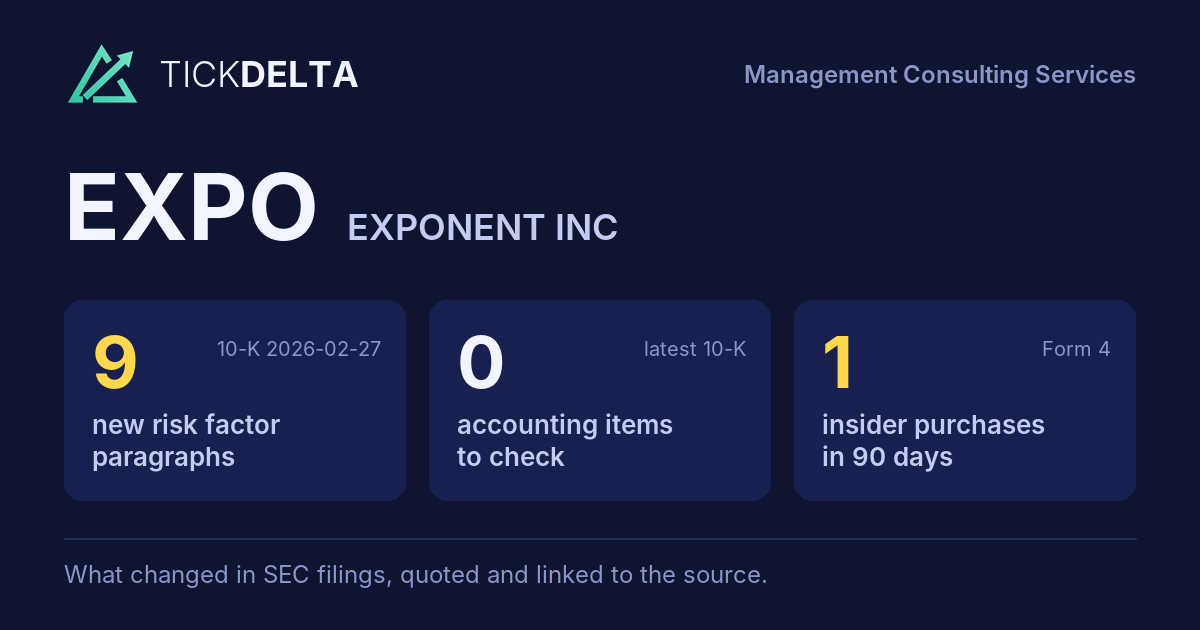
9 paragraphs in Risk Factors of the 10-K filed Feb 27, 2026 with nothing like them in the 10-K filed Feb 28, 2025. Quoted exactly. Paragraphs that were only edited are under 10-K change.
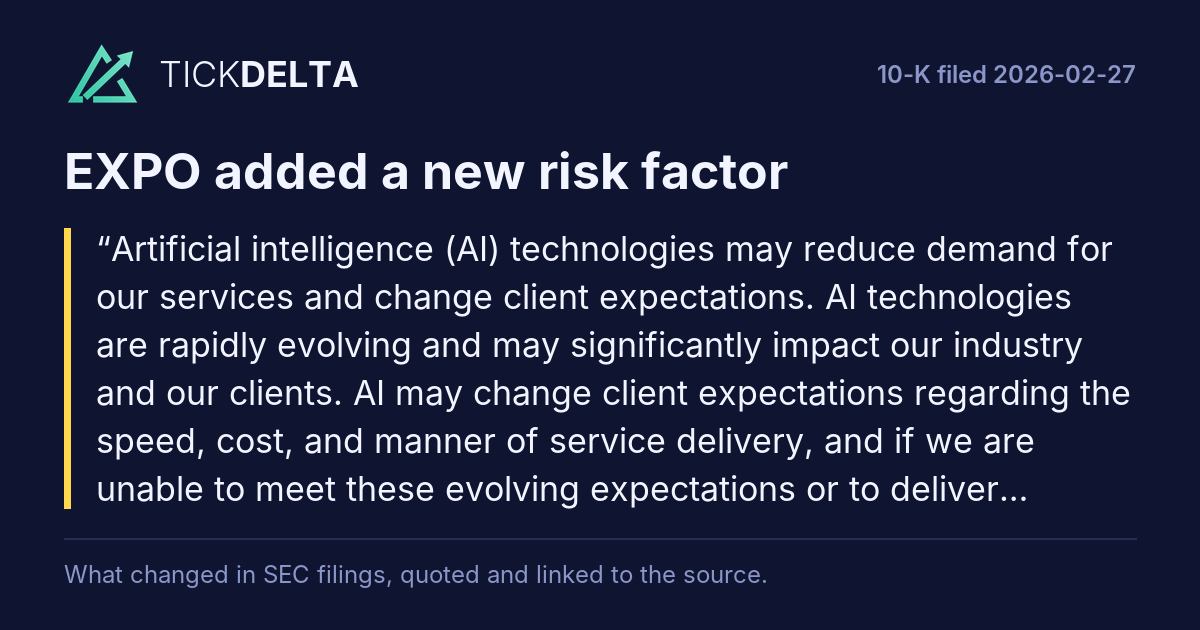
Artificial intelligence (AI) technologies may reduce demand for our services and change client expectations.
AI technologies are rapidly evolving and may significantly impact our industry and our clients. AI may change client expectations regarding the speed, cost, and manner of service delivery, and if we are unable to meet these evolving expectations or to deliver increased value through the use of AI, we may lose engagements or experience pressure on our pricing and margins. Our competitors may adopt and deploy AI technologies more quickly or effectively than we do, and new market entrants offering AI-based solutions may offer automated alternatives as a substitute for our services, potentially displacing demand for certain of our offerings. AI technologies may also render some of our existing service offerings less valuable or obsolete, particularly those that are more standardized in nature. Our failure to capitalize on the many opportunities presented by AI or to adapt our business model in response to AI-driven market changes could have a material adverse effect on our revenues and profitability.
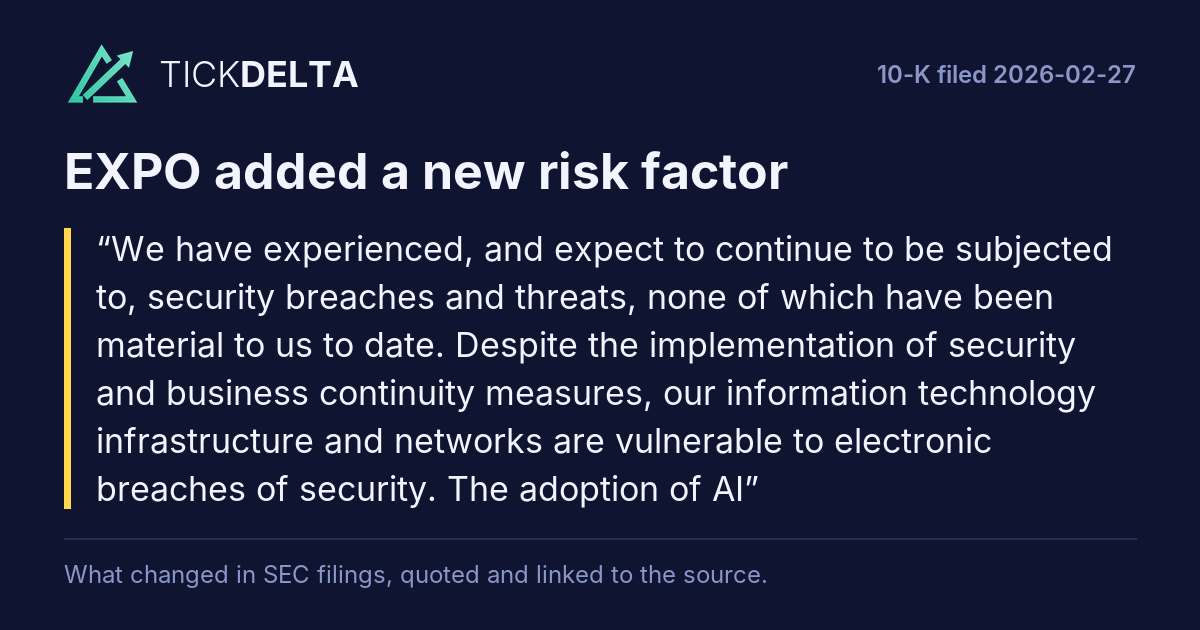
We have experienced, and expect to continue to be subjected to, security breaches and threats, none of which have been material to us to date. Despite the implementation of security and business continuity measures, our information technology infrastructure and networks are vulnerable to electronic breaches of security. The adoption of AI
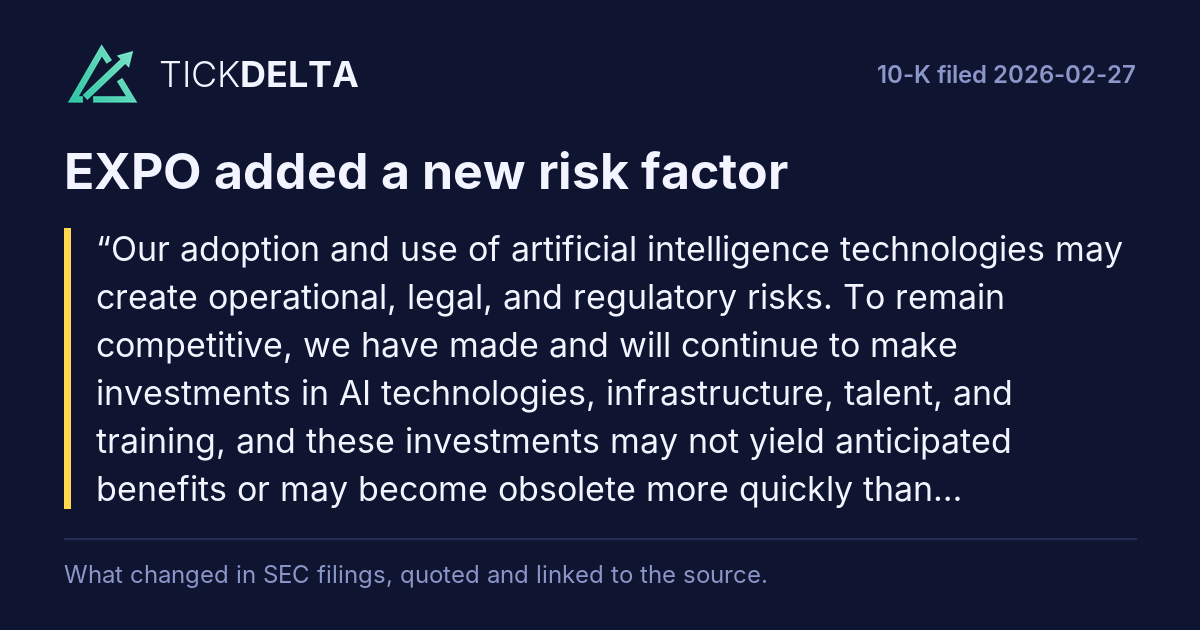
Our adoption and use of artificial intelligence technologies may create operational, legal, and regulatory risks.
To remain competitive, we have made and will continue to make investments in AI technologies, infrastructure, talent, and training, and these investments may not yield anticipated benefits or may become obsolete more quickly than expected. The use of AI tools to assist in the preparation of our work product or our corporate operations may expose us to new forms of liability. AI solution may produce inaccurate, incomplete, incorrect or misleading outputs, and if erroneous AI-generated content is incorporated into our deliverables, we could face claims of professional negligence, harm to our professional reputation, and other legal actions. Maintaining rigorous quality control over AI-assisted work product may require additional resources and oversight that could offset anticipated efficiency gains. AI-driven changes to our workforce and service delivery model could also be disruptive and may adversely affect employee morale and retention. The legal and regulatory landscape governing AI is evolving rapidly and remains uncertain, and compliance with existing and emerging AI regulations may require significant resources. Failure to comply with
applicable AI-related laws and regulations could result in regulatory enforcement actions, fines, litigation, and reputational damage.
underlying cause of the decline and whether stock price declines are short-term in nature or indicative of an event or change in circumstances.
Failure to meet climate expectations or standards could adversely affect our business, reputation, brand, results of operations and financial condition
Our stakeholders, especially our clients, may have expectations about our sustainability-related initiatives, disclosures and progress. Client preferences may shift to support companies demonstrating more positive climate progress than we have shown. Furthermore, if our competitors’ environmental, social, or governance practices are perceived to be better than our own, certain investors or clients may elect to invest in or be a patron of our competitors instead, which could have an adverse impact on our business, financial condition, and results of operations.
Paragraphs in the 10-Q filed Nov 6, 2026 that were not in the one before
New in the latest 10-Q
2 paragraphs in the 10-Q filed Nov 6, 2026 with nothing like them in the 10-Q filed Aug 7, 2026 (at least half the words must differ; new numbers alone do not count). Quoted exactly, grouped by the item heading above them. This is text that changed, not a judgement of how serious it is.
Financial statements and notes
expense of $14,632,000 as a result of changes in the market value of the trust assets with the same amount being recorded as a gain in miscellaneous income, net.
Read in the 10-Q
2026 2025 ────────────────────────────────────────────────────────────────────────────────────────────────────────────────── Cash paid during period: Income taxes $34,493 $32,367 Non-cash investing and financing activities: Vested stock unit awards issued to settle accrued bonuses $13,381 $12,179 Right-of-use asset obtained in exchange for operating lease obligations $1,690 $3,540 Accrual for capital expenditures as of period end $617 $653 Excise tax accrued on repurchases of common stock $1,330 $617
Read in the 10-Q
The 10-Q's risk factors against the 10-K
Item 1A of the 10-Q filed Nov 6, 2026 against Item 1A of the 10-K filed Feb 27, 2026.
A 10-Q repeats only the risks that changed, so a 10-K paragraph that is missing from it is not counted as removed.
Added is a paragraph with nothing like it in the 10-K, Reworded a sentence that is in both with several words changed,
Quiet changes a sentence in both where one to four words changed and one is a hedge or a modal
(cut words struck through, new words highlighted).
Text on the page, not a score; each links to the filing at sec.gov.
What the 10-Q itself says about its risk factors:There have been no material changes from risk factors as previously discussed under the heading “Risk Factors” in the Company’s 2025 Annual Report.
Read in the 10-Q
1 paragraph in the 10-Q's Item 1A, and none of them adds, rewords or quietly edits a paragraph of the 10-K's.
Phrases used for the first time
Two-word phrases in Risk Factors of the 10-K filed Feb 27, 2026 that are in none of the 1 earlier 10-Ks stored, back to Feb 28, 2025
Where each one is used
- artificial intelligence: Artificial intelligence (AI) technologies may reduce demand for our services and change client expectations.
- change client: Artificial intelligence (AI) technologies may reduce demand for our services and change client expectations.
- client expectations: Artificial intelligence (AI) technologies may reduce demand for our services and change client expectations.
- service delivery: AI technologies are rapidly evolving and may significantly impact our industry and our clients. AI may change client expectations regarding the speed, cost, and manner of service delivery, and if we are unable to meet these evolving expectations or to deliver increased value through the use of AI, we may lose...
- work product: To remain competitive, we have made and will continue to make investments in AI technologies, infrastructure, talent, and training, and these investments may not yield anticipated benefits or may become obsolete more quickly than expected. The use of AI tools to assist in the preparation of our work product or our...
- potential global: In addition to our offices in the United States, we have a presence in the United Kingdom, Switzerland, Hong Kong, China, Singapore, Ireland, Germany, and Canada, and conduct business in several other countries. We expect to continue to expand globally and our international revenues may account for an increasing...
- global conflicts: In addition to our offices in the United States, we have a presence in the United Kingdom, Switzerland, Hong Kong, China, Singapore, Ireland, Germany, and Canada, and conduct business in several other countries. We expect to continue to expand globally and our international revenues may account for an increasing...
Used at least twice, small words left out. Counted, not picked: a phrase can be new because the company renamed something.
What was taken out
4 paragraphs of last year's Risk Factors with nothing like them now. The longest are quoted.
Sources
Item 1A of each 10-K and 10-Q on EDGAR, quoted exactly. Each paragraph links to the filing at sec.gov.
Also
10-K change: what was reworded or cut, section by section.
Work with it
Excel workbook · CSV. Google Sheet that stays up to date: paste =IMPORTDATA("https://tickdelta.com/company/EXPO/export.csv") into a cell.