Reworded10-Q 2026-10-30 vs 10-K 2026-02-20
The risks described below in our Annual Report on Form 10-K and our Quarterly Reports on Form 10-Q are not the only risks facing us. our company.
Tickdelta is free for now. Sign up and get Pro free
Extra Space Storage Inc. (“we,” “our,” “us” or the “Company”) is a fully integrated, self-administered and self-managed real estate investment trust (“REIT”) formed as a Maryland corporation on April 30, 2004. 10-K, Item 1
6 paragraphs in Risk Factors of the 10-K filed Feb 20, 2026 with nothing like them in the 10-K filed Feb 28, 2025. Quoted exactly. Paragraphs that were only edited are under 10-K change.
Compared with the Risk Factors in the latest 10-K of the other 29 Real estate companies: a paragraph with at least half its words the same at another company is called similar, and the companies are listed under it. A paragraph most of them have is marked boilerplate. No line means no other company has one like it. This counts text; it does not say how serious a risk is.
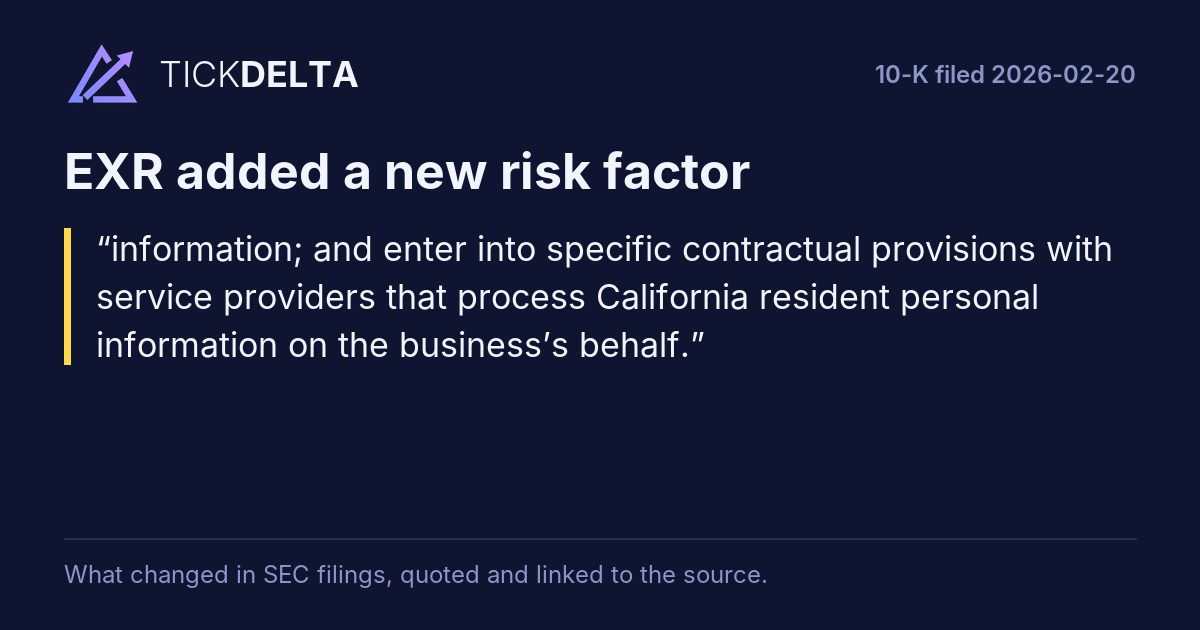
information; and enter into specific contractual provisions with service providers that process California resident personal information on the business’s behalf.
Read in the 10-K ↗
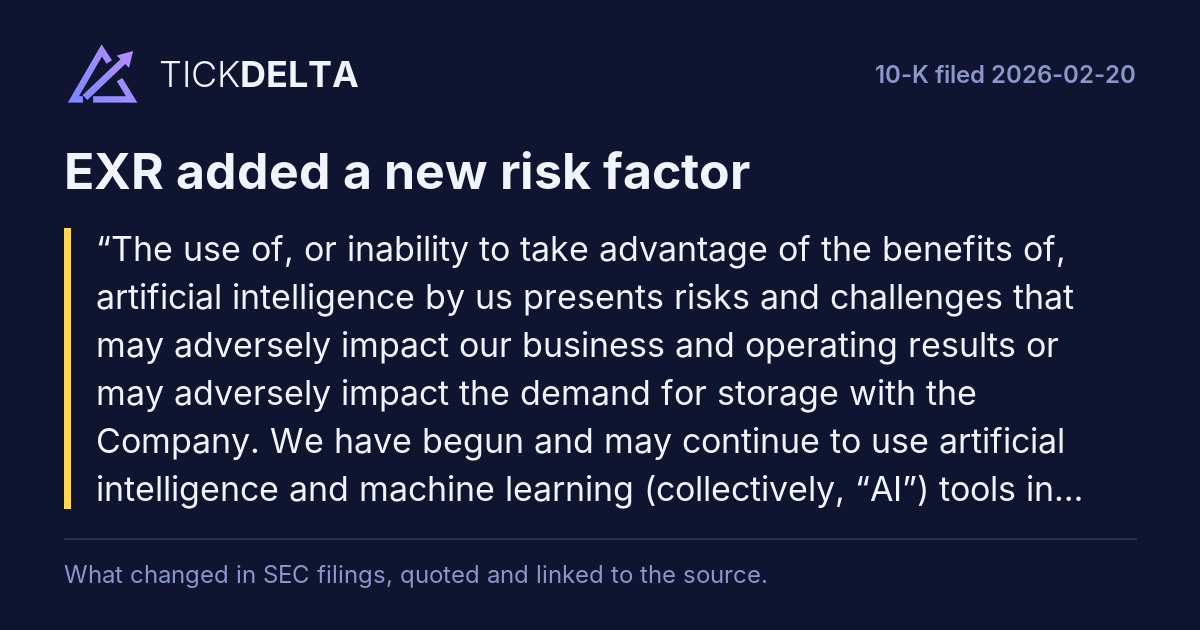
The use of, or inability to take advantage of the benefits of, artificial intelligence by us presents risks and challenges that may adversely impact our business and operating results or may adversely impact the demand for storage with the Company.
We have begun and may continue to use artificial intelligence and machine learning (collectively, “AI”) tools in our operations. We use AI in assessing marketing decisions and operating our stores. However, there can be no assurance that we will realize the desired or anticipated benefits, or any benefits, and we may fail to properly implement such technology. While AI tools may facilitate optimization and operational efficiencies, they also have the potential for inaccuracy, bias, infringement or misappropriation of intellectual property. The use of AI tools may introduce errors or inadequacies that are not easily detectable, including deficiencies, inaccuracies, or biases in the data used for AI training, or in the content, analyses, or recommendations generated by AI applications. Additionally, if our peers use AI tools to optimize operations and we fail to utilize AI tools in a comparable manner, we may be competitively disadvantaged.
New laws and regulations are being adopted, and existing laws and regulations may be interpreted, in ways that could affect our business operations and the way in which we use AI. Our ongoing efforts to comply with privacy and data protection laws, as well as initiatives to comply with new legal regulations relating to privacy, data protection and AI, impose significant costs and challenges that are likely to increase over time. Additionally, this complex and rapidly evolving landscape around AI may expose us to claims, inquiries, demands and proceedings by private parties and global regulatory authorities and subject us to legal liability as well as reputational harm.
Similar paragraph at 1 of 29 other Real estate companies: VTRUncertainty around the safety and security of new and emerging AI applications may require additional investment in the development of proprietary datasets, machine learning models and systems to test for security, accuracy, bias and other variables, which are often complex, may be costly and could impact our operating results. Cybersecurity threat actors may also utilize AI tools to automate and enhance cybersecurity attacks against us and could lead to data breaches, loss of confidential or sensitive information, and financial or reputational harm.
Similar paragraph at 1 of 29 other Real estate companies: VTRThese outcomes could impair our ability to compete effectively, damage our reputation, result in the loss of valuable property or information and adversely affect our business, financial condition, and results of operations.
Read in the 10-K ↗
3 paragraphs in the 10-Q filed Oct 30, 2026 with nothing like them in the 10-Q filed Jul 31, 2026 (at least half the words must differ; new numbers alone do not count). Quoted exactly, grouped by the item heading above them. This is text that changed, not a judgement of how serious it is.
Equity in earnings of unconsolidated real estate ventures - impairment (loss) on joint venture interests and gain on sale of joint venture interests - During the three months ended September 30, 2026, we fully impaired our investments in two joint ventures resulting in a loss of $13,883. During the three and nine months ended September 30, 2025, we recognized a net gain of $9,354 due to the sale of our membership interest in the Life Storage Spacemax LLC joint venture, which held six properties, in July 2025.
Read in the 10-Q ↗
The following table presents our share repurchases made pursuant to our share repurchase program for the three months ended September 30, 2026:
Read in the 10-Q ↗
On October 15, 2026, the Company’s board of directors authorized a new share repurchase program allowing for the repurchase of shares with an aggregate value up to $500,000. The October 2026 increase is not reflected in the “Approximate Dollar Value That May Yet Be Purchased Under the Program” column in the table above, which reflects only the amount available as of the end of each month during the quarter ended September 30, 2026.
Read in the 10-Q ↗
Item 1A of the 10-Q filed Oct 30, 2026 against Item 1A of the 10-K filed Feb 20, 2026.
A 10-Q repeats only the risks that changed, so a 10-K paragraph that is missing from it is not counted as removed.
Added is a paragraph with nothing like it in the 10-K, Reworded a sentence that is in both with several words changed,
Quiet changes a sentence in both where one to four words changed and one is a hedge or a modal
(cut words struck through, new words highlighted and underlined).
Text on the page, not a score; each links to the filing at sec.gov.
Work on EXR in a spreadsheet:
Excel workbook (a sheet per section, ten years by column, charts, links to the filings) ·
CSV.
For a Google Sheet that stays up to date, paste =IMPORTDATA("https://tickdelta.com/company/EXR/export.csv") into a cell.