tickdelta
Sign in

Tickdelta is free for now. Sign up and get Pro free

← Screener

EXRExtra Space Storage

Real estate · REIT · NYSE

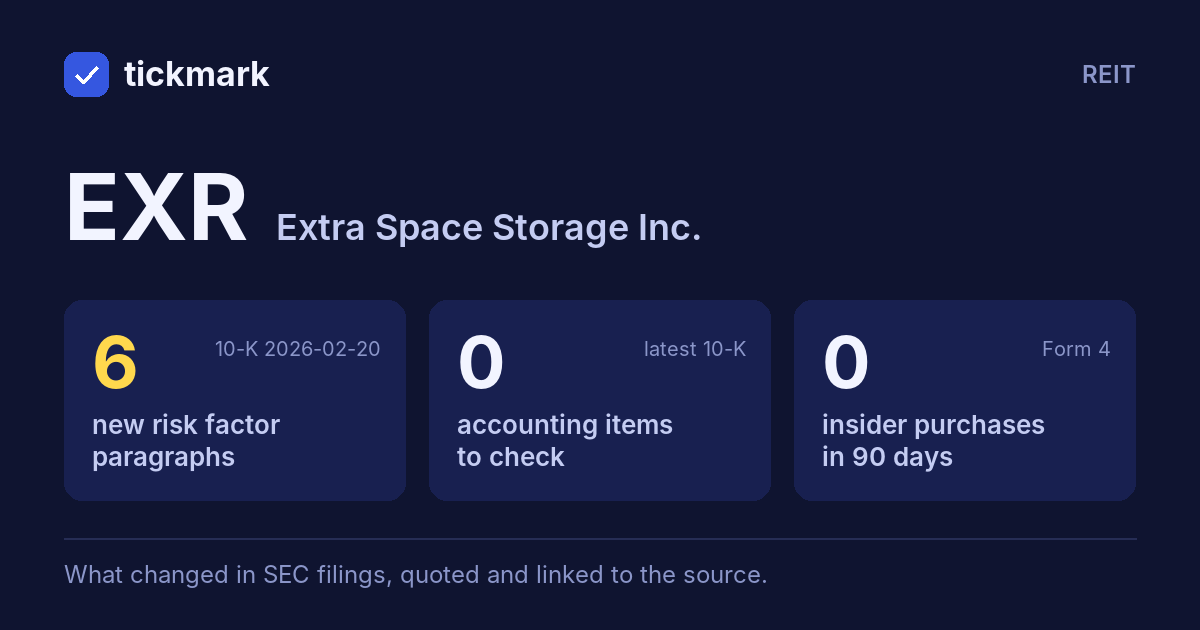
Extra Space Storage Inc. (“we,” “our,” “us” or the “Company”) is a fully integrated, self-administered and self-managed real estate investment trust (“REIT”) formed as a Maryland corporation on April 30, 2004. 10-K, Item 1

Employees
8,393
Headquarters
Salt Lake City, UT
CEO
Joseph D. Margolis
Next results
around Feb 18, 2027
Compare with peers → Embed

When the SEC's staff reviews a filing, it writes to the company with numbered questions, and the company answers each one in a letter. SEC publishes the exchange once the review is over, at least 20 business days later. Below: what the staff asked EXR, and the company's answer to each question, quoted from the letters. A question is not an accusation; most reviews end with the company adding detail to its next filing.

Form 10-K

2023-03-27 to 2023-04-07 · 1 question · 1 letter from the SEC, 1 from the company
Review closed 2023-04-07
Debt
Notes to Consolidated Financial Statements
SEC asked
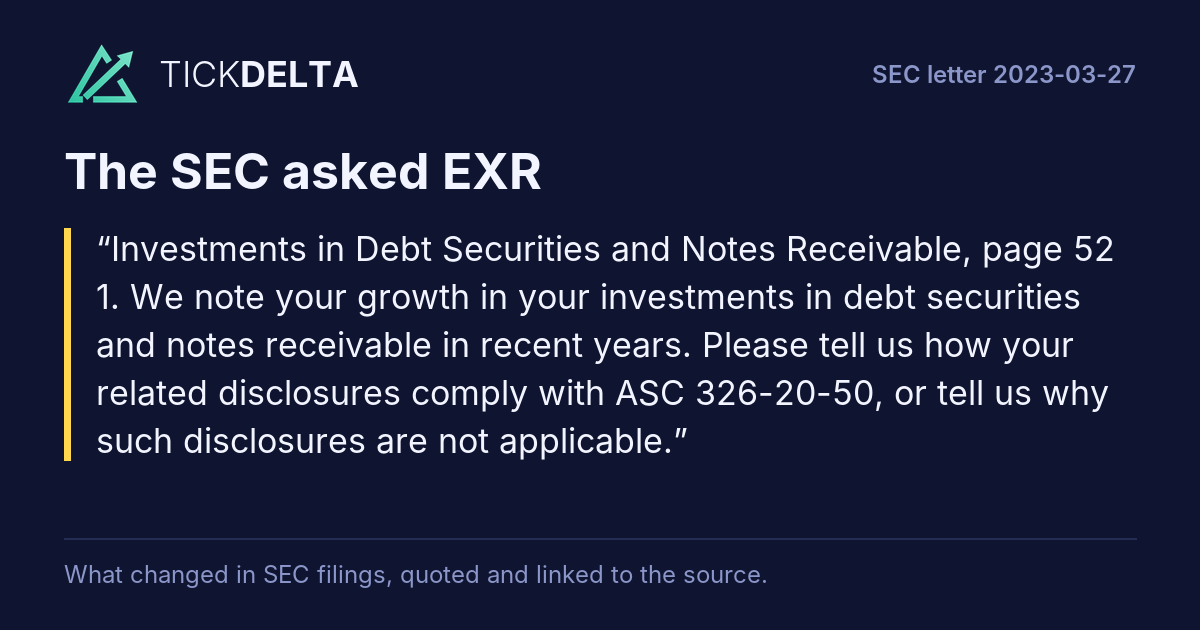
Investments in Debt Securities and Notes Receivable, page 52 1. We note your growth in your investments in debt securities and notes receivable in recent years. Please tell us how your related disclosures comply with ASC 326-20-50, or tell us why such disclosures are not applicable.
EXR answered
We acknowledge the Staff’s comment and confirm that we have reviewed the disclosures required in ASC 326-20-50. We have performed analysis regarding potential credit losses related to our debt securities and notes receivable and respectfully inform the Staff that our allowance for potential credit losses is not material (approximately $1 million) to the consolidated financial statements as of December 31, 2022.
Rest of the answer

We also acknowledge that additional disclosures should be made in future filings regarding credit quality information, past-due status, nonaccrual status and the immaterial nature of the allowance for potential credit losses in our investments in debt securities and notes receivable.

Factors we considered in estimating the allowance for potential credit losses include the following:

•The Company has performed due diligence on the stores underlying the investments in debt securities and notes receivable, including detailed projections of net operating income over the terms of these receivables. These due diligence efforts are consistent with the underwriting procedures we perform on our acquisitions of stores. We believe the due diligence process employed by the Company limits the risk that the stores will not be able to generate the necessary cash flows to repay the notes receivable.

•The Company evaluates the credit worthiness of each borrower and requires a minimum net worth of $10 million and a minimum liquidity of $1 million for borrowers.

•The Company targets loan to value of between 70-80% and based on historical performance of self-storage through economic cycles, a loss of greater than 20% is unlikely.

•The Company requires borrowers to purchase interest rate caps, which limits the borrower’s exposure to changes in interest rates.

•The Company withholds proceeds from these notes receivable at origination to establish interest and operating reserves during the lease up period of the stores.

•The Company withholds distributions from borrowers until the stores reach a debt service coverage ratio (defined as net operating income divided by total debt service obligations) between 1.0 and 1.1.

•The Company requires borrowers to use the Company’s property management services for the stores, giving the company control over the depository accounts.

•The Company acts as property manager for the stores collateralizing debt securities and notes receivable, ensuring operational efficiency and visibility into store performance.

•The Company projects conservative lease-up operating performance based on historical experience and market conditions.

•The Company compares actual property performance to projections on a quarterly basis. If a store is not meeting expectations, the borrower is required to replenish the operating and/or interest reserves.

•The Company has the right, but not the obligation, to foreclose on the notes receivable in the event of default. If the Company were to exercise this option, the potential loss would be limited to any amount owed that exceeds the fair value of the collateral.

•The Company’s debt securities and notes receivable are not past-due or in nonaccrual status. In addition, the Company has experienced no credit losses on debt securities and notes receivable to date.

•The Company uses the loss-rate method as well as assessing the probability of default or loss to estimate its allowance for credit loss. The Company used its own loss rate experience as well as third-party credit loss ratios to estimate its allowance for credit losses.

ASC 326-20-30-3 states that, “The allowance for credit losses may be determined using various methods. For example, an entity may use discounted cash flow methods, loss-rate methods, roll-rate methods, probability-of-default methods, or methods that utilize an aging schedule. An entity is not required to utilize a discounted cash flow method to estimate expected credit losses. Similarly, an entity is not required to reconcile the estimation technique it uses with a discounted cash flow method.”

•The Company uses estimation techniques that are applied consistently to faithfully estimate the collectability of the debt securities and notes receivable.

ASC 326-20-55-7 states that, “Because of the subjective nature of the estimate, this Subtopic does not require specific approaches when developing the estimate of expected credit losses. Rather, an entity should use judgment to develop estimation techniques that are applied consistently over time and should faithfully estimate the collectability of the financial assets by applying the principles in this Subtopic. An entity should utilize estimation techniques that are practical and relevant to the circumstance. The method(s) used to estimate expected credit losses may vary on the basis of the type of financial asset, the entity’s ability to predict the timing of cash flows, and the information available to the entity.”

Based on the factors detailed above and the credit loss analysis at December 31, 2022, the Company determined that the potential credit losses were immaterial (approximately $1 million) to the consolidated financial statements. The Company proposes to add the following disclosures to the “Investments in Debt Securities and Notes Receivable” footnote in future filings: “The Notes Receivable – Bridge Loans typically have a loan to value ratio between 70% and 80%. None of the debt securities or notes receivable are in past-due or nonaccrual status and the allowance for potential credit losses is immaterial.”

We will continue to review these investments in our debt securities and notes receivable and the related disclosures annually as required in ASC 326-20-50 and will update these disclosures as required.
Read in the reply ↗

Also in this review: closing letter, 2023-04-07
Form 10-K

2017-04-10 to 2017-04-19 · 3 questions · 1 letter from the SEC, 1 from the company
Review closed 2017-04-19
Non-GAAP measuresAcquisitions
Form 10-K for the year ended December 31, 2016 · Same-Store Results, page 33
SEC asked (1)
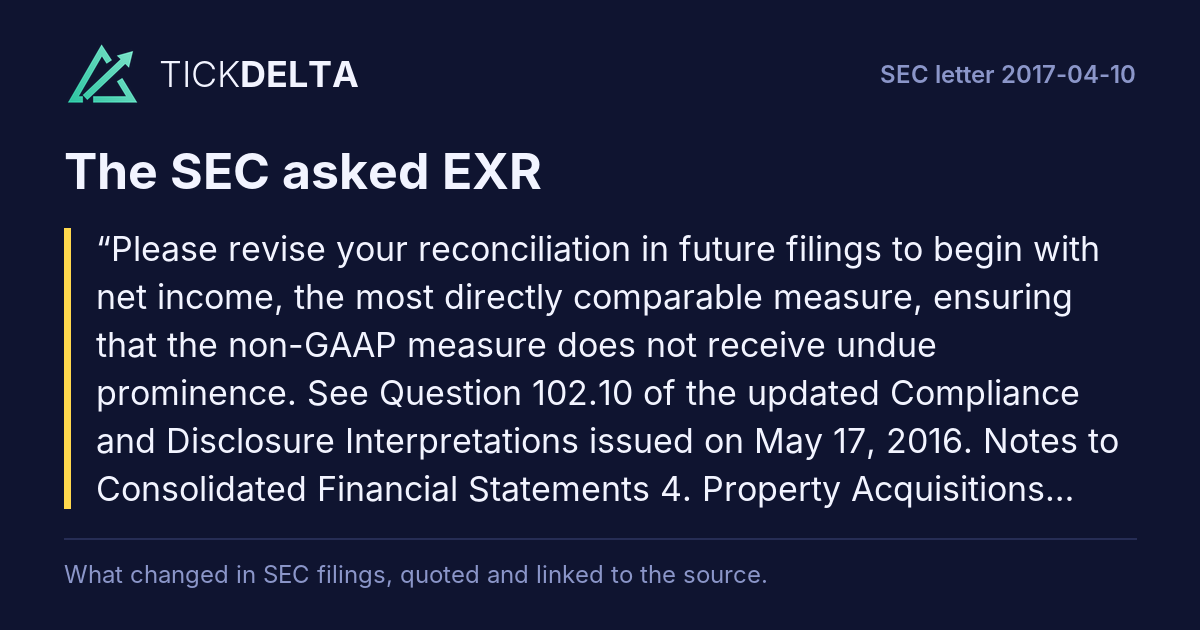
Please revise your reconciliation in future filings to begin with net income, the most directly comparable measure, ensuring that the non-GAAP measure does not receive undue prominence. See Question 102.10 of the updated Compliance and Disclosure Interpretations issued on May 17, 2016. Notes to Consolidated Financial Statements 4. Property Acquisitions and Dispositions, page 60
EXR answered

No numbered answer found in the reply. Read the reply ↗

In its next report

First report after the company's reply of 2017-04-17: 10-Q filed 2017-05-05 ↗, against the 10-Q filed 2016-11-04 ↗.

Tickdelta does not hold the text of both reports, so they are not compared here.

Form 10-K for the year ended December 31, 2016 · Same-Store Results, page 33
SEC asked (2)
We note that the amounts disclosed in the table for the number and value of OP Units issued during 2016 do not agree to the amounts disclosed in Note 13. Please tell us the actual number of OP Units issued during 2016 and the value of those units, and clarify or revise your disclosure in future filings.
Rest of the question

To the extent the value assigned to issued OP Units varies significantly, please tell us the reason for such variances.

EXR answered

No numbered answer found in the reply. Read the reply ↗

In its next report

First report after the company's reply of 2017-04-17: 10-Q filed 2017-05-05 ↗, against the 10-Q filed 2016-11-04 ↗.

Tickdelta does not hold the text of both reports, so they are not compared here.

Exhibit 99.1 · Outlook
SEC asked (3)
We note you provide certain non-GAAP same-store outlook numbers. In future Form 8- K 2.02 filings, please follow the guidance in C&DI Question 102.10 and provide the reconciliations required by Item 10(e)(1)(i) of Regulation S-K.
EXR answered

No numbered answer found in the reply. Read the reply ↗

In its next report

First report after the company's reply of 2017-04-17: 10-Q filed 2017-05-05 ↗, against the 10-Q filed 2016-11-04 ↗.

Tickdelta does not hold the text of both reports, so they are not compared here.

Also in this review: closing letter, 2017-04-19

Form 10-K for the fiscal year ended December 31, 2015

2016-08-08 to 2016-08-16 · 3 questions · 1 letter from the SEC, 1 from the company
Review closed 2016-08-16
Non-GAAP measures
Operations · Funds from Operations, page 43
SEC asked (1)
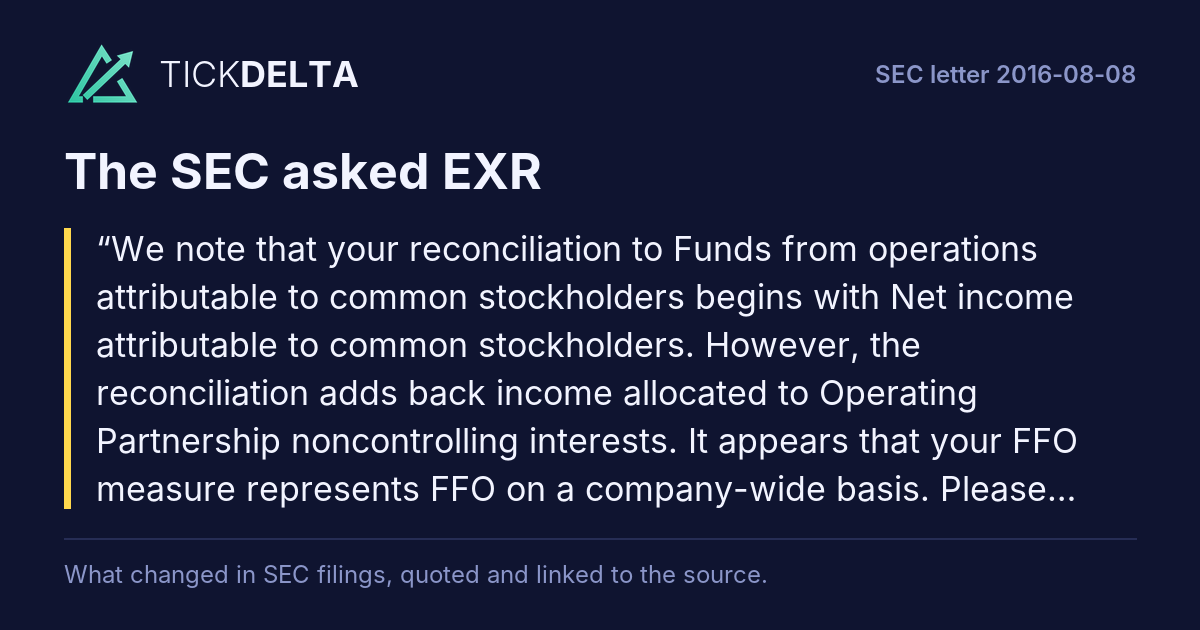
We note that your reconciliation to Funds from operations attributable to common stockholders begins with Net income attributable to common stockholders. However, the reconciliation adds back income allocated to Operating Partnership noncontrolling interests. It appears that your FFO measure represents FFO on a company-wide basis.
Rest of the question

Please clarify and/or revise your presentation and labeling of the measure in future filings to adequately reflect what is being presented.

EXR answered
Extra Space Storage Inc. (the "Company," "we," "us" and "our") submits this letter in response to the Staff’s comment letter dated August 8, 2016. For your convenience, we have set forth the Staff’s comment and the Company’s response for each item below. The Company acknowledges the following in regard to its filings: The Company is responsible for the adequacy and accuracy of the disclosure in its filings; Staff comments or changes to disclosures in response to Staff comments do not foreclose the Commission from taking any action with respect to the filing; and The Company may not assert Staff comments as a defense in any proceeding initiated by the Commission or any person under the
Rest of the letter

federal securities laws of the United States. Item 7. Management’s Discussion and Analysis of Financial Condition and Results of Operations We note that your reconciliation to Funds from operations attributable to common stockholders begins with Net income attributable to common stockholders. However, the reconciliation adds back income allocated to Operating Partnership noncontrolling interests. It appears that your FFO measure represents FFO on a company-wide basis. Please clarify and/or revise your presentation and labeling of the measure in future filings to adequately reflect what is being presented. We acknowledge the Staff’s comment and confirm that to more clearly define the FFO measure, we will relabel the total line to be “Funds from operations attributable to common stockholders and unit holders.” Please tell us how you have met all the disclosure requirements of Item 10(e) of Regulation S-K with regard to your disclosure of same-store net operating income. This comment should also be applied to the same-store presentation within your quarterly earnings release. We acknowledge the Staff’s comment and confirm that in future filings, we will update the disclosures, including by providing reconciliation of same-store net operating income to the most directly comparable GAAP measure, to comply with the disclosures required by Item 10(e) of Regulation S-K. We note that in your quarterly earnings release you focus on key non-GAAP financial measures more prominently than GAAP measures, which is inconsistent with the updated Compliance and Disclosure Interpretations issued on May 17, 2016 (specifically Question 102.10). Please review this guidance when preparing your next earnings release. We acknowledge the Staff’s comment and confirm that we will review the updated Compliance and Disclosure Interpretations issued on May 17, 2016 (including specifically Question 102.10) and update our disclosures accordingly in preparing our future earnings releases.

One letter for all the questions, without numbered answers. Read the reply ↗
In its next report

First report after the company's reply of 2016-08-12: 10-Q filed 2016-11-04 ↗, against the 10-Q filed 2016-08-05 ↗.

Tickdelta does not hold the text of both reports, so they are not compared here.

Same-Store Results, page 43
SEC asked (2)
Please tell us how you have met all the disclosure requirements of Item 10(e) of Regulation S-K with regard to your disclosure of same-store net operating income. This comment should also be applied to the same-store presentation within your quarterly earnings release.
EXR answered

See the reply above.

In its next report

First report after the company's reply of 2016-08-12: 10-Q filed 2016-11-04 ↗, against the 10-Q filed 2016-08-05 ↗.

Tickdelta does not hold the text of both reports, so they are not compared here.

Form 8-K filed July 27, 2016 · Exhibit 99.1
SEC asked (3)
We note that in your quarterly earnings release you focus on key non-GAAP financial measures more prominently than GAAP measures, which is inconsistent with the updated Compliance and Disclosure Interpretations issued on May 17, 2016 (specifically Question 102.10). Please review this guidance when preparing your next earnings release.
EXR answered

See the reply above.

In its next report

First report after the company's reply of 2016-08-12: 10-Q filed 2016-11-04 ↗, against the 10-Q filed 2016-08-05 ↗.

Tickdelta does not hold the text of both reports, so they are not compared here.

Also in this review: closing letter, 2016-08-16

4 other letters: notices that a filing will not be reviewed, requests to declare a registration effective, and the like

From the SEC's correspondence on EDGAR: staff letters (form UPLOAD) and company letters (form CORRESP), 13 letters filed since 2016-08-08. Questions and answers are matched by their numbers; topics come from words in each question. The reports are compared word for word (same form, before the first SEC letter against the first report after the company's reply). No AI.

Work on EXR in a spreadsheet: Excel workbook (a sheet per section, ten years by column, charts, links to the filings) · CSV. For a Google Sheet that stays up to date, paste =IMPORTDATA("https://tickdelta.com/company/EXR/export.csv") into a cell.