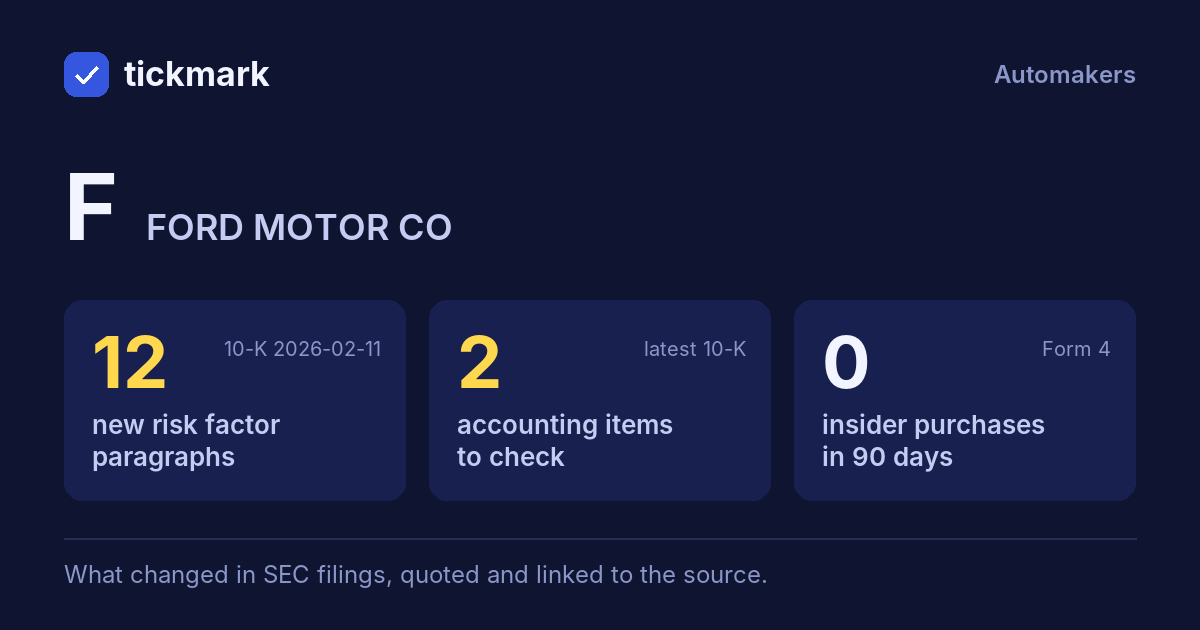
Sentences and paragraphs of F's Risk Factors and MD&A, 10-K 2026-02-11 against 10-K 2025-02-06.
Each links to the text at sec.gov.
RemovedRisk Factors
Changes in international trade policy can also have a substantial adverse effect on our financial condition, results of operations, or our business in general. Steps taken by governments to implement local content requirements or apply or consider applying additional or new tariffs on automobiles, parts, and other products and materials have the potential to disrupt existing supply chains, impose additional costs on our business, and could lead to other countries attempting to retaliate by imposing tariffs, which would make our products more expensive for customers, and, in turn, could make our products less competitive. The new, substantial tariff increases on imports to the United States from Canada and Mexico (in addition to China) announced on February 1, 2025, should they be implemented and sustained for an extended period of time, would have a significant adverse effect, including financial, on the overall automotive industry, Ford, and our supply chain. Further, any additional tariffs in the United States or retaliatory tariffs imposed by other governments would exacerbate the impact.
Read it in 10-K 2025-02-06 at sec.gov ↗
RemovedRisk Factors
With increased consumer interconnectedness through the internet, social media, and other media, mere allegations relating to quality, safety, reliability, fuel efficiency, sustainability, corporate social responsibility, or other key attributes can negatively impact our reputation or market acceptance of our products or services, even where such allegations prove to be inaccurate or unfounded. Further, our ability to successfully grow through capacity expansion and investments in the areas of electrification, connectivity, digital and physical services, and software services depends on many factors,
Read it in 10-K 2025-02-06 at sec.gov ↗
RemovedRisk Factors
The U.S. Inflation Reduction Act (“IRA”) provides, among other things, financial incentives in the form of tax credits to grow the domestic supply chain and domestic manufacturing base for electric vehicles, plug-in hybrid vehicles (“PHEVs”), and other “clean” vehicles. The law likewise incentivizes the purchase of clean vehicles and the infrastructure to fuel them. The IRA authorizes tax credits to manufacturers for the domestic production of batteries and battery components for EVs and PHEVs, and this credit is expected to improve the financial performance of domestic battery manufacturers, including the new operations at our upcoming facility in Michigan and BlueOval SK’s facilities in Kentucky and Tennessee. Further, the degree of success of some of our investment strategies depends upon IRA tax credit eligibility and for those credits to continue to remain available through the currently contemplated expiration.
Read it in 10-K 2025-02-06 at sec.gov ↗
RemovedRisk Factors
The IRA also authorizes tax credits for purchasers of qualified commercial and retail clean vehicles. Ford expects that most commercial customers that purchase an EV or PHEV will be eligible for the commercial clean vehicle credit, although it is unclear at this time how many commercial vehicle purchasers will have the underlying federal tax liability that is necessary to actually monetize this credit. In their current form, the IRA’s tax credit and the commercial clean vehicle credit would, together, likely influence commercial fleets, governmental fleets, and other vehicle purchasers in their evaluation of a transition from internal combustion engine vehicles to EVs and PHEVs.
Read it in 10-K 2025-02-06 at sec.gov ↗
RemovedRisk Factors
To claim the retail tax credit, the IRA establishes numerous and complex prerequisites, including that the vehicle must be assembled in North America; the vehicle must be under specified limitations on manufacturer suggested retail price (“MSRP”); purchaser income limitations; any vehicle that contains “battery components” that were “manufactured or assembled” by a “foreign entity of concern” will be ineligible; and, starting in 2025, any vehicle that contains battery materials that were “extracted, processed, or recycled” by a “foreign entity of concern” will be ineligible. A “Critical Minerals Credit” is available for those vehicles that have a specified percentage of critical minerals that are “extracted or produced” in the United States, in a country with which the United States has a Free Trade Agreement, or that is “recycled” in North America. A “Battery Components Credit” is available for those vehicles that have a specified percentage of “value” of its battery “components” that are “manufactured or assembled” in North America.
Read it in 10-K 2025-02-06 at sec.gov ↗
RemovedRisk Factors
Although we ultimately expect the IRA to benefit Ford and the automotive industry in general, this would be the case only insofar as the IRA remains in place in its current form. Some policymakers have expressed an intent to repeal or restrict eligibility for elements of the IRA, however, including those credits discussed above, which would adversely affect Ford and the industry. To the extent these elements remain in place or are replaced with new laws that provide benefits using comparable eligibility criteria, the availability of such benefits to Ford will depend on the further development and improvement of the U.S. battery supply, sufficient access to raw materials within the scope of the IRA, and the terms of the regulations and guidance (and the limitations therein) the U.S. government issues for such benefits, which will ultimately determine which vehicles qualify for incentives and the amount thereof. Further, battery and electric vehicle manufacturing and the corresponding supply chains involve substantial lead time, and it may take years before Ford can satisfy any new eligibility criteria. Automakers that better optimize eligibility for their vehicles, as compared to their competition, will have a competitive advantage.
Read it in 10-K 2025-02-06 at sec.gov ↗
RemovedMD&A
Trade Policy. To the extent governments in various regions implement or intensify barriers to imports, such as erecting tariff or non-tariff barriers or manipulating their currency, and provide advantages to local exporters selling into the global marketplace, there can be a significant negative impact on manufacturers based in other markets. In addition, as governments consider an expanded use of tariffs as a lever in achieving a balance of trade, this new dynamic could have a substantial adverse effect on our business and the automotive sector. The new, substantial tariff increases on imports to the United States from Canada and Mexico (in addition to China) announced on February 1, 2025, should they be implemented and sustained for an extended period of time, would have a significant adverse effect, including financial, on the overall automotive industry, Ford, and our supply chain. We will continue to monitor and address the developing role that geopolitical, climate, and labor concerns are playing in trade relations.
Read it in 10-K 2025-02-06 at sec.gov ↗
RemovedMD&A
Electric Vehicle Market. Although we continue to invest in our electric vehicle strategy, we have observed lower-than-anticipated industrywide electric vehicle adoption rates and near-term pricing pressures, which has led us, and may in the future lead us, to adjust our spending, production, and/or product launches to better match the pace of electric vehicle adoption. In 2024, we recorded $1.2 billion of expenses related to the cancellation of a previously announced all-electric three-row SUV program. We may incur additional expenses and cash expenditures of about $700 million related to the cancellation, the majority of which we expect to record by the first half of 2025. Further, significant unexpected changes in the EV demand environment have led, and may in the future lead, to incremental competitive pricing actions, and we may continue to incur expenses related to payments to our electric vehicle-related suppliers (battery, raw material, or otherwise), asset write-downs, or other matters. These market dynamics may continue to occur, which could have a substantial impact on our business, including our investments in supply and production capacity. In addition, policy change in the United States could reduce or eliminate supply- and demand-side incentives, resulting in slower adoption of EVs. Further, the pace of EV adoption could force Ford to take various product-led actions (e.g., curtailing the production and sale of certain internal combustion vehicles) that could have substantial adverse effects on our sales volume and operations. See Item 1A. Risk Factors for additional discussion of the risks related to lower-than-anticipated electric vehicle volumes and our planned transition to a greater mix of electric vehicles.
Read it in 10-K 2025-02-06 at sec.gov ↗
Show the other 10
RemovedMD&A
In 2024, the Ford Next segment primarily included expenses and investments for emerging business initiatives aimed at creating value for Ford in vehicle-adjacent market segments. As of January 1, 2025, Ford Next is no longer a reportable segment, and those expenses and investments are reflected in either the reportable segments that benefit from those expenses and investments or Corporate Other.
Read it in 10-K 2025-02-06 at sec.gov ↗
RemovedMD&A
Our Ford Next segment EBIT loss in 2024 was $50 million, an $88 million improvement from a year ago. Ford Next has evolved from primarily investing in the development of autonomous vehicle capabilities to focus exclusively on incubating and launching new businesses creating strategic value for Ford.
Read it in 10-K 2025-02-06 at sec.gov ↗
RemovedMD&A
We recorded $5.1 billion of pre-tax special item charges in 2023, driven primarily by pension and OPEB remeasurement, restructuring actions in Europe and China, and the Transit Connect customs matter.
Read it in 10-K 2025-02-06 at sec.gov ↗
RemovedMD&A
(b)Long-term debt may have fixed or variable interest rates. For long-term debt with variable-rate interest, we estimate the future interest payments based on projected market interest rates for various floating-rate benchmarks received from third parties.
Read it in 10-K 2025-02-06 at sec.gov ↗
RemovedMD&A
(d)Excludes approximately $707 million in future lease payments for various operating leases commencing in a future period.
Read it in 10-K 2025-02-06 at sec.gov ↗
RemovedMD&A
(e)Includes regulatory compliance credit purchase commitments. For additional information on our regulatory compliance credit purchases, see page 10 in the “Government Standards” section in “Item 1. Business”.
Read it in 10-K 2025-02-06 at sec.gov ↗
RemovedMD&A
Changes in Company cash excluding Ford Credit are summarized below (in billions):December 31, 2022 December 31, 2023 December 31, 2024
Read it in 10-K 2025-02-06 at sec.gov ↗
RemovedMD&A
(b)2022 includes a $7.4 billion loss on our Rivian investment. 2023 includes $2.6 billion of capital contributions to BlueOval SK, LLC. 2024 includes $2.3 billion of capital contributions to BlueOval SK, LLC, offset by a return of capital of $1.4 billion.
Read it in 10-K 2025-02-06 at sec.gov ↗
RemovedMD&A
Pension Plan Contributions and Strategy. Our strategy is to reduce the risk of our funded defined benefit pension plans, including minimizing the volatility of the value of our pension assets relative to pension liabilities and the need for unplanned use of capital resources to fund the plans. The strategy reduces balance sheet, cash flow, and income exposures and, in turn, reduces our risk profile. Going forward, we expect to:
Read it in 10-K 2025-02-06 at sec.gov ↗
RemovedMD&A
•Minimize the volatility of the value of our pension assets relative to pension obligations and ensure assets are sufficient to pay plan benefits; and
Read it in 10-K 2025-02-06 at sec.gov ↗