FFord Motor Company
Ford Motor Company was incorporated in Delaware in 1919. 10-K, Item 1
- Headquarters
- Dearborn, MI
- Next results
- around Feb 9, 2027
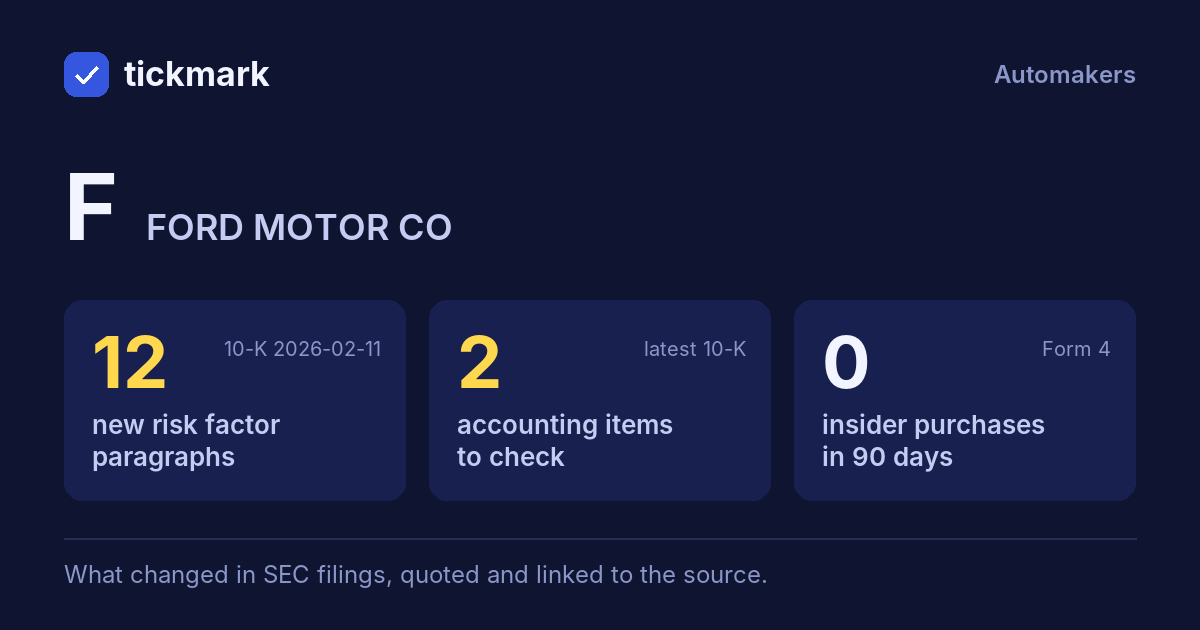
12 paragraphs in Risk Factors of the 10-K filed Feb 11, 2026 with nothing like them in the 10-K filed Feb 6, 2025. Quoted exactly. Paragraphs that were only edited are under 10-K change.
Compared with the Risk Factors in the latest 10-K of the other 46 Consumer discretionary companies: a paragraph with at least half its words the same at another company is called similar, and the companies are listed under it. A paragraph most of them have is marked boilerplate. No line means no other company has one like it. This counts text; it does not say how serious a risk is.
Ford is also subject to environmental regulatory compliance requirements, and in many jurisdictions (including the United States), we are required to report on and correct certain emissions-related defects. Similarly, where required by regulation, we are obligated to honor certain warranties on emissions-related components, which can impose additional obligations beyond our standard warranties and increase our costs.
Read in the 10-K ↗
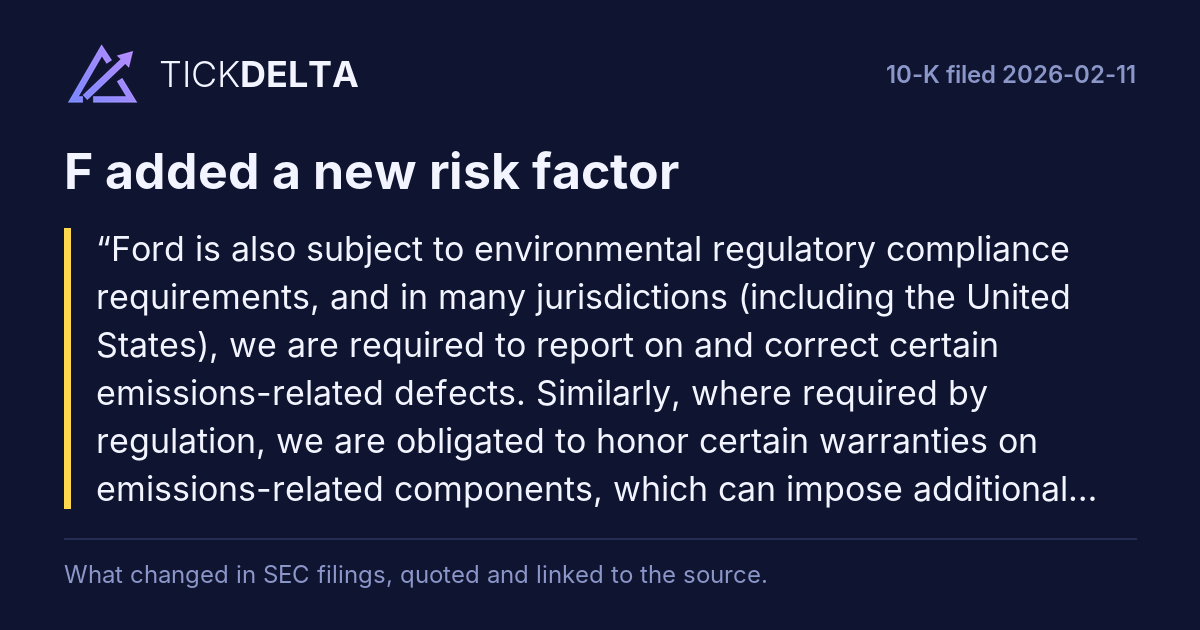
and caused disruptions in our production operations, increases the risk of future production disruptions, and has increased and may further increase costs (e.g., premium freight and expedited shipping costs to make up for delays in component availability). Moreover, as the industry evolves, suppliers of traditional or EV-specific components may face financial distress or choose to exit certain lines of business, further narrowing our sourcing options and potentially leading to higher prices or supply shortages that could have a substantial adverse effect on our results of operations and reputation.
Read in the 10-K ↗
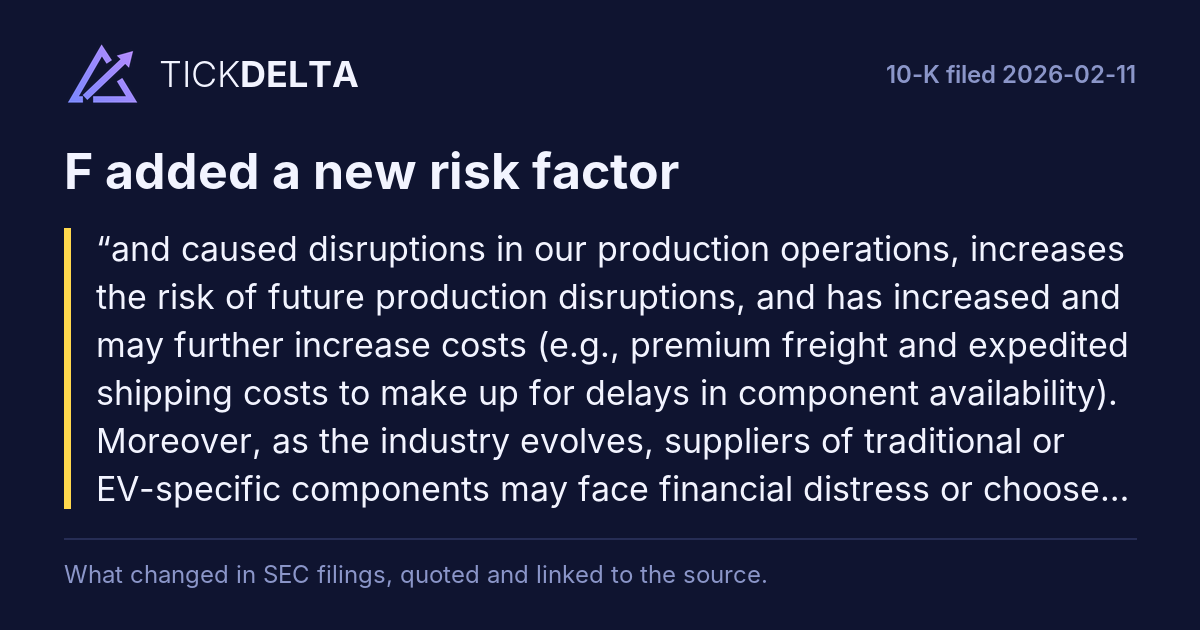
incentives); disrupt our operations; distract management from current operations; or harm our reputation. Further, we may not realize the expected benefits of such restructuring actions (e.g., anticipated cost savings), such benefits may be delayed, or market dynamics or other factors may have evolved such that we cannot obtain the original intended results of an action.
Read in the 10-K ↗
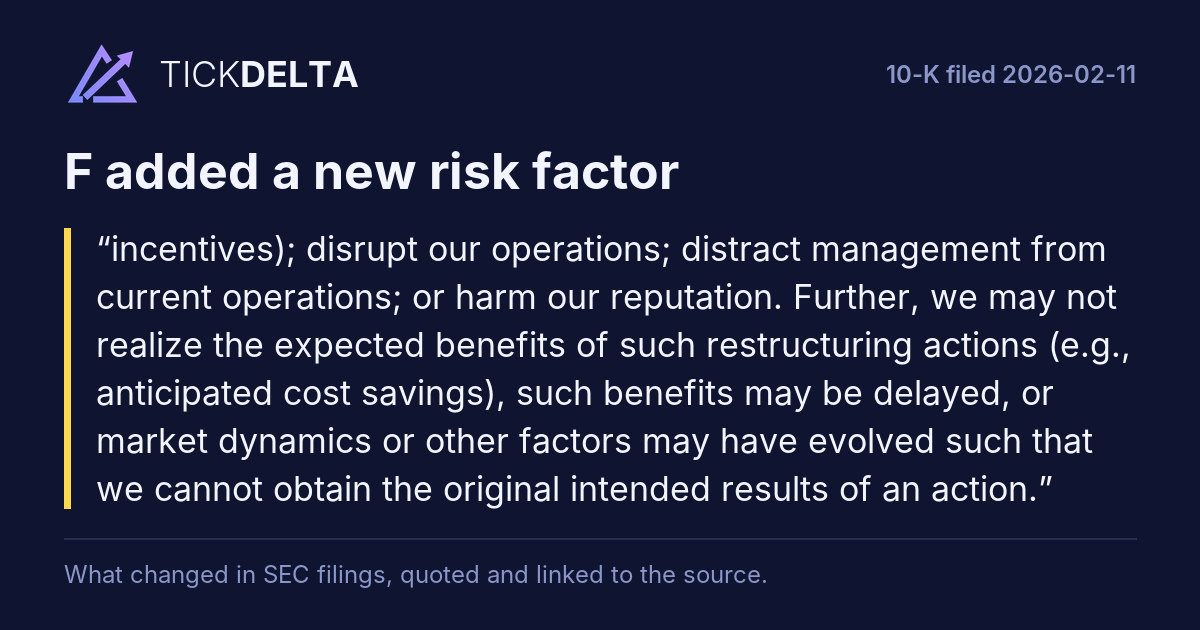
While we continue to invest in direct-to-consumer sales methods for our connectivity, digital and physical services, and integrated software services offerings, we are dependent on the efforts of third-party dealers for the majority of our sales in this space. We have invested and will continue to invest in programs to enhance sales through dealers, including education programs for dealership employees on the benefits of our services offerings and developing and making available digital marketing assets to dealers. These efforts may require a substantial investment of time and capital while providing no assurance of incremental sales.
Read in the 10-K ↗
Changes in international trade policy can also have a substantial adverse effect on our financial condition, results of operations, or our business in general. To the extent governments in various regions implement or intensify restrictions or barriers to trade, such as tariff or non-tariff barriers, export controls, currency manipulation, or policies that otherwise favor domestic companies, there can be a significant negative impact on manufacturers based in other markets. Steps taken by governments to implement local content requirements, restrict export and import activities, or apply or consider applying additional or new tariffs on automobiles, parts, and other products and materials have disrupted supply chains, imposed additional costs on our business, and led to other countries attempting to retaliate by imposing tariffs or other barriers, which make our products more expensive for customers, and, in turn, our products less competitive, and this trend may continue. Tariffs implemented to date in the United States and elsewhere have caused significant disruption, increased costs, and uncertainty in the automotive industry, including for Ford, other OEMs, suppliers, and dealers, as well as customers. Moreover, tariffs implemented or increased in the United States and elsewhere in the future may exacerbate these impacts. The U.S. government has implemented limited tariff relief for qualifying parties based on certain criteria, which could include prospective avoidance and retroactive relief through refunds. This relief is subject to periodic approval by the U.S. Department of Commerce and may be revised based on factors such as U.S. production and import content levels. Although we may be entitled to relief under these programs, and we may carry a receivable on our balance sheet reflecting tariffs paid but for which we expect, but have not yet received, refunds, the timing of our receipt of these amounts (and whether we will ultimately receive a refund) is uncertain and is subject to changes in trade policy. Accordingly, any delay in receiving the refunds could have a negative impact on our cash flow, and in the event we do not ultimately receive a refund, it could have an adverse impact on our financial condition or results of operations.
In addition, instability in the supply chain exacerbated by tariffs and other industry concerns, such as China’s restriction on the export of rare earth minerals and various components, has resulted in production disruptions and increased costs and heightens the risk of future production disruptions and further cost increases. Although there is uncertainty regarding the application, scope, and duration of tariffs, those that have been implemented have had a significant adverse effect, both operationally and financially, on the overall automotive industry, Ford, and our supply chain. Any additional tariffs or other measures that are implemented in the United States and any retaliatory tariffs or other measures or restrictions that are implemented by other governments, and the potential related market impacts, should they be sustained for an extended period of time, may have a significant adverse effect.
Read in the 10-K ↗
manufacturing efficiencies, which may reduce margins. In the event of a shortage of available products, customers may elect to purchase from our competitors and may not return to Ford in the future.
Read in the 10-K ↗
manufacturer’s vehicle using autonomous or driver assist technologies may negatively impact the perception of such technologies and erode customer trust.
Read in the 10-K ↗
Additionally, as noted above, U.S. federal tax incentives for purchasers of plug-in vehicles have changed in recent years. In 2022, Congress established these incentives and many retail and commercial vehicle purchasers were eligible for a tax credit of up to $7,500 per vehicle, increasing market demand for plug-in vehicles. Further, to make vehicles eligible for the tax incentive for retail purchasers, Ford and other manufacturers structured battery supply chains to comply with the “foreign entity of concern” criteria, which were aimed at reducing dependence on China and companies based in or operating in China. In 2025, Congress eliminated these credits, ending the incentives for purchasers and likewise changing the business rationale to use and create battery supply chains with less control by China.
The 2025 legislation preserved the advanced manufacturing production tax credit for the domestic manufacture of batteries and battery components (first established in the 2022 legislation), but restricted the eligibility criteria going forward, most notably by imposing criteria for “prohibited foreign entities,” which concern China and other countries. As a manufacturer that intends to engage in large-scale production of batteries in the United States for vehicles and energy storage, this tax credit influences our decisions concerning the location, scale, supply chain, and operations of our domestic battery manufacturing business. Such decisions involve substantial lead time, and it may take years before Ford can satisfy any new or changed eligibility criteria. Accordingly, the termination of or a change to such incentives could have a significant impact on our financial condition, results of operations, or the operation of our business.
Read in the 10-K ↗
2 more
Government investigations against Ford or Ford Credit have resulted in, and may in the future result in, fines, penalties, orders, customer remuneration, or other resolutions, through litigation, administrative proceedings, settlement, or otherwise, which have in the past had, and could in the future have, an adverse impact on our financial condition, results of operations, or the operation of our business, including oversight by regulators or a government-appointed monitor or independent third party. For example, as part of a consent order we entered into with NHTSA in 2024, we have retained an independent third party selected by NHTSA to assess the Company’s adherence to the consent order and Safety Act over the term of the consent order and to report on Ford’s progress to NHTSA.
Read in the 10-K ↗
and investor litigation could give rise to de facto changes in the interpretation of existing emission laws and regulations, thereby imposing new burdens on manufacturers. For more discussion of the impact of standards on our global business, see the “Governmental Standards” discussion in “Item 1. Business” above.
Read in the 10-K ↗
New in the latest 10-Q
6 paragraphs in the 10-Q filed Oct 29, 2026 with nothing like them in the 10-Q filed Jul 29, 2026 (at least half the words must differ; new numbers alone do not count). Quoted exactly, grouped by the item heading above them. This is text that changed, not a judgement of how serious it is.
Financial statements and notes
(d) Primarily reflects restructuring actions in Europe and our share of asset impairments and other expenses at an equity method investment.
Read in the 10-Q ↗
(a) September 30, 2026 includes assumption of the DOE loan from BOSK in the second quarter of 2026.
Read in the 10-Q ↗
• Commodity headwinds approaching $2.5 billion as we continue to see increasing pressure from input costs
Read in the 10-Q ↗
Legal proceedings
Hetsler v. Ford (as previously reported on page 36 of our 2025 Form 10-K Report). Plaintiff, Robert Hetsler, filed this product liability action against Ford in the Circuit Court of the Fourth Judicial Circuit in and for Duval County, Florida on April 24, 2020, alleging that a 2016 Roush Mustang had a manufacturing defect in an unidentified component of the engine compartment that resulted in a fire. After a trial in February 2024, a jury found Ford liable and awarded plaintiff $103 million in damages. Ford subsequently appealed the judgment, and on September 30, 2026, its final appeal was denied. The judgment has now been satisfied.
Read in the 10-Q ↗
Capic v. Ford Motor Company of Australia. Plaintiff, Biljana Capic, filed this class action against Ford Motor Company of Australia (“Ford Australia”) in the Federal Court of Australia in May 2016 on behalf of current and former owners of Ford Focus, Fiesta, and EcoSport models equipped with DPS6 PowerShift transmissions built between 2011 and 2016 alleging that these vehicles were not of acceptable quality and sought damages from Ford Australia. After a trial in June 2020, the court issued a final ruling in June 2021 holding that Ford was liable under Australian consumer laws for some components installed in the subject vehicles. The plaintiff and Ford Australia each appealed the trial court’s findings, and in November 2024, the High Court of Australia upheld and supplemented the trial court’s decision on the factors to take into account for the assessment of reduction in value damages and remanded the matter back to the trial court for an assessment of damages. In June 2025, the trial court made an initial ruling on the damages available to the lead class representative, Ms. Capic. The court did not rule on damages for the class at that time and conducted a trial in September 2026 to assess damages for sub-groups of the class. The court has not yet issued its decision.
Read in the 10-Q ↗
Item 6
Exhibit 19 Ford Motor Company Insider Trading Policy as of September 10, 2026. Filed with this Report.
Read in the 10-Q ↗
The 10-Q's risk factors against the 10-K
Item 1A of the 10-Q filed Oct 29, 2026 against Item 1A of the 10-K filed Feb 11, 2026.
A 10-Q repeats only the risks that changed, so a 10-K paragraph that is missing from it is not counted as removed.
Added is a paragraph with nothing like it in the 10-K, Reworded a sentence that is in both with several words changed,
Quiet changes a sentence in both where one to four words changed and one is a hedge or a modal
(cut words struck through, new words highlighted and underlined).
Text on the page, not a score; each links to the filing at sec.gov.
This 10-Q has no Item 1A (Risk Factors) text of its own, so there is nothing to compare. Many companies leave it out when their risks have not changed.
Work on F in a spreadsheet:
Excel workbook (a sheet per section, ten years by column, charts, links to the filings) ·
CSV.
For a Google Sheet that stays up to date, paste =IMPORTDATA("https://tickdelta.com/company/F/export.csv") into a cell.