Paragraph 15 · 48% changed
Every version of it
Screener
/
SEC EDGAR
/CIK 0001519751
/10-K filed Feb 23, 2026, compared with Feb 25, 2025
/Numbers from the XBRL of the 10-Ks
NYSE
Materials · Millwood, Veneer, Plywood, & Structural Wood Members
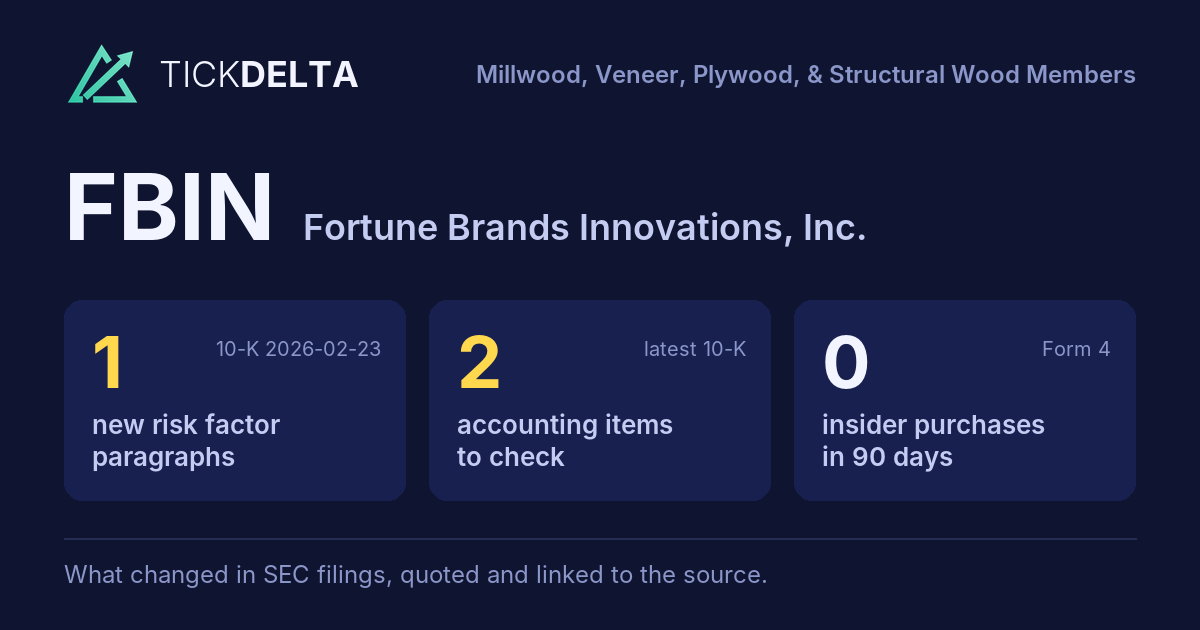
Fortune Brands Innovations, Inc. FBIN
The 10-K against last year's
87 changes: 13 added, 5 removed, 69 reworded
10-K Feb 23, 2026 vs Feb 25, 2025
Risk Factors
10.6%
of the text changed · 6,828 words now · 1 new paragraphs, 2 gone
MD&A
23.0%
of the text changed · 10,221 words now · 12 new paragraphs, 3 gone
Legal Proceedings
19.5%
of the text changed · 376 words now
Accounting Policies
6.1%
of the text changed · 4,637 words now
10-K 0001193125-26-063960 (Feb 23, 2026) vs 10-K 0000950170-25-026763 (Feb 25, 2025)
Every paragraph, and how much of it changed
One bar per paragraph, in the order of the 10-K. Height and colour show the share of its words not in the closest paragraph a year earlier; the tallest bars are new paragraphs.
Risk Factors
66 paragraphs · 1 new · 24 reworded · 2 gone · 10-K Feb 23, 2026 against Feb 25, 2025
New paragraph
Reworded (5% of its words or more)
Same or nearly
Paragraph 8 · 39% changed
Every version of it
Paragraph 25 · 37% changed
Every version of it
We continue to pursue additional investment, engagement of third-party experts and consultants, improvements in the security of our facilities and systems (including through upgrades to our security and information technology systems), and training for employees. We also regularly assess the continued appropriateness of relevant insurance coverage and the strength of our controls and procedures to monitor, mitigate and respond appropriately to these threats. Our businesses may implement digital systems and technologies, enterprise resource planning systems or new applications to replace outdated systems and to operate more efficiently, but we may not be able to successfully implement these projects without experiencing difficulties, expected benefits might not be realized or the costs of implementation might outweigh the benefits realized. We believe we devote appropriate resources to network security, data encryption, and other security measures to protect our systems and data, but these security measures cannot provide absolute security. Actual or perceived breaches and breakdowns affecting our information technology systems or protected data, including as a result of external actors or employee error or malfeasance, could have an adverse effect on our business strategy, results of operations, cash flows, financial condition, reputation and consumer relationships.
Paragraph 41 · 28% changed
Every version of it
Our success depends in part on the efforts and abilities of qualified personnel at all levels, including our senior management team and other key employees. Their motivation, skills, experience, contacts and industry knowledge significantly benefit our operations and administration. As recently announced, we are undergoing a CEO transition, which may create continuity risks and may adversely affect our financial condition, results of operations, cash flows and ability to execute on our business plans.
Paragraph 20 · 26% changed
Every version of it
We are exposed to risks associated with global commodity price volatility arising from restricted or uneven supply conditions, the sustained expansion and volatility of demand from emerging markets, potentially unstable geopolitical and economic variables, severe weather and other unpredictable external factors. We buy raw materials that contain commodities such as wood, petroleum-based products such as resins, brass, zinc, steel, aluminum and glass. In addition, our distribution costs are significantly impacted by the price of oil and diesel fuel, which in turn is affected by a number of macroeconomic and geopolitical factors. Decreased availability and increased or volatile prices for these commodities, as well as energy used in making, distributing and transporting our products, could increase the costs of our products. We have been and may continue to be impacted by near-term supply, labor and freight constraints, a volatile global supply chain environment, as well as sustained elevated rates of inflation, fluctuating interest rates, unfavorable fluctuations in foreign exchange rates and new, ongoing, expanded or retaliatory tariffs, all of which have increased, and may further increase, our costs. While in the past we have been able to mitigate the impact of these cost increases through productivity improvements and passing on increasing costs to our customers over time, there is no assurance that we will be able to offset such cost increases in the future, and the risk of potentially sustained high levels of inflation could adversely impact our results of operations, cash flows and financial condition. While we may use derivative contracts to limit our short-term exposure to commodity price volatility, the commodity exposures under these contracts could still be material to our results of operations, cash flows and financial condition. In addition, in periods of declining commodity prices, these derivative contracts may have the short-term effect of increasing our expenditures for these raw materials.
Paragraph 21 · 26% changed
Every version of it
Paragraph 7 · 26% changed
Every version of it
In connection with the Separation, separation of our Cabinets business, MasterBrand, Inc. (“MasterBrand”), via a tax-free spin-off transaction (the “Separation”), we shifted from a decentralized structure with separate businesses to a more aligned business unit-led operating model that prioritizes activities that are core to brand, innovation, and channel, among other changes. Although we believe that this transition allows us to fully leverage the scale and execution excellence of our total business, such transitions can be inherently difficult to manage, and may result in a diversion of management’s focus and attention from other aspects of our business. In addition, our new operating model may not yield the intended results, and may have unexpected consequences, which could negatively affect our business and results of operations and make it more difficult for us to execute on our strategic plans. We also recently announced certain organizational and leadership changes designed to drive accelerated growth. These efforts will result in certain restructuring cash and non-cash charges and also may not yield the desired results and may have unexpected consequences, including the potential for increased employee transition costs or difficulty retaining key employees, including as a result of market pressures or a reluctance to relocate to a new geographic area, and difficulties in identifying, or negotiating terms with, potential assignees or subtenants for existing leased office space.
Paragraph 18 · 24% changed
Every version of it
We regularly evaluate our organizational productivity and global supply chains and assess opportunities to increase capacity, reduce costs and enhance quality. We may be unable to enhance quality, speed and flexibility to meet changing and uncertain market conditions, as well as manage continued cost inflation, including wages, pension and medical costs. Our success depends in part on refining our cost structure and supply chains to promote consistently flexible and low-cost supply chains that can respond to market changes to protect profitability and cash flow or ramp up quickly and effectively to meet increased demand. Supply chain disruptions could continue to impact our ability to timely source necessary components and inputs. Import tariffs, including recent existing or potential U.S. tariffs imposed or threatened to be imposed on China, Canada and Mexico and other countries and any retaliatory actions taken by such countries, could potentially lead to further increases in prices of raw materials or components which are critical to our business. Failure Such tariffs may increase our costs of products sold, and raising prices to account for any such increases in costs may negatively impact the competitiveness, and in turn market share, of our products. However, on February 20, 2026, the Supreme Court of the United States declared some of the existing U.S. tariffs imposed on China, Canada, Mexico and other countries unconstitutional. It remains uncertain how this decision will affect the existing tariffs or whether additional tariffs will be imposed under other laws. The scope and duration of any such tariffs, as well as the possibility that they may lead to additional, unpredictable retaliatory responses between the impacted countries, make it difficult to predict whether, and to what extent, they will impact our business. While in the past we have been able to mitigate the impact of such tariffs through productivity improvements and passing on increased costs to our customers, if we are unable to offset additional costs created by current or new tariffs, it could result in materially lower margins, result in lower revenue, and have an overall adverse effect on our results of operations. In addition, failure to achieve the desired level of quality, capacity or cost reductions could impair our results of operations, cash flows and financial condition.
Paragraph 15 · 48% changed
Every version of it
10-K Feb 25, 2025We evaluate on an ongoing basis new and emerging technologies that we believe are applicable to our business to potentially integrate them into our current and future products, services, processes and operations. The integration of any such new technologies into our business may also require the development of new processes, including those designed to oversee the implementation of such new technologies. The integration of any such new technologies into our business, even if successful, may require significant financial and operational resources. If we fail to compete with our peers in effectively integrating these or other new technologies into our business, or fail to guard against new competitors disrupting our business using such technologies, such failure may adversely affect our business and results of operations.
10-K Feb 23, 2026
and/or lower cost-to-serve. If we fail to compete with our peers in effectively adopting, deploying or integrating these or other new technologies into our business, or fail to guard against new competitors disrupting our business through the more effective use of such technologies, our competitive position, results of operations, cash flows and financial condition could be adversely affected.
Paragraph 8 · 39% changed
Every version of it
10-K Feb 25, 2025In connection with the Separation, we shifted from a decentralized structure with separate businesses to a more aligned business unit-led operating model that prioritizes activities that are core to brand, innovation, and channel, among other changes. Although we believe that this transition allows us to fully leverage the scale and execution excellence of our total business, such transitions can be inherently difficult to manage, and may result in a diversion of management’s focus and attention from other aspects of our business. In addition, our new operating model may not yield the intended results, and may have unexpected consequences, which could negatively affect our business and results of operations and make it more difficult for us to execute on our strategic plans. We also recently announced certain organizational and leadership changes designed to drive accelerated growth. These efforts will result in certain restructuring cash and non-cash charges and also may not yield the desired results and may have unexpected consequences, including the potential for increased employee transition costs or difficulty retaining key employees, including as a result of market pressures or a reluctance to relocate to a new geographic area, and difficulties in identifying, or negotiating terms with, potential assignees or subtenants for existing leased office space.
10-K Feb 23, 2026
We also recently announced a CEO transition as well as certain other organizational and leadership changes in 2025 designed to drive accelerated growth, resulting in certain restructuring cash and non-cash charges. As part of those changes, we opened our new headquarters campus during the third quarter of 2025. Nevertheless, these efforts may not yield the desired results and may have unexpected consequences, including the potential for increased employee transition costs or difficulty retaining key employees, including as a result of market pressures or a reluctance to relocate to a new geographic area, and difficulties in identifying, or negotiating terms with, potential assignees or subtenants for existing leased office space.
Paragraph 25 · 37% changed
Every version of it
10-K Feb 25, 2025
We continue to pursue additional investment, engagement of third-party experts and consultants, improvements in the security of our facilities and systems (including through upgrades to our security and information technology systems), and training for employees. We also regularly assess the continued appropriateness of relevant insurance coverage and the strength of our controls and procedures to monitor, mitigate and respond appropriately to these threats. Our businesses may implement digital systems and technologies, enterprise resource planning systems or new applications to replace outdated systems and to operate more efficiently, but we may not be able to successfully implement these projects without experiencing difficulties, expected benefits might not be realized or the costs of implementation might outweigh the benefits realized. We believe we devote appropriate resources to network security, data encryption, and other security measures to protect our systems and data, but these security measures cannot provide absolute security. Actual or perceived breaches and breakdowns affecting our information technology systems or protected data, including as a result of external actors or employee error or malfeasance, could have an adverse effect on our business strategy, results of operations, cash flows, financial condition, reputation and consumer relationships.
10-K Feb 23, 2026
We continue to pursue additional investment, engagement of third-party experts and consultants, improvements in the security of our facilities and systems (including through upgrades to our security and information technology systems), and training for employees. We also regularly assess the continued appropriateness of relevant insurance coverage and the strength of our controls and procedures to monitor, mitigate and respond appropriately to these threats. Our businesses may implement digital systems and technologies, enterprise resource planning systems or new applications to replace outdated systems and to
Paragraph 41 · 28% changed
Every version of it
10-K Feb 25, 2025
Our success depends in part on the efforts and abilities of qualified personnel at all levels, including our senior management team and other key employees. Their motivation, skills, experience, contacts and industry knowledge significantly benefit our operations and administration.
10-K Feb 23, 2026
Our success depends in part on the efforts and abilities of qualified personnel at all levels, including our senior management team and other key employees. Their motivation, skills, experience, contacts and industry knowledge significantly benefit our operations and administration. As recently announced, we are undergoing a CEO transition, which may create continuity risks and may adversely affect our financial condition, results of operations, cash flows and ability to execute on our business plans.
Paragraph 20 · 26% changed
Every version of it
10-K Feb 25, 2025
We are exposed to risks associated with global commodity price volatility arising from restricted or uneven supply conditions, the sustained expansion and volatility of demand from emerging markets, potentially unstable geopolitical and economic variables, severe weather and other unpredictable external factors. We buy raw materials that contain commodities such as wood, petroleum-based products such as resins, brass, zinc, steel, aluminum and glass. In addition, our distribution costs are significantly impacted by the price of oil and diesel fuel, which in turn is affected by a number of macroeconomic and geopolitical factors. Decreased availability and increased or volatile prices for these commodities, as well as energy used in making, distributing and transporting our products, could increase the costs of our products. We have been and may continue to be impacted by near-term supply, labor and freight constraints, a volatile global supply chain environment, as well as sustained elevated rates of inflation, fluctuating interest rates, unfavorable fluctuations in foreign exchange rates and new, ongoing, expanded or retaliatory tariffs, all of which have increased, and may further increase, our costs. While in the past we have been able to mitigate the impact of these cost increases through productivity improvements and passing on increasing costs to our customers over time, there is no assurance that we will be able to offset such cost increases in the future, and the risk of potentially sustained high levels of inflation could adversely impact our results of operations, cash flows and financial condition. While we may use derivative contracts to limit our short-term exposure to commodity price volatility, the commodity exposures under these contracts could still be material to our results of operations, cash flows and financial condition. In addition, in periods of declining commodity prices, these derivative contracts may have the short-term effect of increasing our expenditures for these raw materials.
10-K Feb 23, 2026
We are exposed to risks associated with global commodity price volatility arising from restricted or uneven supply conditions, the sustained expansion and volatility of demand from emerging markets, potentially unstable geopolitical and economic variables, severe weather and other unpredictable external factors. We buy raw materials that contain commodities such as wood, petroleum-based products such as resins, brass, zinc, steel, aluminum and glass. In addition, our distribution costs are significantly impacted by the price of oil and diesel fuel, which in turn is affected by a number of macroeconomic and geopolitical factors. Decreased availability and increased or volatile prices for these commodities, as well as energy used in making, distributing and transporting our products, could increase the costs of our products. We have been and may continue to be impacted by near-term supply, labor and freight constraints, a volatile global supply
Paragraph 21 · 26% changed
Every version of it
10-K Feb 25, 2025We are exposed to risks associated with global commodity price volatility arising from restricted or uneven supply conditions, the sustained expansion and volatility of demand from emerging markets, potentially unstable geopolitical and economic variables, severe weather and other unpredictable external factors. We buy raw materials that contain commodities such as wood, petroleum-based products such as resins, brass, zinc, steel, aluminum and glass. In addition, our distribution costs are significantly impacted by the price of oil and diesel fuel, which in turn is affected by a number of macroeconomic and geopolitical factors. Decreased availability and increased or volatile prices for these commodities, as well as energy used in making, distributing and transporting our products, could increase the costs of our products. We have been and may continue to be impacted by near-term supply, labor and freight constraints, a volatile global supply chain environment, as well as sustained elevated rates of inflation, fluctuating interest rates, unfavorable fluctuations in foreign exchange rates and new, ongoing, expanded or retaliatory tariffs, all of which have increased, and may further increase, our costs. While in the past we have been able to mitigate the impact of these cost increases through productivity improvements and passing on increasing costs to our customers over time, there is no assurance that we will be able to offset such cost increases in the future, and the risk of potentially sustained high levels of inflation could adversely impact our results of operations, cash flows and financial condition. While we may use derivative contracts to limit our short-term exposure to commodity price volatility, the commodity exposures under these contracts could still be material to our results of operations, cash flows and financial condition. In addition, in periods of declining commodity prices, these derivative contracts may have the short-term effect of increasing our expenditures for these raw materials.
10-K Feb 23, 2026
chain environment, as well as sustained elevated rates of inflation, fluctuating interest rates, unfavorable fluctuations in foreign exchange rates and new, ongoing, expanded or retaliatory tariffs, all of which have increased, and may further increase, our costs. While in the past we have been able to mitigate the impact of these cost increases through productivity improvements and passing on increasing costs to our customers over time, there is no assurance that we will be able to offset such cost increases in the future, and the risk of potentially sustained high levels of inflation could adversely impact our results of operations, cash flows and financial condition. While we may use derivative contracts to limit our short-term exposure to commodity price volatility, the commodity exposures under these contracts could still be material to our results of operations, cash flows and financial condition. In addition, in periods of declining commodity prices, these derivative contracts may have the short-term effect of increasing our expenditures for these raw materials.
Paragraph 7 · 26% changed
Every version of it
10-K Feb 25, 2025
In connection with the Separation, we shifted from a decentralized structure with separate businesses to a more aligned business unit-led operating model that prioritizes activities that are core to brand, innovation, and channel, among other changes. Although we believe that this transition allows us to fully leverage the scale and execution excellence of our total business, such transitions can be inherently difficult to manage, and may result in a diversion of management’s focus and attention from other aspects of our business. In addition, our new operating model may not yield the intended results, and may have unexpected consequences, which could negatively affect our business and results of operations and make it more difficult for us to execute on our strategic plans. We also recently announced certain organizational and leadership changes designed to drive accelerated growth. These efforts will result in certain restructuring cash and non-cash charges and also may not yield the desired results and may have unexpected consequences, including the potential for increased employee transition costs or difficulty retaining key employees, including as a result of market pressures or a reluctance to relocate to a new geographic area, and difficulties in identifying, or negotiating terms with, potential assignees or subtenants for existing leased office space.
10-K Feb 23, 2026
In connection with the separation of our Cabinets business, MasterBrand, Inc. (“MasterBrand”), via a tax-free spin-off transaction (the “Separation”), we shifted from a decentralized structure with separate businesses to a more aligned business unit-led operating model that prioritizes activities that are core to brand, innovation, and channel, among other changes. Although we believe that this transition allows us to fully leverage the scale and execution excellence of our total business, such transitions can be inherently difficult to manage, and may result in a diversion of management’s focus and attention from other aspects of our business. In addition, our new operating model may not yield the intended results, and may have unexpected consequences, which could negatively affect our business and results of operations and make it more difficult for us to execute on our strategic plans.
Paragraph 18 · 24% changed
Every version of it
10-K Feb 25, 2025
We regularly evaluate our organizational productivity and global supply chains and assess opportunities to increase capacity, reduce costs and enhance quality. We may be unable to enhance quality, speed and flexibility to meet changing and uncertain market conditions, as well as manage continued cost inflation, including wages, pension and medical costs. Our success depends in part on refining our cost structure and supply chains to promote consistently flexible and low-cost supply chains that can respond to market changes to protect profitability and cash flow or ramp up quickly and effectively to meet increased demand. Supply chain disruptions could continue to impact our ability to timely source necessary components and inputs. Import tariffs, including recent U.S. tariffs imposed or threatened to be imposed on China, Canada and Mexico and other countries and any retaliatory actions taken by such countries, could potentially lead to further increases in prices of raw materials or components which are critical to our business. Failure to achieve the desired level of quality, capacity or cost reductions could impair our results of operations, cash flows and financial condition.
10-K Feb 23, 2026
We regularly evaluate our organizational productivity and global supply chains and assess opportunities to increase capacity, reduce costs and enhance quality. We may be unable to enhance quality, speed and flexibility to meet changing and uncertain market conditions, as well as manage continued cost inflation, including wages, pension and medical costs. Our success depends in part on refining our cost structure and supply chains to promote consistently flexible and low-cost supply chains that can respond to market changes to protect profitability and cash flow or ramp up quickly and effectively to meet increased demand. Supply chain disruptions could continue to impact our ability to timely source necessary components and inputs. Import tariffs, including existing or potential U.S. tariffs imposed or threatened to be imposed on China, Canada and Mexico and other countries and any retaliatory actions taken by such countries, could potentially lead to further increases in prices of raw materials or components which are critical to our business. Such tariffs may increase our costs of products sold, and raising prices to account for any such increases in costs may negatively impact the competitiveness, and in turn market share, of our products. However, on February 20, 2026, the Supreme Court of the United States declared some of the existing U.S. tariffs imposed on China, Canada, Mexico and other countries unconstitutional. It remains uncertain how this decision will affect the existing tariffs or whether additional tariffs will be imposed under other laws. The scope and duration of any such tariffs, as well as the possibility that they may lead to additional, unpredictable retaliatory responses between the impacted countries, make it difficult to predict whether, and to what extent, they will impact our business. While in the past we have been able to mitigate the impact of such tariffs through productivity improvements and passing on increased costs to our customers, if we are unable to offset additional costs created by current or new tariffs, it could result in materially lower margins, result in lower revenue, and have an overall adverse effect on our results of operations. In addition, failure to achieve the desired level of quality, capacity or cost reductions could impair our results of operations, cash flows and financial condition.
MD&A
145 paragraphs · 12 new · 65 reworded · 3 gone · 10-K Feb 23, 2026 against Feb 25, 2025
New paragraph
Reworded (5% of its words or more)
Same or nearly
Paragraph 25 · 50% changed
Paragraph 39 · 48% changed
Interest expense increased decreased by $4.0 $5.3 million, or 3.4%, 4.4%, primarily due to higher floating rate debt borrowings in 2024 and higher fixed rate debt lower interest rates with on current-period commercial paper borrowings and lower senior unsecured notes outstanding, partially offset by higher commercial paper borrowings net of repayments of $368.8 million during the issuance of fifty-two weeks ended December 27, 2025, as compared to zero during the $600 million outstanding principal amount of 5.875% Senior Notes due in June 2033 relative to the maturity and settlement of the $600 million outstanding principal amount of 4.000% Senior Notes due in September 2023. fifty-two weeks ended December 28, 2024.
Paragraph 34 · 48% changed
Paragraph 45 · 46% changed
Operating income increased decreased by $64.5 $52.9 million, or 48.3%, 8.9%, primarily due to the higher lower sales unit volume, raw material cost deflation inflation, including tariff costs, higher restructuring and productivity improvements as a result restructuring-related charges of strategic sourcing initiatives and manufacturing efficiencies, $19.8 million, partially offset by higher headcount related costs. manufacturing efficiencies and lower selling, general and administrative expenses, including reductions to incentive compensation.
Paragraph 50 · 46% changed
Paragraph 23 · 45% changed
Paragraph 33 · 45% changed
Net sales decreased by $176.3 $145.8 million, or 11.6%, 3.2%, primarily due to sales volume decreases in China of $87.8 million. The remaining decrease was due to lower overall sales unit volume of our doors and decking products. These were in non-China markets, partially offset by the benefit from changes in product mix disciplined pricing actions, including strategic adjustments to mitigate tariff-related costs and lower customer sales incentives. Net sales were unfavorably impacted by foreign exchange of $2.3 million.
Paragraph 44 · 44% changed
Net sales decreased by $176.3 $117.0 million, or 11.6%, 4.6%, primarily due to sales volume decreases in China of $87.8 million. The remaining decrease was due to lower sales unit volume of our doors and decking products. These were in non-China markets, partially offset by the benefit from changes in product mix disciplined pricing actions across our portfolio, including strategic adjustments to mitigate tariff-related costs and lower customer sales incentives. Net sales was unfavorably impacted by foreign exchange of $3.9 million.
Paragraph 25 · 50% changed
10-K Feb 25, 2025•restructuring and other charges of $54.2 million largely related to costs associated with the closure of a manufacturing facility within our Security segment and headcount actions across all segments;
10-K Feb 23, 2026
•charges of $21.1 million related to a fire in a portion of a manufacturing facility within the Outdoors segment; and
Paragraph 39 · 48% changed
10-K Feb 25, 2025
Interest expense increased by $4.0 million, or 3.4%, primarily due to higher floating rate debt borrowings in 2024 and higher fixed rate debt interest rates with the issuance of the $600 million outstanding principal amount of 5.875% Senior Notes due in June 2033 relative to the maturity and settlement of the $600 million outstanding principal amount of 4.000% Senior Notes due in September 2023.
10-K Feb 23, 2026
Interest expense decreased by $5.3 million, or 4.4%, primarily due to lower interest rates on current-period commercial paper borrowings and lower senior unsecured notes outstanding, partially offset by higher commercial paper borrowings net of repayments of $368.8 million during the fifty-two weeks ended December 27, 2025, as compared to zero during the the fifty-two weeks ended December 28, 2024.
Paragraph 34 · 48% changed
10-K Feb 25, 2025Operating income increased by $64.5 million, or 48.3%, primarily due to the higher sales unit volume, raw material cost deflation and productivity improvements as a result of strategic sourcing initiatives and manufacturing efficiencies, partially offset by higher headcount related costs.
10-K Feb 23, 2026
Cost of products sold decreased by $68.9 million, or 2.7%, primarily due to the lower sales volume, lower restructuring-related charges of $13.5 million and continued productivity gains across the segments, supported by strategic sourcing initiatives and manufacturing efficiencies, partially offset by tariff and cost inflation. Cost of products sold also includes losses, net of insurance recovery, of $21.1 million relating to a fire in a portion of a manufacturing facility within the Outdoors segment.
Paragraph 45 · 46% changed
10-K Feb 25, 2025
Operating income increased by $64.5 million, or 48.3%, primarily due to the higher sales unit volume, raw material cost deflation and productivity improvements as a result of strategic sourcing initiatives and manufacturing efficiencies, partially offset by higher headcount related costs.
10-K Feb 23, 2026
Operating income decreased by $52.9 million, or 8.9%, primarily due to lower sales volume, material cost inflation, including tariff costs, higher restructuring and restructuring-related charges of $19.8 million, partially offset by manufacturing efficiencies and lower selling, general and administrative expenses, including reductions to incentive compensation.
Paragraph 50 · 46% changed
10-K Feb 25, 2025Net sales increased by $9.0 million, or 0.7%, primarily due to higher sales unit volume, partially offset by higher customer sales incentives and unfavorable channel mix.
10-K Feb 23, 2026
Corporate expenses increased by $33.9 million, or 21.8%, primarily due to higher restructuring and restructuring-related charges of $33.4 million, higher professional fees and higher lease expense, partially offset by reductions to incentive compensation
Paragraph 23 · 45% changed
10-K Feb 25, 2025Restructuring charges of $16.2 million in 2024 are largely related to a product-line rationalization within our Outdoors segment, the previously announced closure of a manufacturing facility within our Security segment, and headcount actions across all segments. Restructuring charges of $32.5 million in 2023 are largely related to costs associated with the closure of the same manufacturing facility within our Security segment and headcount actions across all segments.
10-K Feb 23, 2026
•restructuring and restructuring-related charges of $109.1 million are primarily attributable to costs associated with the decision to consolidate our U.S. regional offices into one campus headquarters and our related organizational and personnel changes, a product-line rationalization within our Outdoors segment, and plant closures in all our segments;
Paragraph 33 · 45% changed
10-K Feb 25, 2025
Net sales decreased by $176.3 million, or 11.6%, due to lower sales unit volume of our doors and decking products. These were partially offset by the benefit from changes in product mix and lower customer sales incentives.
10-K Feb 23, 2026
Net sales decreased by $145.8 million, or 3.2%, primarily due to sales volume decreases in China of $87.8 million. The remaining decrease was due to lower overall sales volume in non-China markets, partially offset by disciplined pricing actions, including strategic adjustments to mitigate tariff-related costs and lower customer sales incentives. Net sales were unfavorably impacted by foreign exchange of $2.3 million.
Paragraph 44 · 44% changed
10-K Feb 25, 2025
Net sales decreased by $176.3 million, or 11.6%, due to lower sales unit volume of our doors and decking products. These were partially offset by the benefit from changes in product mix and lower customer sales incentives.
10-K Feb 23, 2026
Net sales decreased by $117.0 million, or 4.6%, primarily due to sales volume decreases in China of $87.8 million. The remaining decrease was due to lower sales unit volume in non-China markets, partially offset by disciplined pricing actions across our portfolio, including strategic adjustments to mitigate tariff-related costs and lower customer sales incentives. Net sales was unfavorably impacted by foreign exchange of $3.9 million.
A paragraph is matched with the one last year that shares the most of its words; under half in common makes it new. The paragraphs shown are the 8 reworded the most in each section.
The paragraph that changed most in each section
The redline
Marked against last year's 10-K: cut words struck through, new words highlighted.
MD&A217 words changed in this paragraph; it is 45% similar to last year's version.
During 2024, 2025, the U.S. home products market was relatively flat overall as an increase contracted due to a decline in both new home housing construction activity was mostly offset by a decrease in and repair and remodel activity. We believe new housing construction activity increased decreased approximately 7% 6% and spending for home repair and remodeling decreased approximately 3% 1% in 2024 2025 compared to 2023. 2024. In 2024, the Company's 2025, our net sales declined 0.4% 3.2% due to lower sales in our international markets ($136.7 million), higher customer sales incentives ($80.8 million) and unfavorable foreign exchange ($6.9 ($2.3 million), partially offset by the benefit from the acquisitions of Springwell disciplined pricing actions, including strategic adjustments to mitigate tariff-related costs and the Emtek and Schaub premium and luxury door and cabinet hardware business (the "Emtek and Schaub Business") and the U.S. and Canadian Yale and August residential smart locks business (the "Yale and August Business", and, collectively with the Emtek and Schaub Business, the "Acquired Businesses") from ASSA ABLOY, Inc. and its affiliates ("ASSA") ($175.5 million). lower customer sales incentives. In 2024, 2025, operating income increased 20.0% decreased 30.1% over 2023 2024 primarily due to the impacts of the acquisitions of SpringWell higher restructuring and the Acquired Businesses, restructuring-related charges, asset impairment charges, raw material cost deflation, lower transportation costs, lower restructuring charges inflation and higher distribution costs. These factors were partially offset by continued productivity improvements in all of our gains across the segments as a result of supported by strategic sourcing initiatives and manufacturing efficiencies as well as the absence of the 2023 asset impairment charge ($33.5 million). These factors were partially offset by increased intangible amortization expense as a result of the acquisitions of SpringWell and the Acquired Businesses ($11.4 million), higher customer sales incentives, higher advertising and marketing costs, higher headcount related costs and higher distribution expenses. reductions to incentive compensation.
Source: Item 7, 10-K 0001193125-26-063960 vs Item 7, 10-K 0000950170-25-026763
Risk Factors191 words changed in this paragraph; it is 65% similar to last year's version.
We regularly evaluate our organizational productivity and global supply chains and assess opportunities to increase capacity, reduce costs and enhance quality. We may be unable to enhance quality, speed and flexibility to meet changing and uncertain market conditions, as well as manage continued cost inflation, including wages, pension and medical costs. Our success depends in part on refining our cost structure and supply chains to promote consistently flexible and low-cost supply chains that can respond to market changes to protect profitability and cash flow or ramp up quickly and effectively to meet increased demand. Supply chain disruptions could continue to impact our ability to timely source necessary components and inputs. Import tariffs, including recent existing or potential U.S. tariffs imposed or threatened to be imposed on China, Canada and Mexico and other countries and any retaliatory actions taken by such countries, could potentially lead to further increases in prices of raw materials or components which are critical to our business. Failure Such tariffs may increase our costs of products sold, and raising prices to account for any such increases in costs may negatively impact the competitiveness, and in turn market share, of our products. However, on February 20, 2026, the Supreme Court of the United States declared some of the existing U.S. tariffs imposed on China, Canada, Mexico and other countries unconstitutional. It remains uncertain how this decision will affect the existing tariffs or whether additional tariffs will be imposed under other laws. The scope and duration of any such tariffs, as well as the possibility that they may lead to additional, unpredictable retaliatory responses between the impacted countries, make it difficult to predict whether, and to what extent, they will impact our business. While in the past we have been able to mitigate the impact of such tariffs through productivity improvements and passing on increased costs to our customers, if we are unable to offset additional costs created by current or new tariffs, it could result in materially lower margins, result in lower revenue, and have an overall adverse effect on our results of operations. In addition, failure to achieve the desired level of quality, capacity or cost reductions could impair our results of operations, cash flows and financial condition.
Source: Item 1A, 10-K 0001193125-26-063960 vs Item 1A, 10-K 0000950170-25-026763
Accounting Policies72 words changed in this paragraph; it is 80% similar to last year's version.
We record liabilities for uncertain income tax positions based on a two-step process. The first step is recognition, where we evaluate whether an individual tax position has a likelihood of greater than 50% of being sustained upon examination based on the technical merits of the position, including resolution of any related appeals or litigation processes. For tax positions that are currently estimated to have a less than 50% likelihood of being sustained, no tax benefit is recorded. For tax positions that have met the recognition threshold in the first step, we perform the second step of measuring the benefit to be recorded. The actual benefits ultimately realized may differ from our estimates. In future periods, changes in facts, circumstances and new information may require us to change the recognition and measurement estimates with regard to individual tax positions. Changes in recognition and measurement estimates are recorded in the consolidated statement of income and consolidated balance sheet in the period in which such changes occur. As of December 28, 2024, we had liabilities for unrecognized tax benefits pertaining to uncertain tax positions totaling $25.2 million. It is reasonably possible that the unrecognized tax benefits may decrease by $6.1 million in the next 12 months primarily as a result of the lapse of statutes of U.S. federal, state and foreign income taxes.
Source: Item 8, Note 2 – Significant Accounting Policies, 10-K 0001193125-26-063960 vs Item 8, Note 2 – Significant Accounting Policies, 10-K 0000950170-25-026763
Legal Proceedings25 words changed in this paragraph; it is 87% similar to last year's version.
Source: Item 3, via Note 21 – Contingencies, 10-K 0001193125-26-063960 vs Item 3, via Note 22 – Contingencies, 10-K 0000950170-25-026763
Sentences and paragraphs added, removed or reworded
Every change, by type
Sentences and paragraphs of FBIN's Risk Factors and MD&A, 10-K Feb 23, 2026 against 10-K Feb 25, 2025. Each links to the text at sec.gov.
Quiet changes are sentences kept from last year with one to four words changed, at least one of them a hedge, a modal or a qualifier (may, could, will, not, significant, material…). A year or date rolling forward is not counted.
The full word list
adverse, adversely, all, although, anticipate, anticipates, any, approximately, believe, believes, can, cannot, certain, could, expect, expects, generally, however, if, intend, intends, largely, likely, many, material, materially, may, might, most, must, never, no, not, possible, primarily, probable, should, significant, significantly, some, substantial, substantially, unlikely, will, would
AddedRisk Factors
In addition, competitors or new market entrants may more effectively use artificial intelligence and other advanced technologies to accelerate product design cycles, optimize pricing and promotions, improve demand forecasting and fulfillment, and target digital marketing, each of which may allow faster innovation
Read it in 10-K Feb 23, 2026 at sec.gov
RemovedRisk Factors
RemovedRisk Factors
RewordedRisk Factors
We have been and may continue to be impacted by near-term supply, labor and freight constraints, a volatile global supply chain environment, as well as sustained elevated rates of inflation, fluctuating interest rates, unfavorable fluctuations in foreign exchange rates and new, ongoing, expanded or retaliatory tariffs, all of which have increased, and may further increase, our costs.
Read it in 10-K Feb 23, 2026 at sec.gov
RewordedRisk Factors
Our businesses may implement digital systems and technologies, enterprise resource planning systems or new applications to replace outdated systems and to operate more efficiently, but we may not be able to successfully implement these projects without experiencing difficulties, expected benefits might not be realized or the costs of implementation might outweigh the benefits realized.
Read it in 10-K Feb 23, 2026 at sec.gov
RewordedRisk Factors
If we fail to compete with our peers in effectively adopting, deploying or integrating these or other new technologies into our business, or fail to guard against new competitors disrupting our business using through the more effective use of such technologies, such failure may adversely affect our business and competitive position, results of operations. operations, cash flows and financial condition could be adversely affected.
Read it in 10-K Feb 23, 2026 at sec.gov
RewordedRisk Factors
We also recently announced a CEO transition as well as certain other organizational and leadership changes in 2025 designed to drive accelerated growth. growth, resulting in certain restructuring cash and non-cash charges.
Read it in 10-K Feb 23, 2026 at sec.gov
RewordedRisk Factors
U.S. single-family and multi-family new home construction activity generally increased from their 2023 level while and U.S. repair and remodel activities generally declined all contracted from their 2023 2024 level.
Read it in 10-K Feb 23, 2026 at sec.gov
Show the other 34
RewordedRisk Factors
RewordedRisk Factors
In light of the increased focus on and public debate surrounding ESG matters, including unpredictable changes in legislation, government regulations, and policies of increasing complexity and numerosity, there can be no certainty that we will manage such issues successfully, or that we will successfully meet stakeholder expectations as to our proper role.
Read it in 10-K Feb 23, 2026 at sec.gov
RewordedRisk Factors
RewordedRisk Factors
RewordedRisk Factors
Significant expenditures and commitment of time by management, employees and outside advisors is involved in developing, implementing and overseeing policies, practices and internal controls related to ESG risk management and performance, and we may undertake additional costs to control, assess and report on ESG metrics as the nature, cost, scope and complexity of ESG reporting, particularly given inconsistency in state and local, federal, and international laws, diligence and disclosure requirements or expectations may continue to expand.
Read it in 10-K Feb 23, 2026 at sec.gov
RewordedRisk Factors
The integration of any such new technologies into our business may also require the development of new processes, including those designed to oversee the implementation of such new technologies. technologies, and may require significant financial and operational resources.
Read it in 10-K Feb 23, 2026 at sec.gov
RewordedRisk Factors
In addition, the Company we could recognize gains in an amount equal to the excess of the fair market value of the MasterBrand common stock distributed to Fortune Brands' our stockholders on the date of the Separation over Fortune Brands’ our tax basis in such MasterBrand common stock.
Read it in 10-K Feb 23, 2026 at sec.gov
AddedMD&A
In January 2025, we announced plans to consolidate our U.S. regional offices into one campus headquarters in Deerfield, Illinois to best position the Company and its brands for long-term growth. The decision is expected to deliver a world-class, collaborative office environment to fuel innovation, accelerate its digital solutions, and grow its core products. This significant investment was supported by annual tax credits offered through Illinois' Economic Development for a Growing Economy ("EDGE") program. We expect to qualify for these credits in 2025. In connection with these consolidation activities and related organizational and personnel changes, we will incur cash and non-cash charges related to employee relocation, severance, retention, non-cash asset related costs, lease exit costs, and other transition costs. The majority of charges have been incurred in 2025 with the remaining charges expected to be incurred in 2026.
Read it in 10-K Feb 23, 2026 at sec.gov
AddedMD&A
We anticipate that, absent any mitigation efforts, our costs of goods sold will increase based on the tariffs that have been announced or imposed as of the date of this report. We are actively working to mitigate the anticipated impacts of tariffs through a combination of supply chain actions, cost-out activities and strategic pricing actions across all of our channels and brands. However, this is a rapidly evolving landscape, and our ability to mitigate the anticipated impacts of tariffs could be affected by a number of factors, including additional tariffs or trade-related sanctions imposed by the U.S. or other countries, and if we are ultimately not able to substantially mitigate the impacts of tariffs, there would be negative impacts to our results of operations. We are also unable at this time to determine any future negative impacts from reduced consumer spending as a result of inflationary or other macroeconomic pressures or uncertainty that may result from the imposition of current or future tariffs. We are currently monitoring, and will continue to monitor, potential changes to these tariffs or the imposition of reciprocal or other tariffs or trade restrictions by other countries.
Read it in 10-K Feb 23, 2026 at sec.gov
AddedMD&A
•transaction expenses of $19.7 million related to the acquisition of the Emtek and Schaub premium and luxury door and cabinet hardware business (the "Emtek and Schaub Business") and the U.S. and Canadian Yale and August residential smart locks business (the "Yale and August Business", and, collectively with the Emtek and Schaub Business, the "Acquired Businesses") from ASSA ABLOY, Inc. and its affiliates ("ASSA").
Read it in 10-K Feb 23, 2026 at sec.gov
AddedMD&A
In 2025, we determined that certain assets within the Outdoors and Water segments met the criteria to be classified as held-for-sale. Impairment charges of $53.6 million were recorded to reduce the carrying value of the assets to equal their fair value, less estimated costs to sell.
Read it in 10-K Feb 23, 2026 at sec.gov
AddedMD&A
Net income was $298.8 million in the fifty-two weeks ended December 27, 2025, compared to $471.9 million in the fifty-two weeks ended December 28, 2024.
Read it in 10-K Feb 23, 2026 at sec.gov
AddedMD&A
Operating income decreased by $114.5 million, or 57.8%,due to lower sales unit volume, material cost inflation, including tariff costs, partially offset by manufacturing efficiencies. Operating income was also unfavorably impacted by asset impairment charges of $50.1 million and by charges, net of insurance recovery, of $21.1 million relating to a fire in a portion of a manufacturing facility.
Read it in 10-K Feb 23, 2026 at sec.gov
AddedMD&A
transactions could have on our results of operations, cash flows or financial condition, whether as a result of the issuance of debt or equity securities or otherwise.
Read it in 10-K Feb 23, 2026 at sec.gov
AddedMD&A
In January 2026, we entered into a fourth amended and restated $1.25 billion revolving credit facility (the “2026 Revolving Credit Agreement”). The 2026 Revolving Credit Agreement extends the 2022 Revolving Credit Agreement for a five-year term maturing in January 2031. Borrowings under the 2026 Revolving Credit Agreement will bear interest at variable rates equal to, at the Company’s election, the term SOFR rate applicable for an interest period selected by us. The applicable term SOFR rate margin will be determined based on the ratings of our senior unsecured long-term debt securities. The daily simple SOFR rate margins range from 0.80% to 1.30%. The required ratio of consolidated EBITDA to consolidated interest expense and
Read it in 10-K Feb 23, 2026 at sec.gov
AddedMD&A
the ratio of consolidated debt minus certain cash and cash equivalents to consolidated EBITDA under the 2026 Revolving Credit Agreement remained unchanged from the 2022 Revolving Credit Agreement.
Read it in 10-K Feb 23, 2026 at sec.gov
AddedMD&A
their abilities to pay cash dividends or to make other distributions with respect to their capital stock or other payments to us.
Read it in 10-K Feb 23, 2026 at sec.gov
AddedMD&A
During the fourth quarter of 2025, the Company entered into a buy-in annuity agreement with an insurance provider. The agreement features a buy-in of the plan assets with an option to elect a future buy-out conversion. As part of the buy-in, a majority of the assets of the Pension Plans were transferred to the insurance company in exchange for an annuity contract to further reduce the risk of plan asset value volatility. The Company retains the primary benefit obligation until the buy-out conversion is completed. Upon election of the buy-out conversion, we will transfer full responsibility of the obligations of the Pension Plans to the insurance company, at which time we will derecognize the assets and liabilities of the Pension Plans and realize a settlement loss as a component of net periodic pension cost.
Read it in 10-K Feb 23, 2026 at sec.gov
AddedMD&A
In the third quarter of 2025, we determined that certain assets, with a carrying value of $166.7 million as of December 28, 2024, met the criteria to be classified as held-for-sale and ceased recording depreciation. Management's decision to dispose of the assets was made as a result of refocusing the business on areas with better growth and profitability potential, while utilizing additional capacity at existing manufacturing facilities. In the fourth quarter of 2025, we determined that assets, with a carrying value of $12.9 million as of December 28, 2024, met the criteria to be classified as held-for-sale and ceased recording depreciation. Management’s decision to dispose of the assets was made as a result of the decision to consolidate its U.S. regional offices into one campus headquarters. We concluded the carrying value of these assets exceeded their fair value, less estimated costs to sell, and recorded an impairment charge of $50.1 million within the Outdoors segment and $3.5 million within the Water segment. The estimated fair values were determined using a combination of market and income approaches, which were based on valuation assumptions including certain Level 3 inputs. These assumptions included estimated sublease rental income, discount rates, market sales data and other market participant assumptions. The assets were reclassified from Property, plant and equipment, net to Assets held for sale in our Consolidated Balance Sheets.
Read it in 10-K Feb 23, 2026 at sec.gov
RemovedMD&A
RemovedMD&A
RemovedMD&A
RewordedMD&A
The decrease in net cash used in investing activities of $198.0 million from 2024 to 2025 reflects the absence of acquisition-related outflows in 2025 and lower capital expenditures in 2025 as compared to 2024.The decrease in net cash used in investing activities of $734.9 million from 2023 to 2024 reflects the net cash paid for the acquisition of SpringWell for $105.6 million in 2024, as compared to the acquisition of the Acquired Businesses of $784.1 million in 2023, as compared to the acquisition of SpringWell for $105.6 million in 2024, as well as a decrease in capital expenditures of $63.2 million.
Read it in 10-K Feb 23, 2026 at sec.gov
RewordedMD&A
RewordedMD&A
The 2024 2025 effective income tax rate was unfavorably impacted by state and local income taxes, foreign income taxed at higher rates, as well as non-deductible executive compensation, taxes and dividend withholding tax, partially offset by favorable benefits related to a valuation allowance release and decreases in uncertain tax positions and tax credits. positions.
Read it in 10-K Feb 23, 2026 at sec.gov
RewordedMD&A
RewordedMD&A
Net sales increased decreased by $9.0 $27.1 million, or 0.7%, 2.0%, primarily due to higher lower sales unit volume, partially offset by higher disciplined pricing actions, including strategic adjustments to mitigate tariff-related costs, and lower customer sales incentives and unfavorable channel mix. incentives.
Read it in 10-K Feb 23, 2026 at sec.gov
RewordedMD&A
Net sales increased decreased by $9.0 $1.7 million, or 0.7%, 0.2%, primarily due to higher lower sales unit volume, partially offset by higher disciplined pricing actions, including strategic adjustments to mitigate tariff-related costs, and lower customer sales incentives and unfavorable channel mix. incentives.
Read it in 10-K Feb 23, 2026 at sec.gov
RewordedMD&A
In addition, we cannot predict whether or when we may enter into acquisitions, joint ventures or dispositions, repurchase shares of our common stock under our share repurchase program or pay dividends, or what impact any such transactions could have on our results of operations, cash flows or financial condition, whether as a result of the issuance of debt or equity securities or otherwise.
Read it in 10-K Feb 23, 2026 at sec.gov
RewordedMD&A
During 2024, 2025, the U.S. home products market was relatively flat overall as an increase contracted due to a decline in both new home housing construction activity was mostly offset by a decrease in and repair and remodel activity.
Read it in 10-K Feb 23, 2026 at sec.gov
RewordedMD&A
(In millions) 2025 2024 2023 2022 Net cash provided by operating activities $ 478.6 $ 667.8 $ 1,055.8 $ 566.3 Net cash used in investing activities (104.9) (302.9) (1,037.8) (455.5) Net cash (used in) provided by used in financing activities (503.3) (363.4) (271.3) 72.5 Effect of foreign exchange rate changes on cash 11.5 (11.5) 0.5 (11.1) Net (decrease) increase decrease in cash, cash equivalents and restricted cash $ (118.1) $ (10.0) $ (252.8) $ 172.2
Read it in 10-K Feb 23, 2026 at sec.gov
RewordedMD&A
In September 2023, June 2025, we repaid all $600 $500 million in aggregate principal of our 2023 4.000% senior unsecured notes issued in June 2015 at their maturity date in September 2023 using a combination of cash on hand. hand and commercial paper borrowings.
Read it in 10-K Feb 23, 2026 at sec.gov
RewordedMD&A
Our subsidiaries are not limited by long-term debt or other agreements in their abilities to pay cash dividends or to make other distributions with respect to their capital stock or other payments to the Company.
Read it in 10-K Feb 23, 2026 at sec.gov
RewordedMD&A
Other expense (income), (income) expense, net, was income of $4.1 million in 2025, compared to expense of $11.9 million in 2024, compared to income of $19.5 million in 2023. 2024.
Read it in 10-K Feb 23, 2026 at sec.gov
Sources
The two latest 10-Ks on EDGAR, section by section. Each change links to the text at sec.gov.
Also
New risk factors: paragraphs with nothing like them last year, quoted in full.
Work with it
Excel workbook · CSV. Google Sheet that stays up to date: paste =IMPORTDATA("https://tickdelta.com/company/FBIN/export.csv") into a cell.