First Citizens Bancshares Inc FCNCA
New risk paragraphs, branching off last year
Each branch is a paragraph in Risk Factors with nothing like it in the 10-K filed Feb 21, 2025. A box jumps to the paragraph as filed, below.
Paragraphs with nothing like them in last year's 10-K
14 paragraphs in Risk Factors of the 10-K filed Feb 24, 2026 with nothing like them in the 10-K filed Feb 21, 2025. Quoted exactly. Paragraphs that were only edited are under 10-K change.
▪Consumers may increasingly decide not to use banks to complete their financial transactions, which could have a material adverse impact on our financial condition and operations.
▪Failure to adopt new technologies that match consumer preferences or to keep pace with or effectively implement technological changes could adversely affect our results of operations and financial condition.
▪The Trump administration has proposed or implemented significant changes to the size and scope of the federal government, including reductions in program or agency funding or workforce, and may continue to do so.
▪We are subject to environmental, social and governance (“ESG”) risks, which may adversely affect our reputation and ability to retain employees and customers, and failure to comply with applicable regulations could have an adverse affect on our business, financial condition or results of operations.
▪Our accounting policies and processes require management to make judgments, assumptions or estimates about matters, which may result in us reporting materially different results or amounts than would have been reported using different judgments, assumptions or estimates.
Show the other 8
Consumers may increasingly decide not to use banks to complete their financial transactions, which could have a material adverse impact on our financial condition and operations.
Failure to adopt new technologies that match consumer preferences or to keep pace with or effectively implement technological changes could adversely affect our results of operations and financial condition.
The use of AI presents its own unique risks. Third-party development of AI models introduces risks related to how those models are developed, trained, and deployed, including unauthorized material in training data and limited visibility into risk mitigation steps. The legal and regulatory environment for AI is uncertain and rapidly evolving, both in the United States and internationally, potentially increasing compliance costs and risk of non-compliance. We are also exposed to the risk that generative AI models may produce incorrect outputs, release confidential information, reflect biases, infringe intellectual property, or otherwise cause harm. Their complexity makes it challenging to understand outputs and comply with documentation or explanation requirements. Crypto-asset related activities also present unique risks, including market and liquidity risk, operational and cybersecurity risks, consumer protection requirements and AML requirements. Refer to Item 1. Business—Regulatory Considerations—Artificial Intelligence and —Crypto-Asset Related Activities for additional information. Failure to adopt new technologies that match consumer preferences or a failure to keep pace with or effectively implement technological changes could adversely affect our results of operations and financial condition.
The Trump administration has proposed or implemented significant changes to the size and scope of the federal government, including reductions in program or agency funding or workforce, and may continue to do so.
Existing and future geopolitical conflicts potentially heighten the risk of cyberattacks and information or security breaches from nation-state actors or others that may be directed at the United States and its critical infrastructure, such as the financial services sector. Due to FCB’s expanded geographic footprint and increased prominence, we may be at higher risk of being targeted and impacted by geopolitical conflicts. If such cyberattacks and information or security breaches occur, it could result in severe costs and disruptions to companies and their operations as well as to governmental entities.
Our loans and leases include concentrations in non-depository financial institutions (“NDFIs”) and the healthcare and technology industries. Although we believe our aggregate loan and lease portfolio is diversified, borrowers in certain industries may have a heightened vulnerability to negative economic conditions. For example, NDFIs may be subject to a less stringent regulatory environment than IDIs or BHCs, which could enable NDFIs that make loans to be less risk-sensitive in their lending which could increase the risk of default on loans NDFIs make and, consequently, the loans we make to NDFIs. There has also been recent focus on the private credit regulatory environment. An increase in regulations applicable to NDFIs could have an adverse affect on their profitability or ability to pay financial obligations, including loans payable to FCB.
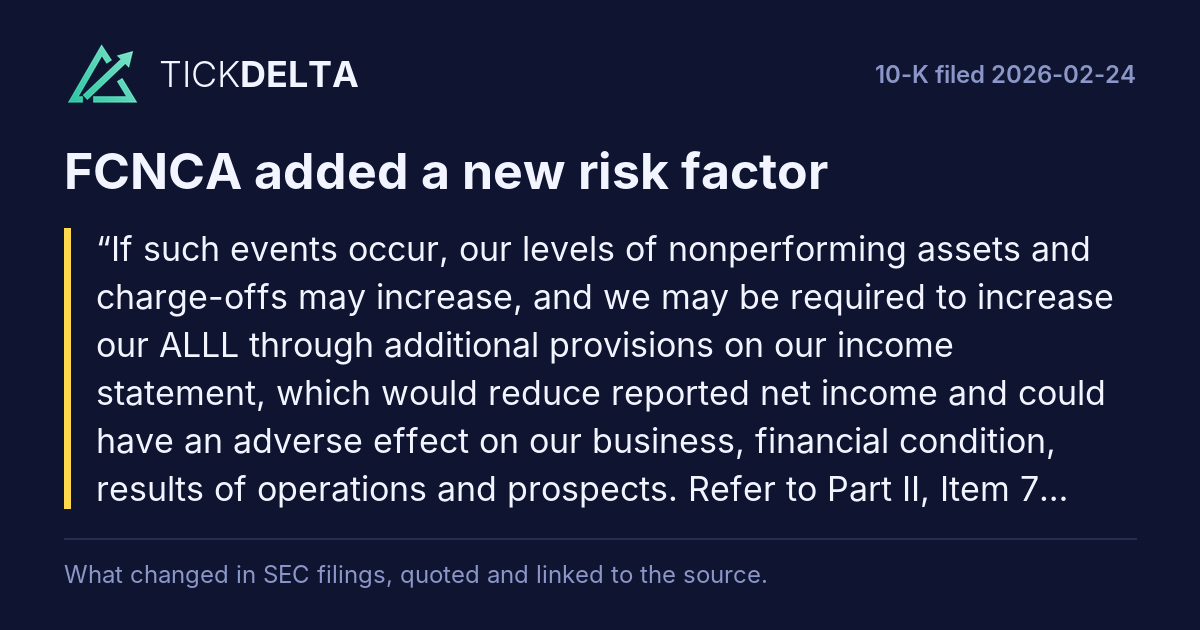
If such events occur, our levels of nonperforming assets and charge-offs may increase, and we may be required to increase our ALLL through additional provisions on our income statement, which would reduce reported net income and could have an adverse effect on our business, financial condition, results of operations and prospects.
Refer to Part II, Item 7. Management’s Discussion and Analysis of Financial Condition and Results of Operations—Risk Management—Credit Risk—Concentration for additional information on NDFIs and loan concentrations.
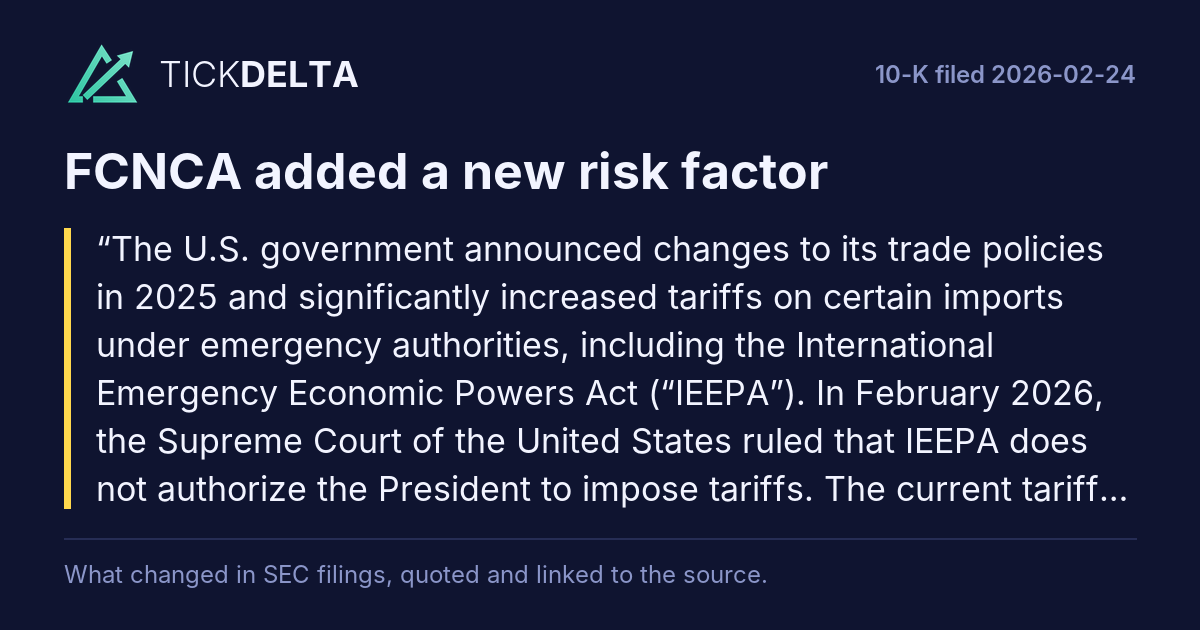
The U.S. government announced changes to its trade policies in 2025 and significantly increased tariffs on certain imports under emergency authorities, including the International Emergency Economic Powers Act (“IEEPA”). In February 2026, the Supreme Court of the United States ruled that IEEPA does not authorize the President to impose tariffs. The current tariff environment remains dynamic and uncertain, including regarding potential refunds of tariffs paid under IEEPA, and the U.S. government could respond with replacement measures under other legal authorities. Replacement measures and changes to tariffs and other trade restrictions may lead to continuing uncertainty and volatility in U.S. and global financial markets and economic conditions which could cause adverse changes in the availability, terms and cost of capital. Additionally, potential tariffs or other U.S. trade policy measures have triggered and may trigger additional retaliatory actions by other countries such as China. Increased tariffs and trade restrictions may cause the prices of our customers’ products to increase, which could reduce demand for such products, or reduce our customers’ margins, and adversely impact their revenues, financial results, and ability to service debt, which in turn, could adversely impact our business, financial condition and results of operations.
Paragraphs in the 10-Q filed Nov 6, 2026 that were not in the one before
New in the latest 10-Q
41 paragraphs in the 10-Q filed Nov 6, 2026 with nothing like them in the 10-Q filed Aug 7, 2026 (at least half the words must differ; new numbers alone do not count). Quoted exactly, grouped by the item heading above them. This is text that changed, not a judgement of how serious it is.
Financial statements and notes
BancShares accounts for business combinations using the acquisition method of accounting. Under this method, acquired assets and assumed liabilities are included with the acquirer’s accounts at their estimated fair value as of the date of acquisition, with any excess of purchase price over the fair values of the net assets acquired and any finite-lived intangible assets established in connection with the business combination recognized as goodwill. Acquisition-related costs are recognized as period expenses as incurred.
Read in the 10-Q
FCB completed the BMO Branch Acquisition on the BMO Branch Acquisition Date. In connection with the BMO Branch Acquisition, FCB assumed $ 4.86 billion in deposits, acquired $ 643 million in loans, paid a preliminary deposit premium of $ 262 million, and acquired other assets and assumed other liabilities as further discussed below.
Read in the 10-Q
The BMO Branch Acquisition was accounted for as a business combination, as defined by ASC 805, Business Combinations, using the acquisition method of accounting, which requires the consideration exchanged, assets acquired and liabilities assumed to be recognized at fair value as of the BMO Branch Acquisition Date. The determination of fair value requires management to make estimates about discount rates, future cash flows, market conditions and other future events that are highly subjective in nature. The fair value measurements of certain assets and liabilities are preliminary as we review the associated valuation assumptions and methodologies. Fair values are considered preliminary until final fair values are determined, or the measurement period has elapsed, which is no later than one year from the BMO Branch Acquisition Date. We believe the preliminary fair value estimates of assets acquired and liabilities assumed are reasonable.
Read in the 10-Q
The following table provides the preliminary purchase price allocation to the identifiable acquired assets and assumed liabilities at their estimated fair values, along with the purchase price consideration, as of the BMO Branch Acquisition Date. The deposit premium is the purchase price consideration in the BMO Branch Acquisition because it represents the amount FCB paid BMO in order to obtain the acquired deposit franchise and related branch operations, as well as the assumed liabilities and acquired assets.
Read in the 10-Q
dollars in millions Fair Value Purchase Price Allocation as of September 4, 2026 (1) Purchase price consideration Deposit premium paid $262 Assets Cash $23 Interest-earning deposits at banks 4,109 Loans, net of ALLL 638 Premises and equipment 92 Core deposit intangibles 192 Other assets 18 Total acquired assets $5,072 Liabilities Deposits $4,861 Other liabilities 21 Total assumed liabilities $4,882 Net assets (2) $190 Goodwill $72
Read in the 10-Q
Show the other 36
(2) Includes the fair value purchase accounting adjustments for assumed liabilities, acquired assets, and core deposit intangibles. Also includes the fair value of interest-earning deposits at banks as further discussed below.
Read in the 10-Q
Preliminary goodwill of $ 72 million represents the excess of the purchase price consideration of $ 262 million over the estimated fair value of the net assets of $ 190 million as of the BMO Branch Acquisition Date. The goodwill was allocated to the General Bank segment and is expected to be deductible for income tax purposes. Refer to Note 8 - Goodwill and Core Deposit Intangibles for additional information on our goodwill.
Read in the 10-Q
The following are descriptions of the methods used to determine the estimated fair values of the assets acquired and liabilities assumed, as presented above:
Read in the 10-Q
Cash included the cash on hand at the acquired BMO branches at the BMO Branch Acquisition Date.
Read in the 10-Q
Interest-earning deposits at banks included the net settlement proceeds that BMO transferred to FCB’s interest-earning deposit account, held with the Federal Reserve Bank (“FRB”), in connection with FCB assuming the net liabilities of the acquired BMO branches.
Read in the 10-Q
For financial instruments with a short-term or no stated maturity, prevailing market rates and limited credit risk, including cash and interest-earning deposits at banks, carrying amounts approximated fair value.
Read in the 10-Q
The loans acquired in the BMO Branch Acquisition primarily consisted of commercial and industrial, commercial real estate, and other consumer loans associated with the acquired branches. Fair values for acquired loans were estimated using BancShares’ fair value framework which incorporated expected cash flows, expected credit losses, prepayment assumptions and market participant discount rates. Refer to Note 12 - Fair Value.
Read in the 10-Q
As discussed in Note 1 - Significant Accounting Policies and Basis of Presentation, we adopted ASU 2025-08 on January 1, 2026. Consequently, we applied the Gross-Up Approach to all loans acquired in the BMO Branch Acquisition which resulted in an ALLL for PSLs (“BMO PSL ALLL”) and a gross-up to PSLs (“PSL Gross-Up”) at the BMO Branch Acquisition Date of $ 5 million. Furthermore, the ALLL for PCD loans and leases was less than $ 1 million and FCB did not acquire any credit card loans in the BMO Branch Acquisition. The following table summarizes the fair value discount and the Gross-Up Approach for acquired loans as of the BMO Branch Acquisition Date:
Read in the 10-Q
dollars in millions Acquired Loans as of the BMO Branch Acquisition Date Unpaid principal balance $ 643 Fair value discount (1) (5) Loans at fair value 638 PSL Gross-Up (1) 5 Loans at fair value, after PSL Gross-Up 643 BMO PSL ALLL (5) Loans, net of ALLL $ 638
Read in the 10-Q
(1) The non-credit fair value discount was immaterial, so there is no discount to accrete to interest income over the contractual lives of the applicable loans.
Read in the 10-Q
Fair values for premises, furniture and fixtures, and other equipment were determined using the cost approach.
Read in the 10-Q
Core deposit intangibles of $ 192 million will be amortized on an accelerated basis over an 8-year estimated useful life.
Read in the 10-Q
Certain core deposits were acquired as part of the BMO Branch Acquisition, which provide an additional source of funds for BancShares. The core deposit intangibles represents the costs saved by BancShares by acquiring the core deposits rather than sourcing the funds elsewhere and was valued using the after tax cost savings method under the income approach. The fair value measurement was determined by discounting to present value the favorable funding spread attributable to the core deposit balances over their estimated average remaining life. The favorable funding spread was calculated as the difference in the alternative cost of funds and the net deposit cost. Refer to Note 8 - Goodwill and Core Deposit Intangibles for further detail.
Read in the 10-Q
Other assets and other liabilities primarily included the right-of-use assets and the associated operating lease liabilities for leased branches assumed in the BMO Branch Acquisition. Additionally, other assets included accrued interest income for acquired loans, while other liabilities included accrued interest expense for assumed interest-bearing deposits.
Read in the 10-Q
BancShares’ results for the three and nine months ended September 30, 2026 included the income statement impact of the BMO Branch Acquisition, beginning on the BMO Branch Acquisition Date. Revenue and net income attributable to the BMO Branch Acquisition, and supplemental pro forma information are not presented because the impacts are not material to BancShares’ unaudited Consolidated Statements of Income.
Read in the 10-Q
Amortized Cost of Loans Modified during the nine months ended September 30, 2026
Read in the 10-Q
Amortized Cost of Loans Modified during the nine months ended September 30, 2025
Read in the 10-Q
(1) Other tax credit investments include renewable energy tax credit investments, along with a $ 2 million NMTC investment.
Read in the 10-Q
(1) Borrowings that are the hedged item in a fair value hedge as discussed in Note 11 - Derivative Financial Instruments.
Read in the 10-Q
(2) Includes an original issuance on June 24, 2026 and an additional issuance on August 3, 2026.
Read in the 10-Q
(4) Other contracts primarily include risk participation agreements and commodity derivatives.
Read in the 10-Q
Variation margin payments are periodic cash settlements FCB receives from or pays to a central counterparty based on changes in the fair value of the underlying derivatives. The following table presents the impact of the variation margin payments on derivatives included in other assets and other liabilities in the Consolidated Balance Sheets:
Read in the 10-Q
Changes in Accumulated Other Comprehensive (Loss) Income by Component, Net of Income Taxes
Read in the 10-Q
Debt issuances from January 1, 2026 to September 30, 2026 had aggregate principal amounts totaling $1.65 billion (the “2026 Debt Issuances”) and included the following:
Read in the 10-Q
dollars in millions, except share data Three Months Ended Nine Months Ended September 30, September 30, 2026 June 30, September 30, 2025 2026 2025
Read in the 10-Q
dollars in millions Deposit Balance Increase From September 30, June 30, December 31, December 31,
Read in the 10-Q
dollars in millions Three Months Ended Increase (Decrease) from Linked Quarter Nine Months Ended Increase (Decrease) from Prior YTD September 30, June 30, September 30, September 30, September 30,
Read in the 10-Q
dollars in millions Three Months Ended Nine Months Ended September 30, September 30, June 30, September 30, 2026 2025
Read in the 10-Q
dollars in millions Three Months Ended Nine Months Ended September 30, September 30, June 30, September 30, 2026 2025
Read in the 10-Q
(1) Primarily includes capital call lines and other loans to non-depository financial institutions (“NDFIs”).
Read in the 10-Q
dollars in millions Three Months Ended Nine Months Ended September 30, September 30, June 30, September 30, 2026 2025
Read in the 10-Q
dollars in millions Three Months Ended Nine Months Ended September 30, September 30, June 30, September 30, 2026 2025
Read in the 10-Q
dollars in millions Three Months Ended Nine Months Ended September 30, September 30, June 30, September 30, 2026 2025
Read in the 10-Q
Item 6
3.1 Certificate of Designation of 7.500% Non-Cumulative Perpetual Preferred Stock, Series F, dated September 11, 2026 (incorporated by reference to Exhibit 3.1 to the Registrant’s Form 8-K filed September 14, 2026)
Read in the 10-Q
4.1 Deposit Agreement, dated as of September 14, 2026, among the Registrant, Broadridge Corporate Issuer Solutions, LLC, as depositary, and the holders from time to time of the depositary receipts described therein (incorporated by reference to Exhibit 4.1 to the Registrant's Form 8-K filed September 14, 2026)
Read in the 10-Q
4.2 Form of Depositary Receipt relating to the Registrant's 7.500% Non-Cumulative Perpetual Preferred Stock, Series F (included as Exhibit A to Exhibit 4.1 hereto)
Read in the 10-Q
The 10-Q's risk factors against the 10-K
Item 1A of the 10-Q filed Nov 6, 2026 against Item 1A of the 10-K filed Feb 24, 2026.
A 10-Q repeats only the risks that changed, so a 10-K paragraph that is missing from it is not counted as removed.
Added is a paragraph with nothing like it in the 10-K, Reworded a sentence that is in both with several words changed,
Quiet changes a sentence in both where one to four words changed and one is a hedge or a modal
(cut words struck through, new words highlighted).
Text on the page, not a score; each links to the filing at sec.gov.
What the 10-Q itself says about its risk factors:There have been no material changes in the risk factors during 2026 from those reported in our 2025 Form 10-K. For a discussion of the risks and uncertainties that management believes are material to an investment in us, refer to Part I, Item 1A. Risk Factors, of our 2025 Form 10-K, and Forward-Looking Statements of this Form 10-Q.
Read in the 10-Q
1 paragraph in the 10-Q's Item 1A, and none of them adds, rewords or quietly edits a paragraph of the 10-K's.
Phrases used for the first time
Two-word phrases in Risk Factors of the 10-K filed Feb 24, 2026 that are in none of the 1 earlier 10-Ks stored, back to Feb 21, 2025
Where each one is used
- applicable regulations: ▪We are subject to environmental, social and governance (“ESG”) risks, which may adversely affect our reputation and ability to retain employees and customers, and failure to comply with applicable regulations could have an adverse affect on our business, financial condition or results of operations.
- judgments assumptions: ▪Our accounting policies and processes require management to make judgments, assumptions or estimates about matters, which may result in us reporting materially different results or amounts than would have been reported using different judgments, assumptions or estimates.
- adopt new: ▪Failure to adopt new technologies that match consumer preferences or to keep pace with or effectively implement technological changes could adversely affect our results of operations and financial condition.
- match consumer: ▪Failure to adopt new technologies that match consumer preferences or to keep pace with or effectively implement technological changes could adversely affect our results of operations and financial condition.
- keep pace: ▪Failure to adopt new technologies that match consumer preferences or to keep pace with or effectively implement technological changes could adversely affect our results of operations and financial condition.
- implement technological: ▪Failure to adopt new technologies that match consumer preferences or to keep pace with or effectively implement technological changes could adversely affect our results of operations and financial condition.
- technological changes: ▪Failure to adopt new technologies that match consumer preferences or to keep pace with or effectively implement technological changes could adversely affect our results of operations and financial condition.
- agency funding: ▪The Trump administration has proposed or implemented significant changes to the size and scope of the federal government, including reductions in program or agency funding or workforce, and may continue to do so.
Used at least twice, small words left out. Counted, not picked: a phrase can be new because the company renamed something.
What was taken out
38 paragraphs of last year's Risk Factors with nothing like them now. The longest are quoted.
Sources
Item 1A of each 10-K and 10-Q on EDGAR, quoted exactly. Each paragraph links to the filing at sec.gov.
Also
10-K change: what was reworded or cut, section by section.
Work with it
Excel workbook · CSV. Google Sheet that stays up to date: paste =IMPORTDATA("https://tickdelta.com/company/FCNCA/export.csv") into a cell.