FDSFactSet
FactSet Research Systems Inc. and its wholly-owned subsidiaries ("we," "our," "us," the "Company" or "FactSet") was founded in 1978 and has been publicly traded since June 1996. 10-K, Item 1
- Employees
- 8,652
- Headquarters
- Norwalk, CT
- CEO
- Sanoke Viswanathan
- Next results
- around Dec 17, 2026
23 paragraphs in Risk Factors of the 10-K filed Oct 20, 2026 with nothing like them in the 10-K filed Oct 22, 2025. Quoted exactly. Paragraphs that were only edited are under 10-K change.
Compared with the Risk Factors in the latest 10-K of the other 75 Financials companies: a paragraph with at least half its words the same at another company is called similar, and the companies are listed under it. A paragraph most of them have is marked boilerplate. No line means no other company has one like it. This counts text; it does not say how serious a risk is.
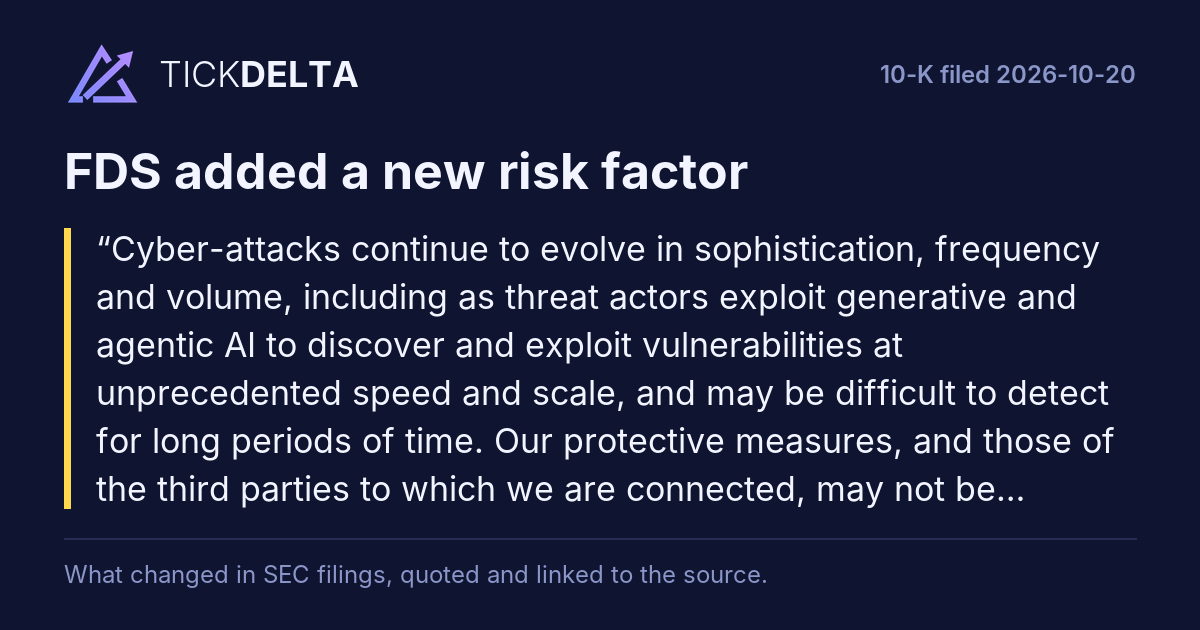
Cyber-attacks continue to evolve in sophistication, frequency and volume, including as threat actors exploit generative and agentic AI to discover and exploit vulnerabilities at unprecedented speed and scale, and may be difficult to detect for long periods of time. Our protective measures, and those of the third parties to which we are connected, may not be effective, and a failure by our clients or third-party providers to notify us of an incident in a timely manner could delay our response and increase the resulting harm. As a result, we may not be able to anticipate, prevent or detect all attacks, and we are exposed to heightened risks of cyber-attacks or other security incidents. In addition, future advances in computing, including quantum computing, could weaken or render obsolete the encryption and other security measures on which we and our third parties rely, including through the potential future decryption of data captured today.
Read in the 10-K ↗
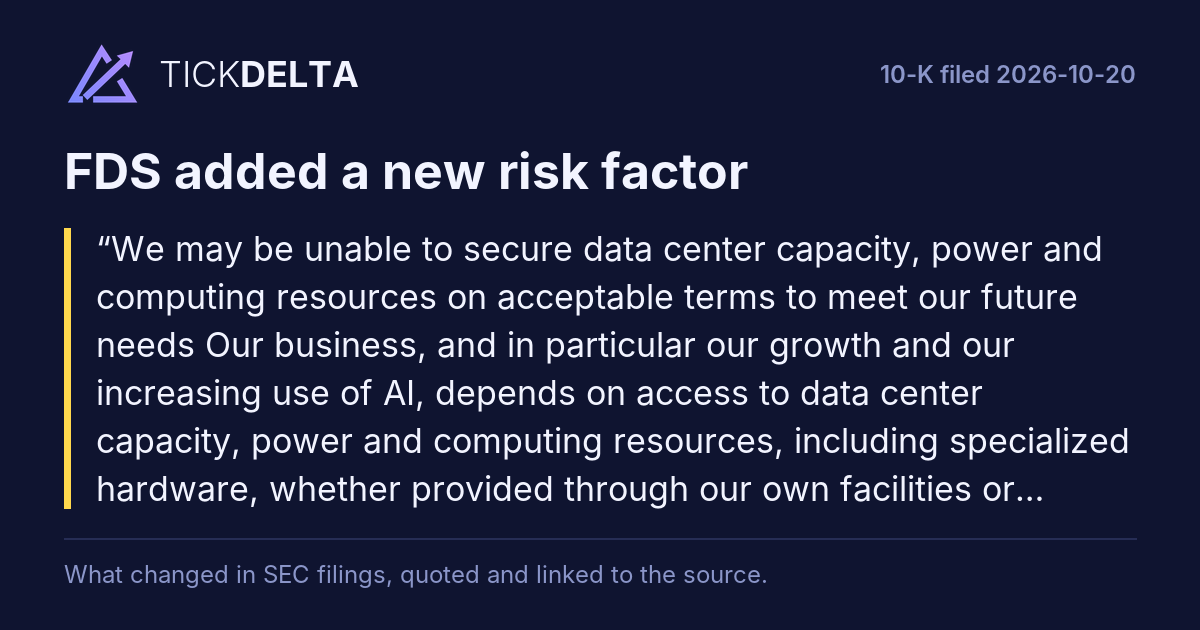
We may be unable to secure data center capacity, power and computing resources on acceptable terms to meet our future needs
Our business, and in particular our growth and our increasing use of AI, depends on access to data center capacity, power and computing resources, including specialized hardware, whether provided through our own facilities or, increasingly, through third-party cloud and data center providers. Demand for these resources has grown rapidly across the industry, driven in significant part by AI, and has contributed to constrained availability and rising costs. As our needs increase, we may be unable to procure sufficient capacity, power or computing resources when needed, in the locations we require, or on commercially acceptable terms, and we may face increased costs, delays in deploying new products and capabilities, or constraints on our ability to scale. Any of the foregoing could adversely affect our operations, margins and our ability to execute our strategy, and could have a material adverse effect on our business, financial condition or results of operations.
Read in the 10-K ↗
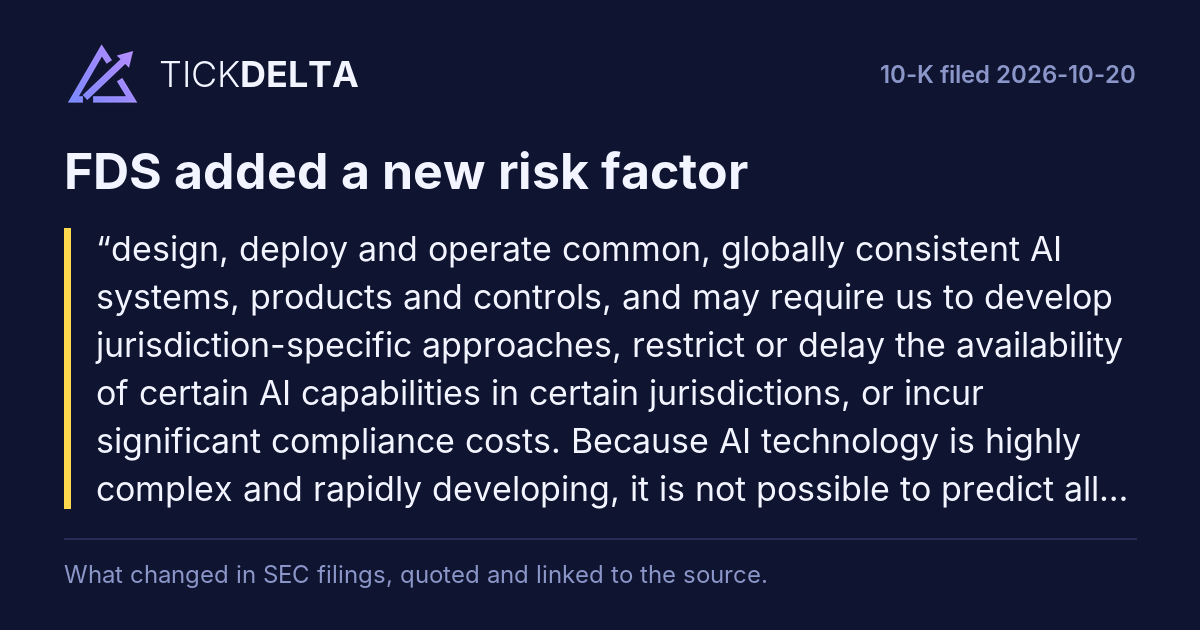
design, deploy and operate common, globally consistent AI systems, products and controls, and may require us to develop jurisdiction-specific approaches, restrict or delay the availability of certain AI capabilities in certain jurisdictions, or incur significant compliance costs. Because AI technology is highly complex and rapidly developing, it is not possible to predict all of the legal, operational or technological risks that may arise relating to our use of AI. Any of these issues could materially adversely affect our business, financial condition or results of operations.
Similar paragraph at 1 of 75 other Financials companies: MSCIAI technologies used in our products and processes may use or incorporate data from third-party sources, including information they input into the AI tools, which may expose us to risks associated with data rights and protection, such as risks associated with infringing, misappropriating or otherwise violating others’ intellectual property rights, and we may also be unable to protect our data from unintended use or access by third-party AI systems. Our ability to develop, commercialize and scale AI-enabled products and services depends in significant part on our ability to obtain and maintain sufficient rights to use data, including our own proprietary data, data licensed from third-party suppliers, and data contributed by or relating to our clients, for the training, fine-tuning, grounding, retrieval and output-generation functions of AI models and applications. If we are unable to secure data rights on commercially reasonable terms and at the scale required, we may be unable to fully realize the anticipated benefits of, or generate the expected revenues from, our investments in AI, our AI-enabled offerings may be delayed, constrained or rendered less competitive, and we may be exposed to claims of infringement, misappropriation or breach of contract, any of which could have a material adverse effect on our business, financial condition or results of operations.
Inadequate or inconsistent governance of our internal use of AI could expose us to security, operational, legal and reputational risks
We are rapidly expanding the use of AI technologies, including generative and agentic AI, across our products, internal systems and business processes. The pace of adoption may outpace the maturity of our governance, controls and oversight. If AI tools are adopted inconsistently or in a decentralized manner across our business, or are used outside of our established governance frameworks and approved environments, we may be exposed to increased operational, security, legal, regulatory and reputational risk.
The introduction of agentic AI, which can take autonomous actions across systems, may create new attack surfaces and novel security vulnerabilities that our existing controls were not designed to address. Our policies, controls and monitoring may not keep pace with the rapid evolution of these technologies or with emerging legal and regulatory requirements. Any failure to establish and enforce effective AI governance could result in security incidents, regulatory scrutiny or enforcement, litigation, harm to our reputation and client relationships, and could otherwise have a material adverse effect on our business, financial condition or results of operations.
We are undergoing significant organizational change and transformation, and our failure to execute these initiatives effectively could disrupt our business and adversely affect our results
We are undertaking a number of significant organizational, operational and strategic transformation initiatives, including changes to our organizational structure, reporting lines, leadership, product development organization, go-to-market approach, pricing models, and technology and data operations, as well as ongoing investment in AI. These initiatives are complex, are being pursued concurrently, and place substantial demands on management attention and on our workforce. In fiscal 2026, we appointed a new Chief Executive Officer, Chief Financial Officer, Chief People and Workforce Transformation Officer and Chief Technology Officer, among other leadership changes. Significant management transitions of this kind, particularly when they occur concurrently and alongside broader organizational change, involve inherent risk. Such transitions can be disruptive, may result in the loss of institutional or technical knowledge, may affect strategic continuity, execution and decision-making, and may take time to yield their intended benefits. Undertaking too many changes simultaneously, or failing to sequence, resource, prioritize or communicate them effectively, could overwhelm our capacity to execute, disrupt our ongoing business operations, degrade product quality, delivery or client service, and divert resources from revenue-generating activities.
Transformation of this scale may also adversely affect employee morale, engagement and retention, including the potential loss of personnel with critical institutional or technical knowledge, and may strain our culture. The costs and disruption associated with these initiatives may be greater than anticipated, and the anticipated benefits, efficiencies or growth may not be realized on the expected timeframe or at all. Any of the foregoing could have a material adverse effect on our business, financial condition or results of operations.
Read in the 10-K ↗
Advances in AI may enable our clients and other third parties to build their own solutions and may reduce demand for our products and services
A significant portion of the value we provide derives from the interfaces, applications, workflows, analytics and connectivity through which we deliver data and functionality to our clients. Advances in generative and agentic AI can lower the cost, time and technical expertise required to aggregate and analyze data and to build software, and may make it increasingly feasible for our clients and other third parties to develop their own tools, interfaces and workflows, or to rely on lower-cost or more generalized AI applications, in place of our offerings. This risk may be accelerated by the growing adoption of standards and protocols that make it easier to connect data and AI models directly, potentially reducing the role of, or demand for, the application and delivery layers on which a substantial part of our business depends.
If clients choose to build or adopt such alternatives, they may reduce or discontinue their use of our products and services, or pressure us to change our pricing or the way we package and deliver our offerings. In addition, to the extent we make our data and capabilities more openly accessible through APIs, AI interfaces or other protocols in order to remain competitive and meet client demand, we may facilitate this substitution or make it more difficult to capture the full value of our offerings. Our efforts to adapt our products, delivery models and pricing in response to these developments may not be successful or timely, and any of the foregoing could reduce demand for our products and services and have a material adverse effect on our business, financial condition or results of operations.
Read in the 10-K ↗
were ultimately favorable, such a claim would require the time and attention of our management, personnel, as well as financial and other resources and potentially pose a significant disruption to our normal business operations and reputational damage.
Read in the 10-K ↗
We depend on third-party vendors, partners and service providers, and disruptions to or failures by these third parties could adversely affect our business
Similar paragraph at 1 of 75 other Financials companies: CPAYWe rely on third-party vendors, partners and service providers for a range of critical functions, including cloud hosting and infrastructure, data and content, software, connectivity, and certain operational and business processes, and our reliance on such third parties, including partners, is increasing. We do not control the operations, security or business continuity of these third parties, and they may fail to perform to our standards or contractual requirements, suffer their own security incidents, outages, financial distress or business disruptions, be acquired (including by our competitors), change or discontinue their offerings, or increase their pricing. Concentration among a limited number of key providers, including our reliance on a single provider for the majority of our cloud computing, increases the potential impact of any such failure or disruption and may make it difficult, costly or time-consuming for us to transition to an alternative provider. Any failure by, or disruption to, our key third parties could impair our ability to deliver our products and services, expose us to increased costs, regulatory scrutiny, liability under our client contracts and reputational harm, and could have a material adverse effect on our business, financial condition or results of operations.
Read in the 10-K ↗
We are party to various legal proceedings, claims, and litigation in the normal course of our business and from time to time the subject of government and regulatory proceedings, investigations, and inquiries, as discussed in Item 3. Legal Proceedings, of this Annual Report on Form 10-K, and we face the risk that additional proceedings, litigation, investigations and inquiries may arise in the future. For example, on March 4, 2022, plaintiffs filed a purported class action, Dinosaur Financial Group LLC et al. v. S&P Global, Inc. et al., in the United States District Court for the Southern District of New York, against FactSet, S&P Global, Inc., and the American Bankers Association. Plaintiffs generally allege that CGS's license terms and enforcement practices charged fees for CGS data delivered through third-party vendors in purported violation of copyright, federal antitrust, and state unfair business practices laws, as well as breach of contract, and seek damages and injunctive relief. On July 14, 2023, the court dismissed plaintiffs' copyright, breach of contract, and half of the federal antitrust claims. On August 28, 2026, the court granted certification of a class of certain subscribers to CGS data. On September 10, 2026, the court vacated that order and scheduled additional class certification briefing. We can provide no assurance as to the scope and outcome of this matter, and we could in the future incur judgments or enter into settlements of claims that could have a material adverse effect on our business, results of operations, financial position, or cash flows.
Any proceedings, litigation, claims, investigations or inquiries impose additional expenses on the Company, require the attention of senior management, and could ultimately result in adverse judgments, damages, fines, penalties, activity restrictions, reduced demand for our products and services, or negative impacts on our cash flows, which could have a material adverse effect on our business, financial condition or results of operations. In view of the uncertainty inherent in such matters, we cannot predict the outcome of the matters we are currently facing or the timing of their resolution, or in most cases reasonably estimate what the eventual impact may be. The outcome of, or cost of defending, matters we are currently facing or that we may face in the future could have a material adverse effect on our business, financial condition, or results of operations.
Similar paragraph at 1 of 75 other Financials companies: SPGIRead in the 10-K ↗
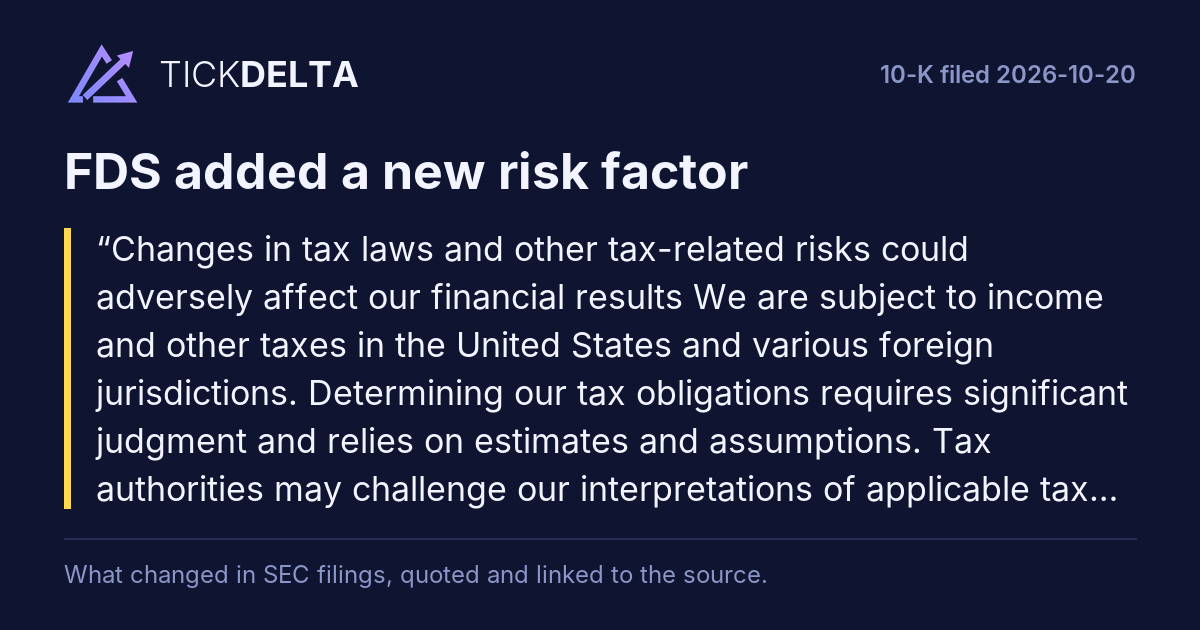
Changes in tax laws and other tax-related risks could adversely affect our financial results
Similar paragraph at 30 of 75 other Financials companies: AIZ, AJG, ALL, AMP, AON, AXP, BAC, BRO and 22 moreWe are subject to income and other taxes in the United States and various foreign jurisdictions. Determining our tax obligations requires significant judgment and relies on estimates and assumptions. Tax authorities may challenge our interpretations of applicable tax laws or the treatment of our transactions. In the ordinary course of business, we are subject to examinations by
Similar paragraph at 1 of 75 other Financials companies: MSCItax authorities. The outcomes of these examinations and related disputes may differ from amounts recorded and could result in additional tax liabilities and related costs, adversely affecting our results of operations, financial condition and cash flows.
Similar paragraph at 1 of 75 other Financials companies: COINOur effective tax rate may be affected by changes in the geographic mix of earnings and our ability to realize tax benefits. Changes in tax laws, regulations or treaties, or their interpretation, application or enforcement, including changes relating to international taxation and minimum tax requirements, could increase our tax obligations, effective tax rate and compliance costs. Evolving guidance, differences in implementation across jurisdictions and potentially conflicting tax requirements may create additional uncertainty and complexity in determining, collecting and remitting taxes. Refer to Part II, Item 8. Note 8, Income Taxes in the Notes to the Consolidated Financial Statements included in this Annual Report on Form 10-K for additional information.
Read in the 10-K ↗
New in the latest 10-Q
3 paragraphs in the 10-Q filed Jul 1, 2026 with nothing like them in the 10-Q filed Apr 2, 2026 (at least half the words must differ; new numbers alone do not count). Quoted exactly, grouped by the item heading above them. This is text that changed, not a judgement of how serious it is.
Financial statements and notes
No liabilities related to these arrangements are reflected in the Consolidated Balance Sheets.
Read in the 10-Q ↗
• Employee compensation costs increased by 90 basis points, primarily driven by restructuring charges to drive organizational efficiencies.
Read in the 10-Q ↗
Client bankruptcy charges 0.02 0.02 — India Labor Codes Reform — 0.06 — Asset impairment — 0.02 — Sales Tax Dispute(2) — — 0.05 Gain on sale of investments — (0.14) — Non-operating income from business disposition 0.00 (0.01) — Income tax items — (0.02) 0.04 Adjusted Diluted EPS(5) $ 4.53 4.27 6.1 % $ 13.49 $ 12.92 4.4% Weighted average common shares (diluted) 36,191 38,344 36,957 38,457
Read in the 10-Q ↗
Work on FDS in a spreadsheet:
Excel workbook (a sheet per section, ten years by column, charts, links to the filings) ·
CSV.
For a Google Sheet that stays up to date, paste =IMPORTDATA("https://tickdelta.com/company/FDS/export.csv") into a cell.