tickdelta
Sign in

Tickdelta is free for now. Sign up and get Pro free

← Screener

FEFirstEnergy

Utilities · Electric Utilities · NYSE
Compare with peers → Embed

When the SEC's staff reviews a filing, it writes to the company with numbered questions, and the company answers each one in a letter. SEC publishes the exchange once the review is over, at least 20 business days later. Below: what the staff asked FE, and the company's answer to each question, quoted from the letters. A question is not an accusation; most reviews end with the company adding detail to its next filing.

Form 10-K for the Fiscal Year ended December 31, 2022

2023-03-10 to 2023-04-13 · 1 question · 1 letter from the SEC, 2 from the company
Review closed 2023-04-13
Critical estimatesPensions
Critical Accounting Policies and Estimates · Pension and OPEB Accounting, page 68
SEC asked
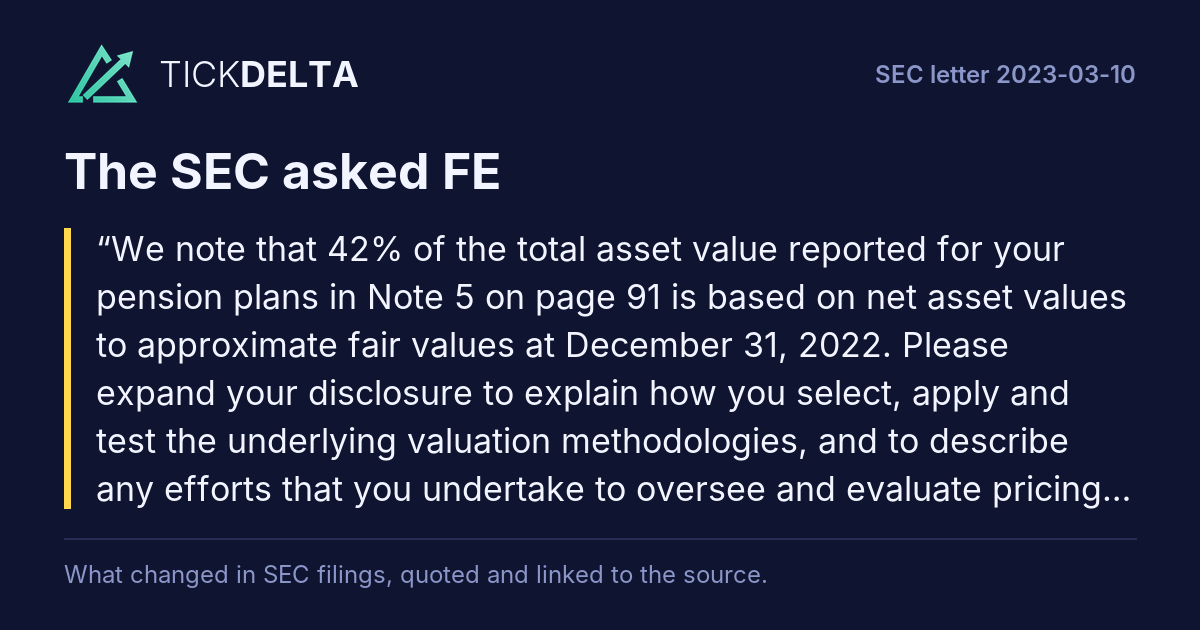
We note that 42% of the total asset value reported for your pension plans in Note 5 on page 91 is based on net asset values to approximate fair values at December 31, 2022. Please expand your disclosure to explain how you select, apply and test the underlying valuation methodologies, and to describe any efforts that you undertake to oversee and evaluate pricing services that are based on the net asset values of the
Rest of the question

investments. Please also clarify how you applied the guidance in FASB ASC 820-10-35-60 in considering whether adjustments to the most recent net asset values were necessary.

FE answered
Under Accounting Standards Codification (“ASC”) 820-10-50-10, “Plan assets of a defined benefit pension or other postretirement plan that are accounted for in accordance with ASC 715 are not subject to the disclosure requirements in paragraphs 820-10-50-1C through 50-81. The disclosures required in paragraphs 715-20-50-1(d)(iv) and 715-20-50-5(c)(iv) shall

_____________________

1 Disclosure requirements for investments measured using the NAV practical expedient are codified in ASC 820-10-50-6A.

apply for fair value measurement of plan assets of a defined benefit pension or other
Rest of the answer

postretirement plan”. The Company believes that it has complied with paragraph 715-20-50-1(d)(iv) and that paragraph 715-20-50-5(c)(iv) is not applicable to the Company as it applies to disclosure by nonpublic entities.

In response to the Staff’s comment regarding how we evaluate the appropriateness of utilizing the NAV practical expedient, the Company regularly evaluates such investments to ensure they qualify for the NAV practical expedient in accordance with ASC 820-10-35-59 which states “A reporting entity is permitted, as a practical expedient, to estimate the fair value of an investment within the scope of paragraphs 820-10-15-4 through 15-5 using the net asset value per share (or its equivalent, such as member units or an ownership interest in partners’ capital to which a proportionate share of net assets is attributed) of the investment, if the net asset value per share of the investment (or its equivalent) is calculated in a manner consistent with the measurement principles of Topic 946 as of the reporting entity’s measurement date.”

In addition, as further discussed below, in situations where the measurement date for the most recent net asset value per share of the investment is not the same as our reporting date, we consider whether an adjustment to the most recent net asset value per share is necessary.

In response to the Staff’s comment to expand our related disclosure, and considering the Company’s use of the NAV practical expedient, the following is an example of the type of information we will provide for each of the investment categories of our pension and other postretirement plan in future filings with the Commission, as applicable:

“Private – equity and debt funds: Private equity and private debt funds primarily include limited partnerships that invest in equity or directly originated senior loans of high-quality middle market operating companies. Distributions are received periodically through the liquidation of underlying assets in each fund. For most private equity and debt funds, immediate access to capital at the limited partner’s discretion is not available and such funds prevent full redemption and return of capital until fund liquidation. The purpose of each fund is to maximize total return of capital with an emphasis on minimizing default risk. Each fund’s NAV is made available to fund participants quarterly.”

“Insurance Linked Securities funds: The insurance linked securities funds invest in securities which indirectly participate in portfolios of reinsurance and retrocession contracts which primarily cover catastrophe property risks. Redemptions can be achieved with 90-day notices with gating factors that may apply. The purpose of these investments is to generate attractive risk-adjusted returns that are demonstrably uncorrelated with traditional asset classes. Each fund’s NAV is made available to fund participants monthly.”

“Hedge funds: The hedge funds invest in a combination of long and short equity, multi-strategy, global macro and structured credit strategies. Redemptions can be achieved with 90-day notices with gating factors that may apply. The purpose of these investments is to deliver diversified risk-adjusted returns to traditional asset classes. Each fund’s NAV is made available to fund participants monthly.”

“Real estate funds: The real estate funds primarily invest in U.S commercial real estate markets that include office, residential, retail, industrial, life science/lab space, storage and student housing. The investment values of the real estate properties are determined on a quarterly basis by independent market appraisers hired by the board of directors of each fund. Distributions from each fund will be received as the underlying investments of the fund are liquidated. Each investor’s ability to withdraw capital from certain funds may be limited depending on whether a queue has been established. The purpose of each fund is to invest in real estate and real estate related assets that generate a total return from current income and capital appreciation which exceeds the applicable fund’s index. Each fund’s NAV is made available to fund participants quarterly.”

In response to the second part of the Staff’s comment, the following summary describes the process undertaken to evaluate whether adjustments to the most recent net asset values were necessary under ASC 820-10-35-60.

Valuation of the investments is overseen by the Company’s Investment Management Department (“IMD”) with consultation from the Company’s external investment consultant (“Consultant”). The IMD reviews external investment managers at least annually with private equity managers being reviewed semi-annually.

The Consultant assists the Company by performing investment research in the areas of strategic asset allocation, investment manager due diligence and risk management. Due diligence research includes a thorough analysis of investment processes, people, operational integrity, fees and performance. The Consultant authors reports on each investment manager and makes recommendations to the IMD regarding investment manager selection. In addition, the Consultant develops supplemental investment guidelines for each investment manager that relate to the investment portfolio over which the investment manager has investment authority. Lastly, the Consultant performs regular maintenance research of each investment manager and makes recommendations to the IMD and the Company’s Investment Committee (“IC”) regarding the replacement of investment managers who are not performing consistent with expectations.

The IMD assists and supports the IC in implementing its responsibilities. The IMD monitors and administers, under the IC’s oversight, the relationships with external service providers including investment managers. During the year, the IMD holds meetings and conference calls with investment managers including real estate, private equity and private debt managers to determine significant fluctuations in short-term performance against performance expectations. During periods of market dislocation and/or significant volatility in equity and fixed income markets, the IMD holds additional calls with the investment managers to determine the impact on the expected results of the portfolios.

For year-end reporting, the Company uses the most recent valuation available for the private equity and private debt portfolios because December 31st valuations are not available for the majority of the investments by the time the Company completes its year-end closing and files its Annual Report on Form 10-K. As noted above, the IMD will discuss potential adjustments to year-end valuations with the appropriate investment managers and the IC. If the adjustment is deemed material by management, the adjustment will be made to the year-end valuation. Such adjustments typically include capital calls or related changes in the investment position subsequent to the most recent valuation date.

Finally, the IMD performs a lookback test of all investments where interim valuation dates were used for year-end reporting. This lookback test compares the valuations used at year-end with final valuation reports provided by the investment managers. This lookback has confirmed that the estimates used for interim valuations were accurate in all material respects.

In connection with your comments, we acknowledge that the Company and its management are responsible for the accuracy and adequacy of their disclosures, notwithstanding any review, comments, action or absence of action by the Staff.

Read in the reply ↗
In its next report

First report after the company's reply of 2023-04-05: 10-Q filed 2023-04-27 ↗, against the 10-Q filed 2022-10-25 ↗.

Tickdelta does not hold the text of both reports, so they are not compared here.
Also in this review: company letter, 2023-03-23, closing letter, 2023-04-13
Form 10-K for the Fiscal Year ended December 31, 2020

2021-03-18 to 2021-04-28 · 2 questions · 2 letters from the SEC, 2 from the company
Review closed 2021-04-28
Legal and contingenciesResults discussion (MD&A)Risk factors
Financial Statements · Note 15. Commitments, Guarantees, and Contingencies, page 121
SEC asked
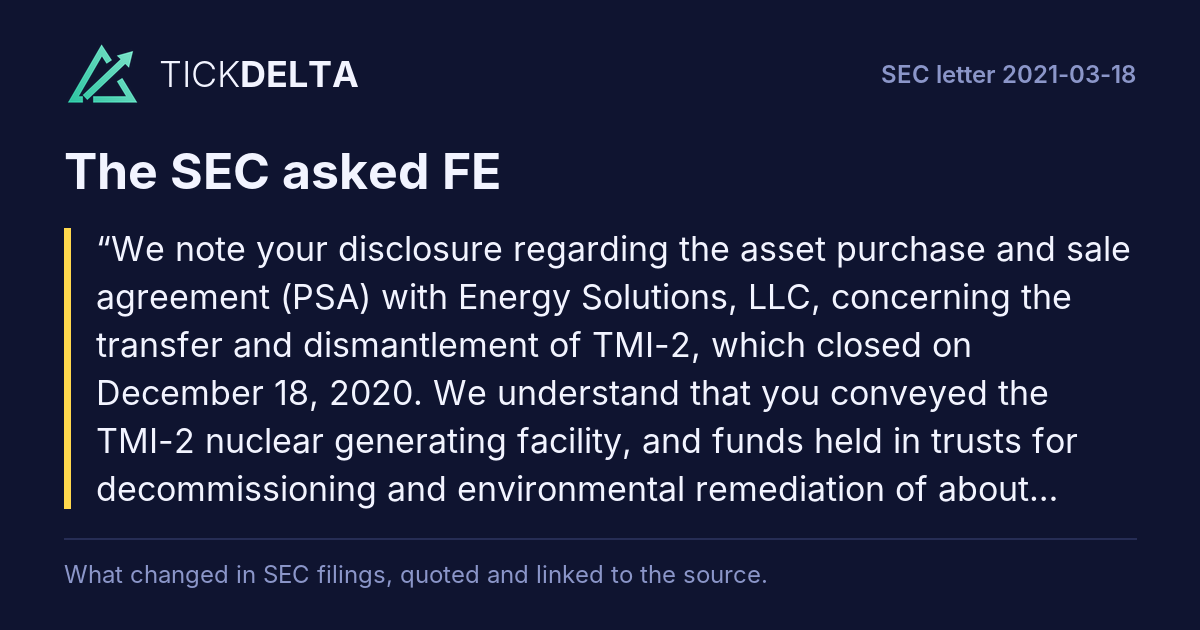
We note your disclosure regarding the asset purchase and sale agreement (PSA) with Energy Solutions, LLC, concerning the transfer and dismantlement of TMI-2, which closed on December 18, 2020. We understand that you conveyed the TMI-2 nuclear generating facility, and funds held in trusts for decommissioning and environmental remediation of about $900 million; you disclose that you were relieved of related
Rest of the question

liabilities. On pages 89 and 112 you indicate that accounting for the transaction resulted in a gain of $33 million, with the write-off of a tax related regulatory liability, and derecognition of a $726 million asset retirement obligation related to the site. However, we understand from the December 2, 2020 New Jersey Board of Public Utilities (NJBPU) order approving the transaction that you have retained some liabilities and may have exposure to future liabilities for which you would be barred from seeking recovery from ratepayers. The NJBPU order distinguishes between Assumed Liabilities that are covered by the transaction, and Excluded Liabilities that are identified in the PSA, for which you will remain responsible, and which are described as "...environmental liabilities existing prior to the closing date of the sale." We note references to Rate Counsel views that (i) as a former owner of TMI-2, you may be liable for remediation costs under the Comprehensive Environmental Response, Compensation and Liability Act, if the buyer fails to meet the environmental obligations set out in the PSA, and (ii) as you will have continuing involvement with an independent manager on the TMI-2 Solutions Board overseeing decommissioning activities, you may have "operator, arranger, or transporter liability," if environmental issues arise. The NJBPU along with Rate Counsel express the view of there being "tremendous uncertainty" associated with decommissioning, in connection with setting conditions on its approval that preclude future recovery from ratepayers of any incremental costs that you may incur in connection with ongoing exposure. Please explain how you have assessed your exposures relative to the guidance in FASB ASC 410-20-40, on derecognition, 410-30-25 and 450-20-25, on recognition, and FASB ASC 450-20-50-1 and 50-3 through 50-5, on disclosure, considering the guidance in 5511 through 55-15, as applicable, in determining that no disclosure would be made of the excluded liabilities that you have retained, or of any probable or reasonably possible loss regarding the concerns expressed and referenced above. In connection with the foregoing request, please describe any accounting that is reflected in your financial statements for the environmental liabilities excluded from the transaction, and explain how you have distinguished these from the liabilities conveyed. Please submit the PSA along with your reply and tell us of any reasons you would not file this agreement pursuant to Item 601(b)(10) of Regulation S-K.

FE answered
For the reasons discussed below, we do not believe an environmental obligation or loss contingency has been incurred as of December 31, 2020, with respect to the Three Mile Island Nuclear Generating Station Unit 2 (“TMI-2”) because we believe our exposure to residual environment risk associated with TMI-2 is remote.

On October 15, 2019, certain of the Company’s subsidiaries, GPU Nuclear, Inc., Jersey Central Power & Light Company, Metropolitan Edison Company, and Pennsylvania Electric Company (collectively, the “Sellers”), entered into an asset purchase and sale agreement (the “PSA”) with
Rest of the answer

TMI-2 Solutions, LLC (the “Buyer”), a subsidiary of EnergySolutions, Inc. (“EnergySolutions”), concerning the transfer and dismantlement of TMI-2 in Middletown, Pennsylvania.

TMI-2 began commercial operations on December 30, 1978. On March 28, 1979, TMI-2 experienced an accident that resulted in severe damage to the reactor core. Following the accident, TMI-2 was permanently shut down. Approximately 99 percent of the fuel and damaged core material was removed from TMI-2’s reactor and site and shipped to the Department of Energy’s (“DOE”) Idaho National Laboratory.

EnergySolutions and its affiliates specialize in providing nuclear services, such as high-level waste management, spent fuel handling and transportation, and complex decontamination and decommissioning projects, including the decommissioning of commercial nuclear power generation facilities. Among the services provided by EnergySolutions and its affiliates are the packaging, transportation, storage, and disposal of radioactive waste at its disposal facility in Clive, Utah.

Under the terms of the PSA, Sellers would transfer to Buyer substantially all of the assets associated with TMI-2, including assets held in external trusts for the nuclear decommissioning and environmental remediation of TMI-2 (the “Trusts”) and related liabilities. The terms of the PSA and the ancillary agreements also include Buyer’s assumption of liability for all responsibility for the TMI-2 site, including full decommissioning and ongoing management of core debris material not previously transferred to the DOE, as well as various forms of performance assurances for the obligations of Buyer to complete the required decommissioning, including, but not limited to, a payment and performance guaranty by EnergySolutions and the delivery of a letter of credit to backstop Buyer’s key decommissioning obligations. In addition to the guaranty and letter of credit, the Buyer committed to implement certain structures and procedures to provide the Sellers additional assurances with the decommissioning process, such as the following:

•the Buyer will regularly prepare an updated project schedule, cash flow schedule showing projected future expenses, and progress reports regarding expenditures, nuclear decommissioning trust balance, and estimated costs to achieve decommissioning plans to be shared with the Sellers; and

•the Buyer’s limited liability company agreement provides that an independent manager (the independent manager is not affiliated with the Company or the Sellers) will be appointed by the Sellers and certain actions – such as filing a voluntary bankruptcy or accessing certain funds in the decommissioning trust prior to a scheduled draw – require consent of the independent manager.

After receipt of the necessary regulatory approvals from the United States Nuclear Regulatory Commission (“NRC”) and the New Jersey Board of Public Utilities (“NJBPU”) on December 2, 2020, TMI-2, along with the Trusts and related liabilities, was transferred to the Buyer, on December 18, 2020, in accordance with the terms of the PSA.

The NRC is responsible for licensing and regulating the operation of nuclear power plants in the United States. The owner of a nuclear power plant must obtain and maintain a license from the NRC in order to possess, use, and operate the plant.1 As a condition of the license, a nuclear power plant owner must provide financial assurances to satisfy the ultimate liability to decommission the nuclear power plant.2 One acceptable form of providing financial assurances is “prepayment” into a dedicated trust such as the Trusts. Failure to comply with the financial assurances requirement could result in financial and/or civil or criminal penalties.3 Nuclear power plant licensees are required to make numerous regulatory filings to show continued compliance with the terms and conditions of the operating license and the NRC regulations.4

Once a nuclear power plant has ceased operations, such as is the case with TMI-2, the license for the plant will continue beyond the expiration date to “authorize ownership and possession of the facility until the NRC notifies the licensee in writing that the license is terminated.”5 The licensee is required to take all actions necessary to decommission the facility during this extended period of the license.6 The NRC will terminate the license once decommissioning is completed.7 Until the license is terminated, the licensee, in this case now the Buyer, is obligated to fund and ensure the safe and timely decommissioning of the nuclear power plant.

A licensee may transfer an NRC license only with the written consent of the NRC.8 Consent for a license transfer is obtained through a rigorous application process. The applicants must describe the technical and financial qualifications of the transferee, the purpose for the transfer, and the nature of transaction necessitating the transfer.9 The NRC thoroughly reviews each application and scrutinizes the proposed transferee as if it were applying for an initial license.

In addition to the transfer of TMI-2, along with the Trusts and related liabilities, the ownership and operating NRC licenses for TMI-2 were transferred to the Buyer pursuant to the NRC’s approval of such transfer. As such, the Buyer is licensed to possess TMI-2, and assumed responsibility for all licensed activities at TMI-2, including the sole responsibility under its NRC license to complete decommissioning.

The Comprehensive Environmental Response, Compensation and Liability Act of 1980 (“CERCLA”) provides a means for governments and private parties to recover the money they spend on remediating contaminated sites. Under Section 107(a) of CERCLA, in addition to the owner/operator of a facility, any person who formerly owned or operated a facility “at the time

1 10 CFR § 50.10(b).

2 10 CFR § 50.75(a), (b)(1).

3 10 CFR § 50.110, 111.

4 10 CFR § 50.71, 75.

5 10 CFR § 50.51(b).

6 10 CFR § 50.51(b)(1).

7 See 10 CFR § 50.82(a)(11).

8 10 CFR § 50.80(a).

9 10 CFR § 50.80(b)(1).

of disposal of any hazardous substance” is also potentially a responsible party. To the extent a person is found “responsible” pursuant to Section 107(a), they may be liable for the costs of “removal” actions or “remedial” actions to address the hazardous substances at the site.

In the unlikely event that decommissioning of TMI-2 is not completed by the Buyer and EnergySolutions and, notwithstanding the additional financial assurance EnergySolutions has provided to the NRC and the additional financial assurance required under the PSA and its ancillary agreements, the financial resources of the Buyer and EnergySolutions are exhausted and the Buyer fails to fully remediate the hazardous substance contamination at the site, the remaining waste could be viewed as a release or threatened release to the environment. In such a case, CERCLA claims against a former licensee (owner or operator) such as the Sellers could potentially be made to recover the cost of final remediation.

The Company and the Sellers do not concede that such CERCLA claims should or would be successful, as we explained to the NJBPU and Rate Counsel: (1) EnergySolutions’ capabilities and qualifications to decommission TMI-2, (2) the NRC’s reporting requirements and oversight, (3) the value of the Trusts transferred to the Buyer (approximately $874 million as of the date of the transfer), and (4) the substantial financial and operational assurances required under the PSA and ancillary agreements, including a letter of credit and financial support agreements from EnergySolutions to provide additional funding for decommissioning costs, guard against the possibility that the Buyer may exhaust its financial resources before fully decommissioning and remediating the contamination at TMI-2. Also, despite Rate Counsel’s assertions to the contrary, the Sellers’ right to appoint an unaffiliated independent manager with limited authority neither constitutes continuing involvement nor does it otherwise provide a basis for operator liability under CERCLA. As such, we believe any residual environmental risk associated with TMI-2 under CERCLA or otherwise, is hypothetical, typical to any former owner of nuclear generating facilities and is remote.

We have assessed our exposure to residual environmental risks associated with TMI-2 relative to the referenced guidance in FASB ASC 410 and ASC 450, and concluded no accrual or additional disclosure is required, as further described below. FASB ASC 410-20-40, on derecognition addresses the settlement of an asset retirement obligations (“ARO”). Settlement of the ARO was accomplished when the decommissioning liabilities were transferred to and assumed by the Buyer at the time the transaction closed pursuant to the PSA and in conformance with the transferred NRC license, which, as discussed above, imposes sole responsibility on the Buyer to complete decommissioning. Recognition of environmental obligations under FASB ASC 410-30-25 and loss contingencies under FASB ASC 450-20-25 is required when it is probable that a liability has been incurred. For the reasons discussed above, we do not believe an environmental obligation or loss contingency has been incurred as of December 31, 2020, because we believe our exposure to residual environment risk associated with TMI-2 is remote. Disclosure of unrecognized contingencies under FASB ASC 450-20-50-3 is required when “there is at least a reasonable possibility that a loss or an additional loss may have been incurred…”. Accordingly, we believe our exposure to excluded environmental liabilities (i.e., those retained by the Sellers) under the PSA and any hypothetical liabilities under CERCLA is remote and, as such, the “reasonable possibility” threshold for disclosure is not met.

Application of Item 601(b)(10) of Regulation S-K to the PSA

In response to the Staff’s comment, we have not filed the PSA as we have determined that it has not been, and is not, required to be filed pursuant to the requirements of Item 601(b)(10) of Regulation S-K. Item 601(b)(10)(ii) of Regulation S-K states that “[I]f the contract is such as ordinarily accompanies the kind of business conducted by the registrant and its subsidiaries, it will be deemed to have been made in the ordinary course of business and need not be filed unless it falls within [one of the categories listed in Item 601(b)(10)(ii)(A)-(D)].”

We believe that facility-specific asset sale or transfer agreements ordinarily accompany the business of companies such as ours in the energy industry. Furthermore, it is common for the Company, the Sellers and other companies in the energy industry to sell and transfer assets, including related licenses, and to allocate decommissioning costs and other liabilities amongst the parties. For this reason, the Company respectfully submits that the PSA was entered into in the ordinary course of its business.

We also reviewed the requirements of each subsection of Item 601(b)(10)(ii) and concluded that the PSA does not fall within the categories set forth in subsections (A) through (D). Subsections (A) and (D) are generally inapplicable.

Item 601(b)(10)(ii)(B) requires contracts made in the ordinary course of business to be filed if a registrant’s business is substantially dependent upon them. As disclosed above, the terms of the PSA and the ancillary agreements also include Buyer’s assumption of liability for all responsibility for the TMI-2 site, including full decommissioning and ongoing management of core debris material not previously transferred to the DOE, as well as various forms of performance assurances for the obligations of Buyer to complete the required decommissioning. Also as discussed above, (i) we believe any residual environmental risk under CERCLA or otherwise, is hypothetical, typical to any former owner of nuclear generating facilities and is remote, and (ii) we do not believe an environmental obligation or loss contingency has been incurred as of December 31, 2020 pursuant to applicable FASB ASC standards because we believe our exposure to residual environment risk is remote. Accordingly, the Company respectfully advises the Staff that the Company’s business is not substantially dependent on the PSA, including any related ongoing obligations.

Item 601(b)(10)(ii)(C) requires contracts made in the ordinary course of business to be filed if they relate to the acquisition or sale of any property, plant or equipment for consideration exceeding 15 percent of the fixed assets of the registrant on a consolidated basis. The consideration provided to the Sellers in the PSA was nominal; pursuant to the terms of the PSA and by virtue of the transfer of the NRC license, EnergySolutions’ assumed decommissioning and remediation liabilities roughly equivalent to the value of the Trusts (approximately $874 million as of the date of the transfer), which also were transferred to EnergySolutions, and thus substantially below the value of 15 percent of the fixed assets of the Company on a consolidated basis as of December 31, 2020.

Given that the PSA is a type of contract that ordinarily accompanies the kind of business conducted by the Company, and does not fall within the categories set forth in subsections (A) through (D) of Item 601(b)(10)(ii), we do not believe the PSA is required to be filed pursuant to Item 601(b)(10).

We recognize that a particular agreement may not be material upon execution but may become material as its significance may increase over time. As such, we will continue to review the materiality of the PSA on a periodic basis in conjunction with the preparation of our periodic reports.

As requested by the Staff, concurrently with this response letter we are submitting a copy of the PSA and related exhibits (collectively, the “Supplemental Information”). The Supplemental Information represents confidential and proprietary business information.

Because the Supplemental Information is not required to be filed with the Commission under the Securities Exchange Act of 1934 (the “Exchange Act”), the Supplemental Information constitutes “supplemental information” pursuant to Rule 12b-4 under the Exchange Act and is being provided to the Commission pursuant to such rule. In accordance with such rule, on behalf of the Company, we hereby request that the Supplemental Information be destroyed by the Commission at the conclusion of its assessment and to notify the Company of such destruction once completed.

In connection with your comments, we acknowledge that the Company and its management are responsible for the accuracy and adequacy of their disclosures, notwithstanding any review, comments, action or absence of action by the Staff.

Read in the reply ↗
In its next report

First report after the company's reply of 2021-03-26: 10-Q filed 2021-04-22 ↗, against the 10-Q filed 2020-11-19 ↗.

Tickdelta does not hold the text of both reports, so they are not compared here.

Financial Statements · Note 15. Commitments, Guarantees, and Contingencies, page 121
SEC asked
We note your response to prior comment one explaining that you do not have any environmental obligation or loss contingency as of December 31, 2020, with respect to the Three Mile Island Nuclear Generating Station Unit 2 ("TMI-2").
Rest of the question

You state “The terms of the PSA and the ancillary agreements also include Buyer’s assumption of liability for all responsibility for the TMI-2 site, including full decommissioning and ongoing management of core debris material not previously transferred to the DOE....” However, in describing the transaction on pages 66 and 126, you indicate only that the transfer included "related liabilities" and we see that you have risk factor disclosures on page 15 stating “We Are or May Be Subject to Environmental Liabilities, Including Costs of Remediation of Environmental Contamination at Current or Formerly Owned Facilities, Which Could Have a Material Adverse effect on Our Results of Operations and Financial Condition,” and “We cannot predict the amount and timing of all future expenditures (including the potential or magnitude of fines or penalties) related to such environmental matters, although we expect that they could be material.” We understand from your response that no actual liabilities currently fall within the category of "Excluded Liabilities" under the PSA and that you have assessed your exposure to loss contingencies associated with TMI-2 subsequent to the transfer as remote. Therefore, we believe that you should revise your description of the transaction in subsequent periodic reports to include the clarifying language referenced above from your response, and modify the risk factor disclosure to clarify that the exposure being described is unrelated to TMI-2, as you have indicated in your response.

FE answered
We acknowledge the Staff’s comment regarding the description of the transfer and dismantlement of TMI2 and, in future filings, management will provide additional disclosure concerning the transferred liabilities accepted by TMI-2 Solutions, LLC, a subsidiary of EnergySolutions, LLC, pursuant to the asset purchase and sale agreement in the substantially the following form:

On October 15, 2019, JCP&L, ME, PN and GPUN executed an asset purchase and sale agreement with TMI-2 Solutions, LLC, a subsidiary of EnergySolutions, LLC, concerning the transfer and dismantlement of TMI-2.
Rest of the answer

This transfer of TMI-2 to TMI-2 Solutions, LLC, will include the: (i) transfer of the ownership and operating NRC licenses for TMI-2; (ii) transfer of the external trusts for the decommissioning and environmental remediation of TMI-2; and (iii) the assumption by TMI-2 Solutions, LLC, of certain liabilities, including all responsibility for the TMI-2 site, full decommissioning of TMI-2 and ongoing management of core debris material not previously transferred to the United States Department of Energy. On August 10, 2020, JCP&L, ME, PN, GPUN, TMI-2 Solutions, LLC, and the PA DEP reached a settlement agreement regarding the decommissioning of TMI-2. On December 2, 2020, the NJBPU issued an order approving the transfer and sale under the conditions requested by Rate Counsel and agreed to by JCP&L. Those conditions will restrict JCP&L from seeking recovery from its ratepayers for any future liabilities JCP&L could incur with respect to TMI-2. Also, on December 2, 2020, the NRC issued its order approving the license transfer as requested. With the receipt of all required regulatory approvals, the transaction was consummated on December 18, 2020.

We acknowledge the Staff’s request to modify the risk factor in the Form 10-K entitled “We Are or May Be Subject to Environmental Liabilities, Including Costs of Remediation of Environmental Contamination at Current or Formerly Owned Facilities, Which Could Have a

Material Adverse effect on Our Results of Operations and Financial Condition” (the “Risk Factor”). We respectfully refer the Staff to our March 26, 2021 response (the “Original Response”), in which we stated “In the unlikely event that decommissioning of TMI‐2 is not completed by the Buyer and EnergySolutions . . . . CERCLA claims against a former licensee (owner or operator) such as the Sellers could potentially be made to recover the cost of final remediation.” We also stated in the Original Response that “. . . . we believe any residual environmental risk associated with TMI-2 under CERCLA or otherwise, is hypothetical, typical to any former owner of nuclear generating facilities and is remote.” Although management believes that the Company’s exposure to residual environmental risk associated with TMI-2 is remote for purposes of accounting treatment and disclosure under applicable FASB ASC guidance, we believe that the Risk Factor appropriately addresses our risk with respect to environmental liabilities associated with our formerly owned properties, including TMI-2. The Risk Factor states, in part: “[i]n some cases, a third party who has acquired assets from us has assumed the liability we may otherwise have for environmental matters related to the transferred property. If the transferee fails to discharge the assumed liability or disputes its responsibility, a regulatory authority or injured person could attempt to hold us responsible, and our remedies against the transferee may be limited by the financial resources of the transferee.” Although the risks associated with failures by transferees to discharge assumed liabilities at a particular site may be remote (and, as noted in the Original Response, is remote with respect to TMI-2), such failures individually or in the aggregate could be material to the Company. For example, governmental proceedings and litigation related to failures by transferees to discharge assumed liabilities may result in significant litigation costs, even if we are ultimately successful in such proceedings or litigation. As such, we believe adding clarifying language to the Risk Factor to exclude TMI-2, or other properties on a property by property basis, would be inaccurate.

In connection with your comments, we acknowledge that the Company and its management are responsible for the accuracy and adequacy of their disclosures, notwithstanding any review, comments, action or absence of action by the Staff.

Read in the reply ↗
In its next report

First report after the company's reply of 2021-04-13: 10-Q filed 2021-04-22 ↗, against the 10-Q filed 2020-11-19 ↗.

Tickdelta does not hold the text of both reports, so they are not compared here.

Also in this review: closing letter, 2021-04-28

Form 10-K for the Fiscal Year Ended December 31, 2016

2017-06-14 to 2017-06-28 · 1 question · 1 letter from the SEC, 1 from the company
Review closed 2017-06-28
Legal and contingenciesDebt
Item 8. Financial Statements and Supplementary Data · Combined Notes to Consolidated Financial Statements
SEC asked
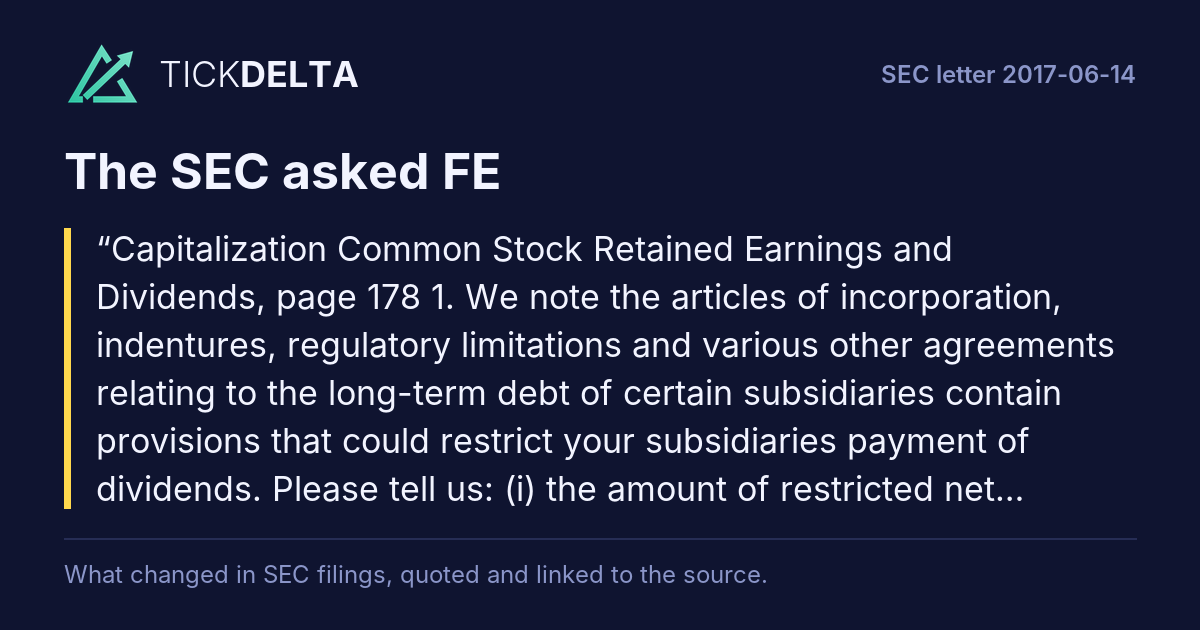
Capitalization Common Stock Retained Earnings and Dividends, page 178 1. We note the articles of incorporation, indentures, regulatory limitations and various other agreements relating to the long-term debt of certain subsidiaries contain provisions that could restrict your subsidiaries payment of dividends.
Rest of the question

Please tell us: (i) the amount of restricted net assets of consolidated subsidiaries and your equity in the undistributed earnings of investments accounted for by the equity method as of December 31, 2016 and how you computed the amount; (ii) your consideration of providing the disclosures required by Rule 4-08(e)(3)(i) and (ii) of Regulation S-X; and (iii) your consideration of providing the condensed financial information prescribed by Rule 12-04 of Regulation S- X in accordance with Rule 5-04 of Regulation S-X. 18. Supplemental Guarantor Information, page 201 2. Please disclose that FG is 100% owned by FES pursuant to Rule 3-10(c) and (i)(8)(i) of Regulation S-X. Form 10-Q for the Quarterly Period Ended March 31, 2017 10. Commitments, Guarantees and Contingencies Environmental Matters, page 40 3. Reference is made the last paragraph on page 41 and first paragraph on page 42 where you discuss the claim from BNSF and NS, which are the counterparties to the coal transportation contract covering the delivery of 2.5 million tons annually through 2025. Please disclose an estimate of the possible loss or range of loss in excess of the amount accrued or a statement that such an estimate cannot be made.

FE answered
(i) The amount of restricted net assets of consolidated subsidiaries and FirstEnergy's equity in the undistributed earnings of investments accounted for by the equity method was $199 million, or 3% of the consolidated net assets of FirstEnergy as of December 31, 2016.

FirstEnergy's computation of restricted net assets is consistent with the requirements of Rule 4-08 of Regulation S-X, which determines the amount of FirstEnergy's proportionate share of net assets, after intercompany eliminations, reflected in the balance sheets of its consolidated and unconsolidated subsidiaries as of the end
Rest of the answer

of each fiscal year which may not be transferred to FirstEnergy, in the form of loans, advances or cash dividends by the subsidiaries without the consent of a third party. The computation is conducted for each consolidated and unconsolidated subsidiary and includes specific limitations or restrictions arising under the articles of incorporation, indentures, regulatory limitations, and various other agreements relating to the long-term debt of each subsidiary.

Specific third party limitations or restrictions considered in the computation as of December 31, 2016 were as follows:

•

Under the Federal Power Act it is unlawful for any officer or director of any public utility "to participate in the making or paying of any dividends of such public utility from any funds properly included in the capital account." The Federal Energy Regulatory Commission (FERC) has interpreted this provision to allow dividends to be paid as long as the source of the dividend is clearly disclosed, the dividend is not "excessive," and there is no self-dealing on the part of corporate officials. Dividends are not considered "excessive" as long as they are payable out of, and do not exceed retained earnings. However, as disclosed in Note 12 of the Combined Notes to the Consolidated Financial Statements in FirstEnergy's 2016 Form 10-K, certain subsidiaries have authorization from the FERC to pay cash dividends to FirstEnergy from paid-in capital accounts as long as their FERC-defined equity to total capitalization ratio remains above 35% or 45%, as applicable.

As disclosed on page 83 of FirstEnergy's 2016 Form 10-K within the Capital Resources and Liquidity section of Management's Discussion and Analysis of Registrant and Subsidiaries, FirstEnergy's revolving credit facilities contain financial covenants requiring each borrower to maintain a consolidated debt to total capitalization ratio of no more than 65%, or in one instance 75%, depending on the subsidiary, as measured at the end of each fiscal quarter with certain exclusions for FE as disclosed.

The first mortgage bond indenture of one of FirstEnergy's subsidiaries requires it to maintain a minimum balance within retained earnings, limiting its ability to pay dividends to FirstEnergy.

Other limitations or restrictions were considered in the computation but were not as restrictive as those noted above.

(ii) The disclosures required by Rule 4-08(e)(3)(i) and (ii) of Regulation S-X are required if the restricted net assets of consolidated and unconsolidated subsidiaries and the parent's equity in the undistributed earnings of 50% or less owned persons accounted for by the equity method together exceed 25% of consolidated net assets as of the end of the most recently completed fiscal year. FirstEnergy's restricted net assets of consolidated and unconsolidated subsidiaries and its equity in the undistributed earnings of 50% or less owned persons accounted for by the equity method were $199 million, or 3% of consolidated net assets as of December 31, 2016, and therefore disclosure under Rule 4-08(e)(3)(i) and (ii) of Regulation S-X was not required.

(iii) The condensed financial information prescribed by Rule 12-04 of Regulation S-X in accordance with Rule 5-04 of Regulation S-X are required when the restricted net assets of consolidated subsidiaries exceed 25% of consolidated net assets as of the end of the most recently completed fiscal year. FirstEnergy's restricted net assets of consolidated subsidiaries were $199 million, or 3% of consolidated net assets as of December 31, 2016, and therefore the condensed financial information prescribed by Rule 12-04 of Regulation S-X in accordance with Rule 5-04 of Regulation S-X was not required.

18. Supplemental Guarantor Information, page 201

2. Please disclose that FG is 100% owned by FES pursuant to Rule 3-10(c) and (i)(8)(i) of Regulation S-X.

Response:

We respectfully refer the Staff to the Glossary of Terms on page iii of the 2016 Form 10-K which defines FG as “FirstEnergy Generation, LLC, a wholly-owned subsidiary of FES, which owns and operates non-nuclear generating facilities.” Nonetheless, we acknowledge the Staff’s comment and to clarify, in future filings we will include disclosure in the Supplemental Guarantor footnote that FG is 100% owned by FES.

Form 10-Q for the Quarterly Period Ended March 31, 2017

10. Commitments, Guarantees and Contingencies

Environmental Matters, page 40

3. Reference is made the last paragraph on page 41 and first paragraph on page 42 where you discuss the claim from BNSF and NS, which are the counterparties to the coal transportation contract covering the delivery of 2.5 million tons annually through 2025. Please disclose an estimate of the possible loss or range of loss in excess of the amount accrued or a statement that such an estimate cannot be made.

Response:

As disclosed in our 2017 Form 10-Q, FG, a wholly owned subsidiary of FES as discussed above, and BNSF and NS were engaged in settlement discussions to resolve all claims related to a long-term coal transportation contract dispute. In the first quarter of 2017, FG recorded a pre-tax charge associated with this contract dispute of $55 million, which was included in the total pre-tax charge of $164 million for both the BNSF/NS and BNSF/CSX long-term coal transportation contract disputes and was based on FG’s estimated loss as a result of the status of settlement discussions. Management considered the disclosure of a loss in excess of the amount accrued and determined, based on the status of settlement discussions, that the dispute would be settled and a loss that was materially in excess of the amount accrued was remote, resulting in no additional disclosure under ASC 450, Contingencies.

However, given the concerns about FES’ ability to continue as a going concern, as disclosed in our 2017 Form 10-Q, management concluded that it was necessary to disclose that in the event the disputes were unable to settle, which management viewed as remote, the amount of damages owed could be materially higher and may cause FES to seek bankruptcy protection.

Currently, settlement discussions continue with BNSF and NS and management continues to believe that its disclosures are appropriate. However, management will consider the status of settlement discussion in future filings and will disclose any reasonably possible loss or range of loss that is materially in excess of the amount accrued or state that such an estimate cannot be made.

Read in the reply ↗
In its next report

First report after the company's reply of 2017-06-19: 10-Q filed 2017-07-27 ↗, against the 10-Q filed 2017-04-27 ↗.

Tickdelta does not hold the text of both reports, so they are not compared here.

Also in this review: closing letter, 2017-06-28

2 other letters: notices that a filing will not be reviewed, requests to declare a registration effective, and the like

From the SEC's correspondence on EDGAR: staff letters (form UPLOAD) and company letters (form CORRESP), 14 letters filed since 2017-06-14. Questions and answers are matched by their numbers; topics come from words in each question. The reports are compared word for word (same form, before the first SEC letter against the first report after the company's reply). No AI.

Next in Owners and insiders Insider trades →

Work on FE in a spreadsheet: Excel workbook (a sheet per section, ten years by column, charts, links to the filings) · CSV. For a Google Sheet that stays up to date, paste =IMPORTDATA("https://tickdelta.com/company/FE/export.csv") into a cell.