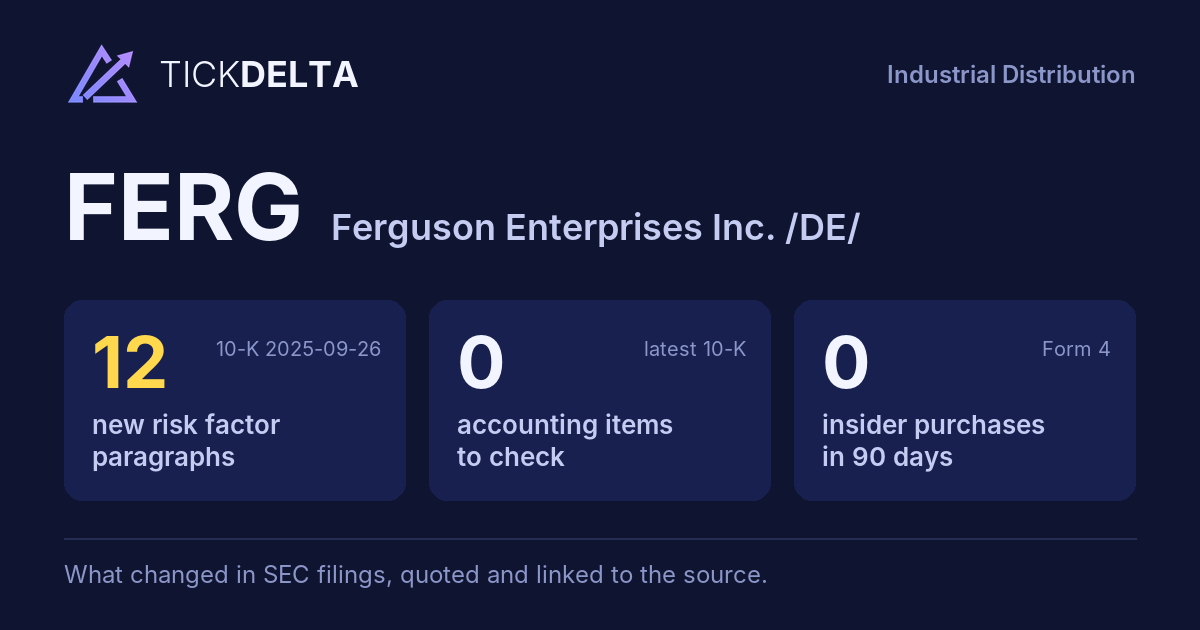
10-K 0002011641-25-000027 (2025-09-26) vs 10-K 0002011641-24-000005 (2024-09-25)
| Section | Compared text | Words now | Changed |
|---|
| Risk Factors | Item 1A | 12,678 |
21.2% |
| MD&A | Item 7 | 4,363 |
34.5% |
| Legal Proceedings | Item 3, via Note 11 – Commitments and contingencies | 96 |
not compared |
| Accounting Policies | Item 8, Note 1 – Summary of significant accounting policies | 4,013 |
11.0% |
The redline: what was cut and what was added
In each section, the paragraph that changed most, marked against last year's 10-K:
cut words struck through, new words highlighted and underlined.
Risk Factors 272 words changed in this paragraph; it is 40% similar to last year's version.
We are subject to income taxes in the U.S. and various other countries globally. Changes in tax laws, regulations and treaties, treaties and conflicts in related interpretations or the interpretation thereof can and do occur. Significant judgment is required for determining the Company’s tax liabilities, and the Company’s tax returns are periodically examined by various tax authorities. The ultimate resolution of any tax matters guidance may result in payments greater or less than amounts accrued, which could have a negative impact on our provision for income taxes. In addition, our future earnings and the value of our deferred tax assets and liabilities could be negatively impacted by further changes in tax legislation, including changes in tax rates, tax laws and changes in the rules for earnings repatriations in the U.S. or other countries. For example, the current U.S. presidential administration has proposed a higher U.S. federal corporate tax rate and increased taxation of offshore income. Further, in July and October 2021, the OECD/G20 Inclusive Framework agreed on the general rules for redefined jurisdictional taxation rights and a global minimum tax. In December 2022, the European Union member states voted unanimously to adopt a Directive implementing the Pillar Two (global minimum tax) rules giving member states until December 31, 2023 to implement the Directive into national legislation. Certain jurisdictions in which we operate, under the OECD/G20 Inclusive Framework, have enacted legislation that adopts a subset of such rules effective for tax years beginning after January 1, 2024, with the remaining rules becoming effective January 1, 2025. The application of tax law is subject to interpretation. Additionally, administrative guidance can be incomplete or vary from legislative intent, and therefore the application of the tax law is uncertain. While we believe the positions reported by the Company comply with relevant tax laws and regulations, we could be subject to tax audits and taxing authorities could interpret our application of certain laws and regulations differently. Future tax controversy matters may result in previously unrecorded tax expenses, higher future tax expenses or the assessment of interest and penalties which could have a material adverse effect on our business, financial condition, results of operations and cash flows.
Source: Item 1A, 10-K 0002011641-25-000027 vs Item 1A, 10-K 0002011641-24-000005
Accounting Policies 166 words changed in this paragraph; it is 36% similar to last year's version.
In November 2023, 2024, the FASB Financial Accounting Standards Board (“FASB”) issued Accounting Standards Update (“ASU”) No. 2023-07, “Segment Reporting (Topic 280): Improvements to Reportable Segment Disclosures.” 2024-03, “Income Statement—Reporting Comprehensive Income—Expense Disaggregation Disclosures (Subtopic 220-40): Disaggregation of Income Statement Expenses.” This ASU expands public entities’ required segment disclosures, requires new financial statement disclosures disaggregating prescribed expense categories within relevant income statement expense captions, including disclosure information about purchases of significant segment expenses that inventory, employee compensation, depreciation and intangible asset amortization for each relevant expense caption on the face of the income statement. Per ASU No. 2025-01, the amendments under ASU No. 2024-03 are regularly provided to the chief operating decision maker and included within each reported measure of segment profit or loss, an amount and description of its composition for other segment items and interim disclosures of a reportable segment’s profit or loss and assets that are currently not required. This ASU is effective for fiscal years annual reporting periods beginning after December 15, 2023, 2026, and interim periods within fiscal years annual reporting periods beginning after December 15, 2024. 2027. Early adoption is permitted. The ASU No. 2024-03 can be adopted either prospectively or retrospectively. The Company is currently evaluating the ASU to determine the impact of adopting this ASU on its disclosures.
Source: Item 8, Note 1 – Summary of significant accounting policies, 10-K 0002011641-25-000027 vs Item 8, Note 1 – Summary of significant accounting policies, 10-K 0002011641-24-000005
MD&A 135 words changed in this paragraph; it is 49% similar to last year's version.
Net sales for the United States segment were $28.2 $29.3 billion in fiscal 2024, a decrease 2025, an increase of $0.1 $1.1 billion, or 0.3%, 3.8%, compared with the prior year. The decrease increase in net sales was primarily driven by price deflation of approximately 2%, mainly within certain commodity categories, and to a lesser extent, lower higher sales volume. These decreases were partially offset by volume, along with incremental sales from acquisitions of 1.7% and 1.0%. These increases were partially offset by price deflation of approximately 1%, mainly within certain commodity categories in the benefit first half of the fiscal year that was partially offset by improvements in finished goods pricing. In addition, net sales growth was partially offset by the impact of one additional fewer sales day of 0.4% in the year-over-year comparison. Net sales growth in the non-residential markets was 6.8% due to growth in each of Commercial, Civil/Infrastructure and Industrial. Net sales in the residential markets decreased increased by 2.4%, driven by lower sales in 0.9%, with growth across both new construction reflecting housing starts and permit activity that were below prior year levels, as well as lower sales in RMI. Net sales growth in the non-residential markets, was 1.9%, with growth in the civil/infrastructure and commercial markets.
Source: Item 7, 10-K 0002011641-25-000027 vs Item 7, 10-K 0002011641-24-000005
Every change, by type
Sentences and paragraphs of FERG's Risk Factors and MD&A, 10-K 2025-09-26 against 10-K 2024-09-25.
Each links to the text at sec.gov.
Quiet changes are sentences kept from last year with one to four words changed, at least one of them a hedge, a modal or a qualifier
(may, could, will, not, significant, material…). A year or date rolling forward is not counted.
The full word list
adverse, adversely, all, although, anticipate, anticipates, any, approximately, believe, believes, can, cannot, certain, could, expect, expects, generally, however, if, intend, intends, largely, likely, many, material, materially, may, might, most, must, never, no, not, possible, primarily, probable, should, significant, significantly, some, substantial, substantially, unlikely, will, would
AddedRisk Factors
Any of these events could impair the ability of our customers to make full and timely payments for, or reduce the volume of, products our customers purchase from us and could cause increased pressure on our selling prices. In particular, our customers may be affected by the shortage of skilled trade professionals in the U.S. If the shortage continues, it could lead to customers delaying or failing to place orders due to a lack of sufficient skilled trade professionals needed to take on additional projects.
Read it in 10-K 2025-09-26 at sec.gov ↗
AddedRisk Factors
Furthermore, any of these conditions could affect key suppliers, which could impair their ability to deliver products and result in delays for our customers or added costs. Accordingly, any prolonged uncertainty about current or future micro- or macro-economic conditions and potential volatility in our relevant end markets has in the past and may in the future negatively impact our business, financial condition and results of operations.
Read it in 10-K 2025-09-26 at sec.gov ↗
AddedRisk Factors
We operate a variety of pension plans, including defined benefit plans in Canada and the U.K. The amount we are required to contribute to these plans is determined by the laws and regulations governing each plan and is generally related to the funded status of the plans. A deterioration in the value of the plans’ investments or a decrease in the discount rate used to calculate plan liabilities generally would negatively impact the funding status of the plans, which may result in an increase in our obligation to make contributions to the plans.
Read it in 10-K 2025-09-26 at sec.gov ↗
AddedRisk Factors
The U.K. defined benefit pension plan (the “U.K. Plan”), our largest defined benefit plan, is closed to future service costs. The trustee of the U.K. Plan has purchased a bulk annuity insurance policy that provides an income stream equivalent to the obligations to pensioners covered by the arrangement. As a result, the Company is no longer expected to make ongoing deficit reduction contributions to the U.K. Plan, but will make ongoing contributions to cover the plan’s expenses and other payments that may be required.
Read it in 10-K 2025-09-26 at sec.gov ↗
AddedRisk Factors
In spite of the efforts taken to match our plan liabilities with a portfolio of assets designed to hedge the underlying interest, inflation and longevity risk, certain actions by pensions regulators or the trustees of our pension plans, any material revisions to existing pension legislation or any failure by the insurer to fulfill its obligations could result in us being required to incur significant additional costs immediately or in short time frames. Such costs could reduce the cash available for working capital and other corporate uses, and may have an adverse impact on the Company’s financial condition.
Read it in 10-K 2025-09-26 at sec.gov ↗
AddedRisk Factors
Changes in laws or policies governing the terms of foreign trade, and in particular increased trade restrictions, tariffs, sanctions or taxes on imports from countries where we import products or raw materials (either directly or through our suppliers), could have a material adverse impact on our competitive position, business, financial condition and results of operations. Recently, the U.S. has announced tariffs and reciprocal tariffs on a wide range of products manufactured or produced worldwide. Several countries have similarly announced reciprocal or other tariffs impacting products manufactured or produced in the U.S. The U.S. has and may in the future pause, reimpose or increase tariffs, and countries subject to such tariffs have and in the future may impose reciprocal tariffs or other retaliatory countermeasures in response to the imposition of tariffs by the U.S. If these tariffs are fully implemented and we are unable to pass on the costs of these tariffs to our customers, our gross profits will be reduced. In addition, if our customers’ costs are increased, we could suffer from decreased demand as our customers may choose to delay or cancel projects and other purchases that include the products that we sell to them.
Read it in 10-K 2025-09-26 at sec.gov ↗
AddedRisk Factors
Conversely, if tariffs, duties or quotas are lifted or if the level of imported products otherwise increases, we could be adversely affected to the extent that we would then have higher-cost products in our inventory or experience lower prices and margins due to increased supplies of these products that could drive down prices and margins. If prices of these products were to decrease significantly, we might not be able to profitably sell these products, and the value of our inventory would decline. In addition, significant price decreases could result in a significantly longer holding period for some of our inventory.
Read it in 10-K 2025-09-26 at sec.gov ↗
AddedRisk Factors
Trade restrictions could be adopted with little to no advanced notice, and we may not be able to effectively mitigate the adverse impacts from such measures.
Read it in 10-K 2025-09-26 at sec.gov ↗
AddedRisk Factors
Additionally, the loss of key supplier arrangements could have a material adverse impact on us. Although in many instances we have agreements with our suppliers, these agreements are generally terminable by either party on limited notice. Failure by our suppliers to continue to supply us with products on commercially reasonable terms, or at all, could put pressure on operating margins, result in reduced customer purchases or lead to termination of certain customer relationships, any of which could have a material adverse effect on our business, financial condition and results of operations. These risks may be amplified in cases where we are unable to identify and secure alternative sources of supply. Furthermore, more of our existing suppliers may decide to supply products directly to end users that are our existing or potential customers, which could have a detrimental effect on our ability to keep and procure customers, and maintain and win business, thereby having a material adverse effect on our business, financial condition and results of operations.
Read it in 10-K 2025-09-26 at sec.gov ↗
AddedRisk Factors
For example, the rapid evolution of AI and machine learning technologies and the implementation of pilot programs integrating generative AI into both our internal and external-facing systems may intensify our cybersecurity, privacy and data security risks, such as the risk of increased vulnerability to cybersecurity threats and exposure or theft of proprietary, confidential, personal or otherwise sensitive information (which could result in such information being made available to our competitors and other members of the public), the generation of factually incorrect or biased outputs and reliance on outdated or unverified data.
Read it in 10-K 2025-09-26 at sec.gov ↗
AddedRisk Factors
We rely on information technology systems, networks, products, and services, some of which are managed by service providers to protect our information. Increased information security threats and more sophisticated threat actors pose a risk to our information security program. Additionally, we collect, store, and process personal information relating to our customers, suppliers, and associates. This information is increasingly subject to a variety of international and U.S. federal and/or state laws and regulations that are constantly changing and becoming more complex.
Read it in 10-K 2025-09-26 at sec.gov ↗
AddedRisk Factors
We are subject to income taxes in the U.S. and various other countries globally. Changes in tax laws, regulations and treaties and conflicts in related interpretations or guidance may result in payments greater or less than amounts accrued, which could have a negative impact on our provision for income taxes. In addition, our future earnings and the value of our deferred tax assets and liabilities could be negatively impacted by further changes in tax legislation, including changes in tax rates, tax laws and changes in the rules for earnings repatriations in the U.S. or other countries.
Read it in 10-K 2025-09-26 at sec.gov ↗
RemovedRisk Factors
Our financial performance depends significantly on industry trends and general economic conditions, including the state of the residential and non-residential markets, as well as changes in gross domestic product in the geographic markets in which we operate, particularly in the U.S. where we generated 95% of our net sales in fiscal 2024. We serve several end markets in which the demand for our products is sensitive to the construction activity, capital spending and demand for products of our customers. Many of these customers operate in markets that are subject to fluctuations resulting from market uncertainty, costs of goods sold, rising interest rates, foreign currency exchange rates, labor shortages, including a shortage of skilled trade professionals, work stoppages and strikes, foreign competition, offshoring of production, oil, natural gas and other commodity prices, energy costs, geopolitical developments and conflicts and any related international response thereto, wage inflation and a variety of other factors beyond our control. In particular, our customers may be affected by the shortage of skilled trade professionals in the U.S. If the shortage continues, it could lead to existing customers delaying the placement of or failing to place additional orders due to a lack of sufficient skilled trade professionals needed to take on additional projects. Any of these factors could cause customers to idle or close facilities, delay purchases, reduce production levels or experience reductions in the demand for their own products or services.
Read it in 10-K 2024-09-25 at sec.gov ↗
RemovedRisk Factors
We operate a variety of pension plans, including funded and underfunded defined benefit schemes in Canada and the U.K. Our pension trustees and plan sponsors aim to match the liabilities with a portfolio of assets, comprising equity and debt securities alongside diversified growth assets and further investments designed to hedge the underlying interest and inflation risk in the associated liabilities. The market value of these assets can rise and fall over time, which impacts the funding position of the plan. The U.K. defined benefit pension plan (the “U.K. Plan”), our largest defined benefit plan, is closed to future service costs and has a buy-in insurance policy which covers a large proportion of the existing participants.
Read it in 10-K 2024-09-25 at sec.gov ↗
RemovedRisk Factors
As required by U.K. pensions regulation, the U.K. Plan completed its triennial actuarial valuation exercise in fiscal 2023, which is measured on a technical provisions basis, based on the U.K. Plan’s financial position as of April 30, 2022. The triennial valuation resulted in a need for deficit reduction contributions of £133 million spread over the period to January 31, 2026, of which we have paid £50 million as of July 31, 2024. New funding requirements will apply to the next triennial valuation of the U.K. Plan (as of April 30, 2025), requiring the plan to target a funding level where dependency on the employer is low. Any additional funding requirements, which could be affected by factors such as a deterioration in economic conditions or changes in actuarial assumptions, could have an adverse effect on our financial condition.
Read it in 10-K 2024-09-25 at sec.gov ↗
RemovedRisk Factors
Furthermore, the U.K. pensions regulator could take action (for example civil, criminal, monetary and non-monetary penalties) in situations where the “employer covenant” of a defined benefit plan—the willingness and ability of the sponsor to fund the plan—has been detrimentally affected in a material way or where corporate activity, such as certain corporate activities taken in connection with the Merger, poses a materially detrimental risk to accrued plan benefits. The consequences of successful civil and criminal actions include fines, and (in the case of civil actions) requirements to provide further funding for the plan, for both the sponsor and its connected group companies. In addition, actions by the trustees of our pension plans or any material revisions to the existing pension legislation could result in us being required to incur significant additional costs immediately or in short time frames. Such costs, in turn, could have an adverse effect on our financial condition.
Read it in 10-K 2024-09-25 at sec.gov ↗
RemovedRisk Factors
Trade tensions between the U.S. and China have escalated over the past several years which resulted in elevated tariffs. The current U.S. presidential administration has not taken action to roll these back. Following the Office of United States Trade Representative’s (the “USTR”) quadrennial review of the tariffs imposed on China-origin goods pursuant to Section 301 of the Trade Act of 1974 (the “U.S. Trade Act”), in May 2024, the USTR recommended that tariffs on products from China would continue at current rates or have their rates raised. Rates on certain steel and aluminum products under Section 301 will increase from 0-7.5% to 25% in 2024.
Read it in 10-K 2024-09-25 at sec.gov ↗
RemovedRisk Factors
This process and the change in the U.S. presidential administration resulting from the 2024 election may or may not change these tariff actions and it remains unclear what additional, new, or different actions, if any, will be taken by the U.S., China, or other governments with respect to international trade agreements, the imposition of tariffs on goods imported into the U.S., the erection of barriers to trade, tax policy related to international commerce, or other trade matters. The potential removal of some of the tariffs and trade actions and the respective deflationary impact could have an effect on our business, financial condition and results of operations. At this point in time, it remains to be seen what effects, if any, the current administration will have on a long-term comprehensive agreement on tariffs between the U.S. and China.
Read it in 10-K 2024-09-25 at sec.gov ↗
RemovedRisk Factors
We rely on IT systems, networks, products, and services, some of which are managed by service providers to protect our information. Increased information security threats and more sophisticated threat actors pose a risk to our information security program. Additionally, we collect, store, and process personal information relating to our customers, suppliers, and associates. This information is increasingly subject to a variety of U.S. and international laws and regulations that are constantly changing and becoming more complex, such as the General Data Protection Regulation, as enacted in the European Union and the U.K., Canada’s Personal Information Protection and Electronic Documents Act, and the California Consumer Privacy Act (the “CCPA”). These laws and regulations may carry significant potential penalties for non-compliance. For example, in the U.S. the CCPA, which came into effect in January 2020, has given California consumers more control over the personal information that businesses collect about them. The law created new data privacy rights for California consumers and requires certain businesses who collect personal information from California consumers to comply with various data protection requirements. Further, in November 2020, the California Privacy Rights Act (the “CPRA”) was voted into law by California residents. The CPRA, which became enforceable in July 2023, significantly amends the CCPA and imposes additional data protection obligations on companies doing business in California, including additional consumer rights processes and opt outs for certain uses of sensitive data. It also creates a new California data protection agency specifically tasked to enforce the law, which could result in increased regulatory scrutiny of businesses conducting activities in California in the areas of data protection and security. Businesses like ours that are subject to the CCPA who fail to comply with the CCPA may be subject to fines and penalties per incident of non-compliance and class action lawsuits in the event of a data breach of sensitive personal information. Other U.S. states continue to enact or are proposing or have enacted similar laws related to the protection of consumer personal information.
Read it in 10-K 2024-09-25 at sec.gov ↗
RemovedRisk Factors
We rely on data centers and other technologies and services provided by third parties in order to manage our cloud-based infrastructure and operate our business. If any of these services becomes unavailable or otherwise is unable to serve our requirements due to extended outages, interruptions, facility closure, or because it is no longer available on commercially reasonable terms, expenses could increase and our operations could be disrupted or otherwise impacted until appropriate substitute services, if available, are identified, obtained, and implemented, which could have a material adverse effect on our business, financial condition and results of operations.
Read it in 10-K 2024-09-25 at sec.gov ↗
RemovedRisk Factors
A public health crisis, such as a pandemic or epidemic, and associated government restrictions to prevent its spread, could have a material adverse impact on our business, results of operations and financial condition as well as the operations of some of our suppliers. For example, the COVID-19 pandemic resulted in supply chain disruptions and caused significant disruption in the U.S. and Canadian economies, including due to the restrictive measures adopted to prevent its spread and general market unpredictability.
Read it in 10-K 2024-09-25 at sec.gov ↗
RemovedRisk Factors
A widespread public health crisis may decrease demand for our products and solutions due to public reaction to the health crisis or actions taken by governmental or other regulatory organizations to control or otherwise limit the effects of the public health crisis. This crisis may also limit labor availability that could adversely impact manufacturing and distribution throughout the supply chain and limit the availability of product from our suppliers. Depending on the ultimate scope and duration of the supply chain disruptions, we may experience increases in product costs which we may not be able to pass on to our customers, loss of sales due to lack of product availability or potential customer claims from the inability to provide products in accordance with contractual terms. In addition, if significant numbers of associates, key personnel and/or senior management become unavailable due to sickness, legal requirements or self-isolation, our operations could be disrupted. Measures taken in response to a public health crisis could adversely impact our ability to retain and attract associates, including key personnel. While we are unable to predict the likelihood, timing, magnitude and duration of a public health crisis and the associated effects to our business, a public health crisis and any associated supply chain disruption, labor market impact, recession, or depression could have a material adverse effect on our business, financial condition and results of operations and may also have the effect of heightening many of the other risks described in this “Risk Factors” section.
Read it in 10-K 2024-09-25 at sec.gov ↗
RewordedRisk Factors
Our business could be negatively impacted by a Any of the following, or additional other factors beyond our control, may cause serious disruption in the movement of products through our supply chain chain, leading to a substantial decrease in the availability of products or by an increase in the cost of such products, including due to any of the following or other factors beyond our control: products: financial instability among key suppliers; global or regional political unrest, disputes or war, or labor unrest, in source countries or elsewhere in our supply chain; changes in the total costs in our supply chain (including, but not limited to, changes in fuel and labor costs and currency exchange rates); port or rail labor disputes and security; the outbreak or resurgence of pandemics or epidemics; weather- adverse weather events or climate-related events; natural disasters; foreign competition; work stoppages or strikes; shipping capacity constraints or embargoes; changes in trade policy and any trade restrictions; tariffs or duties; fluctuations in currency exchange rates; or transport availability, capacity and costs.
Read it in 10-K 2025-09-26 at sec.gov ↗
RewordedRisk Factors
Other Accordingly, a number of factors beyond our control, including but not limited to inflation, deflation, slow or stagnant economic growth stagflation or recession, trade restrictions such as tariffs, sanctions and retaliatory countermeasures, the political climate, government spending, unemployment, interest rate and mortgage rate fluctuations, mortgage delinquency and foreclosure rates, inventory loss due to theft, foreign currency fluctuations, labor shortages, including as a result of changes in immigration policy, labor and healthcare costs, the availability of financing, disruption in the financial and credit markets, including as a result of instability in the banking sector and the failure of financial institutions, changes in tax laws affecting the real estate industry, laws, product availability constraints as a result of the ineffectiveness of or disruption to our domestic or international supply chain or fulfillment networks, weather, cybersecurity incidents or network security breaches, adverse weather events or natural disasters, acts of terrorism, acts of war, consumer activism, pandemics or epidemics, international trade tensions, civil unrest and geopolitical conditions, could have a material adverse effect on our business, financial condition and results of operations.
Read it in 10-K 2025-09-26 at sec.gov ↗
RewordedRisk Factors
If we do not adapt to or comply with such investor, customer customer, regulator or other stakeholder expectations, or if we are perceived to have not responded appropriately or quickly enough to growing concern for ESG and concerns related to sustainability issues, regardless of whether there is a regulatory or legal requirement to do so, we may suffer from reputational damage damage, be subject to litigation or regulatory enforcement or be precluded from doing business with certain customers and customers, any of which could materially adversely affect our business, financial condition condition, results of operations and/or the market price of our common stock could be materially and adversely affected. stock.
Read it in 10-K 2025-09-26 at sec.gov ↗
RewordedRisk Factors
Loss of customer, supplier, associate, or other business information or compromise of our information systems could disrupt operations, operations and our key business processes, result in the impairment or loss of critical data, be costly and resource intensive to remedy, damage our reputation, our relationship with customers, suppliers and other stakeholders and expose us to claims from customers, suppliers, financial institutions, regulators, payment card associations, associates, associates and others, any of which could have a material adverse effect on our business, financial condition and results of operations.
Read it in 10-K 2025-09-26 at sec.gov ↗
RewordedRisk Factors
In response to these competitive pressures, among other initiatives, we are applying leveraging technology as an important medium for delivering better to enhance customer service alongside the supply of our products, service, streamline product delivery and to create dedicated develop tools to save customers time and money.
Read it in 10-K 2025-09-26 at sec.gov ↗
RewordedRisk Factors
Inventory levels in excess of customer demand due to the difficulty of calibrating demand for such products, the concentration of demand for a limited number of products, difficulties in product sourcing, sourcing or rapid changes in demand may result in extended cash conversion cycles, inventory write-downs, write-downs and the sale of excess inventory at discounted prices prices, any of which could have an a material adverse effect on our operating results, business, financial condition condition, results of operations and cash flows.
Read it in 10-K 2025-09-26 at sec.gov ↗
RewordedRisk Factors
If the tight labor market persists, this may increase Substantial increases in our operating costs to maintain our workforce as well as negatively impact may have an adverse effect on our business, financial condition and results of operations.
Read it in 10-K 2025-09-26 at sec.gov ↗
RewordedRisk Factors
However, We seek to enter into contracts with suppliers which provide for indemnification from any costs associated with the provision of defective products; however, there can be no assurance that such contractual rights will be obtained or would be adequate, or that related indemnification claims will be successfully asserted by us.
Read it in 10-K 2025-09-26 at sec.gov ↗
RewordedRisk Factors
Weakness in the economy, market trends, uncertainty and other conditions in the markets in which we operate, particularly in the U.S., have in the past and may in the future adversely affect the profitability and financial stability of some of our customers, customers and could vendors, and, in turn, negatively impact our sales growth business, financial condition and results of operations.
Read it in 10-K 2025-09-26 at sec.gov ↗
RewordedRisk Factors
Moreover, we have in the past, we have experienced and may in the future, experience volatility in our stock price, and we may experience such volatility again in the future, which may make it more difficult and expensive to recruit and retain associates, particularly senior leadership, through equity-based compensation.
Read it in 10-K 2025-09-26 at sec.gov ↗
RewordedRisk Factors
A significant deterioration in the economy, including as a result of any public health crisis or any geopolitical conflict economy could have an adverse effect on collecting our ability to collect our accounts receivable, including longer payment cycles, increased collection costs and defaults.
Read it in 10-K 2025-09-26 at sec.gov ↗
RewordedRisk Factors
Furthermore, while we regularly evaluate potential upgrades and enhancements to our information technology systems and processes, we may be unable to make complete such upgrades efforts on a timely basis or at all due to a lack of specialized associates or insufficient resources.
Read it in 10-K 2025-09-26 at sec.gov ↗
Quiet changesRisk Factors
If we are unable to protect our sensitive data and information systems against data corruption, cybersecurity incidents or network security breaches, or if we are unable to provide adequate security in the electronic transmission of sensitive data, it could materially adversely affect our business, financial condition and results of operations.
Read it in 10-K 2025-09-26 at sec.gov ↗
Quiet changesRisk Factors
Cyber-attacks from computer hackers and cyber criminals and other malicious internet-based activity continue to increase generally, increase, and our services and systems, including the systems of our outsourced service providers, have been and may in the future continue to be the target of various forms of cybersecurity incidents such as Domain Name System attacks, wireless network attacks, viruses and worms, malicious software, ransomware, application centric attacks, peer-to-peer attacks, business email compromises and phishing attempts, backdoor trojans and distributed DoS attacks.
Read it in 10-K 2025-09-26 at sec.gov ↗
Quiet changesRisk Factors
A failure of a key information technology system or process could materially adversely affect the operations of our business.
Read it in 10-K 2025-09-26 at sec.gov ↗
AddedMD&A
Corporate restructuring expenses were $7 million and $28 million in fiscal 2025 and 2024, respectively. During fiscal 2024, these expenses primarily related to establishing a new corporate structure to domicile our ultimate parent company in the United States. During fiscal 2025, these expenses were primarily related to transition activities following the establishment of our ultimate parent company’s domicile in the United States.
Read it in 10-K 2025-09-26 at sec.gov ↗
AddedMD&A
During the second half of fiscal 2025, the Company implemented targeted actions to streamline operations, enhancing speed and efficiency to better serve customers and drive further profitable growth. As a result of these actions, the Company recorded non-recurring business restructuring expenses of $73 million. No such amounts were recorded in fiscal 2024.
Read it in 10-K 2025-09-26 at sec.gov ↗
AddedMD&A
(2)For fiscal 2025, business restructuring expenses related to the Company’s implementation of targeted actions to streamline operations, enhancing speed and efficiency to better serve customers and drive further profitable growth.
Read it in 10-K 2025-09-26 at sec.gov ↗
AddedMD&A
(3)For fiscal 2025, business restructuring expenses related to the Company’s implementation of targeted actions to streamline operations, enhancing speed and efficiency to better serve customers and drive further profitable growth.
Read it in 10-K 2025-09-26 at sec.gov ↗
AddedMD&A
Dividends paid to shareholders were $489 million and $784 million in fiscal 2025 and 2024, respectively. The decrease was due to the timing of dividend payments in fiscal 2025 and 2024. The Company generally pays dividends in the fiscal quarter following the fiscal quarter in which the dividend was declared. However, the dividends declared in the fourth quarter of fiscal 2024 were also paid in the fourth quarter of fiscal 2024 in connection with establishing a new corporate structure to domicile our ultimate parent company in the United States. As such, no dividends were paid in the first quarter of fiscal 2025.
Read it in 10-K 2025-09-26 at sec.gov ↗
AddedMD&A
Subsequent to July 31, 2025, the Company repaid $400 million in Private Placement Notes that matured in September 2025.
Read it in 10-K 2025-09-26 at sec.gov ↗
AddedMD&A
As of July 31, 2025, the Company has issued a total of $3.1 billion in unsecured notes, collectively referred to as the “Unsecured Senior Notes”.
Read it in 10-K 2025-09-26 at sec.gov ↗
AddedMD&A
•In October 2024, Ferguson Enterprises Inc. (“FEI”) issued an aggregate principal amount of $750 million of Unsecured Senior Notes.
Read it in 10-K 2025-09-26 at sec.gov ↗
AddedMD&A
In September 2025, FEI issued an additional $750 million aggregate principal amount of Unsecured Senior Notes, maturing in March 2031 (the “2031 Senior Notes”). The 2031 Senior Notes bear interest at a rate of 4.35%, payable semi-annually.
Read it in 10-K 2025-09-26 at sec.gov ↗
AddedMD&A
In April 2025, the Company entered into a revolving credit agreement (the “Revolving Credit Agreement”), replacing its existing $1.35 billion Multicurrency Revolving Facility. The Revolving Credit Agreement provides an unsecured revolving credit facility in an aggregate committed amount of $1.5 billion (the “Revolving Facility”). The Revolving Credit Agreement provides the Company with the ability to increase from time to time the aggregate capacity of the facility by $500 million under certain conditions, subject to lender participation.
Read it in 10-K 2025-09-26 at sec.gov ↗
AddedMD&A
In October 2024, FEI issued and sold $750 million aggregate principal amount of certain Unsecured Senior Notes. The obligations under such Unsecured Senior Notes are unsecured and are fully and unconditionally guaranteed on an unsecured basis by FUKHL (the “Guarantor” and together with FEI, the “Obligor Group”).
Read it in 10-K 2025-09-26 at sec.gov ↗
AddedMD&A
FEI is a holding company that primarily repurchases shares and pays dividends, issues and services third-party debt obligations and engages in certain corporate and headquarters activities, as well as holds an investment in its direct subsidiary, that primarily holds investments in and borrows from the Guarantor. The Guarantor is a holding company that primarily issues and services third-party debt obligations and holds investments in, borrows from and lends to non-guarantor subsidiary operating companies. These activities are generally funded by non-guarantor subsidiaries. The Guarantor is a private limited company incorporated under the laws of England and Wales and an indirect subsidiary of FEI.
Read it in 10-K 2025-09-26 at sec.gov ↗
RemovedMD&A
(2)For fiscal 2023, impairments and other charges related to the $107 million in software impairment charges and $18 million in charges associated with the closure of certain smaller, underperforming branches in the United States.
Read it in 10-K 2024-09-25 at sec.gov ↗
RemovedMD&A
(3)For fiscal 2023, impairments and other charges related to the $107 million in software impairment charges and $18 million in charges associated with the closure of certain smaller, underperforming branches in the United States.
Read it in 10-K 2024-09-25 at sec.gov ↗
RemovedMD&A
The Unsecured Senior Notes are fully and unconditionally guaranteed on a direct, unsubordinated and unsecured senior basis by the Company and generally carry the same terms and conditions with interest paid semi-annually. The Unsecured Senior Notes may be redeemed, in whole or in part, (i) at 100% of the principal amount on the notes being redeemed plus a “make-whole” prepayment premium at any time prior to three months before the maturity date (the “Notes Par Call Date”) or (ii) after the Notes Par Call Date at 100% of the principal amount of the notes being redeemed plus accrued and unpaid interest on the principal being redeemed. The Unsecured Senior Notes include covenants, subject to certain exceptions, which include limitations on the granting of liens and on mergers and acquisitions.
Read it in 10-K 2024-09-25 at sec.gov ↗
RemovedMD&A
In October 2022, the Company and Ferguson UK Holdings Limited (“Ferguson UK”) entered into, and Ferguson UK borrowed in full, the $500 million of term loans available under the Term Loan Agreement (as defined below). The proceeds of the term loans may be used for general corporate purposes. The Term Loan Agreement will mature on October 7, 2025. The benchmark rate is Term SOFR (as defined in the Term Loan Agreement) plus a credit spread adjustment of 10 basis points plus a margin ranging from 100 to 150 basis points, determined on the basis of the Company’s corporate credit ratings (or if public credit ratings are not published, senior unsecured debt ratings).
Read it in 10-K 2024-09-25 at sec.gov ↗
RemovedMD&A
The Company maintains a revolving credit facility (the “Revolving Facility”) under the Revolving Facility Agreement (as defined below) with aggregate total available credit commitments of $1.35 billion. The benchmark rate applicable to U.S. dollar denominated loans is Term SOFR (as defined in the Revolving Facility Agreement) plus a credit spread adjustment of 10 basis points plus a margin ranging from 20 to 75 basis points, determined on the basis of the Company’s corporate credit ratings (or if public credit ratings are not published, senior unsecured debt ratings).
Read it in 10-K 2024-09-25 at sec.gov ↗
RemovedMD&A
(c)As required by United Kingdom pensions regulation, the United Kingdom Plan completed its triennial actuarial valuation exercise, which is measured on a technical provisions basis, based on the United Kingdom Plan’s financial position as of April 30, 2022. The triennial valuation resulted in a need for deficit reduction contributions by the Company of £133 million spread over the period to January 31, 2026, of which the Company has paid £50 million as of July 31, 2024. The related obligations in the table above have been converted to U.S. dollars using a year-end spot rate, which may be different when amounts are actually paid.
Read it in 10-K 2024-09-25 at sec.gov ↗
RewordedMD&A
For fiscal 2024, 2025, diluted earnings per share was $8.53 $9.32 (adjusted diluted earnings per share: $9.69), decreasing 6.5% $9.94), increasing 9.3% compared with the prior year due to lower higher net income and the impact of one-time, non-cash deferred tax charges of $137 million in fiscal 2024 in connection with the Merger, partially offset by not having the software impairment and other charges recorded in fiscal 2023, as well as the impact of share repurchases.
Read it in 10-K 2025-09-26 at sec.gov ↗
RewordedMD&A
The increase decrease in income tax expense and the increase decrease in the effective tax rate were primarily driven by one-time, non-recurring, non-cash deferred tax charges of $137 million incurred in the prior fiscal year due to the elimination of certain pre-existing U.K. tax attributes of the Company in connection with establishing a new corporate structure to domicile our ultimate parent company in the United States, as part well as the release of uncertain tax positions following the Merger. lapse of statute of limitations in fiscal 2025.
Read it in 10-K 2025-09-26 at sec.gov ↗
RewordedMD&A
For the years ended July 31, (In millions) 2025 2024 2023 Net income $1,856 $1,735 $1,889 Income, discontinued operations (net of tax) — — Income from continuing operations 1,735 1,889 Provision for income taxes 567 729 575 Interest expense, net 190 179 184 Other expense, net (7) 9 11 Operating profit 2,606 2,652 2,659 Corporate restructurings(1) restructuring expenses(1) 7 28 Business restructuring expenses(2) 73 — Impairments and other charges(2) — 125 Amortization of acquired intangibles 156 144 133 Adjusted operating profit $2,842 $2,824 $2,917
Read it in 10-K 2025-09-26 at sec.gov ↗
RewordedMD&A
For the years ended July 31, (In millions, except per share amounts) 2025 2024 2023 per share(1) per share(1) Net income $1,856 $9.32 $1,735 $8.53 $1,889 $9.12 Corporate restructurings(2) 7 0.03 28 0.14 Business restructurings(3) 73 0.37 — — Impairments and other charges(3) — — 125 0.60 Amortization of acquired intangibles 156 0.78 144 0.71 133 0.64 Discrete tax adjustments(4) (52) (0.26) 101 0.49 (36) (0.17) Tax impact on non-GAAP adjustments(5) (59) (0.30) (36) (0.18) (73) (0.35) Adjusted net income $1,981 $9.94 $1,972 $9.69 $2,038 $9.84 Diluted weighted average shares outstanding 199.2 203.5 207.2
Read it in 10-K 2025-09-26 at sec.gov ↗
RewordedMD&A
The Company maintains a Receivables Securitization Facility with an aggregate total available amount of $915 million (as amended from time to time, the “Receivables Facility”) with an aggregate total available amount of $1.1 billion, including a swingline for up to $100 million in same day funding. Facility”).
Read it in 10-K 2025-09-26 at sec.gov ↗
RewordedMD&A
Gross profit as a percent of sales was 30.5% 30.7% in fiscal 2024 2025 compared with 30.4% 30.5% in the prior year with the increase reflecting favorable product mix, partially offset by price deflation in net sales within certain commodity categories. year.
Read it in 10-K 2025-09-26 at sec.gov ↗
RewordedMD&A
Adjusted operating profit in the United States was $2.8 billion, a decrease an increase of $0.1 billion, or 2.5%, 0.7% compared with the prior year, primarily reflecting the impact higher gross profit, partially offset by higher operating costs in light of wage sales volume growth and infrastructure cost inflation.
Read it in 10-K 2025-09-26 at sec.gov ↗
RewordedMD&A
Adjusted diluted earnings per share decreased 1.5%, increased 2.6%, primarily due to the lower adjusted operating profit, partially offset by the impact of the Company’s share repurchases. repurchases, and to a lesser extent, higher adjusted operating profit.
Read it in 10-K 2025-09-26 at sec.gov ↗
RewordedMD&A
The increase in SG&A as a percent of sales primarily reflects the impact of wage and infrastructure cost inflation, corporate restructuring costs higher performance based incentive compensation and the impact of acquisitions. cost inflation on labor, infrastructure and fleet.
Read it in 10-K 2025-09-26 at sec.gov ↗
RewordedMD&A
Management’s Discussion and Analysis of Financial Conditions and Results of Operations of the our fiscal 2024 Annual Report on Form 10-K filed by Ferguson plc with the SEC on September 26, 2023 for fiscal 2023. Report.
Read it in 10-K 2025-09-26 at sec.gov ↗
RewordedMD&A
(1)For (2)For fiscal 2024, 2025, corporate restructuring costs expenses primarily related to incremental costs in connection with transition activities following the Merger. establishment of our ultimate parent company’s domicile in the United States.
Read it in 10-K 2025-09-26 at sec.gov ↗
RewordedMD&A
These decreases were In addition, net sales growth was partially offset by incremental sales from acquisitions of 1.7% and the benefit impact of one additional fewer sales day of 0.4% in the year-over-year comparison.
Read it in 10-K 2025-09-26 at sec.gov ↗