Screener / SEC EDGAR /CIK 0000708955 /10-K filed Feb 19, 2026, compared with Feb 20, 2025 /Numbers from the XBRL of the 10-Ks
Nasdaq Financials · Banks

First Financial Bancorp FFBC

Compare with peers Embed
The 10-K against last year's

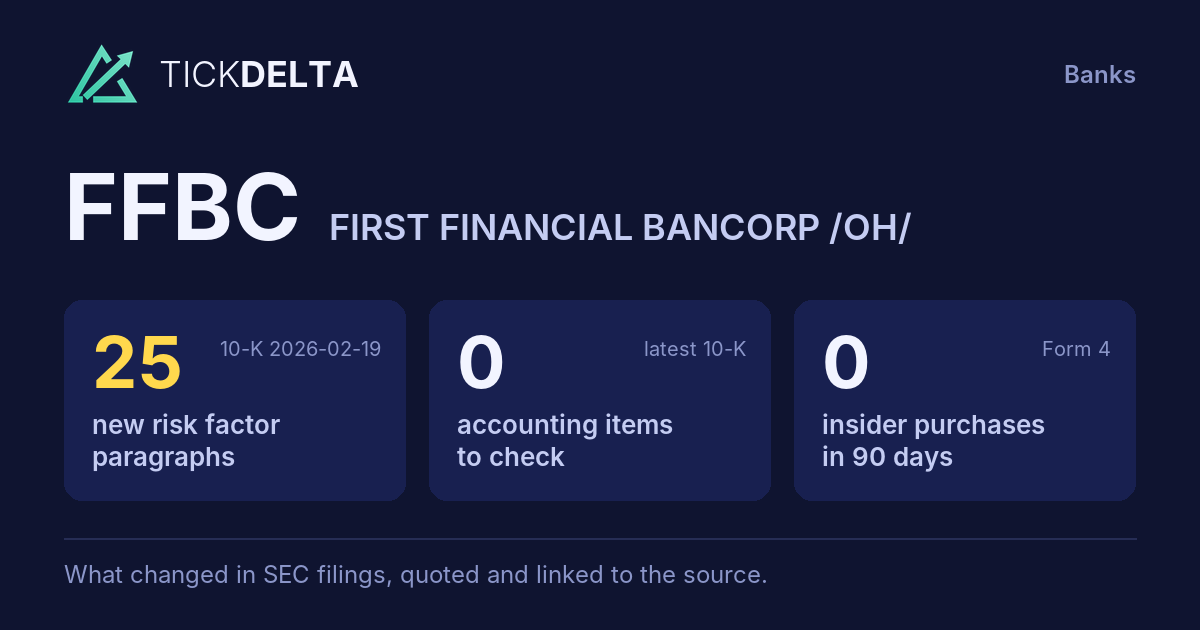
96 changes: 25 added, 46 removed, 23 reworded, 2 quiet changes

10-K Feb 19, 2026 vs Feb 20, 2025

10-K 0000708955-26-000028 (Feb 19, 2026) vs 10-K 0000708955-25-000012 (Feb 20, 2025) Not compared: MD&A, Accounting Policies.

Every paragraph, and how much of it changed

One bar per paragraph, in the order of the 10-K. Height and colour show the share of its words not in the closest paragraph a year earlier; the tallest bars are new paragraphs.

Risk Factors

131 paragraphs · 25 new · 70 reworded · 46 gone · 10-K Feb 19, 2026 against Feb 20, 2025
New paragraph Reworded (5% of its words or more) Same or nearly
Paragraph 94 · 44% changed Every version of it
•the time and expense associated with identifying and evaluating potential expansions; expansions, including the ability to conduct due diligence and the access to information discovered during the due diligence process;
Paragraph 4 · 42% changed Every version of it
If the strength of the United States economy declines, this could result in, among other things, a deterioration of credit quality, altered consumer spending habits habits, decreased deposit balances maintained by our customers, or a reduced demand for credit, including a resultant effect on our loan portfolio and allowance for credit losses. While Although the Federal Reserve began cutting eased monetary policy in 2025 with a series of rate cuts that brought the target fed federal funds range down to 3.50% – 3.75% by year-end, policymakers paused rate reductions in 2024, there are no assurances that it will continue to cut early 2026 and signaled patience in setting future policy as inflation remains elevated and labor market signals evolve. Despite these reductions, the target fed funds rate future path of interest rates remains uncertain. Market and policy forecasts have not settled on expectations in 2025 and it may remain open to increasing rates further should inflation dynamics remain unfavorable. This the coming year. A scenario of higher in which short-term interest rates remain elevated for a longer period than currently anticipated by market participants (“higher for longer”), along with anticipated, or rise again in response to inflation or other factors, macroeconomic developments, could also result in increase stress on borrowers, potentially leading to higher delinquencies and greater charge-offs in future periods, which could materially affect and adversely affecting our financial condition and results of operations. In addition, earnings sensitivity may be driven not only by rate levels but also by rate volatility and speed of rate changes, which may reduce hedge effectiveness and pressure margins.
Paragraph 118 · 42% changed Every version of it
We operate in a highly regulated industry and compliance with regulations and/or regulatory actions could impact the results of our operations. We, as well as our subsidiaries, are subject to the supervision and regulation of various state and federal regulators, including the Federal Reserve Board, the FDIC, the SEC, the CFPB, the Financial Industry Regulatory Authority, and ODFI. As such, we are subject to a wide variety of state and federal laws and regulations that require compliance of a complex and evolving regulatory framework. This includes, among others, capital adequacy requirements, Anti-Money Laundering and Bank Secrecy Act compliance, consumer protection laws and data privacy laws. As part of their supervisory process, which includes periodic examinations and continuous monitoring, the regulators have the authority to impose restrictions or conditions on our activities and the manner in which we operate our business. These actions could impact the Company and the Bank in a variety of ways, including subjecting us to fines, restricting our ability to pay dividends, precluding mergers or acquisitions, limiting our ability to offer certain products or services, requiring us to undertake significant remedial measures, removing key employees from their positions, imposing additional capital, operating, or oversight requirements or ultimately, in the event that any regulatory violations or actions cannot be corrected and are substantial in nature to cause an imminent risk of loss to depositors, we could be placed into receivership or conservatorship. Additionally, investigations and/or actions by regulatory agencies against us could cause us to devote significant time and resources to defending our business and/or modifying our practices and operations and may lead to penalties or fines that materially affect us and our shareholders. These regulatory inquiries, investigations, examinations and actions ultimately could have an adverse effect on our reputation, lead to increased costs and impact our financial condition and the results of our operations.
Paragraph 3 · 40% changed Every version of it
The new Presidential administration has stated its intention U.S. trade policies and international economic relationships continue to scrutinize evolve, including potential changes to trade agreements and tariffs. Such changes may contribute to economic uncertainty and could negatively affect financial markets, supply chains, and the United States’ trade relationships with its economic partners, indicated an interest in renegotiating trade agreements, and stated a willingness to implement tariffs with some performance of the United States’ trade partners which could lead to trade wars. These statements by the administration have signaled a change in the United States’ economic policies, Company’s customers and it is not clear which policies, if any, will be implemented and what effect these policies may have on the local, national, and global economy. markets. Trade wars and tariffs can affect the economy and stock prices in the United States and can impact the costs of goods paid by customers, which can affect our deposit levels and concentration, the demand for loans and other products and services and the ability of our customers to repay outstanding loans, which could adversely affect our financial condition and the results of operations.
Paragraph 29 · 38% changed Every version of it
Our allowance for credit losses may prove to be insufficient to absorb losses in our loan portfolio or may produce volatility in provision expense and earnings. We maintain an allowance for credit losses that we believe is a reasonable estimate of the expected losses over the expected life of the loan portfolio based on a CECL model. We believe that our allowance for credit losses is maintained at a level adequate to absorb expected losses over the life of the loans in the loan portfolio model as of the corresponding balance sheet date. However, our allowance for credit losses may not be sufficient to cover actual credit losses, and future provision for credit losses could materially affect our operating results. The accounting measurements related to the allowance for credit losses require significant estimates which are subject to uncertainty and change related to new information and changing circumstances. Management estimates the allowance using relevant available information from both internal and external sources, relating to past events, current conditions and reasonable and supportable forecasts. Historical credit loss experience paired with economic forecasts provide the basis for the quantitatively modeled estimation of expected credit losses. We adjust our quantitative model, as necessary, to reflect conditions not already considered by such model. Our estimates of the risk of loss and amount of loss on any loan are complicated by the significant uncertainties surrounding our borrowers’ abilities to successfully execute their business models through changing economic environments, competitive challenges and other factors. Because of the degree of uncertainty and susceptibility of these factors to change, our actual losses may vary from our current estimates.
Paragraph 79 · 38% changed Every version of it
greater flexibility and lower cost structures. Securities firms and insurance companies that elect In addition to become non-bank competitors, we face competition from within the traditional financial holding companies may acquire banks and other financial institutions. These developments may significantly change the competitive environment in which we conduct business. Some of our competitors have greater financial resources and/or face fewer regulatory constraints, such as FinTechs, digital assets or cryptocurrencies. FinTechs and other new technologies seek to complete financial transactions without banks or by utilizing banks that are not dependent on having physical branches in a customer’s market area. Consumers can also shop for higher deposit interest rates at banks across the country, which may offer higher rates because they have few or no physical branches and open deposit accounts electronically. services industry. Credit unions that compete with us have tas, tax, regulatory and other advantages that allow them to price products and services more competitively. Competing banks may have greater financial resources and/or face fewer regulatory constraints. Competing banks may also be more successful in implementing new technologies or developing or launching new products or services. As a result of these various sources of competition, we could lose loan, deposit, or other types of business to competitors or be forced to price products and services on less advantageous terms to retain or attract clients, either of which could affect our profitability.
Paragraph 23 · 38% changed Every version of it
Loan defaults and foreclosures are unavoidable in the banking industry, and we try to limit our exposure to this risk by monitoring carefully our extensions of credit. In 2024, our classified Classified asset balances increased $83.1 $11.4 million, driven by a $45.0 or 5.1%, to $235.5 million asset that was recorded following at December 31, 2025 from $224.1 million at December 31, 2024. The change in classified assets during 2025 included $20.4 million of loans rated substandard or worse acquired in the mutually agreed upon termination Westfield transaction. Absent the impact from Westfield, classified assets declined $9.0 million during 2025 as resolutions of a foreign exchange trade, as well as classified assets outpaced downward credit migration during the downgrade of three commercial real estate loans, one commercial and industrial loan and one construction loan. Continued period. Any increases in our classified asset balances and/or an increase in loan defaults may also increase our costs associated with servicing these loans, foreclosing on properties and costs of property maintenance on foreclosed properties. We cannot fully eliminate credit risk, and as a result, credit losses may increase in the future and impact our financial condition and results of operations.
Paragraph 77 · 36% changed Every version of it
greater flexibility and lower cost structures. Securities firms and insurance companies that elect to become financial holding companies may acquire banks and other financial institutions. These developments may significantly change the competitive environment in which we conduct business. Some of our competitors have greater financial resources and/or face fewer regulatory constraints, such as FinTechs, digital assets or cryptocurrencies. FinTechs and other new technologies seek to complete financial transactions without banks or by utilizing banks that are not dependent on having physical branches in a customer’s market area. Consumers can area, or embed financial services into non-bank platforms which could reduce customer reliance on traditional banking services. FinTechs have also begun seeking commercial bank or industrial loan company charters, or are actively seeking to acquire commercial banks or industrial loan companies to further compete with traditional banking services. The rise in technological advances in the financial services industry has led to simpler opportunities for consumers to shop for higher deposit interest rates at banks across the country, which may offer higher rates because they have few or no physical branches and open deposit accounts electronically. Credit unions that compete with us have tas, regulatory and other advantages that allow them to price products and services more competitively. As a result of these various sources of competition, we could lose loan, deposit, or other types of business to competitors or be forced to price products and services on less advantageous terms to retain or attract clients, either of which could affect our profitability.

MD&A

2 paragraphs · 0 new · 0 reworded · 0 gone · 10-K Feb 19, 2026 against Feb 20, 2025
New paragraph Reworded (5% of its words or more) Same or nearly

A paragraph is matched with the one last year that shares the most of its words; under half in common makes it new. The paragraphs shown are the 8 reworded the most in each section.

The paragraph that changed most in each section

The redline

Marked against last year's 10-K: cut words struck through, new words highlighted.

Risk Factors218 words changed in this paragraph; it is 45% similar to last year's version.
We operate in a highly regulated industry and compliance with regulations and/or regulatory actions could impact the results of our operations. We, as well as our subsidiaries, are subject to the supervision and regulation of various state and federal regulators, including the Federal Reserve Board, the FDIC, the SEC, the CFPB, the Financial Industry Regulatory Authority, and ODFI. As such, we are subject to a wide variety of state and federal laws and regulations that require compliance of a complex and evolving regulatory framework. This includes, among others, capital adequacy requirements, Anti-Money Laundering and Bank Secrecy Act compliance, consumer protection laws and data privacy laws. As part of their supervisory process, which includes periodic examinations and continuous monitoring, the regulators have the authority to impose restrictions or conditions on our activities and the manner in which we operate our business. These actions could impact the Company and the Bank in a variety of ways, including subjecting us to fines, restricting our ability to pay dividends, precluding mergers or acquisitions, limiting our ability to offer certain products or services, requiring us to undertake significant remedial measures, removing key employees from their positions, imposing additional capital, operating, or oversight requirements or ultimately, in the event that any regulatory violations or actions cannot be corrected and are substantial in nature to cause an imminent risk of loss to depositors, we could be placed into receivership or conservatorship. Additionally, investigations and/or actions by regulatory agencies against us could cause us to devote significant time and resources to defending our business and/or modifying our practices and operations and may lead to penalties or fines that materially affect us and our shareholders. These regulatory inquiries, investigations, examinations and actions ultimately could have an adverse effect on our reputation, lead to increased costs and impact our financial condition and the results of our operations.

Source: Item 1A, 10-K 0000708955-26-000028 vs Item 1A, 10-K 0000708955-25-000012

Legal Proceedings61 words changed in this paragraph; it is 76% similar to last year's version.
We are from time to time engaged in various litigation matters including the defense of claims of improper or fraudulent loan practices or lending violations, and other matters, and we have a number of unresolved claims pending. In addition, as part of the ordinary course of business, we are parties to litigation involving claims to the ownership of funds in particular accounts, the collection of delinquent accounts, challenges to security interests in collateral, and foreclosure interests, that are incidental to our regular business activities. While the ultimate liability with respect to these other litigation matters and claims cannot be determined at this time, we believe that damages, if any, and other amounts relating to pending matters, such as costs, are not likely to be material to our consolidated financial position or results of operations. Reserves are established for these various matters of litigation, when appropriate under FASB ASC Topic 450, Contingencies, based in part upon the advice of legal counsel.

Source: Item 3, 10-K 0000708955-26-000028 vs Item 3, 10-K 0000708955-25-000012

Sentences and paragraphs added, removed or reworded

Every change, by type

Sentences and paragraphs of FFBC's Risk Factors and MD&A, 10-K Feb 19, 2026 against 10-K Feb 20, 2025. Each links to the text at sec.gov.

Quiet changes are sentences kept from last year with one to four words changed, at least one of them a hedge, a modal or a qualifier (may, could, will, not, significant, material…). A year or date rolling forward is not counted.

The full word list

adverse, adversely, all, although, anticipate, anticipates, any, approximately, believe, believes, can, cannot, certain, could, expect, expects, generally, however, if, intend, intends, largely, likely, many, material, materially, may, might, most, must, never, no, not, possible, primarily, probable, should, significant, significantly, some, substantial, substantially, unlikely, will, would

AddedRisk Factors
Changes in leadership of the Federal Reserve Board of Governors may adversely affect us. The Federal Reserve is the primary regulator of bank holding companies and financial holding companies, and is also responsible for regulating the money supply and credit conditions in the United States. The monetary policies and regulations of the Federal Reserve have had a significant effect on the operating results of commercial banks and are expected to continue to do so in the future.
Read it in 10-K Feb 19, 2026 at sec.gov
AddedRisk Factors
The Federal Reserve is expected to go through a change of leadership in 2026. The term of the Chair of the Federal Reserve Board of Governors, Jerome Powell, expires on May 15, 2026. On January 30, 2026, Kevin Warsh was nominated as the
Read it in 10-K Feb 19, 2026 at sec.gov
AddedRisk Factors
A change in leadership may result in policy changes of the Federal Reserve related to the regulation of bank holding companies and financial holding companies, the money supply, and/or credit conditions in the United States. The effects of such policies upon our financial condition, results of operations, business and prospects cannot be predicted or determined.
Read it in 10-K Feb 19, 2026 at sec.gov
AddedRisk Factors
Loan defaults and foreclosures are unavoidable in the banking industry, and we try to limit our exposure to this risk by carefully adhering to our credit risk standards and actively and carefully monitoring our extensions of credit throughout the lifespan of a loan.
Read it in 10-K Feb 19, 2026 at sec.gov
AddedRisk Factors
•Currency Risk: Recent depreciation and volatility in the U.S. dollar have increased uncertainty in foreign exchange markets, which may affect transaction volumes, hedging activity, client demand, and the value of positions managed within Bannockburn’s matched book operations. Continued currency volatility or abrupt shifts in exchange rates could result in reduced revenues, valuation impacts, or increased liquidity and collateral requirements, adversely affecting our financial condition and results of operations.
Read it in 10-K Feb 19, 2026 at sec.gov
AddedRisk Factors
The fraudulent activity and cybersecurity risks can result in financial liability and litigation risk to us and/or our customers, as well as harm to our reputation and negative impacts on our financial condition, results of our operations, business and prospects.
Read it in 10-K Feb 19, 2026 at sec.gov
AddedRisk Factors
The increased use and capacity of AI, Generative AI, large language models (LLMs), and AI agents by customers, vendors and competitors increases risks to our business. The use and capacity of AI, Generative AI, LLMs and AI agents has increased in the past year and is being employed by customers, competitors, and vendors at increased rates. Many of these tools can increase cybersecurity risks, require specific technical expertise to operate, or expose information through open source code. These tools are being used by parties in various capacities, and employing these tools without sufficient knowledge or expertise of the power and risks associated with the tools can increase risks for the users. These tools are relatively new and there is potential of continued and/or increased adoption of legal and regulatory frameworks governing the use of these tools, by law, our primary banking regulators, other federal or state regulatory bodies, or other self-regulatory organizations.
Read it in 10-K Feb 19, 2026 at sec.gov
Show the other 30
AddedRisk Factors
The use of these tools by customers can increase the risk of exposure to their personal information and/or banking credentials which can result in increased opportunities for bad actors to initiate fraudulent activity with respect to a customer’s account(s). While we have implemented commercially reasonable policies and procedures to protect against fraudulent activity on the accounts of our customers, we cannot assure that such policies and procedures will prevent all fraudulent activity or capture activity that has been inadvertently been authorized by the customer. Such activity can result in financial liability and litigation risk to us and/or our customers, as well as harm to our reputation and negative impacts on our financial condition, results of our operations, business and prospects.
Read it in 10-K Feb 19, 2026 at sec.gov
AddedRisk Factors
The use of these tools by vendors engaged by us can increase the risk of unauthorized use or disclosure of sensitive or confidential client or customer information and cyberattacks. In conducting due diligence of our vendors, we request detailed information regarding how the vendor uses these tools and attempt to mitigate risks related to exposure by agreement with vendors. While these processes seek to mitigate risks associated with vendor use of these tools, we cannot eliminate this risk. Vendors may employ tools without realizing the risks associated with the tools, may have employees that use unauthorized technology tools that were not disclosed to us during our diligence process, or the tools that were disclosed may implement new services, features, or technologies that increase the exposure to cybersecurity risks. If a vendor engaged by us experienced a cyberattack related to use of these tools, or deliberately or inadvertently exposed sensitive or confidential client or customer information, we may experience financial liability and litigation risk to us and/or our customers, as well as harm to our reputation and negative impact on our financial condition, results of operations and business. Additionally, if any vendors incur additional costs related to any legal or regulatory framework adopted governing the use of such tools, we may face increased costs to engage such vendor, which could impact or financial condition and results of operations if we continue to use such vendor or as a result of costs incurred to find an alternative vendor.
Read it in 10-K Feb 19, 2026 at sec.gov
AddedRisk Factors
The use of these tools by competitors may impair our ability to attract or retain business if our competitors are successful in their implementation. Failure to keep pace with these evolving technologies can have a negative impact on our financial condition, results of operations, business and prospects. In addition, if our competitors suffer any reputational harm as a result of the implementation of these evolving technologies, it could have a negative effect on the financial services industry as a whole and have a negative impact on our financial condition, results of operations, business and prospects. The increased use of these tools by competitors may also increase pressure to impose legal or regulatory frameworks regarding these tools, which could impact the financial services industry as a whole and cause us to incur increased costs to comply with such legal or regulatory frameworks, which may result in a negative impact on our financial condition, results of operations and business.
Read it in 10-K Feb 19, 2026 at sec.gov
AddedRisk Factors
Further, in 2025, the United States passed the Guiding and Establishing National Innovation for U.S. Stablecoins Act (the “GENIUS Act”), which provides a regulatory framework for the issuance and adoption of stablecoins in the United States. The passage of the GENIUS Act may result in increased competition from issuers of stablecoins and providers of related technology, as well as non-bank competitors and financial institutions that offer to hold stablecoin reserve assets or custody stablecoins.
Read it in 10-K Feb 19, 2026 at sec.gov
RemovedRisk Factors
Changes in market interest rates or financial markets could affect our revenues and expenses, the value of assets and obligations, and the availability and cost of capital or liquidity.
Read it in 10-K Feb 20, 2025 at sec.gov
RemovedRisk Factors
We anticipate that the Presidential administration will seek to implement a regulatory reform agenda that is significantly different than that of the Biden administration, impacting the rulemaking, supervision, examination and enforcement priorities of the federal banking agencies. While we do not specifically know what these changes will be, we may be required to implement different compliance procedures and modify our policies and activities to comply with changes set forth by the administration. This may cause us to incur additional costs and expenses, and dedicate additional resources, to achieve compliance with any changes from the Presidential administration, which can impact our financial condition and the results of our operations.
Read it in 10-K Feb 20, 2025 at sec.gov
RemovedRisk Factors
Declines in the local economic conditions in our market areas could impact: our deposit levels and composition; the demand for our products and services; the strength of our credit quality; the demand for loans; the ability of borrowers to repay their loans; the value of collateral securing loans; the number of foreclosures and workouts; the amount of our allowance for credit losses; and the number of loans that we charge off. This can lead to a detrimental impact on our financial condition and the results of our operations.
Read it in 10-K Feb 20, 2025 at sec.gov
RemovedRisk Factors
Our loan portfolio and investments in mortgage-backed securities consist of a significant number of loans secured by real estate and other assets, the value of which can be affected by national and local market conditions.
Read it in 10-K Feb 20, 2025 at sec.gov
RemovedRisk Factors
In 2024, we experienced losses in mortgage-backed securities primarily due to a $9.7 million impairment loss on two commercial mortgage backed securities where the underlying collateral consisted of skilled nursing facilities with credit deterioration, which we expect to sell in the near term. This is especially relevant in light of the ongoing inflationary pressures and potential impact of trade wars and tariffs to increase those inflationary pressures.
Read it in 10-K Feb 20, 2025 at sec.gov
RemovedRisk Factors
When we loan money, commit to loan money or enter into a letter of credit or other contract with a counterparty, we incur credit risk, or the risk of loss if our borrowers do not repay their loans or our counterparties fail to perform according to the terms of their contracts.
Read it in 10-K Feb 20, 2025 at sec.gov
RemovedRisk Factors
an impact on the results of operations. In addition, large loans, letters of credit and contracts with individual counterparties in our portfolio magnify the credit risk that we face, as the impact of large borrowers and counterparties not repaying their loans or performing according to the terms of their contracts has a disproportionately significant impact on our credit losses, reserves and the results of operations.
Read it in 10-K Feb 20, 2025 at sec.gov
RewordedRisk Factors
Additionally, implementation of certain new technologies, such as artificial intelligence, machine learning and other large language models AI, Generative AI, LLMs, AI agents and similar technologies, can expose us to new or increased operational risks, including risks related to our system of data leakage, model bias, decision errors, regulatory non-compliance, or ineffective governance or internal controls.
Read it in 10-K Feb 19, 2026 at sec.gov
RewordedRisk Factors
Management’s Discussion and Analysis of Financial Condition and Results of Operations” for certain additional discussion of forward looking statements.) statements that could result in a material effect on our financial condition, results of operations, business and prospects.)
Read it in 10-K Feb 19, 2026 at sec.gov
RewordedRisk Factors
A sudden Sudden increases in collateral or unexpected increase in margin requirements during periods of market volatility may create additional liquidity needs needs, which could strain our resources and negatively impact our financial position.
Read it in 10-K Feb 19, 2026 at sec.gov
RewordedRisk Factors
As of December 31, 2024, 2025, we had indebtedness of $1.1 $1.2 billion which was a decrease an increase from $1.3 $1.1 billion in 2023 in large part due to an increase in deposits. 2024.
Read it in 10-K Feb 19, 2026 at sec.gov
RewordedRisk Factors
If we do not accurately forecast demand for our banking and financial products, products or if technology conversion challenges and/or customer attrition risks delay realization of expected benefits from acquisitions or branch purchases, it could result in us incurring significant expenses without the anticipated increases in revenue, which could result in a material effect on the Bank’s business, capital, and/or results of our operations.
Read it in 10-K Feb 19, 2026 at sec.gov
RewordedRisk Factors
Consumers can also The rise in technological advances in the financial services industry has led to simpler opportunities for consumers to shop for higher deposit interest rates at banks across the country, which may offer higher rates because they have few or no physical branches and open deposit accounts electronically.
Read it in 10-K Feb 19, 2026 at sec.gov
RewordedRisk Factors
FinTechs and other new technologies seek to complete financial transactions without banks or by utilizing banks that are not dependent on having physical branches in a customer’s market area. area, or embed financial services into non-bank platforms which could reduce customer reliance on traditional banking services.
Read it in 10-K Feb 19, 2026 at sec.gov
RewordedRisk Factors
Some of our competitors Competing banks may have greater financial resources and/or face fewer regulatory constraints, such as FinTechs, digital assets or cryptocurrencies. constraints.
Read it in 10-K Feb 19, 2026 at sec.gov
RewordedRisk Factors
If such events or circumstances were to occur, it could result in a potential loss of revenue, revenue and increase in recovery costs and which could have an effect on our business, financial condition, results of operations and financial condition. business.
Read it in 10-K Feb 19, 2026 at sec.gov
RewordedRisk Factors
Changes to the economic conditions in these local markets, which may be different from the national economic conditions, may adversely affect our financial condition and the condition, results of our operations. operations, and business prospects.
Read it in 10-K Feb 19, 2026 at sec.gov
RewordedRisk Factors
If the strength of the United States economy declines, this could result in, among other things, a deterioration of credit quality, altered consumer spending habits habits, decreased deposit balances maintained by our customers, or a reduced demand for credit, including a resultant effect on our loan portfolio and allowance for credit losses.
Read it in 10-K Feb 19, 2026 at sec.gov
RewordedRisk Factors
We maintain an allowance for credit losses that we believe is a reasonable estimate of the expected losses over the expected life of the loan portfolio based on a CECL model. model as of the corresponding balance sheet date.
Read it in 10-K Feb 19, 2026 at sec.gov
Quiet changesRisk Factors
Continued Any increases in our classified asset balances and/or an increase in loan defaults may also increase our costs associated with servicing these loans, foreclosing on properties and costs of property maintenance on foreclosed properties.
Read it in 10-K Feb 19, 2026 at sec.gov
Quiet changesRisk Factors
A decline in home values or overall economic weakness could also have an impact upon the value of real estate or other assets which we own upon foreclosing a loan and our ability to realize value on any subsequent sale of such assets.
Read it in 10-K Feb 19, 2026 at sec.gov

Sources

The two latest 10-Ks on EDGAR, section by section. Each change links to the text at sec.gov.

Also

New risk factors: paragraphs with nothing like them last year, quoted in full.

Work with it

Excel workbook · CSV. Google Sheet that stays up to date: paste =IMPORTDATA("https://tickdelta.com/company/FFBC/export.csv") into a cell.

Next:Related parties
Esc

Type a ticker such as AAPL, a name, an investor such as Buffett, or a topic such as tariffs. ↑ ↓ to move, Enter to open.