Screener / SEC EDGAR /CIK 0000036377 /10-K filed Feb 27, 2026, compared with Feb 28, 2025 /Numbers from the XBRL of the 10-Ks
Nasdaq Financials · Banks

First Hawaiian, Inc. FHB

Compare with peers Embed
New in the 10-K 8 paragraphs with nothing like them in the 10-K filed Feb 28, 2025 New in the 10-Q 22 paragraphs not in the 10-Q filed Aug 3, 2026 10-Q against the 10-K 1 risk factor paragraphs and sentences added or reworded

New risk paragraphs, branching off last year

Each branch is a paragraph in Risk Factors with nothing like it in the 10-K filed Feb 28, 2025. A box jumps to the paragraph as filed, below.

8 new

Paragraphs with nothing like them in last year's 10-K

Quoted exactly

8 paragraphs in Risk Factors of the 10-K filed Feb 27, 2026 with nothing like them in the 10-K filed Feb 28, 2025. Quoted exactly. Paragraphs that were only edited are under 10-K change.

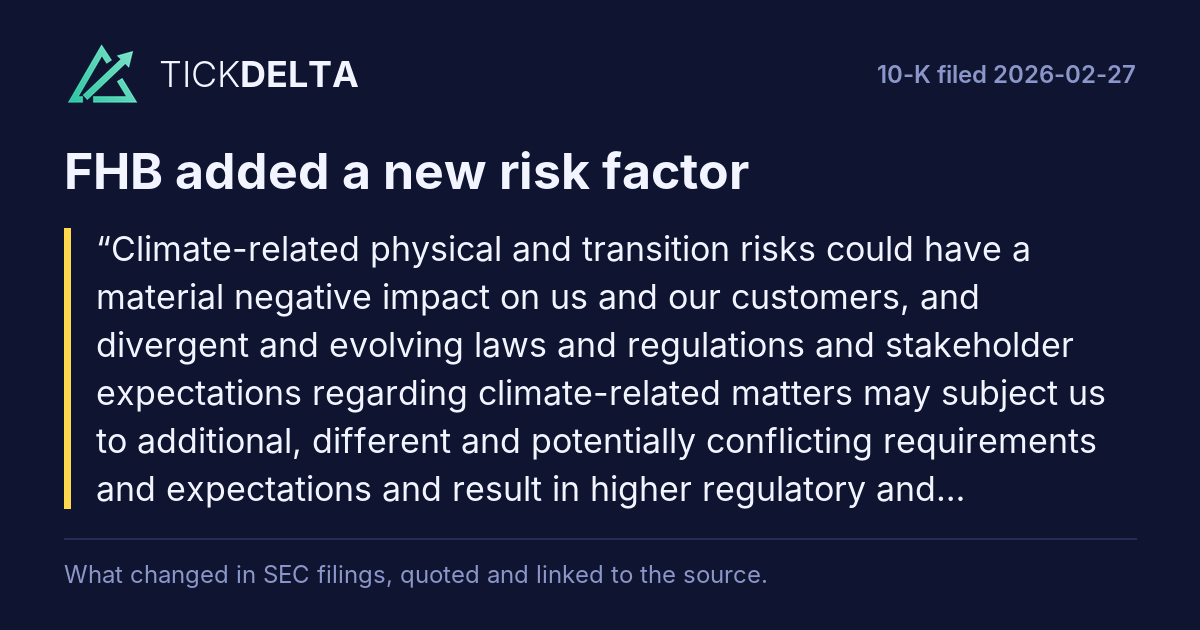
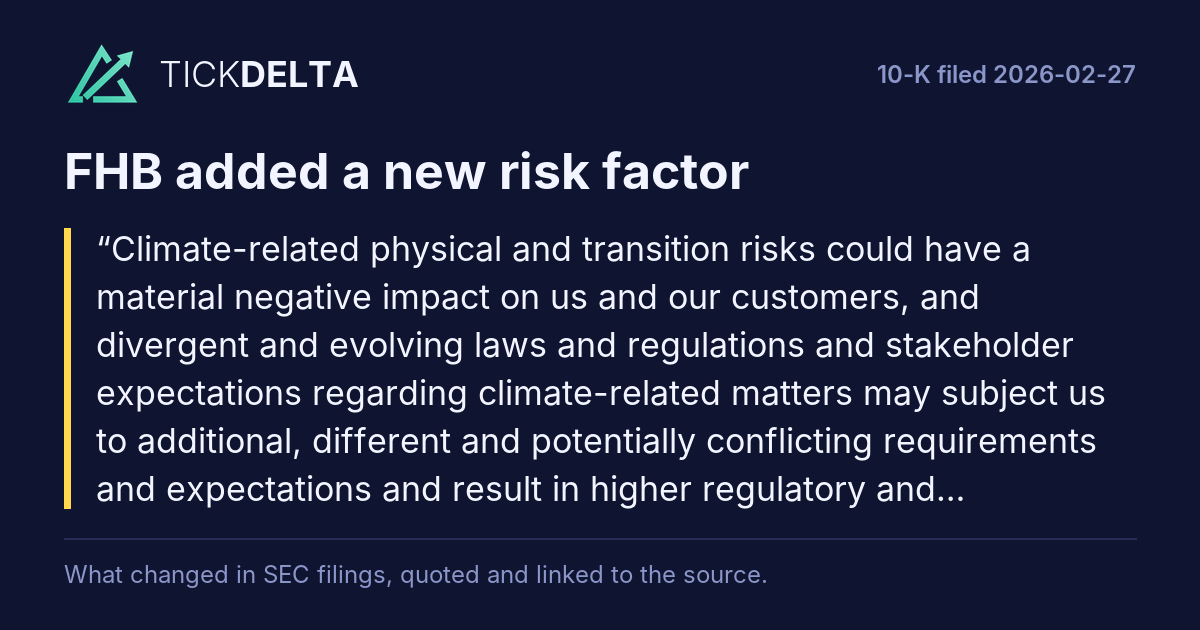
Climate-related physical and transition risks could have a material negative impact on us and our customers, and divergent and evolving laws and regulations and stakeholder expectations regarding climate-related matters may subject us to additional, different and potentially conflicting requirements and expectations and result in higher regulatory and compliance and other risks and costs.

Read in the 10-K

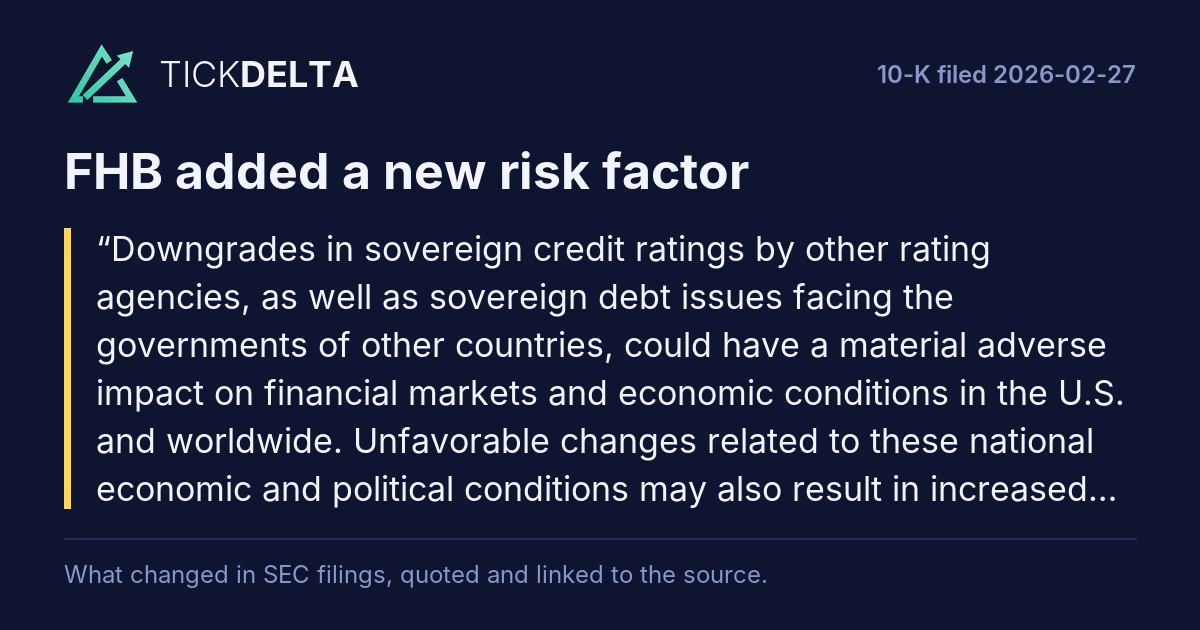
Downgrades in sovereign credit ratings by other rating agencies, as well as sovereign debt issues facing the governments of other countries, could have a material adverse impact on financial markets and economic conditions in the U.S. and worldwide. Unfavorable changes related to these national economic and political conditions may also result in increased delinquencies and defaults among borrowers in light of economic uncertainty, which could require us to charge off a higher percentage of loans and increase the provision for credit losses, ultimately reducing our net income.

Read in the 10-K

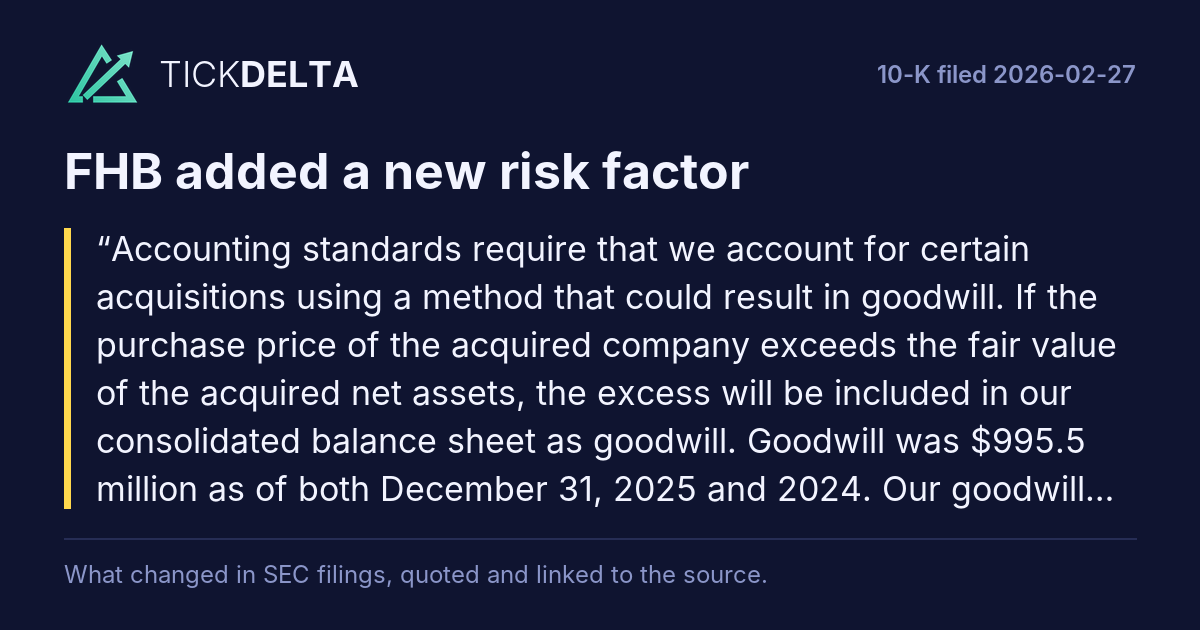
Accounting standards require that we account for certain acquisitions using a method that could result in goodwill. If the purchase price of the acquired company exceeds the fair value of the acquired net assets, the excess will be included in our consolidated balance sheet as goodwill. Goodwill was $995.5 million as of both December 31, 2025 and 2024. Our goodwill originated from the acquisition of the Company by BNPP in December of 2001. Goodwill generated in that acquisition was recorded on the balance sheet of the Bank as a result of push down accounting treatment, and remains on our consolidated balance sheets.

The Company’s policy is to assess goodwill for impairment at the reporting unit level on an annual basis or between annual assessments if a triggering event occurs or circumstances change that would more likely than not reduce the fair value of a reporting unit below its carrying amount. Evaluations may be based on many factors, some of which are the price of our common stock, discounted cash flow projections and data from comparable market acquisitions. A significant and sustained decline in our stock price and market capitalization, a significant decline in our expected future cash flows, a significant adverse change in the business climate or slower growth rates could result in impairment of our goodwill. Future evaluations of goodwill may result in the impairment and write-down of our goodwill balance which could have a material adverse impact on our earnings and adversely affect our operating results.

Read in the 10-K

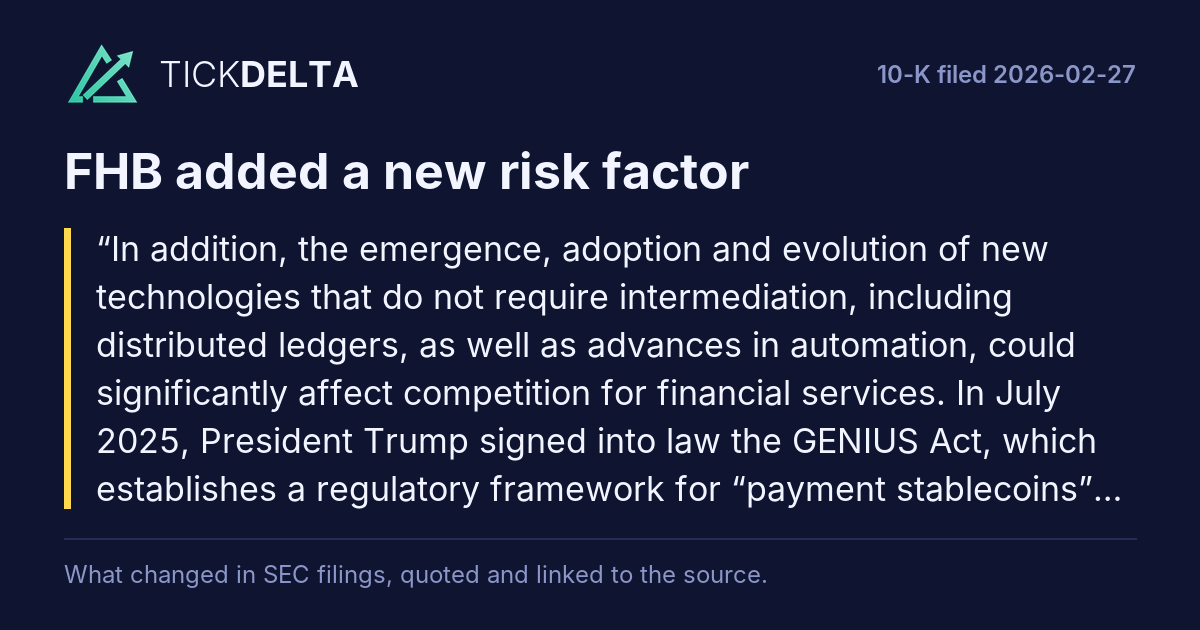
In addition, the emergence, adoption and evolution of new technologies that do not require intermediation, including distributed ledgers, as well as advances in automation, could significantly affect competition for financial services. In July 2025, President Trump signed into law the GENIUS Act, which establishes a regulatory framework for “payment stablecoins” and their issuers. Consumers and businesses may view payment stablecoins as a substitute for traditional bank deposits, resulting in deposit withdrawals. Depending on consumer and business interest in payment stablecoins, and the characteristics and utility of payment stablecoins, the passage of the GENIUS Act requires the U.S. Treasury Department and federal and state regulators to issue regulations on numerous topics to interpret and implement the statute, so the effect of the GENIUS Act will depend on what those regulations provide.

Our profitability depends upon our continued ability to compete successfully in our market area.

Read in the 10-K

Climate-related physical and transition risks could have a material negative impact on us and our customers, and divergent and evolving laws and regulations and stakeholder expectations regarding climate-related matters may subject us to additional, different and potentially conflicting requirements and expectations and result in higher regulatory and compliance and other risks and costs.

Read in the 10-K
Show the other 1

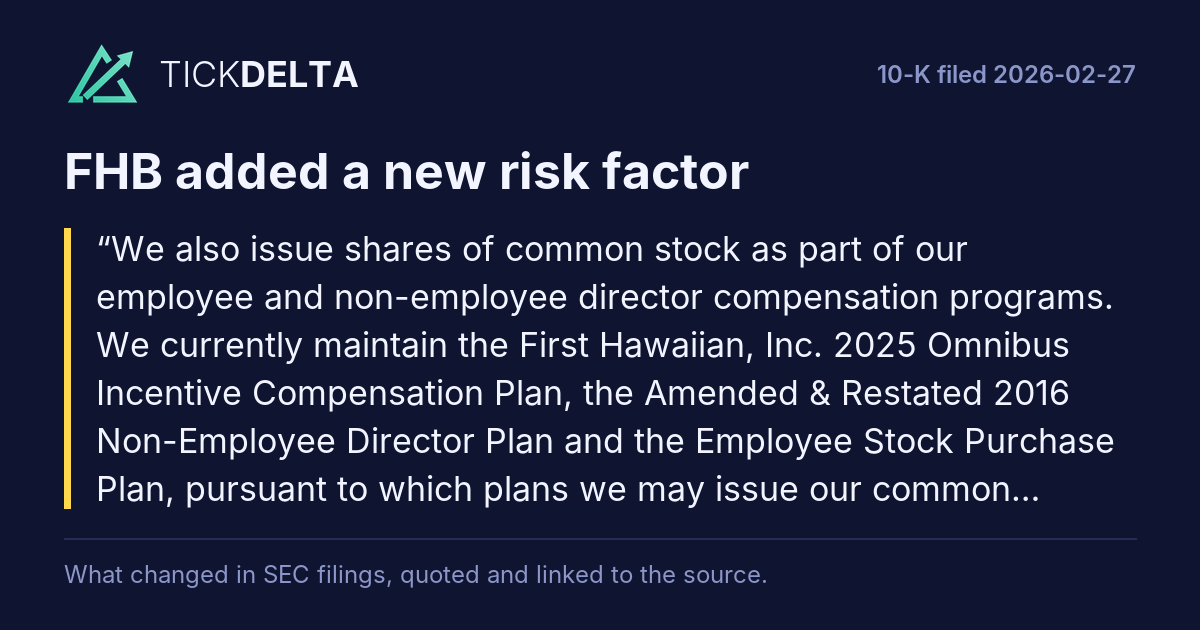
We also issue shares of common stock as part of our employee and non-employee director compensation programs. We currently maintain the First Hawaiian, Inc. 2025 Omnibus Incentive Compensation Plan, the Amended & Restated 2016 Non-Employee Director Plan and the Employee Stock Purchase Plan, pursuant to which plans we may issue our common stock. In addition, we maintain the First Hawaiian, Inc. 2016 Omnibus Incentive Compensation Plan (the “2016 Plan” and, together with the other plans listed in the preceding sentence, the “Equity Compensation Plans”). Though we may not make further equity awards under the 2016 Plan, we have unvested equity awards that remain outstanding under such plan. Collectively, we have 5,294,029 shares of common stock available for future grants that could be issued pursuant to the Equity Compensation Plans as of December 31, 2025, and we issued 286,912, 277,713, and 255,434 shares of common stock, net of shares withheld to satisfy tax obligations, under the Equity Compensation Plans during the years ended December 31, 2025, 2024 and 2023, respectively. We may increase the number of shares available for issuance pursuant to equity compensation plans from time to time, subject to stockholder approval.

Read in the 10-K

Paragraphs in the 10-Q filed Nov 2, 2026 that were not in the one before

New in the latest 10-Q

22 paragraphs in the 10-Q filed Nov 2, 2026 with nothing like them in the 10-Q filed Aug 3, 2026 (at least half the words must differ; new numbers alone do not count). Quoted exactly, grouped by the item heading above them. This is text that changed, not a judgement of how serious it is.

Financial statements and notes

Amortization of unrealized holding losses on held-to-maturity securities 9,513 (2,538) 6,975

Read in the 10-Q

Amortization of unrealized holding losses on held-to-maturity securities 33,131 (8,838) 24,293

Read in the 10-Q

Amortization of unrealized holding losses on held-to-maturity securities 11,464 (3,057) 8,407

Read in the 10-Q

The table below sets forth those ratios at September 30, 2026 and December 31, 2025:

Read in the 10-Q

In addition, the Company also updated the following reconciliation of the amount of unrecognized tax benefits for the nine months ended September 30, 2026:

Read in the 10-Q
Show the other 17

Included in the balance of unrecognized tax benefits for the nine months ended September 30, 2026 and the year ended December 31, 2025 was $26.0 million and $55.7 million, respectively, of unrecognized tax benefits that, if recognized, would impact the effective tax rate.

Read in the 10-Q

Further, the Company also utilized an interest rate swap to manage interest rate risk and protect against downside risk in yields associated with interest payments received on a pool of floating-rate assets. The floating-rate index of the swap (SOFR) corresponds to the floating-rate nature of the interest receipts being hedged (based on SOFR). An interest rate swap involves exchanging or swapping interest rate cash flows, usually between floating and fixed interest rate payments. By hedging with an interest rate swap, the Company mitigates the adverse impact on interest income associated with possible future decreases in interest rates.

Read in the 10-Q

The interest rate collars, floors, and swap are designated and qualify as cash flow hedges. To the extent that the hedge is considered highly effective, the gain or loss on the interest rate collars, floors, and swap is reported as a component of other comprehensive income (“OCI”) and reclassified out of accumulated other comprehensive income (“AOCI”) into earnings in the same period that the hedged transaction affects earnings.

Read in the 10-Q

The assessment of hedge effectiveness excludes the initial time value of the interest rate floors at inception and on an ongoing basis. This initial time value is recognized as an adjustment to OCI, with an offset to interest income, over the life of the floors through an amortization approach.

Read in the 10-Q

Pretax net (losses) gains recognized in OCI - included component $ (7,733) $ (156) $ (7,808) $ 193

Read in the 10-Q

Pretax net losses recognized in OCI - excluded component (1,284) (593) (3,634) (620)

Read in the 10-Q

Total pretax net losses recognized in OCI on cash flow derivative hedges $ (9,017) $ (749) $ (11,442) $ (427)

Read in the 10-Q

Pretax net gains reclassified from AOCI into income - included component(1) $ (196) $ - $ (196) $ -

Read in the 10-Q

Pretax net losses reclassified from AOCI into income - excluded component(1) 560 126 1,393 200

Read in the 10-Q

Total pretax net losses reclassified from AOCI into income(1) $ 364 $ 126 $ 1,197 $ 200

Read in the 10-Q

(1) Losses (gains) are reclassified from AOCI into interest income from loans and lease financing.

Read in the 10-Q

The estimated net amount to be reclassified within the next 12 months out of AOCI into earnings is $4.2 million as a decrease to interest income from loans and lease financing. As of September 30, 2026, the maximum length of time over which forecasted transactions are hedged is approximately three years.

Read in the 10-Q

For the derivatives that are not designated as hedges, changes in fair value are reported in current period earnings. The following table summarizes the impact on pretax earnings of derivatives not designated as hedges, as reported on the unaudited interim consolidated statements of income for the three and nine months ended September 30, 2026 and 2025:

Read in the 10-Q

Corporate/Other includes activity within the support units of the Company and not associated with a segment. One such area is Treasury, which includes activities surrounding the management of interest-bearing deposits, investment securities, federal funds sold and purchased, government deposits, short- and long-term borrowings and bank-owned properties (and these assets’ and liabilities’ related interest income and expense). The primary sources of noninterest income are from bank-owned life insurance, net gains from the sale of investment securities, foreign exchange income related to customer driven cross-border wires for business and personal reasons and management of bank-owned properties. The net residual effect of the transfer pricing of assets and liabilities is included in Corporate/Other, along with the elimination of intercompany transactions.

Read in the 10-Q

Other organizational units within Corporate/Other (such as Technology, Operations, Credit and Risk Management, Human Resources, Finance, Administration, Marketing and Corporate and Regulatory Administration) provide a wide range of support to the Company’s reportable segments. Expenses incurred by these support units are charged to the business segments through an internal cost allocation process.

Read in the 10-Q

On October 29, 2026, First Hawaiian, Inc. and TriCo jointly announced that all required approvals have been received from their respective stockholders and shareholders related to First Hawaiian’s acquisition of TriCo. The final voting results from each special meeting are reported in separate Current Reports on Form 8-K filed by First Hawaiian and TriCo with the U.S. Securities and Exchange Commission.

Read in the 10-Q

As of September 30, 2026, commercial real estate non-accrual loans were $13.8 million, an increase of $10.8 million from December 31, 2025. This increase was primarily attributable to the addition of a $23.5 million commercial real estate loan during the third quarter of 2026, which was partially charged off by $12.5 million during the same period. The loan is secured by an office building located in downtown Seattle and was originated prior to the COVID-19 pandemic. The charge-off reflected the decline in values across the Seattle office real estate market. The majority of the property's leasable square footage is occupied by a federal government agency. The write-down was based on an assessment of the current market value of the underlying collateral.

Read in the 10-Q

The 10-Q's risk factors against the 10-K

Item 1A of the 10-Q filed Nov 2, 2026 against Item 1A of the 10-K filed Feb 27, 2026. A 10-Q repeats only the risks that changed, so a 10-K paragraph that is missing from it is not counted as removed. Added is a paragraph with nothing like it in the 10-K, Reworded a sentence that is in both with several words changed, Quiet changes a sentence in both where one to four words changed and one is a hedge or a modal (cut words struck through, new words highlighted). Text on the page, not a score; each links to the filing at sec.gov.

Added10-Q Nov 2, 2026 vs 10-K Feb 27, 2026
Item 1A of Part I of the Company’s Annual Report on Form 10-K for the year ended December 31, 2025, filed with the SEC on February 27, 2026 contains a discussion of our risk factors. In addition, First Hawaiian has identified certain supplemental risk factors relate to First Hawaiian’s pending acquisition of TriCo pursuant to the Merger Agreement. These risk factors and other risks associated with the transactions contemplated by the Merger Agreement are discussed under the heading “Risk Factors” in the joint proxy statement/prospectus filed by First Hawaiian with the SEC on September 16, 2026. Except as set forth in this Item 1A and to the extent that additional factual information disclosed in this Quarterly Report on Form 10-Q relates to such risk factors, there are no material changes from the risk factors as disclosed in the Company’s Annual Report on Form 10-K for the year ended December 31, 2025 and the Company’s Quarterly Report on Form 10-Q for the quarter ended June 30, 2026.

Read it in the 10-Q at sec.gov

Phrases used for the first time

Two-word phrases in Risk Factors of the 10-K filed Feb 27, 2026 that are in none of the 1 earlier 10-Ks stored, back to Feb 28, 2025

climate-related risks ×9payment stablecoins ×4equity compensation ×4climate-related physical ×3transition risks ×3regarding climate-related ×3climate-related matters ×3genius act ×3stakeholder expectations ×2additional different ×2consolidated balance ×2reporting unit ×2political bodies ×2risks present ×2inc omnibus ×2omnibus incentive ×2
Where each one is used
  • climate-related risks: Our business, as well as the operations and activities of our customers, could be negatively impacted by climate-related physical and transition risks. Climate-related risks present both immediate and long-term risks to us and our customers and these risks may increase over time. Climate-related risks present...
  • payment stablecoins: In addition, the emergence, adoption and evolution of new technologies that do not require intermediation, including distributed ledgers, as well as advances in automation, could significantly affect competition for financial services. In July 2025, President Trump signed into law the GENIUS Act, which establishes...
  • equity compensation: We also issue shares of common stock as part of our employee and non-employee director compensation programs. We currently maintain the First Hawaiian, Inc. 2025 Omnibus Incentive Compensation Plan, the Amended & Restated 2016 Non-Employee Director Plan and the Employee Stock Purchase Plan, pursuant to which plans...
  • climate-related physical: Climate-related physical and transition risks could have a material negative impact on us and our customers, and divergent and evolving laws and regulations and stakeholder expectations regarding climate-related matters may subject us to additional, different and potentially conflicting requirements and...
  • transition risks: Climate-related physical and transition risks could have a material negative impact on us and our customers, and divergent and evolving laws and regulations and stakeholder expectations regarding climate-related matters may subject us to additional, different and potentially conflicting requirements and...
  • regarding climate-related: Climate-related physical and transition risks could have a material negative impact on us and our customers, and divergent and evolving laws and regulations and stakeholder expectations regarding climate-related matters may subject us to additional, different and potentially conflicting requirements and...
  • climate-related matters: Climate-related physical and transition risks could have a material negative impact on us and our customers, and divergent and evolving laws and regulations and stakeholder expectations regarding climate-related matters may subject us to additional, different and potentially conflicting requirements and...
  • genius act: In addition, the emergence, adoption and evolution of new technologies that do not require intermediation, including distributed ledgers, as well as advances in automation, could significantly affect competition for financial services. In July 2025, President Trump signed into law the GENIUS Act, which establishes...

The 10-K at sec.gov

Used at least twice, small words left out. Counted, not picked: a phrase can be new because the company renamed something.

What was taken out

6 paragraphs of last year's Risk Factors with nothing like them now. The longest are quoted.

Across all companies
Revenues derived from transaction fees associated with overdraft protection programs offered to our customers are included in noninterest income. Members of Congress and the leadership of the OCC and CFPB have expressed a heightened interest in bank overdraft protection programs. On December 12, 2024, the CFPB finalized a rule that significantly reforms the regulatory framework governing overdraft practices applicable to banks such as FHB that have more than $10 billion in assets. The rule will become effective on October 1, 2025. The new rule will likely result in decreased revenue from...
In the 10-K filed Feb 28, 2025
In response to this increased congressional and regulatory scrutiny, and in anticipation of enhanced supervision and enforcement of overdraft protection practices in the future, certain banking organizations have modified their overdraft protection programs, including by discontinuing the imposition of overdraft transaction fees. These competitive pressures from our peers, as well as any further adoption by our regulators of new rules or supervisory guidance or more aggressive examination and enforcement policies in respect of banks’ overdraft protection practices, could cause us to modify...
In the 10-K filed Feb 28, 2025
We have filed a registration statement to register 6,253,385 shares of our common stock for issuance pursuant to awards granted under the equity incentive and employee stock purchase plans. In April 2021, our stockholders approved an amendment and restatement of the First Hawaiian, Inc. 2016 Non-Employee Director Plan principally to increase the total number of shares of common stock that may be awarded under that plan by 193,941 shares. We have granted awards covering 4,063,680 shares of our common stock under these plans as of December 31, 2024. We may increase the number of shares...
In the 10-K filed Feb 28, 2025
Many of our non-bank competitors are not subject to the same extensive regulations that govern our activities and may have greater flexibility in competing for business. The financial services industry could become even more competitive as a result of legislative, regulatory and technological changes and continued consolidation. In addition, some of our current commercial banking customers may seek alternative banking sources as they develop needs for credit facilities larger than we may be able to accommodate. Our inability to compete successfully in the markets in which we operate could...
In the 10-K filed Feb 28, 2025

Sources

Item 1A of each 10-K and 10-Q on EDGAR, quoted exactly. Each paragraph links to the filing at sec.gov.

Also

10-K change: what was reworded or cut, section by section.

Work with it

Excel workbook · CSV. Google Sheet that stays up to date: paste =IMPORTDATA("https://tickdelta.com/company/FHB/export.csv") into a cell.

Next:10-K change
Esc

Type a ticker such as AAPL, a name, an investor such as Buffett, or a topic such as tariffs. ↑ ↓ to move, Enter to open.