Federated Hermes, Inc. FHI
New risk paragraphs, branching off last year
Each branch is a paragraph in Risk Factors with nothing like it in the 10-K filed Feb 28, 2025. A box jumps to the paragraph as filed, below.
Paragraphs with nothing like them in last year's 10-K
10 paragraphs in Risk Factors of the 10-K filed Feb 27, 2026 with nothing like them in the 10-K filed Feb 28, 2025. Quoted exactly. Paragraphs that were only edited are under 10-K change.
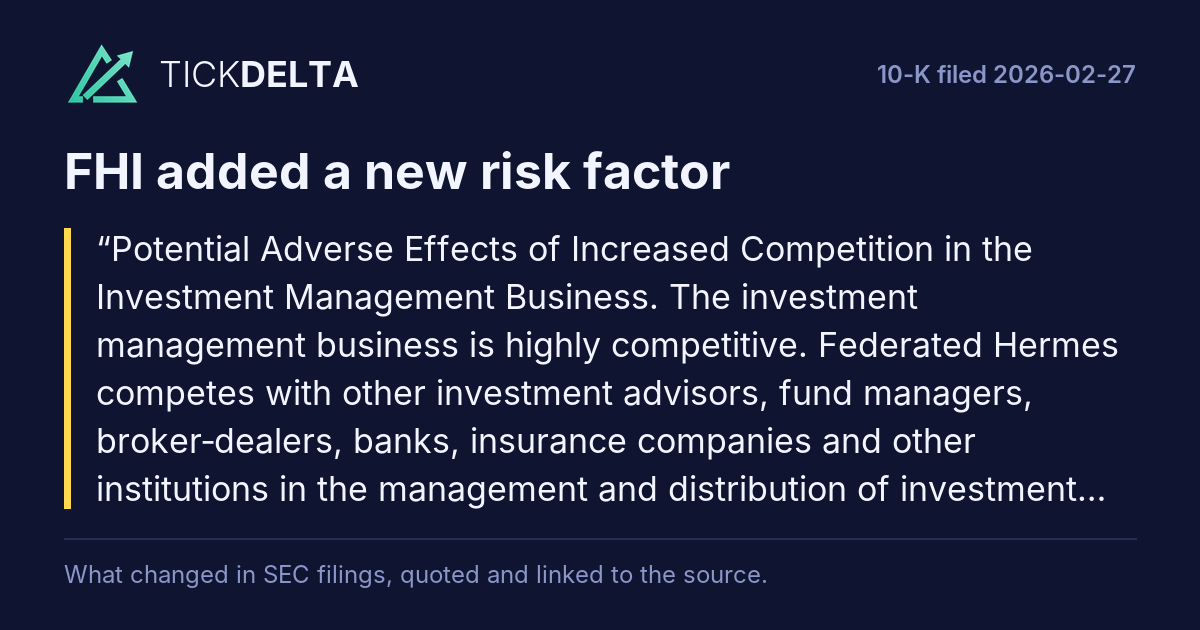
Potential Adverse Effects of Increased Competition in the Investment Management Business. The investment management business is highly competitive. Federated Hermes competes with other investment advisors, fund managers, broker‑dealers, banks, insurance companies and other institutions in the management and distribution of investment offerings, stewardship services, real estate development and renewal energy project services, many of which have substantially greater resources and brand recognition. Certain intermediaries also distribute proprietary or competitor offerings that can be prioritized over Federated Hermes’ offerings. Federated Hermes’ offerings also can compete against each other as new similar or “clone” offerings (such as exchange-traded funds with similar strategies as mutual fund offerings), or new exchange-traded share classes are added to mutual funds, which can result in redemptions from traditional mutual funds or share classes.
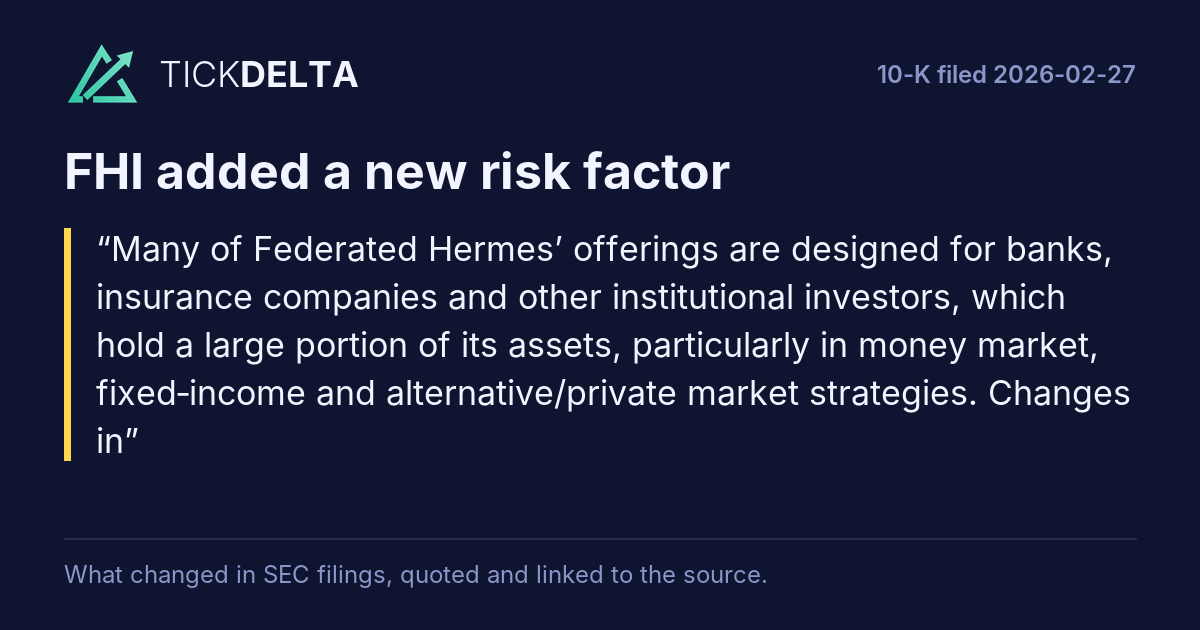
Many of Federated Hermes’ offerings are designed for banks, insurance companies and other institutional investors, which hold a large portion of its assets, particularly in money market, fixed‑income and alternative/private market strategies. Changes in
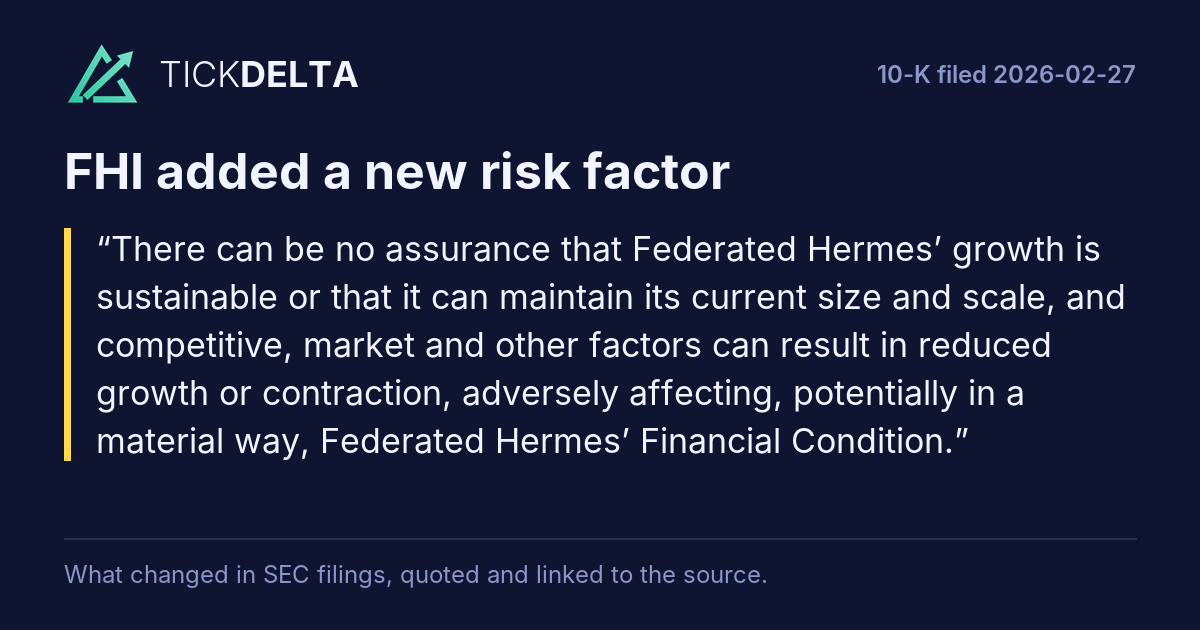
There can be no assurance that Federated Hermes’ growth is sustainable or that it can maintain its current size and scale, and competitive, market and other factors can result in reduced growth or contraction, adversely affecting, potentially in a material way, Federated Hermes’ Financial Condition.
trade, can require certain offerings or asset classes to be partially or fully closed to new investments, potentially resulting in redemptions or asset reallocation. Changing market conditions, regulatory developments and regulatory requirements, among other factors, can cause a shift in Federated Hermes’ asset mix among offerings or asset classes, such as towards money market and fixed-income offerings, between money market offerings or from money market offerings to other offerings. Each of these factors can cause a decline in or otherwise affect, potentially in a material way, Federated Hermes’ Financial Condition.
The SEC primarily regulates Federated Hermes and its U.S.‑distributed offerings. FINRA also regulates Federated Hermes, particularly its registered broker-dealer subsidiary. Federated Hermes, and certain Federated Hermes Funds, are also subject to CFTC and National Futures Association (NFA) regulation when their investments in futures, swaps or certain other commodity interests are above de minimis levels.
Outside the U.S., Federated Hermes, its business, and its offerings are regulated by foreign regulatory or other authorities, such as the FCA (U.K.), CBI (Ireland), CIMA (Cayman Islands), Monetary Authority of Singapore, ASIC (Australia) and CSSF (Luxembourg), which can impose different regulatory requirements than in the U.S. Operating outside the U.S. through foreign subsidiaries and offerings organized or distributed outside the U.S. can provide a different (including a lessor) level of legal protections, transparency, and regulatory certainty than in the U.S.
Recent and future legislation by Congress, state legislatures, foreign parliaments, and other governments, and rulemaking by the SEC, FINRA, CFTC, NFA, NYSE, state or local governments and regulators, the FCA, CBI, CIMA, Monetary Authority of Singapore, ASIC, CSSF, and other regulators, self-regulatory organizations or exchanges, have increased, and can further increase, Federated Hermes’ operating expenses, and affected the conduct of its offerings, as well as its AUM, revenues, and operating income. Federated Hermes’ offerings are affected by regulatory requirements and regulatory authorities that impact the way Federated Hermes’ offerings are structured, marketed, distributed, delivered or sold. Federated Hermes’ stewardship (engagement and proxy recommendations) services are also impacted by securities laws, proxy‑advisor regulation, antitrust or competition laws, governance, environmental, and social‑related laws, and other regulatory requirements, as well as Congressional and other governmental inquiries, examinations, investigations, hearings, and enforcement. Regulatory requirements applicable to banks, other financial institutions, intermediaries, real estate and power generation can also affect Federated Hermes and its offerings, including changes to renewable energy grid connection, capacity allocation, and permitting regimes that can delay projects or reduce their viability.
Show the other 2
Growth of Federated Hermes’ business and offerings (whether organic or through acquisitions, product expansion, market appreciation, or entry into new jurisdictions or markets, or otherwise) can increase compliance obligations, costs and risk, reporting risks, and operating costs. The pace of the issuance and adoption/enactment of new regulatory developments and regulatory requirements, overlapping compliance deadlines, and actual or potential conflicts amongst requirements and regulatory approaches across or among the various jurisdictions where Federated Hermes operates, and its offerings are distributed or marketed, compound compliance risks, internal and external resource requirements, and operational costs. Compliance risk, internal and external resource requirements, and operating expenses also can increase as Federated Hermes
Operational Risks. Like other companies, Federated Hermes’ business, offerings, and operations rely globally on internal resources and numerous outsourcing and vendor relationships with third‑party service providers, whose own operations depend on additional third‑party relationships. Operational risks include, among others: improper, inefficient or unauthorized transaction execution, processing, pricing or monitoring; inadequate, deficient, inefficient, inflexible, non-resilient, or non‑scalable technology, processes, operating systems, security or other infrastructure, resources or controls; underperformance by internal resources or third-party service providers; inadequate recruiting, supervision, training, retention or promotion of the well-being and resiliency of qualified human capital resources (whether internal or external); employee turnover (whether because of retirement or otherwise, and particularly involving executives, management or other key employees); insufficient
due diligence on third-party service providers; business or supply‑chain disruptions; health and safety incidents and work conditions involving employees, contractors, or third parties at facilities and project sites; failures to effectively upgrade, patch, integrate, modernize or decommission technology or transition to a “cloud-based” environment; weaknesses in or breaches of governance or internal controls (whether by Federated Hermes, its offerings, or third-party service providers); unauthorized disclosure or manipulation of, or access to, confidential, proprietary or non-public personal or business information; unauthorized access to accounts, applications or systems; and noncompliance with investment mandates and related investment parameters, regulatory requirements or customer-imposed restrictions. As Federated Hermes and its service providers expand or face increasing complexity or customization or scalability needs, operational risk can increase. System or process changes, including upgrades or patches, can be implemented in an improperly controlled environment, ineffectively, untimely, inefficiently or incorrectly, creating additional risks, such as, among others, intentional or unintentional compromise of the integrity or security of confidential, proprietary or personal information or other data of Federated Hermes, its employees, its customers, shareholders, service providers or other third parties. Federated Hermes relies on employees, service providers, technology, and business continuity plans to comply with established procedures, controls, regulatory requirements, investment parameters or customer‑imposed restrictions. Failures in or improper use of systems, human error, improper actions, or noncompliance can materially adversely affect Federated Hermes’ Financial Condition.
Paragraphs in the 10-Q filed Oct 30, 2026 that were not in the one before
New in the latest 10-Q
34 paragraphs in the 10-Q filed Oct 30, 2026 with nothing like them in the 10-Q filed Jul 31, 2026 (at least half the words must differ; new numbers alone do not count). Quoted exactly, grouped by the item heading above them. This is text that changed, not a judgement of how serious it is.
Financial statements and notes
Consolidated Statements of Cash Flows (dollars in thousands) (unaudited) Nine Months Ended September 30, 2026 2025 Operating Activities Net Income Including the Noncontrolling Interests in Subsidiaries $ 313,639 $ 306,662 Adjustments to Reconcile Net Income to Net Cash Provided (Used) by Operating Activities Depreciation and Amortization 19,767 16,686 Share-Based Compensation Expense 24,458 23,178 (Gain) Loss on Disposal of Assets (6,697) (6,077) Provision (Benefit) for Deferred Income Taxes (3,828) 19,948 Consolidation/(Deconsolidation) of Other Entities 0 (7,845) Net Unrealized (Gain) Loss on Investments (1,937) (13,730) Net Sales (Purchases) of Investments—Consolidated Investment Companies (64,447) (144,529) Other Changes in Assets and Liabilities: (Increase) Decrease in Receivables, net 807 (8,472) (Increase) Decrease in Prepaid Expenses and Other Assets 7,270 (39,412) Increase (Decrease) in Accounts Payable and Accrued Expenses (36,494) (41,011) Increase (Decrease) in Other Liabilities (8,631) 30,747 Net Cash Provided (Used) by Operating Activities 243,907 136,145 Investing Activities Purchases of Investments—Affiliates and Other (8,930) (5,608) Cash Paid for Business Acquisitions, Net of Cash Acquired (213,288) (12,755) Proceeds from Redemptions of Investments—Affiliates and Other 15,000 15,485 Cash Paid for Property and Equipment (19,980) (3,188) Other Investing Activities 0 (6,028) Net Cash Provided (Used) by Investing Activities (227,198) (12,094) Financing Activities Dividends Paid (83,103) (78,516) Purchases of Treasury Stock (186,127) (185,676) Distributions to Noncontrolling Interests in Subsidiaries (26,535) (33,313) Contributions from Noncontrolling Interests in Subsidiaries 71,196 158,100 Other Financing Activities 320 8 Net Cash Provided (Used) by Financing Activities (224,249) (139,397) Effect of Exchange Rates on Cash, Cash Equivalents, Restricted Cash and Restricted Cash Equivalents (2,578) 14,550 Net Increase (Decrease) in Cash, Cash Equivalents, Restricted Cash and Restricted Cash Equivalents (210,118) (796) Cash, Cash Equivalents, Restricted Cash and Restricted Cash Equivalents, Beginning of Period 584,381 507,567 Cash, Cash Equivalents, Restricted Cash and Restricted Cash Equivalents, End of Period 374,263 506,771 Less: Restricted Cash and Restricted Cash Equivalents Recorded in Other Long-Term Assets 599 492 Cash and Cash Equivalents $ 373,664 $ 506,279
Read in the 10-Q
On September 25, 2026, Federated Hermes renewed its material operating lease related to its corporate headquarters in Pittsburgh, Pennsylvania. The renewed lease expires in 2041 and has renewal options for additional periods through 2051. The lease includes provisions for leasehold improvement incentives, rent escalation and certain penalties for early termination. The renewal resulted in non-cash increases of $ 34.6 million and $ 45.9 million to Right-of-Use Assets, net and Lease Liabilities, respectively, and $ 11.3 million of leasehold improvement incentive, primarily recorded in Other Long-Term Assets. These values recognized do not include the consideration of any renewal options, as they are not yet reasonably certain to be exercised.
Read in the 10-Q
On September 25, 2026, Federated Hermes renewed its material operating lease related to its corporate headquarters in Pittsburgh, Pennsylvania. The renewed lease expires in 2041 and has renewal options for additional periods through 2051. The lease includes provisions for leasehold improvement incentives, rent escalation and certain penalties for early termination. The renewal resulted in non-cash increases of $34.6 million and $45.9 million to Right-of-Use Assets, net and Lease Liabilities, respectively, and $11.3 million of leasehold improvement incentive, primarily recorded in Other Long-Term Assets. These values recognized do not include the consideration of any renewal options, as they are not yet reasonably certain to be exercised.
Read in the 10-Q
SEC Releases 2027 Examination Priorities. On October 23, 2026, the SEC Division of Examinations released its Fiscal Year 2027 Examination Priorities, identifying areas expected to receive heightened examination focus. Key priorities relevant to investment advisers and registered funds include fiduciary duties, conflicts of interest, compliance programs, retail investor protection, private funds and private credit strategies, cybersecurity and operational resiliency, protection of customer information, and the use of emerging technologies, including artificial intelligence. While the priorities do not create new legal requirements, they provide insight into the Division's current areas of regulatory focus.
Read in the 10-Q
SEC Proposes Amendments to the Rule 17a-7 Cross Trading Rule. On October 9, 2026, the SEC proposed amendments to 1940 Act Rule 17a-7, the cross-trading rule, under the 1940 Act to: (1) expand the scope of securities eligible for cross trades (which are transactions between a registered investment company and certain affiliates, such as affiliated funds) to include most fixed income securities; (2) modernize the rule’s conditions, including those related to pricing and oversight of cross trades; and (3) require aggregated reporting and recordkeeping for related trading activity. The public comment period ends on December 14, 2026.
Read in the 10-Q
Show the other 29
SEC Proposes Custody Rule Amendments for Investment Advisers and Investment Companies. On October 1, 2026, the SEC proposed amendments to the custody requirements applicable to registered investment advisors and registered investment companies. While the proposal addresses the custody of crypto assets, it also would modernize certain existing custody requirements and address longstanding interpretive and operational issues under the Advisers Act and 1940 Act custody frameworks. The proposal would permit, subject to specified conditions, investment advisors and registered investment companies to self-custody certain crypto assets when a qualified custodian is unavailable and would modernize requirements for investment companies using broker-dealers as custodians. The proposal also would address certain non-crypto custody matters applicable to investment advisors, including standing letters of authorization, inadvertent custody, the authorized trading exception, segregation of client cash and bank deposits, and financial statement audit provisions. The proposed amendments include various conditions and safeguards that could require investment advisors and funds to modify their administrative, operational and compliance practices. The public comment period ends on December 7, 2026.
Read in the 10-Q
Interval Fund Modernization and Multiple Share Classes. On September 30, 2026, the SEC proposed amendments to modernize the regulatory framework for interval funds and expand the ability of registered CEFs and BDCs to use multiple share-class structures. Among other changes, the proposal would amend 1940 Act Rule 23c-3 to permit extended deferral of an interval fund’s first repurchase offer, more frequent discretionary repurchases, monthly periodic intervals and, subject to specified conditions, the deduction of deferred sales loads from repurchase proceeds. The proposal also would simplify certain repurchase procedures and replace the rule’s existing liquidity requirements with a principles-based liquidity approach. In addition, the proposal would permit regulated CEFs to use multiple share-class structures and enter into arrangements for the payment of asset-based distribution and service fees; update certain prospectus and reporting requirements; require enhanced expense disclosures for regulated CEFs; and rescind certain existing exemptive orders relating to interval funds and multiple share-class arrangements. The public comment period ends on December 4, 2026.
Read in the 10-Q
Investment Advisor Performance-Based Compensation Modernization. On September 30, 2026, the SEC proposed amendments that would expand the ability of investment advisors to receive performance-based compensation from registered management investment companies and BDCs. Under the proposal, such compensation could not exceed 20% of a regulated fund’s net gains over a specified period, the regulated fund would be required to satisfy specified fund-governance standards, and the fund’s board, including a majority of its independent directors, would be required to determine that the compensation arrangement is in the best interests of the fund and its shareholders and make specified findings regarding the arrangement. The proposal also would amend certain registration and reporting forms to require disclosure of performance-based compensation and revise the definition of “qualified client” to include investors meeting the definition of “accredited investor” under Regulation D, while removing the definition’s separate net-worth and assets-under-management tests. The public comment period ends on December 7, 2026.
Read in the 10-Q
SEC Proposes Proxy Solicitation Modernization Reforms. On September 16, 2026, the SEC proposed amendments intended to modernize and simplify the federal proxy solicitation rules to reflect changes in technology and market practices. Among other changes, the proposal would eliminate the requirement that registrants deliver annual reports to security holders in connection with proxy solicitations, eliminate the delivery deadline for documents incorporated by reference into proxy statements, eliminate the requirement and ability to file notices of certain exempt solicitations, and shorten from 20 business days to five business days the minimum period for conducting broker searches in advance of record dates. The SEC stated that the
Read in the 10-Q
amendments are intended to simplify compliance and update requirements that have not kept pace with current shareholder communication practices. The public comment period will end on November 20, 2026.
Read in the 10-Q
SEC Proposes Rescission of Shareholder Proposal Rule and Amendments to Proxy Voting Rules. On September 16, 2026, the SEC proposed rescinding Exchange Act Rule 14a-8, which governs when public companies must include shareholder proposals in their proxy materials, on the grounds that the rule exceeds the SEC’s statutory authority and that matters concerning shareholder proposals are more appropriately governed by state law and company governing documents. The SEC also proposed amendments to Rule 14a-4(c) that would expand the circumstances in which companies may exercise discretionary voting authority over shareholder proposals presented at a meeting but not included in company proxy materials, while permitting shareholders to prevent the exercise of such authority with respect to their shares. If adopted, the rescission would represent a significant change to the current federal shareholder proposal framework and leave the treatment and inclusion of shareholder proposals principally to applicable state corporate law and company governing documents. The public comment period ends on November 20, 2026.
Read in the 10-Q
SEC Proposes to Rescind Pay-to-Play Rules. On September 3, 2026, the SEC proposed rescinding Rule 206(4)-5 under the Advisers Act, commonly known as the “pay-to-play rule,” and the related recordkeeping requirements. The SEC stated that, after more than 15 years of administering the rule, it believes the rule is overly prescriptive, burdensome, and has produced unintended consequences, while existing fiduciary, antifraud, and compliance requirements would continue to address potential pay-to-play concerns. The public comment period ends on November 9, 2026, and the current rule remains in effect unless and until a final rescission is adopted.
Read in the 10-Q
SEC Proposes Amendments to Transfer Agent Rules. On September 1, 2026, the SEC proposed updates to the rules and forms that apply to registered transfer agents. The proposal would, among other things: (1) amend the registration and annual reporting requirements for transfer agents, including the questions and instructions on Forms TA-1 and TA-2; (2) modernize the rules to reflect how transfer agents carry out their activities in light of technological advancements, including the use of electronic and blockchain-based recordkeeping and uncertificated securities; (3) establish new requirements related to turnaround, risk management, and inactive security holders; and (4) introduce two new rules addressing compliance and restrictive legends for registered transfer agents. The public comment period ends on November 3, 2026.
Read in the 10-Q
SEC and Commodity Futures Trade Commission (CFTC) Further Extend Form PF Compliance Date. On August 31, 2026, the SEC and the CFTC jointly published a final rule further extending the compliance date for the comprehensive February 2024 amendments to Form PF (the confidential reporting form for certain SEC-registered investment advisors to private funds, including those also registered with the CFTC as a commodity pool operator or commodity trading advisor) from October 1, 2026 to July 1, 2027, effective September 3, 2026. This is the fourth extension of the compliance date for the 2024 Form PF amendments and follows the SEC’s and CFTC’s April 20, 2026 proposal to eliminate filing requirements for smaller advisors, raise reporting thresholds for large hedge fund advisors, and streamline or eliminate a range of other Form PF reporting requirements adopted in 2024. The SEC and CFTC stated that the extension is intended to allow Form PF filers to avoid the cost of implementing reporting changes that may be substantially revised or eliminated once the SEC and CFTC act on the pending April 2026 proposal, and to provide the SEC and CFTC additional time to fully consider the comments received on that proposal, which closed on June 23, 2026. Until the new compliance date, Form PF filers, including certain of Federated Hermes’ private fund advisory subsidiaries, may continue to file the version of Form PF in effect prior to the 2024 amendments.
Read in the 10-Q
SEC Proposes Regulation Crypto Assets. On August 18, 2026, the SEC proposed Regulation Crypto Assets, which would create the SEC’s first tailored securities-offering regime for certain investment contracts involving crypto assets (“covered investment contracts”). As proposed, Regulation Crypto Assets would create two new exemptions from 1933 Act registration for offerings of covered investment contracts - a “startup exemption” permitting offerings of up to $5 million over a four-year period, and a “fundraising exemption” permitting offerings of up to $75 million during each 12-month period - each conditioned on principles-based disclosure and, for the larger exemption, financial statements and ongoing reporting. The proposal addresses only the offering side of the crypto regulatory framework, leaving questions of trading and exchange regulation, as well as custody matters subsequently addressed in the SEC’s October 2026 crypto asset custody proposal discussed above, to separate SEC rulemakings. The public comment period ended on October 20, 2026.
Read in the 10-Q
State Actions and Litigation Relating to Proxy Advisory Firms. As previously disclosed, several states have enacted laws regulating proxy advisory firms with respect to certain proxy voting recommendations, and the two largest proxy advisory firms have challenged several of these laws on First Amendment and other grounds. During the 2026 legislative sessions, Tennessee, Oklahoma, Indiana, Kentucky and Kansas enacted proxy advisor disclosure laws, while more than a dozen states considered legislation regulating proxy advisory firms. Tennessee’s H.B. 2476, which became effective July 1, 2026, imposes certain requirements relating to proxy advisory services provided to state and local government investment programs and pension plans. Since June 30, 2026, federal courts have issued preliminary injunctions preventing the Kansas and Indiana proxy advisor disclosure laws from taking effect, following a similar preliminary injunction previously issued with respect to a Texas law; litigation challenging these laws remains pending. Litigation challenging Kentucky’s proxy advisor disclosure law also remains pending. In August 2026, one of the two largest proxy advisory firms filed a federal lawsuit seeking to enjoin Oklahoma’s H.B. 4429 before its November 1, 2026 effective date, asserting, among other things, that the law violates the First Amendment by imposing additional requirements when proxy advice differs from company management’s recommendation. Separately, state Attorneys General have continued to pursue consumer protection and other claims relating to proxy advisory firms, including through actions brought by multiple states against the largest proxy advisory firms.
Read in the 10-Q
a new framework for Fund Reporting for Asset Management Entities (to be known as FRAME) in consultation paper CP 26/26 (which would replace the existing fund reporting requirements with a single framework calibrated to fund type, size and activity), and revised remuneration requirements for solo-regulated firms that would be less prescriptive and more principles-based in consultation paper CP 26/27 (which would replace the existing AIFM, UCITS and Markets in Financial Instruments Directive Prudential Requirements remuneration codes with a single code). Since June 30, 2026, the FCA has extended the deadline for responses to the principal consultation paper on the new AIFM regulatory framework and the discussion chapter on prudential reforms to October 22, 2026 (CP 26/28) and separately extended the deadline for its FRAME reporting proposals (CP 26/26) to October 22, 2026. The original response deadlines for CP 26/28 and CP 26/26 were October 14, 2026 and September 22, 2026, respectively. The consultation period for CP 26/27 closed on September 16, 2026, the deadline for responses on the other discussion chapters in CP 26/28 was September 18, 2026, and HM Treasury’s deadline for technical comments on its draft statutory instrument was October 14, 2026. Final Handbook rules are expected in 2027, with the new regime anticipated to take effect in 2028.
Read in the 10-Q
U.K. Money Market Fund Reform Update. On September 4, 2026, the FCA published Quarterly Consultation CP 26/32, which included reforms intended to facilitate the integration of money market fund reporting within the FRAME proposals discussed above. The FCA stated that the proposed changes are intended to ensure a proportionate approach that allows for effective monitoring of financial stability risks. Under the proposals, U.K. money market funds and non-U.K. money market funds that are marketed in the U.K. would be required to submit essential and enhanced reporting on a quarterly basis. This would replace the current quarterly reporting obligations for U.K. money market funds. In addition, the FCA proposes to replace daily reporting of NAV calculations (currently applicable to U.K. money market funds) with weekly reporting of a limited number of metrics, including data on NAV, liquidity buffers and other metrics such as money market fund maturity metrics and net flows to support timely oversight. The consultation period for CP 26/32 closed on October 12, 2026. In addition, the FCA confirmed that it intends for the new money market fund rules and guidance to take effect on the same timetable as the U.K. Government’s planned repeal of the existing U.K. Money Market Funds Regulation, with the Government expecting to introduce implementing legislation in Parliament by the end of 2026.
Read in the 10-Q
U.K. Liquidity Risk Management Reforms. On August 13, 2026, the FCA published Policy Statement PS 26/17 (following consultation paper CP 25/38, which closed on February 23, 2026), which sets out final rules and guidance on enhancing liquidity risk management requirements for authorized fund managers of U.K. UCITS schemes and non-UCITS retail schemes. Among other changes, the final rules refine requirements for assessing asset liquidity and the anti-dilution tools available to fund managers. In particular, authorized fund managers must have an anti-dilution mechanism available for use, although the FCA did not adopt fixed triggers for when it must be used, and the FCA introduced new guidance on liquidity stress testing. The rules do not apply to U.K. money market funds on the basis that the requirements for U.K. money market funds are being consulted on separately as part of the broader U.K. money market fund reforms discussed above. The final rules and guidance take effect on February 1, 2027, with transitional provisions for certain requirements applying until August 1, 2027. The FCA has stated its intention to consult separately on the wider liquidity tools for authorized funds investing in illiquid assets (such as daily-dealing property funds).
Read in the 10-Q
U.K. Consumer Duty Requirements. The Consumer Duty refers to certain FCA rules that aim to ensure firms providing financial services in the U.K. deliver good outcomes to retail customers. On June 29, 2026, the FCA published consultation paper CP 26/23, which proposes targeted amendments to some of the existing FCA rules and guidance. The proposals include (amongst other matters) changes to clarify how the Consumer Duty should apply to firms across a distribution chain, including when firms may rely on information provided by, or actions taken by, other firms in the chain, and changes to remove non-U.K. customers from the scope of the Consumer Duty (subject to limited exceptions, such as pre-paid funeral plans and certain U.K. pension-related activities). The consultation closed on September 18, 2026. The FCA expects to publish final rules in a policy statement in the first quarter of 2027. In addition, the FCA continues to conduct reviews to assess whether firms are adequately complying with the Consumer Duty. On July 10, 2026 the FCA published its findings and expectations regarding the products and services outcome under the Consumer Duty, and, on July 27, 2026, the FCA published its findings and guidance for firms’ approaches to monitoring consumer outcomes, in each case identifying examples of good and poor practice.
Read in the 10-Q
EU Sustainability Requirements for Asset Managers and Investment Offerings. As previously disclosed, the European Commission published its proposed overhaul of the Sustainable Finance Disclosure Regulation (SFDR 2.0) on November 20, 2025. On May 4, 2026 the European Parliament published a draft report suggesting certain changes to the European Commission proposal. The Council of the EU reached an agreement regarding its negotiating position on June 24, 2026. On September 10, 2026, the European Parliament’s Economic and Monetary Affairs Committee (ECON) announced that it had reached a broad compromise on the proposal for a regulation amending SFDR 2.0, and on September 15, 2026, a revised report was published to show ECON’s amendments against the European Commission’s initial proposals. The positions of the Council
Read in the 10-Q
of the EU and European Parliament broadly align on retaining the European Commission’s proposed transition from the current Article 6, 8 and 9 disclosure framework to three voluntary product categories - sustainable, transition and ESG basics (under proposed new Articles 9, 7 and 8, respectively), each generally requiring that at least 70% of a product’s assets be invested in accordance with the category’s criteria. Areas of disagreement remain regarding the criteria for those categories (in particular the treatment of fossil fuel-related investments in the transition category), and the length of the implementation period. Regarding next steps, trilogue negotiations among the Commission, Council and Parliament are expected to commence shortly, with the co-legislators targeting political agreement by the end of 2026.
Read in the 10-Q
EU Sustainability Requirements for Corporations. The CSRD imposes requirements in the EU on the disclosure of sustainability reports by in-scope companies, as previously disclosed. The detailed reporting requirements are set out in European Sustainability Reporting Standards (ESRS). On July 3, 2026, the European Commission adopted revised ESRS as part of the EU’s simplification of CSRD. The revised ESRS are designed to reduce administrative burdens for EU businesses by (amongst other matters) introducing additional flexibility measures and new exemptions and reducing the mandatory datapoints by more than 60% (and total datapoints by more than 70%). In addition, the European Commission has adopted voluntary sustainability reporting standards for certain small companies not subject to the CSRD (Commission Delegated Regulation (EU) 2026/1560, which entered into force on September 24, 2026). The adopted Delegated Act was transmitted to the European Parliament and the Council for a two-month scrutiny period, which ended without objection, and was published in the Official Journal of the EU on September 21, 2026 as Commission Delegated Regulation (EU) 2026/1563. The Commission Delegated Regulation will enter into force on November 10, 2026, and apply to financial years beginning on or after January 1, 2027, with optional early application for financial year 2026. The voluntary reporting standard is intended to facilitate reporting by companies that are not themselves subject to mandatory reporting under CSRD, but may be in value chains with counterparties that are subject to CSRD and that require sustainability information. The voluntary standard also includes a “value chain cap” intended to limit the information that CSRD-reporting companies may require from smaller value chain counterparties to what the voluntary standard covers. The European Financial Reporting Advisory Group is consulting on a draft digital (XBRL) taxonomy for the revised ESRS until November 11, 2026.
Read in the 10-Q
EU T+1 Settlement. In the EU, preparations for the T+1 settlement cycle transition (scheduled to take effect on October 11, 2027) are ongoing. On July 6, 2026, the European Commission adopted legislation to supplement the EU Central Securities Depositories Regulation (CSDR), notably the delegated regulations which amend: (1) the RTS on settlement discipline and (2) the RTS on central securities depositaries providing information to regulators. In addition, ESMA published a statement on July 20, 2026, which sets out key deadlines and action points that firms should follow when preparing for the EU T+1 settlement cycle. The statement noted that firms should consider applicable requirements in combination with recommendations
Read in the 10-Q
from the EU T+1 industry committee, and it was noted that the first T+1 deadline is scheduled for December 7, 2026, for requirements relating to allocations and confirmations. ESMA also consulted on revised CSDR guidelines on standardized procedures and messaging protocols for allocations and confirmations (the consultation period closed on July 7, 2026), with final guidelines expected in October 2026 and proposed to apply from December 7, 2026.
Read in the 10-Q
U.K. Financial Services and Markets Bill 2026-27 Advances Through Parliament. The Financial Services and Markets Bill 2026-27 is proposed legislation that will make certain changes to the U.K. financial services regulatory framework. The proposals include changes to the U.K. SMCR that will provide greater flexibility to the FCA to simplify the regime applicable to individuals working for financial services businesses (including by removing the Certification Regime from legislation so that it can be recast in regulator rules). The proposals also include abolishing the Payment Systems Regulator and transitioning its remaining functions to the FCA. The Financial Services and Markets Bill 2026-27 would also, among other matters, bring appointed representatives within the scope of the SMCR and the compulsory jurisdiction of the Financial Ombudsman Service and consolidate anti-money laundering supervision of professional firms within the FCA. The Financial Services and Markets Bill 2026-27, which was introduced in the House of Lords on May 19, 2026, received its third reading in the House of Lords on September 15, 2026, and has moved to the House of Commons (where it received its first reading on the same day) for further consideration.
Read in the 10-Q
U.K. Transaction Reporting Reform Update. On August 3, 2026, the FCA published Policy Statement PS 26/15, confirming final rules simplifying the U.K. Markets in Financial Instruments Regulation (MiFIR) transaction reporting regime. Among other changes, the final rules reduce the number of transaction reporting fields from 65 to 52, remove certain instruments (such as foreign exchange derivatives) from the reporting requirements and reduce the default back-reporting period from five to three years. The new regime takes effect on April 3, 2028, although the FCA is applying a flexible supervisory approach to certain requirements beginning August 3, 2026. The FCA estimates that the changes will reduce firms’ reporting costs by more than £100 million annually, and expects to consult on a draft reporting schema, validation rules and guidelines beginning in October 2026. Collective portfolio management investment firms, including U.K. UCITS management companies and AIFMs, generally remain outside the U.K. MiFIR transaction-reporting firm definition, with their reporting requirements being considered separately through the FCA’s FRAME consultation.
Read in the 10-Q
EU Transaction Reporting Simplification and EU EMIR III. On July 2, 2026, ESMA published its Final Report on the Call for Evidence regarding simplification of financial transaction reporting. ESMA concluded that a transition toward a “report once” framework represents the preferred approach to simplifying reporting across MiFIR, EMIR and Securities Financing Transactions Regulation (SFTR), under which transaction data would be reported through a common modular structure and reused across supervisory authorities, which ESMA estimates could deliver annual net cost savings of up to EUR 1 billion but would require targeted legislative amendments to MiFIR, EMIR and SFTR. On July 14, 2026, the European Commission adopted a delegated regulation amending the EMIR clearing threshold RTS (reflecting the revised clearing threshold regime under EMIR III, which is based primarily on uncleared over-the-counter (OTC) derivative positions), which will enter into force on the twentieth day after its publication in the Official Journal of the EU unless the European Parliament or the Council objects, and on July 31, 2026, the European Supervisory Authorities published a joint report on a draft RTS amending EMIR initial margin requirements, which would extend the current exemption from exchanging initial margin for counterparties below the EUR 8 billion aggregate average notional amount threshold to their existing uncleared OTC derivative contracts and which has been submitted to the European Commission for endorsement. ESMA has indicated that it will engage with EU institutions regarding its recommendations as next steps toward implementation.
Read in the 10-Q
U.K. Short Selling Regime. The FCA finalized rules replacing the U.K.’s prior short selling regime based on assimilated EU law with bespoke FCA rules in a new Short Selling Rules sourcebook (published in Policy Statement PS 26/5 on April 16,
Read in the 10-Q
U.K. and EU Anti-Money Laundering (AML) and Financial Crime. HM Treasury’s Money Laundering and Terrorist Financing (Amendment) Regulations 2026 (S.I. 2026/621, made on June 9, 2026) amend the U.K.’s existing AML framework, including customer due diligence requirements for crypto asset businesses and high-risk jurisdictions and a new due diligence regime for pooled accounts. Most provisions of these regulations came into force on June 30, 2026, with certain crypto-related change-in-control provisions scheduled to take effect from October 25, 2027, and new enhanced due diligence requirements for crypto asset correspondent relationships scheduled to take effect from February 1, 2027. In addition, on July 27, 2026, the FCA published its findings on financial crime controls at asset management and alternative firms, highlighting good practices and areas of improvement that firms should be aware of. The FCA emphasized that firms which face higher financial crime risks must establish frameworks and appropriate controls to mitigate these risks. Separately, in the EU, the Authority for Anti-Money Laundering and Countering the Financing of Terrorism has continued its consultation and standard-setting activities, including launching a survey of national Central Contact Points on August 6, 2026 (which closed on September 15, 2026) and consulting on draft guidelines on ongoing monitoring of business relationships. The consultation closed on September 3, 2026, with final guidelines expected in the fourth quarter 2026.
Read in the 10-Q
FCA Requirements on U.K. Equity IPO Information Flows and other Regulatory Developments. On August 5, 2026, the FCA published Policy Statement PS 26/16, finalizing reforms relating to information flows in connection with U.K. equity initial public offerings, including by removing the seven-day waiting period before connected research may be published and the requirement that syndicate banks share the same information with unconnected analysts as with their own research analysts, with effect from publication. Separately, on August 7, 2026, the FCA issued a statement raising concerns regarding risks associated with certain unregulated lenders, custody providers, money brokers and financial leasing companies (Annex 1 firms), in particular the potential for those firms to facilitate financial crime and their reliance on parent company controls. The FCA also sent an information request to approximately 900 Annex 1 firms and is closely scrutinizing applications to register as an Annex 1 firm. The FCA also announced that its authorization window for crypto-asset activities (including qualifying staking) opened on September 30, 2026 and will remain open until February 28, 2027 for firms seeking to rely on transitional provisions, ahead of the U.K.’s broader crypto-asset regulatory regime becoming effective on October 25, 2027.
Read in the 10-Q
European Single Access Point (ESAP) Implementation. On July 10, 2026, ESMA began collecting information from national competent authorities and officially appointed mechanisms (which act as collection bodies that forward information and metadata submitted by reporting entities) as part of the phased implementation of the European Single Access Point, a centralized EU platform intended to provide public access to financial and sustainability-related information filed by companies and financial market participants. The first phase covers information required under the Transparency Directive, the Prospectus Regulation and the Short Selling Regulation. Public accessibility is required to begin by July 2027, with further categories of information phased in from January 2028 and January 2030.
Read in the 10-Q
interests in subsidiaries. These were partially offset by $71.2 million of contributions from noncontrolling interests in subsidiaries.
Read in the 10-Q
Item 6
Exhibit 10.1 Amendment No. 12 to Federated Hermes Tower Lease dated September 24, 2026 (filed herewith)
Read in the 10-Q
The 10-Q's risk factors against the 10-K
Item 1A of the 10-Q filed Oct 30, 2026 against Item 1A of the 10-K filed Feb 27, 2026.
A 10-Q repeats only the risks that changed, so a 10-K paragraph that is missing from it is not counted as removed.
Added is a paragraph with nothing like it in the 10-K, Reworded a sentence that is in both with several words changed,
Quiet changes a sentence in both where one to four words changed and one is a hedge or a modal
(cut words struck through, new words highlighted).
Text on the page, not a score; each links to the filing at sec.gov.
What the 10-Q itself says about its risk factors:There are no material changes to the risk factors included in Federated Hermes’ Annual Report on Form 10-K for the year ended December 31, 2025.
Read in the 10-Q
1 paragraph in the 10-Q's Item 1A, and none of them adds, rewords or quietly edits a paragraph of the 10-K's.
Phrases used for the first time
Two-word phrases in Risk Factors of the 10-K filed Feb 27, 2026 that are in none of the 1 earlier 10-Ks stored, back to Feb 28, 2025
Where each one is used
- strategic transactions: No Assurance of Successful Strategic Transactions. Like other companies, Federated Hermes’ business strategy contemplates seeking acquisition candidates and other business relationships, and growing through such acquisitions and other strategic transactions, each of which involves risks and uncertainties. For...
- renewable energy: Potential Adverse Effects of Changes in Federated Hermes’ Distribution Channels. Federated Hermes distributes its investment offerings as a wholesaler through financial intermediaries, including banks, broker‑dealers, registered investment advisors and other financial planners, and also sells investment offerings,...
- portfolio investments: Potential Adverse Effects of Poor Investment Performance. Success in the investment management business depends largely on the investment performance of Federated Hermes’ Funds, Separate Accounts, and other offerings relative to market conditions and competing offerings. Investment performance also depends on...
- hermes class: Common Stock and Status as a Controlled Company. Federated Hermes has two classes of common stock: Class A, which has voting power; and Class B, which is non-voting except in certain limited circumstances. All the outstanding shares of Class A common stock are held by the Voting Shares Irrevocable Trust for the...
- retail government: Risk of Federated Hermes’ Money Market Offerings’ Ability to Maintain a Stable Net Asset Value. Approximately 53% of Federated Hermes’ total 2025 revenue was attributable to money market assets. Money market fund investments are neither insured nor guaranteed by the FDIC or any other government agency. Federated...
- debt private: Risk of Federated Hermes’ Money Market Offerings’ Ability to Maintain a Stable Net Asset Value. Approximately 53% of Federated Hermes’ total 2025 revenue was attributable to money market assets. Money market fund investments are neither insured nor guaranteed by the FDIC or any other government agency. Federated...
- offerings stewardship: Potential Adverse Effects of Increased Competition in the Investment Management Business. The investment management business is highly competitive. Federated Hermes competes with other investment advisors, fund managers, broker‑dealers, banks, insurance companies and other institutions in the management and...
- services real: Potential Adverse Effects of Increased Competition in the Investment Management Business. The investment management business is highly competitive. Federated Hermes competes with other investment advisors, fund managers, broker‑dealers, banks, insurance companies and other institutions in the management and...
Used at least twice, small words left out. Counted, not picked: a phrase can be new because the company renamed something.
What was taken out
12 paragraphs of last year's Risk Factors with nothing like them now. The longest are quoted.
Sources
Item 1A of each 10-K and 10-Q on EDGAR, quoted exactly. Each paragraph links to the filing at sec.gov.
Also
10-K change: what was reworded or cut, section by section.
Work with it
Excel workbook · CSV. Google Sheet that stays up to date: paste =IMPORTDATA("https://tickdelta.com/company/FHI/export.csv") into a cell.