Added10-Q Nov 5, 2026 vs 10-K Feb 26, 2026
Material changes from risk factor disclosures in FHN's Annual Report on Form 10-K for the year ended December 31, 2025:
Each branch is a paragraph in Risk Factors with nothing like it in the 10-K filed Feb 27, 2025. A box jumps to the paragraph as filed, below.
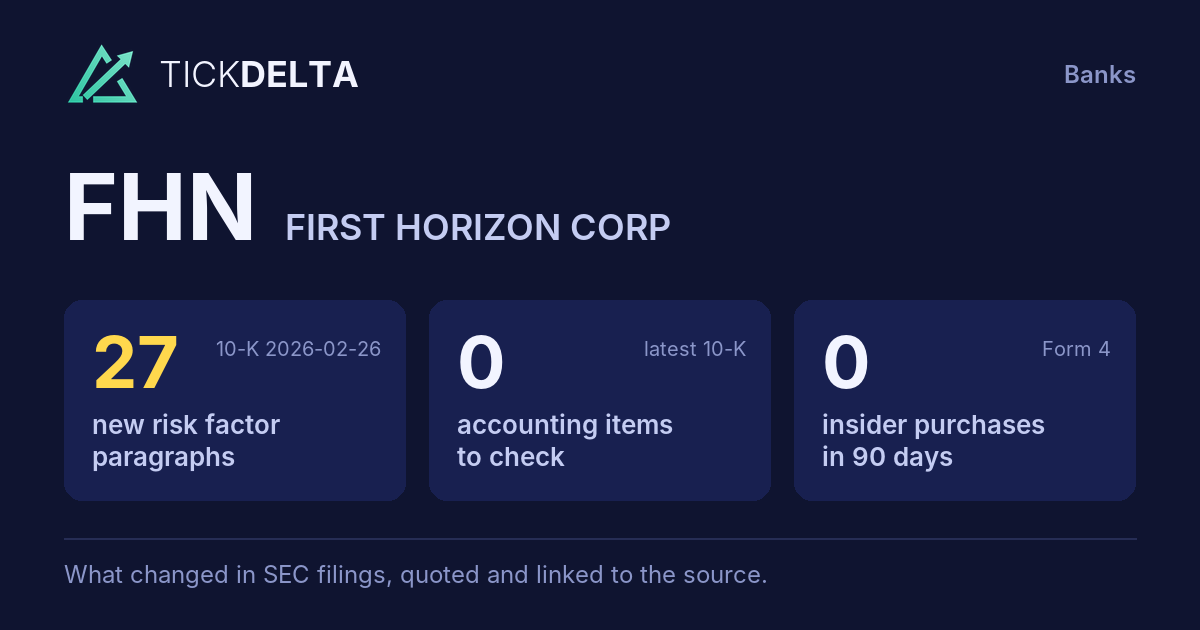
27 paragraphs in Risk Factors of the 10-K filed Feb 26, 2026 with nothing like them in the 10-K filed Feb 27, 2025. Quoted exactly. Paragraphs that were only edited are under 10-K change.
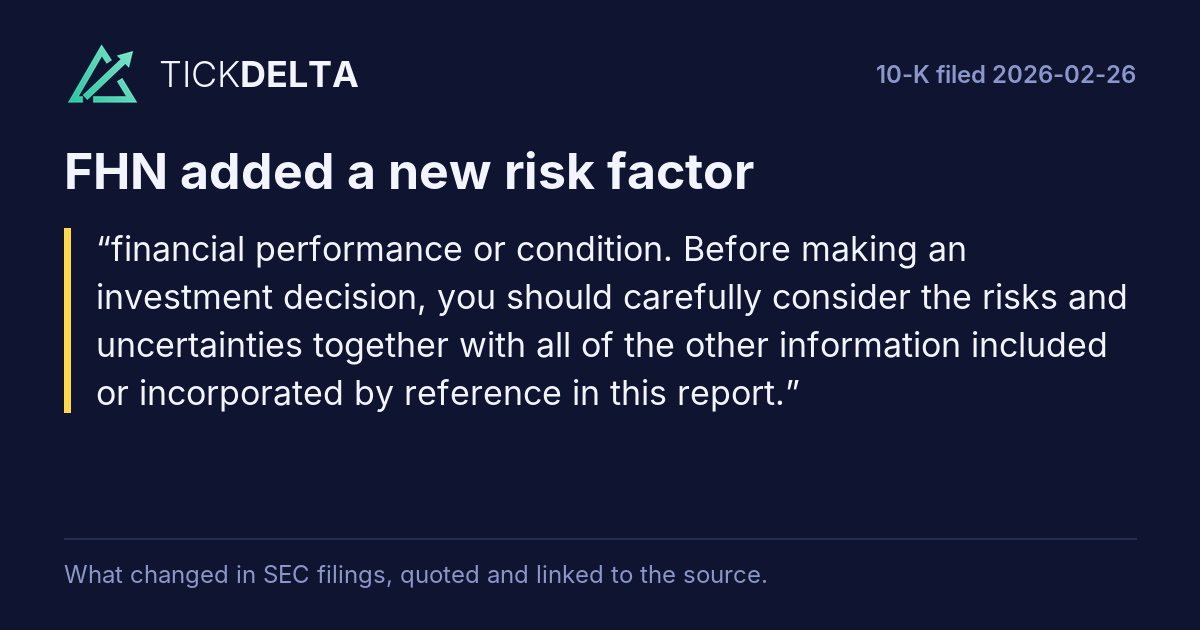
financial performance or condition. Before making an investment decision, you should carefully consider the risks and uncertainties together with all of the other information included or incorporated by reference in this report.
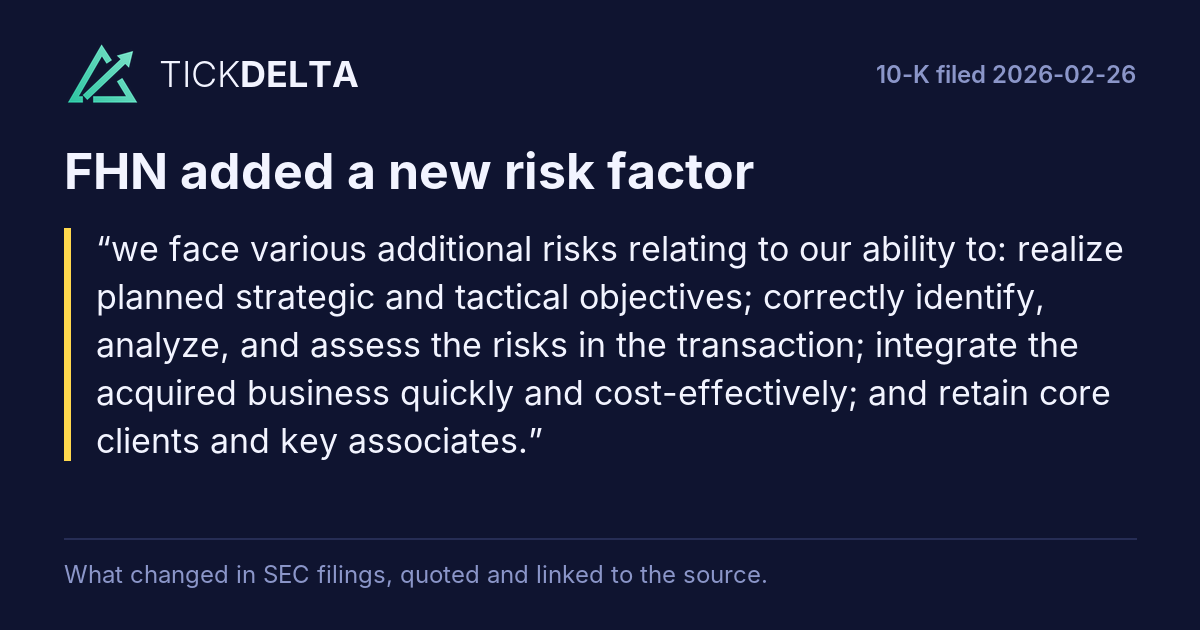
we face various additional risks relating to our ability to: realize planned strategic and tactical objectives; correctly identify, analyze, and assess the risks in the transaction; integrate the acquired business quickly and cost-effectively; and retain core clients and key associates.
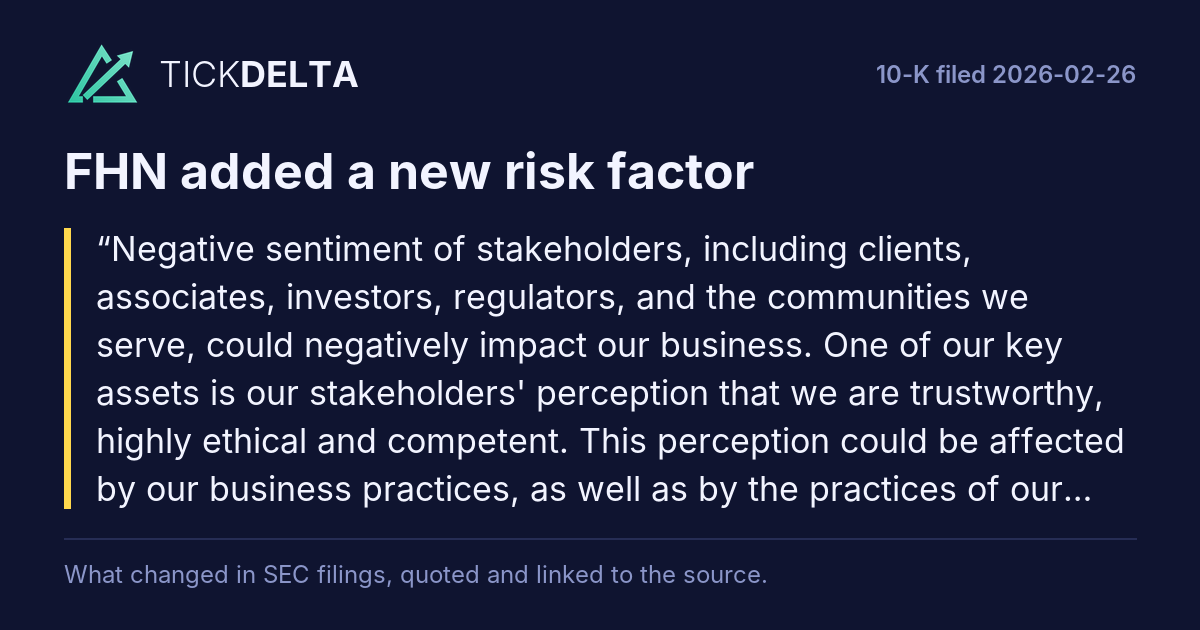
Negative sentiment of stakeholders, including clients, associates, investors, regulators, and the communities we serve, could negatively impact our business. One of our key assets is our stakeholders' perception that we are trustworthy, highly ethical and competent. This
perception could be affected by our business practices, as well as by the practices of our competitors, our industry as a whole, and the parties with whom we have important relationships. Senior management oversees processes for monitoring and actively reporting on stakeholder sentiment and for ensuring that the Company and its brand continue to be viewed positively by both internal and external stakeholders.
Technological innovations continue to change financial services at a rapid pace, creating new competitive challenges. We provide a large number of services remotely (online and mobile). Technology has helped us reduce costs and improve service, but also has created new competitive challenges by allowing disruptors, such as peer-to-peer lending arrangers, non-bank deposit acceptors, and non-bank digital asset financial service providers, to enter traditional banking areas, and by enabling banks to make client inroads unrelated to physical presence. The competitive risks from technological innovation are especially pronounced from the largest U.S. banks, and from online-only banks and non-bank financial technology firms (including blockchain‑based payment networks, stablecoin issuers, and digital‑asset lending and financing platforms), due in part to the large investments they are able to sustain in their digital platforms.
New technologies proliferating in the financial services industry are subject to risks and uncertainties that could impair their effectiveness or have a negative impact on our business. New technologies, services, and systems based wholly or in part on artificial intelligence are proliferating within our industry, including at our Company as we are seeking to accelerate both our data capabilities and our responsible use of artificial
challenges as we strive to maintain client service and compliance at high quality and low cost.
We use third-party service providers for certain bank functions. The failure, interruption, or poor performance of these third parties, whether due to cyber incidents, financial distress, operational breakdowns, or regulatory actions, could disrupt our operations, compromise data security, interfere with client services, compromise client privacy, or result in violations of laws or regulations
applicable to us and the Bank. In addition, transitioning to alternative providers may be difficult, costly or time-consuming and could require regulatory approval. Any significant disruption or deficiency involving our third-party service providers could materially and adversely affect our business, financial condition, and results of operations.
private banking, consumer, small business, wealth and trust management, retail brokerage, capital markets, fixed income, and mortgage banking services, among others. We manage these risks primarily through training programs, compliance programs, and supervision processes.
Despite our efforts to control expenses, our costs could rise due to adverse structural changes, market shifts, inflationary pressures, or errors in judgment. In addition, our costs could be impacted by increased regulatory compliance expense as we approach and surpass $100 billion in assets, which is the next regulatory tier above us now, but the extent of any additional regulatory compliance costs remains uncertain due to evolving regulatory policies and possible legislative or regulatory change.
In recent years, the Federal Reserve has implemented significant economic strategies that have impacted interest rates, inflation, asset values, and the shape of the yield curve. These strategies have had, and will continue to have, a significant impact on our business and on many of our clients. Federal Reserve strategies can, and often are intended to, affect the domestic money supply, inflation, interest rates, and the shape of the yield curve. Among other things, easing strategies are intended to lower interest rates, encourage borrowing, expand the money supply, and stimulate economic activity, while tightening strategies are intended to increase interest rates, discourage borrowing, tighten the money supply, and restrain economic activity. These effects significantly impact our business, including through impacts on deposit levels, and may also materially affect many of our customers.
We record loan and lease charge-offs in accordance with accounting and regulatory guidelines and rules. As
The consumer real estate category is highly sensitive to economic impacts on consumer clients and on residential real estate values.
Changes to statutes, regulations or regulatory policies, or their interpretation or implementation, and/or regulatory practices, requirements or expectations, could affect us in substantial and unpredictable ways. In particular, the potential effects of a number of proposed regulations on us remain uncertain due to legal challenges
and the 2025 changes in the U.S. presidential administration and control of the U.S. Senate, which have resulted in, and could result in additional, changing federal or state regulatory priorities.
We are unable to predict the form or nature of any future changes to statutes or regulation, including the interpretation or implementation thereof. Changes to statutes, regulations, or regulatory policies, including changes in interpretation or implementation of statutes, regulations, or policies, have and could in the future subject us to additional costs, limit the types of financial services and products we may offer, and/or increase the ability of non-banks to offer competing financial services and products, among other things. Failure to comply with laws, regulations, policies or supervisory guidance, and any such changes, could result in enforcement and other legal actions by Federal or state authorities, including criminal and civil penalties, the loss of FDIC insurance, revocation of a banking charter, other sanctions by regulatory agencies, civil money penalties, and/or damage to our brand, any of which could have a material adverse effect on our business, financial condition, and results of operations.
Legal disputes are an unavoidable part of business, and the outcome of pending or threatened litigation cannot
Data privacy is becoming an area of heightened legislative and regulatory focus. One prominent example is the California Consumer Privacy Act, which applies to for-profit businesses that conduct business in California and meet certain revenue and data collection thresholds, including the Bank. Further general regulation to protect data privacy appears likely. Banks in the U.S. already operate under privacy-protection laws and rules, but banking industry regulations in this area might be enlarged in response to this concern. Any enlargement of general or banking industry data privacy laws or regulations could adversely affect our business if it requires us to alter our systems or change our business practices.
Public expectations concerning corporate controls on emissions of carbon dioxide, methane, and other greenhouse gases (GHG) could, in the future, increase our operating costs and curtail some aspects of our business. At present, federal environmental regulations do not require us to monitor the direct or indirect GHG
Recent state laws and federal disclosure rules concerning GHG emissions could impose significant additional costs upon us. Recent state and federal disclosure laws and regulations related to GHG emissions are discussed in Item
1 of this report. Should these laws become effective as adopted, they could impose significant direct and indirect costs on us, including creating systems to capture relevant data and engaging vendors to provide required assurances.
Deposit levels may be affected, fairly quickly, by changes in monetary policy. The Federal Reserve began reducing short-term rates in the last half of 2024 based on
economic events during the year, including reduced inflationary pressures, employment data, and overall economic activity, and rate reductions continued in 2025, leading to decreased competition for deposits. However, even in a declining interest rate environment, quantitative tightening by the Federal Reserve can trigger increased competition for deposits. Whether, and to what extent, economic conditions will support continued short-term rate reductions in 2026 remains uncertain.
A number of more general factors could make funding more difficult, more expensive, or unavailable on
tends to reduce demand for long-term debt securities, which adversely impacts the revenues of our fixed income business.
continued through 2023. The improvement in the shape of the yield curve in the second half of 2024, which continued in 2025, subsequently resulted in an increase in fixed income values and revenues.
New in the latest 10-Q
35 paragraphs in the 10-Q filed Nov 5, 2026 with nothing like them in the 10-Q filed Aug 6, 2026 (at least half the words must differ; new numbers alone do not count). Quoted exactly, grouped by the item heading above them. This is text that changed, not a judgement of how serious it is.
During the third quarter of 2026, as part of a balance sheet repositioning strategy, FHN decided to pursue a sale of approximately $ 4.5 billion of lower-yielding consumer mortgages from its loan portfolio. These loans were reclassified and presented within loans held for sale. After consideration of valuation adjustments, the net amount recognized in loans held for sale was $ 4.0 billion as of September 30, 2026. An estimated loss on sale of $ 473 million was recognized in the third quarter. The transaction closed in October 2026 with no significant change to the loan portfolio valuation.
Read in the 10-Q
(b) Balance as of September 30, 2026 reflects the reclassification of approximately $ 4.5 billion of mortgage loans to held for sale. For further detail, see Note 1 - Basis of Presentation and Accounting Policies.
Read in the 10-Q
(e) The decline in this portfolio was attributable to the reclassification of certain mortgage loans to held for sale as a result of the mortgage loan portfolio sale transaction that closed in October 2026.
Read in the 10-Q
(a) As of September 30, 2026, the provision benefit in the consumer real estate portfolio includes a $ 45 million allowance reversal related to the reclassification of certain mortgage loans to held for sale as a part of the portfolio sale that closed in October 2026.
Read in the 10-Q
Mortgage servicing rights with a net carrying amount of $ 10 million were sold during the third quarter of 2025, resulting in a gain of $ 5 million, which is included in mortgage banking income on the Consolidated Statements of Income (Loss).
Read in the 10-Q
(a) For the three months ended September 30, 2026, all potential common shares were anti-dilutive due to the net loss available to common shareholders.
Read in the 10-Q
(a) 2026 includes a $ 473 million loss on pending sale of mortgage loans in the Corporate segment.
Read in the 10-Q
(d) 2026 includes a benefit of $ 45 million from the allowance reversal related to the pending sale of select mortgage loans in the Corporate segment.
Read in the 10-Q
(a) 2026 includes a $ 473 million loss on pending sale of mortgage loans in the Corporate segment.
Read in the 10-Q
(d) 2026 includes a benefit of $ 45 million from the allowance reversal related to the pending sale of select mortgage loans in the Corporate segment.
Read in the 10-Q
(b) Represents noninterest income excluded from the scope of ASC 606. Amount is presented for informational purposes to reconcile total noninterest income.
Read in the 10-Q
(b) Represents noninterest income excluded from the scope of ASC 606. Amount is presented for informational purposes to reconcile total noninterest income.
Read in the 10-Q
(a) Represents the carrying value of select consumer mortgages transferred to held for sale during third quarter 2026 and valued at the lower of cost or fair value.
Read in the 10-Q
(a) Valuation adjustments on these select consumer mortgages are recognized in loss on pending sale of mortgage loans within noninterest income on the Consolidated Statements of Income (Loss).
Read in the 10-Q
During the third quarter 2026, approximately $ 4.5 billion of residential mortgage loans were transferred to held for sale from held for investment in conjunction with a balance sheet repositioning strategy. The residential mortgage loans transferred to held for sale were not recognized under the fair value election. Accordingly, the loans were transferred to held for sale at amortized cost and were subject to LOCOM valuation. Upon transfer, a LOCOM valuation adjustment of $ 452 million was recognized. The bids received were the only significant input used in determining the estimated fair value of the
Read in the 10-Q
mortgage loan portfolio. The bids reflected the impact of current higher interest rates compared to the contractual rates for the loans included in the portfolio.
Read in the 10-Q
During the third quarter of 2026, as part of a balance sheet repositioning strategy, FHN decided to pursue a sale of approximately $4.5 billion of lower-yielding consumer mortgages from its loan portfolio. These loans were reclassified and presented within loans held for sale. After consideration of valuation adjustments, the net amount
Read in the 10-Q
recognized in loans held for sale was $4.0 billion as of September 30, 2026. An estimated loss on sale of $473 million was recognized in the third quarter. The transaction closed in October 2026 with no significant change to the loan portfolio valuation.
Read in the 10-Q
Noninterest income decreased $491 million, resulting in a noninterest loss of $276 million for third quarter 2026, compared to noninterest income of $215 million for third quarter 2025, primarily due to a $473 million loss related to the pending sale of select mortgage loans.
Read in the 10-Q
Noninterest income for the year-to-date period decreased $456 million, primarily due to a $473 million loss related to the pending sale of select mortgage loans.
Read in the 10-Q
The Common Equity Tier 1 ratio decreased 29 basis points to 10.34% at September 30, 2026, compared to 10.63% at December 31, 2025, largely attributable to the loss associated with the pending sale of certain mortgage loans, common share repurchases, and an increase in risk-weighted assets.
Read in the 10-Q
Mortgage banking income decreased $7 million compared to third quarter 2025, largely attributable to a $5 million pre-tax gain from a sale of mortgage servicing rights recognized during third quarter 2025.
Read in the 10-Q
Mortgage banking income of $26 million decreased $7 million, largely attributable to a $5 million pre-tax gain from a sale of mortgage servicing rights recognized during third quarter 2025.
Read in the 10-Q
Legal and professional fees decreased $8 million, largely due to project expenses in technology and risk in the prior year.
Read in the 10-Q
concentration is attributable to the reclassification of certain mortgage loans to held for sale as a result of the pending mortgage portfolio sale transaction that closed in October 2026. Industry concentrations are discussed under the C&I heading below.
Read in the 10-Q
(b) Reported FHLB borrowing capacity as of period-end includes certain loans that are no longer eligible to be pledged due to the pending mortgage loan sale. Balances and related borrowing capacity will be updated at the next pledge cycle.
Read in the 10-Q
Core deposits from commercial and consumer clients represent the primary funding source for FHN's lending activities. As of December 31, 2025, FHN's period-end loans-to-deposits ratio was 95%. Following the reclassification of approximately $4.5 billion of select consumer mortgage loans to held for sale during third quarter 2026, FHN's loans-to-deposits ratio improved 674 basis points to 88% as of September 30, 2026. Improved liquidity from the sale, which was completed in October 2026, repositions FHN to continue enhancing its focus on core client relationships.
Read in the 10-Q
Reserve held the target range steady through the first two quarters of 2026, the Federal Reserve increased its target range to 3.75% to 4.00% in September 2026. In its statement announcing its September 2026 rate increase, the Federal Reserve noted that, while economic activity
Read in the 10-Q
continued to expand at a solid pace despite elevated uncertainty due, in part, to geopolitical developments, inflation remained elevated relative to the Federal Reserve's 2% goal. In October 2026, the Federal Reserve decided to maintain its target range at 3.75% to 4.00%, noting that the accumulation of more information will be helpful in determining the policy stance appropriate to return inflation to the Federal Reserve's 2% goal.
Read in the 10-Q
FHN cannot predict how the yield curve will change or whether the relationship between the yield curve, on the one hand, and FHN's net interest margin and fixed income bond trading revenues, on the other, will continue.
Read in the 10-Q
California's GHG disclosure requirements are subject to pending federal litigation challenging their constitutionality. Although a federal appellate court has enjoined enforcement of California's separate climate-related financial risk disclosure law, SB 261, it has not enjoined enforcement of SB 253. The ultimate outcome of litigation challenging SB 253 and SB 261, and its effect on the scope and timing of the reporting requirements, remains uncertain.
Read in the 10-Q
Other states have considered, but not yet adopted, similar climate-related disclosure requirements.
Read in the 10-Q
In recent years, weather-related economic losses in the Southeast have remained elevated, and beyond hurricanes, severe convective storms (hail, tornadoes, and straight‑line winds) have been a meaningful driver of losses.
Read in the 10-Q
The availability, reliability, and cost of adequate property insurance are significant concerns for FHN and FHN's clients in affected markets. Although legislative reforms and other developments in insurance markets have generally stabilized market conditions compared to recent years, availability and pricing remain subject to reinsurance costs, loss experience, and regulatory changes, and conditions could re‑tighten following severe weather events. In addition, conditions continue to vary across state and local markets, and improvements in one jurisdiction may not generalize to others. This instability in property insurance markets increases FHN's risks of loan loss and business downturn.
Read in the 10-Q
Exh. No. Description of Exhibit to this Report Filed Here Mngt. Exh. Furnished Incorporated by Reference to Form Exh. No. Filing Date ────────────────────────────────────────────────────────────────────────────────────────────────────────────────────────────────────────────────────────────────────────────────────────────────────────────────────────────────────────────────────────────────────────────────────────────────────────────────────────────────────────────────────────────────── 3.1 Amended and Restated Charter of First Horizon Corporation [2024] 8-K 3.1 7/24/2024 3.2 Articles of Amendment to the Amended and Restated Charter, of the Company, related to the Series H Preferred Stock 8-K 3.1 3/12/2026 3.3 Bylaws of First Horizon Corporation, as amended and restated effective October 26, 2026 8-K 3.1 10/27/2026 4.1 FHN agrees to furnish to the Securities and Exchange Commission upon request a copy of each instrument defining the rights of the holders of the senior and subordinated long-term debt of FHN and its consolidated subsidiaries 10.1 Rate Applicable to Participating Directors under the Directors and Executives Deferred Compensation Plan X X
Read in the 10-Q
Item 1A of the 10-Q filed Nov 5, 2026 against Item 1A of the 10-K filed Feb 26, 2026.
A 10-Q repeats only the risks that changed, so a 10-K paragraph that is missing from it is not counted as removed.
Added is a paragraph with nothing like it in the 10-K, Reworded a sentence that is in both with several words changed,
Quiet changes a sentence in both where one to four words changed and one is a hedge or a modal
(cut words struck through, new words highlighted).
Text on the page, not a score; each links to the filing at sec.gov.
Two-word phrases in Risk Factors of the 10-K filed Feb 26, 2026 that are in none of the 1 earlier 10-Ks stored, back to Feb 27, 2025
Used at least twice, small words left out. Counted, not picked: a phrase can be new because the company renamed something.
84 paragraphs of last year's Risk Factors with nothing like them now. The longest are quoted.
Item 1A of each 10-K and 10-Q on EDGAR, quoted exactly. Each paragraph links to the filing at sec.gov.
10-K change: what was reworded or cut, section by section.
Excel workbook · CSV. Google Sheet that stays up to date: paste =IMPORTDATA("https://tickdelta.com/company/FHN/export.csv") into a cell.