FIGRFigure Technology Solutions
Figure is building the future of capital markets using blockchain-based technology. 10-K, Item 1
- Headquarters
- Reno, NV
- CEO
- Michael Benjamin Tannenbaum
- Next results
- around Jan 11, 2027
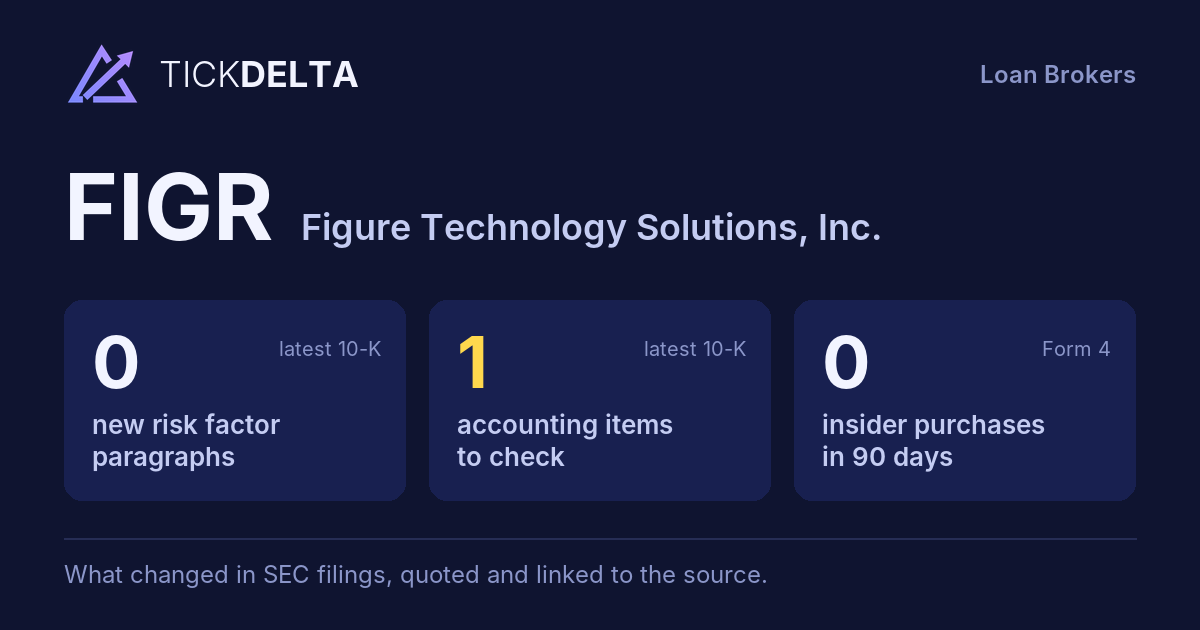
What the 10-K filed 2026-03-16 says about risks that are not on the face of the balance sheet, from the notes to the financial statements, Legal Proceedings and the MD&A (and, for big customers and key suppliers, Business and Risk Factors). Tickdelta picks sentences with specifics (amounts, accruals, covenant ratios) and quotes them as filed.
Big customers
Customers the company names as a large share of revenue or receivables (it must name any worth 10% of revenue).
“At December 31, 2025, trade accounts receivable from four customers individually accounted for approximately 28.8%, 18.6%, 16.8%, and 14.8% of trade accounts receivables.”
Read it in the 10-K ↗
“No other customer accounted for 10% or more of trade accounts receivable.”
Read it in the 10-K ↗
Key suppliers
Parts or manufacturing that depend on one or a few suppliers.
“In some cases, third-party vendors are one of a limited number of sources.”
Read it in the 10-K ↗
Lawsuits and legal claims
Pending cases, settlements and what the company has set aside for them.
“Other (expense) income, net includes unrealized and realized gains (losses) resulting from transactions of certain digital assets, litigation settlements, adjustments to non-equity method investments, foreign exchange rate gains (losses) and other non-income based state and local taxes.”
Read it in the 10-K ↗
Guarantees and indemnities
Promises to pay someone else's debts or losses if they cannot.
No specific sentence about this in the 10-K.
Debt covenants
Conditions in loan agreements that, if broken, can make debt due early.
“Other than as noted above, our warehouse credit facilities bear floating interest rates, are payable on a monthly basis, and contain certain financial covenants, such as minimum tangible net worth, minimum liquidity, maximum leverage ratios, required range of net income or loss during specified periods, and periodic financial reporting requirements.”
Read it in the 10-K ↗
“As of December 31, 2025 and 2024 we were in compliance with the applicable covenants under each of our warehouse credit facilities.”
Read it in the 10-K ↗
“Certain debt obligations are subject to customary loan covenants, such as minimum tangible net worth, minimum liquidity, maximum leverage ratios, required range of net income or loss during specified periods, periodic financial reporting requirements, and event of default provisions, including event of default provisions triggered by certain specified declines in the Company’s equity or a failure to maintain a specified tangible net worth, liquidity, or indebtedness to tangible net worth ratio.”
Read it in the 10-K ↗
“The Company was in compliance with all of its debt covenants at December 31, 2025.”
Read it in the 10-K ↗
“Debt Covenants — Certain of the Company’s debt obligations are subject to loan covenants and event of default provisions.”
Read it in the 10-K ↗
Commitments off the balance sheet
Contracts the company must pay for later: purchase obligations, take-or-pay deals.
“As of December 31, 2025, we had $1.2 billion in cash and cash equivalents, $68.6 million in restricted cash, $47.6 million in digital assets, excluding digital assets held as collateral, and approximately $1.8 billion in available Funding Debt capacity, excluding purchase commitments from third-party loan buyers.”
Read it in the 10-K ↗
“As of December 31, 2024, we had $289.7 million in cash and cash equivalents, $57.8 million in restricted cash, $20.7 million in digital assets held, excluding digital assets held as collateral, and $1.3 billion in available Funding Debt capacity, excluding purchase commitments from third-party loan buyers.”
Read it in the 10-K ↗
Sentences are chosen by their words, not read by AI, so some can be off topic. Always check the filing. Open the 10-K ↗
Work on FIGR in a spreadsheet:
Excel workbook (a sheet per section, ten years by column, charts, links to the filings) ·
CSV.
For a Google Sheet that stays up to date, paste =IMPORTDATA("https://tickdelta.com/company/FIGR/export.csv") into a cell.