Form S-1
Please revise here and where appropriate to clarify the intended timing of the Recombination, or if it has already occurred, provide the date when you completed the Recombination.
No reply letter found.
We note the statement in the second paragraph that you have grown quickly and profitably, with net income of $20 million and Adjusted EBITDA of $102 million. Please balance with disclosure of your accumulated deficit and losses. Please revise your organizational chart on page 16 to provide quantification of the 3.Rest of the question
ownership interests, including identification and quantification of ownership interests of persons or entities that control each depicted entity. 4. We note your references on pages 6, 12 and elsewhere to tokenized real-world assets. You also describe your plan to add them to your ATS and state that once these assets flow through Figure Connect and the corresponding securitization markets, they are expected to be traded on Figure Exchange. Please revise to specify what you mean by real-world assets and explain the process of tokenizing them. Expand your disclosure to describe the anticipated timeline and milestones for adding these assets, and clarify how you intend to monetize these activities. We also note your disclosure that you are granting Figure Exchange customers access to private company equity offered for secondary trading and bankruptcy claims created on-chain. Please further explain this service, how you grant customers access to this service, the material terms related to this service, and any distinct revenue derived from this service. State, if true, that you have not generated more than de minimis revenues from these real-world tokenization and bankruptcy-related activities. If amounts are more than de minimis, please provide approximate quantification. 5. Please revise the Summary and where appropriate to clarify which of your products and servicers currently generate significant revenues. For example, please revise Our Solutions on page 3 to disclose the approximate percentages of your revenues attributed to each of the systems and activities, including LOS, Figure Connect and DART. In this regard, please disclose, if true, that a substantial majority of your revenues relate to originating and selling HELOC loans that still rely on traditional systems of record. Additionally, clarify in approximate, quantified terms the extent to which your activities, such as loan origination, do not rely solely on blockchain technology. 6. It appears that some products or services may not be fully operational or generating significant revenues. For example, we note the statement on page 8 that your goal is for YLDS to become the de-facto currency of Figure Exchange. You also refer to your growing stream of ecosystem and technology fees. Please clarify the extent to which products and services are not yet fully operational or generating revenues, and include as applicable a discussion of the anticipated timelines and impediments to achieving the stated goals. 7. Please revise to clarify your key products and services and minimize the use of what appear to be defined terms and industry jargon. As non-exclusive examples, we note references on page 129 and elsewhere to your "active partners," but it is unclear how you differentiate between an active partner and other partners. Where you discuss real-world and digitally native assets, clarify what these assets are and how they differ. Where you refer to "standardized assets" and "homogenous loan origination," please clarify what you mean. As other examples of unclear business descriptions, we note the reference on page 156 to Disintermediated Lending and Borrowing, which involves "self-custody technology" and users able to "directly lend assets to borrowers within the ecosystem, effectively allowing for the monetization of assets without the need for exchange intermediation." Are these peer to peer retail loans? How are the relevant agreements structured and how does FT Intermediate generate revenues and incur expenses 8. through these exchanges? As another example, please provide a step by step summary of how the Figure Connect marketplace "disintermediates the loan delivery process after origination." Similarly please revise to summarize how MPC wallets work. In this regard, we note statements in the media suggesting that the multi-party feature enables a bankruptcy remote relationship. Please revise to clarify and use cross references as appropriate to the more detailed information you provide in the Business section. 9. We also note the Democratized Prime product on page 154. Please revise to clarify the parties involved and mechanics for this product offering. For example, we note the Figure Markets website talks about users making an offer to "lend an asset into a lending pool." Please clarify what a lending pool is and clarify the material terms and conditions applicable to the various parties as well as how the company generates revenue and incurs expenses with this product. Indicate, if true, that this product has not yet generated significant revenues. 10. Please further describe here or elsewhere as appropriate your relationship with your partners, including the types of arrangements that govern these relationships. Additionally, please clarify your reference to loan originations throughout the registration statement to indicate whether you are referring only to loans you originated or also to loans acquired from "wholesale brokers," loans originated by your partners, or otherwise. For example, you state on page 1 that 71% of your loan originations for the quarter ended March 31, 2025 utilized the DART platform. If this percentage includes loans originated by partners, disclose the percentage of loans originated by your partners. 11. We note your disclosure on page 2 that approximately $1 billion in HELOC volume was transacted on Figure Connect from June 2024 to March 2025. We also note your disclosure on page 185 that Figure REIT purchases loans from FL LLC through Figure Connect. Please quantify the loan volume Figure REIT purchased from FL LLC on Figure Connect during the period from June 2024 to March 2025. If material to your business, please file the Right of First Refusal to Purchase Loans Originated or Acquired by FL LLC as an exhibit. 12. You state on page 6 that your pricing structure and unit economics are designed to further incentive customers to transact on Figure Connect, as revenue received has historically exceeded costs incurred by a margin of at least 2%. Please describe your pricing structure and unit economics, and how these elements incentive your customers to transact on Figure Connect. 13. We note the statement on page 3 that paying any type of yield "would require a stablecoin to be registered as a security." Please revise to qualify this statement given that YLDS is a security and therefore subject to certain applicable regulatory restrictions/requirements to which stablecoins are not subject. For example, we note that YLDS is not permissionless like stablecoins. Our Solutions, page 3 14. Please briefly describe your "Figure-branded strategy" in this section so readers can place your discussion and reference to this strategy into context. 15. We note the reference on page 5 to Figure-branded loans. Please revise to clarify the difference between Figure-branded loans and the other 72% of your total loan originations. Proprietary Loan Origination System, page 5 16. Please revise your disclosure on pages 5 and 152 to define “loss rates.” 17. We note your disclosure that your top 10 partners contributed 52% of your origination volume. Consider including a risk factor discussing risks associated with any material concentrations. Please revise to describe the business conducted by the top 10 (e.g., by industry, size, whether banks or non-bank finance companies, any geographic concentration, etc.). 18. We note your reference to your joint venture with Sixth Street Partners and your goals for the guarantor vehicle. Please disclose if the guarantor vehicle is currently deployed. If it is not, please disclose the status of this joint venture and clarify when you expect to deploy the guarantor vehicle, if known. Please provide similar disclosure regarding your Figure Certified program. 19. Please refer to your disclosure in the second bullet point on page 7 that many assets available for trading on Figure Exchange are expected to be available for trading only on Figure Exchange. Please revise your disclosure to identify which assets you are referring to and explain why you expect the assets to be exclusively traded on Figure Exchange. YLDS, page 7 20. We note from your website that YLDS can be traded for Bitcoin directly on Figure Markets. Please summarize here and in your business section the mechanics of how holders of YLDS can use them. For example, identify the parties and entities involved, describe the payment flows, clarify the impact on your processes for regulatory compliance, such as account reconciliation, and indicate in quantified terms the extent to which your monetization of these activities has not contributed materially to your revenues and expenses. 21. Please advise us of how the Figure Certificate Company face amount securities are designated "YLDS." It is unclear if this designation is registered with a third party, changeable at will or otherwise limited. It appears YLDS could be confused with a security that is listed on a national securities exchange or OTC market. Please revise to clarify. 22. We note your disclosure here and throughout that your loan origination system and Figure Connect marketplace is expandable to broader consumer loan assets. Please more clearly describe what features make these products expandable, when you plan to expand to broader consumer loan assets and which consumer loan assets you plan to expand to, if known, and material barriers to such expansion. 23. We note references here and throughout to your assumed take rate based on your targeted pricing. Please describe how you determined the take rate and any material underlying assumptions. Our Growth Strategy, page 10 24. We note the statement that you envision the development of a forward market linked to underlying asset production, "similar to the operation of TBA securities in the Fannie Mae and Freddie Mac loan trading market." To provide context and balance this statement, please revise to explain material structural and regulatory impediments to creating a TBA market. Voting Rights, page 19 25. We note the dual class capitalization and 10 votes per share for Class B shares. Please revise to further clarify the features and impact of the Class B shares. For example, identify any circumstances for mandatory conversion and any sunset provisions that limit the lifespan of the high-vote shares; disclose the percentage of outstanding shares that Class B shareholders must keep to continue to control the outcome of matters submitted to shareholders for approval; disclose any circumstances or events in which the conversion of high-vote is mandatory or optional, and any resulting impact on low-vote shareholders, including dilution. Our growth depends, in part, on the success of our strategic relationships to attract potential customers, page 30 26. We note your disclosure that in some cases, you may offer consumers incentives to obtain HELOCs from you, such as gift cards. Please describe the terms of the gift cards and other incentives. For example, disclose whether they solely have cash value or are otherwise redeemable for, among other things, interests in you or your affiliates. We also note your risk factor on page 88 regarding your marketing practices. If material, please describe how the offered incentives are treated under RESPA. A significant amount of the trading volume on Figure Exchange is derived from a relatively small number of customers, page 64 27. Please disclose the number of customers accounting for the significant amount of trading volume on Figure Exchange, and quantify the amount of trading volume contributed by these customers. Consider revising Business section to describe these relationships and any key terms or agreements governing these relationships. We hold state licenses that result in substantial costs, page 93 28. Please disclose whether you have obtained the material licenses and permits for operations you describe. In this regard, we note your disclosure that you may not currently have, and may not be able to obtain or maintain all required licenses and permits. Business Overview, page 129 We note your disclosures that your process reduces the time from application to funding of a home equity loan by about 30 days and reduces the average production cost by approximately $10,500 per loan, compared to industry averages. Please enhance your disclosure, here or elsewhere as appropriate, to identify and, if possible, 29. quantify the key features and/or processes associated with your loan origination system that have resulted in these reductions. For example, consider including a comparative presentation of your HELOC application to funding process and typical industry average process, showing what key improvements and efficiencies result in time reduction. 30. Please revise your filing to disclose whether you paid any fees to use the Provenance blockchain. If so, quantify the fees paid for each period presented, specify to whom the fees were paid, and identify where these costs are reflected in the financial statements. Management's Discussion and Analysis of Financial Condition and Results of Operations, 31. Please revise to include a discussion of financial condition and changes in financial condition as required by Item 303(b) of Regulation S-K. 32. Please revise your disclosure, where appropriate, to include the typical contractual term (i.e., maturities) and typical contractual payment terms and conditions for your HELOC product and any other significant loan products. In addition, please disclose the weighted average term and weighted average APR for these products. Key Operating Metrics, page 130 33. Please revise your disclosure of key operating metrics to separately quantify loan origination system volume for both the Figure-branded and Partner-branded channels. In addition, please revise your disclosure, here or in your discussion of results of operations, to quantify the fees (e.g., ecosystem and technology fees, origination fees, etc.) recognized for each channel. To the extent that changes or trends in your channels or loan products results in a material impact on your loan origination volume and/or financial results, please provide appropriate discussion and analysis explaining why such changes occurred. Continued Expansion of our Ecosystem and Product Offerings, page 131 34. We note your disclosure that your current roster of partners includes many of the largest mortgage originators across the country. Please identify these partners and provide a summary of the material terms of your agreements with your partners, such as duration of the agreement and whether your partners have an obligation to issue a certain amount of loans via your platform. Gain on Servicing Asset, page 134 35. We note the reference to "personal loans, mortgage loans and Figure Pay credit loans" To provide context, please quantify the approximate percentage of your loans falling under these categories as compared to your HELOC loans. Please also briefly describe the "Figure Pay credit loans." Net Revenue Ecosystem and technology fees, page 136 Please enhance your disclosure to describe the services that you began offering in the 36. fourth fiscal quarter of 2023 that resulted in the additional program fee during the fiscal year ended December 31, 2024. 37. Your revenue recognition policy on page F-19 states that you earn volume-based technology and processing fees based on the principal balance of each loan originated. Your disclosure on page 136, however, states that $10.1 million of the year-over-year increase in ecosystem and technology fees reflects fees earned from the purchase of certain HELOC loans, along with an increase in the platform fee rate. Please revise your disclosures to clarify whether, and if so, how, you earn fees from the purchase of HELOC loans. 38. Please revise your disclosure here, or in your key operating metrics on page 130, to include the average platform fee rate for both your Figure-branded and Partnerbranded products for each period presented and to explain any significant differences between these rates. Gain on sale of loans, net, page 137 39. We note that Gain on sale of loans, net represented 41% of your net revenues for the year ended December 31, 2024. We also note your disclosures (e.g., pages 133, F-16, F-17, etc.) that Gain on sale of loans, net is comprised of numerous items, including gains from sale of loans to third-party buyers; adjustments for changes in fair value; realized and unrealized gains / losses for derivative assets and liabilities, which appear to be treasury note futures; and realized and unrealized changes in fair value of marketable securities. Please revise your disclosures, for each period presented, to: • provide, in tabular format, a disaggregation of each component of Gain on sale of loan, net; and • separately disclose fair value adjustments recognized on loans originated and loans purchased from third-party partners for each period presented. Gain on servicing asset, net, page 137 40. We note that Gain on servicing asset, net appears to reflect the level of servicing assets retained, paydowns, and changes in fair value of existing servicing assets. To provide additional context for your discussion of period-over-period changes, please enhance your disclosures to provide, in tabular format, a breakout of the components that make up this line item for each period presented. In addition, to the extent that there are changes in valuation inputs and assumptions, expand your narrative to explain what changed and why. Operating Expenses General and administrative, page 137 41. We note that General and administrative (“G&A”) expenses constituted 31% of your Total expenses in 2024. We also note your disclosure on page 134 that G&A has multiple components, including payroll, stock-based compensation, legal and compliance, and other items. To help readers better understand G&A's composition and to give context for your discussion of period over period changes on page 137, please enhance your disclosures by quantifying, in tabular format, the material components of this line item for each period presented. Servicing fees, page 137 42. Please revise your disclosure to include the weighted average servicing fee rate for each period presented. Technology and product development, page 137 43. We note that Technology and product development was about 19% of Total expenses in 2024, and that it includes numerous items, such as certain payroll, stock-based compensation, and systems and tools expenses. To allow readers to better understand the composition of this line item and to give context for your discussion of period over period changes, please enhance your disclosures by quantifying, in tabular format, the material components of this line item for each period presented. Other income (expense), page 138 44. Please revise your disclosure to include a tabular presentation disaggregating the material components of other income (expense), accompanied by an enhanced discussion of the reasons for any material changes in these components. Proprietary Loan Origination System, page 139 45. Please enhance your disclosure to describe and quantify any key differences in the types of fees, fee rates and various expenses associated with the Partner-branded strategy compared to the Figure-branded strategy. Warehouse Credit Facilities, page 139 46. We note your disclosure that you have, in the past, not complied with certain warehouse credit facility covenants and that these were subsequently waived by the applicable warehouse lender. Please revise your disclosure to provide a discussion of the financial covenants you did not comply with, the periods of time that this occurred, how often you have received waivers during the periods presented, and the consequences, if any, that you experienced as a result of non-compliance. 47. Please provide further clarification of the terms and status of your warehouse facilities. For example, • Update the disclosure for the warehouse credit facilities that have matured or are maturing in 2025; • From page F-34, it appears there are 9 warehouse credit facilities. Please revise to reconcile; and • We note your disclosure that you maintain warehouse credit facilities through your operating subsidiary. Please revise to identify which operating subsidiary maintains your warehouse credit facilities. Business, page 148 We note your risk factor disclosure on page 65 that you sell a significant percentage of your loans to a concentrated number of loan purchasers. We also note the reference to "partners and loan purchasers in our loan funding program" on page 34 and elsewhere. Please revise this section, where appropriate, to discuss your relationships 48. with and the role of these partners and loan purchasers, including any material terms or agreements governing these relationships. Provide quantified disclosure of the concentration and identify the partners and loan purchasers if material. Similarly, please revise to further clarify the role played by your wholesale brokers in originations, and include if material qualitative and quantitative disclosure regarding the concentration of wholesale brokers. 49. We note your disclosure that your loan origination system leverages automated valuation models, digital title and lien matching, and digital income verification via data aggregators. Please describe each of these leveraged elements and how they contribute to your loan origination business, and how they may differ to the legacy lending infrastructure you reference. In this regard, we note your risk factor disclosure on page 47 regarding your reliance on online notaries and that the use of out-of-state remote online notaries is a new concept that has not been tested in court. Where appropriate, provide a detailed explanation of how your products address state lien registry and records requirements. Explain to us and revise to provide a detailed description of how your system addresses state requirements without using MERS and other standard systems. 50. We note your reference in the Risk Factor on page 57 to heightened complexity of your operations, including fiat and blockchain reconciliations and the maintenance of your internal ledger and related accounting procedures. Please further describe how you perform your fiat and blockchain reconciliations with your internal ledger, including, for example, how often you perform these reconciliations. More broadly, please revise to clarify which of your products rely on (1) a traditional, off-chain system or record, such as a record of ownership maintained by a transfer agent, (2) a traditional, off-chain system or record, such as a record of ownership maintained by a transfer agent combined with a blockchain or other digital systems that must be reconciled to the official or off-chain record or system and (3) a blockchain or other digital system without the use of any official or off-chain system or record, such as a record of ownership maintained by a transfer agent. As a nonexclusive example, you refer to your "on-chain DART monitoring service" on page 6 and elsewhere, but it is unclear to what extent you maintain a separate record for loans and liens or if in some jurisdictions you are required to maintain off-chain records or technologies in connection with the on-chain aspects of DART. It is also unclear if DART is not used in some jurisdictions or otherwise partially used as a result of the analyses and surveys of "state and federal statutory law, case law, regulations, and regulatory guidance to determine that DART, in conjunction with our technology, constitutes a valid and effective lien," as referenced in the Risk Factor on page 100. In this regard, please clarify what you mean by "technology" where you state that DART is used "in conjunction with our technology." We note social media posts describing how investors "can now lend shoulder to shoulder with institutions and major hedge funds on-chain" and that there is a targeted "~8% APY by lending into a pool of real world cash flowing assets originated by figure." Posts also talk about offering customers the ability to "turn someone else's home equity into [their] yield." Please advise us of these products and reconcile to 51. your disclosures. In this regard, it is unclear which institutions and major hedge funds are involved and how this business model or product is provided to investors. We also note statements by one of your co-founders that you expect to have $1 billion a month of loans coming on-chain this summer. Please provide a basis for the targeted APY and for the forecasted monthly volume of on-chain loans. What key assumptions are involved? Executive Compensation, page 175 52. We note that your Chief Financial Officer commenced employment with you on December 2, 2024. Please clarify if another individual served as your Chief Financial Officer prior to this time. If so, please identify the individual and provide compensation information for the period presented. Certain Relationships and Related Party Transactions, page 184 53. We note your disclosure on page 141 that you lent $4.0 million to a related party in the year ended December 31, 2023. Please disclose this transaction and provide the information required by Item 404(a) of Regulation S-K. Provenance Foundation Term Note, page 186 54. Please further describe the circumstances surrounding the issuance of the non-interest bearing term note with the Provenance Foundation. Describe the terms of the note relating to settlement via contribution of equivalent value of Hash, and how such value will be determined. Please also disclose the outstanding balance as of the latest practicable date and any amount repaid during the periods for which disclosure is provided. Reflow Services LLC, page 186 55. Please describe the certain other transactions you engage in with Reflow, or advise. Combined Consolidated Statements of Cash Flows, page F-7 56. Please revise your disclosure, where appropriate, to explain the $4.97 million other asset impairment charge, such as what was impaired and why. Ecosystem and Technology Fees, page F-19 57. Please revise your revenue recognition disclosure to clearly differentiate between technology offering fees and ecosystem fees. 58. Please revise your disclosure to (i) clarify what you mean by "subscription" of the Technology Offering and (ii) specifically identify which fees (e.g., technology offering fees, ecosystem fees and/or program fees) are recognized using the asinvoiced practical expedient. Software Costs, page F-21 We note your disclosure that during the year ended December 31, 2024, the Company recognized an impairment of $8.6 million in connection with internally-developed software. Please revise your disclosure to better describe the impaired intangible asset, 59. the facts and circumstances leading to impairment, the method for determining impairment, and any other information necessary in evaluating the likelihood of potential future impairments. Refer to ASC 350-30-50-3. Note 11 - Fair Value Measurements, page F-49 60. We note your disclosure that digital assets held for sale at fair value excludes digital assets held at cost that are considered intangible assets. Please revise your disclosure to identify and quantify the digital assets held at cost that are considered intangible assets and to indicate where these would be reflected on your balance sheet. General 61. Please provide the basis for the below statements. Additionally, we note multiple references to "industry sources." Please disclose the industry sources upon which you are relying. • "[O]ur solutions produce greater efficiency and liquidity across asset classes and markets." • "[O]ur operational processes reduce the work effort and error rate of application and provider greater transparency and functionality for end-customers and partners." • "Through our platform, we have the ability to list tokenized real-world assets, which may be exclusive in the United States to Figure Exchange." • "We have nearly fully eliminated the impact of human error from our origination processes and the quality of loans originated on our platform[.]" • "[I]n 2024, we were the leading originator of HELOCs among non-depository lenders[.]" • "By deploying our modern LOS, we believe we are the first company to develop and offer a consumer-friendly HELOC product that can compete with unsecured personal loan alternative and cash-out mortgage refinance products." 62. We note your disclosure on page 43 that you entrust the collateral for digital assetsecured loans to Anchorage Digital Bank National Association, a qualified custodian. Where appropriate, please briefly describe the terms governing your relationship with Anchorage Digital Bank National Association, as well as any related agreements. Revise or advise us why you believe this is not a material agreement under Item 601(b)(10).
No reply letter found.
We note your response to comment 16. Please revise your disclosure on page iii to clarify, if true, that the denominator in the calculation of loss rates is the total amount of unpaid principal balance of loans originated rather than the total number of loans originated. Please revise the definition of Tokenized real world assets to clarify the ownership rights that are conveyed and any related limitations.Rest of the question
For example, are the real world ownership rights exactly the same as the tokenized ownership rights that are conveyed, or can some rights not be transferred or otherwise copied to the digital 2. asset? Are the parties associated with the real world asset sometimes not involved in the conveyance of ownership rights to the holder of the digital asset? Consider including the more detailed information in the back of the prospectus. Additionally, please advise us what consideration you gave to revising here or where appropriate to define "Layer 1 blockchain." Overview, page 1 3. Noting the revised disclosure on page 158 in response to prior comment 35, please revise pages 1 and 2 where you initially discuss the consumer credit market and "origination, gain on sale, and servicing revenue from assets generated through our LOS," to disclose that HELOCs comprised 100% of your total loan originations as of the most recent quarter. 4. We note your revised disclosure in response to prior comment 5. Your disclosure on page 1 continues to highlight products such as the DART platform, Figure Connect, Figure Exchange, YLDS, and volume transacted on your marketplace as well as volume-based fees, without indicating the associated revenues of these products. And it is not until page 2 that you state that you "also earn origination, gain on sale, and servicing revenue from assets generated through our LOS." Given the bulk of your historical HELOC business (i.e., servicing fees, interest income, origination fees, and gain on sale of loans) represents over 70% of your revenue, please revise the beginning of Summary to provide quantitative and qualitative disclosure indicating the relatively smaller portion of your revenues associated with the newer products. 5. We note your response to prior comments 8 and 12 and the revised disclosure on page 10 after the statement that Figure Connect "disintermediates the loan delivery process." It is still unclear how Figure Connect disintermediates the loan delivery process. Please revise the graphic on page 7 to describe the typical buyers, explain the transaction flow (including the extent to which buyers sell back into the marketplace) and explain how the "comprehensive marketplace" is different from "one-to-one transactions." Additionally, please revise to disclose which source(s) on the right hand side is/are responsible for the $262 million since June 2024. In this regard, it is our understanding that the Guarantor Vehicle and Forward Securitizations were not involved. Please advise and also revise to disclose the key terms of the relevant agreements with users on Figure Exchange and users of your MPC-enabled self-custody technology. In this regard, we note the graphic on page 8 portrays the user but not the multi-party entities that apparently enable the MPC custody. 6. Please also further clarify how FT Intermediate generates revenues and incurs expenses through Figure Connect and Figure Exchange. For example, further explain in quantitative and qualitative terms what sellers agree to when they "pay a fee for utilizing our technology for origination, as well as a fulfillment fee associated with the execution of loan sales." Include cross references to the more detailed information you provide in Business. We note the revised disclosure regarding your "entirely automated application process" that takes as little as five minutes to complete and as few as five days to fund. Please revise here and Business to disclose the extent to which there are other 7. platform or FinTech competitors with loan origination times closer to your application and funding times, as opposed to the "traditional" industry timeframe, which you indicate is approximately 42 days. Additionally, to the extent comparing your median to the industry average results in less comparable numbers than comparing median to median, please revise to clarify. Friction in Access and Extension of Consumer Credit, page 3 8. We note your disclosure on page 3 regarding “mortgage entrepreneurs unburdened by capital markets constraints.” Please revise to clarify this reference as it is unclear what regulations and/or markets are assumed. Limited Real-World Success of Blockchain Technology, page 4 9. We note your response to prior comment 13. Please revise here and/or Regulatory Environment on page 185 to summarize the applicable regulatory restrictions and requirements to which YLDS is subject as compared to permissionless stablecoins. Our Solutions, page 4 10. We note your revised disclosure and response to comment 50. Currently the disclosure addresses transfer agents and other off-chain and digital processes, including "an increasing number of hot and cold wallets, as well as an increasing number of omnibus bank accounts." However, it is still unclear whether DART, LOS, Figure Connect or any of your other products or services rely solely on blockchain or other digital technology as the primary system of record. As requested, please disclose for each material product or service whether it relies solely on blockchain, primarily on a traditional, off-chain system or record (such as a record of ownership maintained by a transfer agent) with blockchain as a supplemental record, or otherwise. Additionally, please revise to clarify the process by which, and the order in which, your loan originations are recorded on Provenance Blockchain and on traditional analog systems, such as FOB or omnibus bank accounts. In this regard, we note your disclosure on page 4 that all of your loan originations are recorded on Provenance Blockchain, which also starts the process of record keeping on traditional analog systems. We also note the figure on page 5 and the text under "Day 5" stating that the loan is recorded in county land records and a hashed record of the loan is recorded to provenance. Please revise accordingly. Figure Connect, page 6 11. Please expand your discussion of the joint venture with Sixth Street Partners to better describe the nature of this agreement as well as ownership of any legal entity associated with this arrangement, ownership of the loans purchased by the Guarantor Vehicle, and whose balance sheet reflects the purchased loans. In addition, revise your disclosures to address whether, and, if so, to what extent, Figure has contributed or is expected to contribute capital to the Guarantor Vehicle. Additionally, please revise your disclosure to clarify whether the Guarantor Vehicle is currently purchasing loans within the figure connect ecosystem and discuss the source (e.g., which entity, person, etc.) provided the initial capitalization. Describe the 12. business of Sixth Street Partners and your relationship, including for example purposes only the key terms of any agreements governing this relationship. Clarify how this relationship will contribute to your goal of “enhance[ing] liquidity for loans originated on [y]our LOS.” Please also clarify if the Guarantor Vehicle may provide a guaranty or backing of the loans. Advise us whether you plan to file the agreement with Sixth Street as a material agreement and, if not, explain why you believe it is not required by Item 601(b)(10) of Regulation S-K. YLDS, page 9 13. We note your response to prior comment 20 but are unable to locate revised disclosure completely responsive to the comment. In this regard, you state that: • YLDS allows for an "off-ramp to fiat during U.S. banking hours" and that your goal is to allow transfers 24 hours a day. However, it is unclear what regulatory compliance is required to achieve your goal and where you are in the process. With respect to the goal of YLDS being the "de-facto currency" of Figure Exchange, please quantify the approximate percentage that is currently done using YLDS; • As other non-exclusive examples, your goals include cross-border remittances and YLDS as a settlement currency for digital asset trades, such as BCT. However, you do not explain the regulatory compliance required or indicate where you are in the process of seeking approval for cross-border remittance and YLDS as a settlement currency for digital asset trades, such as BTC; • Third-party interest is expected to increase as you "begin to mint YLDS on other Layer 1 blockchains." However, it is unclear what this phrase means, what regulatory compliance may be necessary, and what the timeline is; and • Interest income was approximately $4 thousand, but it is unclear how you receive this interest, whether as payments from Figure Certificate Company or otherwise, and what the related expenses are. Please revise accordingly. Homogeneous underwriting with immutable, transparent access, page 11 14. We note your page 11 reference to “third-party review expenses.” Please expand your disclosure to clarify what these third-party reviews are, the role they play in your underwriting, and the parties involved in this process. Disclose the requirements and parameters of these third-party reviews. For instance, do third-party reviews include a review of 100% of the pool assets? Please also describe the characteristics of the 2025 securitizations (registered, unregistered, or both, Agency MBS, RMBS, inclusion of other asset classes). Expand Figure Connect Volume, page 13 We note the disclosure on page 14 that you “could face regulatory hurdles” and that these “may” include various requirements and limitations. Please revise to clarify how you intend to make Figure Connect the venue for market making and trading of this related market. In this regard, we note that the TBA market is currently limited only to the GSEs. Please detail how you plan to achieve your stated goal, making sure to 15. address how you have considered the current structures in place. Additionally, please revise to clarify whether the public data rooms, full guarantees and other hurdles and restrictions that you reference currently apply to you and identify the source(s) of these restrictions and hurdles, whether internal, regulatory or otherwise. In this regard, please further clarify the reference to “more than 10% of the collateral,” including the source of the 10% threshold. Our growth depends, in part, on the success of our strategic relationships, page 32 16. We note your response to prior comment 26. We are unable to locate revised disclosure responsive to all information requested in the comment. Please tell us how, if at all, the offered incentives are treated under RESPA, or advise. Increases in borrower default rates on loans could make us and our loans less attractive, page 17. Noting your disclosure throughout with respect to VIEs and on page 43 that HELOC securitizations are non-recourse to you, please revise to explain how the loan performance of the loans securing your securitizations may result in a change in bond rating for you. We hold state licenses that result in substantial costs, page 98 18. We note your response to prior comment 28. With a view to revised disclosure to the extent material, advise us of the expected timeframe for approvals and the scope of the various licenses that need to be reapplied for (i.e., state, federal and nature of the activity for which a license is required, including for "lending and servicing, money transmission, virtual currency, and other related activities"). Management's Discussion and Analysis of Financial Condition and Results of Operations, 19. We note your response to prior comment 31 and revisions to pages 134-143. Please enhance your disclosures to provide more narrative explaining the reasons behind period-over-period changes in material balance sheet line items and noting whether such changes indicate an ongoing trend. As examples only, this might include: • an explanation of why loans held for sale at fair value (about 34% of total assets at December 31, 2024) rose approximately 55% year-over-year (e.g., perhaps tying to specific business expansion efforts, etc.), as well as quantitative and qualitative disclosure of any material concentrations (e.g., geographic, internal risk rating, etc.); • an indication of why cash and cash equivalents (25% of total assets at December 31, 2024) more than doubled year-over-year (e.g., if applicable, underlying strategic changes, activity in particular business(es), requirements associated with YLDS, etc.); and • a discussion of why payables to third-party loan owners increased year-over-year. Key Operating Metrics, page 136 We note your response to prior comment 33. Please revise your key operating metrics 20. disclosures to separately quantify loan origination system volume for the Figurebranded and the Partner-branded channels. In addition, please enhance your revised disclosure discussing results of operations to quantify the amount of each revenue component that is attributable to Figure-branded loans versus Partner-branded loans (e.g., origination fees, gain amounts, etc.). Gain on sale of loans, net, page 145 21. Please expand your disclosure to better explain how you recognize gains and fair value adjustments through Partner-branded channels, considering your disclosure on pages 2, 134 and 168 that your partners use your technology to independently originate loans. Other expense, net, page 147 22. We note your response to prior comment 44 and your revised disclosure on pages 147 and 152. Please revise your disclosure to identify the digital assets and the investments that were written off and to discuss the underlying reasons to support the amount and timing of these charges. Credit Risk, page 165 23. We note your disclosure on page 43 that as of March 31, 2025 and December 31, 2024, you did not hold the first lien on 94% and 91%, respectively, of the HELOCs on your balance sheet. Please revise your disclosure to address how you monitor credit risk on those loans for which the first lien is owned by others. Business, page 167 24. We note your response to prior comments 10 and 48 and the statement that partners get to use LOS and the Figure Connect marketplace in exchange for fees. Please describe the typical fee structure contained in your contractual agreements with partners, including an explanation of each specific service activity each category of fee is based on and whether they are calculated using percentages, per transaction, or otherwise. Additionally, we note your reference on pages 2, 134, and 168 to DART Figure LOS. Please clarify how DART Figure LOS is the same or differs from your DART platform and your LOS. Additionally, we note multiple references to "transparent and homogeneous loan origination," "underwriting guidelines," "standardized assets," and automated valuation models. You also refer to loans with "similar characteristics" and "uniform" loans. Please revise to disclose, if true, that there are minimum underwriting criteria for HELOC loans to qualify for your transparent and homogeneous marketplace and/or your various platforms. If there are minimum FICO scores, LTVs, loan size restrictions and/or other characteristics that you and your partners (including Sixth Street) use in order to label a HELOC loan as qualifying, please revise to disclose such characteristics. Alternatively, if there are no minimum underwriting criteria, explain how the loans become standardized, homogeneous, uniform, etc. We also note that your goals to expand into auto loans and other types of loans would involve a "validator layer [that] 25. will ensure the integrity of third-party loans by verifying that they meet underwriting criteria." Please also revise to disclose the minimum underwriting criteria for your expanded market to the extent they have been determined. 26. We note your response to prior comment 51 indicating that (a) the reference to shoulder to shoulder with institutions is "meant to convey the accessibility and inclusivity of our platform," and (b) the forecasted monthly volume of $1 billion in on-chain loans is based on several key assumptions. It is unclear in what way your platform currently allows investors to lend alongside institutions and "major hedge funds." Please revise to clarify, including, if true, that this is an innovation you are planning for the future. Clarify who the parties are and the flow of funds, including where you act as the borrower. Consider including a graphic to explain the structure. Additionally, with a view to clarifying disclosure, please advise us of the current monthly volume of on-chain loans. If you expand your disclosure to address your expectation of $1 billion of monthly on-chain volume, identify and describe the key assumptions, material barriers, and whether the key assumption are in line with past trends or performances. 27. We note your disclosure on page 2 and throughout that you pay a minimal amount in the form of HASH for your use of the Provenance Blockchain. We also note your disclosure on page 102 that participants incur certain “gas” fees in connection with their use of the Provenance Blockchain, which are paid in the form of HASH. Please revise your disclosure to quantify the minimal amount or indicate, if true, that they are de minimis, and clarify the transaction fees that accrue for use of the Provenance Blockchain, including by identifying the parties that must pay them and how they are calculated. 28. Please provide a brief description of the Provenance Blockchain and HASH, including, but not limited to the validation process, the consensus mechanism, the block size, transaction speed, how the native token HASH is minted and burned, how your products such as DART and YLDS interact with the Provenance Blockchain and the role of the Provenance Foundation. Proprietary Loan Origination System, page 171 We note your response to prior comment 49. With a view to clarifying disclosure to the extent material, advise us if other FinTechs, online mortgage originators or other platforms use similar third party services to determine property value, income verification, and so forth. If the market for loans includes other originators or platforms using such methods, revise to clarify the extent to which your specific approach differs from that of other FinTechs and online platforms, especially with respect to state/county lien registries that do not support remote notary services or otherwise allow digital verification. Additionally, given the statement on page 60 that you retain personal information, such as the investor’s name, address and other contact information, tax identification number, and other identifying or non-public information, "off-chain," please revise to qualify the statement on pages 5 and 171 that your capabilities are enhanced by "data immutability" and process compliance, "as all loans and related data are recorded on a public blockchain." Please revise similar statements elsewhere to clarify when your products and services are not 100% 29. digital or on the blockchain. 30. Please revise to further clarify how you manage credit risk in acquisitions and decisions whether to sell loans. For example, clarify how you "monitor customer payment performance through our lending platform and utilize our algorithms," as referenced on page 165. Clarify the extent to which your credit risk monitoring tools are the same as the tools available to third parties that originate loans using your platform. Figure Exchange, page 174 31. We note the revised disclosure on page 67 referring to the top seven trading customers who accounted for 96% and 99% of the trading volume on Figure Exchange during the three months ended March 31, 2025 and the year ended December 31, 2024, respectively. Please disclose the nature of the high-transaction volume customers and clarify if you have agreements or arrangements with them. To provide context for the Risk Factor, further clarify how the loss of these customers could have an adverse effect on your business, financial condition, and results of operations. 32. Please revise to describe the typical lenders and borrowers and clarify the nature and incentives of the parties involved in Democratized Prime. You state that users lend their assets or excess cash into the ecosystem at a market-clearing rate. Please identify the assets that are most frequently used and explain the use cases for borrowers. Where you state "the user can choose the most appropriate and efficient pool for their unique use case," further expand on and explain what this means. What factors do users consider when choosing which pool is most efficient? Please revise accordingly. Additionally, we note the social media post by a co-founder stating that users can receive a "9% annual coupon with hourly liquidity." We also note prices are set every hour in a Dutch-style auction. Please clarify the steps for these auctions and any reference rates used, such as SOFR. Quantify average hourly rates as of the most recently practicable date. Additionally, please clarify what you mean by "assets under management" in the context of Democratized Prime and explain why you have not generated any revenue despite having $.8 million assets under management. Origination and Distribution Marketplace, page 181 33. We note your response to prior comment 22. Please describe in your disclosure the material barriers to expansion of Figure Connect to accommodate the various asset classes from third-parties. For example, it is unclear why you indicate that auto loans are expected to be accommodated in the "near future," but that apparently is not the case for personal loans or other types of loans you identify. Additionally, we note the reference to DSCR and crypto-backed loans, which you indicate are already supported by Figure Connect. Please further explain DSCR loans, including what borrower information (e.g., proof of personal and/or rental income) is required and, to provide context, please (a) describe the typical loan size and type of borrower for each of these classes and (b) quantify the approximate percentage of these loans as compared to your standard HELOC loans. We note your response to prior comment 23 regarding the take rate of approximately 4% based in part on historical revenue "comprised of ecosystem and technology fees, 34. origination fees, gain on sale, and capitalized servicing rights on a per volume basis." Please revise to further clarify how you are defining and interpreting historical revenue take rate in order to arrive at 4%. Additionally, please further identify and explain the key assumptions. For example, it is unclear if the reference to "targeted pricing" is meant to indicate that you assume prices will increase by a certain amount. Term Note, page 209 35. We note your response to prior comment 54 and the revised disclosure indicating that the note is interest bearing. Please disclose the key terms of the note, such as for example the interest rate and terms. Please also file the note as an exhibit to your filing. Additionally, we note the reference to the fair value of the HASH token "to be determined or agreed upon" and the statement that you or FCC is obligated to reimburse the Provenance Foundation an amount equal to the then-current market value of HASH paid by Provenance Foundation to validators. Please revise to disclose the amount that was "determined or agreed upon" and quantify the average current market value of the HASH. Clarify why no reimbursements were made, as it appears that HASH was required to be paid to validators. Condensed Combined Consolidated Statements of Operations, page F-3 36. Please revise your disclosure here and on page F-54 to include earnings per share information for each period presented and to provide the disclosures required by ASC 260-10-50, or explain to us why you believe no historical earnings per share information is required. Refer to ASC 260-10-15-2. Risks and Uncertainties, page F-11 37. We note your disclosure on pages 32 and 69 regarding a concentration of partners accounting for a substantial portion of loan originations and a concentration of purchasers of loans on the secondary market. We also note your disclosure on page 57 regarding a concentration of customers on Figure Exchange. Please revise your disclosure on pages F-11 and F-61, or elsewhere in the financial statement footnotes, to address any concentrations required by ASC 275-10-50-16. Loan Repurchase Obligations, page F-40 38. As it relates to your obligation to repurchase loans that are in early payment default status, please revise your disclosure here and on page F-93, or elsewhere as appropriate, to discuss how the specific repurchase price is determined as well as how the respective loss on repurchase is determined. Combined Consolidated Statements of Cash Flows, page F-56 39. We note your disclosure on pages F-57 and F-80 regarding transfers of loans from held for investment to held for sale during the years ending December 31, 2024 and 2023. We further note that the cash flows related to these loans appear to be classified as operating activities in the consolidated statement of cash flows. Please tell us how you considered ASC 230-10-45-12(e) in determining whether the cash flows from these loans should have been classified as cash flows from investing activities. Ecosystem Fees, page F-68 40. We note your response to prior comment 57 and revised disclosures, including that you provide certain loan originators access to your marketplace platform in exchange for fees to use your technology for origination, and that your performance obligation is satisfied when each loan is originated. Please enhance your disclosures, here and in your interim footnotes, to clarify how long loan originators can access your system without payment of ecosystem fees if they do not engage in a transaction. General 41. We note your response to prior comment 62 and reissue the comment. Please file the agreement with Anchorage Digital Bank or provide a detailed analysis that addresses your facts and circumstances and supports your conclusion. Additionally, please revise to disclose the annual fee based on the size of the collateral.
No reply letter found.
Please revise the graphic on page 18 to clarify the entities, such as Figure Certificate Company, that conduct operations relating to the products you describe, including YLDS, Figure Connect, Figure Exchange, and so forth. We note your response to prior comment 2.Rest of the question
• Please expand your disclosure to provide a more detailed explanation of how the company tokenizes securities, including whether and how it holds the underlying securities and whether token holders have all of the rights, obligations, and privileges with respect to the underlying securities. 2. • We note the statement that all parties in the underlying real-word asset "will typically participate in the transfer of ownership unless their fractional interests remain unaffected by the digital conveyance." Please include a more detailed explanation of what this means. Additionally, with respect to your particular business model and tokenization of RWA, please revise Summary and Business to clarify any important limitations of holding the tokenized asset. For example, if all relevant parties are not made aware of or allowed to participate in potential transfers of digital conveyance, please summarize how disagreements or disputes are resolved. As another example, does the holder of an RWA with certain rights and benefits potentially not receive the same rights and benefits when holding the tokenized asset? Are some features of loans, debt or equity not translated to the tokenized asset? Please revise accordingly. • We note the token enables holders to have fractional interests in the underlying securities. Please revise your disclosure to explain how you handle securities of companies that do not permit fractional shares. Limited Real-World Success of Blockchain Technology, page 4 3. We note your response to prior comment 9 and the statement on page 11 that "Figure Exchange and Figure Payments Corporation make it possible to buy BTC with YLDS by first swapping USD for YLDS and then using YLDS to buy BTC. This process allows YLDS holders to use YLDS as a form of payment when purchasing BTC." Please describe the specific steps of how this is done (for example, what third parties or platforms are involved? Is there a specific ratio involved and if so how is that determined?). 4. We note your response to prior comment 12 and the statement that once the Guarantor Vehicle begins purchasing HELOCs via Figure Connect, these purchases will increase the amount of liquidity available to your network of partners selling their assets on Figure Connect. With a view to revised disclosure, please advise us how the Guarantor Vehicle is expected to work within Figure Connect and how its functioning within Figure Connect will increase available liquidity other than by paying for loans. Additionally, advise us why you use the term “Guarantor” when the JV apparently does not guaranty payment by the securitization vehicle or any other element of the financings. We note recent announcements, including with respect to Animoca Brands/NUVA and a statement by a co-founder that Figure, "the largest holder of $HASH which is the governance token - holds 20% of the supply but does not vote and delegates across multiple validators." With a view to clarifying disclosure in the registration statement, please advise us (i) where the Animoca Brands "strategic partnership [connecting] issuers with investors" will fit in among Figure's products; and (ii) whether Figure's ownership percentage and ability or lack of ability to vote and delegate across multiple validators should be addressed in the prospectus. Additionally, it appears NUVA will create "nuYLDS and nuHELOCs" and "a unified, chain-agnostic vault marketplace that offers a curated set of vaults from leading asset issuers, each with distinct yield strategies and risk profiles," which will enable retail investors and others "to access a wide range of investment products permissionlessly via NUVA." 5. Please clarify for us in layman's terms how these will work, how they will fit in with Figure and what, if any, material challenges and risks are presented by this and similar strategic partnerships. Figure Exchange, page 9 6. We note your response to prior comment 32. We were unable to locate revised disclosure in response to the entirety of the comment, including how users choose the most appropriate and efficient pool for their unique use case and what you mean by this reference, clarification of the steps of the Dutch-style auction and any reference rates used, quantification of average hourly rates as of the most recently practicable date, and what you mean by "assets under management" in the context of Democratized Prime. Please revise your disclosure, or advise. In this regard, please revise to describe the lenderand borrower-interfacing product, including for "retail customers who want to lend their capital." Homogeneous Underwriting, page 14 7. We note your response to prior comment 14. Noting your disclosure on page 13 that your third-party review expenses are also reduced by as much as 80% as compared to a sample of 2025 securitizations, which had 100% of their loan pool reviewed versus 20% for Figure, please expand your disclosure to discuss the requirements and parameters of the third-party reviews. Disclose the factors or considerations upon which these percentages are based. 8. We note your response to prior comment 25 and the discussion of FICO scores. Please revise here and where appropriate to state, if true, that a significant percentage of your borrowers are subprime. Additionally, with a view to clarifying disclosure, advise us if borrowers are required to draw down a minimum amount at origination. A significant amount of the trading volume, page 69 9. We note your response to prior comment 31. Please disclose the material terms of the loan agreements entered into with two of your largest institutional customers. We hold state licenses that result in substantial costs, page 99 10. We note your response to prior comment 18. To the extent material, please disclose the scope of the various licenses for which the company needs to reapply, or advise. For example, please disclose the nature of the activities for which the licenses are required, such as if the licenses are required for your lending and servicing, money transmission, virtual currency, and other related activities. Key Operating Metrics, page 138 We note your response to prior comment 20 and your disclosure on pages 148 and 153 that changes in Figure branded revenue are driven by changes in Figure branded volume. We further note disclosure on pages 29 and 138 that Figure branded volume decreased in the three months ended March 31, 2025 compared to the three months ended March 31, 2024, as well as in the year ended December 31, 2024 compared to 2023. However, disclosures on pages 148 and 153 indicate that Figure branded ecosystem and technology fees and Figure branded gain on sale of loans both 11. increased year-over-year for the three months ended March 31, 2025 and the year ended December 31, 2024, despite the decrease in Figure branded volume. Please revise your disclosure to more fully explain the underlying reasons for the increase in these revenue streams despite the decrease in Figure branded volume. 12. We note your disclosure on pages 146 and 152 discussing additional technology offering fees from the fulfillment of $762.6 million, $590.5 million, $2.3 billion and $1.6 billion in Partner-branded loan originations during the three months ended March 31, 2025 and 2024 and the years ended December 31, 2024 and 2023, respectively. We also note your disclosure on pages 29 and 138 that total Partner-branded origination volume was $1.0 billion, $763.4 million, $3.4 billion and $1.7 billion for the three months ended March 31, 2025 and 2024 and the years ended December 31, 2024 and 2023, respectively. Please clarify why these Partner-branded loan origination figures differ, and revise your disclosure as necessary. Figure branded, page 153 13. We note references to the year ended March 31, 2024 and 2023. Please revise your disclosure to reference the year ended December 31, 2024 and 2023, if appropriate. 14. Please revise your disclosure to explain why there was no Figure branded ecosystem and technology fee revenue during the year ended December 31, 2023. Partner branded, page 154 15. Please revise your disclosure to explain why there was no Partner branded origination fee revenue during the year ended December 31, 2023. Proprietary Loan Origination System, page 177 16. We note your responses to prior comments 10 and 29 and that every asset passing through your system is recorded on Provenance Blockchain, which you state is the sole system of record. Please revise to clarify when and how events throughout the life of a loan, such as delinquencies or defaults, become documented where necessary. Further clarify the reconciliation process between real world recordkeeping and the blockchain. Your revised disclosure should summarize, for each of your core systems/services, how that system or service interacts with or uses Provenance Blockchain, and when and at what point that system or service is on the blockchain or otherwise digital and when it is not on the blockchain or digital. Origination and Distribution Marketplace, page 188 17. We note your response to prior comment 34. We were unable to identify a discussion of the assumptions underlying your expectation that the take rate will remain at 4%. Please revise your disclosure. 18. We note your response to prior comment 33. To allows investors to place your disclosure into better context, please revise your disclosure to quantify the approximate percentage of DSCR loans as compared to your standard HELOC loans. Note 3 - Investments, page F-23 We note the following disclosures quantifying the change in fair value of digital 19. assets: • "Other expense, net" disclosure on pages 149 and 156, which states that the change in fair value of digital assets was $(10,509), $0, $13,603 and $0 for the three months ended March 31, 2025 and 2024 and the years ended December 31, 2024 and 2023, respectively. • Non-GAAP disclosure on pages 167 and 168, which includes adjustments indicating that the change in fair value of digital assets was $(9,962), $0, $10,674 and $0 for the three months ended March 31, 2025 and 2024 and the years ended December 31, 2024 and 2023, respectively. • Investments footnote disclosure on pages F-25 and F-75, which states that the change in fair value of digital assets held as collateral and held for sale was $(20,442), $0, $7,910 and $215 for the three months ended March 31, 2025 and 2024 and the years ended December 31, 2024 and 2034, respectively. Please provide us with a reconciliation showing how these amounts correlate for each period presented, and revise your disclosure to reconcile and explain the differences in these varying amounts of the change in fair value of digital assets. Combined Consolidated Statements of Cash Flows, page F-57 20. Your response to prior comment 39 appears to indicate that all loans held for investment transferred to loans held for sale in 2023 and 2024 were originally classified as held for sale upon origination or purchase, moved to held for investment, and then moved back to held for sale. However, we also note your disclosure on page 162 that loans held in consolidated securitization trusts are included in loans held for investment. Please clarify and confirm whether you have any loans that were originally classified as held for investment upon origination or purchase relating to consolidated securitization trusts or for any other reason. If so, tell us how they are currently reflected in the balance sheets and statements of cash flows. Ecosystem Fees, page F-68 We note your response to prior comment 40 and your disclosure on pages F-18 and F68 describing your revenue recognition policy for ecosystem fees charged to partners in exchange for use of the Figure Connect platform. We also note your disclosure on page 186 stating that while there are no upfront costs charged to your partners to onboard or test, partners are assessed a delayed implementation fee if they fail to meet a minimum number of loans originated through the platform. Please address the items below. • Tell us whether ecosystem fees and implementation fees are the same and, if so, please revise your disclosure throughout the document to use consistent terminology. If not, please clarify the difference between these fees and quantify implementation fees. • Please revise your disclosure on pages F-18 and F-68 to provide sufficient detail to fully understand recognition of ecosystem fees, including any hurdles to recognition, how you determine the fee amount (e.g., flat fee per partner or per loan, sliding fee based on certain volume goals, etc.), whether this is a one time or recurring fee, and when you have a right to invoice users for such fees. 21. • Please revise your disclosure, where appropriate, to include the total number of partners and the total number of partners that failed to meet the minimum number of loans originated through the platform for each period presented. Exhibits 22. We note your response to prior comment 41. It appears based on the increasing emphasis on the digital-asset lending and the volatility of the assets that this is a material agreement under Item 601(b)(10) of Regulation S-K. Please file the agreement or provide further analysis as to why you believe it is not material.
The Company respectfully acknowledges the Staff’s comment and has revised the disclosure on page 17. Read in the reply ↗
We note your response to prior comment 5. Please advise us of the following: • What are "vaults" and a "vault marketplace"? It is unclear if these are the same types of vaults as are referenced on page 184 as "secure electronic vaults"; • How do (or will, if this is a prospective offering) vaults and a vault marketplace interact within and/or apart from Figure Exchange and the other parts of your business?; • WouldRest of the question
nuYLDS or the vaults or vault marketplace present offerings that compete with Figure Exchange or other parts of your business?; and • Are there risks associated with such strategic partnerships that should be addressed in your prospectus. Please revise or advise.
The Company advises the Staff that nuYLDS, vault and vault marketplace are third party products unrelated to the Company. As previously referenced in a prior response letter, Animoca is a firm that may buy our tokenized assets much like any other buyer. These Aminoca products do not compete with Figure Connect but in fact are additional potential buyers on Figure Connect for tokenized assets. As discussed with the Staff, the Company is confused by certain of the statements made in the Animoca press release, and the
Company has no control over the content it releases.Read in the reply ↗Rest of the answer
Given the above, there are no associated risks of the Aminoca products.
We note your response to prior comment 4 and your disclosure that the Guarantor Vehicle has yet to purchase HELOCs via Figure Connect but has instead purchased $25 million of residual equity from your securitization completed in May 2025.Rest of the question
Noting also your response that you use the term "Guarantor" because the Guarantor Vehicle assumes the first loss or residual position in its securitizations by holding the equity portion of those securitizations on its balance sheet, please advise us, with a view to clarifying disclosure, of the following: • If the Guarantor Vehicle is obligated to and will continue to purchase an equity portion of each securitization and describe any related underlying agreements governing this obligation. If applicable, describe instances wherein the Guarantor Vehicle is not obligated to purchase an equity portion of securitizations; • How "first loss" is defined and what quantitative and/or qualitative factors are used to determine the residual position; • What risks you are exposed to in the JV taking the first loss or residual position in securitizations; • Any limitations to the JV's assumption of first loss in the securitizations (dollar amount, percentage, etc.); and • If the assumption by the Guarantor Vehicle of the first loss or residual position in securitizations extends to third party investors. Additionally, please disclose whether, once the Guarantor Vehicle begins purchasing HELOCs via Figure Connect, the Guarantor Vehicle will be obligated to purchase HELOCs, any related underlying agreements governing this obligation, and any limitations wherein the Guarantor Vehicle will not purchase HELOCs. In this regard, we note your disclosure on page 8 that the Guarantor Vehicle is specifically mandated to purchase and securitize assets sold via Figure Connect.
The Company respectfully acknowledges the Staff’s comment and has revised the disclosure on pages 8, 190 and 191 in response to each of the bullet points above. Read in the reply ↗
Additionally, as you continue to use the term "Guarantor," please revise to clarify whether and to what extent there is an indirect guarantee, as suggested by the statement that the vehicle "does not directly provide a guarantee or backing of the loans."
The Company respectfully acknowledges the Staff’s comment and has revised the disclosure on pages 8, 190 and 191. Read in the reply ↗
We note your response to prior comment 6 and revised disclosure on page 188 stating that Democratized Prime "connects asset owners looking to borrow against those assets with liquidity providers seeking to earn yield by lending to those assets." It is still unclear who the users and other parties are and how users choose the most appropriate and efficient pool for their unique use case.Rest of the question
Please revise to provide a graphic or other explanatory disclosure that identifies the parties to a typical transaction, the typical asset involved, and the typical interest rate. In this regard, we note your website includes the statement that "[i]nvestors access overcollateralized, short-duration claims tied to real assets, starting with mortgage warehouse lines, through a structure designed for daily settlement and clear reporting." As nonexclusive examples of disclosures that may be appropriate for clarification based on information from your website, it is unclear how assets are pooled, how many lenders and borrowers may be involved in a single transaction, how warehouse lines play a role, and whether and how you or your agreements with users ensure that any LTV exceeding 90% gets "automatically liquidate[d]" to repay loans. Please revise accordingly. Tokenization and Trading, page 12 We note your response to prior comments 2 and 16 and revised disclosure, including on pages 2, 12, 184 and 195. It is unclear why you state that Provenance is the sole system of record when you also state on page 2 that the blockchain is a validation mechanism to "support the traditional, off-chain processes [you] use for tracking and monitoring loan transactions." As other examples of off-chain records and activities that appear to set up a hybrid system of record, we note the following: • References on page 12 and elsewhere to real-world asset representations documented through traditional legal documents that record real-world assets pursuant to state laws; • Statements throughout that personally identifiable information of the borrower is not recorded on a public blockchain; and • The statement on page 184 that "data and the documents collected in the origination process are digitally stored in a secure electronic vault outside of the Provenance Blockchain." Please revise Our Solutions on page 4 and other descriptions of the blockchain as your "sole system of record" to further clarify the apparently hybrid nature of the documentation, reconciliation and other processes associated with your systems. Additionally, we also note your statement on page 12 and elsewhere that you contractually require all owners of tokenized real-world assets to reflect all asset transactions on the Provenance Blockchain and to pass the same obligation along to any subsequent owner, as well as the statement on page 184 that loan owners use the Portfolio Manager to transfer loans by transferring the tokens and "access rights to the 6. loan file in the secure electronic vault." With a view to clarifying disclosure in Risk Factors, advise us of the risks and/or limitations associated with downstream purchasers. For example, could they intentionally or unintentionally not comply with the obligation? 7. Please clarify if the owners of tokenized real-world assets with which you have contractual agreements also own the real-world assets. To the extent the owners are not the same, clarify if there are any agreements in place that require changes to or transactions concerning real-world assets to also be reflected on the blockchain. Further describe here how the design of your systems makes it impractical to transfer ownership without the use of blockchain-based systems. 8. We note your statement in response to prior comment 2 that the current principal business is the tokenization of loans and not the tokenization of securities. However, we note the statement on page 17 discussing your tokenization of digital assets and belief that the market opportunity for tokenized securities is as large as the existing securities market. To the extent you have definite plans to tokenize securities as a material part of your business, please revise and advise us with respect to the tokenization of securities as requested in prior comment 2. For example, summarize important limitations or risks associated with transacting in or holding tokenized securities, including whether all relevant parties would be made aware of or allowed to participate in potential creation and transfer of tokenized securities. 9. Please refer to prior comment 16 and the request for clarification of reconciliation processes. To the extent material to an understanding of key aspects of your blockchain and related business, including technological competitiveness and/or the risks described on pages 43-46, please clarify the statement on page 184 that the "hash can detect any subsequent changes to the data and documents, allowing for verification of authenticity." It is unclear how hash is used in the reconciliation or verification process, how it can detect changes, and what types of changes are detected. It is also unclear who is involved in this process. For example, when hash detects a change, it is unclear who verifies and authenticates it and how these steps are viewed by the lender, borrower, purchaser, and so forth. Additionally, it appears that reconciliation is only possible where the servicer or sub-servicer has agreements with you and has connected their software to the Provenance Blockchain. Please revise to provide clarification, including a summary, if true, of how your agreements with third parties obligate them to use your Portfolio Manager and the Provenance Blockchain. If third parties are able to use LOS for underwriting and/or originating while opting out of some or all of the blockchain-related features, please revise to clarify. Homogeneous underwriting, page 14 10. We note your response to prior comment 8. Please revise your disclosure to discuss, as you discuss in your correspondence, that you collect FICO scores as part of the digital assets-backed loans origination process but do not use FICO scores in the digital assets-backed loan underwriting, and disclose the required minimum draw down amounts at origination. Organizational History, page 20 11. We note your response to prior comment 1. Please revise the graphic on page 21 and accompanying discussion to connect your key operations, such as HELOC originations and LOS, with the corresponding entities in the organizational structure. In this regard, it is unclear why FCC is not identified. Key Operating Metrics, page 141 12. We note your response to prior comment 12 and your revised disclosure on pages 149 and 158 clarifying that technology fees are only earned on a subset of Partners included in the Partner Branded Volume reported on page 141. Please revise your revenue recognition disclosure on pages F-19 and F-72 in a similar manner, to clearly differentiate between the loan originators that are charged a technology fee and those that are not charged a fee. Blockchain Common Stock, page 238 13. Please expand your disclosure to discuss the type and general character of blockchain common stock. It is unclear why these are designated "blockchain." Do you plan for this series to be issued as a digital asset or otherwise differently than the other series? Note 3 - Investments, page F-26 14. We note your response to prior comment 19 and your revised disclosure on pages 155, 161, 173 and 174. Please address the following: • Your response appears to indicate that the non-GAAP adjustments for "Change in Fair Value of Digital Assets and Related Investments" on pages 173 and 174 include changes in fair value of the digital assets you hold directly and changes in fair value of your investment in the Domestic Solana Fund, which primarily holds Solana tokens. Enhance your disclosure on pages 173 and 174 to more fully describe and define this adjustment, so that the filing disclosures are clear and quantify the components included in this amount. • Revise your disclosures where appropriate to ensure that an investor is able to reconcile the "Change in Fair Value of Digital Assets Held and Related Investments" amounts as disclosed on pages 173-174 to the related amounts in your footnotes, such as the tabular summaries of activities involving digital assets held by you and your ratable investment in the Domestic Solana Fund on pages F26, F-27, F-78 and F-79.
The Company respectfully acknowledges the Staff’s comment and has revised the disclosure on pages 9, 10, 11, 192, 193 and 194. Read in the reply ↗
We note your response to our prior comment 25 in our letter dated June 6, 2025. Please revise to disclose the percentage of outstanding shares that Class B shareholders must keep to continue to control the outcome of matters submitted to shareholders for approval. We note the 12 color pages between the cover page and the Summary.Rest of the question
These pages give prominence to the statements, statistics and quotes without the context provided in the Summary and elsewhere. We also note the identified "Lender Participants." Consider revising to move these pages to the Summary or later in the prospectus to provide context, and revise as appropriate to explain on what basis the particular Lender Participants were chosen or are representative of your lenders, which appear to 2. be the partners who use your LOS for originating HELOCs. We refer you to Securities Act Forms Compliance and Disclosure Interpretation 101.02. Figure Connect, page 7 3. We note your response to prior comment 3 and revised disclosure that the Guarantor Vehicle offloads some of the risk, "often retaining most." Please clarify how the Guarantor Vehicle determines which HELOCs to purchase and which transactions to be the sponsor for. In this regard, we note page 192 indicates that the Guarantor Vehicle is not obligated to buy HELOCs under certain circumstances, including as a result of a return on equity target. Please disclose the return on equity target and explain whether these discretionary and threshold features may limit the amount of liquidity the Guarantor Vehicle is expected to provide. Where you indicate that the Guarantor Vehicle plays the role that Figure "previously played," please revise to clarify if you believe your exit from the intermediary role was accomplished solely by setting up the Guarantor Vehicle arrangement or if other factors were involved. Democratized Prime, page 9 4. We note your response to prior comment 5. To the extent necessary to an understanding of Democratized Prime, please revise to clarify the following: • Where you state that "[c]ollateral terms are established," explain which party/parties or processes determine the collateral terms; • Given disclosure about loans being homogeneous and pre-defined standards and underwriting criteria, clarify what types of differentiating factors lenders assess when evaluating "[q]uality," as referenced on page 9; • Clarify approximately how much time borrowers have to add collateral or reduce loan amounts in the event a liquidation has been triggered; • With respect to LTVs, please quantify in approximate terms what the LTV "threshold" is and what parties or processes determine the threshold; and • Explain whether LTV thresholds depend on the type of asset (HELOC, digital asset, etc.) and quantify any such differences in approximate terms. Please provide any ranges of values, formulas or other factors, such as index references, that are used for the above and indicate, if true, that features are subject to change. Dilution, page 140 Please provide us with your calculations, with appropriate explanation, for arriving at the numbers disclosed in the dilution table on page 140. In addition, please expand your disclosure within the Dilution section, such as including a footnote to the table, to show the calculation of historical and pro forma net tangible book value ("NTBV") per share, detailing the individual components of the numerator and denominator in each of these calculations. Ensure that your revised disclosure allows readers to clearly quantify and fully understand: (i) any differences between the amounts presented in your financial statements on page F-2 and amounts used in the historical NTBV calculation, (ii) the impact of the Transactions you give effect to in arriving at the pro forma denominator share amount, and (iii) the offering adjustments to the 5. numerator and denominator. Our Proprietary Loan Origination System, page 188 6. We note your revised disclosure, response to comment 6 and references on page 190 to parties being able to remove HELOCs from the Provenance Blockchain. To the extent material, clarify whether sponsors, purchasers or others have opted out or have been party to disputes about whether to use the Provenance Blockchain. Exhibit Index, page II-5 7. We note certain portions of exhibit 10.14 are redacted. Please mark the exhibit index to indicate that portions of the exhibit have been omitted and state the basis upon which you are relying for such redactions. If you intend to redact information pursuant to Item 601(b)(10)(iv) of Regulation S-K, please revise each applicable exhibit to include a prominent statement on the first page of such redacted exhibit that certain identified information has been excluded because it is both not material and the type of information that the registrant treats as private or confidential.
The Company respectfully acknowledges the Staff’s comment and has revised the disclosure on the cover page. Read in the reply ↗
We note your response to prior comment 3, as well as your disclosure that the Guarantor Vehicle has a minimum monthly loan commitment and the return on equity target is, at the current market, approximately 16%. With a view towards clarifying the impact of features that limit how much liquidity is provided by the Guarantor Vehicle, such as the minimum monthly loan commitment and return on equity target, pleaseRest of the question
disclose the minimum monthly loan commitment and the approximate percentage of current HELOCs that would be excluded from purchase by the Guarantor Vehicle based on the current return on equity target.
The Company respectfully acknowledges the Staff’s comment and has revised the disclosure on page 194.
We hope that the foregoing has been responsive to the Staff’s comments and look forward to resolving any outstanding issues as quickly as possible. Please do not hesitate to contact me at 1.212.906.1281 with any questions or further comments you may have regarding this filing or if you wish to discuss the above. Read in the reply ↗
Please revise to clarify the transactions registered in this registration statement as it does not appear, for example, that the firm commitment underwritten offering of the Class A common stock is registered in this registration statement. Also, to the extent that such offering is not included in the registration statement, please tell us why you believe that it is exempt from registration under the Securities Act.
The Company respectfully acknowledges the Staff’s comment and has revised its disclosure on the cover page of Amendment No. 1. The Company also respectfully directs the Staff’s attention to the filing fee table included as Exhibit 107 to Amendment No. 1, which identifies the securities being registered.
For the avoidance of doubt, the firm commitment underwritten offering of the Class A common stock is being registered in the Registration Statement, as reflected in the revised disclosure and the filing fee table.Read in the reply ↗Rest of the answer
The Class A common stock into which the blockchain stock is convertible is also being registered on the Registration Statement, as reflected in the filing fee table.
You state that shares of blockchain stock will be convertible into shares of Class A common stock at the option of the holder at any time. Please tell us whether you intend to register the offer and sale of the Class A common stock into which the blockchain stock is convertible as part of this registration statement. Refer to Securities Act Sections Compliance and Disclosure Interpretation Question 103.04.
The Company respectfully acknowledges the Staff’s comment and directs the Staff’s attention to the filing fee table included as Exhibit 107 to Amendment No. 1, which identifies the securities being registered.
For the avoidance of doubt, the Class A common stock into which the blockchain stock is convertible is being registered in the Registration Statement, as reflected in the filing fee table. Read in the reply ↗
Please tell us whether you expect to close the offerings of blockchain stock and Class A common stock on the same date.
The Company respectfully acknowledges the Staff’s comment and confirms that it expects the offering of blockchain stock and the sale of the Class A common stock to us by the underwriters to close on the same date. Should any shares of Class A common stock be sold by the underwriters into the market, the Company also expects any such sales to commence on the same date. Read in the reply ↗
Please provide us with your analysis as to whether the blockchain stock and the Class A common stock are a single class of securities for purposes of the registration requirements of Section 12(b) of the Exchange Act. See, e.g., Section 12(g)(5) of the Exchange Act.Rest of the question
To the extent you do not believe they represent a single class under Section 12(b), please also provide us your analysis as to whether you are required to register the blockchain stock under Section 12(g).
The Company respectfully acknowledges the Staff’s comment. Section 12(g)(5) of the Exchange Act states that the term ‘‘class’’ shall include all securities of an issuer which are of substantially similar character and the holders of which enjoy substantially similar rights and privileges. The Company believes that the blockchain stock and the Class A common stock are not the same class of equity security for purposes of either Section 12(g) or Section 12(b). As described below, the blockchain stock does not have substantially similar rights and privileges as the Class A common stock.Read in the reply ↗Rest of the answer
The Company also notes that the definition of equity security in Rule 3a-11 of the Exchange Act includes securities convertible into an equity security as a separate type of equity security from the security into which it is convertible.
Section 12(a) of the Exchange Act provides that it is unlawful for any member, broker or dealer to effect a transaction on a national securities exchange unless that security is registered. Section 12(b) provides for the registration of the security for purposes of satisfying Section 12(a). As the blockchain stock will not be traded on a national securities exchange, the registration provisions of Section 12(b) are not implicated. The Company intends to register the blockchain stock under Section 12(g) on Form 8-A upon effectiveness of the Registration Statement.
The blockchain stock and the Class A common stock should not be viewed as a single class of equity security for purposes of Section 12 of the Exchange Act for the following reasons. Nevada law treats the blockchain stock and the Class A common stock as separate classes for state law purposes. The blockchain stock and the Class A common stock are separate classes of authorized shares in the Company’s Second Amended and Restated Articles of Incorporation
January 27, 2026 2 under Nevada law. While holders of blockchain stock, Class A common stock and Class B common stock will generally be required to vote together as a single class on all matters submitted to a vote of our stockholders, Nevada law requires holders of blockchain stock to vote separately as a single class if the Company were to seek to amend the Certificate of Designation for the Series A Blockchain Common Stock, and Nevada law could require a separate class vote of our blockchain stock if the Company were to seek to amend its Second Amended and Restated Articles of Incorporation in a manner that alters or changes the powers, preferences or special rights of the blockchain stock in a manner that affects the blockchain stock adversely but does not so affect the common stock. The blockchain stock also has different rights and privileges than Class A common stock, including the right to convert into shares of Class A common stock. In addition, the blockchain stock will not trade on the Nasdaq Stock Market or any other national securities exchange, but rather may trade only on the Company’s ATS, as described in the Registration Statement. Further, under the terms of the blockchain stock, there are restrictions on who may hold the blockchain stock and how it may be traded.
For these reasons, while the Company believes that the blockchain stock and Class A common stock into which the blockchain stock is convertible have similar economic and voting rights on matters submitted to a vote of stockholders, the blockchain stock and the Class A common stock do not have substantially similar rights and privileges for purposes of characterizing them as a single class under the definition of Section 12(g)(5) of the Exchange Act.
Please provide us with a copy of the Certificate of Designations for the blockchain stock.
The Company respectfully acknowledges the Staff’s comment and advises the Staff that it has filed the form of the Certificate of Designation for the Series A Blockchain Common Stock as Exhibit 4.2 to Amendment No. 1. Read in the reply ↗
You state on page 235 that you intend to offer to all holders of your blockchain stock the option to exchange their whole shares of blockchain stock for an equal number of whole shares of Class A common stock in transactions that are exempt from registration pursuant to Section 3(a)(9) of the Securities Act.Rest of the question
Please tell us why you would make this exchange offer if the blockchain stock is already convertible into shares of Class A common stock at the option of the holder at any time.
The Company respectfully acknowledges the Staff’s comment. While the blockchain stock is convertible into shares of Class A common stock at the option of the holder, the exchange offer serves a distinct operational and structural purpose.
The conversion feature is a contractual right of holders of blockchain stock to convert their shares into Class A common stock through the traditional transfer agent process.Read in the reply ↗Rest of the answer
By contrast, the exchange offer is designed to provide a streamlined mechanism, administered by the Company through its platform, to facilitate the movement of shares between the blockchain stock and Class A common stock in a manner that is operationally efficient. In addition, the exchange offer is structured to permit a two-way exchange from blockchain stock to Class A common stock and vice versa, whereas a one-way conversion of Class A common stock into blockchain stock is not permitted. Accordingly, the exchange offers complement, rather than duplicate, the existing conversion feature. To the extent a holder is unable or elects not to utilize the exchange mechanism to move from blockchain stock to Class A common stock, such holder may instead exercise its contractual conversion right.
Please revise to clarify that your Class A common stock cannot trade on your ATS.
The Company respectfully acknowledges the Staff’s comment and has revised its disclosure on pages 28 and 113 of Amendment No. 1. Read in the reply ↗
Please revise to disclose the material characteristics of the blockchain stock, the Provenance Blockchain and the ATS, including: • a detailed account of the steps necessary to transfer blockchain stock in both a peerto-peer transaction and a transaction on the ATS, including any gas fees associated with the transfer of blockchain stock or, if on the ATS, a description of the transfer of YLDS, and who pays suchRest of the question
fees; • the transfer agent’s and registrar’s roles in peer-to-peer transfers and transfers on the ATS, including a description of the records maintained by the transfer agent and registrar and whether these records are on-chain or off-chain or a combination of both; • whether the blockchain stock are divisible and, if so, by how much; • how the blockchain stock holders exercise their voting rights; • how the blockchain stock holders receive dividends or distributions, if any; • any differences in the rights and privileges of holders of Class A common stock and those of holders of blockchain stock; and • a detailed description of how shares of Class A common stock are exchanged for blockchain stock and how shares of blockchain stock are converted into or exchanged for Class A common stock, including any fees associated with such conversions or exchanges and the time for settlement.
The Company respectfully acknowledges the Staff’s comment and has revised its disclosure on pages 236 and 237 of Amendment No. 1.
•the transfer agent’s and registrar’s roles in peer-to-peer transfers and transfers on the ATS, including a description of the records maintained by the transfer agent and registrar and whether these records are on-chain or off-chain or a combination of both;
Response: The Company respectfully acknowledges the Staff’s comment and has revised its disclosure on page 241 of Amendment No.Read in the reply ↗Rest of the answer
1.
•whether the blockchain stock are divisible and, if so, by how much;
Response: The Company respectfully acknowledges the Staff’s comment and has revised its disclosure on page 239 of Amendment No. 1.
•how the blockchain stock holders exercise their voting rights;
Response: The Company respectfully acknowledges the Staff’s comment and has revised its disclosure on page 238 of Amendment No. 1.
•how the blockchain stock holders receive dividends or distributions, if any;
Response: The Company respectfully acknowledges the Staff’s comment and has revised its disclosure on page 237 of Amendment No. 1.
•any differences in the rights and privileges of holders of Class A common stock and those of holders of blockchain stock; and
Response: The Company respectfully acknowledges the Staff’s comment and has revised its disclosure on page 231 of Amendment No. 1.
•detailed description of how shares of Class A common stock are exchanged for blockchain stock and how shares of blockchain stock are converted into or exchanged for Class A common stock, including any fees associated with such conversions or exchanges and the time for settlement.
Response: The Company respectfully acknowledges the Staff’s comment and has revised its disclosure on pages 238 and 239 of Amendment No. 1. The Company also directs the Staff to the
January 27, 2026 4 form of the Certificate of Designation for the Series A Blockchain Common Stock filed as Exhibit 4.2 to Amendment No. 1 for additional information on how shares of blockchain stock are converted into Class A common stock. The Company does not plan to charge holders any fees for conversions or exchanges.
We note your disclosure on the cover page that “initially” blockchain stock will be transferable only to wallets that have gone through a KYC and AML on-boarding process. Please revise to describe this process and clarify what you mean by “initially.” Similarly, we note your disclosure on page 116 that blockchain stock will “initially” be transmissible only among permitted holders.Rest of the question
Please revise to clarify what you mean by “initially” and disclose how blockchain shares may be transmissible in the future. Please revise to disclose whether holders of the blockchain stock may only hold the blockchain stock in Provenance wallets that you offer to investors. In addition, please disclose whether you offer both self-custodial wallets or custodial wallets. To the extent that the Provenance Blockchain wallets are custodial wallets, please disclose the 10. percentage of private keys that are held in cold storage and whether the wallets are insured for loss of the blockchain stock. 11. Please revise to disclose the material terms of the agreements with the registrar and transfer agent for the blockchain stock, and, if required by Item 601 of Regulation S-K, file the agreements with the registrar as exhibits to your registration statement. 12. We note your disclosure that a portion of the shares of blockchain stock will be offered to retail investors through certain online brokerage platforms. Please revise to clarify, if true, that purchases of shares of blockchain stock on such platforms will require payment in YLDS. 13. Please disclose the number of shares of blockchain stock that will be offered on platforms to retail investors. 14. Please note that the staff of the Division of Trading and Markets continues to review your disclosure and may have further comments.
The Company respectfully acknowledges the Staff’s comment and has revised its disclosure on pages 28, 117, 237 and 249 of Amendment No. 1. Read in the reply ↗
The Division of Trading and Markets is still considering issues raised by your registration statement, including the potential regulatory implications for the National Market System of having both OTC and exchange-traded versions of a common stock that appear to be closely linked. Trading and Markets will be reaching out to you to schedule a call. In addition, TM offers the following comments 2 through 6.
The Company respectfully acknowledges the Staff’s comment. Read in the reply ↗
Please describe how brokers or dealers quoting the blockchain stock over the counter will comply with Rule 15c2-11 and how Figure will comply with Rule 10b-17 under the Exchange Act when distributing the blockchain stock. We also remind firms to consider any applicable anti-manipulation and anti-fraud laws, including Regulation M.Rest of the question
To extent that your ATS will be the only venue for trading the blockchain stock, please state that. If not, please provide examples of types of trading venues and methods of 3. “peer-to-peer transfers” for a holder to buy or sell the blockchain security on and what, if anything, such holder must do to trade the blockchain security at such venue or by peerto-peer method that is different than trading the blockchain stock on the Figure ATS. 4. To the extent that your ATS will be a significant market for trading the blockchain stock, please tell us how your ATS will comply with Rule 301(b)(5) of Regulation ATS (“Fair Access Rule”). 5. Given the requirements of Rule 301(b)(2), including the requirement that an ATS to file a material amendment on Form ATS 20 days before implementing such change, please explain when subscribers to the Figure ATS will be able to trade the blockchain stock on the Figure ATS. 6. We note your disclosure on page 113 that “[t]he shares of blockchain stock will initially be available for trading on our ATS on the same dates and during the same market trading hours as our Class A common stock, as published by the NASDAQ,” but “[i]f the blockchain stock were permitted to trade on [the] ATS outside of NASDAQ market trading hours, the trading price of the blockchain stock could differ materially from the trading price of our Class A common stock.” Please revise to also disclose that the Class A common stock could trade on a trading center, such as an NMS Stock ATS, during an overnight session, and discuss the impact of such trading on the price of the blockchain stock. 7. We note your response to prior comment 6. Please clarify how holders of blockchain shares exchange such shares into shares of Class A common stock pursuant to the exchange offer and tell us how the movement of shares between the blockchain stock and Class A common stock on your OPEN platform differs from the traditional transfer agent process. In this regard, we note your disclosure on page 13 that you “intend to support frictionless two-way exchangeability between [your] securities issued on OPEN and [your] listed Class A common stock.” Description of Capital Stock Blockchain Common Stock, page 231 8. Refer to your response to prior comment 7. In your revised disclosure on page 231, you state that “dividends or other distributions to holders of blockchain stock through blockchain-based representations delivered to holders' wallets (including, at [your] election, in a dollar-based digital asset).” Please revise to clarify what you mean by “blockchain-based representations” and identify or further describe the characteristics of the “dollar-based digital asset” you may use for dividends or other distribution to holders of blockchain stock. Description of Blockchain Stock Trading and Transfers, page 236 9. We note your response to prior comment 8. Please revise to provide a summary of how orders on the ATS are matched and describe the fee schedule on the ATS, including which party pays the fees, so that investors understand the fees they may owe if they choose to transfer shares of blockchain stock on the ATS. 10. We note your response to prior comment 8. Please disclose how holders of fractional shares of blockchain stock exercise their voting rights. In addition, please disclose whether there are any fees associated with exchanging Class A common stock for blockchain common stock and whether there are any fees associated with exchange of blockchain stock for Class A common stock using OPEN or otherwise.
The Company respectfully acknowledges the Staff’s comment.
With respect to Rule 15c2-11, because the Company is undertaking a registered offering of its blockchain stock on Form S-1 and is a public company subject to the reporting requirements under Section 13 of the Securities Exchange Act of 1934, as amended (the “Exchange Act”), we expect that a broker or dealer entering a quotation for the blockchain stock over the counter will be able to comply with Rule 15c2-11, to the extent applicable to such quotation, by having in its records either (1) the prospectus relating to the RegistrationRead in the reply ↗Rest of the answer
Statement for this offering, and/or (2) the annual, periodic and current reports to be filed by the Company under the Exchange Act (as applicable at the relevant time). We believe these materials would enable a broker or dealer to satisfy its obligations under Rule 15c2-11 pursuant to paragraphs (b)(1) or (b)(3)(i) of such rule. We also expect that such documentation will be current and publicly available, as those terms are defined in Rule 15c2-11 .
With respect to Rule 10b-17, the Company does not believe that its proposed distribution of the blockchain stock to investors under the Registration Statement—as opposed to a distribution of blockchain stock to existing securityholders by way of a dividend or other distribution—would involve any of the events described in Rule 10b-17 (generally, dividends or distributions in cash or in kind, stock splits or rights offerings). With respect to any future events that would implicate the notice requirements of Rule 10b-17 for either the Class A common stock or blockchain stock of the Company, the Company will make such notifications with respect to each class, as required under Rule 10b-17.
The Company also respectfully acknowledges the Staff’s reminder and confirms its intent to comply with applicable requirements of Regulation M and other applicable anti-manipulation and anti-fraud provisions of the federal securities laws.
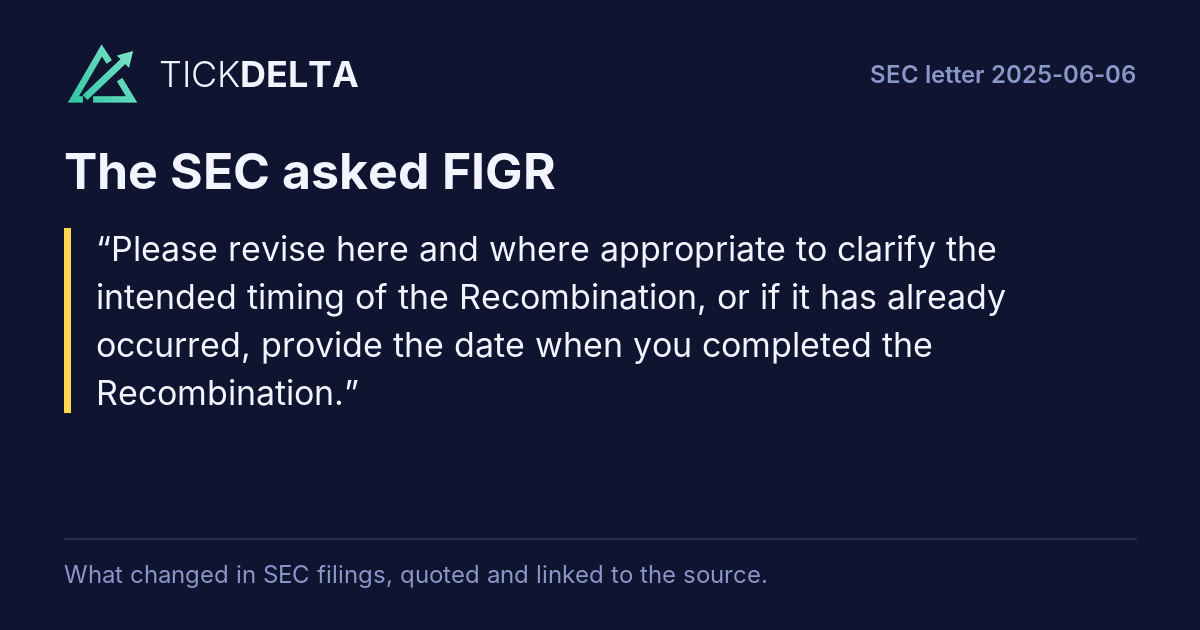
Also in this review: company letter, 2025-08-22, company letter, 2025-09-08, company letter, 2025-09-08