tickdelta
Sign in

Tickdelta is free for now. Sign up and get Pro free

← Screener

FISFidelity National Information Services

Financials · Business Services · NYSE

FIS is a financial technology company providing solutions to financial institutions, businesses and developers. 10-K, Item 1

Employees
44,000
Headquarters
Jacksonville, FL
Next results
around Feb 23, 2027
Compare with peers → Embed

When the SEC's staff reviews a filing, it writes to the company with numbered questions, and the company answers each one in a letter. SEC publishes the exchange once the review is over, at least 20 business days later. Below: what the staff asked FIS, and the company's answer to each question, quoted from the letters. A question is not an accusation; most reviews end with the company adding detail to its next filing.

Form 10-K for the fiscal Year Ended December 31, 2023

2024-05-06 to 2024-06-21 · 3 questions · 1 letter from the SEC, 1 from the company
Review closed 2024-06-21
Non-GAAP measuresLiquidity and cashAcquisitions
SEC asked (1)
Please provide a clear description of the process for calculating the constant currency amounts. Refer to Question 104.06 of the Non-GAAP Financial Measures Compliance and Disclosure Interpretations..
FIS answered
In response to the Staff’s comment, the Company will update its disclosure when presenting revenue on a constant currency basis in future earnings releases and similar materials as follows:

Adjusted revenue growth reflects the percentage change in constant currency revenue for the current period as compared to the prior period. Constant currency revenue is calculated by applying prior-period foreign currency exchange rates to current-period revenue. When referring to adjusted revenue growth, revenue from our Corporate and Other segment is excluded. Read in the reply ↗
Free cash flow, page 9
SEC asked (2)
Please revise the title of your free cash flow measure to adjusted free cash flow or a similar description as your calculation differs from the typical calculation of cash flows from operating activities less capital expenditures. Refer to Question 102.07 of the Non- GAAP Financial Measures Compliance and Disclosure Interpretations.
Rest of the question

Notes to Unaudited - Supplemental GAAP to Non-GAAP Reconciliations for the three months and years ended December 31, 2023 and 2022.

FIS answered
In response to the Staff’s comment, the Company will use the title “adjusted free cash flow” in future earnings releases and similar materials.

Notes to Unaudited—Supplemental GAAP to Non-GAAP Reconciliations for the three months and years ended December 31,

2023 and 2022. Read in the reply ↗
In its next report

First report after the company's reply of 2024-06-03: 10-Q filed 2024-08-06 ↗, against the 10-Q filed 2023-11-07 ↗.

Tickdelta does not hold the text of both reports, so they are not compared here.
Exhibit H, page 13
SEC asked (3)
We note your adjustment for acquisition, integration and other costs includes “Enterprise transformation, including Future Forward and platform modernization.” Please tell us the nature of these costs, your consideration of Question 100.01 of the Non-GAAP Financial Measures Compliance and Disclosure Interpretations, including why they are not related to normal, recurring, cash operating expenses and explain why this
Rest of the question

adjustment is deemed “non-operational.”

FIS answered
The Company respectfully acknowledges the Staff’s comment and advises the Staff that the Company has considered the guidance in Question 100.01 of the Non-GAAP Financial Measures Compliance and Disclosure Interpretations. The Company’s enterprise transformation costs for 2023 of $335 million (comprised of $312 million from continuing operations and $23 million from discontinued operations) related to (1) our “Future Forward” enterprise transformation announced in the third quarter of 2022 (approximately $227 million), (2) a multi-year platform modernization and development organization
Rest of the answer

transformation program announced in the third quarter of 2021 (approximately $60 million) and (3) a post-pandemic workspace transformation program (approximately $48 million).

The following information is provided to the Staff in response to the Staff’s comment.

Future Forward

Our Future Forward enterprise transformation is a large-scale, multi-year program designed to fundamentally change how the company behaves and create permanent structural cost savings. Future Forward is part of a broader initiative to radically transform the enterprise and improve our performance. This initiative also included the appointment of a new management team and the evaluation of strategic alternatives for our Worldpay merchant acquiring business, which concluded in the sale of a 55% interest in Worldpay to funds affiliated with GTCR in January 2024. The cost adjustments associated with our Future Forward program represent incremental, non-recurring costs that are not reflective of our operating performance and are primarily related to (1) incremental non-recurring external consulting fees related to the overall program, (2) costs for discrete, non-recurring strategic projects under the program, including incremental third-party professional services fees required to implement certain initiatives and discretionary incremental one-time incentives paid to non-executive officers for successful execution, and (3) one-time transition fees associated with outsourcing certain operations. We expect the Future Forward program to be substantially implemented by the end of 2025, with some remaining non-recurring costs in 2026. Based on the significant, discrete, transformational nature of this program, we do not consider the incremental Future Forward expenses to be normal, recurring cash operating expenses necessary to operate our business.

Platform Modernization and Development Organization Transformation

Our platform modernization and development organization transformation initiative is a generational program designed to (1) accelerate the retirement of over a dozen of our platforms that have been in use for between 20 and 55 years, as we consolidate onto our strategic platforms, (2) transform our networks and migrate applications and enterprise data to strategic, centralized cloud-based platforms, and (3) transform and restructure our product development organization to fundamentally re-engineer the product development process and integrate systems, people, process and data across the broader organization. These discrete, non-recurring strategic projects are transformative in nature and, once complete, are expected to generate significant cost savings over time. This work is expected to be substantially complete by the end of 2025, with a small tail expected to occur in 2026, with the length of the program driven in large part by the complexity of migrating a significant number of customers to the strategic platforms without disrupting our clients’ operations. The costs excluded in our non-GAAP financial measures relate to one-time migration expenses and temporarily duplicative costs from operating redundant platforms during the migration period, in addition to the non-recurring costs associated with our process re-engineering. As such, we do not consider the incremental platform and development organization transformation expenses to be normal, recurring cash operating expenses.

Post-Pandemic Workspace Transformation

Our post-pandemic workspace transformation program involved a broad transformation of our entire real estate portfolio to support more hybrid work, leading to a number of office actions, including closures, right-sizing and reconfigurations. In total, we reduced the number of sites by 60%, including redundant sites from our 2019 Worldpay acquisition, and reconfigured our key sites to accommodate hybrid work arrangements. The workspace transformation program was largely completed in 2023, although we expect to incur additional expenses through the end of non-cancelable lease terms on properties that have been abandoned.

Finally, in response to the Staff’s comment about our use of the term

“non-operational in nature,” which appears in the definitions of Adjusted EBITDA and Adjusted Net Earnings in our press release, that term was intended to mean that those items did not reflect normal, recurring operating expenses. In order to avoid any confusion in future releases, we plan to revise those definitions to read as follows:

“Adjusted EBITDA reflects net earnings (loss) before interest, other income (expense), taxes, and depreciation and amortization, and excludes certain costs and other transactions that management deems non-operational in nature, or that otherwise improve the comparability of operating results across reporting periods by their exclusionthat do not constitute normal, recurring, cash operating expenses necessary to operate our business. This measure is reported to the chief operating decision maker for purposes of making decisions about allocating resources to the segments and assessing their performance. For this reason, adjusted EBITDA, as it relates to our segments, is presented in conformity with Accounting Standards Codification 280, Segment Reporting, and is excluded from the definition of non-GAAP financial measures under the Securities and Exchange Commission’s Regulation G and

Item 10(e) of Regulation S-K.

Adjusted net earnings excludes the impact of certain costs and other transactions which management deems non-operational in nature or that otherwise improve the comparability of operating results across reporting periods by their exclusion. These include, among others, the impact of acquisition-related purchase accounting amortization which is recurring. the effect of purchase price amortization, as well as certain costs that do not constitute normal, recurring, cash operating expenses necessary to operate our business.”

Consistent with the guidance in

Question 100.01 of the Non-GAAP Financial Measures Compliance and Disclosure Interpretations and our Company’s non-GAAP policy, the Company does not believe that excluding our enterprise transformation expenses from our non-GAAP performance measures is misleading. Given the nature of the related costs and the significance of the transformations, as well as the expectation for the spending on these discrete and independent initiatives to cease at the end of the respective programs and not recur in the foreseeable future, we believe the costs are not reflective of our future ongoing operations and that their inclusion in our performance measures would adversely affect the comparability of the Company’s operational results between periods and among the Company’s peers.

* * * * * * * *

In connection with its response to the Staff’s comments, the Company acknowledges that the Company and its management are responsible for the accuracy and adequacy of its disclosures, notwithstanding any review, comments, action or absence of action by the Staff. If you have any questions or comments about this letter, please call me at (904) 831-4681.

Read in the reply ↗
In its next report

First report after the company's reply of 2024-06-03: 10-Q filed 2024-08-06 ↗, against the 10-Q filed 2023-11-07 ↗.

Tickdelta does not hold the text of both reports, so they are not compared here.

Also in this review: closing letter, 2024-06-21
Form 10-K for the Fiscal Year Ended December 31, 2022

2023-09-06 to 2023-12-05 · 7 questions · 3 letters from the SEC, 3 from the company
Review closed 2023-12-05
ClimateResults discussion (MD&A)Risk factors
After reviewing your response to these comments, we may have additional comments. General
SEC asked (1)
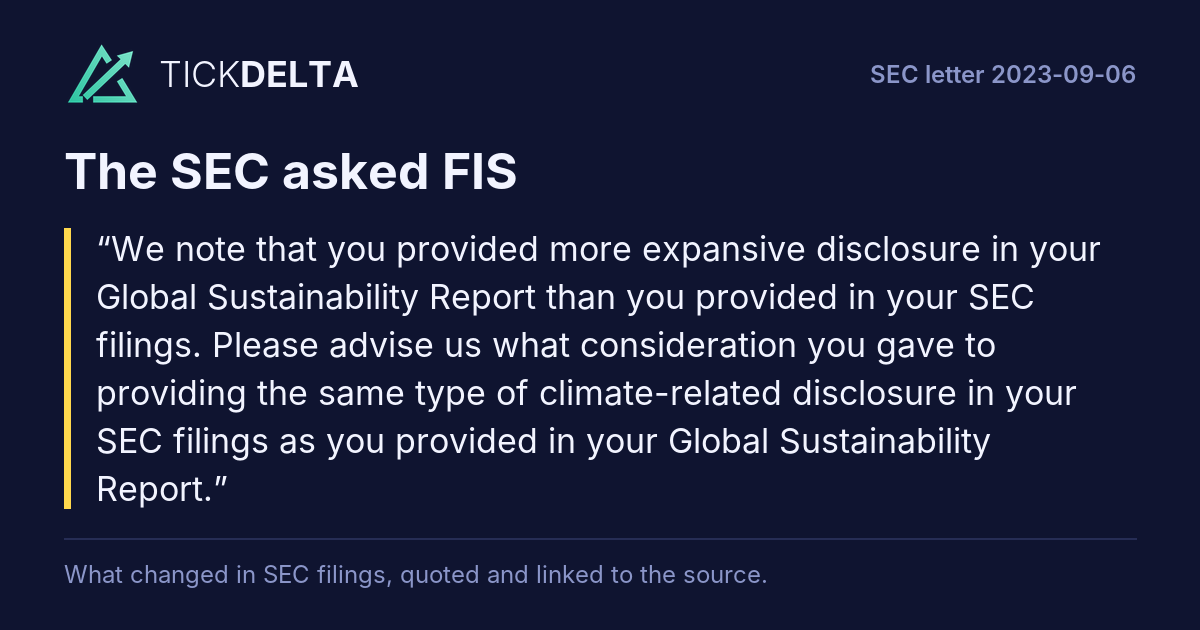
We note that you provided more expansive disclosure in your Global Sustainability Report than you provided in your SEC filings. Please advise us what consideration you gave to providing the same type of climate-related disclosure in your SEC filings as you provided in your Global Sustainability Report.
FIS answered
The Company respectfully acknowledges the Staff’s comment and agrees that the Company’s 2022 Global Sustainability Report (the “Global Sustainability Report”) contained more expansive climate-related discussion compared with the

Company’s disclosures in the Form 10-K.

In preparing the Form

10-K, the Company carefully considered its disclosure obligations under applicable U.S.
Rest of the answer

securities laws and regulations, including judicial interpretations thereof and applicable materiality standards, while also taking into account the Commission Guidance Regarding Disclosure Related to Climate Change (Release No. 33-9106, Feb. 2, 2010) and other relevant Commission guidance and interpretative advice. The

Company also reviewed, and continues to follow the development of, the Commission’s proposed Rules regarding The Enhancement and Standardization of Climate-Related Disclosures for Investors (Release No. 33-11042, March 21, 2022).

After thoughtful deliberation and internal review and discussion, the Company’s management reasonably concluded that the effects of climate change were not material to the Company and its operations with respect to the period covered by the

Form 10-K, and that the disclosures in the Form 10-K were adequate and appropriate given the nature of the Company’s business.

In contrast to the Form 10-K, the Global Sustainability Report is prepared for a broader range of stakeholders, including employees, customers, suppliers, certain investors and business partners, as well as the communities in which the Company operates. The Global Sustainability Report is intended to highlight the Company’s ongoing initiatives related to climate change and other Environmental, Social and Governance (“ESG”) topics that may be of interest to this wider audience of Company stakeholders. The climate-related information contained in the Global

Sustainability Report reflects, in significant part, discussions between the Company and its stakeholders and a desire to be responsive to such stakeholders’ feedback and requests for information concerning ESG matters. The inclusion of such information in the Global Sustainability Report also reflects the Company’s consideration of certain voluntary third-party disclosure frameworks, including the disclosure frameworks promulgated by the Sustainability Accounting Standards Board, the Global Reporting Initiative (“GRI”), the Task Force on Climate-Related Financial Disclosures, the Greenhouse Gas Protocol and the Company’s own assessment of what might be useful or informative for the benefit of its various stakeholders. “Material” and “materiality,” as such terms are defined by GRI and reflected in the Global Sustainability Report, for example, are different and broader than how those terms are defined and used in the context of the filings with the Commission as defined under Basic Inc. v. Levinson, 485 U.S. 224 (1988) or U.S. securities laws and regulations. The Company believes that the Global Sustainability Report would be less informative to the relevant stakeholders if such report only included information that the Company is required by law or regulation to disclose in its filings with the Commission. In this regard, the Company respectfully advises the Staff that the Company’s voluntary inclusion of climate-related information in the Global Sustainability Report is not intended to imply that such information is material under the federal securities laws or is otherwise within the scope of the information required to be disclosed by the Company under U.S. securities laws and regulations.

Accordingly, the Company respectfully advises the Staff that there are no pending or existing climate-related matters that the Company reasonably believes were required under applicable laws and regulations to be further described in the Form 10-K. The Company will continue to monitor evolving regulatory proposals regarding climate change and will include any required additional disclosures in the Company’s future filings with the Commission.

Read in the reply ↗
In its next report

First report after the company's reply of 2023-09-20: 10-Q filed 2023-11-07 ↗, against the 10-Q filed 2023-08-02 ↗.

Tickdelta does not hold the text of both reports, so they are not compared here.

Management's Discussion and Analysis of Financial Condition and Results of Operations, page
SEC asked (2)
To the extent material, discuss the indirect consequences of climate-related regulation or business trends, such as the following: • decreased demand for goods or services that produce significant greenhouse gas emissions or are related to carbon-based energy sources; • increased demand for goods that result in lower emissions than competing products; • increased competition to develop innovative new products that
Rest of the question

result in lower emissions; • increased demand for generation and transmission of energy from alternative energy sources; and • any anticipated reputational risks resulting from operations or products that produce material greenhouse gas emissions.

FIS answered
The Company respectfully acknowledges the Staff’s comment. Set forth below is a response to each bullet point listed in the comment:

The Company respectfully advises the Staff that the Company provides services to a broad base of customers across a range of industries. These services utilize sophisticated software and computer systems, but do not directly emit greenhouse gas (“GHG”) emissions.
Rest of the answer

More details about the Company’s business and customer base are set forth below.

The Company’s Banking Solutions and Capital Market Solutions segments (i) focus on serving financial services clients of all sizes, with no single financial services client representing more than 5% of the Company’s revenues, (ii) do not target their service offerings toward the functions of those financial services clients that are particularly exposed to disruption as a result of climate-related issues and (iii) do not, in the Company’s reasonable judgment, face any material risk that their financial services clients are at risk of being replaced (whether as a whole or in significant part) as a result of climate-related issues or related legal or business shifts. With respect to the Company’s Merchant Solutions segment, which is the subject of a pending sale of a 55% stake in the business, the

Company provides services to a diverse client base of merchants in eCommerce, as well as to enterprise customers and smalland medium-sized businesses. The Merchant Solutions segment’s customer base is not materially concentrated in merchants that produce GHG emissions as a byproduct of their businesses. Lastly, the Company’s Corporate and Other segment does not directly generate any GHG emissions, as it consists solely of corporate overhead expense, certain leveraged functions and miscellaneous expenses that are not included in the aforementioned operating segments, as well as certain non-strategic businesses that the Company plans to wind down or sell.

During the three-year period covered by the Form 10-K, the Company did not experience any decreased demand for goods or services because those goods or services produced significant GHG emissions or because they were related to carbon-based energy sources. As highlighted above, the Company does not produce or sell any goods or services that directly emit GHG emissions, nor is the Company’s customer base materially concentrated in companies that produce GHG emissions as a byproduct of their businesses or that are especially vulnerable to climate-related shifts in the business or legal environment. The Company does not currently expect any material market shift in demand for its services based on climate change-related issues. Nonetheless, the Company is mindful that the consequences of climate change are evolving and have the potential to affect the Company and/or its customers in the future. As such, the Company will continue to monitor the direct and indirect effects of climate change, including effects on the Company’s customers, and if any such developments are reasonably likely to have a material effect on the Company’s business, financial condition or results of operations, the Company will make appropriate disclosures in its future filings with the Commission.

During the three-year period covered by the Form 10-K, the Company did not experience any increased demand for goods that result in lower emissions than competing products. As a services business that does not directly produce GHG emissions as a byproduct of its business, the Company does not currently expect to experience the type of increased demand referenced in this bullet point. However, given that the consequences of climate change are evolving and have the potential to affect the Company and/or its customers in the future, the Company will monitor the likelihood of increased demand for goods that result in lower emissions than competing products, and if such increased demand is reasonably likely to have a material effect on the Company’s business, financial condition or results of operations, the Company will make appropriate disclosures in its future filings with the Commission.

During the three-year period covered by the Form 10-K, the Company did not experience any increased competition to develop innovative new products that result in lower emissions. As a services business that does not directly produce GHG emissions as a byproduct of its business, the Company does not currently expect to experience the type of competition referenced in this bullet point. However, given that the consequences of climate change are evolving and have the potential to affect the Company and/or its customers in the future, the Company will monitor the likelihood of increased competition to develop innovative new products that result in lower emissions, and if such increased competition is reasonably likely to have a material effect on the Company’s business, financial condition or results of operations, the Company will make appropriate disclosures in its future filings with the Commission.

experience increased demand for the generation and transmission of energy from alternative energy sources that has materially impacted the Company’s business, financial condition or results of operations. The Company is not engaged in the generation or transmission of energy, whether from alternative energy sources or otherwise. However, the Company does purchase electricity in the ordinary course of its business. The Company’s energy usage declined by approximately 35% from

2019 to 2022, and the Company continues to explore ways to reduce its energy consumption. In preparing the Form 10-K, the Company’s management reasonably determined that these developments in the

Company’s energy consumption were not material to the Company’s business, financial condition or results of operations. If future changes in energy consumption are reasonably likely to materially impact the Company’s business, financial condition or results of operations, the Company will make appropriate disclosures in its future filings with the Commission.

At the time of filing the Form 10-K the Company was not, and the

Company currently is not, aware of any reputational damage that has occurred or is reasonably anticipated to occur as a result of operations or products that produce material GHG emissions. As noted above, the Company does not have any operations or products that directly emit GHG emissions. The Company will monitor the likelihood of reputational risks resulting from operations or products that produce material GHG emissions, and if such risks are reasonably likely to have a material effect on the Company’s business, financial condition or results of operations, the Company will make appropriate disclosures in future filings with the Commission.

Read in the reply ↗
In its next report

First report after the company's reply of 2023-09-20: 10-Q filed 2023-11-07 ↗, against the 10-Q filed 2023-08-02 ↗.

Tickdelta does not hold the text of both reports, so they are not compared here.

Management's Discussion and Analysis of Financial Condition and Results of Operations, page
SEC asked (3)
Discuss the physical effects of climate change on your operations and results. This disclosure may include the following: • severity of weather, such as floods, hurricanes, sea levels, arability of farmland, extreme fires, and water availability and quality; • quantification of material weather-related damages to your property or operations; • potential for indirect weather-related impacts that have affected or may
Rest of the question

affect your major customers or suppliers; and • any weather-related impacts on the cost or availability of insurance. Your response should include quantitative information for each of the periods for which financial statements are presented in your Form 10-K and explain whether changes are expected in future periods.

FIS answered
should include quantitative information for each of the periods for which financial statements are presented in your Form 10-K and explain whether changes are expected in future periods.

RESPONSE:

The Company respectfully acknowledges the Staff’s comment. Set forth below is a response to each bullet point listed in the comment:

As disclosed in Part I, Item 2 of the Form 10-K, in addition to the Company’s corporate headquarters in Jacksonville, Florida, the Company owns or leases support centers, data processing facilities and other facilities at approximately 110 locations around the
Rest of the answer

world. During the three-year period covered by the Form 10-K, the Company did not experience any material physical effects or material damage to its operations due to severe weather. During such three-year period, the two most significant weather-related events were: (1) a temporary disruption of the Company’s operations in its Cebu City, Philippines office as a result of Typhoon Odette, which struck the Philippines in December 2021; and (2) minor physical damage to the Company’s office in Orlando, Florida, as a result of Hurricane Ian in September 2022, neither of which had a material effect on the Company’s operations. The Company will monitor the likelihood of severe weather and any resulting material impact on the Company’s properties or operations, and to the extent any such developments are reasonably likely to materially impact the Company’s business, financial condition or results of operations, the Company will make

During the three-year period covered by the Form 10-K, the Company did not experience any material weather-related damages to its property or operations. The damages and disruptions due to Typhoon Odette in 2021 and Hurricane Ian in 2022 resulted in less than $100,000 in aggregate losses to the Company, which the Company’s management reasonably determined were not material. The Company will monitor the likelihood of material weather-related damages to its property or operations, and to the extent any such developments are reasonably likely to materially impact the Company’s business, financial condition or results of operations, the Company will make appropriate disclosures in its future filings with the Commission.

During the three-year period covered by the Form 10-K, the

Company did not experience indirectly the effects of weather-related impacts that affected the Company’s major customers or suppliers. The Company will monitor the likelihood of indirect weather-related impacts that may affect the

Company’s major customers or suppliers, and to the extent any such developments are reasonably likely to materially impact the Company’s business, financial condition or results of operations, the Company will make appropriate disclosures in its future filings with the Commission.

During the three-year period covered by the Form 10-K, the Company did not experience any weather-related impacts on the cost or availability of insurance to the Company. The Company did experience an approximately 3% cumulative cost increase over the three-year period for property and casualty insurance premiums purchased in the ordinary course of business. To the Company’s knowledge, such cost increase was principally based on the Company’s revenue and headcount rather than weather-related impacts. In preparing the Form

10-K, the Company’s management reasonably determined that this modest increase in insurance costs was not material to the Company’s business, financial condition or results of operations. The Company will monitor the likelihood of weather-related impacts that may affect the cost or availability of insurance to the Company, and to the extent any such developments are reasonably likely to materially impact the Company’s business, financial condition or results of operations, the Company will make appropriate disclosures in its future filings with the Commission.

Read in the reply ↗
In its next report

First report after the company's reply of 2023-09-20: 10-Q filed 2023-11-07 ↗, against the 10-Q filed 2023-08-02 ↗.

Tickdelta does not hold the text of both reports, so they are not compared here.

Management's Discussion and Analysis of Financial Condition and Results of Operations, page
SEC asked (4)
We note you disclose in your Global Sustainability Report that you purchased and retired carbon credits in the amounts 7,200, 4,363, 0, and 0 scope metric tonnes CO2 for the years ended December 31, 2022, 2021, 2020, and 2019 respectively.
Rest of the question

Please tell us how you considered providing disclosure about the purchase of carbon credits or offsets and any material effects on your business, financial condition, and results of operations. Please also discuss any purchase or sale of carbon credits or offsets in future periods and ensure you provide quantitative information with your response.

FIS answered
The Company respectfully acknowledges the Staff’s comment. The Company respectfully advises the Staff that the Company purchased carbon credits in the amount of $72,000, $35,000, $0 and $0 with respect to the years ended December 31, 2022, 2021, 2020 and 2019, respectively. In preparing the Form 10-K, the Company’s management reasonably determined that the purchase of an aggregate of $107,000 of carbon credits during the period covered by the Form 10-K was not material to the Company’s business, financial condition or results of operations.
Rest of the answer

The Company continues to evaluate the use of carbon credits or offsets to meet its business needs and currently does not expect that any future purchases of carbon credits or offsets will materially affect its business, financial condition or results of operations. To the extent any such future purchases become reasonably likely to materially impact the Company’s business, financial condition or results of operations, the Company will make appropriate disclosures in its future filings with the Commission.

* * * * * * * *

In connection with its response to the Staff’s comments, the Company acknowledges that the Company and its management are responsible for the accuracy and adequacy of its disclosures, notwithstanding any review, comments, action or absence of action by the Staff. If you have any questions or comments about this letter, please call me at (904)

831-4681.

Read in the reply ↗
In its next report

First report after the company's reply of 2023-09-20: 10-Q filed 2023-11-07 ↗, against the 10-Q filed 2023-08-02 ↗.

Tickdelta does not hold the text of both reports, so they are not compared here.

Management's Discussion and Analysis of Financial Condition and Results of Operations, page
SEC asked (1)
We note your response to prior comment 2 that you do not directly emit GHG emissions as a byproduct of your business. However, your Global Sustainability Report discloses Scope 1, 2 and 3 emissions. We further note such report states that your real estate portfolio is critical to pursuing ESG excellence as it relates to energy efficiency and renewable energy, and that you may be exposed to new costs from potential
Rest of the question

governmentimposed carbon tax or cap and trade schemes. Please explain in greater detail your analysis of the following indirect consequences of climate-related regulations or business trends and any conclusions as to materiality: • decreased demand for goods or services that produce significant greenhouse gas emissions or are related to carbon-based energy sources; • increased demand for goods that result in lower emissions than competing products; • increased competition to develop innovative new products that result in lower emissions; and • increased demand for generation and transmission of energy from alternative energy sources. In addition, please discuss potential reputational risks resulting from operations or products that produce material greenhouse gas emissions.

FIS answered
The Company respectfully acknowledges the Staff’s comment. The Company’s business is to provide technology solutions to a wide range of businesses, including financial institutions, merchants and smalland medium-sized businesses around the world. The Company’s products and services do not directly emit material greenhouse gas

(“GHG”) emissions.
Rest of the answer

However, the Company’s 2022 Global Sustainability Report (“Global Sustainability Report”) disclosed GHG emissions “associated with” the Company’s operations, including Scope 1 (emissions from owned and controlled sources, primarily facilities, data centers and vehicles), Scope 2 (indirect emissions, primarily from the purchase of electricity, chilled water and steam consumed across the Company’s global facility portfolio) and

Scope 3 (other indirect emissions not included in Scope 2).

With respect to the Company’s statements regarding its real estate portfolio being “critical to pursuing ESG excellence as it relates to energy efficiency and renewable energy[,]” the Company respectfully advises the Staff that these statements were made in the context of the Company’s desire to reduce its environmental impact, taking into account the findings learned from its Task Force on Climate-related Financial Disclosures (TCFD) assessment. The Company intended to highlight its efforts to date to utilize energy more efficiently and to promote the use of carbon-free energy alternatives in targeted ways (e.g., making vehicle electric charging stations available where feasible), rather than to comment on the energy efficiency of the Company’s product and service offerings or to suggest that such offerings themselves produce significant GHG emissions.

SERVICES, INC. - 2 -

The Global Sustainability Report also notes that “[f]rom a transition risk perspective, while [the Company] may be exposed to new costs from potential government-imposed carbon tax or cap and trade schemes, the Company’s risk is lowered by its commitment to set long-term science-based targets.” The inclusion of a brief description of this transition risk in the Global Sustainability Report was intended to address the potential business impact of potential climate-related regulatory changes amid the global shift toward a low-carbon economy, not to imply that the Company’s product and service offerings expose it to material risks vis-à-vis carbon taxes or similar schemes or to suggest that such offerings themselves produce significant GHG emissions. In 2022, the Company performed a quantitative climate-related risk assessment to understand the business impact of potential carbon taxes. This carbon pricing assessment was conducted based on established frameworks from the International Energy Agency (IEA), an intergovernmental organization that provides authoritative analysis, data, and policy recommendations on all matters related to energy. The assessment concluded that although the Company faces risk from carbon pricing, the Company believes such risk is not material and can be mitigated through reducing the GHG emissions indirectly produced by its business, including through continued engagement with suppliers to help mitigate Scope 3 emissions. Overall, as described in the Global Sustainability Report, the

TCFD assessment found that the Company “did not have any material risk related to the various categories of climate-related risk[,]” including transition risks.

With respect to the initial three bullets in the Staff’s comment above, the Company respectfully advises the Staff that the Company does not develop, market or sell products, goods or services that produce significant GHG emissions or are related to carbon-based energy sources. While the Company acknowledges the possibility of decreased demand for goods and services that produce significant GHG emissions or are related to carbon-based energy sources, the Company did not experience such reduced demand with respect to its products or services during the three-year period covered by the Form

10-K, and the Company does not currently expect any material change in demand for its products or services based on climate-related factors. Instead, the Company believes that demand for its products and services is primarily driven by its technological innovations; the service, support and reliability it provides to its financial services, enterprise and other business customers; relative pricing and perceived value by its customers relative to its competitors’ offerings; and developments in the overall global economy as well as regional economies. Similarly, during the three-year period covered by the Form 10-K, the Company did not experience any increased competition to develop innovative new products that result in lower emissions, and the Company does not currently expect to experience such competition in the future given the types of products and services offered by the Company. Rather, as described in “Item 1. Business, Competition” of the Form 10-K, the Company believes that it primarily experiences competition based on the following factors: (i) the ability of many of the

Company’s competitors to compete with the Company across multiple solutions, markets and geographies; (ii) the fact that some of the Company’s competitors possess greater financial, sales and marketing resources than the Company possesses; (iii) the quality of the technology-based application or service; (iv) application features and functions; (v) ease of delivery and integration; (vi) the ability to maintain, enhance and support the applications or solutions; (vii) price and (viii) overall relationship management.

SERVICES, INC. - 3 -

With respect to the fourth bullet in the Staff’s comment above, the Company did not experience material increased customer demand for the Company to utilize alternative energy sources during the three-year period covered by the Form 10-K. However, the Company is focused on its energy usage

(particularly its data center footprint) and the environmental impact that its operations may have. As noted in the Global Sustainability Report, the Company’s total energy consumption declined by 35% from 2019 to 2022, and the Company remains focused on increasing its sourcing of renewable energy (but does not currently expect any such developments to have a material impact on its business, financial condition or results of operations).

Lastly, with regard to potential reputational risks, the Company does not have products or services that directly emit material GHG emissions

(unlike, for example, a manufacturer of automobiles). However, the Company actively tracks, reports on and seeks to mitigate the impact of GHGs associated with its operations, and the Company continues to address stakeholder expectations through its continued stakeholder engagement efforts. Based upon the foregoing, the Company believes that the likelihood of adverse reputational impacts related to operations or products that produce material GHG emissions is low.

Read in the reply ↗
In its next report

First report after the company's reply of 2023-10-19: 10-Q filed 2023-11-07 ↗, against the 10-Q filed 2023-08-02 ↗.

Tickdelta does not hold the text of both reports, so they are not compared here.

Management's Discussion and Analysis of Financial Condition and Results of Operations, page
SEC asked (2)
We note your response to prior comment 3. Please further address the following: • We note your risk factor on page 15 discussing that your systems and operations could be exposed to damage or interruption from severe weather events and other natural disasters. Please tell us how you considered disclosing the uncertainties and risks of climate-related physical effects on your business and operations around the world.
Rest of the question

In that regard, we note your Global Sustainability Report reflects that the TCFD assessment found that water stress may pose a risk to you, and you are planning to take measures to mitigate risks associated with water stress. • Please discuss how your business and operations could be impacted to the extent your customers or suppliers are impacted by severe weather. • Your response quantifies your increase in insurance premiums. Please also quantify the cost of insurance premiums for each of the periods covered by your Form 10-K. Please contact Michael Purcell at 202-551-5351 or Karina Dorin at 202-551-3763 with any questions.

FIS answered
quantifies your increase in insurance premiums. Please also quantify the cost of insurance premiums for each of the periods covered by your Form 10-K.

RESPONSE:

The Company respectfully acknowledges the Staff’s comment. Set forth below is a response to each bullet point listed in the comment:

interruption from severe weather events and other natural disasters. Please tell us how you considered disclosing the uncertainties and risks of climate-related physical effects on your business and operations around the world.
Rest of the answer

In that regard, we note your Global Sustainability Report reflects that the TCFD assessment found that water stress may pose a risk to you, and you are planning to take measures to mitigate risks associated with water stress.

SERVICES, INC. - 4 -

As part of the preparation of the Form 10-K, the

Company’s management assessed prior severe weather events and their effect on the Company in order to determine (i) whether any such events had occurred that were sufficiently material to warrant disclosure in the Form 10-K and (ii) whether there was a risk of future severe weather events that were reasonably likely to have a material effect on the Company’s business, financial condition or results of operations. As noted in the Initial Response Letter, during the three-year period covered by the Form 10-K, the Company experienced minor physical damage or disrupted operations due to two severe weather events, which events resulted in less than $100,000 in aggregate losses. Consequently, the Company’s management reasonably determined that these events were not material. While the Company’s management is unable to predict the occurrence, timing or severity of future weather events that may adversely impact the Company, the Company does not believe that it faces a material risk to its business or operations from climate-related physical effects. The Company’s recently opened headquarters in

Jacksonville, Florida, was constructed in accordance with LEED Platinum certification standards and is built to withstand natural disasters, including a 500-year water-related weather event. In recent years, the Company has moved data centers to lower-risk areas. The Company also has a globally distributed workforce and a hybrid work program, which provides an additional level of operational resiliency. The Company’s business continuity plans also account for the transfer of processes and functions to alternate locations should the Company’s facilities be impacted by a climate-related event.

The Company acknowledges that the TCFD assessment referenced in the Global Sustainability Report did note that “inland flooding and water stress were possible physical risks to the Company, but…the Company had operational redundancy and other mitigating measures integrated into its current business plans[,]” which are described above. The TCFD assessment concluded that the threat of water stress did not pose a material risk to the Company.

While the Company’s management is unable to predict the occurrence, timing or severity of future weather events that may adversely impact the Company’s customers or suppliers, given the diversified nature of the Company’s customer and supplier base (both geographically and otherwise), weather-related impacts on the

Company’s customers or suppliers have not had, and are not currently expected to have, a material impact on the Company’s business, financial condition or results of operations. With respect to customers, the Company provides its solutions to a diverse range of businesses, including financial institutions, eCommerce and other merchants and smalland medium-sized businesses, with no single customer representing more than 5% of the Company’s revenues. Additionally, the Company’s customers are dispersed geographically in over 100 countries across North America, South America, Europe, the Middle East, Africa and Asia, such that the loss of one customer or a few customers in a particular country or region would not be expected to result in a material adverse effect on the Company’s business, financial condition or results of operations. In addition, although the majority of the Company’s revenue is generated by customers in the United States, the Company’s business is geographically dispersed across most U.S. states such that a severe weather event in one state that might impact one or more customers would not be expected to result in a material adverse effect on the Company’s business, financial condition or results of operations. The Company’s technology and other suppliers are similarly diverse, and therefore the Company believes that it does not face any material risk to its business, financial condition or results of operations due to weather-related impacts on its suppliers.

SERVICES, INC. - 5 -

Your response quantifies your increase in insurance premiums. Please also quantify the cost of insurance

Rule 83

Confidential Treatment Request by Fidelity National Information Services, Inc. Request #1

The Company respectfully acknowledges the

Staff’s comment. The Company’s aggregate cost of property and casualty insurance premiums for the years ended December 31, 2022, 2021 and 2020 was $[***], $[***] and $[***], respectively.

Fidelity National Information Services, Inc. respectfully requests that the information contained in this Request #1 be treated as confidential information and that the Commission provide timely notice to the individual noted on the Company’s accompanying Rule 83 cover letter prior to disclosure of any such information.

* * * * * * * *

In connection with its response to the Staff’s comments, the Company acknowledges that the Company and its management are responsible for the accuracy and adequacy of its disclosures, notwithstanding any review, comments, action or absence of action by the

Staff. If you have any questions or comments about this letter, please call me at (904) 831-4681.

Read in the reply ↗
In its next report

First report after the company's reply of 2023-10-19: 10-Q filed 2023-11-07 ↗, against the 10-Q filed 2023-08-02 ↗.

Tickdelta does not hold the text of both reports, so they are not compared here.

Management's Discussion and Analysis of Financial Condition and Results of Operations, page
SEC asked
We note your response to prior comment 1 that your 2022 Global Sustainability Report disclosed Scope 1, 2, and 3 emissions "associated with" the Company's operations. We further note such report reflects that your operations include greenhouse gas emissions relating to the purchase of electricity, chilled water and steam consumed across your global facility portfolio, including your data centers and facilities.
Rest of the question

Please explain in greater detail how you determined that there was no increased demand for generation and transmission of energy from alternative energy sources and discuss the potential adverse consequences to your reputation resulting from your operations that produce greenhouse gas emissions.

FIS answered
The Company respectfully acknowledges the Staff’s comment. Below please find greater detail (i) as to how the Company determined that there was no increased demand for generation and transmission of energy from alternative energy sources and

(ii) regarding the potential adverse consequences to the Company’s reputation resulting from operations that produce greenhouse gas (“GHG”) emissions.

“[D]emand for generation and transmission of energy from alternative energy sources”

In connection with the Company’s engagement with the key stakeholders discussed below, such stakeholders have not
Rest of the answer

raised with the Company that it was a priority issue that the Company increase its use of alternative energy sources for generation and transmission of energy in the operation of the Company’s business.

•

Shareholders and the Investment Community. The Company regularly engages with current and prospective shareholders and other members of the investment community, including securities analysts and representatives of large investment managers. As noted in the Company’s 2022 Global Sustainability Report, in 2022 the Company conducted a comprehensive shareholder engagement program in which it sought meetings with its top 32 shareholders, representing the holders of approximately 75% of the Company’s outstanding shares. Based on the Company’s engagement with these top shareholders and other stakeholders in the investment community, the Company believes that such stakeholders’ priority issues are the Company’s overall financial results, growth prospects, business strategy and capital allocation priorities.

Customers. The Company regularly engages with its material customers in an effort to learn more about such customers’ needs and to ensure that the Company’s products and services continue to meet such customers’ current and evolving business challenges in a timely, cost-effective, sustainable and legally compliant manner.

Based on the Company’s engagement with its material customers, the Company believes that such customers’ priority issues are the Company’s technological innovations; the service, support and reliability that the Company provides to its customers; relative pricing and perceived value by the Company’s customers compared with competitors’ offerings; and developments in the overall global economy as well as regional economies.

Lenders. The Company also regularly engages with its current and prospective material lenders under its credit facilities, its commercial paper programs, its senior notes and other potential debt instruments. Based on the Company’s engagement with its current and prospective material lenders, the Company believes that such lenders’ priority issues are the Company’s overall business performance and financial results; the Company’s ability to comply with current or proposed leverage ratios or interest coverage ratios; the Company’s capital allocation strategy; the Company’s ability to incur new indebtedness, or to repay or refinance its outstanding indebtedness; and whether new or modified borrowings would be secured or unsecured and the scope of the covenants applicable to the Company in connection therewith.

Consistent with the Company’s prior response, if future demands for increased use of alternative energy sources for generation and transmission of energy in the operation of the Company’s business are reasonably likely to materially impact the Company’s business, financial condition or results of operations, the Company will make appropriate disclosures in its future filings with the Commission.

“[P]otential adverse consequences to [the Company’s] reputation resulting from [its] operations that produce greenhouse gas emissions”

Based on its key stakeholders’ priority issues as described above, the

Company has not seen increased demand for generation and transmission of energy from alternative energy sources in the operation of the Company’s business. Regardless, the Company performs an annual survey of its global facilities to measure energy usage (including energy derived from renewable sources) and Scope 1, 2 and 3 emissions, and reports these metrics publicly through its annual Global Sustainability Report. Given this transparency and the Company’s regular engagement with the key stakeholders described above, the Company believes that the likelihood of adverse reputational consequences resulting from operations that produce GHG emissions is low. As noted in the Company’s prior response, the

Company will monitor the likelihood of reputational risks resulting from operations that produce material GHG emissions, and if such risks are reasonably likely to have a material effect on the Company’s business, financial condition or results of operations, the Company will make appropriate disclosures in its future filings with the Commission.

* * * * * * * *

In connection with its response to the Staff’s comments, the Company acknowledges that the Company and its management are responsible for the accuracy and adequacy of its disclosures, notwithstanding any review, comments, action or absence of action by the Staff. If you have any questions or comments about this letter, please call me at (904)

831-4681.

Read in the reply ↗
In its next report

First report after the company's reply of 2023-11-30: 10-K filed 2024-02-26 ↗, against the 10-K filed 2023-02-27 ↗.

Tickdelta does not hold the text of both reports, so they are not compared here.

Also in this review: closing letter, 2023-12-05

Schedule 14A

2022-09-22 to 2022-10-03 · 3 questions · 1 letter from the SEC, 1 from the company
Review closed 2022-10-03
Controls
Definitive Proxy Statement on Schedule 14A filed April 15, 2022 · General
SEC asked (1)
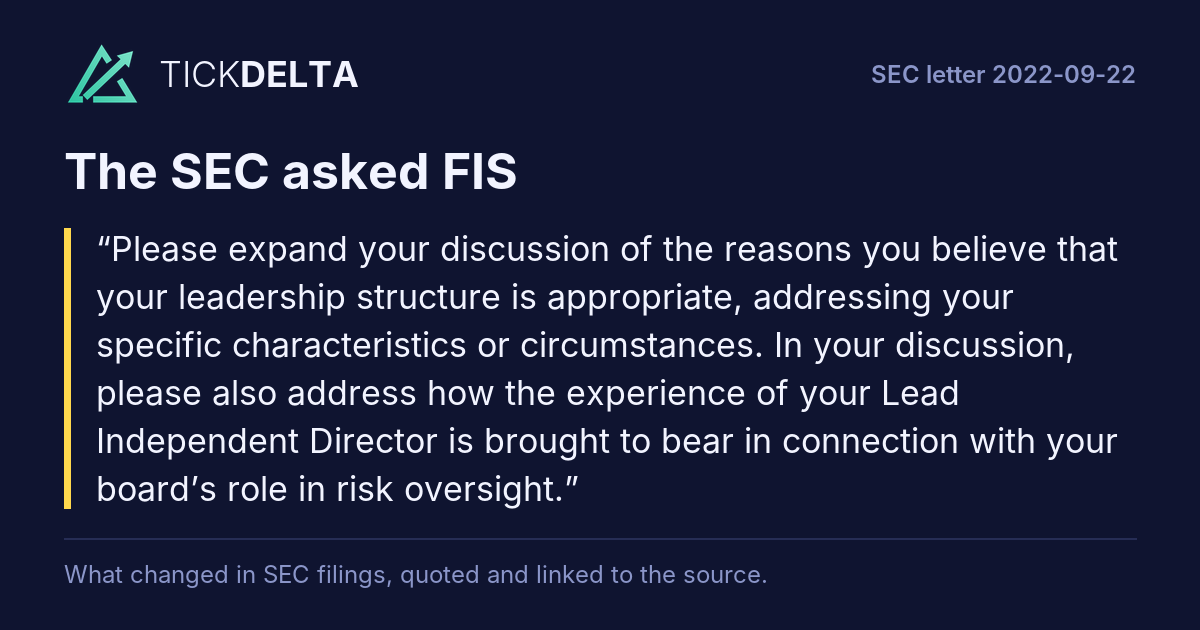
Please expand your discussion of the reasons you believe that your leadership structure is appropriate, addressing your specific characteristics or circumstances. In your discussion, please also address how the experience of your Lead Independent Director is brought to bear in connection with your board’s role in risk oversight.
FIS answered
National Information Services, Inc. (“FIS,” “we” or the “Company”), we hereby acknowledge receipt of the comment letter dated September 22, 2022, from the Staff (the “Staff”) of the Securities and Exchange Commission relating to your review of the above-referenced filing, and confirm that we will address the Staff’s comments in the comment letter in our future filings. One letter for all the questions, without numbered answers. Read the reply ↗
Definitive Proxy Statement on Schedule 14A filed April 15, 2022 · General
SEC asked (2)
Please expand upon the role that your Lead Independent Director plays in the leadership of the board. For example, please enhance your disclosure to address whether or not your Lead Independent Director may: • represent the board in communications with shareholders and other stakeholders; • require board consideration of, and/or override your CEO on, any risk matters; or • provide input on design of the board itself.
FIS answered

See the reply above.

Definitive Proxy Statement on Schedule 14A filed April 15, 2022 · General
SEC asked (3)
Please expand upon how your board administers its risk oversight function. For example, please disclose: • the timeframe over which you evaluate risks (e.g., short-term, intermediate-term, or long-term) and how you apply different oversight standards based upon the immediacy of the risk assessed; • whether you consult with outside advisors and experts to anticipate future threats and trends, and how often you
Rest of the question

re-assess your risk environment; • how the board interacts with management to address existing risks and identify significant emerging risks; • whether you have a Chief Compliance Officer and to whom this position reports; and • how your risk oversight process aligns with your disclosure controls and procedures.

FIS answered

See the reply above.

Also in this review: closing letter, 2022-10-03

Form 10-K

2020-12-30 to 2021-01-26 · 1 question · 1 letter from the SEC, 1 from the company
Review closed 2021-01-26
Executive pay
Executive Compensation, page 101
SEC asked
We note that adjusted earnings per share and total shareholder return are used to set your performance-based cash incentives and performance-based equity incentives, respectively. We also note disclosure in your Form 10-K related to common stock repurchases that occurred from 2017 to 2019.
Rest of the question

In future filings, please discuss if and how the share repurchases affected the manner in which the Compensation Committee set the relevant targets used in your compensation plan and determined whether such targets were met.

FIS answered
On behalf of Fidelity National Information Services, Inc. (“FIS,” “we” or the “Company”), we hereby submit the following response to the comment letter dated December 30, 2020, from the Staff (the “Staff”) of the Securities and Exchange Commission relating to your review of the Form 10-K of FIS for the fiscal year ended December 31, 2019 filed on February 20, 2020.
Rest of the answer

To assist your review, we have retyped the text of those comment below.

Form 10-K, Filed February 20, 2020

We note that adjusted earnings per share and total shareholder return are used to set your performance-based cash incentives and performance-based equity incentives, respectively. We also note disclosure in your Form 10-K related to common stock repurchases that occurred from 2017 to 2019. In future filings, please discuss if and how the share repurchases affected the manner in which the Compensation Committee set the relevant targets used in your compensation plan and determined whether such targets were met.

The Company acknowledges the Staff’s comment. In future filings, we will discuss if and how share repurchases affect the manner in which the relevant targets in our compensation plan are set by our Compensation Committee and their determination of whether such targets were met.

*****************

Please let us know any further comments at the Staff’s earliest convenience. If you have any questions regarding this letter, please contact me at your convenience at woody.woodall@fisglobal.com or 904.438.6735.

Read in the reply ↗
In its next report

First report after the company's reply of 2021-01-05: 10-K filed 2021-02-18 ↗, against the 10-K filed 2020-02-20 ↗.

Tickdelta does not hold the text of both reports, so they are not compared here.

Also in this review: closing letter, 2021-01-26

Form 10-K

2018-09-12 to 2018-11-08 · 1 question · 1 letter from the SEC, 2 from the company
Review closed 2018-11-08
RevenueNon-GAAP measuresAcquisitions
SEC asked
We note that your earnings release includes non-GAAP measures for Adjusted net earnings and Adjusted EPS, which primarily include adjustments to eliminate amortization expense on all intangible assets acquired in various Company acquisitions and to eliminate acquisition, integration and severance expenses that management deems non-operational primarily related to the SunGard acquisition.
Rest of the question

Please tell us in more detail why you believe measures of net earnings and EPS that are adjusted for these items are meaningful to investors. As part of your response, please tell us in more detail what comprises each of these adjustments including the extent to which these adjustments relate to any acquisitions other than SunGard, the frequency with which you have historically made acquisitions that contribute to these adjustments, and the length of time over which these adjustments will be needed; along with better explaining to us why it is meaningful to present metrics that include all of the revenue from your acquisitions but only a portion of the related expenses. We may have further comments after reviewing your response.

FIS answered
The Company believes that the non-GAAP measures referred to in the Staff’s comment, Adjusted Net Earnings and Adjusted EPS, are useful to both management and investors because they provide an additional method for assessing FIS’ operating results that is focused on the performance of its operations and is consistent with how management internally evaluates and assesses operating results. Furthermore, these non-GAAP measures address questions the Company routinely receives from its significant shareholders so they can better understand the underlying value of our operations.
Rest of the answer

Since this information is so routinely of interest to our significant shareholders, we want to ensure that all investors have access to this data and, therefore, we include it in our earnings release.

With respect to the purchase accounting amortization adjustment noted by the Staff, our adjustment primarily consists of eliminating the amortization of customer relationships and the incremental amortization of the fair value step-up related to software acquired in business combinations. The incremental amortization resulting from the step-up to fair value in purchase accounting may cause differences when comparing our results to companies that grow internally because the fair value assigned to the intangible assets acquired through acquisition may significantly exceed the equivalent expenses that a company may incur for similar efforts when performed internally. As noted in our Form 10-K, our customer relationships and software are each amortized over their estimated useful lives, which are up to a 10-year period.

Significant acquisitions for the Company have not been frequent. We acquired SunGard on November 30, 2015 for about $9 billion, inclusive of approximately $4 billion of assumed debt, and Metavante Technologies, Inc. on October 1, 2009 for about $4 billion. As illustrated in the table below, these two acquisitions account for 94% of the total purchase accounting adjustment in 2018, with no other acquisition accounting for more than 2% of the adjustment. The ten-year anniversary of the Metavante acquisition falls next year, at which time the purchase accounting adjustments relating to that transaction will end.

Incremental Amortization of

Purchase Accounting Step-Up

Total Purchase

Customer

Accounting

Relationships

Software

Adjustment

SunGard

%

100

Metavante

All Others

Total

With respect to the acquisition, integration and severance adjustment noted by the Staff, our adjustment primarily consists of these types of costs that are related to a significant acquisition, such as SunGard. Following certain acquisitions, the Company initiates programs in connection with the integration of the acquired businesses to eliminate duplicative positions and redundant costs and realign the business structure. As each acquisition has unique facts and circumstances, the extent and timing of any related programs will vary based on the nature, size and type of business acquired. Our typical program runs for 1-3 years after an acquisition, generally on the longer end of that range for a significant acquisition. We purchased SunGard on November 30, 2015 and our acquisition, integration and severance costs related to this acquisition have largely ended as of June 30, 2018. For the periods presented, there are no acquisition, integration and severance costs, other than de minimis amounts, from other acquisitions included within this adjustment.

Over 90% of the costs included within this adjustment are severance, facility and systems consolidation, synergy incentive, and other integration costs. These costs vary in size and frequency and create significant volatility in our operating performance results. Importantly, the elimination of these costs does not result in a reduction of normal, recurring cash operating expenses necessary to conduct the business in the ordinary course. As such, the Company believes that the exclusion of the acquisition, integration and severance costs provide supplemental information that enables the Company’s management and investors to analyze and compare the Company’s operating performance on a consistent basis from period to period and to help them estimate future operating performance.

We include all the revenue earned in our non-GAAP measures as we would be unable to meaningfully separate revenue from our acquired businesses from the rest of our operations upon integration. Similarly, we include all the ongoing operating expenses for the same reason as part of these non-GAAP measures. The costs adjusted as part of the non-GAAP measures are ones that are incremental to ongoing operations and are only incurred due to the acquisitions.

*****************

Please let us know any further comments at the Staff’s earliest convenience. If you have any questions regarding this letter, please contact me at your convenience at katy.thompson@fisglobal.com or 904.438.6611.

Read in the reply ↗

Also in this review: company letter, 2018-10-29, closing letter, 2018-11-08

2 other letters: notices that a filing will not be reviewed, requests to declare a registration effective, and the like

From the SEC's correspondence on EDGAR: staff letters (form UPLOAD) and company letters (form CORRESP), 22 letters filed since 2018-09-12. Questions and answers are matched by their numbers; topics come from words in each question. The reports are compared word for word (same form, before the first SEC letter against the first report after the company's reply). No AI.

Work on FIS in a spreadsheet: Excel workbook (a sheet per section, ten years by column, charts, links to the filings) · CSV. For a Google Sheet that stays up to date, paste =IMPORTDATA("https://tickdelta.com/company/FIS/export.csv") into a cell.