FISVFiserv
Fiserv, Inc. is a leading global provider of payments and financial services technology solutions. 10-K, Item 1
- Employees
- 38,000
- Headquarters
- Milwaukee, WI
- CEO
- Panagiotis Georgakopoulos
- Next results
- around Feb 9, 2027
13 paragraphs in Risk Factors of the 10-K filed Feb 19, 2026 with nothing like them in the 10-K filed Feb 20, 2025. Quoted exactly. Paragraphs that were only edited are under 10-K change.
Compared with the Risk Factors in the latest 10-K of the other 75 Financials companies: a paragraph with at least half its words the same at another company is called similar, and the companies are listed under it. A paragraph most of them have is marked boilerplate. No line means no other company has one like it. This counts text; it does not say how serious a risk is.
We use artificial intelligence in our business, and challenges with properly managing its use could result in legal liability or reputational harm.
We believe that data, and the insights enabled by data, can be used to create or enhance the products and services that we offer to our clients. As a result, we are using, and expect to continue to expand our use of, artificial intelligence and machine learning in our product development processes, services and operations. The use of artificial intelligence technologies carries inherent
Read in the 10-K ↗
In 2025, we announced a strategic plan, referred to as the One Fiserv action plan, that focuses on: operating with a client-first mindset to win new enterprise clients and grow average revenue per client; building the pre-eminent small business operating platform through Clover; creating differentiated, innovative platforms in finance and commerce, including embedded finance and stablecoin; delivering operational excellence enabled by artificial intelligence; and employing disciplined capital allocation for the long-term. To successfully execute the plan, we must implement operational, technological and cultural changes across our organization, which may be difficult to do. In addition, although we have planned for a certain level of expense in implementing the plan, there are factors beyond our control that could cause the total amount or the timing of the expenses we may incur to be different than anticipated. As a result, the actual benefits of the plan may be less significant than anticipated. Furthermore, we may not be able to achieve expected benefits of the plan on our anticipated timeline or at all.
Read in the 10-K ↗
We make significant investments in emerging, innovative areas of financial services and technology that may not achieve expected returns.
We expect to continue to make significant investments in research, development, and marketing for new and existing products, services, and technologies, including embedded finance, stablecoin and artificial intelligence based products and services. We may not achieve significant revenue from our investment in innovative platforms and product offerings for several years, if at all, due to regulatory uncertainty, competitors’ success with similar offerings, lack of demand from our customer base for these offerings, our inability to successfully integrate these offerings into our established platforms, or other factors. New products and services may not be profitable or may not achieve operating margins as high as we have experienced historically.
The costs associated with developing, integrating and deploying these product offerings may be higher than anticipated, and these product offerings may require significant additional investment. Competitors may identify and develop applications for these technologies that reduce our ability achieve our desired financial returns. Our customers’ rate of adoption of novel product offerings may be slower than we anticipate and impact the feasibility of these product offerings going forward. Perceptions of mismanagement, driven by regulatory activity or negative public reaction to our practices or product experiences, could negatively impact product and feature adoption. Developing new technologies is complex. It can require long development and testing periods. We could experience significant delays in new releases or significant problems in creating new products or services. These factors could adversely affect our business, financial condition, and results of operations.
Among the new services we intend to offer is custody for stablecoin reserves held under the GENIUS Act and other stablecoin regulations to help financial institutions retain funds associated with FIUSD stablecoin issuance. Our stablecoin offering has only recently been enabled by regulation. We have made certain assumptions about future stablecoin regulation, but there is no certainty about the favorability of the final regulatory environment. Additionally, given the relative recency of the GENIUS Act, it is not clear what the market demand will be for our stablecoin offering from our financial institution customers.
Our embedded finance business is an emerging product area that could expose us to liability.
Our embedded finance business involves providing financial services to a merchant’s customers. These financial services may be branded in the name of a merchant. In addition, these financial services may be incorporated into the merchant’s products or services or may be used to facilitate financial transactions that permit the merchant to sell more products or services. In some cases, we resell the services of third parties, including financial institutions, technology providers, or program managers. Those
third-party services may be integrated with our own technology or services. We are exposed to financial and performance risks related to the third parties whose services we resell. In addition, we may be contractually entitled to a percentage of the revenue earned by the financial institution or other third party, and accordingly, we may assume risks, either contractually or as a matter of law, that would ordinarily be risks assumed by a financial institution and not by a technology provider. These risks include credit risk, consumer fraud risk, operational risk, and compliance risk. It is possible that state or federal regulators may determine that we are directly subject to regulations that have not previously applied directly to us.
Read in the 10-K ↗
•our clients may decrease spending for value-added services, or may choose another provider with lower processing fees; and
Read in the 10-K ↗
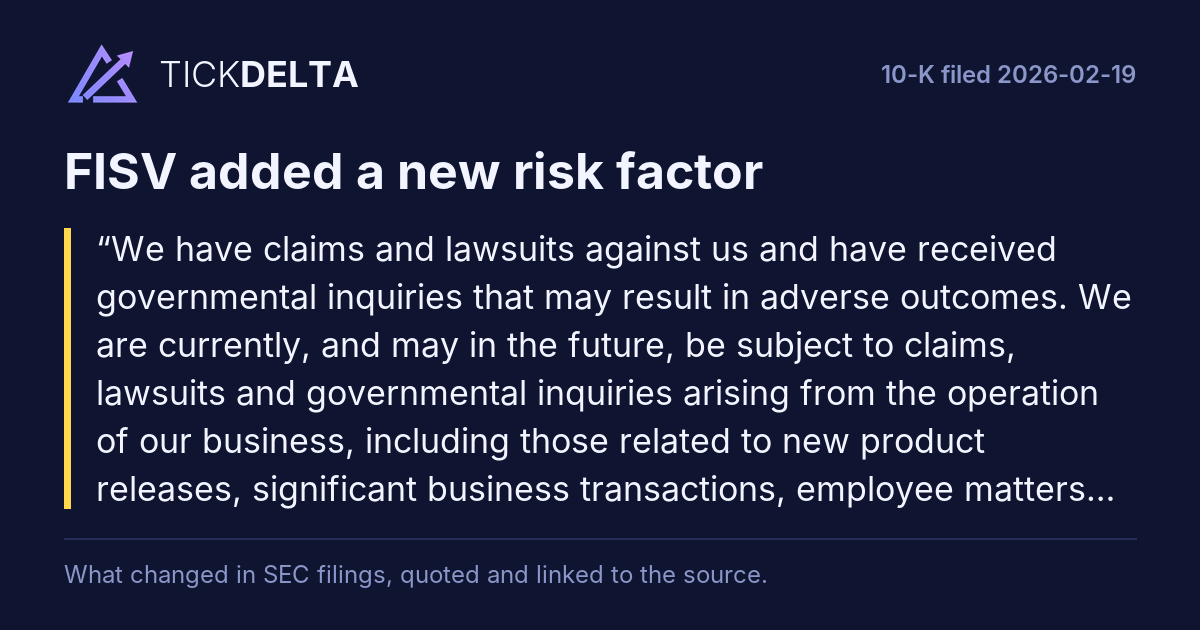
We have claims and lawsuits against us and have received governmental inquiries that may result in adverse outcomes.
We are currently, and may in the future, be subject to claims, lawsuits and governmental inquiries arising from the operation of our business, including those related to new product releases, significant business transactions, employee matters, artificial intelligence activities, and regulation. As described in Note 17. Commitments and Contingencies - Litigation and Investigation Matters to our consolidated financial statements, we are also currently subject to federal securities law complaints, derivative complaints and governmental investigations. As we continue to expand our business and offerings, we may be subject to additional types of legal claims. Any claims asserted against us, regardless of merit or eventual outcome, may harm our reputation. Litigation could be costly, time-consuming and divert attention of our management and employees from daily operational needs. There is no guarantee that we will be successful in defending ourselves in pending or future litigation or similar matters under various laws. Adverse outcomes in some or all of these claims may result in significant monetary damages or injunctive relief that could adversely affect our ability to conduct our business. Litigation and other claims are subject to inherent uncertainties and management’s view of these matters may change in the future. An adverse impact to our financial condition and results of operations could occur for the period in which the effect of an unfavorable outcome becomes probable and reasonably estimable.
Similar paragraph at 1 of 75 other Financials companies: GPNRead in the 10-K ↗
New in the latest 10-Q
25 paragraphs in the 10-Q filed Nov 4, 2026 with nothing like them in the 10-Q filed Aug 7, 2026 (at least half the words must differ; new numbers alone do not count). Quoted exactly, grouped by the item heading above them. This is text that changed, not a judgement of how serious it is.
Financial statements and notes
months ended September 30, 2026. The leasebacks of these facilities are classified as operating leases and are recorded as right-of-use assets and lease liabilities in the consolidated balance sheet.
Read in the 10-Q ↗
During the three months ended September 30, 2026, the Company recognized an impairment charge of $68 million related to a change in the intended use of certain facility operating lease right-of-use assets, resulting in the modification and remeasurement of the related leases. The impairment charge was recorded within selling, general and administrative expenses in the consolidated statement of income (loss). The Company evaluated the right-of-use assets for impairment and estimated their fair values using a discounted cash flow model based primarily on expected future sublease payments (Level 3 of the fair value hierarchy).
Read in the 10-Q ↗
The Company determined the fair value of its reporting units using a discounted cash flow income approach (Level 3 of the fair value hierarchy) as the Company believes it directly reflects the Company’s future growth and operating performance, and engaged an independent valuation specialist to assist in the fair value determinations. Determining the fair value of a reporting unit involves judgment and the use of significant estimates and assumptions, which include assumptions regarding the revenue growth rates and operating margins used to calculate estimated future cash flows, risk-adjusted discount rates and future economic and market conditions. In connection with its interim goodwill impairment test during the third quarter of 2026, the Company used risk-adjusted discount rates ranging from 14 % to 18 %, compound annual revenue growth rates ranging from 1 % to 8 % and terminal growth rates ranging from 0 % to 4 %.
Read in the 10-Q ↗
The table below presents the impairment charge and remaining goodwill balance by reporting unit and corresponding reportable segment:
Read in the 10-Q ↗
Reportable Segments (In millions) Merchant Financial Total Goodwill - December 31, 2025 $ 23,106 $ 14,597 $ 37,703 Acquisition measurement period adjustments (see Note 4) 16 — 16 Dispositions (see Note 4) — (173) (173) Impairment (3,692) (2,760) (6,452) Foreign currency translation (115) (26) (141) Goodwill - September 30, 2026 $ 19,315 $ 11,638 $ 30,953
Read in the 10-Q ↗
September 30, 2026 and 2025, respectively, which is included within other income (expense), net in the consolidated statements of income (loss).
Read in the 10-Q ↗
On September 2, 2026, the Company completed the sale of its student loan servicing business, which was reported within the Financial segment, for net consideration of $ 85 million, of which $ 48 million was received in cash as of September 30, 2026 plus contingent earn-out provisions of up to $ 52 million, which will be recognized upon realization. During the third quarter of 2026, the Company recognized a pre-tax loss on the sale of $ 98 million, recorded within net gain on disposition of businesses and other assets, with a related income tax benefit of $ 6 million, recorded within the income tax provision, in the consolidated statements of income (loss). The pre-tax loss was comprised of the difference between the net cash consideration plus deferred
Read in the 10-Q ↗
payments and the net carrying amount of the business, including $ 77 million of capitalized software, $ 73 million of goodwill, and $ 33 million of other net assets.
Read in the 10-Q ↗
On August 5, 2026, the Company completed the sale of a 51 % controlling financial interest in its MoneyPass Network, ATM Managed Services and Cash Intelligence businesses (“MoneyPass Group”), which were reported within the Financial segment, for net cash proceeds of $ 102 million. The 51 % controlling financial interest consists of preferred units with an annual cumulative preferred return. Prior to the closing of the transaction, MoneyPass Group obtained $ 218 million, net of fees, of third-party debt financing. The proceeds from this debt financing were primarily distributed to the Company. Following the transaction, the Company retained a 49 % noncontrolling ownership interest in MoneyPass Group. Upon deconsolidation, the Company recognized its retained ownership interest at fair value and recorded a pre-tax gain of $ 198 million, representing the excess of the consideration received and the fair value of the retained interest over the carrying amount of the net assets derecognized. The carrying amounts of the assets and liabilities derecognized primarily included $ 97 million of customer relationship intangible assets, $ 100 million of goodwill, and $ 218 million of long-term debt. The pre-tax gain was recorded within net gain on disposition of businesses and other assets, and the related income tax expense of $ 71 million was recorded within the income tax provision, in the consolidated statements of income (loss).
Read in the 10-Q ↗
In connection with the transaction, the Company entered into a services agreement to provide certain processing and other support services to MoneyPass Group for defined service fees. MoneyPass Group is a variable interest entity, and the Company holds variable interests through its 49 % ownership interest and the services agreement. The Company is not the primary beneficiary of MoneyPass Group because it does not control MoneyPass Group’s board of directors, which maintains the power to direct the activities that most significantly impact MoneyPass Group’s economic performance, and, therefore, does not consolidate MoneyPass Group. The Company accounts for its retained ownership interest under the equity method. At September 30, 2026, the carrying amount of the Company’s investment in MoneyPass Group was $ 107 million and was included within investments in unconsolidated affiliates in the consolidated balance sheet.
Read in the 10-Q ↗
The income tax provision as a percentage of income (loss) before income taxes and income (loss) from investments in unconsolidated affiliates was ( 2.4 )% and 17.9 % for the three months ended September 30, 2026 and 2025, respectively, and ( 7.1 )% and 18.4 % for the nine months ended September 30, 2026 and 2025, respectively. The effective income tax rate for the three and nine months ended September 30, 2026 included impacts from the impairment of non-deductible goodwill (see Note 1), along with the disposal of non-deductible goodwill associated with the disposition of businesses (see Note 4). The effective income tax rate for the nine months ended September 30, 2025 included discrete tax benefits from share-based awards, resulting in a lower effective income tax rate compared to the statutory income tax rate.
Read in the 10-Q ↗
15. Shares Used in Computing Net Income (Loss) Per Share Attributable to Fiserv, Inc.
Read in the 10-Q ↗
segment a gain of $ 89 million related to the distribution of certain merchant contracts for the redemption of a minority partner’s membership interest in the third quarter and first nine months of 2025.
Read in the 10-Q ↗
including embedded finance and stablecoin; delivering AI-enabled operational excellence and efficiency; and employing disciplined long-term capital allocation.
Read in the 10-Q ↗
On September 2, 2026, we completed the sale of our student loan servicing business, which was reported within the Financial segment, for net consideration of $85 million, of which $48 million was received in cash as of September 30, 2026 plus contingent earn-out provisions of up to $52 million, which will be recognized upon realization. During the third quarter of 2026, we recognized a pre-tax loss on the sale of $98 million, with a related income tax benefit of $6 million.
Read in the 10-Q ↗
Group. Upon deconsolidation, we recognized our retained ownership interest at fair value and recorded a pre-tax gain of $198 million, along with related income tax expense of $71 million, representing the excess of the consideration received and the fair value of the retained interest over the carrying amount of the net assets derecognized. We account for our retained ownership interest under the equity method. In connection with this transaction, we entered into a services agreement to provide certain processing and other support services to MoneyPass Group for defined service fees.
Read in the 10-Q ↗
We review the carrying value of goodwill for impairment annually, or more frequently if events or circumstances indicate that the carrying value may not be recoverable. We determined that a triggering event occurred during the third quarter of 2026 as a result of sustained decreases in our share price and market capitalization, and therefore performed an interim quantitative goodwill impairment test for all of our reporting units in connection with the preparation of our consolidated financial statements for the three months ended September 30, 2026. Additional information regarding our goodwill impairment assessment during the third quarter of 2026 is included in Note 1 to the consolidated financial statements.
Read in the 10-Q ↗
Three Months Ended September 30, (In millions) Merchant Financial Corporate Total
Read in the 10-Q ↗
Nine Months Ended September 30, (In millions) Merchant Financial Corporate Total
Read in the 10-Q ↗
The net gain on disposition of businesses and other assets in the third quarter and first nine months of 2026 included an aggregate net gain of $100 million on the sale of a 51% controlling interest in our MoneyPass Network, ATM Managed Services and Cash Intelligence businesses and the sale of our student loan servicing business. The net gain on disposition of businesses and other assets also included a net gain of $83 million on the sale-leaseback of certain facilities in the first nine months of 2026 and an $89 million gain related to the distribution of certain merchant contracts for the redemption of a minority partner’s membership interest in the third quarter and first nine months of 2025.
Read in the 10-Q ↗
foreign currency exchange losses of $14 million and $53 million for the three months ended September 30, 2026 and 2025, and $23 million and $117 million for the nine months ended September 30, 2026 and 2025, respectively.
Read in the 10-Q ↗
We expect to repurchase $500 million of our common stock during the fourth quarter of 2026 under our existing share repurchase authorization.
Read in the 10-Q ↗
We completed the sales of our student loan servicing business and a 51% controlling financial interest in our MoneyPass Network, ATM Managed Services and Cash Intelligence businesses in the third quarter of 2026 for aggregate net consideration of $187 million, of which $150 million was received in cash as of September 30, 2026 plus contingent earn-out provisions of up to $52 million, which will be recognized upon realization. The net cash proceeds from these dispositions were used for general
Read in the 10-Q ↗
corporate purposes, including the repayment of debt. The results of operations for these divested businesses are included in our consolidated results through the respective dates of disposition. We account for our retained 49% noncontrolling ownership interest in MoneyPass Group under the equity method and, in connection with this transaction, entered into a services agreement to provide certain processing and other support services to MoneyPass Group for defined service fees.
Read in the 10-Q ↗
We maintained a liability of $2 million at September 30, 2026 for the estimated fair value of our non-contingent obligation to stand ready to perform over the term of the Sagent guarantee arrangement, which will be amortized in future periods over the contractual term of the related debt. In addition, we maintained a contingent liability of $2 million at September 30, 2026,
Read in the 10-Q ↗
The 10-Q's risk factors against the 10-K
Item 1A of the 10-Q filed Nov 4, 2026 against Item 1A of the 10-K filed Feb 19, 2026.
A 10-Q repeats only the risks that changed, so a 10-K paragraph that is missing from it is not counted as removed.
Added is a paragraph with nothing like it in the 10-K, Reworded a sentence that is in both with several words changed,
Quiet changes a sentence in both where one to four words changed and one is a hedge or a modal
(cut words struck through, new words highlighted and underlined).
Text on the page, not a score; each links to the filing at sec.gov.
This 10-Q has no Item 1A (Risk Factors) text of its own, so there is nothing to compare. Many companies leave it out when their risks have not changed.
Work on FISV in a spreadsheet:
Excel workbook (a sheet per section, ten years by column, charts, links to the filings) ·
CSV.
For a Google Sheet that stays up to date, paste =IMPORTDATA("https://tickdelta.com/company/FISV/export.csv") into a cell.