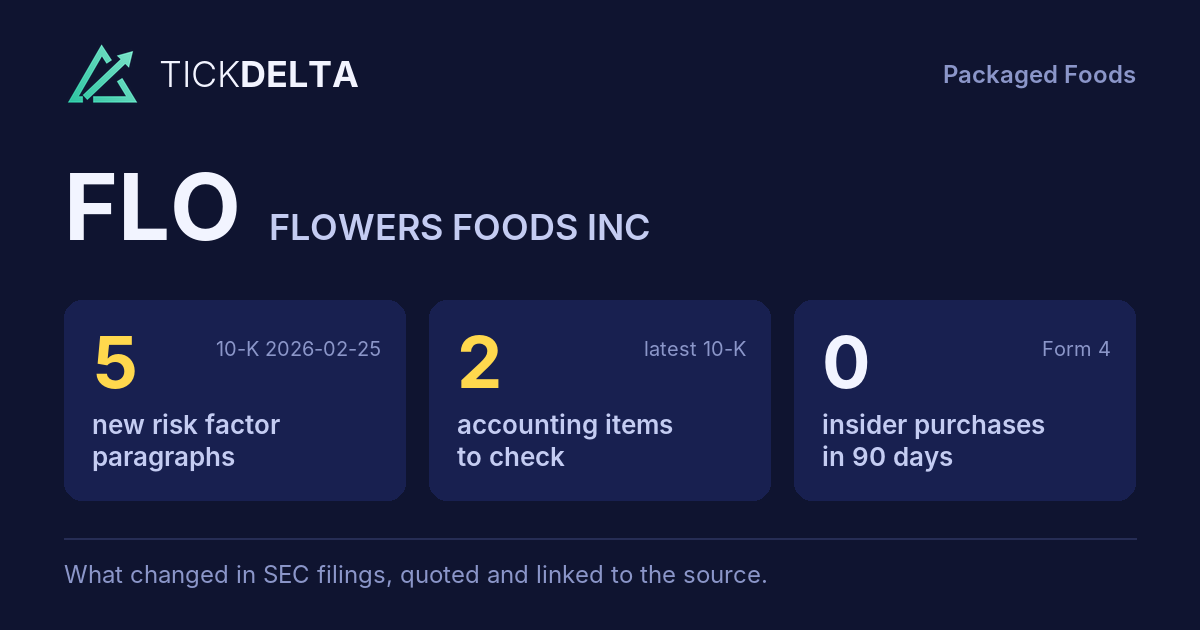
Screener / SEC EDGAR /CIK 0001128928 /10-K filed Feb 25, 2026, compared with Feb 18, 2025 /Numbers from the XBRL of the 10-Ks
NYSE Consumer staples · Packaged Foods

Flowers Foods Inc FLO

Compare with peers Embed
The 10-K against last year's

155 changes: 25 added, 29 removed, 99 reworded, 2 quiet changes

10-K Feb 25, 2026 vs Feb 18, 2025

10-K 0001193125-26-071441 (Feb 25, 2026) vs 10-K 0000950170-25-022243 (Feb 18, 2025)

Every paragraph, and how much of it changed

One bar per paragraph, in the order of the 10-K. Height and colour show the share of its words not in the closest paragraph a year earlier; the tallest bars are new paragraphs.

Risk Factors

80 paragraphs · 5 new · 16 reworded · 13 gone · 10-K Feb 25, 2026 against Feb 18, 2025
New paragraph Reworded (5% of its words or more) Same or nearly
Paragraph 52 · 39% changed Every version of it
Competitor and customer pressures require that we timely and effectively respond to changes in relevant markets, including changes to distribution channels and technological developments. Substantial growth in e-commerce has encouraged the entry of new competitors and business models, intensifying competition by simplifying distribution and lowering barriers to entry. The expanding presence of e-commerce retailers has impacted, and may continue to impact, consumer preferences and market dynamics, which in turn may negatively affect our sales or profits. Failure to effectively and timely assess new or developing trends, technological advancements (including advancements such as AI and machine learning, which may become critical in understanding consumer preferences in the future) or changes in distribution methods could negatively impact demand for our products, our operating results, achievement of our strategic and financial goals and our ability to capitalize on new revenue or value-producing opportunities.
Paragraph 73 · 26% changed Every version of it
Additionally, as concerns about climate change and other environmental issues continue to increase, we may be required to comply with new laws and regulations which may result in increased/not yet identified compliance costs, the scale of which is to be evaluated. We continue to evaluate the possible impact of such new laws and regulations, including those mentioned in the following sentence. In October 2023, California passed new laws that mandate the disclosure of GHG emissions, climate-related financial risks and measures adopted to reduce and adapt to such risks. These California laws require initial disclosures in 2026. regulations.
Paragraph 53 · 17% changed Every version of it
Competitor and customer pressures require that we timely and effectively respond to changes in relevant markets, including changes to distribution channels and technological developments. Substantial growth in e-commerce has encouraged the entry of new competitors and business models, intensifying competition by simplifying distribution and lowering barriers to entry. The expanding presence of e-commerce retailers has impacted, and may continue to impact, consumer preferences and market dynamics, which in turn may negatively affect our sales or profits. Failure to effectively and timely assess new or developing trends, technological advancements (including advancements such as AI and machine learning, which may become critical in understanding consumer preferences in the future) or changes in distribution methods could negatively impact demand for our products, our operating results, achievement of our strategic and financial goals and our ability to capitalize on new revenue or value-producing opportunities.
Paragraph 56 · 15% changed Every version of it
We may be required to recall certain of our products should they be mislabeled, contaminated, spoiled, tampered with or damaged. We may become involved in lawsuits and legal proceedings alleging that the consumption of any of our products causes or caused injury, illness or death. Any such product removal, damaged product or an adverse result in any litigation related to such a product removal or damaged product could have a material adverse effect on our operating and financial results in future periods, depending on the costs of the product removal from the market, the destruction of product inventory, diversion of management time and attention, contractual and other claims made by customers that we supply, loss of key customers, competitive reaction and consumer attitudes. Even if a product liability, consumer fraud or other claim is unsuccessful or without merit, the negative publicity surrounding such assertions regarding our products could adversely affect our reputation and brand image. We also could be adversely affected if our customers or consumers in our principal markets lose confidence in the safety and quality of our products.
Paragraph 18 · 15% changed Every version of it
From time to time, we undertake acquisitions, divestitures, joint ventures and co-investments. The success of any acquisition, divestiture or joint venture depends on the company’s ability to identify opportunities that help us meet our strategic objectives, consummate a transaction on favorable contractual terms, and achieve expected returns and other financial benefits. In particular, this risk arises in the context of the pending Simple Mills Acquisition, which is expected to close in the first quarter of Fiscal 2025.
Paragraph 11 · 15% changed Every version of it
Additionally, health care and workers’ compensation are increasing and will likely continue to do so. Any substantial increase in these costs may have an adverse impact on our profitability. The company records the liabilities related to its benefit plans based on actuarial valuations, which include key assumptions determined by management. Material changes in benefit plan liabilities may occur
Paragraph 41 · 15% changed Every version of it
In addition, our IT systems (including those provided to us by third parties), and the IT systems of our third-party business partners, may be vulnerable to damage or interruption from circumstances beyond our control, including fire, natural disasters, systems failures, security breaches or intrusions (including theft of customer, consumer or other confidential data), and cyber incidents. Cyber-attacks and other cyber incidents are occurring more frequently in the United States and are becoming more sophisticated with a wide range of expertise and motives. Such cyber-attacks and cyber incidents can take many forms, including extortion, denial of service, employee or personnel failures, or social engineering through phishing, ransomware or malware. Cybersecurity threat actors also may attempt to exploit vulnerabilities through software including software that is commonly used by companies in cloud-based services and bundled software. In addition, the risk of cyber-attacks has increased in connection with the military conflict between Russia and Ukraine, the conflict current instability in the Middle East, and the resulting geopolitical conflicts. In light of those and other geopolitical events, nation-state actors or their supporters may launch retaliatory cyber-attacks, and may attempt to cause supply chain and other third-party service provider disruptions, or take other geopolitically motivated retaliatory actions that may disrupt our business operations, result in data compromise, or both. These circumstances increase the likelihood of cyber-attacks and/or security breaches. In addition, the rapid evolution and increased adoption of artificial intelligence (“AI”) and machine learning technologies may intensify our cybersecurity risks and make it more difficult to anticipate and implement protective measures to recognize, detect, and prevent the occurrence of any of the cyber events described above. Further, the technology and techniques used in cyber-attacks are constantly evolving and the pace and extent of that evolution may accelerate with the use of emerging technologies including AI and machine learning.
Paragraph 12 · 9% changed Every version of it
actuarial valuations, which include key assumptions determined by management. Material changes in benefit plan liabilities may occur in the future due to changes in these assumptions. Future annual amounts could be impacted by various factors, such as changes in the number of plan participants, changes in the discount rate, changes in the expected long-term rate of return, changes in the level of contributions to the plan, and other factors. In addition, legislation or regulations involving labor and employment and employee benefit plans (including employee health care benefits and costs) may impact our operational results.

MD&A

144 paragraphs · 20 new · 77 reworded · 16 gone · 10-K Feb 25, 2026 against Feb 18, 2025
New paragraph Reworded (5% of its words or more) Same or nearly
Paragraph 12 · 49% changed
Restructuring charges. In April 2024, charges and related implementation costs. During the company first quarter of Fiscal 2025, we began a review of our cost-to-serve focused on improving efficiencies and identifying cost reduction opportunities. Based on this review, we announced a cost savings restructuring program to improve operational performance, which included in the third quarter of Fiscal 2025 and incurred costs for employee termination benefits associated with related to a reduction-in-force ("RIF") and other expense optimization initiatives. During Fiscal 2024, the company incurred RIF costs of $7.4 $5.5 million and made payments of $7.3 million. $4.8 million during Fiscal 2025. The RIF charges are included in the restructuring charges line item of the Consolidated Statements of Income. In the fourth quarter of Fiscal 2025, we began a comprehensive review of our brands, operations, and financial strategy. Although this review is in the early stages, as discussed in the Impairment of intangible assets section below, it resulted in the impairment of two regional brands in the fourth quarter of Fiscal 2025. This aligns with our strategy to optimize our brand portfolio and invest in our national brands and key product categories. Additionally, during Fiscal 2025, the company also incurred $19.5 million of consulting costs associated with implementing the restructuring program in Fiscal 2024 to implement these transformative programs and these costs are included in the selling, distribution, and administrative expenses line item of the Consolidated Statements of Income. We anticipate additional restructuring charges and related costs in subsequent quarters.
Paragraph 66 · 49% changed
Sales increased year over year mainly due to improved the Simple Mills acquisition contribution and the benefit of the extra week in Fiscal 2025 partially offset by softer volumes and negative price/mix in both sales categories. Weakness in the fresh packaged bread category, particularly for traditional loaf breads, and, to a lesser extent, in the away-from-home market largely resulted in the volume declines. Lower store branded sales also contributed to the volume declines. The overall negative price/mix was partially offset by improvements in our non-retail business resulting foodservice price/mix from executing our portfolio optimization strategies and to a much lesser extent the Papa Pita acquisition contribution mostly offset by volume declines, most notably beginning in the Other sales category. Volume decreases second quarter of the prior year. Additionally, we implemented price increases on certain branded retail products in the Other sales category resulted from the company strategically exiting certain foodservice business in the latter half fourth quarter of Fiscal 2023 and declines in vending volumes, net of increased volume for store branded retail products. The Branded Retail sales category also experienced volume declines from lower branded retail cake volumes, partially offset by volume growth in branded bread products. Our mix of Branded Retail sales 2025. Due to total sales was 63.9% for Fiscal 2024 as compared to 64.1% for Fiscal 2023. Year over year, the challenging consumer environment, our promotional activity increased in response to inflationary pressure on consumer spending. year over year, targeting differentiated products.
Paragraph 93 · 48% changed
•Completed the Papa Pita Simple Mills acquisition on February 17, 2023 for $274.8 21, 2025 and paid $791.9 million, which is net of cash acquired, of the total consideration of approximately $848.6 million in cash (inclusive of a net working capital purchase price adjustment). Fiscal 2025.
Paragraph 113 · 47% changed
•As discussed in the Executive Overview "Executive Overview" section above, on February 17, 2023, 21, 2025, we completed the Papa Pita Simple Mills acquisition for $274.8 total cash consideration of approximately $848.6 million of which $791.9 million, which is net of cash acquired, was paid in cash (inclusive Fiscal 2025. The determination of a net working capital the final purchase price adjustment). Papa Pita operates one manufacturing facility in West Jordan, Utah. is pending post-close purchase price adjustments.
Paragraph 80 · 46% changed
Depreciation and amortization expense increased in dollars and as a percent of sales compared to the prior year over year primarily due to amortization expense associated with the ERP finite-lived intangible assets being placed in service acquired in the second quarter of Fiscal 2023 and, to a lesser extent, other capital projects being placed in service and the Papa Pita assets acquired midway through the first quarter of Fiscal 2023, net of assets becoming fully depreciated. Simple Mills acquisition.
Paragraph 85 · 46% changed
The increase decrease in comprehensive income year over year resulted primarily from increased decreased net income. income, and to a much lesser extent, changes in the fair value of derivatives.
Paragraph 40 · 46% changed
Valuation Impairment of Long-Lived Assets, Goodwill Long-Lived, Intangible, and Other Intangible Assets. Assumptions and estimates used in the evaluation of potential impairment can result in adjustments affecting the carrying values of long-lived, intangible, and other assets and the recognition of impairment expense in the company’s consolidated financial statements. The company records evaluates its long-lived assets (property, plant and equipment), definite-lived intangible assets, and other assets (including right-of-use lease assets, notes receivable, and equity) for impairment whenever indicators of impairment exist, or when it commits to sell the asset. If the sum of the undiscounted expected future cash flows from a long-lived asset or definite-lived intangible asset group is less than the carrying value of that asset group, an asset impairment charge to property, plant is recognized. Key assumptions and equipment, goodwill estimates used in the projection of expected future cash flows generally include price levels, sales growth, profit margins and intangible assets in accordance with applicable accounting standards when, based on certain indicators of impairment, it believes such assets have experienced a decline in value that is other than temporary. asset life. Future adverse changes, including such as decisions to discontinue or significantly reduce the use of certain brands, in market conditions or poor operating results of these underlying assets could result in losses or an inability to recover the carrying value of the asset that may not be reflected in the asset’s current carrying value, thereby possibly requiring impairment charges in the future. The amount of an impairment charge, if any, is calculated as the excess of the asset’s carrying value over its fair value, generally represented by the discounted future cash flows from that asset or, in the case of assets the company evaluates for sale, estimated sale proceeds less costs to sell. The company takes into consideration historical data and experience together with all other relevant information available when estimating the fair values of its assets. However, fair values that could be realized in actual transactions may differ from the estimates used to evaluate impairment. In addition, changes in the assumptions and estimates may result in a different conclusion regarding impairment. Impairment charges recorded in Fiscal 2024 2025 and Fiscal 2023 2024 are discussed above in the “Matters Affecting Comparability” section.
Paragraph 70 · 46% changed
Sales increased year over year mainly in the Other category decreased 2.7% due to improved price/mix softer volumes for our both store branded retail and non-retail business resulting from executing our optimization strategies sales and unfavorable price/mix, partially offset by the benefit of the additional week. Store branded retail sales decreased due to softer volumes, most notably for cake items, and to a much lesser extent negative price/mix, net of the Papa Pita acquisition contribution mostly benefit of the additional week. Our non-retail sales experienced softer volumes for foodservice and institutional sales, partly offset by volume declines, most notably growth in contract manufacturing. Foodservice price/mix improved from optimization of that business subsequent to the Other sales category. Volume decreases in the Other sales category resulted from the company strategically exiting certain foodservice business in the latter half first quarter of Fiscal 2023 and declines in vending volumes, net of increased volume for store branded retail products. The Branded Retail sales category also experienced volume declines from lower branded retail cake volumes, partially 2024, but was offset by volume growth in branded bread products. Our negative price mix of Branded Retail sales to total sales was 63.9% for Fiscal 2024 as compared to 64.1% for Fiscal 2023. Year over year, our promotional activity increased in response to inflationary pressure on consumer spending. other non-retail sales.

A paragraph is matched with the one last year that shares the most of its words; under half in common makes it new. The paragraphs shown are the 8 reworded the most in each section.

The paragraph that changed most in each section

The redline

Marked against last year's 10-K: cut words struck through, new words highlighted.

Accounting Policies324 words changed in this paragraph; it is 36% similar to last year's version.
Balance Balance ────────────────────────────────────────────────────────────────────────── Fiscal 2024 $1,586 $ $1,801 $3,387 Fiscal 2023 $1,030 $ $556 $1,586 Fiscal 2022 $1,030 $ $ - $1,030 Self-Insurance Reserves. The company is self-insured for various levels of general liability, auto liability, workers’ compensation, and employee medical and dental coverage. Insurance reserves are calculated based on a combination of an undiscounted basis based on actual claim data and estimates of incurred but not reported claims developed utilizing historical claim trends. Projected settlements of incurred but not reported claims are estimated based on pending claims, historical trends and industry trends related to expected losses and actual reported losses, and key assumptions, including loss development factors and expected loss rates. Loss Contingencies. Loss contingencies are recorded at the time it is probable an asset is impaired, or a liability has been incurred and the amount can be reasonably estimated. For litigation claims the company considers the degree of probability of an unfavorable outcome and the ability to make a reasonable estimate of the loss. Losses are recorded in selling, distribution, and administrative expense in our Consolidated Statements of Income. Net Income Per Common Share. Basic net income per share is computed by dividing net income by the weighted average common shares outstanding for the period. Diluted net income per share is computed by dividing net income by the weighted average common and common equivalent shares outstanding for the period. Common stock equivalents consist of the incremental shares associated with the company’s stock compensation plans, as determined under the treasury stock method. The performance contingent restricted stock awards do not contain a non-forfeitable right to dividend equivalents and are included in the computation for diluted net income per share. Fully vested shares which have a deferral period extending beyond the vesting date are included in the computation for basic net income per share. See Note 21, Earnings Per Share, for additional disclosure. Variable Interest Entities. The incorporated IDPs are not voting interest entities since the company has no direct interest in each entity; however, they qualify as variable interest entities (“VIEs”). The IDPs who are formed as sole proprietorships are excluded from the VIE accounting analysis because sole proprietorships are not within scope for determination of VIE status. The company typically finances the incorporated IDP and enters into a contract with the incorporated IDP to supply product at a discount for distribution in the IDP’s territory. The combination of the company’s loans to the incorporated IDP and the ongoing supply arrangements with the

Source: 10-K text, Note 2 – Summary of Significant Accounting Policies, 10-K 0001193125-26-071441 vs 10-K text, Note 2 – Summary of Significant Accounting Policies, 10-K 0000950170-25-022243

MD&A287 words changed in this paragraph; it is 37% similar to last year's version.
Valuation Impairment of Long-Lived Assets, Goodwill Long-Lived, Intangible, and Other Intangible Assets. Assumptions and estimates used in the evaluation of potential impairment can result in adjustments affecting the carrying values of long-lived, intangible, and other assets and the recognition of impairment expense in the company’s consolidated financial statements. The company records evaluates its long-lived assets (property, plant and equipment), definite-lived intangible assets, and other assets (including right-of-use lease assets, notes receivable, and equity) for impairment whenever indicators of impairment exist, or when it commits to sell the asset. If the sum of the undiscounted expected future cash flows from a long-lived asset or definite-lived intangible asset group is less than the carrying value of that asset group, an asset impairment charge to property, plant is recognized. Key assumptions and equipment, goodwill estimates used in the projection of expected future cash flows generally include price levels, sales growth, profit margins and intangible assets in accordance with applicable accounting standards when, based on certain indicators of impairment, it believes such assets have experienced a decline in value that is other than temporary. asset life. Future adverse changes, including such as decisions to discontinue or significantly reduce the use of certain brands, in market conditions or poor operating results of these underlying assets could result in losses or an inability to recover the carrying value of the asset that may not be reflected in the asset’s current carrying value, thereby possibly requiring impairment charges in the future. The amount of an impairment charge, if any, is calculated as the excess of the asset’s carrying value over its fair value, generally represented by the discounted future cash flows from that asset or, in the case of assets the company evaluates for sale, estimated sale proceeds less costs to sell. The company takes into consideration historical data and experience together with all other relevant information available when estimating the fair values of its assets. However, fair values that could be realized in actual transactions may differ from the estimates used to evaluate impairment. In addition, changes in the assumptions and estimates may result in a different conclusion regarding impairment. Impairment charges recorded in Fiscal 2024 2025 and Fiscal 2023 2024 are discussed above in the “Matters Affecting Comparability” section.

Source: Item 7, 10-K 0001193125-26-071441 vs Item 7, 10-K 0000950170-25-022243

Legal Proceedings175 words changed in this paragraph; it is 58% similar to last year's version.
El Paso, of Villa Rica, LLC Salgado v. Flowers Foods, Inc. and Holsum Bakery, Inc. 4:22-cv-00420 U.S. District Court District of Arizona 9/15/2022 ────────────────────────────────────────────────────────────────────────────────────────────────────────────────────────────────────────────────────────────────────────────────────────────────────────────────────────────────────────────────── The company and/or its respective subsidiaries contests the allegations and are vigorously defending all of these lawsuits. Given the stage of the complaints and the claims and issues presented, except for lawsuits disclosed herein that have reached a settlement or agreement in principle, the company cannot reasonably estimate at this time the possible loss or range of loss that may arise from the unresolved lawsuits. The company has settled, and the appropriate court has approved, the following collective and/or class action lawsuits filed by distributors alleging that such distributors were misclassified as independent contractors. In each of these settlements, in addition to the monetary terms noted below, the settlements also included certain non-economic terms intended to strengthen and enhance the independent contractor model. The list below details settled collective and/or class action lawsuits that impacted the company's presented financial statements since Fiscal 2023: Case Name Case No. Venue Date Filed Comments ────────────────────────────────────────────────────────────────────────────────────────────────────────────────────────────────────────────────────────────────────────────────────────────────────────────────────────────────────────────────────────────────────────────────────────────────────────────────────────────────────────────────────────────────────────────────────────────────────────────────────────────────────────────────────────────────────────────────────────────────────────────────────────────────────────────────────────────────────────────────────────────────────────────────────────────────────────────────────────────────────────────────────────────────────────── Ludlow et al. v. Flowers Foods, Inc., Flowers Bakeries, LLC and Flowers Finance, LLC 3:18-cv-01190 U.S. District Court Southern District of California 6/6/2018 On March 18, 2024, the court approved a settlement to settle this lawsuit and two companion cases - Maciel et al. v. Flowers Foods, Inc. et al., No. 3:20-cv-02059-JO-JLB (U.S. District Court for the Southern District of California) and Maciel v. Flowers Foods, Inc. et al., No. 20-CIV-02959 (Superior Court of San Mateo County, California). The settlement provides for a $55 million common fund, which was paid during the second quarter of Fiscal 2024, to cover settlement payments to a class... See Note 16, 15, Debt and Other Commitments, for additional information on the company’s commitments.

Source: Item 3, via Note 23 – Commitments and Contingencies, 10-K 0001193125-26-071441 vs Item 3, via Note 24 – Commitments and Contingencies, 10-K 0000950170-25-022243

Risk Factors162 words changed in this paragraph; it is 89% similar to last year's version.
Name, Age and Office Business Experience A. Ryals McMullian Mr. McMullian serves as chairman and chief executive officer of Flowers. He was elected as chairman of the board of directors effective May 25, 2023 and has served as chief executive officer since May 2019. Previously, Mr. McMullian served as president and chief executive officer from May 2019 to August 2023. He served as chief operating officer from July 2018 until May 2019 and as chief strategy officer from May 2017 to July 2018. Prior to those appointments, Mr. McMullian served as vice president of mergers and acquisitions and deputy general counsel from 2015 until 2017, vice president and associate general counsel from 2011 until 2015, and as associate general counsel from 2003, when he joined the company, until 2011. Age 55 56 Chairman and Chief Executive Officer R. Steve Kinsey D. Anthony Scaglione Mr. Kinsey has Scaglione joined the company as chief financial officer (“CFO”) on January 1, 2026. Previously, he served as chief financial officer (“CFO”) since April 2020. Previously, he served as CFO of Total Wine & More, a privately held retailer specializing in wine, spirits, and chief accounting officer ("CAO") beer, from April 2020 September 2024 to December 2024, and executive vice president, CFO and chief administrative officer from May 2017 to April 2020. Mr. Kinsey March 2025. He also served as executive vice president and CFO chief financial officer of ODP Corporation, a global B2B office equipment and services company, from 2008 until 2017, and as senior July 2020 to September 2024. Prior to joining ODP Corporation, he was executive vice president and CFO chief financial officer of ABM Industries Inc. (“ABM”), a global services company, from 2007 2015 to 2008. July 2020. Prior to those appointments, joining ABM in 2009, Mr. Kinsey Scaglione held executive finance positions at CA Technologies from 2005 to 2009 and served in various accounting roles since joining the company in 1989. as a manager with Ernst & Young from 2001 to 2005. Age 64 53 Chief Financial Officer Heeth Varnedoe IV Mr. Varnedoe was named president and chief operating officer effective September 2023. Previously, he served as chief operating officer from January 2023 to August 2023. He served as chief transformation officer from December 2020 until January 2023, senior vice president of DSD Regions/Sales from August 2017 until December 2020, and president of Flowers’ Phoenix, Arizona bakery from January 2016 to August 2017. Mr. Varnedoe joined Flowers in 1990 and held a number of positions before leaving the company in 2000 to pursue other business interests. He rejoined Flowers in 2012. Age 58 59 President and Chief Operating Officer Terry S. Thomas Mr. Thomas joined Flowers as chief growth officer in September 2023. Prior to joining the company, Mr. Thomas served as global chief customer officer of Unilever, a global food, personal care, and household products company, from January 2022 to July 2023, and executive vice president, chief customer officer of Unilever from July 2019 to July 2023. During his career with Unilever, he was named senior vice president of customer development in 2013 and senior vice president of customer development, U.S. grocery channel, DSD & natural channel in 2018. Prior to joining Unilever, Mr. Thomas worked for PepsiCo, Inc. for 13 years, serving as vice president and general manager of various business channels, including small format, global convenience, gas, drug, dollar, and super regional grocery. Mr. Thomas also held management positions at the Coca-Cola Company, Clorox Company, and The Procter & Gamble Company. From August 2020 to August 2023, Mr. Thomas served on Flowers’ board of directors as an independent director. Age 55 56 Chief Growth Officer Stephanie B. Tillman Ms. Tillman was named chief legal counsel and corporate secretary effective January 2020. Previously, she served as vice president, chief compliance officer, and deputy general counsel from April 2011 to January 2020. Prior to that, Ms. Tillman served in various roles in the legal department since joining the company in 1995. Age 54 55 Chief Legal Counsel Cindy L. Cox Ms. Cox joined Flowers as chief human resources officer in February 2023. Before joining Flowers, she served as vice president of human resources for the Refrigeration segment of Carrier Corporation, the leading global provider of healthy, safe, sustainable, and intelligent building and cold chain solutions (“Carrier”), since July 2017. During her 27-year tenure with Carrier and Pratt & Whitney, she held multiple human resources roles of increasing scale and responsibility. Age 58 59 Chief Human Resources Officer H. Mark Courtney Mr. Courtney was named chief brand officer in July 2020. He previously served as president of the Fresh Packaged Bread Business Unit from May 2019 to July 2020, senior vice president of retail accounts from May 2017 to May 2019, and senior vice president of sales from June 2008 to May 2017. Prior to that, Mr. Courtney served in various sales positions since joining the company in 1983. Age 64 65 Chief Brand Officer

Source: Item 1A, 10-K 0001193125-26-071441 vs Item 1A, 10-K 0000950170-25-022243

Sentences and paragraphs added, removed or reworded

Every change, by type

Sentences and paragraphs of FLO's Risk Factors and MD&A, 10-K Feb 25, 2026 against 10-K Feb 18, 2025. Each links to the text at sec.gov.

Quiet changes are sentences kept from last year with one to four words changed, at least one of them a hedge, a modal or a qualifier (may, could, will, not, significant, material…). A year or date rolling forward is not counted.

The full word list

adverse, adversely, all, although, anticipate, anticipates, any, approximately, believe, believes, can, cannot, certain, could, expect, expects, generally, however, if, intend, intends, largely, likely, many, material, materially, may, might, most, must, never, no, not, possible, primarily, probable, should, significant, significantly, some, substantial, substantially, unlikely, will, would

AddedRisk Factors
We periodically enter into arrangements with independent contract manufacturers, or co-manufacturers, of products. In some cases, a co-manufacturer may produce all of our requirements for a particular product or brand. Our future ability to enter into co-manufacturing arrangements is not guaranteed. If we lose or need to change one or more co-manufacturers or fail to retain co-manufacturers for newly acquired or developed products or brands, production of our products may be delayed or postponed and/or the availability of some of our products may be reduced or eliminated, which could adversely affect our business, financial condition or results of operations.
Read it in 10-K Feb 25, 2026 at sec.gov
AddedRisk Factors
Changes in tariffs and other trade disruptions may impact our business, results of operations and financial condition, depending on future developments, which are highly uncertain and are difficult to predict.
Read it in 10-K Feb 25, 2026 at sec.gov
AddedRisk Factors
The extent to which recently announced tariffs (including retaliatory tariffs) and other trade disruptions (such as embargoes, sanctions and export controls) may impact our business, results of operations and financial condition will depend on future developments, which are highly uncertain and are difficult to predict. Such tariffs, trade disruptions and future developments may impact the consumer, our workforce and operations, as well as the workforce, operations and financial prospects of our customers, vendors and suppliers. There is considerable uncertainty regarding the extent to which tariffs and/or other trade disruptions (such as embargoes, sanctions and export controls) will be enacted and the duration for which enacted tariffs and/or other trade disruptions will be in place and such developments could adversely impact our production costs, customer demand and our relationships with customers and
Read it in 10-K Feb 25, 2026 at sec.gov
AddedRisk Factors
suppliers. Some of the impacts our business may experience as a result of tariffs and other trade disruptions include, but are not limited to, increases of the costs of the ingredients, packaging and other materials necessary to produce, distribute and sell our products, and an unfavorable shift in sales mix away from our Branded Retail products, due to a change in consumer buying patterns as a result of increased prices in the economy as a whole. In addition, our compliance with any such newly enacted tariffs and/or other trade disruptions could increase our cost of doing business, restrict our ability to operate our business or execute our strategies, and could result in fines and penalties or reputational harm if we are found to not be in full compliance. Any of these events could exacerbate the other risks and uncertainties described herein, or in other reports filed with the SEC from time to time, and could materially adversely affect our business, results of operations and financial condition.
Read it in 10-K Feb 25, 2026 at sec.gov
RemovedRisk Factors
The market price for our common stock following the closing of the Simple Mills Acquisition may be affected by factors different from those that historically have affected or currently affect our common stock.
Read it in 10-K Feb 18, 2025 at sec.gov
RemovedRisk Factors
Our future financial position may differ from our financial position before the completion of the Simple Mills Acquisition, and the results of operations of the combined company may be affected by some factors that are different from those currently affecting our results of operations. Accordingly, the market price and performance of our common stock is likely to be different from the performance of our common stock in the absence of the Simple Mills Acquisition. In addition, general fluctuations in stock markets could have a material adverse effect on the market for, or liquidity of, our common stock, regardless of our actual operating performance.
Read it in 10-K Feb 18, 2025 at sec.gov
Show the other 56
RemovedRisk Factors
We may not consummate the Simple Mills Acquisition, which is subject to the satisfaction of customary closing conditions. Certain of the conditions to completion of the Simple Mills Acquisition are not within our control, and we cannot predict when, or if, these conditions will be satisfied. If any of these conditions are not satisfied or waived prior to the outside date, it is possible that the Simple Mills Acquisition may be terminated. In addition, satisfying the conditions to and completion of the Simple Mills Acquisition may take longer, and could cost more than we currently expect. There can be no assurance that such conditions will be satisfied or that the Simple Mills Acquisition will be consummated on the terms currently contemplated or at all.
Read it in 10-K Feb 18, 2025 at sec.gov
RemovedRisk Factors
Failure to complete the Simple Mills Acquisition could negatively impact our stock price and have a material adverse effect on our results of operations, cash flows and financial position.
Read it in 10-K Feb 18, 2025 at sec.gov
RemovedRisk Factors
If the Simple Mills Acquisition is not completed for any reason, including as a result of failure to obtain all requisite regulatory approvals, we may be materially adversely affected and, without realizing any of the benefits of having completed the acquisition, we would be subject to a number of risks, including the following:
Read it in 10-K Feb 18, 2025 at sec.gov
RemovedRisk Factors
•matters relating to the acquisition (including integration planning) require substantial commitments of time and resources by our management, which may have resulted in the distraction of our management from ongoing business operations and pursuing other opportunities that could have been beneficial to us.
Read it in 10-K Feb 18, 2025 at sec.gov
RemovedRisk Factors
If the Simple Mills Acquisition is not completed, the risks described above may materialize and they may have a material adverse effect on our results of operations, cash flows, financial position and stock price.
Read it in 10-K Feb 18, 2025 at sec.gov
RemovedRisk Factors
Our business relationships may be subject to disruption due to uncertainty associated with the Simple Mills Acquisition, which could have a material adverse effect on the results of operations, cash flows and financial position of us pending and following the closing of the Simple Mills Acquisition.
Read it in 10-K Feb 18, 2025 at sec.gov
RewordedRisk Factors
He previously served as chief strategic projects officer from August 2022 to January 2026, president of cake operations from July 2020 until August 2022, and president of the Snacking/Specialty Business Unit from May 2017 to July 2020, and senior vice president of organics from September 2015 until May 2017. 2020.
Read it in 10-K Feb 25, 2026 at sec.gov
RewordedRisk Factors
In addition, as a result of California distributor-related litigation, we began converting converted our independent distributor partners distribution model in California to an employment model in Fiscal 2024 and anticipate completing the conversion early in the second quarter of Fiscal 2025. model.
Read it in 10-K Feb 25, 2026 at sec.gov
RewordedRisk Factors
Additionally, a company determination that any brand is no longer expected to contribute to the company's future results or to be utilized in a limited capacity could lead to an impairment or material impairment of an intangible asset, resulting in an impairment or an acceleration of amortization due to a reduction in the useful life, and could adversely affect our business, financial condition or results of operations.
Read it in 10-K Feb 25, 2026 at sec.gov
RewordedRisk Factors
While we do not expect our operations to be directly impacted by these conflicts this conflict and instability at this time, changes in global grain and commodity flows and increased supply chain costs could impact the markets in which we operate, which may in turn negatively impact our business, results of operations, supply chain and financial condition.
Read it in 10-K Feb 25, 2026 at sec.gov
AddedMD&A
Impairment of intangible assets. In the fourth quarter of Fiscal 2025, concurrent with the company's annual planning process, the company performed an assessment of its finite-lived brands and determined two of its regional brands were impaired based on their current and expected future performance. As a result of this assessment, the company recorded an impairment charge of $136.0 million. The company intends to continue to use these two trademarks for the foreseeable future but on a more limited basis, including eliminating certain stock-keeping-units, as it intends to focus on growing its national brands. These costs are included as a separate line item of the Consolidated Statements of Income.
Read it in 10-K Feb 25, 2026 at sec.gov
AddedMD&A
Loss on inferior ingredients. In Fiscal 2025, the company recognized $2.7 million of identifiable and measurable costs associated with product losses. These product losses resulted from inferior coconut sugar and cashew flour used in certain of Simple Mills' products due to tiny fragments of metal present in the ingredients and from the presence of gluten in certain of Canyon Bakehouse's gluten-free products. We are not currently able to estimate any future anticipated losses and we continue to seek recovery of all losses through appropriate means. These costs are included as a separate line item of the Consolidated Statements of Income.
Read it in 10-K Feb 25, 2026 at sec.gov
AddedMD&A
Sales increased 3.0% in Fiscal 2025 compared to Fiscal 2024 due to the acquisition contribution (excluding the 53rd week) of 4.1% and the benefit of the additional week of 1.7%, partially offset by volume declines of 2.0% and negative price/mix of 0.8%. Branded Retail sales increased 6.2% due to the acquisition contribution (excluding the 53rd week) of 6.4%. Sales in the Other sales category decreased 2.7%. Both sales categories experienced negative price/mix and softer volumes due to a challenging consumer environment which was partially offset by the benefit of the additional week. Weakness in both the fresh packaged bread and cake categories negatively impacted our sales.
Read it in 10-K Feb 25, 2026 at sec.gov
AddedMD&A
Business Combinations. The company’s acquisitions of businesses are accounted for in accordance with ASC 805, “Business Combinations.” The company recognizes the identifiable assets acquired, the liabilities assumed, and any noncontrolling interests in an acquired business at their fair values as of the date of acquisition. Goodwill is measured as the excess of the consideration transferred, also measured at fair value, over the net of the acquisition date fair values of the identifiable assets acquired and liabilities assumed. The acquisition method of accounting requires us to make significant estimates and assumptions regarding the fair values of the elements of a business combination as of the date of acquisition, including the fair values of identifiable intangible assets, property, plant, and equipment, deferred tax asset valuation allowances, liabilities including those related to debt, pensions and other postretirement plans, uncertain tax positions, contingent consideration, and contingencies. This method also requires us to refine these estimates over a measurement period not to exceed one year to reflect new information obtained about facts and circumstances that existed as of the acquisition date that, if known, would have affected the measurement of the amounts recognized as of that date. If we are required to adjust provisional amounts that we have recorded for the fair values of assets and liabilities in connection with acquisitions, these adjustments could have a material impact on our financial condition and results of operations.
Read it in 10-K Feb 25, 2026 at sec.gov
AddedMD&A
Significant estimates and assumptions in estimating the fair value of customer relationships, trademarks, non-compete agreements, distributor relationships, and other identifiable intangible assets include future cash flows that the company expects to generate from the acquired assets, discount rate, customer attrition rate, and long-term revenue growth projections. Projecting discounted future cash flows requires the company to make significant estimates regarding projected revenues, projected earnings before interest, taxes, depreciation, and amortization margins, discount rates, royalty rate and customer attrition rates. If the subsequent actual results and updated projections of the underlying business activity change compared with the assumptions and projections used to develop these values, the company could record impairment charges. In addition, the company has estimated the economic lives of certain acquired assets and these lives are used to calculate depreciation on property, plant, and equipment and amortization expense on definite-lived intangible assets. If the estimates of the economic lives change, depreciation or amortization expenses could be increased or decreased, or the acquired asset could become impaired.
Read it in 10-K Feb 25, 2026 at sec.gov
AddedMD&A
For leases acquired in a business combination, the company measures the lease liability at the present value of the remaining lease payments, as if the acquired lease were a new lease of the company at the acquisition date. When the implicit rate in the acquired lease is not readily determinable, the company calculates the lease liabilities using discount rates based upon the company’s applicable incremental borrowing rate. An assessment of the certainty associated with the exercise of any lease renewal, termination, and purchase options included in the acquired lease contracts is also performed. The company measures the right-of-use asset at the same amount as the lease liability as adjusted to reflect favorable or unfavorable terms of the lease when compared with market terms.
Read it in 10-K Feb 25, 2026 at sec.gov
AddedMD&A
When performing a quantitative analysis, the company estimates the fair value of its reporting units using a weighted average of the income and market approaches. Under the income approach, the company uses a discounted cash flow model based on projections of future years’ operating results and associated cash flows. The company’s assessments reflected a number of significant management assumptions and estimates including the: (a) weighted average cost of capital; (b) forecasted sales growth rates; (c) forecasted EBITDA margins; and (d) market multiples (not applicable to the income approach). Changes in these assumptions could materially impact the company’s conclusions. Based on its assessments, the company concluded that there was no impairment of goodwill for either of its reporting units.
Read it in 10-K Feb 25, 2026 at sec.gov
AddedMD&A
The company’s assessments, whether qualitative or quantitative, incorporate management’s expectations for the future, including forecasted growth rates and/or margin improvements. Therefore, should there be changes in the relevant facts and circumstances and/or expectations, management’s conclusions regarding goodwill impairment may change as well.
Read it in 10-K Feb 25, 2026 at sec.gov
AddedMD&A
In considering the level of uncertainty regarding the potential for goodwill impairment, management has concluded that any such impairment would, in most cases, likely be the result of adverse changes in more than one assumption. Management considers the assumptions used to be its best estimates across a range of possible outcomes based on available evidence at the time of the assessment. Other than in the Simple Mills reporting unit there is no specific singular event or single change in circumstances management has identified that it believes could reasonably result in a change to the expected future results in the legacy Flowers Foods reporting unit that would be significant enough to result in goodwill impairment. In the case of Simple Mills, the lower differential between the fair value and carrying value of the reporting unit is due to the acquisition (in February 2025), at which time the majority of assets and liabilities acquired were recorded at fair value. In management’s opinion, a change of such magnitude would more likely be the result of changes to some combination of the factors identified above, a general deterioration in competitive position, significant unexpected changes in customer preferences, an inability to pass through significant raw material cost increases, and other such items as identified in “Item 1A. Risk Factors” in this Annual Report on Form 10-K.
Read it in 10-K Feb 25, 2026 at sec.gov
AddedMD&A
Although no reporting units failed the annual impairment test, in management’s opinion, the goodwill balance of the Simple Mills reporting unit is at risk of impairment in the near term if the reporting unit’s operation does not perform in line with management’s expectations, or if there is a negative change in the long-term financial outlook for the reporting unit or in other factors such as the particular discount rates used. Total goodwill associated with the Simple Mills reporting units was $367.9 million at January 3, 2026.
Read it in 10-K Feb 25, 2026 at sec.gov
AddedMD&A
We anticipate our Fiscal 2026 sales will be lower than Fiscal 2025 due to the additional week in Fiscal 2025 and continued weakness in the fresh packaged bread category. The sales benefit from the Simple Mills acquisition contribution (acquired on February 21, 2025), growth in more differentiated products, including Simple Mills' products, and the benefit of price increases implemented in the fourth quarter of Fiscal 2025 are anticipated to partially offset the sales decrease.
Read it in 10-K Feb 25, 2026 at sec.gov
AddedMD&A
Branded Retail sales increased 6.2% compared to the prior year due to the Simple Mills acquisition contribution and the benefit of the additional week, partially offset by volume declines and unfavorable price/mix. Volumes were negatively impacted by weakness in the fresh packaged bread category with the largest declines in sales of traditional loaf products. Volume growth in organic, Keto, and cake items partially offset the decrease. The company introduced Wonder cake in the first quarter of Fiscal 2025. Other recent product introductions include Nature's Own protein loaf, small loaves, and Keto buns and multi-grain loaf as well as, DKB sandwich rolls and snack bites, and Wonder bagels and English muffins. Price/mix was unfavorable primarily due to increased targeted promotional activity and, to a lesser extent, a shift in mix to greater branded retail cake sales and the addition of smaller loaf sizes.
Read it in 10-K Feb 25, 2026 at sec.gov
RemovedMD&A
During the second quarter of Fiscal 2022, we invested $9.0 million in Base Culture, a Clearwater, Florida-based company with one manufacturing facility. We made an additional investment of $2.0 million in the second quarter of Fiscal 2023. Base Culture's product offerings include better-for-you, gluten-free, and grain-free sliced breads and baked goods that are all-natural, 100% Paleo-certified, kosher-certified, dairy-free, soy-free, and non-GMO verified. These investments are being accounted for at cost, less any impairment, as we do not control, nor do we have the ability to significantly influence Base Culture. In the fourth quarter of Fiscal 2023, we recognized an impairment loss of $5.5 million on this investment and recognized an additional impairment of $4.0 million in Fiscal 2024.
Read it in 10-K Feb 18, 2025 at sec.gov
RemovedMD&A
During the third and fourth quarters of Fiscal 2023, the company entered into agreements to sell a warehouse and a closed bakery, respectively, both of which were classified as held for sale, and recorded impairment charges totaling $1.8 million. The company completed the sale of the impaired warehouse at the end of the third quarter of Fiscal 2023 and completed the sale of the closed bakery in the first quarter of Fiscal 2024.
Read it in 10-K Feb 18, 2025 at sec.gov
RemovedMD&A
On February 17, 2023, the company completed the acquisition of Papa Pita for total consideration of $274.8 million, inclusive of a net working capital purchase price adjustment. We funded the purchase price with cash on hand and from our existing credit facilities. Papa Pita is a manufacturer and distributor of bagels, tortillas, breads, buns, English muffins, and flat breads with one production facility in West Jordan, Utah. Prior to the acquisition, Papa Pita co-manufactured certain products for us. Papa Pita has direct-store-delivery distribution in the western U.S., expanding our geographic reach. We incurred additional acquisition-related costs of $3.7 million in Fiscal 2023.
Read it in 10-K Feb 18, 2025 at sec.gov
RemovedMD&A
Sales increased 0.2% in Fiscal 2024 compared to Fiscal 2023. Price/mix contributed 1.8% to the sales growth and the Papa Pita acquisition contributed 0.1% (cycled on February 17, 2024), partially offset by volume declines of 1.7%. Branded Retail sales decreased 0.1% and Other sales increased 0.8%. The benefits from optimizing our foodservice business were mostly offset by overall softness in the fresh packaged bread and cake categories, volume declines from exiting certain lower margin non-retail business, and consumer trade down to store branded products. Inflationary pressure on consumer spending and shifts in consumer behavior and preferences have negatively impacted the fresh packaged bread and cake categories. Sales of our leading brands, Nature's Own, DKB, and Canyon Bakehouse, continued to increase year over year.
Read it in 10-K Feb 18, 2025 at sec.gov
RemovedMD&A
Our annual evaluation of goodwill impairment requires management judgment and the use of estimates and assumptions to determine the fair value of our reporting unit. Fair value is estimated using standard valuation methodologies incorporating market participant considerations and management’s assumptions on revenue, revenue growth rates, operating margins, discount rates, and EBITDA. Our estimates can significantly affect the outcome of the test. We perform the fair value assessment using the income and market approach. Changes in our forecasted operating results and other assumptions could materially affect these estimates. This test is performed in the fourth quarter of each fiscal year unless circumstances require this analysis to be completed sooner. The income approach is tested using a sensitivity analysis to changes in the discount rate and yield a sufficient buffer to significant variances in our estimates. The estimated fair value of our reporting unit exceeded its carrying value in excess of $3.3 billion in Fiscal 2024. A 1% decrease in the discount rate would increase the fair value of the reporting unit by $1.1 billion and a 1% increase in the discount rate would decrease the fair value by $0.8 billion. Based on management’s evaluation, no impairment charges relating to goodwill were recorded for Fiscal 2024 or Fiscal 2023.
Read it in 10-K Feb 18, 2025 at sec.gov
RemovedMD&A
In connection with acquisitions, the company has acquired trademarks, customer lists, non-compete agreements, and distributor relationships a portion of which are amortizable. The company evaluates these assets whenever events or changes in circumstances indicate that the carrying amount of the asset may not be recoverable. The undiscounted future cash flows of each intangible asset are compared to the carrying amount, and if less than the carrying value, the intangible asset is written down to the extent the carrying amount exceeds the fair value. The fair value is computed using the same approach described above for goodwill and includes the same risks and estimates. The fair value of the trademarks could be less than our carrying value if any of our four material assumptions in our fair value analysis: (a) weighted average cost of capital; (b) long-term sales growth rates; (c) forecasted operating margins; and (d) market multiples do not meet our expectations, thereby requiring us to record an asset impairment. We use the multi-period excess earnings and relief from royalty methods to value these intangibles. The method used for impairment testing purposes is consistent with the valuation method employed at acquisition of the intangible asset. In Fiscal 2023, we recorded a $2.3 million charge to fully impair held and used distribution rights classified as intangibles assets. This was in conjunction with costs related to a California legal settlement. No impairment charges related to amortizing intangible assets were recorded in Fiscal 2024.
Read it in 10-K Feb 18, 2025 at sec.gov
RemovedMD&A
As of December 28, 2024, the company also owns trademarks acquired through acquisitions with a total carrying value of $127.1 million that are indefinite-lived intangible assets not subject to amortization. The company evaluates the recoverability of intangible assets not subject to amortization by comparing the fair value to the carrying value on an annual basis or at a time when events occur that indicate the carrying value may be impaired. In addition, the assets are evaluated to determine whether events and circumstances continue to support an indefinite life. The fair value is compared to the carrying value of the intangible asset, and if less than the carrying value, the intangible asset is written down to fair value. There are certain inherent risks included in our expectations about the performance of acquired trademarks and brands. If we are unable to implement our growth strategies for these acquired intangible assets as expected, it could adversely impact the carrying value of the brands. The fair value of the trademarks could be less than our carrying value if any of our four material assumptions in our fair value analysis: (a) weighted average cost of capital; (b) long-term sales growth rates; (c) forecasted operating margins; and (d) market multiples do not meet our expectations, thereby requiring us to record an asset impairment.
Read it in 10-K Feb 18, 2025 at sec.gov
RemovedMD&A
We anticipate our Fiscal 2025 sales will increase from optimizing our non-retail business, new product innovation, and the additional week in Fiscal 2025. However, category headwinds and changes in consumer buying patterns and promotional activity could partially offset that improvement.
Read it in 10-K Feb 18, 2025 at sec.gov
RemovedMD&A
Branded Retail sales decreased 0.1% year over year due to softer volumes, partially offset by favorable price/mix and the acquisition contribution. Improved price/mix resulted from greater sales of our more differentiated branded products, such as organic and Keto. Decreases in branded cake volumes were partially offset by volume growth in branded bread products. Declines in branded cake resulted from overall category softness, market share declines, and targeted sales rationalization. Higher branded bread volumes were due to increases in organic products, traditional buns and rolls, and Keto products, partially offset by softness in traditional loaf breads. Inflationary pressure on consumer spending contributed to lower volumes.
Read it in 10-K Feb 18, 2025 at sec.gov
RemovedMD&A
Sales of our leading brands, Nature's Own, DKB, and Canyon Bakehouse, increased year over year. Sales of Nature's Own benefited from growth in Keto bread (introduced in Fiscal 2023), Keto buns (introduced in Fiscal 2024), and traditional buns and rolls, but experienced volume declines for traditional loaf breads. DKB benefitted from efficient market execution and growth from more recently introduced products, such as rolls and snack bars. Consistent with our strategy to grow our business beyond the traditional bread category, the company plans to launch the national rollout of DKB snack bites in Fiscal 2025. Canyon Bakehouse's sales increased on higher volumes as we resolved production capacity constraints that impacted prior year results.
Read it in 10-K Feb 18, 2025 at sec.gov
RemovedMD&A
Sales in the Other category increased 0.8% primarily from optimizing our foodservice business, increased store branded retail sales on higher volume, and the acquisition contribution, partially offset by volume declines for our non-retail sales. Store branded retail sales increased year over year from volume growth in store branded traditional loaf breads and gluten-free bread, net of negative price/mix. Store branded retail sales as a percent of our total sales was relatively unchanged from the prior year. Non-retail sales increased year over year due to positive price/mix and to a much lesser extent the acquisition contribution, partially offset by volume declines. Foodservice drove most of the volume decrease as we exited certain lower margin business in the second half of Fiscal 2023. Declines in vending, institutional, and thrift store sales also contributed to lower volumes.
Read it in 10-K Feb 18, 2025 at sec.gov
RemovedMD&A
Materials, supplies, labor and other production costs as a percent of sales decreased year over year due to moderating ingredient and packaging costs, improved sales price/mix, and decreased product returns. Lower production volumes and higher workforce-related costs partially offset the overall improvement. The decrease in ingredient and packaging costs was mostly attributed to lower pricing for commodities such as flour, fats and oils, and eggs, and packaging items including bags and corrugated containers. Higher costs for sweeteners partially offset the lower ingredient costs. Wage inflation, higher employee compensation costs, and lower production volumes drove the increase in workforce-related costs as a percent of sales. We expect the impact of lower production volumes and the competitive labor market to continue to negatively impact our operations. The increase in the Other line item mostly reflects the impact of lower production volumes, increased outside purchases of product (sales with no associated ingredient costs), and higher bakery maintenance costs.
Read it in 10-K Feb 18, 2025 at sec.gov
RewordedMD&A
Interest Rate at Final Balance at Fixed or January 3, 2026 Maturity January 3, 2026 December 28, 2024 Maturity December 28, 2024 December 30, 2023 Variable Rate (Amounts in thousands) 2026 notes 3.500% 2026 $ 399,575 $ 398,992 Fixed Rate 2031 notes 2.40% 2.400% 2031 $ 496,193 495,452 $ 494,723 Fixed Rate 2026 2035 notes 3.50% 2026 398,992 398,421 5.750% 2035 494,776 — Fixed Rate Unsecured 2055 notes 6.200% 2055 294,588 — Fixed Rate New credit facility 7.53% 2026 6.875% 2030 5,000 — Variable Rate Previous credit facility — 2,200 — Variable Rate Accounts receivable repurchase facility 5.27% 2026 4.541% 2027 65,000 125,000 155,000 Variable Rate Right-of-use lease obligations 2036 325,075 322,989 284,501 2,080,207 1,344,633 1,332,645 Less:
Read it in 10-K Feb 25, 2026 at sec.gov
RewordedMD&A
Fiscal 2025 Fiscal 2024 Fiscal 2023 Footnote 52 53 weeks 52 weeks Disclosure (Amounts in thousands) Business process improvement costs $ 3,368 $ 4,529 $ 21,521 Note 2 Restructuring charges 6,083 7,403 7,099 Note 6 5 Restructuring-related implementation costs 19,529 2,979 — Note 6 5 Plant closure costs and impairment of assets 7,397 10,310 7,298 Note 2 Acquisition-related costs 2,008 3,712 Impairment of intangible assets 135,981 — Note 2, 7, 25 10 Acquisition and integration-related costs 17,904 2,008 Note 6 Loss on inferior ingredient 2,657 — Note 2 Legal settlements and related costs 902 3,800 137,529 Note 24 23 Pension plan settlement loss — 241 — Note 22 21 $ 193,821 $ 31,270 $ 177,159
Read it in 10-K Feb 25, 2026 at sec.gov
RewordedMD&A
Income from operations increased in dollars and decreased as a percent of sales compared to the prior year primarily due to significantly lower the impairment of intangible assets and, to a lesser extent, unfavorable sales price/mix, greater outside purchases of product, higher selling, distribution, and administrative costs, as described above, moderating input costs, and improved sales price/mix, partially offset by lower production volumes, increased bakery workforce-related costs, and greater depreciation expense. volumes.
Read it in 10-K Feb 25, 2026 at sec.gov
RewordedMD&A
Additionally, for both fiscal years, the current deferred income tax activity was composed of changes in temporary differences year included over year, including the impact of year over year differences in tax depreciation activity, the vesting of stock equity awards, the impact of payments for a previously accrued legal settlement for the repurchase of distribution rights, and activity related to the capitalization of research and development expenses as defined under Internal Revenue Code Section 174.
Read it in 10-K Feb 25, 2026 at sec.gov
RewordedMD&A
Branded Retail Other Total Favorable (Unfavorable) Pricing/Mix^* 0.2 3.8 (0.5) (1.7) (0.8) Volume* (1.5) (2.6) (2.0) Acquisition (excluding the impact of Week 53) 6.4 — 4.1 Week 53 1.8 Volume* (0.5) (3.1) (1.7) Acquisition until cycled on February 17, 2024 0.2 0.1 0.1 1.6 1.7 Total percentage point change in net sales (0.1) 0.8 0.2 6.2 (2.7) 3.0 ^ Includes sales reductions from variable consideration and payments to customers. * Computations above are calculated as follows (the Total column is consolidated and is not adding the Branded Retail and Other columns):
Read it in 10-K Feb 25, 2026 at sec.gov
RewordedMD&A
On February 14, 2025, the company issued (i) $500.0 million aggregate principal amount of 5.750% Senior Notes due 2035 (the “2035 Notes”) and (ii) $300.0 million aggregate principal amount of 6.200% Senior Notes due 2055 (the "2055 Notes", and. together with the 2035 Notes, Notes and the 2055 Notes (together, the “Notes”), pursuant to the Indenture, dated as of April 3, 2012 (the “Base Indenture”), by and between the company, as issuer, and Computershare Trust Company, N.A.
Read it in 10-K Feb 25, 2026 at sec.gov
RewordedMD&A
Net interest expense increased in dollars and as a percent of sales as compared to the prior year primarily due to lower interest income year over year due the issuance of the Notes (as defined below) on February 14, 2025 to decreases in distributor notes receivable outstanding. fund the Simple Mills acquisition and related fees and expenses.
Read it in 10-K Feb 25, 2026 at sec.gov
RewordedMD&A
Amount Available Highest Lowest for Withdrawal at Balance in Balance in Facility December 28, 2024 January 3, 2026 Fiscal 2024 2025 Fiscal 2024 2025 (Amounts in thousands) Accounts receivable repurchase facility (1) $ 75,000 135,000 $ 195,000 155,000 $ 95,000 Unsecured 50,000 New credit facility (1) 489,400 30,000 (2) 486,600 18,600 — Previous credit facility — 2,200 — $ 564,400 621,600
Read it in 10-K Feb 25, 2026 at sec.gov
RewordedMD&A
Those We continue to evaluate these various potential risks business risks, which include the possibility of future economic downturns that could result in a significant shift consumer demand away from our branded retail Branded Retail products to store branded products, supply chain disruptions that have impacted, and could continue to impact, the procurement and cost of raw materials and packaging items, items (including the impacts of tariffs and retaliatory tariffs), the workforce available to us, among other risks.
Read it in 10-K Feb 25, 2026 at sec.gov
RewordedMD&A
Although there has been no material adverse impact on the company’s results of operations, liquidity or cash flows in Fiscal 2024, 2025, volatility in global and U.S. economic environments, including as a result of, among other things, the inflationary economic environment, supply chain disruptions, including any impact from the imposition of tariffs, tariffs (including retaliatory tariffs), increased labor shortages, the conflict between Russia and Ukraine, and the conflict current instability in the Middle East, could significantly impact our ability to generate future cash flows and we continue to evaluate these various potential business risks. flows.
Read it in 10-K Feb 25, 2026 at sec.gov
RewordedMD&A
Fiscal 2025 Fiscal 2024 Fiscal 2023 Purchase of property, plant, and equipment $ (127,113) $ (132,088) $ (129,078) Repurchases of independent distributor distribution rights, net (26,924) (43,466) (374) of principal payments from notes receivable Acquisition of business (791,928) — (274,755) Investment in unconsolidated affiliate Proceeds from insurance settlement 1,389 — (1,981) Proceeds from sale of property, plant and equipment 616 2,140 2,312 Other 805 745 64 Net cash disbursed for investing activities $ (943,155) $ (172,669) $ (403,812)
Read it in 10-K Feb 25, 2026 at sec.gov
RewordedMD&A
At this time, we do not expect to make any voluntary cash contributions to our pension plans in Fiscal 2025 and We expect to pay $0.2 million in nonqualified pension benefits from corporate assets. assets in Fiscal 2026.
Read it in 10-K Feb 25, 2026 at sec.gov

Sources

The two latest 10-Ks on EDGAR, section by section. Each change links to the text at sec.gov.

Also

New risk factors: paragraphs with nothing like them last year, quoted in full.

Work with it

Excel workbook · CSV. Google Sheet that stays up to date: paste =IMPORTDATA("https://tickdelta.com/company/FLO/export.csv") into a cell.

Next:Related parties
Esc

Type a ticker such as AAPL, a name, an investor such as Buffett, or a topic such as tariffs. ↑ ↓ to move, Enter to open.