Screener / SEC EDGAR /CIK 0001635327 /10-K filed Feb 26, 2026, compared with Mar 4, 2025 /Numbers from the XBRL of the 10-Ks
NYSE Technology · Internet & Software Services

Flutter Entertainment plc FLUT

Compare with peers Embed
New in the 10-K 35 paragraphs with nothing like them in the 10-K filed Mar 4, 2025 New in the 10-Q 40 paragraphs not in the 10-Q filed Aug 5, 2026 10-Q against the 10-K 4 risk factor paragraphs and sentences added or reworded

New risk paragraphs, branching off last year

Each branch is a paragraph in Risk Factors with nothing like it in the 10-K filed Mar 4, 2025. A box jumps to the paragraph as filed, below.

35 new

Paragraphs with nothing like them in last year's 10-K

Quoted exactly

35 paragraphs in Risk Factors of the 10-K filed Feb 26, 2026 with nothing like them in the 10-K filed Mar 4, 2025. Quoted exactly. Paragraphs that were only edited are under 10-K change.

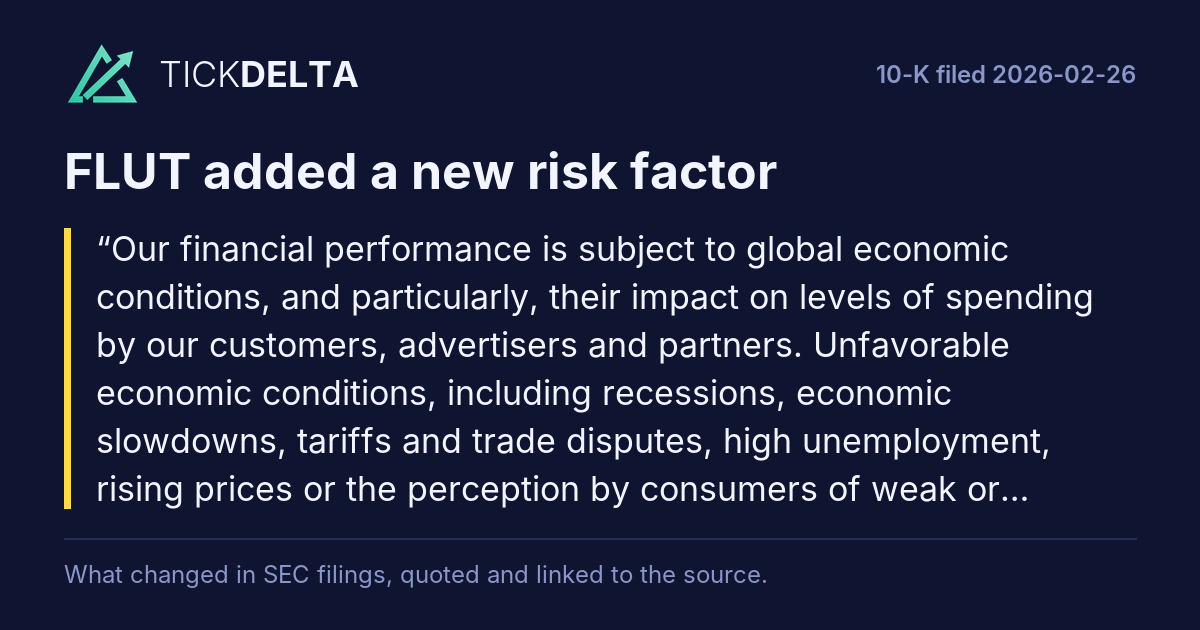
Our financial performance is subject to global economic conditions, and particularly, their impact on levels of spending by our customers, advertisers and partners. Unfavorable economic conditions, including recessions, economic slowdowns, tariffs and trade disputes, high unemployment, rising prices or the perception by consumers of weak or weakening economic conditions, may reduce levels of disposable income and participation in entertainment and leisure activities, such as betting or iGaming. Our business may be particularly sensitive to such changes, and as a result, there can be no assurance that demand for our product offerings will remain consistent.

A deterioration in global macroeconomic conditions could also adversely affect our business by increasing our overall cost structure and constraining our ability to invest in growth initiatives. For example, recent inflationary pressures have increased our labor costs and other operating expenses. Unfavorable economic conditions may also reduce the availability of credit, increase cost of credit or adversely affect our liquidity. If, as a result of such conditions, we are unable to secure financing when needed or on commercially acceptable terms, it may materially impair our ability to invest in new products, enhance our platforms or pursue strategic opportunities.

Adverse economic conditions that reduce customer participation or otherwise constrain liquidity may also materially reduce the attractiveness and competitiveness of our liquidity-dependent products such as Betfair Exchange, FanDuel’s DFS and prediction markets and PokerStars’ poker business, resulting in lower customer engagement and reduced revenues.

Additionally, the insolvency of any of our partners, advertisers or licensees could result in disrupted operations including by delaying payments owed to us, interrupting the delivery of services, or requiring us to identify and contract with replacement partners or require our exit from a particular market. Any of the foregoing could have a material adverse effect on our business, financial condition and results of operations.

Read in the 10-K

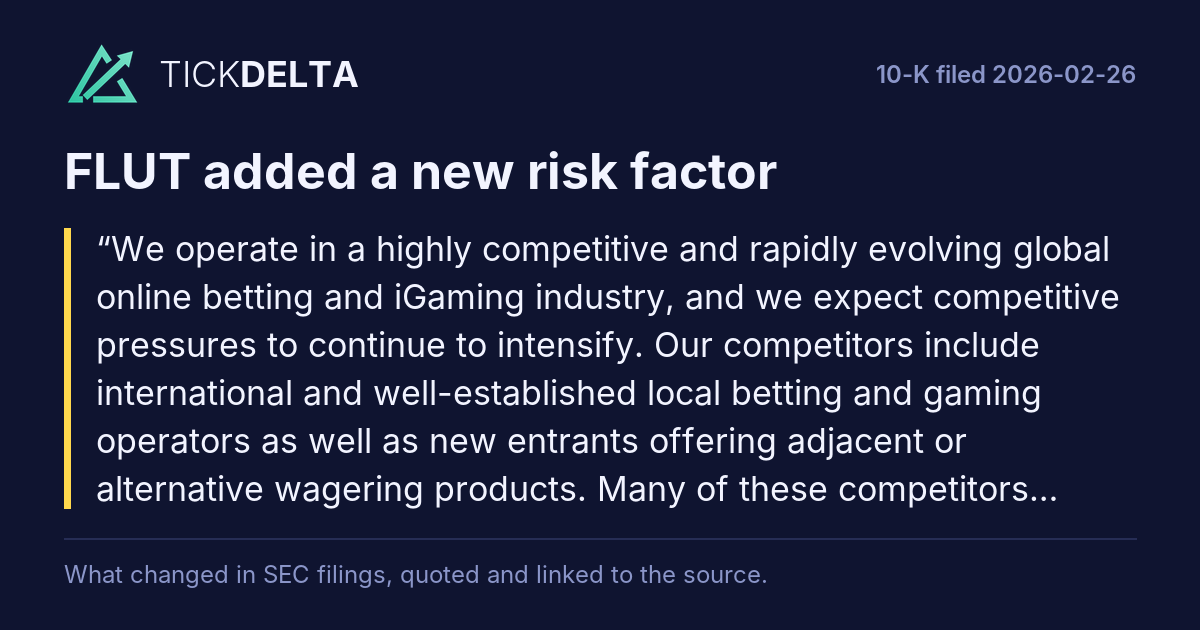
We operate in a highly competitive and rapidly evolving global online betting and iGaming industry, and we expect competitive pressures to continue to intensify. Our competitors include international and well-established local betting and gaming operators as well as new entrants offering adjacent or alternative wagering products. Many of these competitors operate at significant scale enabling them to attract customers to their offerings, have strong brand recognition, and may spend more money and time on developing and testing products and services, undertake more extensive marketing campaigns, adopt more aggressive pricing or promotional policies or otherwise develop more commercially successful products or services than ours. In addition, new competitors, whether licensed or not, may enter the gaming industry, further increasing competitive pressure. Barriers to customers switching between operators are low, which increases the risk that customers may choose competing offerings.

We also face competition from companies with different and emerging business models, regulatory frameworks and cost structures, including prediction markets or other derivatives-based products. In the United States, for example, prediction markets contracts regulated by the Commodity Futures Trading Commission (“CFTC”) are being offered by a growing number of providers. We do not currently offer sports contracts in U.S. states in which we offer our sportsbook product. In those states, other providers may offer sports contracts while being subject to different regulatory requirements, which could place us at a competitive disadvantage. In states where we do offer sports contracts, and for other prediction markets contracts available more broadly, competitors may offer similar products more successfully due to differences in business models, cost structures, regulatory approaches or reduced focus on account management and user safety.

In certain jurisdictions, we also face competition from illegal operators that do not comply with applicable regulatory and licensing requirements, allowing them to avoid compliance costs and restrictions, customer-focused safeguards and payment of gaming taxes. The increasing scale and sophistication of such operations may intensify competition in affected markets, increase regulatory scrutiny on the industry as a whole and put our customers at higher risk of harm.

Read in the 10-K

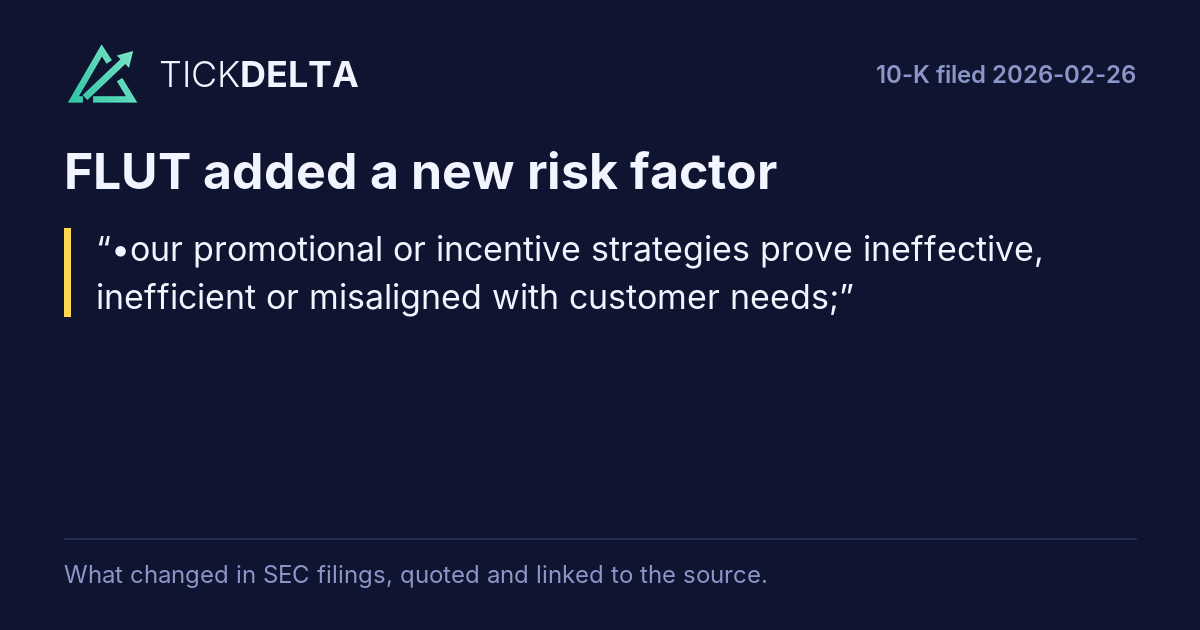
•our promotional or incentive strategies prove ineffective, inefficient or misaligned with customer needs;

Read in the 10-K

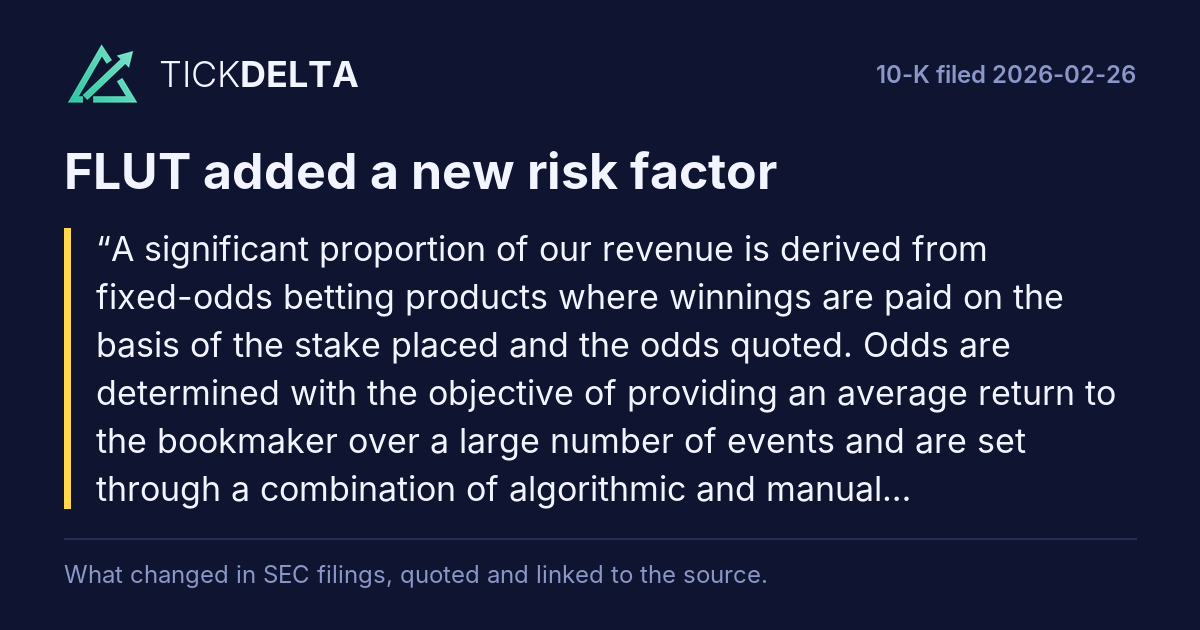
A significant proportion of our revenue is derived from fixed-odds betting products where winnings are paid on the basis of the stake placed and the odds quoted. Odds are determined with the objective of providing an average return to the bookmaker over a large number of events and are set through a combination of algorithmic and manual odds-making processes. However, there can be significant variation in our results event-by-event and day-by-day.

Read in the 10-K

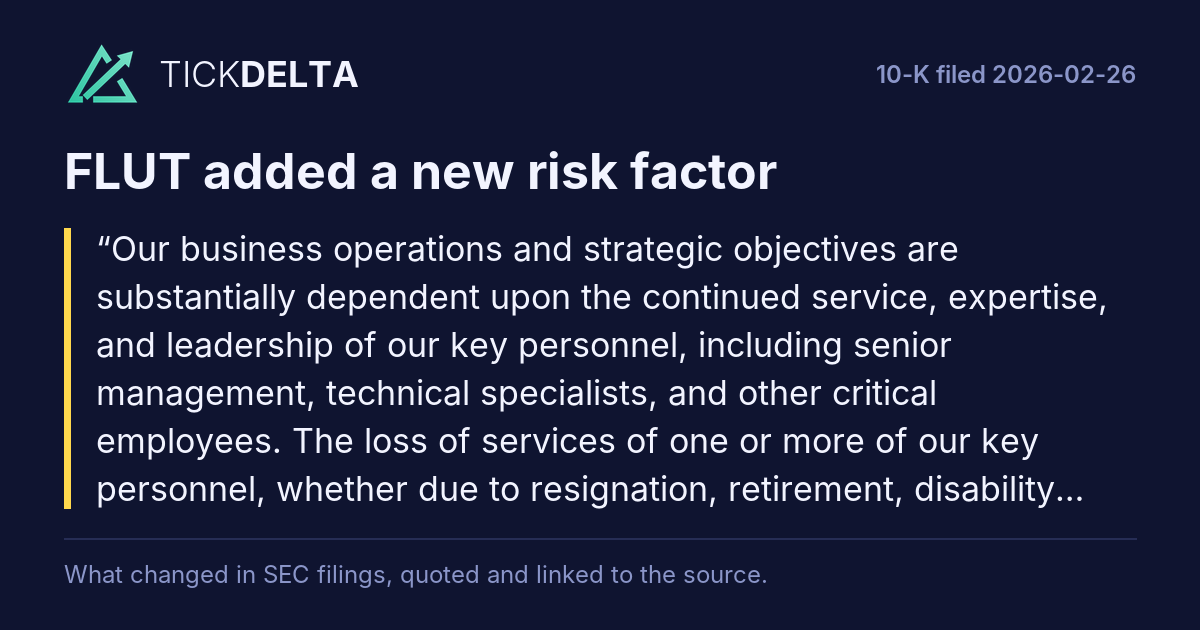
Our business operations and strategic objectives are substantially dependent upon the continued service, expertise, and leadership of our key personnel, including senior management, technical specialists, and other critical employees. The loss of services of one or more of our key personnel, whether due to resignation, retirement, disability, death, or other circumstances, could have a material adverse effect on our business, financial conditions and results of operations.

Read in the 10-K
Show the other 19

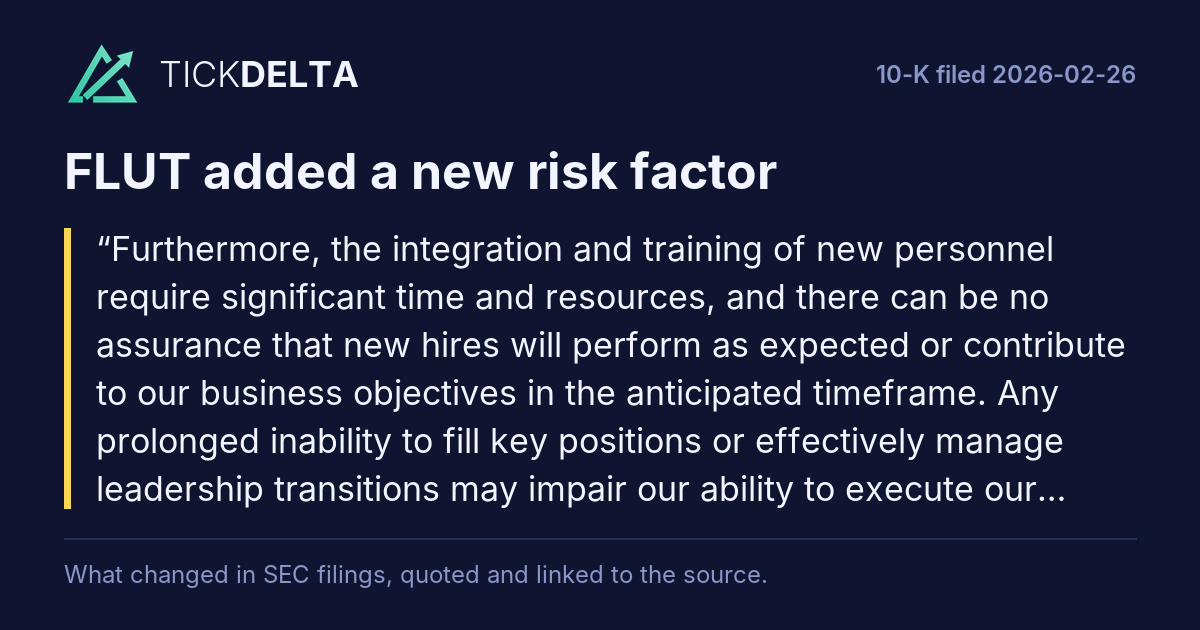
Furthermore, the integration and training of new personnel require significant time and resources, and there can be no assurance that new hires will perform as expected or contribute to our business objectives in the anticipated timeframe. Any prolonged inability to fill key positions or effectively manage leadership transitions may impair our ability to execute our business plan and achieve our strategic objectives, which could have a material adverse effect on our business, financial condition, and results of operations.

Read in the 10-K

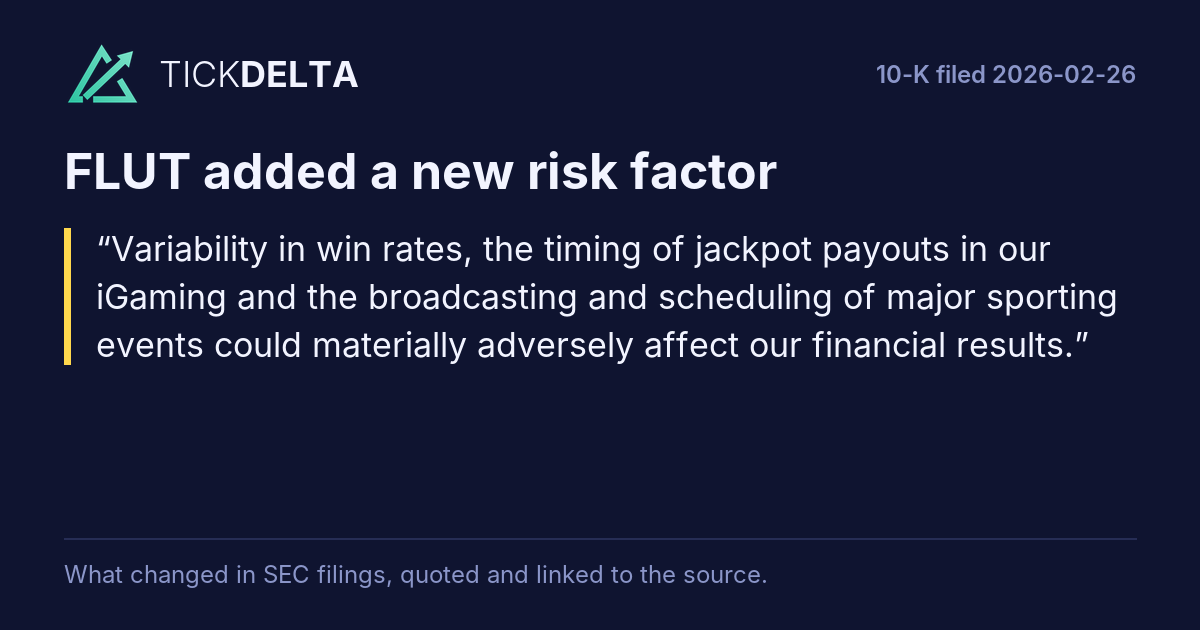
Variability in win rates, the timing of jackpot payouts in our iGaming and the broadcasting and scheduling of major sporting events could materially adversely affect our financial results.

Read in the 10-K

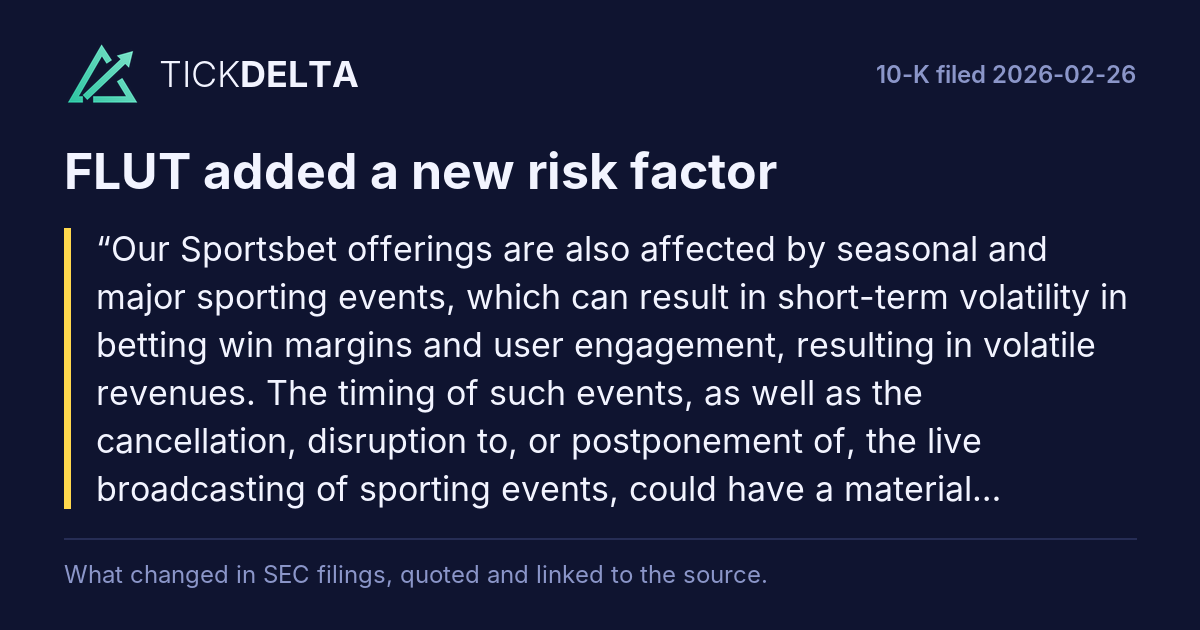
Our Sportsbet offerings are also affected by seasonal and major sporting events, which can result in short-term volatility in betting win margins and user engagement, resulting in volatile revenues. The timing of such events, as well as the cancellation, disruption to, or postponement of, the live broadcasting of sporting events, could have a material adverse effect on our business, financial condition and results of operations.

Read in the 10-K

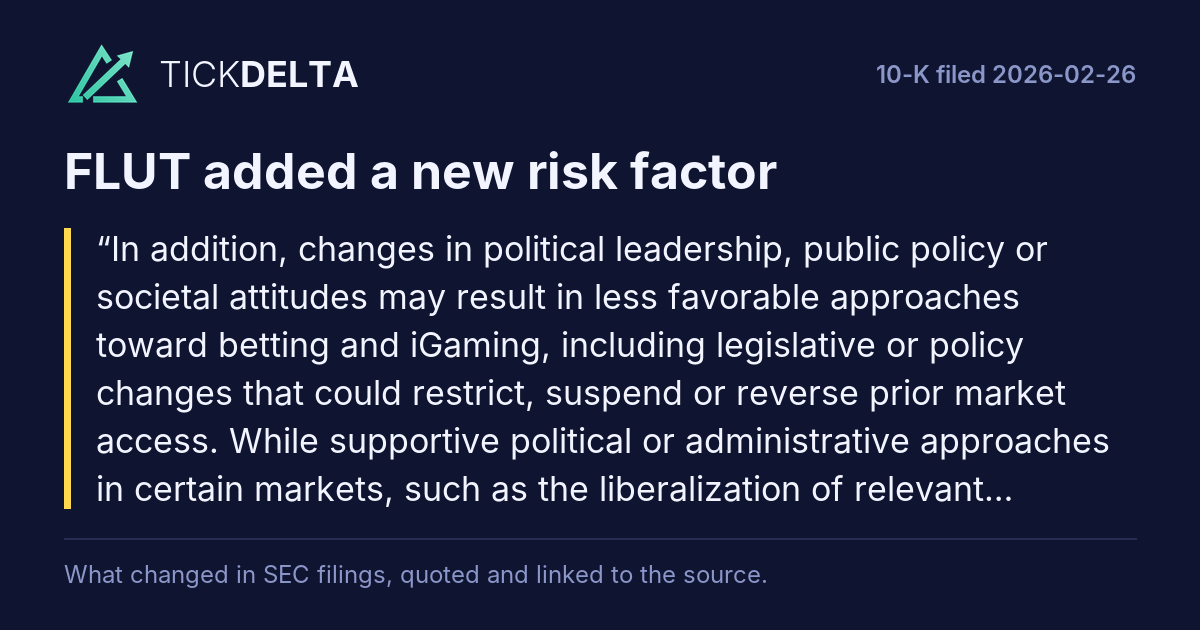
In addition, changes in political leadership, public policy or societal attitudes may result in less favorable approaches toward betting and iGaming, including legislative or policy changes that could restrict, suspend or reverse prior market access. While supportive political or administrative approaches in certain markets, such as the liberalization of relevant regulations and support for emerging products in the United States, have facilitated industry growth, such approaches may not continue or, if expanded or altered, could result in a less predictable regulatory framework and increased compliance uncertainty. See also “—The successful execution of our growth strategy, particularly with respect to our U.S. business, depends on our ability to expand our provision of online betting and iGaming services into new and existing jurisdictions and markets where the regulatory status of the provision of such services has been clarified or liberalized.”

Read in the 10-K

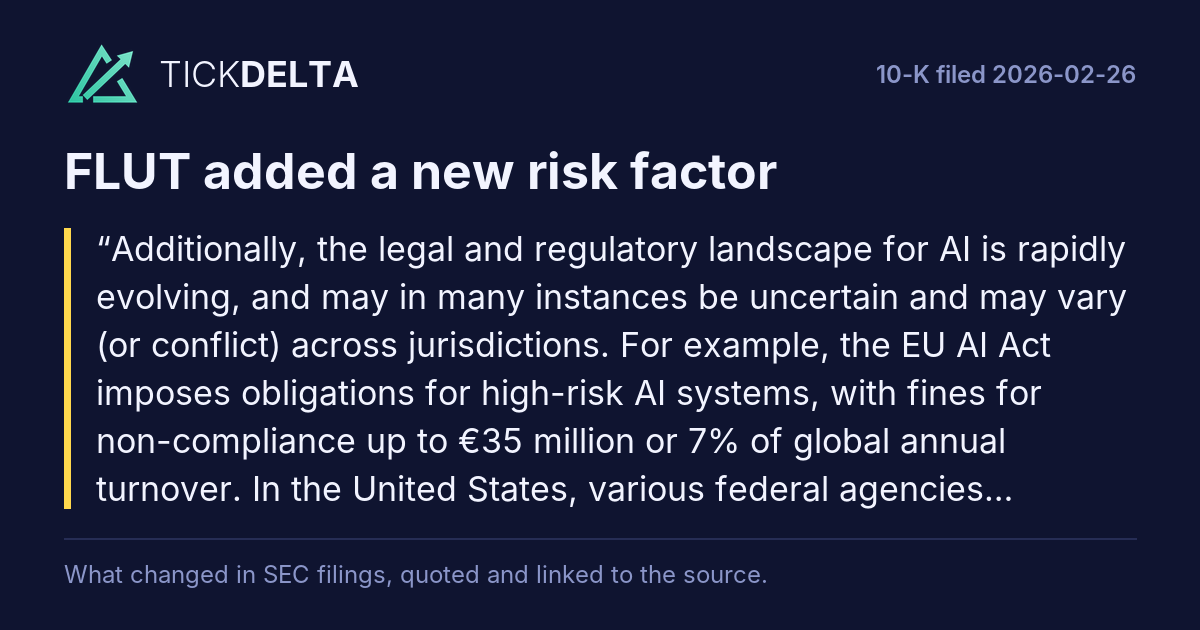
Additionally, the legal and regulatory landscape for AI is rapidly evolving, and may in many instances be uncertain and may vary (or conflict) across jurisdictions. For example, the EU AI Act imposes obligations for high-risk AI systems, with fines for non-compliance up to €35 million or 7% of global annual turnover. In the United States, various federal agencies including the FTC are developing AI governance frameworks, and several states are considering AI-specific legislation. AI systems may exhibit bias, produce discriminatory outcomes, consumer protection, or responsible gaming principles. Training data used in AI models may inadvertently contain biased, inaccurate, or protected information, potentially leading to regulatory violations or reputational harm. The rapid evolution of AI, including with respect to compliance with existing and potential government regulation of such technology, may require significant resources, including to develop, test and maintain platforms, offerings, services, and features to help us implement AI in accordance with varying laws across jurisdictions, and to minimize other adverse effects on our results of operations.

Read in the 10-K

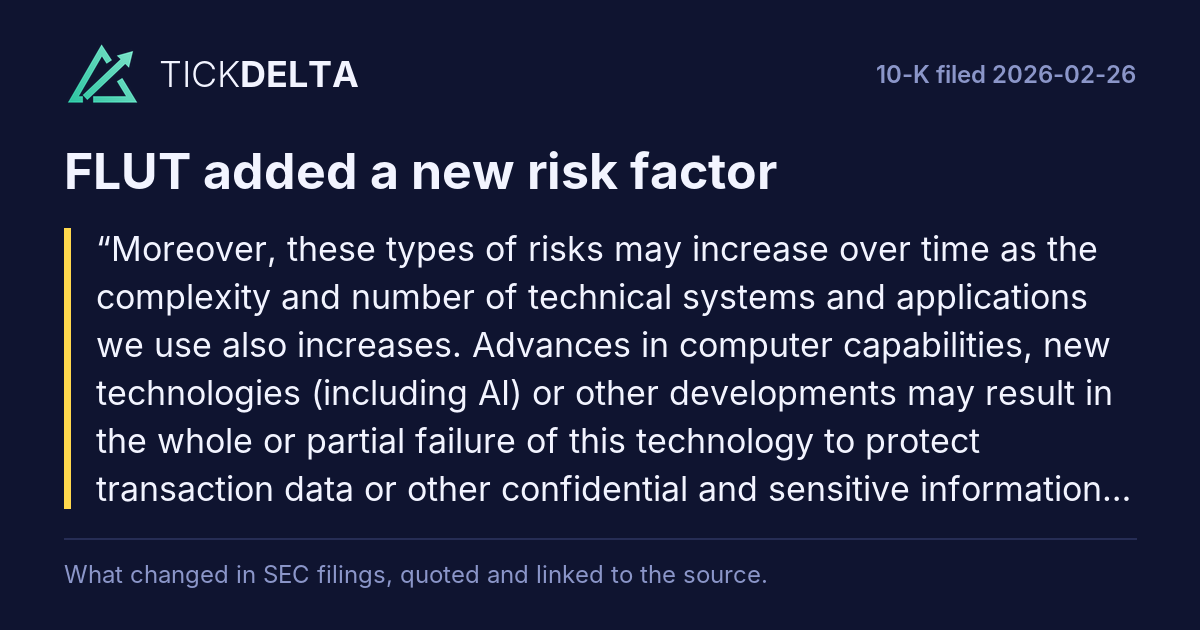
Moreover, these types of risks may increase over time as the complexity and number of technical systems and applications we use also increases. Advances in computer capabilities, new technologies (including AI) or other developments may result in the whole or partial failure of this technology to protect transaction data or other confidential and sensitive information from being breached or compromised. As cybersecurity threats continue to evolve, we may be required to expend significant additional resources to continue to modify or enhance our protective measures or to investigate and remediate any information security vulnerabilities.

Read in the 10-K

In certain jurisdictions in which we operate, we accept payment from our customers through credit card transactions, certain online payment service providers and mobile payment platforms. The use of these payment methods involves risks that may be outside of our direct control and could disrupt our payment processing capabilities.

Read in the 10-K

If we or any of our third-party providers or payment processors fail to adequately prevent fraudulent or erroneous credit card transactions, including as a result of misconduct, errors, or control failures, we may face litigation, fines, governmental enforcement action, civil liability, diminished public perception of our security measures, significantly higher credit card-related costs and substantial remediation costs or refusal by credit card processors to continue to process payments on our behalf, any of which could materially and adversely affect our business, financial condition and results of operations.

Read in the 10-K

In addition to government regulation, we are also subject to various industry privacy standards, the terms of our own privacy policies and privacy-related obligations to third parties.

Read in the 10-K

Any adverse changes to the regulation of online betting and iGaming, the interpretation of these laws, regulations and licensing requirements by relevant regulators, or the revocation of operating licenses, as a result of industry-specific reviews, could have a material adverse effect on our ability to conduct our operations and generate revenue in such jurisdictions. For example, following an extensive review of the Gambling Act of 2005 (the “UK Gambling Act”), the UK government is implementing a broad program of regulatory reform, and further regulatory changes remain under consideration. Similarly, in October 2024, the Irish government enacted the Irish Gambling Act, which also introduced major reform and consolidation of gambling laws in Ireland, including the creation of the GRAI, which will have broad powers to publish further guidance and codes of conduct. The new licensing framework is expected to be commenced on a phased basis, with the issuing of licenses by the GRAI expected to take place in 2026.

Adverse legislative, regulatory or judicial developments may also limit our ability to expand into, or scale within, adjacent and emerging industries. For example, in 2025, we launched our prediction markets product across multiple U.S. states. These products have been subject to regulatory scrutiny and litigation, and future court decisions, new legislation, changes in the interpretation of the Commodity Exchange Act, or regulatory action by the CFTC or state authorities could limit or prohibit us from offering certain types of prediction markets contracts or offering such contracts into certain states. Similarly, future rulemaking or policy shifts by the CFTC, including renewed efforts to prohibit or more heavily regulate the prediction markets, could curtail our product set or require operational changes on short notice. As a result, our ability to drive incremental growth in the U.S. through our prediction markets offering could be materially adversely affected.

Read in the 10-K

Legal uncertainty and inconsistent enforcement of online betting and iGaming laws could require us to restrict or cease operations in certain jurisdictions, or expose us to regulatory or legal action.

Read in the 10-K

Uncertainty may also arise regarding where online betting and iGaming activities are deemed to occur and which authorities have jurisdiction over them.

Our determination of whether to permit customers in a given jurisdiction to access our products or to engage in marketing and customer contact is based on our interpretation of applicable laws, licensing requirements and regulatory enforcement practices, including their potential extraterritorial application. If this determination is incorrect or later challenged, we could be subject to regulatory or legal action, be required to restrict or cease operations in that jurisdiction, or incur significant costs, which could materially adversely affect our business, financial condition and results of operations.

Read in the 10-K

The betting and gaming industry has been, and is expected to continue to be, the focus of frequent regulatory changes and the introduction of new taxes or levies. See also “Item 1A. Risk Factors—Uncertain and evolving interpretations of tax laws for online betting, iGaming and adjacent products may expose us to disproportionate liability.” For example, the November 2025 UK budget announced significant increases to remote gaming taxes, including an increase in the tax rate on online iGaming from 21% to 40% effective from April 2026, and online sports betting (ex-horseracing) from 15% to 25% effective from April 2027. In the United States, the federal government and individual U.S. States continue to refine and expand their regulatory and taxation frameworks for online gaming and betting. For example, Illinois imposed a progressive tax on sports betting revenue (up to 40%) from July 2024 and per-wager fee from July 2025, which has contributed to a decline in legal betting volume. Certain municipalities have also proposed additional local taxes on online wagering, which if the subject of widespread adoption, could materially and adversely affect our business, financial condition and results of operation. The adoption of substantial new or increased taxes could materially increase our costs, reduce customer activity, constrain U.S. growth plans and adversely affect our business.

Read in the 10-K

In addition to specific taxes, duties and levies on the provision of betting and gaming services and related activities, we are also subject to direct and indirect taxes that apply generally to businesses operating in relevant jurisdictions. For example, certain jurisdictions in which we operate have implemented, or are expected to implement, Pillar One of the OECD’s Base Erosion and Profit Shifting (BEPS) 2.0 project. Pillar One would allocate taxing rights based on digital presence rather than physical presence and could increase the Group’s effective tax rate and subject us to taxation in jurisdictions where we are not currently taxable. Further, until an agreement on Pillar One is reached, some jurisdictions have imposed digital services taxes (“DSTs”) on certain digital business models, including online betting and gaming. The interpretation and implementation of Pillar One and DSTs, particularly if applied inconsistently across jurisdictions, could materially increase our tax liability and have a material adverse effect on our business, financial condition and results of operations.

Uncertain and evolving interpretations of tax laws for online betting, iGaming and adjacent products may expose us to disproportionate liability.

Read in the 10-K

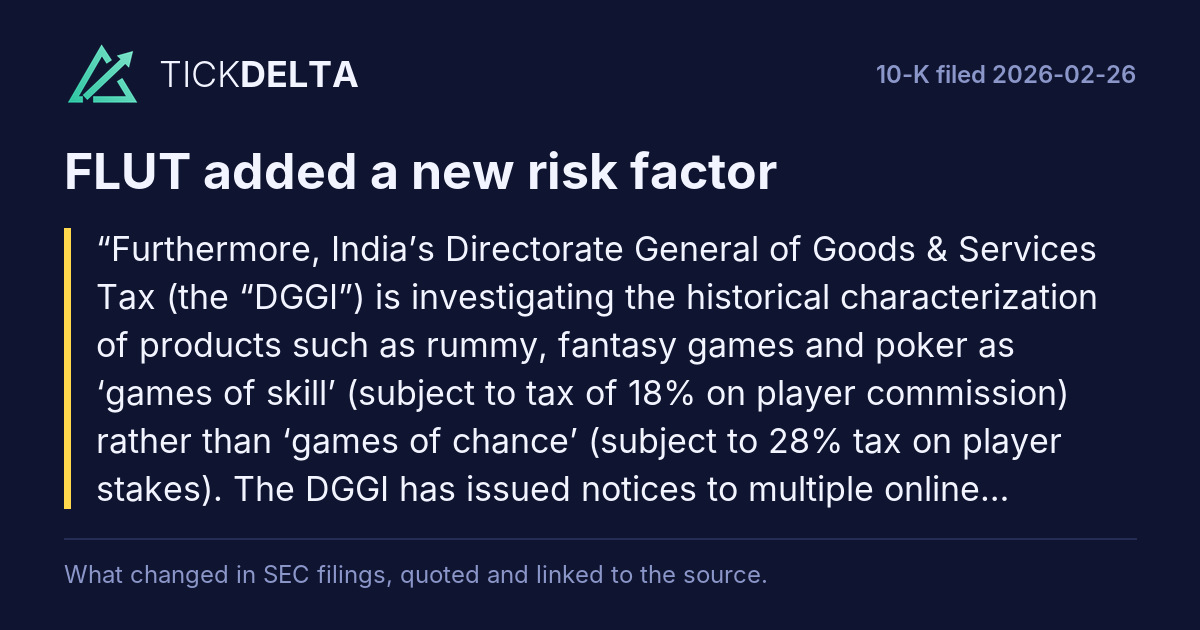
Furthermore, India’s Directorate General of Goods & Services Tax (the “DGGI”) is investigating the historical characterization of products such as rummy, fantasy games and poker as ‘games of skill’ (subject to tax of 18% on player commission) rather than ‘games of chance’ (subject to 28% tax on player stakes). The DGGI has issued notices to multiple online gaming businesses alleging historical underpayment of GST, including to Junglee and PokerStars India, for a total amount of ₹198.5 billion ($2.2 billion). While we believe our historical GST treatment is appropriate, the proceedings remain unresolved, and an adverse outcome could result in significant additional GST liabilities, which would materially affect our business, financial condition and results of operations. See Note 21 “Commitments and Contingencies” in the audited financial statements included in this Annual Report.

Read in the 10-K

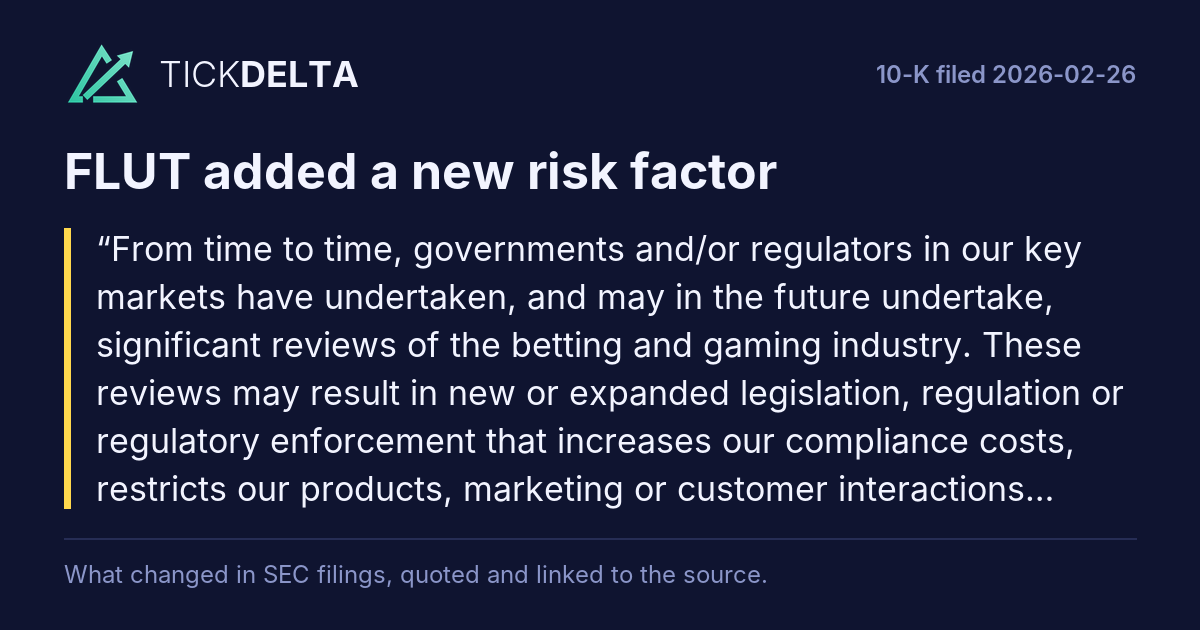
From time to time, governments and/or regulators in our key markets have undertaken, and may in the future undertake, significant reviews of the betting and gaming industry. These reviews may result in new or expanded legislation, regulation or regulatory enforcement that increases our compliance costs, restricts our products, marketing or customer interactions, reduces demand for our offerings, or otherwise has a material adverse effect on our business, financial condition and results of operations.

For example, the UK government’s review of the UK Gambling Act, published in April 2023, has resulted, and may continue to result, in legislative changes, including the introduction of maximum staking limits for online slots and a statutory levy to fund the research, prevention and treatment of gambling harms and amendments to the regulatory requirements implemented by the UKGC. These changes have included, among other things, the introduction of financial vulnerability checks, mandatory customer prompts for deposit limits, restrictions on promotional incentives, changes to direct marketing consents and modifications to the design and offer of non-slots online gaming products. While the Group has not experienced materially increased operational or compliance costs as a result of these changes to date, the full scope of the impact of the review, including the potential for additional legislative or regulatory changes, remains uncertain. For example, the UKGC is also currently piloting the introduction of financial risk assessments, which if implemented on a permanent basis, could increase our operational and compliance costs, and materially impact our business. In addition, campaign groups are calling for further reviews of UK gambling legislation, with particular focus on restricting gambling advertising and sponsorship, and the UKGC could introduce additional requirements in the future. Any further review of the UK Gambling Act, legislative changes or incremental regulatory intervention could materially impact our business, financial condition and results of operations.

Similar reviews or regulatory changes in any of our key jurisdictions could, individually or in the aggregate, have a material adverse effect on our business, financial condition and results of operations. In addition, regulators around the world increasingly take note of each others’ approaches to regulating the betting and gaming industries. Consequently, new laws or regulations in one jurisdiction may be replicated in others, negatively affecting our business across multiple jurisdictions or product or service offerings.

Read in the 10-K

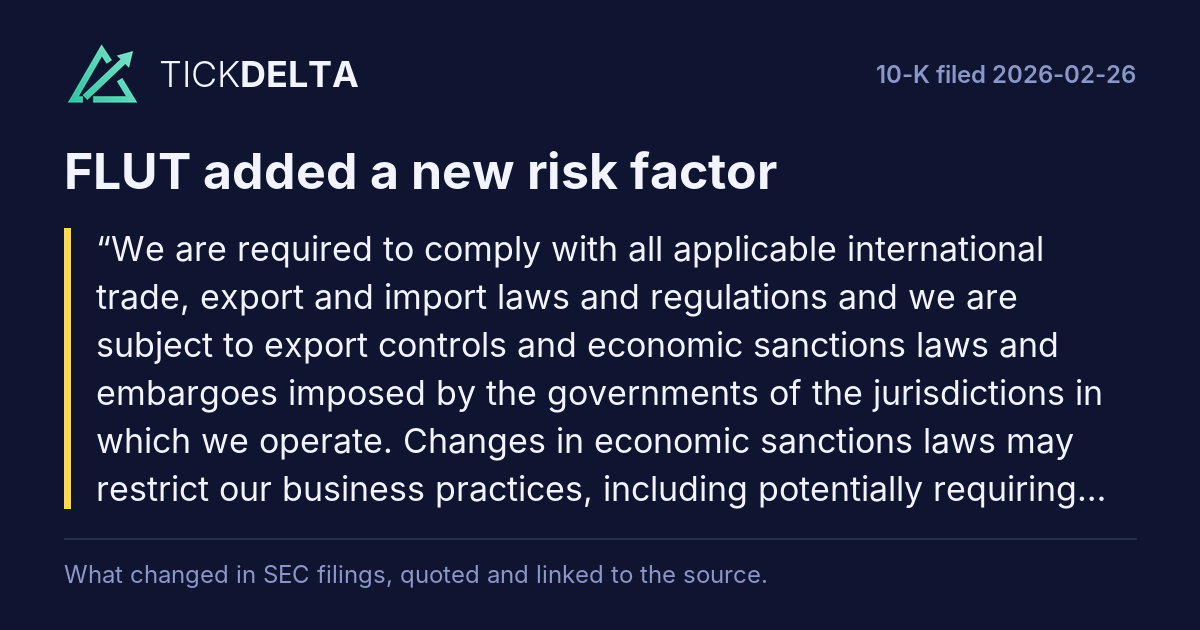
We are required to comply with all applicable international trade, export and import laws and regulations and we are subject to export controls and economic sanctions laws and embargoes imposed by the governments of the jurisdictions in which we operate. Changes in economic sanctions laws may restrict our business practices, including potentially requiring the cessation of business activities in sanctioned countries or with sanctioned entities or persons, and may result in our modifying our compliance programs.

Read in the 10-K

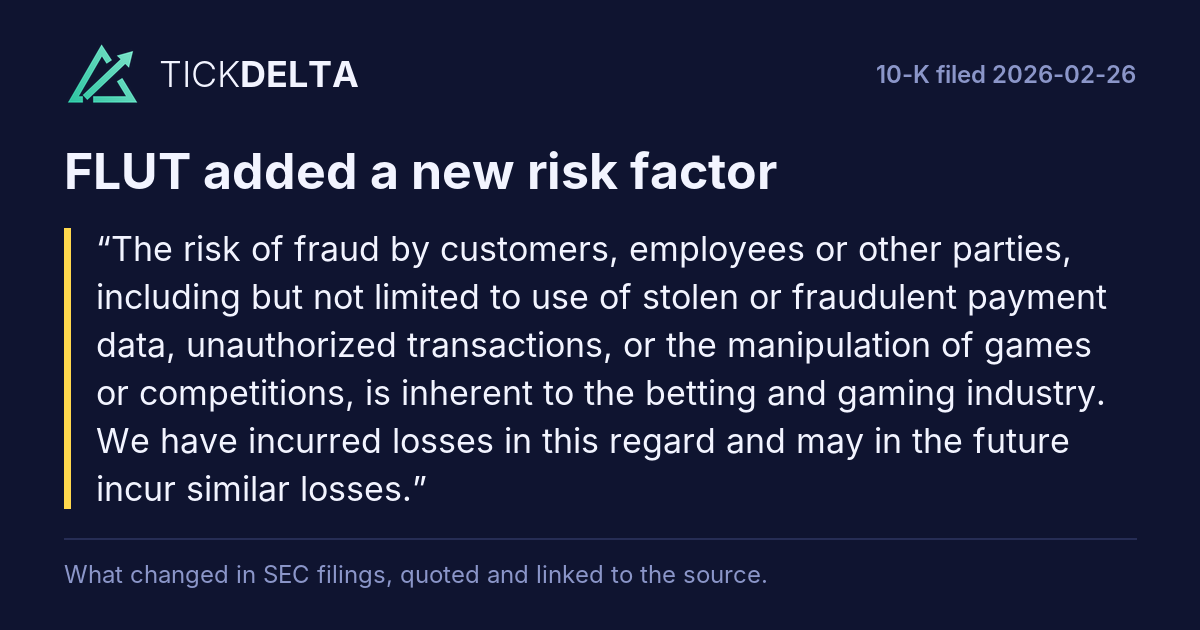
The risk of fraud by customers, employees or other parties, including but not limited to use of stolen or fraudulent payment data, unauthorized transactions, or the manipulation of games or competitions, is inherent to the betting and gaming industry. We have incurred losses in this regard and may in the future incur similar losses.

Read in the 10-K

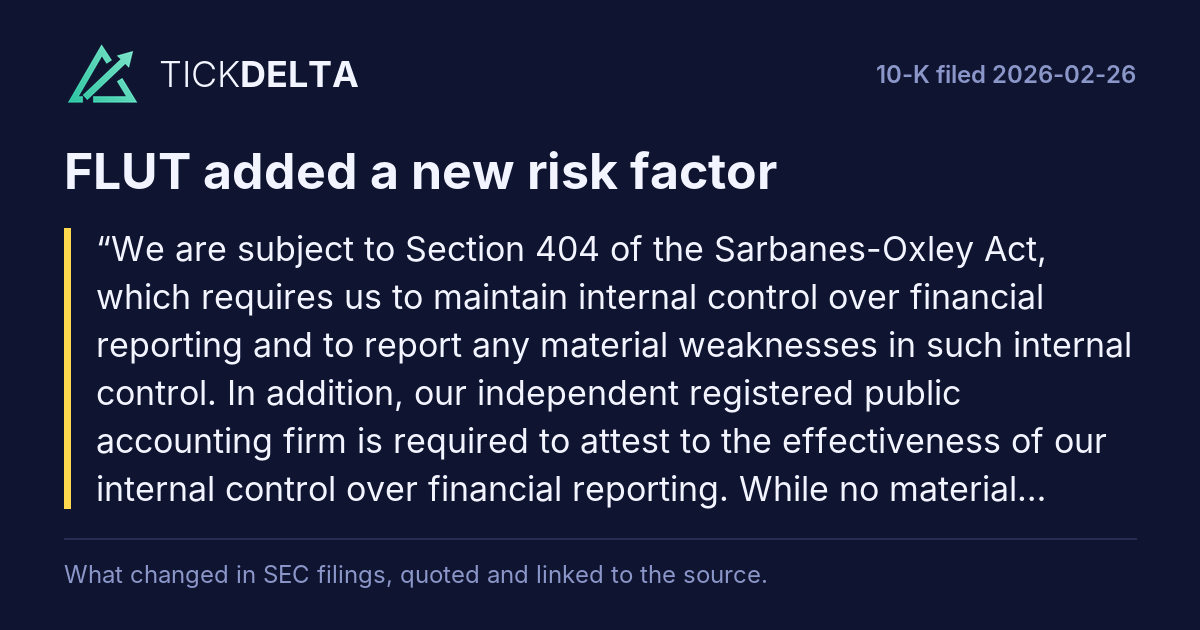
We are subject to Section 404 of the Sarbanes-Oxley Act, which requires us to maintain internal control over financial reporting and to report any material weaknesses in such internal control. In addition, our independent registered public accounting firm is required to attest to the effectiveness of our internal control over financial reporting. While no material weaknesses were identified as of December 31, 2025, we previously identified material weaknesses in our internal controls over financial reporting for fiscal years 2024 and 2023, and we cannot assure you that additional material weaknesses will not arise in the future. Details of remediation activities completed in fiscal year 2025, are set out in Item 9A. Controls and Procedures.

Our reporting obligations as a public company place significant requirements on our management and we are required to devote substantial operational and financial resources to meet those obligations and expect to continue to do so for the foreseeable future. Changes in personnel, systems or procedures (including the implementation, upgrade, replacement or integration of enterprise resource planning systems), as well as other significant events, including M&A, may have an adverse impact on our internal controls and increase the risk of deficiencies. The existence of any material weakness could require us to incur significant expense to remediate, and we may not be able to do so in a timely manner or at all. In addition, a control system, no matter how well designed and operated, can provide only reasonable, not absolute, assurance that the control system’s objectives will be met. Further, because of the inherent limitations in all control systems, no evaluation of controls can provide absolute assurance that misstatements due to error or fraud will not occur or that all control issues and instances of fraud, if any, within a company have been detected.

Read in the 10-K

Paragraphs in the 10-Q filed Nov 4, 2026 that were not in the one before

New in the latest 10-Q

40 paragraphs in the 10-Q filed Nov 4, 2026 with nothing like them in the 10-Q filed Aug 5, 2026 (at least half the words must differ; new numbers alone do not count). Quoted exactly, grouped by the item heading above them. This is text that changed, not a judgement of how serious it is.

10-Q

• The uncertain and evolving legal and regulatory treatment of prediction markets and its impact on Flutter’s prediction markets strategy, products and market making activities;

Read in the 10-Q

Financial statements and notes

Fair value of cash flow hedges transferred to the income statement (2) (13) (14) 88

Read in the 10-Q

Foreign exchange (loss) gain on translation of the net assets of foreign currency denominated entities (28) (82) (202) 1,064

Read in the 10-Q

5. Brazil reflects our Betfair and Betnacional (effective from the acquisition date of May 14, 2025) operations in the region. Following the Provisional Measure No. 1,394 (the “Measure”) announced on September 25, 2026 banning fixed-odds sports betting and online gaming, our operations in Brazil are currently ceased. In October 2026, the Group announced the closure of Betfair Brazil and the decision to focus on a single-brand strategy in Brazil intended to ensure an agile operating model to navigate the future regulatory environment.

Read in the 10-Q

5. During the three and nine months ended September 30, 2026, the Group recognized impairment charges of $ 873 million related to Brazil within the International segment, due to the previously disclosed challenging trading environment driven by government implemented socio-economic measures together with the Measure announced on September 25, 2026 banning fixed-odds sports betting and online gaming. Out of the total impairment charge of $ 873 million, $ 296 million is related to long-lived assets and $ 541 million is related to goodwill. Long-lived asset impairment charges primarily included $ 122 million related to the trademark, $ 108 million related to customer relationships, $ 31 million related to technology, and $ 22 million related to capitalized development costs. Trademark and customer relationships impairment charges were recognized in sales and marketing expenses; technology and capitalized development costs in technology, research and development expenses; and license cost in cost of sales. The impairment charges related to property, plant and equipment and right-of-use assets were recognized in general and administrative expenses.

Read in the 10-Q
Show the other 35

During the three and nine months ended September 30, 2025, the Group recognized impairment charges of $ 559 million mainly related to Junglee. The Promotion and Regulation of Online Gaming Act, 2025 (the “Act”), which was passed by the Indian Parliament and received Presidential assent on August 22, 2025, banned all forms of online real money gaming in India. As a result of the Act, from August 22, 2025, Junglee ceased offering all real-money games in India. The Junglee impairment charge is $ 556 million before income taxes. The assets impaired substantially consists of goodwill of $ 517 million, acquired and developed intangibles of $ 32 million and other long-lived assets of $ 7 million. The $ 517 million of goodwill impaired is not deductible for tax purposes, and therefore there was no income tax benefit. Income tax impacts arising for acquired and developed intangibles and other long-lived assets are not material.

Read in the 10-Q

During the nine months ended September 30, 2026, the Group recognized an impairment in relation to the Brazil business. See Note 3. Segments and Disaggregation of Revenue.

Read in the 10-Q

Subsequent to September 30, 2026, the Group entered into the First Amendment and Restatement Agreement (the “First Amendment and Restatement Agreement”) to the Credit Agreement dated November 24, 2023. For additional information regarding the First Amendment and Restatement Agreement see Note 17. Subsequent events.

Read in the 10-Q

As of September 30, 2026 ($ in millions) Level 1 Level 2 Level 3 Total ───────────────────────────────────────────────────────────────────────────────────────────────────────────────────────── Financial assets measured at fair value: Equity securities – Investments1 — — 5 5 Derivative financial assets — 97 — 97 Total — 97 5 102 Financial liabilities measured at fair value: Derivative financial liabilities — 30 — 30 Fox Option liability — — 100 100 Total — 30 100 130 Redeemable non-controlling interests at fair value $ $ $ $

Read in the 10-Q

Following the Measure announced on September 25, 2026 banning fixed-odds sports betting and online gaming, our operations in Brazil were ceased. Accordingly, the enterprise value of the Brazil reporting unit and the associated redeemable non-controlling interests at fair value were determined to be nil as of September 30, 2026.

Read in the 10-Q

The proposed adjustments in connection with the NOPAs total approximately $ 181 million, excluding interest. The Group disagrees with the IRS’s position and intends to pursue all available administrative and judicial remedies. In September 2026, the Group timely filed a protest to the proposed adjustments.

Read in the 10-Q

On October 30, 2026 the Company and certain of its subsidiaries entered into the “First Amendment and Restatement Agreement” to the Term Loan A, Term Loan B and Revolving Credit Facility Agreement dated as of November 24, 2023 (the “Credit Agreement”).

Read in the 10-Q

• extends the maturity date of the Group’s term A facilities and the revolving credit facility to May 3, 2032;

Read in the 10-Q

• increases the commitments under the revolving credit facility to $ 1.86 billion and redenominates the base currency of the revolving credit facility from Sterling to U.S. dollars;

Read in the 10-Q

• redenominates the term A facilities solely into U.S. dollars and Euros, such that, following the effective date of the First Amendment and Restatement Agreement, an aggregate principal amount of € 382 million of term A2 loans and $ 1,374 million of term A3 loans are outstanding and no Sterling-denominated term A loans remain outstanding; and

Read in the 10-Q

• replaces the net total leverage financial covenant with a net first lien leverage financial covenant and the financial covenant level increased to 5.70 :1.00.

Read in the 10-Q

After giving effect to the First Amendment and Restatement Agreement, the term A loans and revolving credit facility loans will bear interest at the applicable screen rate (Term SOFR, EURIBOR or SONIA, as applicable) plus a margin ranging from 1.40 % to 2.00 % per annum determined by reference to the Company’s corporate ratings from Moody’s, S&P and Fitch.

Read in the 10-Q

On October 20, 2026, the Group committed to a restructuring plan affecting the Group’s UKI reporting unit (the “Restructuring Plan”). The Restructuring Plan is designed to mitigate the impact of increases in UK gaming taxation, in accordance with the Group’s previously announced UK gaming tax mitigation plans. The Restructuring Plan is expected to entail a reduction in headcount of up to 1,400 employees.

Read in the 10-Q

The Group currently estimates that it will incur aggregate pre-tax charges of approximately $ 80 million to $ 90 million in connection with the Restructuring Plan, consisting primarily of cash expenditure related to employee severance, benefits, and related costs. The Group also expects to record certain non-cash charges in respect of stock-based compensation; however, such charges cannot be reasonably estimated at this time.

Read in the 10-Q

During the period, several states increased sports betting tax rates, including North Carolina, where the sports betting tax rate increased from 18% to 23%, and Colorado, where free-bet deductions were removed from the sports betting tax base, both effective in the quarter. Other states have also proposed further tax rate increases, which may adversely impact our results of operations in the affected jurisdictions.

Read in the 10-Q

In April 2026, the Australian government announced a package of online gambling reforms which enter into force on January 1, 2027. The reforms package includes substantial advertising changes across broadcast, digital and social media platforms, payment blocking for illegal offshore wagering, reforms to BetStop (the National Self-Exclusion Register), and consumer protection measures, including a ban on the payment of commissions, reforms to promotions and at-risk customer monitoring.

Read in the 10-Q

As previously disclosed, in 2026, there has been a rapid increase in anti-gambling legislative and regulatory activity in Brazil, including, in January 2026, a gradual tax increase on gross gaming revenue to 13% in 2026, 14% in 2027 and 15% in 2028, and the introduction of socio-economic measures, including a self-exclusion register for customers and the prohibition of recipients of certain welfare benefits and participants of debt finance schemes.

Read in the 10-Q

This trend accelerated in the run-up to Brazil's presidential election in October 2026, culminating in a unilateral executive order provisionally banning sports betting and iGaming operations in Brazil announced on September 25, 2026. While the executive measure requires Congressional approval or amendment within 120 days to remain in effect, it had immediate effect, subject to certain wind-down provisions with full site closure from October 5, 2026. Flutter ceased operating sports betting and iGaming in Brazil on September 26, 2026 and, together with the wider industry, is pursuing available avenues to challenge the ban, including legal challenges, while continuing to engage with the Brazilian authorities. In the short term, we have paused all discretionary and uncommitted spend. To ensure that we have an agile operating model ready for when the future regulatory framework becomes clearer, we have restructured our business to focus on a single brand commercial strategy with Betnacional, resulting in the closure of Betfair Brazil.

Read in the 10-Q

Additionally, on September 28, 2026, the Brazilian federal government initiated a civil class action against 17 betting companies, including Betnacional and Betfair, alleging liability for gambling-related harm. The matter is currently in preliminary stages and the scope and potential liability to Flutter cannot currently be determined.

Read in the 10-Q

Separately, in August 2026, Brazil’s Federal Public Prosecutor’s Office and Federal Revenue Service initiated an investigation into NSX for alleged tax evasion and money laundering relating to its use of an offshore corporate structure for a period largely prior to acquisition by Flutter and the launch of Brazil’s regulated betting market. In a related but separate proceeding, Brazil’s Revenue Service initiated an investigation and requested documents relating to potential back taxes claims against NSX. As of the date of this filing, it is not yet possible to ascertain the scope or potential liability to NSX, if any. It appears that Brazilian authorities have initiated separate investigations against other licensed betting operators in Brazil, although it is not possible to confirm whether these matters are of a similar nature or scope to the NSX investigation.

Read in the 10-Q

Three months ended September 30, 2026 compared to three months ended September 30, 2025:

Read in the 10-Q

Goodwill impairment increased by $24 million. In 2026, goodwill impairment of $541 million relates to the Brazil business due to the previously disclosed challenging trading environment and cessation of operations in Brazil in September 2026, compared to $517 million of impairment of Junglee goodwill driven by the cessation of operations in India in August 2025. See Note 3. “Segments and Disaggregation of Revenue” within the Unaudited Condensed Consolidated Financial Statements for additional information.

Read in the 10-Q

Stakes growth was driven by a strengthened customer proposition, including the expansion of our rewards program to all sportsbook customers; improved social features such as bet-sharing, and greater personalization through Re-Use+ and Bet it Again markets; expanded differentiated betting market offering to include FIFA World Cup same game parlay and FanDuel Labs for WNBA and NFL.

Read in the 10-Q

iGaming revenue for the three months ended September 30, 2026 increased by 8% driven by a 24% increase in AMPs to 1.2 million for the three months ended September 30, 2026 compared to 0.9 million for the three months ended September 30, 2025, despite competitive dynamics and market moderation. AMP growth was primarily driven by new content releases, including Huff ‘n’ Even More Puff Hard Hat and content featuring Vegas Matt and Lady Luck, alongside our launch in Alberta.

Read in the 10-Q

CEE revenue grew 10% period over period driven by 9% iGaming growth from market share gains in Georgia, Serbia and Armenia, and 14% growth in sportsbook revenue reflecting increased customer engagement during the FIFA World Cup.

Read in the 10-Q

Nine months ended September 30, 2026 compared to nine months ended September 30, 2025:

Read in the 10-Q

Goodwill impairment increased by $24 million. In 2026, goodwill impairment of $541 million relates to the Brazil business driven by the challenging trading environment and cessation of operations in Brazil in September 2026, compared to $517 million impairment of Junglee goodwill driven by the cessation of operations in India in August 2025. See Note 3. “Segments and Disaggregation of Revenue” within the Unaudited Condensed Consolidated Financial Statements for additional information.

Read in the 10-Q

Brazil revenue increased 47% period over period, driven by NSX, while Betfair Brazil was largely flat. Favorable change in foreign currency exchange rates contributed 8% growth. We ceased to operate sports betting and iGaming in Brazil at the end of September in accordance with the implementation of a provisional measure announced on September 25, 2026. See “Business Environment” for further details.

Read in the 10-Q

4. During the three and nine months ended September 30, 2026, the Group recognized impairment charges of $873 million is related to Brazil within the International segment, due to the previously disclosed challenging trading environment driven by government implemented socio-economic measures together with the Measure announced on September 25, 2026 banning fixed-odds sports betting and online gaming. Out of the total impairment charge of $873 million, $296 million is related to long-lived assets and $541 million is related to goodwill. Long-lived asset impairment charges primarily included $122 million related to the trademark, $108 million related to customer relationships, $31 million related to technology, and $22 million related to capitalized development costs. Trademark and customer relationships impairment charges were recognized in sales and marketing expenses; technology and capitalized development costs in technology, research and development expenses; and license cost in cost of sales. The impairment charges related to property, plant and equipment and right-of-use assets were recognized in general and administrative expenses.

Read in the 10-Q

During the three and nine months ended September 30, 2025, the Group recognized impairment charges of $559 million mainly related to Junglee. The Act, which was passed by the Indian Parliament and received Presidential assent on August 22, 2025, banned all forms of online real money gaming in India. As a result of the Act, from August 22, 2025, Junglee ceased offering all real-money games in India. The Junglee impairment charge is $556 million before income taxes. The assets impaired substantially consist of goodwill of $517 million, acquired and developed intangibles of $32 million and other long-lived assets of $7 million. The $517 million of goodwill impaired is not deductible for tax purposes, and therefore there was no income tax benefit. Income tax impacts arising for acquired and developed intangibles and other long-lived assets are not material.

Read in the 10-Q

On October 30, 2026, the Company and certain of its subsidiaries entered into a First Amendment and Restatement Agreement (the “First Amendment and Restatement Agreement”) to the Credit Agreement dated as of November 24, 2023 (as amended) (the “Credit Agreement”). After giving effect to the First Amendment and Restatement Agreement on November 3, 2026, the Group’s committed revolving credit facility has been increased to $1.86 billion. See Note 17, “Subsequent Events,” to the Unaudited Condensed Consolidated Financial Statements included in Part I, “Item 1. Financial Statements” of this Quarterly Report.

Read in the 10-Q

Nine months ended September 30, 2026 compared to nine months ended September 30, 2025:

Read in the 10-Q

Risk Factors

Our restructuring and cost-saving initiatives may not achieve their anticipated benefits and could adversely affect our business, financial condition and results of operations.

Read in the 10-Q

We have undertaken, and expect to continue to undertake, a range of restructuring and cost-transformation initiatives intended to reduce our operating cost base and align resource allocation with our strategic priorities, including in response to regulatory changes, such as tax increases, implementation of anti-gambling legislation, and other macroeconomic factors. These initiatives involve, among other things, workforce reductions, cessation of targeted operations, technology platform migrations, consolidation of duplicative functions and increased use of automation and artificial intelligence (“AI”) to drive efficiencies. There can be no assurance that these initiatives will achieve their intended objectives within the expected timeframe, or at all, and the costs of implementation, including severance and other restructuring charges, technology investments and transition as well as consultation costs, may exceed anticipated savings.

Read in the 10-Q

Execution of these initiatives carries operational risk. Workforce reductions and reorganizations may result in loss of institutional knowledge and increased workload for remaining employees, potentially affecting productivity, service levels and talent retention. These actions could increase the risk of operational disruptions, service interruptions, control failures or other significant events, particularly during transition periods, as responsibilities are reassigned and processes are adjusted. Technology platform migrations, such as the PokerStars migration, involve risk of customer disruption, data migration errors and regulatory notification obligations across licensed jurisdictions. Our increasing reliance on AI and automation to deliver cost efficiencies introduces additional risk, including the potential for erroneous outputs, algorithmic bias, data privacy or security incidents, and inadequate human oversight of automated decisions, any of which could undermine anticipated savings, create regulatory exposure, or cause reputational or operational harm. If anticipated savings and efficiencies from any of these initiatives are not realized, whether due to implementation delays, labor relations matters, technology or AI-related failures, or other unforeseen difficulties, our results of operations, cash generation and financial condition could be materially and adversely affected.

Read in the 10-Q

The 10-Q's risk factors against the 10-K

Item 1A of the 10-Q filed Nov 4, 2026 against Item 1A of the 10-K filed Feb 26, 2026. A 10-Q repeats only the risks that changed, so a 10-K paragraph that is missing from it is not counted as removed. Added is a paragraph with nothing like it in the 10-K, Reworded a sentence that is in both with several words changed, Quiet changes a sentence in both where one to four words changed and one is a hedge or a modal (cut words struck through, new words highlighted). Text on the page, not a score; each links to the filing at sec.gov.

What the 10-Q itself says about its risk factors:There have been no material changes to the risk factors disclosed in “Part I, Item 1A. Risk Factors” in our 2025 Annual Report other than those listed in this section.

Read in the 10-Q
Added10-Q Nov 4, 2026 vs 10-K Feb 26, 2026
The risks described in our 2025 Annual Report are not the only risks we face. Additional risks and uncertainties not currently known to us or that we currently deem to be immaterial also may materially adversely affect our business, financial condition and/or operating results.

Read it in the 10-Q at sec.gov

Added10-Q Nov 4, 2026 vs 10-K Feb 26, 2026
We have undertaken, and expect to continue to undertake, a range of restructuring and cost-transformation initiatives intended to reduce our operating cost base and align resource allocation with our strategic priorities, including in response to regulatory changes, such as tax increases, implementation of anti-gambling legislation, and other macroeconomic factors. These initiatives involve, among other things, workforce reductions, cessation of targeted operations, technology platform migrations, consolidation of duplicative functions and increased use of automation and artificial intelligence (“AI”) to drive efficiencies. There can be no assurance that these initiatives will achieve their intended objectives within the expected timeframe, or at all, and the costs of implementation, including severance and other restructuring charges, technology investments and transition as well as consultation costs, may exceed anticipated savings.

Read it in the 10-Q at sec.gov

Added10-Q Nov 4, 2026 vs 10-K Feb 26, 2026
Execution of these initiatives carries operational risk. Workforce reductions and reorganizations may result in loss of institutional knowledge and increased workload for remaining employees, potentially affecting productivity, service levels and talent retention. These actions could increase the risk of operational disruptions, service interruptions, control failures or other significant events, particularly during transition periods, as responsibilities are reassigned and processes are adjusted. Technology platform migrations, such as the PokerStars migration, involve risk of customer disruption, data migration errors and regulatory notification obligations across licensed jurisdictions. Our increasing reliance on AI and automation to deliver cost efficiencies introduces additional risk, including the potential for erroneous outputs, algorithmic bias, data privacy or security incidents, and inadequate human oversight of automated decisions, any of which could undermine anticipated savings, create regulatory exposure, or cause reputational or operational harm. If anticipated savings and efficiencies from any of these initiatives are not realized, whether due to implementation delays, labor relations matters, technology or AI-related failures, or other unforeseen difficulties, our results of operations, cash generation and financial condition could be materially and adversely affected.

Read it in the 10-Q at sec.gov

Phrases used for the first time

Two-word phrases in Risk Factors of the 10-K filed Feb 26, 2026 that are in none of the 1 earlier 10-Ks stored, back to Mar 4, 2025

prediction markets ×16party service ×9regulatory changes ×6party suppliers ×5markets contracts ×4markets offering ×4party platforms ×4reduce customer ×3offer sports ×3sports contracts ×3compliance obligations ×3across jurisdictions ×3across multiple ×3evolving interpretations ×3adjacent products ×3unfavorable economic ×2
Where each one is used
  • prediction markets: Adverse economic conditions that reduce customer participation or otherwise constrain liquidity may also materially reduce the attractiveness and competitiveness of our liquidity-dependent products such as Betfair Exchange, FanDuel’s DFS and prediction markets and PokerStars’ poker business, resulting in lower...
  • party service: In addition, certain third party service providers may be reluctant to provide us with services if they determine that an association with us could result, directly or indirectly, in adverse consequences for their business due to concerns regarding public, political, regulatory or market sentiment toward the...
  • regulatory changes: Any adverse changes to the regulation of online betting and iGaming, the interpretation of these laws, regulations and licensing requirements by relevant regulators, or the revocation of operating licenses, as a result of industry-specific reviews, could have a material adverse effect on our ability to conduct our...
  • party suppliers: Uncertainty as to the legality of online betting and/or iGaming or adverse public sentiment towards online betting and/or iGaming may deter third party suppliers from dealing with us.
  • markets contracts: We also face competition from companies with different and emerging business models, regulatory frameworks and cost structures, including prediction markets or other derivatives-based products. In the United States, for example, prediction markets contracts regulated by the Commodity Futures Trading Commission...
  • markets offering: In addition, management may not properly ascertain or assess the risks of new initiatives, and subsequent events may alter the risks that were evaluated at the time we decided to execute any new initiative. Developing and creating additional product offerings, such as our prediction markets offering, can also...
  • party platforms: Our business model depends upon the continued compatibility between our applications and the major mobile operating systems and upon third party platforms for the distribution of our product offerings.
  • reduce customer: Adverse economic conditions that reduce customer participation or otherwise constrain liquidity may also materially reduce the attractiveness and competitiveness of our liquidity-dependent products such as Betfair Exchange, FanDuel’s DFS and prediction markets and PokerStars’ poker business, resulting in lower...

The 10-K at sec.gov

Used at least twice, small words left out. Counted, not picked: a phrase can be new because the company renamed something.

What was taken out

138 paragraphs of last year's Risk Factors with nothing like them now. The longest are quoted.

Across all companies
Additionally, India’s Directorate General of Goods & Services Tax (the “DGGI”) is currently investigating the historical characterization of products such as rummy, fantasy games and poker as ‘games of skill’ (subject to tax of 18% on player commission) rather than ‘games of chance’ (subject to 28% tax on player stakes). In making GST returns, Junglee and PokerStars India have consistently followed the Supreme Court of India’s rulings in relation to the distinction between games of skill and games of chance and treated its products as games of skill. The DGGI has issued notices to multiple...
In the 10-K filed Mar 4, 2025
We are subject to the evolving rules and regulations with respect to sustainability matters of a number of governmental and self-regulatory bodies and organizations, such as the European Union, the Irish and UK governments, the UK Financial Conduct Authority (“FCA”) and the International Sustainability Standards Board, that could make compliance more difficult and uncertain. In addition, regulators, customers, investors, employees and other stakeholders are increasingly focused on sustainability matters and related disclosures and often have disparate views on such matters. These changing...
In the 10-K filed Mar 4, 2025
Additionally, inflation has the potential to adversely affect our business, financial condition and results of operations by increasing our overall cost structure. The recent significant inflationary trends have had an adverse effect on our cost of labor expenditure, as well as other operating expenses. Moreover, our business is particularly sensitive to reductions from time to time in discretionary consumer spending, which is driven by socioeconomic factors beyond our control. Demand for entertainment and leisure activities, including betting and iGaming, can be affected by changes in the...
In the 10-K filed Mar 4, 2025
Under the Irish Takeover Rules, if an acquisition of ordinary shares were to increase the aggregate holding of the acquirer and its concert parties to ordinary shares that represent 30% or more of the voting rights of the company, the acquirer and, in certain circumstances, its concert parties would be required (except with the consent of the Irish Takeover Panel) to make an offer for the outstanding ordinary shares at a price not less than the highest price paid for the ordinary shares by the acquirer or its concert parties during the previous 12 months. This requirement would also be...
In the 10-K filed Mar 4, 2025

Sources

Item 1A of each 10-K and 10-Q on EDGAR, quoted exactly. Each paragraph links to the filing at sec.gov.

Also

10-K change: what was reworded or cut, section by section.

Work with it

Excel workbook · CSV. Google Sheet that stays up to date: paste =IMPORTDATA("https://tickdelta.com/company/FLUT/export.csv") into a cell.

Next:10-K change
Esc

Type a ticker such as AAPL, a name, an investor such as Buffett, or a topic such as tariffs. ↑ ↓ to move, Enter to open.