The Company accounts for this investment using the measurement alternative under ASC 321 because the investment does not have a readily determinable fair value. Under the measurement alternative, the investment is measured at cost, less impairment, if any, plus or minus changes resulting from observable price changes in orderly transactions for an identical or similar investment of the same issuer.
Read in the 10-Qopen_in_new
In May 2026, Raytek’s shares began trading on the Taipei Exchange Emerging Stock Board (“ESB”). The shares held by the Company are subject to restrictions and are not currently listed or publicly tradable on the ESB. The Company determined that trading in Raytek’s publicly traded shares represented an observable price change for purposes of applying the ASC 321 measurement alternative. Accordingly, as of September 25, 2026, the Company remeasured its investment based on the observable ESB market price, adjusted to reflect differences between the publicly traded shares and the Company's shares, including a discount for the lack of marketability associated with the Company's restricted shares. As a result of the remeasurement, the Company recognized an unrealized loss of $ 21.5 million in other income (expense), net, for the three months ended September 25, 2026 and decreased the carrying amount of the investment to $ 67.6 million as of September 25, 2026. As of June 26, 2026, the carrying amount of the investment was $ 89.1 million.
Read in the 10-Qopen_in_new
The following tables present details of the Company’s property, plant and equipment, net:
Read in the 10-Qopen_in_new
The Company’s total borrowings, including current and non-current portions of long-term borrowings, consisted of the following:
Read in the 10-Qopen_in_new
As of September 25, 2026, future maturities of long-term borrowings during each fiscal year were as follows:
Read in the 10-Qopen_in_new
On August 20, 2019, Fabrinet Thailand (the “Borrower”) and Bank of Ayudhya Public Company Limited (the “Bank”) entered into a credit facility agreement (the “2019 Credit Facility Agreement”), which provides for a facility of Thai baht 110.0 million (approximately $ 3.6 million based on the applicable exchange rate as of September 27, 2019) and $ 160.9 million that may be used for, among other things, an overdraft facility, short-term loans against promissory notes, a letter of guarantee facility, a term loan facility and foreign exchange facilities. The Bank may approve any request for extension of credit under the 2019 Credit Facility Agreement and may increase or decrease any facility amount in its sole discretion.
Read in the 10-Qopen_in_new
On August 17, 2026, the Borrower and the Bank amended the 2019 Credit Facility Agreement to increase the facility to Thai baht 2.61 billion (approximately $ 78.3 million based on the applicable exchange rate as of August 17, 2026) and $ 100.0 million. The credit facility will mature on August 20, 2044.
Read in the 10-Qopen_in_new
In connection with the amendment, the Borrower and the Bank entered into a term loan agreement (the “Term Loan Agreement”) in the original principal amount of Thai baht 2.50 billion (not exceeding $ 75.0 million). The proceeds from the term loan, together with cash on hand, were used to support the Company's capital expenditures.
Read in the 10-Qopen_in_new
The term loan bears interest at a rate of 2.45 % and was drawn down on August 19, 2026. The term loan is repayable in quarterly installments and matures on September 30, 2031. During the three months ended September 25, 2026, the Company recognized $ 0.2 million of interest expense related to the term loan.
Read in the 10-Qopen_in_new
Any borrowings under the 2019 Credit Facility Agreement, including those borrowings under the Term Loan Agreement, are guaranteed by Fabrinet.
Read in the 10-Qopen_in_new
The Term Loan Agreement contains affirmative and negative covenants applicable to the Borrower, including delivery of financial statements and other information, compliance with laws, and restrictions on granting security interests or liens on its assets, disposing of its assets, incurring indebtedness and making acquisitions. The Company is also required to maintain a debt service coverage ratio of at least 2.00 times and an interest-bearing debt ratio of less than or equal to 1.0 time.
Read in the 10-Qopen_in_new
The events of default under the Term Loan Agreement include failure to timely pay amounts due under the Term Loan Agreement or the related finance documents, failure to comply with the covenants under the Term Loan Agreement or the related finance documents, cross default with other indebtedness of the Borrower, events of bankruptcy or insolvency in respect of the Borrower, and the occurrence of any event or series of events that in the opinion of the Bank has or is reasonably likely to have a material adverse effect.
Read in the 10-Qopen_in_new
As of September 25, 2026, Thai baht 2.50 billion (approximately $ 74.7 million) was outstanding under the term loan.
Read in the 10-Qopen_in_new
On June 28, 2024, Ngan In Leng and First Laser Limited (collectively, the “Plaintiffs”) filed a complaint in the Fuzhou Intermediate People’s Court (the “Court”) in Fuzhou, China against Fujian Enterprises (Holdings) Co., Ltd. (“FEHC”), Jian An Investment Limited (“Jian”), and Casix, Inc. (“Casix”), the Company's wholly-owned subsidiary located in the PRC. The complaint alleged unjust enrichment related to a purported investment in Casix by the Plaintiffs in 1997, which predates the Company's acquisition of Casix from JDS Uniphase Corporation. The Plaintiffs requested that the Court order FEHC to return the unjust enrichment to the Plaintiffs in the amount of RMB 400 million, with interest from March 1, 2000, and order Jian and Casix to bear joint and several liability for all payment obligations of FEHC.
Read in the 10-Qopen_in_new
In September 2024, the Court dismissed the complaint in its entirety based on jurisdictional grounds. The Plaintiffs subsequently appealed the Court’s ruling to the High People's Court of Fujian Province (the "Appellate Court"). In their appeal, the Plaintiffs claimed that Casix is the primary obligor to return the alleged unjust enrichment to the Plaintiffs. In November 2025, the Appellate Court upheld the Court's ruling and dismissed the lawsuit on jurisdictional grounds.
Read in the 10-Qopen_in_new
In April 2026, the Plaintiffs appealed the Appellate Court’s ruling to the Supreme People’s Court of the People’s Republic of China (the “PRC Supreme Court”). The PRC Supreme Court held an initial hearing on July 2, 2026 and, on July 30, 2026, rendered a ruling accepting the case for retrial. The acceptance of the case for retrial does not represent a determination on the merits of the Plaintiffs' claims. At this time, the Company is not able to quantify any potential liability in connection with this litigation because of the early stage of this litigation.
Read in the 10-Qopen_in_new
In September 2026, the Company implemented a restructuring initiative aimed at enhancing operational effectiveness and streamlining activities within its subsidiary located in Thailand. As a result of the restructuring, the Company incurred total charges of $ 1.0 million, which were primarily related to employee severance and other termination benefits. These severance-related charges reflect the costs associated with workforce reductions across various functions within the Thailand operations.
Read in the 10-Qopen_in_new
The OECD introduced a global minimum tax framework (“Pillar Two”) that imposes a minimum tax rate of 15% on multinational enterprise groups with annual consolidated revenue exceeding €750 million. Pillar Two includes a Qualified Domestic Minimum Top-up Tax (“QDMTT”), an Income Inclusion Rule (“IRR”), and an Undertaxed Profits Rule (“UTPR”).
Read in the 10-Qopen_in_new
Risk Factors
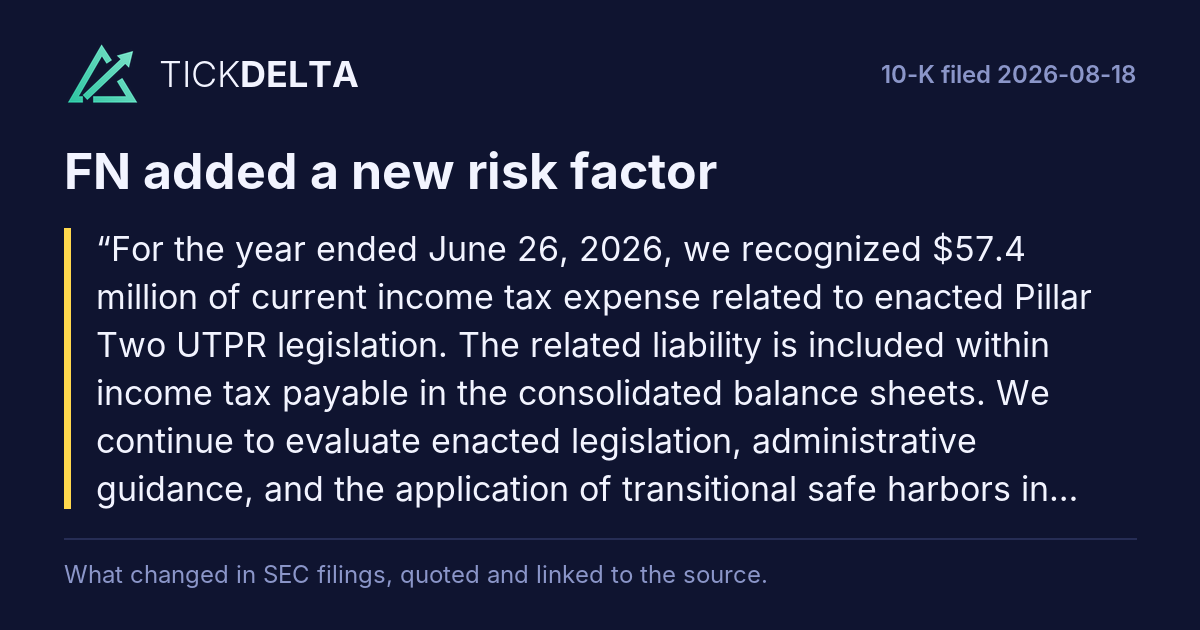
For the three months ended September 25, 2026, we recognized $19.9 million of current income tax expense related to enacted Pillar Two legislation. The related liability is included within income tax payable in the unaudited condensed consolidated balance sheets. We continue to evaluate enacted legislation, administrative guidance, and the application of transitional safe harbors in the jurisdictions in which we operate. Future changes in enacted tax laws and interpretations could materially affect our future effective tax rate and cash tax obligations.
Read in the 10-Qopen_in_new
Financial statements and notes
2025 Revenues 100.0 % 100.0% Cost of revenues (88.2) (88.1) Gross profit 11.8 11.9 Selling, general and administrative expenses (1.8) (2.3) Restructuring and other related costs (0.1) — Operating income 9.9 9.6 Interest income 0.4 1.0 Interest expense (0.0) — Foreign exchange gain (loss), net (0.0) (0.2) Other income (expense), net (1.5) (0.0) Income before income taxes 8.8 10.4 Income tax expense (1.8) (0.6) Net income 7.0 9.8 Other comprehensive income (loss), net of tax (0.1) (0.3) Net comprehensive income 6.9 % 9.5%
Read in the 10-Qopen_in_new
(1) Data center includes data center interconnect (DCI), high-performance computing (HPC), and other data center-specific applications.
Read in the 10-Qopen_in_new
(2) Communications infrastructure includes communications and networking products that are not specific to data center applications, primarily telecommunications products excluding DCI.
Read in the 10-Qopen_in_new
(3) Automotive, Industrial and Others includes products serving automotive components, industrial, medical devices and sensors.
Read in the 10-Qopen_in_new
During the three months ended September 25, 2026, we borrowed $74.7 million of the term loan under our 2019 Credit Facility Agreement. As a result, as of September 25, 2026, we had a long-term borrowing of $74.7 million under our 2019 Credit Facility Agreement (see Note 11 of Notes to Unaudited Condensed Consolidated Financial Statements for further details). We anticipate that our internally generated working capital, along with our cash and cash equivalents will be adequate to repay these obligations. To better manage our cash on hand, we held short-term investments of $363.4 million as of September 25, 2026.
Read in the 10-Qopen_in_new
Legal proceedings
On June 28, 2024, Ngan In Leng and First Laser Limited (collectively, the “Plaintiffs”) filed a complaint in the Fuzhou Intermediate People’s Court (the “Court”) in Fuzhou, China against Fujian Enterprises (Holdings) Co., Ltd. (“FEHC”), Jian An Investment Limited (“Jian”), and Casix, Inc. (“Casix”), our wholly-owned subsidiary located in the PRC. The complaint alleged unjust enrichment related to a purported investment in Casix by the Plaintiffs in 1997, which predates our acquisition of Casix from JDS Uniphase Corporation. The Plaintiffs requested that the Court order FEHC to return the unjust enrichment to the Plaintiffs in the amount of RMB 400 million, with interest from March 1, 2000, and order Jian and Casix to bear joint and several liability for all payment obligations of FEHC.
Read in the 10-Qopen_in_new
In September 2024, the Court dismissed the complaint in its entirety based on jurisdictional grounds. The Plaintiffs subsequently appealed the Court’s ruling to the High People's Court of Fujian Province (the "Appellate Court"). In their appeal, the Plaintiffs claimed that Casix is the primary obligor to return the alleged unjust enrichment to the Plaintiffs. In November 2025, the Appellate Court upheld the Court's ruling and dismissed the complaint on jurisdictional grounds.
Read in the 10-Qopen_in_new
In April 2026, the Plaintiffs appealed the Appellate Court’s ruling to the Supreme People’s Court of the People’s Republic of China (the “PRC Supreme Court”). The PRC Supreme Court held an initial hearing on July 2, 2026 and, on July 30, 2026, rendered a ruling accepting the case for retrial. The acceptance of the case for retrial does not represent a determination on the merits of the Plaintiffs' claims. At this time, we are not able to quantify any potential liability in connection with this litigation because of the early stage of this litigation.
Read in the 10-Qopen_in_new
Risk Factors
For the three months ended September 25, 2026, we recognized $19.9 million of current income tax expense related to enacted Pillar Two legislation. The related liability is included within income tax payable in the unaudited condensed consolidated balance sheets. We continue to evaluate enacted legislation, administrative guidance, and the application of transitional safe harbors in the jurisdictions in which we operate. Future changes in enacted tax laws and interpretations could materially affect our future effective tax rate and cash tax obligations.
Read in the 10-Qopen_in_new