New risk paragraphs, branching off last year
Each branch is a paragraph in Risk Factors with nothing like it in the 10-K filed Feb 27, 2025. A box jumps to the paragraph as filed, below.
Paragraphs with nothing like them in last year's 10-K
14 paragraphs in Risk Factors of the 10-K filed Feb 24, 2026 with nothing like them in the 10-K filed Feb 27, 2025. Quoted exactly. Paragraphs that were only edited are under 10-K change.
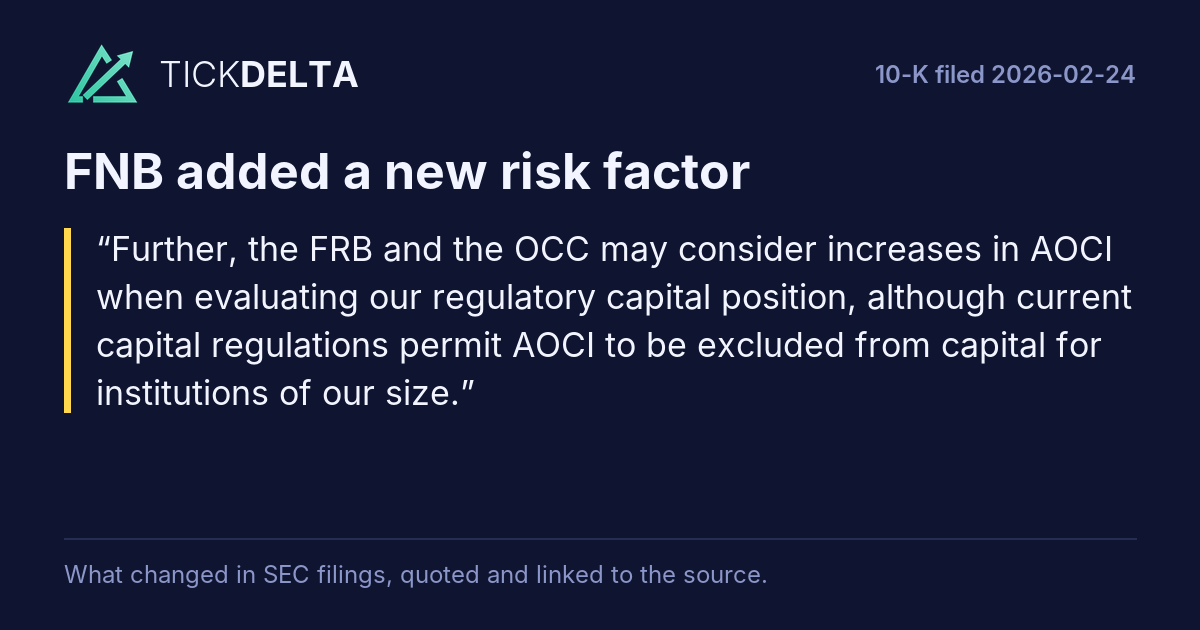
Further, the FRB and the OCC may consider increases in AOCI when evaluating our regulatory capital position, although current capital regulations permit AOCI to be excluded from capital for institutions of our size.
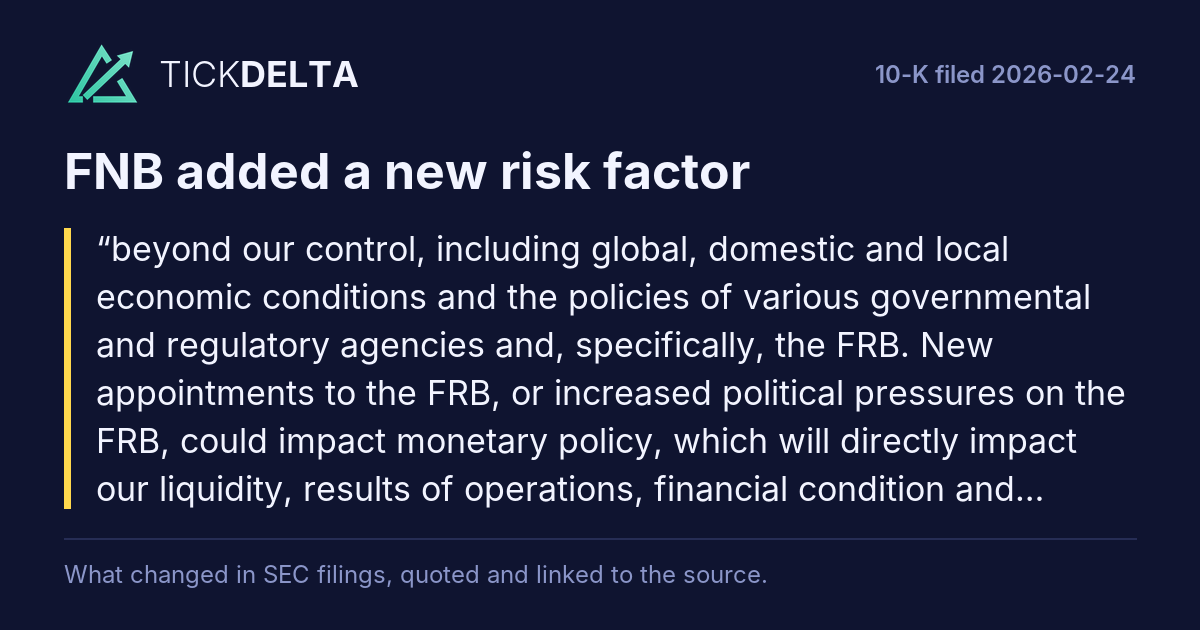
beyond our control, including global, domestic and local economic conditions and the policies of various governmental and regulatory agencies and, specifically, the FRB. New appointments to the FRB, or increased political pressures on the FRB, could impact monetary policy, which will directly impact our liquidity, results of operations, financial condition and capital position.
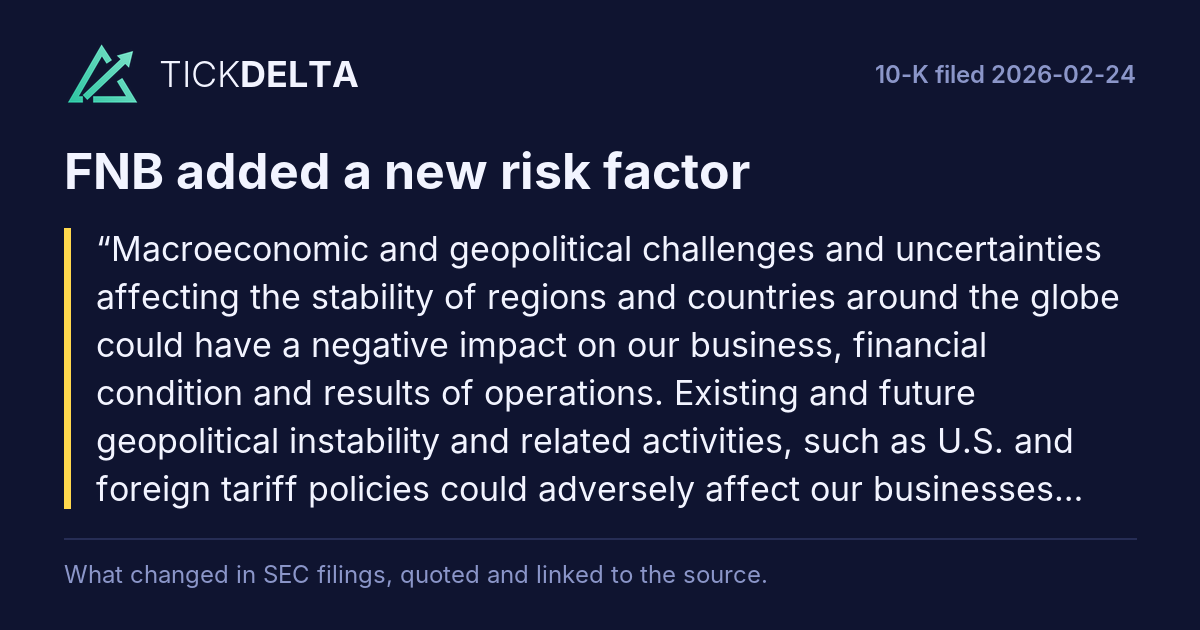
Macroeconomic and geopolitical challenges and uncertainties affecting the stability of regions and countries around the globe could have a negative impact on our business, financial condition and results of operations. Existing and future geopolitical instability and related activities, such as U.S. and foreign tariff policies could adversely affect our businesses, financial condition and results of operations.
Global trade policies, including changing tariffs and the imposition of new or increased tariffs and related uncertainty thereof, could have a material adverse effect on our business, results of operations or financial condition.
There continues to be significant uncertainty about the future relationship between the U.S. and other countries, including with respect to trade policies, treaties, government regulations, sanctions, tariffs, and application thereof. For example, in April 2025, the U.S. government began imposing “reciprocal” tariffs intended to address trade deficits and inconsistent economic treatment of importation between the U.S. and other countries. In response, China, among others, has announced retaliatory tariffs against certain imports from the U.S., among other measures. Although we are continuing to evaluate the impact of these evolving developments, we cannot provide any assurance about the ultimate outcome or impact of these developments or other changes in trade policies, including the imposition or application of new or increased tariffs between the U.S. and other countries. Furthermore, changes to trade policies, retaliatory measures, or prolonged uncertainty in trade relationships could increase the cost of, and reduce demand for, our products and services, or customers’ ability to service debt, which would adversely impact our business. In addition, political tensions as a result of trade policies could reduce trade volume, investment and other economic activities between major international economies, resulting in a material adverse effect on global economic conditions and the stability of global financial markets, which could adversely affect our business, results of operations and financial condition.
Extensive use of models, AI and generative AI technologies presents operational, regulatory and reputational risks.
We rely heavily on a broad range of quantitative models, advanced analytics, AI, and generative AI technologies across multiple areas of our operations, including credit decisioning, fraud detection, risk monitoring, customer engagement, productivity enhancement and internal operational processes. In addition, we are making strategic investments in AI initiatives, including generative AI, to, among other things, recommend relevant content across our products, enhance our advertising tools, develop new products, streamline and customize the customer experience and develop new features for existing markets. The development and use of AI presents potential risks and challenges to our business and may require significant additional investments in infrastructure, personnel and trainings. There can be no assurance that the usage of AI will enhance our products or services or be beneficial to our business or customers, including our efficiency or profitability. As these technologies become more integrated into our business model, our dependence on the accuracy, quality and completeness of underlying data and on the soundness of model design, governance, assumptions and controls continues to increase. Generative AI systems, in particular, may sometimes produce inaccurate, incomplete, biased or misleading outputs, or results that are difficult to interpret, explain or reproduce. Errors, limitations or failures involving models or AI tools could adversely affect decision‑making, risk identification, customer interactions, operational performance or the accuracy of financial, regulatory or risk reporting. Further, we may rely on AI models developed by third parties, and, to that extent, would be dependent in part on the manner in which those third parties develop and train their models, including risks arising from the inclusion of any unauthorized material in the training data for their models and the effectiveness of the steps these third parties have taken to limit the risks associated with the output of their models, matters over which we may have limited visibility.
The expanded use of AI and generative AI also introduces heightened risks related to privacy, cybersecurity, data usage, intellectual property, consumer protection and fair lending, as well as potential exposure to evolving federal and state regulatory frameworks, litigation or other legal liability. Regulators are increasingly focused on AI transparency, model explainability, bias mitigation and governance standards, and new rules or supervisory expectations may require additional investment, modification of our systems or changes to how we apply these technologies. We may incur operational, compliance or legal risk if AI‑enabled tools behave in unintended ways or if our governance, monitoring and validation practices do not keep pace with technological developments. Additionally, if we fail to keep pace with AI advancements, or if competitors are able to deploy AI more effectively, our competitive position may be harmed. Any failure to appropriately manage risks associated with our extensive use of models, AI and generative AI could result in regulatory criticism, operational disruption, reputational harm or adverse effects on our business, financial condition or results of operations.
Show the other 2
Our business operations are subject to extensive supervision, examination and regulation by a number of U.S. federal and state regulatory authorities, including the FRB, OCC and FDIC. These authorities have broad powers to conduct examinations of our operations, enforce compliance with applicable laws and impose enforcement actions, fines and other actions for violations. Recently, the federal banking agencies have signaled a desire to remove excessive regulatory, supervisory and examination burdens, while prioritizing efforts to focus supervision on material financial risks. On October 7, 2025, the OCC, together with the FDIC, issued a notice of proposed rulemaking to codify the elimination of reputation risk from their supervisory programs, which would, among other things, prohibit the OCC from criticizing or taking adverse action against an institution on the basis of reputation risk, and to prohibit politicized debanking. In addition, the OCC, together with the FDIC issued a notice of proposed rulemaking that would define the term “unsafe or unsound practice” for purposes of section 8 of the Federal Deposit Insurance Act and revise the supervisory framework for the issuance of matters requiring attention and other supervisory communications. On November 18, 2025, the FRB issued a Statement of Supervisory Operating Principles intended to focus FRB examiners on material financial risks threatening the safety and soundness of banks, reduce duplication between exams from different supervisors, and streamline the remediation of issues cited by supervisors. Changes resulting from these new supervisory practices may create opportunities for us or for our competitors to streamline compliance programs to focus on meeting the agencies’ more targeted expectations. However, shifts in supervisory priorities and practices, whether in the short-term or long-term, could expose us to regulatory compliance risks, increased operational costs, and evolving legal uncertainties.
The aforementioned voting requirement does not apply if any one of several conditions is satisfied:
•FNB has had fewer than 300 shareholders of record during the prior three years;
•the interested shareholder has beneficially owned at least 80% of FNB's outstanding voting shares for at least five years; or
•the interested shareholder beneficially owns at least 90% of the outstanding voting shares (excluding shares acquired directly from FNB without the approval of a majority of the disinterested directors).
The voting requirement is also inapplicable where the affiliated transaction satisfies specified "fair price" and procedural protections, including payment of consideration meeting minimum value standards, use of cash or matching consideration previously paid by the interested shareholder, maintenance of regular dividend practices, restrictions on additional acquisitions of voting share by the interested shareholder, the distribution of a proxy or information statement at least 25 days prior to consummation of the transaction unless otherwise approved by a majority of the disinterested directors, and affiliated transactions wherein the interested shareholder became an interested shareholder inadvertently.
Paragraphs in the 10-Q filed Nov 3, 2026 that were not in the one before
New in the latest 10-Q
17 paragraphs in the 10-Q filed Nov 3, 2026 with nothing like them in the 10-Q filed Aug 5, 2026 (at least half the words must differ; new numbers alone do not count). Quoted exactly, grouped by the item heading above them. This is text that changed, not a judgement of how serious it is.
Financial statements and notes
and $ 0 at December 31, 2025. The fair values of risk participation agreements purchased and sold were $ 0.03 million and $ 0.02 million, respectively, at September 30, 2026, and $ 0.1 million and $ 0.1 million, respectively, at December 31, 2025.
Read in the 10-Q
estimable. We believe that our accruals for legal proceedings are appropriate and, in the aggregate, are not material to our consolidated financial position, although future accruals could have a material effect on net income in a given period.
Read in the 10-Q
On October 28, 2026, we entered into a preliminary agreement to acquire all outstanding Partnership interests and, upon closing, obtain control of FNB Financial Tower Partners LLC (the Partnership) through FNB Crawford Place LLC, a wholly-owned subsidiary of the Bank, for consideration of $ 32 million and the assumption of all outstanding Partnership debt which is owed to the Bank and affiliates of FNB.
Read in the 10-Q
The Partnership has total assets of approximately $ 240 million (net book value) and was formed to own and operate the FNB Financial Center, a 26-story office tower in Pittsburgh, Pennsylvania, that serves as corporate headquarters of FNB and the Bank. Prior to the closing of the proposed transaction, the Partnership is a variable interest entity for which FNB is not the primary beneficiary and, accordingly, is not consolidated by FNB.
Read in the 10-Q
Upon closing of the proposed transaction, FNB Crawford Place LLC will assume full ownership of the FNB Financial Center. The transaction is expected to close on or before December 31, 2026. The financial effect of the proposed transaction is still being evaluated and has not yet been determined based on the timing of the preliminary agreement. We continue to evaluate the accounting impact of the proposed transaction, including receiving a third-party valuation of FNB Financial Center which is in process, to determine the amount of potential loss to be recognized. This agreement will serve as a mutually agreeable resolution and global release of the FNB Financial Center development project and any/all related litigation.
Read in the 10-Q
Show the other 12
• our capability to effectively deploy multi-layered defense strategies to mitigate risks associated with evolving artificial intelligence enabled fraud schemes;
Read in the 10-Q
Management believes certain items (e.g., FDIC special assessment) are not organic to running our operations and facilities. These items are considered significant items impacting earnings as they are deemed to be outside of ordinary banking activities.
Read in the 10-Q
These costs are specific to each individual transaction and may vary significantly based on the size and complexity of the transaction.
Read in the 10-Q
For the third quarter of 2026, we generated record net interest income, expanded net interest margin and increased tangible book value per common share (non-GAAP) 7% year-over-year, while continuing to return capital through share repurchase activity and an attractive common stock dividend. We continue to leverage technology investments to gain market share throughout our diverse geographic footprint with 8.5% annualized linked-quarter total loan and lease growth and 8.9% annualized linked-quarter total deposit growth. Our consistent underwriting standards and comprehensive credit monitoring program contributed to solid credit quality results for the quarter. We continued to invest in innovative technology to grow primary relationships and low-cost deposits, while also maintaining a focus on expanding high-value fee-based businesses to diversify revenue streams.
Read in the 10-Q
• Net interest income increased $10.8 million, or 3.0%, compared to the second quarter of 2026 primarily due to growth in earning assets, higher yields on earning assets (non-GAAP) and the impact of one more day in the current quarter more than offsetting a slight increase in the cost of funds.
Read in the 10-Q
Income tax expense was lower for the third quarter of 2026. Although pre-tax income increased slightly, the impact on income tax expense was offset by the recognition of a deferred tax benefit related to a capital loss.
Read in the 10-Q
Insurance commissions and fees increased $1.6 million, or 10.6%, primarily relating to new organic production activity in 2026.
Read in the 10-Q
Bank shares tax expense increased $1.4 million, or 11.7%, resulting from growth in the capital base subject to the tax.
Read in the 10-Q
The following table presents non-interest expense excluding a significant item impacting earnings:
Read in the 10-Q
practices. FNB’s and FNBPA’s capital amounts and classifications are also subject to qualitative judgments by the regulators about components, risk weightings and other factors.
Read in the 10-Q
under various hypothetical rate scenarios. The ALCO regularly reviews earnings simulations over multiple years under various interest rate scenarios. Reviewing these various measures provides us with a comprehensive view of our interest rate risk profile, which provides the basis for balance sheet management strategies.
Read in the 10-Q
The table above shows how operating net income available to common shareholders (non-GAAP) is derived from amounts reported in our financial statements. We believe certain charges, such as the item presented above are not organic costs to run our operations and facilities. These costs are specific to each individual transaction, and may vary significantly based on the size and complexity of the transaction.
Read in the 10-Q
The 10-Q's risk factors against the 10-K
Item 1A of the 10-Q filed Nov 3, 2026 against Item 1A of the 10-K filed Feb 24, 2026.
A 10-Q repeats only the risks that changed, so a 10-K paragraph that is missing from it is not counted as removed.
Added is a paragraph with nothing like it in the 10-K, Reworded a sentence that is in both with several words changed,
Quiet changes a sentence in both where one to four words changed and one is a hedge or a modal
(cut words struck through, new words highlighted).
Text on the page, not a score; each links to the filing at sec.gov.
What the 10-Q itself says about its risk factors:For more information regarding risk factors that could affect our results of operations, financial condition and liquidity, see the risk factors disclosed in the “Risk Factors” section of our 2025 Annual Report on Form 10-K. As of the date of this Quarterly Report on Form 10-Q, there have been no material changes to the risk factors described in our 2025 Annual Report on Form
Read in the 10-Q
1 paragraph in the 10-Q's Item 1A, and none of them adds, rewords or quietly edits a paragraph of the 10-K's.
Phrases used for the first time
Two-word phrases in Risk Factors of the 10-K filed Feb 24, 2026 that are in none of the 1 earlier 10-Ks stored, back to Feb 27, 2025
Where each one is used
- interested shareholder: In the case of a proposed business combination with a shareholder owning more than 10% of the voting shares of FNB (an "interested shareholder"), the vote of the holders of at least two-thirds of the voting shares not owned by such shareholder is required to approve the business combination. A majority of FNB's...
- trade policies: Global trade policies, including changing tariffs and the imposition of new or increased tariffs and related uncertainty thereof, could have a material adverse effect on our business, results of operations or financial condition.
- corporate responsibility: Increasing, complex, evolving and conflicting federal government policies, regulatory, stakeholder, and other third-party expectations on sustainability, human capital and social governance (Corporate Responsibility) practices could adversely affect our reputation, expose us to government investigations and...
- average total: In response to several large bank failures in the spring of 2023, the federal banking agencies have engaged in rulemaking that could increase compliance costs should we grow in excess of $50 billion in average total assets, including the FDIC adopting resolution planning requirements for IDIs with $50 billion or...
- total assets: In response to several large bank failures in the spring of 2023, the federal banking agencies have engaged in rulemaking that could increase compliance costs should we grow in excess of $50 billion in average total assets, including the FDIC adopting resolution planning requirements for IDIs with $50 billion or...
- sustainability human: Increasing, complex, evolving and conflicting federal government policies, regulatory, stakeholder, and other third-party expectations on sustainability, human capital and social governance (Corporate Responsibility) practices could adversely affect our reputation, expose us to government investigations and...
- responsibility matters: We are subject to a variety of risks arising from various Corporate Responsibility matters, which include, among other things, environmental sustainability, human capital and human resource practices, and human rights. Risks arising from such matters may adversely affect, among other things, our reputation and the...
- increased tariffs: Global trade policies, including changing tariffs and the imposition of new or increased tariffs and related uncertainty thereof, could have a material adverse effect on our business, results of operations or financial condition.
Used at least twice, small words left out. Counted, not picked: a phrase can be new because the company renamed something.
What was taken out
14 paragraphs of last year's Risk Factors with nothing like them now. The longest are quoted.
Sources
Item 1A of each 10-K and 10-Q on EDGAR, quoted exactly. Each paragraph links to the filing at sec.gov.
Also
10-K change: what was reworded or cut, section by section.
Work with it
Excel workbook · CSV. Google Sheet that stays up to date: paste =IMPORTDATA("https://tickdelta.com/company/FNB/export.csv") into a cell.