Screener / SEC EDGAR /CIK 0001507079 /10-K filed Feb 19, 2026, compared with Feb 20, 2025 /Numbers from the XBRL of the 10-Ks
NYSE Consumer discretionary · Home Improvement Retail

Floor & Decor Holdings, Inc. FND

Compare with peers Embed
The 10-K against last year's

100 changes: 9 added, 26 removed, 62 reworded, 3 quiet changes

10-K Feb 19, 2026 vs Feb 20, 2025

10-K 0001628280-26-009770 (Feb 19, 2026) vs 10-K 0001507079-25-000013 (Feb 20, 2025)

Every paragraph, and how much of it changed

One bar per paragraph, in the order of the 10-K. Height and colour show the share of its words not in the closest paragraph a year earlier; the tallest bars are new paragraphs.

Risk Factors

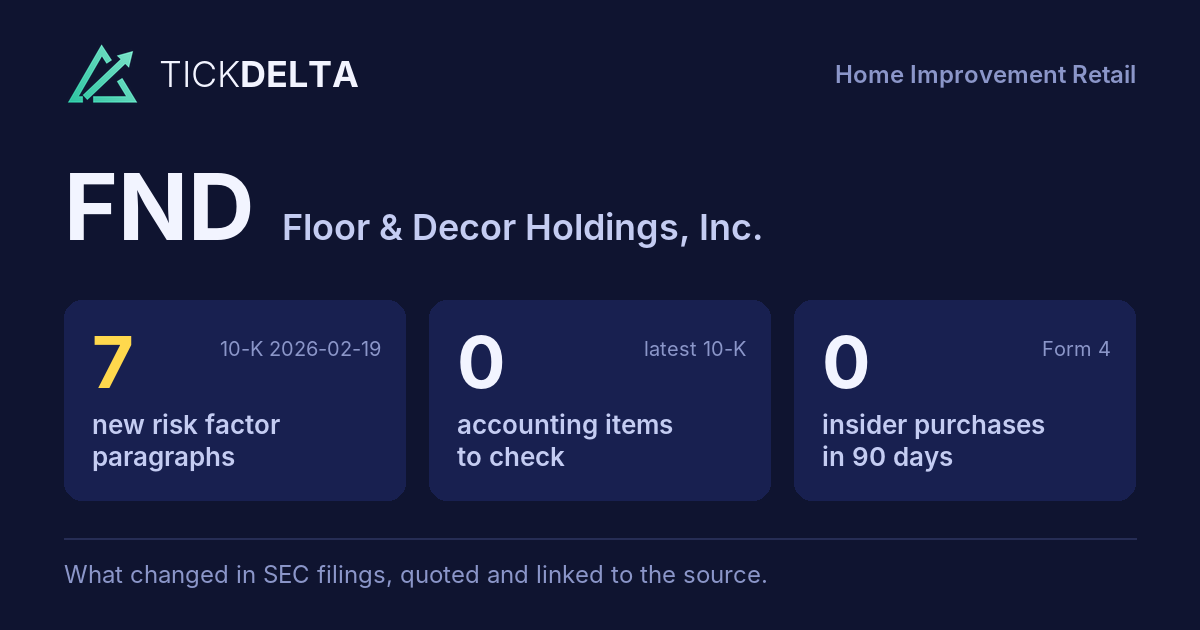
100 paragraphs · 7 new · 42 reworded · 22 gone · 10-K Feb 19, 2026 against Feb 20, 2025
New paragraph Reworded (5% of its words or more) Same or nearly
Paragraph 35 · 50% changed Every version of it
Our success depends substantially upon on the continued retention service of our key personnel, including our executive officers. and we are undergoing a significant leadership transition.
Paragraph 36 · 47% changed Every version of it
We believe that our success has depended historically depended, and continues will continue to depend depend, to a significant extent on upon the efforts skills, experience, and abilities leadership of our executive officers and other key personnel, including our executive officers, and the management personnel. The loss of the services of one or more of our executive officers these individuals, or any failure to successfully manage leadership transitions, could have a material adverse effect on us our business, financial condition, and would be potentially disruptive to our business until such time as a suitable replacement is hired. For example, operating results. Trevor Lang, who initially joined the Company in 2011 and served as our President since 2022, has announced his retirement retired effective March 1, 2025. As In connection with this transition, we announced in January 2025, we have appointed a Bradley Paulsen as our new President, Bradley Paulsen, who will join the Company President in March 2025. Although Subsequently, Mr. Paulsen assumed the role of Chief Executive Officer in fiscal 2026, succeeding Thomas V. Taylor, who became Executive Chairman of the Board of Directors (the “Board”). This represents the first change in our previous executive transitions have been smooth, any future changes to our key personnel, including our executive officers, or our failure to successfully manage the transition or engage in effective succession planning, may be disruptive to our business, including by distracting management from our core business and impacting employee productivity. Further, we may have difficulty identifying, attracting and integrating new executives to replace any losses of our other existing or future executive officers, all of which could adversely affect our business, financial condition, and operating results. Chief Executive Officer position since 2012.
Paragraph 4 · 43% changed Every version of it
If we fail to successfully manage the challenges that our planned new store growth poses or encounter unexpected difficulties or higher costs during higher-than-expected costs, our expansion, our operating results expansion plans and future growth opportunities profitability could be adversely affected. suffer.
Paragraph 23 · 39% changed Every version of it
The current domestic and international political environment, including existing and potential changes to U.S. policies related to in global trade and tariffs, have has resulted in uncertainty surrounding the future state of the global economy. economy and related impacts to our supply chain. In particular, 2025, the ongoing U.S. imposed significant additional tariffs on products from most countries where we source products. Although the U.S. has agreed to trade dispute deals or frameworks for trade deals with certain countries and continues to negotiate with other countries, the timing of implementation and stability of these trade deals are unclear. Additionally, if the U.S. implements further tariffs, countries where we source products may impose new tariffs and other trade measures on the U.S. in response, resulting in potentially escalating trade conflict between the U.S. and China has resulted in the U.S. announcing on February 1, 2025, an additional 10% tariff for all products from China, beyond the previous 25% tariff already imposed on the vast majority of the products we import from China. Approximately 18% of the products we sold in fiscal 2024 were produced in China. The current U.S. presidential administration has also indicated the possibility of imposing significantly increased tariffs on imports into the U.S., not only from China but also from other countries. Any further expansion in the types or levels of tariffs implemented on China or other countries has the potential to negatively impact our business, financial condition, and results of operations. Additionally, there is a risk that the U.S. tariffs on imports are met with tariffs on U.S. produced exports and that a further trade conflict could ensue, which has the potential to significantly impact global trade and economic conditions, including the imposition of new measures with little notice. its trading partners. Potential costs and any attendant impact on pricing arising from these tariffs and any further expansion in the types or levels of tariffs implemented could require us to modify our current business practices and could adversely affect our business, financial condition, and results of operations. These tariffs have increased and will continue to increase our inventory costs and associated cost of sales, which have resulted in and in the future may result in increased retail prices and may adversely impact sales. Furthermore, the broader impact of increased tariffs on the economy has and in the future may negatively impact consumer demand for our products, which may also have an adverse impact on sales.
Paragraph 83 · 29% changed Every version of it
We Any failure to protect our intellectual property rights could reduce the value of our products and brand and harm our business, and we may be involved in disputes from time to time relating to our intellectual property and the intellectual property of third parties.
Paragraph 6 · 16% changed Every version of it
In addition, stores opened more recently have had, and many continue to have, higher construction, occupancy, and operating costs than stores opened in the past, and such stores may have lower profitability than stores opened in the past. Furthermore, laws or regulations may make opening new stores more difficult or cause unexpected delays. For example, we have experienced unexpected delays in opening new stores due to delays in obtaining necessary construction and occupancy permits, which have resulted in higher costs than previously anticipated. As we continue to open new stores, the ultimate cost of future store openings could continue to rise significantly due to delays in obtaining necessary construction and occupancy permits, construction-related costs, or other reasons, including construction and other delays and cost overruns, such as shortages of materials; shortages of skilled labor or work stoppages; unforeseen construction, scheduling, engineering, environmental or geological problems; governmental or permitting delays; weather interference, fires or other casualty losses; and unanticipated cost increases. reasons. We cannot guarantee that any project will be completed on time, and delays in store openings have had, and may continue to have, a negative impact on our business and operating results. In addition, consumers in new markets may be less familiar with our brand, and we may need to increase brand awareness in such markets through additional investments in advertising or higher cost locations with more prominent visibility.
Paragraph 24 · 15% changed Every version of it
Rising Ongoing geopolitical tensions could adversely affect our business, financial condition, and results of operations. In particular, in recent years, tensions between mainland China and Taiwan have further escalated, with China accelerating the development of military capabilities in order to “reunite Taiwan by force.” escalated. In case of a military conflict between China and Taiwan, our ability to import products from China Asia could be limited. Similarly, the ongoing wars war between Russia and Ukraine and in the Middle East could impact our ability to import products and result in further increases in energy costs, and attacks on shipping in the Red Sea have impacted and may continue to increase our supply chain costs. The uncertain nature, magnitude, and duration of hostilities stemming from such conflicts, including the potential effects of sanctions and countersanctions, and retaliatory cyberattacks on the world economy and markets, have contributed to increased market volatility and uncertainty, which could have an adverse impact on macroeconomic factors that affect our business and operations.
Paragraph 81 · 11% changed Every version of it
We accept payments using a variety of methods, including credit cards, debit cards, gift cards, cash, and physical bank checks. These payment options subject us to many compliance requirements, including, but not limited to, compliance with the Payment Card Industry Data Security Standards, which represents a common set of industry tools and measurements to help ensure the safe handling of sensitive information, Standards and compliance with contracts with our third-party processors. These payment options also subject us to potential fraud by criminal elements seeking to discover and take advantage of security vulnerabilities that may exist in some of these payment systems.

MD&A

78 paragraphs · 2 new · 31 reworded · 4 gone · 10-K Feb 19, 2026 against Feb 20, 2025
New paragraph Reworded (5% of its words or more) Same or nearly
Paragraph 33 · 36% changed
Net interest expense during fiscal 2024 decreased $7.1 2025 increased $0.6 million, or 72.0%, 22.9%, compared to fiscal 2023 2024 primarily due to a decrease in capitalized interest, partially offset by lower average amounts interest rates and lower average outstanding under our ABL Facility and higher interest income as a result of higher cash balances. borrowings.
Paragraph 34 · 30% changed
Income tax expense was $58.0 million in fiscal 2025 compared to $47.5 million in fiscal 2024 compared to $65.6 million in fiscal 2023. 2024. The effective tax rate was 21.8% for fiscal 2025 compared to 18.8% for fiscal 2024 compared to 21.0% for fiscal 2023. 2024. The effective tax rate decrease increase was primarily due to a decrease in state income taxes and an increase in excess tax benefits related to stock-based compensation awards that were partially offset by limitations on deductions for compensation to certain employees under Internal Revenue Code Section 162(m). awards.
Paragraph 49 · 27% changed
Net cash used in financing provided by operating activities was $3.0 $381.8 million for fiscal 2024 2025 and $214.0 $603.2 million for fiscal 2023. 2024. The decrease in net cash used in financing provided by operating activities was primarily driven by a decrease changes in net ABL Facility repayments. trade accounts payable.
Paragraph 53 · 26% changed
Net cash used in financing activities was $2.4 million for fiscal 2025 and $3.0 million for fiscal 2024 and $214.0 million for fiscal 2023. The decrease in net cash used in financing activities was primarily driven by a decrease in net ABL Facility repayments. 2024.
Paragraph 6 · 26% changed
During fiscal 2024, 2025, we opened 30 20 new warehouse-format stores, stores and closed one warehouse-format store, ending the year with 251 270 warehouse-format stores and five design studios. Additionally, we opened a new distribution center near Seattle, ending the year with five distribution centers.
Paragraph 22 · 23% changed
Selling Selling, general and store operating administrative (“SG&A”) expenses consist primarily of store personnel and store support center wages, bonuses incentive compensation and benefits, rent store and infrastructure expenses, supplies, store support center occupancy costs, depreciation and amortization, training expenses, and advertising costs. Credit costs, credit card fees, insurance, personal property taxes, pre-opening costs, information technology costs, and other miscellaneous operating costs are also included. costs. We expect that our selling and store operating SG&A expenses will increase in future periods with future growth. Selling and store operating SG&A expenses include variable as well as fixed components, which may not directly correlate with net sales. The components of our selling and store operating SG&A expenses may not be comparable to the components of similar measures of other retailers.
Paragraph 32 · 22% changed
Selling and store operating SG&A expenses during fiscal 2024 2025 increased $123.1 $101.8 million, or 9.9%, 6.1%, compared to fiscal 2023. 2024. The increase in selling and store operating SG&A expenses was primarily driven by $156.7 million for the 20 new stores that we opened during the year, which increased compensation costs, occupancy costs, and $5.6 depreciation and amortization expense. SG&A expenses for non-comparable stores increased $126.8 million at Spartan, partially offset by a decrease of $39.2 million at our and for comparable stores. stores decreased $24.8 million. As a percentage of net sales, selling and store operating SG&A expenses increased by approximately 250 30 basis points to 30.6% 37.8% from 28.1% 37.5% in fiscal 2023. 2024. This increase was primarily attributable to the addition of new stores and deleverage from a decrease in comparable store sales and the addition of new stores. sales, partially offset by a decrease in pre-opening expenses.
Paragraph 13 · 20% changed
The number and timing of new store openings, and the costs and fixed lease obligations associated with those openings, have had, and are expected to continue to have, a significant impact on our results of operations. The number of new stores reflects the number of stores opened during a particular reporting period. Before we open new stores, we incur pre-opening expenses, operating expenditures, which are defined below under as pre-opening expenses. The majority of pre-opening expenses are incurred during the heading “Other Key Financial Definitions.” three months before a store opens. A new store’s operating performance is excluded from the comparable store base until the first day of the thirteenth full fiscal month following a store’s opening. Net sales at new stores are generally lower than net sales at our stores that have been open for more than one year. Our ability to open new, profitable stores is important to our long-term sales and profit growth goals.

A paragraph is matched with the one last year that shares the most of its words; under half in common makes it new. The paragraphs shown are the 8 reworded the most in each section.

The paragraph that changed most in each section

The redline

Marked against last year's 10-K: cut words struck through, new words highlighted.

Risk Factors330 words changed in this paragraph; it is 32% similar to last year's version.
The current domestic and international political environment, including existing and potential changes to U.S. policies related to in global trade and tariffs, have has resulted in uncertainty surrounding the future state of the global economy. economy and related impacts to our supply chain. In particular, 2025, the ongoing U.S. imposed significant additional tariffs on products from most countries where we source products. Although the U.S. has agreed to trade dispute deals or frameworks for trade deals with certain countries and continues to negotiate with other countries, the timing of implementation and stability of these trade deals are unclear. Additionally, if the U.S. implements further tariffs, countries where we source products may impose new tariffs and other trade measures on the U.S. in response, resulting in potentially escalating trade conflict between the U.S. and China has resulted in the U.S. announcing on February 1, 2025, an additional 10% tariff for all products from China, beyond the previous 25% tariff already imposed on the vast majority of the products we import from China. Approximately 18% of the products we sold in fiscal 2024 were produced in China. The current U.S. presidential administration has also indicated the possibility of imposing significantly increased tariffs on imports into the U.S., not only from China but also from other countries. Any further expansion in the types or levels of tariffs implemented on China or other countries has the potential to negatively impact our business, financial condition, and results of operations. Additionally, there is a risk that the U.S. tariffs on imports are met with tariffs on U.S. produced exports and that a further trade conflict could ensue, which has the potential to significantly impact global trade and economic conditions, including the imposition of new measures with little notice. its trading partners. Potential costs and any attendant impact on pricing arising from these tariffs and any further expansion in the types or levels of tariffs implemented could require us to modify our current business practices and could adversely affect our business, financial condition, and results of operations. These tariffs have increased and will continue to increase our inventory costs and associated cost of sales, which have resulted in and in the future may result in increased retail prices and may adversely impact sales. Furthermore, the broader impact of increased tariffs on the economy has and in the future may negatively impact consumer demand for our products, which may also have an adverse impact on sales.

Source: Item 1A, 10-K 0001628280-26-009770 vs Item 1A, 10-K 0001507079-25-000013

MD&A262 words changed in this paragraph; it is 31% similar to last year's version.
The current domestic and international political environment, including existing and potential changes to U.S. policies related to global trade and tariffs, have resulted in uncertainty surrounding the future state of the global economy. In particular, the ongoing trade dispute between the U.S. and China has resulted in the U.S. announcing on February 1, 2025, an additional 10% tariff for all products from China, beyond the previous 25% tariff already imposed on the vast majority of the products we import from China. While exclusions from the previous 25% tariff were granted for certain products from China that we sell, nearly all of those exclusions have expired. In fiscal 2024, approximately 18% of the products we sold were produced in China. The current U.S. presidential administration has also indicated the possibility of imposing significantly increased tariffs on imports into the U.S. not only from China but also from other countries. As we continue to manage the impact these tariffs may have on our business, business and the complexities of the various trade policy actions, we continue taking steps to mitigate some of these the cost increases through negotiating lower costs from negotiations with our vendors, sourcing from alternative countries, and increasing retail pricing as we deem appropriate. While our efforts have mitigated a substantial portion of we continue to take steps to mitigate the overall effect of increased tariffs to date, the enacted tariffs, these tariffs have increased and will continue to increase our inventory costs and associated cost of sales for sales, which have resulted in and in the remaining products still sourced from China future may result in increased retail prices and may adversely impact sales sales. Furthermore, the broader impact of products sourced from China or other countries if new or higher increased tariffs are imposed. on the economy has and in the future may negatively impact consumer demand for our products, which may also have an adverse impact on sales.

Source: Item 7, 10-K 0001628280-26-009770 vs Item 7, 10-K 0001507079-25-000013

Accounting Policies105 words changed in this paragraph; it is 62% similar to last year's version.
Our Pro Premier loyalty program allows customers to earn points through purchases in our stores and our website. The Company allocates the transaction price between the goods and services sold and the loyalty points earned based on their relative standalone selling prices, which takes into account the portion of loyalty points expected to be redeemed. Eligible transactions typically earn loyalty points at a rate of one percent of the merchandise selling price. However, our high-volume customers may earn loyalty points at a rate of three percent. These The Company defers the estimated standalone selling price of the loyalty points are recognized as a liability at reduction to revenue and establishes a corresponding liability. The estimated selling price accounts for the time portion of sale and are only redeemable for loyalty points expected to be redeemed. The loyalty program represents a material right to the customer as points may be redeemed on future purchases of Company merchandise, as well as goods and services fulfilled by third parties. Breakage for loyalty point rewards is estimated based on historical customer redemption patterns and may change in the future as the program matures.

Source: Item 8, Note 1 – Summary of Significant Accounting Policies, 10-K 0001628280-26-009770 vs Item 8, Note 1 – Summary of Significant Accounting Policies, 10-K 0001507079-25-000013

Legal Proceedings38 words changed in this paragraph; it is 92% similar to last year's version.
The Company accounts for leases in accordance with ASC 842. The majority of the Company’s long-term operating lease agreements are for its retail locations, distribution centers, and corporate office, which expire in various years through 2055. Most of these agreements are retail leases wherein both the land and building are leased. The Company also has ground leases in which only the land is leased. The initial lease terms for the Company’s retail locations, distribution centers, and corporate office typically range from 10-20 years. The majority of the Company’s leases also include options to extend, which are factored into the recognition of their respective assets and liabilities when appropriate based on management’s assessment of the probability that the options will be exercised. Lease payments used in measurement of the lease liability typically do not include executory costs, such as taxes, insurance, and maintenance, unless those costs can be reasonably estimated at lease commencement. Additionally, one building lease contains variable lease payments, which are determined based on a percentage of retail sales over a contractual level, and the Company subleases real estate within one of its distribution centers to a third party. Certain of the lease agreements include escalating rents over the lease terms, which, under ASC 842, results in rent being expensed on a straight-line basis over the life of the lease that commences on the date the Company has the right to control the property. The Company’s lease agreements do not contain any residual value guarantees or restrictive covenants that would reasonably be expected to have a material impact on the business.

Source: Item 3, via Note 9 – Commitments and Contingencies, 10-K 0001628280-26-009770 vs Item 3, via Note 9 – Commitments and Contingencies, 10-K 0001507079-25-000013

Sentences and paragraphs added, removed or reworded

Every change, by type

Sentences and paragraphs of FND's Risk Factors and MD&A, 10-K Feb 19, 2026 against 10-K Feb 20, 2025. Each links to the text at sec.gov.

Quiet changes are sentences kept from last year with one to four words changed, at least one of them a hedge, a modal or a qualifier (may, could, will, not, significant, material…). A year or date rolling forward is not counted.

The full word list

adverse, adversely, all, although, anticipate, anticipates, any, approximately, believe, believes, can, cannot, certain, could, expect, expects, generally, however, if, intend, intends, largely, likely, many, material, materially, may, might, most, must, never, no, not, possible, primarily, probable, should, significant, significantly, some, substantial, substantially, unlikely, will, would

AddedRisk Factors
Our sales are highly sensitive to consumer discretionary spending, which is influenced by factors such as overall economic conditions, interest rates, housing market activity, inflation, employment levels, and consumer confidence. In the past few years, we have faced a challenging environment as mortgage interest rates remain high and existing home sales remain low, which together have reduced home remodeling activity. Many homeowners are staying in their homes rather than moving or undertaking renovations due to factors including high financing costs and home affordability concerns. These conditions have directly contributed to softer demand for hard surface flooring. We have seen pressure on customer traffic and average ticket sizes, resulting in negative comparable store sales and weaker performance from new stores. If interest rates remain elevated or climb further, if housing turnover stays depressed, or if broader economic growth slows, consumers may continue deferring flooring purchases. High inflation over the past two years has also eroded discretionary income and savings, making budget-conscious consumers more hesitant to undertake big ticket projects. Any sustained weakness in consumer demand – whether due to prolonged high borrowing costs, low housing turnover, reduced consumer confidence, or an economic downturn – would adversely affect our sales and profitability. Prolonged macroeconomic headwinds could lead to continued negative same store sales, inventory build-up, and the need for heavier promotions to stimulate demand, which in turn would further pressure our margins and cash flow and could continue to adversely affect our business, financial condition, and operating results.
Read it in 10-K Feb 19, 2026 at sec.gov
AddedRisk Factors
Although this succession has been carefully planned, including Mr. Taylor’s active involvement and continued service as Executive Chairman, any change in senior leadership entails execution risk. Differences in leadership style or strategic priorities between outgoing and incoming executives could, if not effectively managed, result in confusion or misalignment. Our relationships with customers, suppliers, lenders, and other stakeholders may be impacted during the transition. Additionally, changes at the Chief Executive Officer level may prompt other key management personnel to reevaluate their positions, and there can be no assurance that all will remain with the Company. Failure to successfully execute these transitions or maintain alignment and motivation among our leadership team could materially and adversely affect our business, financial condition, and operating results.
Read it in 10-K Feb 19, 2026 at sec.gov
AddedRisk Factors
Our indebtedness, combined with our lease and other financial obligations and contractual commitments, could adversely affect our business, financial condition, and operating results by making it more difficult for us to satisfy our obligations with respect to our indebtedness, including restrictive covenants and borrowing conditions, which may lead to an event of default under the agreements governing our debt; requiring us to dedicate a substantial portion of our cash flow from operations to payments on our indebtedness, thereby reducing the availability of cash flows to fund current operations and future growth; exposing us to the risk of increased interest rates and increased debt service obligations as our borrowings under our Credit Facilities are at variable rates; restricting us from making strategic acquisitions; requiring us to comply with financial and operational covenants that may restrict us, among other things, from placing liens on our assets, making investments, incurring debt, making payments to our equity or debt holders and engaging in transactions with affiliates; limiting our ability to borrow additional amounts for working capital, capital expenditures, debt service requirements, execution of our business and growth strategies or other purposes; and limiting our ability to obtain credit from our suppliers and other financing sources on acceptable terms or at all.
Read it in 10-K Feb 19, 2026 at sec.gov
AddedRisk Factors
Certain provisions of our certificate of incorporation and bylaws and applicable provisions of Delaware law may have the effect of rendering more difficult, delaying or preventing an acquisition or change of control of the Company that stockholders may consider to be favorable. These provisions, among other things authorize the Board to issue “blank check” preferred stock without stockholder approval, which, if issued, would increase the number of outstanding shares of our capital stock, make it more difficult for someone to acquire us, and potentially adversely affect the voting power of the holders of our other classes of voting stock; establish the sole power of a majority of our Board to fix the number of directors; require that certain advance notice procedures be followed for our stockholders to submit nominations of candidates for election to our Board and to bring other proposals before a meeting of the stockholders; provide our Board with the ability to amend our bylaws without stockholder approval; provide that any vacancy on the Board, whether such vacancy occurs as a result of an increase in the number of directors or otherwise, may only be filled by a majority of the Board members still in office; prohibit stockholder action by written consent, thus requiring all stockholder actions to be taken at a meeting of stockholders; and require that, to the fullest extent permitted by law, certain proceedings against or involving us or our directors, officers, or associates be brought exclusively in the Court of Chancery in the State of Delaware.
Read it in 10-K Feb 19, 2026 at sec.gov
Show the other 44
RemovedRisk Factors
Consumer discretionary spending affects our sales and is impacted by factors outside of our control, including general economic and political conditions, interest rates, the residential housing market, unemployment rates, inflation, disposable income levels, consumer confidence, recession fears, energy costs, consumer credit availability and terms, consumer debt levels, salaries and wage rates, and geopolitical events and uncertainty. Declines in the level of consumer confidence and spending and high interest rates have adversely affected, and could continue to adversely affect, consumer spending habits and consumer discretionary spending, which have resulted in, and may continue to result in, reduced demand for our products.
Read it in 10-K Feb 20, 2025 at sec.gov
RemovedRisk Factors
The hard surface flooring industry is highly dependent on existing home sales because homeowners often replace flooring before selling a home or shortly after purchasing a home and, to a lesser extent, on new home construction. The increase in interest rates in 2022 and 2023 and persistently higher interest rates in 2024 has contributed to several years of negative existing home sales, with such sales near record lows in 2024. We believe such inflationary pressure has resulted in elevated mortgage rates and adversely impacted consumer behavior. High interest rates, housing affordability, and any such shift in consumer behavior may adversely affect the demand for existing homes, remodeling, and new home construction. In addition, existing home sales, remodeling, and new home construction depend on a number of other factors that are beyond our control, including inflation, tax policy, trade policy, employment levels, consumer confidence, credit availability, real estate prices, home-price appreciation, demographic trends, weather conditions, natural disasters, geopolitical or public safety conditions, and general economic conditions. In particular, interest rates and inflation could remain at high levels, continue to rise, or decline at too slow a rate, undermining consumer confidence and eroding discretionary income; home-price appreciation could slow or turn negative; and regions where we have stores could be impacted by hurricane, fire, or other natural disasters.
Read it in 10-K Feb 20, 2025 at sec.gov
RemovedRisk Factors
We believe any one or a combination of these factors has resulted, and could continue to result in, decreased demand for our products, reduced spending on homebuilding or remodeling of existing homes, or a decline in purchases of new and existing homes, each of which has adversely affected and could continue to adversely affect our business, financial condition, and operating results.
Read it in 10-K Feb 20, 2025 at sec.gov
RemovedRisk Factors
Rising geopolitical tensions and U.S. policies related to global trade and tariffs, including with respect to antidumping and countervailing duties, could adversely affect our business, financial condition, and results of operations.
Read it in 10-K Feb 20, 2025 at sec.gov
RemovedRisk Factors
Additionally, approximately 18% of the products we sold in fiscal 2024 were produced in China. The Chinese government has in the past imposed restrictions on manufacturing facilities, including a shut-down of transportation of materials and power plants to reduce air pollution. If, in the future, restrictions are imposed that include our operations, our suppliers’ ability to supply current or new orders would be significantly impacted. These and other factors beyond our control could disrupt the ability of our suppliers to ship certain products to us cost-effectively or at all, expose us to significant operational and legal risk, and negatively affect our reputation, any of which could adversely affect our business, financial condition, and results of operations.
Read it in 10-K Feb 20, 2025 at sec.gov
RemovedRisk Factors
Our indebtedness, combined with our lease and other financial obligations and contractual commitments, could adversely affect our business, financial condition, and operating results by:
Read it in 10-K Feb 20, 2025 at sec.gov
RemovedRisk Factors
•making it more difficult for us to satisfy our obligations with respect to our indebtedness, including restrictive covenants and borrowing conditions, which may lead to an event of default under the agreements governing our debt;
Read it in 10-K Feb 20, 2025 at sec.gov
RemovedRisk Factors
•requiring us to dedicate a substantial portion of our cash flow from operations to payments on our indebtedness, thereby reducing the availability of cash flows to fund current operations and future growth;
Read it in 10-K Feb 20, 2025 at sec.gov
RemovedRisk Factors
•requiring us to comply with financial and operational covenants that may restrict us, among other things, from placing liens on our assets, making investments, incurring debt, making payments to our equity or debt holders and engaging in transactions with affiliates;
Read it in 10-K Feb 20, 2025 at sec.gov
RemovedRisk Factors
•limiting our ability to borrow additional amounts for working capital, capital expenditures, debt service requirements, execution of our business and growth strategies or other purposes; and
Read it in 10-K Feb 20, 2025 at sec.gov
RewordedRisk Factors
While such detentions and inquiries have we do not had a material impact on believe that our business as of December 26, 2024, suppliers source materials from Xinjiang for the products they sell to us, any detentions, withhold release orders, inquiries, or other policy developments could result in shortages, delays, and/or price increases that could disrupt our own supply chain, adversely affect our relationships with our suppliers, or cause our suppliers to fail to perform their obligations.
Read it in 10-K Feb 19, 2026 at sec.gov
RewordedRisk Factors
While we have developed multiple supply sources in a variety of countries and believe our vendor compliance program reflects our commitment to a supply chain free of forced labor, Despite these efforts, we could still be adversely affected by increases in our costs, negative publicity related to the industry, or other adverse consequences to our business.
Read it in 10-K Feb 19, 2026 at sec.gov
RewordedRisk Factors
While we We have developed multiple supply sources in a variety of countries and believe our vendor compliance program reflects our commitment to a supply chain free of forced labor, we could still be adversely affected by increases in our costs, negative publicity related to the industry, or other adverse consequences to our business. labor.
Read it in 10-K Feb 19, 2026 at sec.gov
RewordedRisk Factors
We Any failure to protect our intellectual property rights could reduce the value of our products and brand and harm our business, and we may be involved in disputes from time to time relating to our intellectual property and the intellectual property of third parties.
Read it in 10-K Feb 19, 2026 at sec.gov
RewordedRisk Factors
If we fail to successfully manage the challenges that our planned new store growth poses or encounter unexpected difficulties or higher costs during higher-than-expected costs, our expansion, our operating results expansion plans and future growth opportunities profitability could be adversely affected. suffer.
Read it in 10-K Feb 19, 2026 at sec.gov
RewordedRisk Factors
Similarly, the ongoing wars war between Russia and Ukraine and in the Middle East could impact our ability to import products and result in further increases in energy costs, and attacks on shipping in the Red Sea have impacted and may continue to increase our supply chain costs.
Read it in 10-K Feb 19, 2026 at sec.gov
RewordedRisk Factors
These payment options subject us to many compliance requirements, including, but not limited to, compliance with the Payment Card Industry Data Security Standards, which represents a common set of industry tools and measurements to help ensure the safe handling of sensitive information, Standards and compliance with contracts with our third-party processors.
Read it in 10-K Feb 19, 2026 at sec.gov
RewordedRisk Factors
The current domestic and international political environment, including existing and potential changes to U.S. policies related to in global trade and tariffs, have has resulted in uncertainty surrounding the future state of the global economy. economy and related impacts to our supply chain.
Read it in 10-K Feb 19, 2026 at sec.gov
RewordedRisk Factors
In particular, in recent years, tensions between mainland China and Taiwan have further escalated, with China accelerating the development of military capabilities in order to “reunite Taiwan by force. escalated.
Read it in 10-K Feb 19, 2026 at sec.gov
RewordedRisk Factors
Changing rules, regulations, and stakeholder expectations have resulted in, and are likely to continue to may result in, additional obligations, increased general and administrative expenses, and increased management time and attention spent complying with or meeting such regulations and expectations, and heightened risks of litigation and enforcement actions. expectations.
Read it in 10-K Feb 19, 2026 at sec.gov
RewordedRisk Factors
We are In addition, we have been and may continue to in the future become parties to disputes from time to time over rights and obligations concerning intellectual property, and we may not prevail in these disputes.
Read it in 10-K Feb 19, 2026 at sec.gov
RewordedRisk Factors
Although we purchase from a diverse supplier base, purchases from our largest supplier, which has operations in China, supplier accounted for approximately 11% 10% of our net sales in fiscal 2024. 2025.
Read it in 10-K Feb 19, 2026 at sec.gov
AddedMD&A
The current geopolitical environment, particularly related to existing and potential changes in global trade and tariffs, has created uncertainty surrounding the future state of the global economy and related impacts to our supply chain. In 2025, the U.S. imposed significant additional tariffs on products from most countries where we source products. Although the U.S. has agreed to trade deals or frameworks for trade deals with certain countries and continues to negotiate with other countries, the timing of implementation and stability of these trade deals are unclear. Additionally, if the U.S. implements further tariffs, countries where we source products may impose new tariffs and other trade measures on the U.S. in response, resulting in potentially escalating trade conflict between the U.S. and its trading partners.
Read it in 10-K Feb 19, 2026 at sec.gov
AddedMD&A
As we continue to manage the impact these tariffs may have on our business and the complexities of the various trade policy actions, we continue taking steps to mitigate some of the cost increases through negotiations with our vendors, sourcing from alternative countries, and increasing retail pricing as we deem appropriate. While we continue to take steps to mitigate the overall effect of increased tariffs, these tariffs have increased and will continue to increase our inventory costs and associated cost of sales, which have resulted in and in the future may result in increased retail prices and may adversely impact sales. Furthermore, the broader impact of increased tariffs on the economy has and in the future may negatively impact consumer demand for our products, which may also have an adverse impact on sales.
Read it in 10-K Feb 19, 2026 at sec.gov
RemovedMD&A
We account for non-capital operating expenditures incurred prior to opening a new store or relocating an existing store as “pre-opening” expenses in our Consolidated Statements of Operations and Comprehensive Income. Our pre-opening expenses begin, on average, three months to one year in advance of a store opening or relocating due to, among other things, the amount of time it takes to prepare a store for its grand opening. The majority of pre-opening expenses are incurred during the three months before a store opens. Pre-opening expenses primarily include the following: rent, advertising, recruiting, training, utilities, personnel, and equipment rental. A store is considered to be relocated if it is closed temporarily and re-opened within the same primary trade area.
Read it in 10-K Feb 20, 2025 at sec.gov
RemovedMD&A
Fiscal Year Ended in thousands December 26, 2024 December 28, 2023 Net income $ 205,872 $ 245,980 Depreciation and amortization (a) 230,293 199,856 Interest expense, net 2,773 9,897 Income tax expense 47,531 65,551 EBITDA 486,469 521,284 Stock-based compensation expense (b) 33,695 27,240 Litigation settlement recovery (c) (6,794) — Other (d) (866) 2,609 Adjusted EBITDA $ 512,504 $ 551,133
Read it in 10-K Feb 20, 2025 at sec.gov
RemovedMD&A
As part of our ongoing efforts to improve cash flow and liquidity, we facilitate supply chain finance programs through financial intermediaries. Suppliers that participate in a supply chain finance program extend our payment terms by approximately 40 days on average. Amounts due to financial intermediaries for suppliers that elected to participate in a supply chain finance program totaled $167.7 million and $114.0 million as of December 26, 2024 and December 28, 2023, respectively, and are included in trade accounts payable in our Consolidated Balance Sheets. See Note 13, “Supply Chain Finance” of the notes to our consolidated financial statements included in this Annual Report for additional details related to our supply chain finance programs.
Read it in 10-K Feb 20, 2025 at sec.gov
RemovedMD&A
The current domestic and international political environment, including existing and potential changes to U.S. policies related to global trade and tariffs, have resulted in uncertainty surrounding the future state of the global economy. In particular, the ongoing trade dispute between the U.S. and China has resulted in the U.S. announcing on February 1, 2025, an additional 10% tariff for all products from China, beyond the previous 25% tariff already imposed on the vast majority of the products we import from China. While exclusions from the previous 25% tariff were granted for certain products from China that we sell, nearly all of those exclusions have expired. In fiscal 2024, approximately 18% of the products we sold were produced in China. The current U.S. presidential administration has also indicated the possibility of imposing significantly increased tariffs on imports into the U.S. not only from China but also from other countries. As we continue to manage the impact these tariffs may have on our business, we continue taking steps to mitigate some of these cost increases through negotiating lower costs from our vendors, sourcing from alternative countries, and increasing retail pricing as we deem appropriate. While our efforts have mitigated a substantial portion of the overall effect of increased tariffs to date, the enacted tariffs have increased our inventory costs and associated cost of sales for the remaining products still sourced from China and may impact sales of products sourced from China or other countries if new or higher tariffs are imposed.
Read it in 10-K Feb 20, 2025 at sec.gov
RewordedMD&A
The effective tax rate decrease increase was primarily due to a decrease in state income taxes and an increase in excess tax benefits related to stock-based compensation awards that were partially offset by limitations on deductions for compensation to certain employees under Internal Revenue Code Section 162(m). awards.
Read it in 10-K Feb 19, 2026 at sec.gov
RewordedMD&A
Fiscal Year Ended December 25, 2025 December 26, 2024 December 28, 2023 Comparable store sales (7.1) (1.8) % (7.1) % Comparable average ticket 1.8 % (2.5) % 0.2 % Comparable transactions (3.5) % (4.7) % (7.2) % Number of warehouse-format stores 270 251 221 Adjusted EBITDA (in thousands) (1) $ 538,171 $ 512,504 $ 551,133 Adjusted EBITDA (% of net sales) (1) 11.5 % 12.5 11.5 %
Read it in 10-K Feb 19, 2026 at sec.gov
RewordedMD&A
We estimate that retail sales during both fiscal 2025 and fiscal 2024 were approximately 51% 50% from homeowners and 49% 50% from Pros compared to approximately 55% from homeowners and 45% from Pros during fiscal 2023. Pros.
Read it in 10-K Feb 19, 2026 at sec.gov
RewordedMD&A
This increase was primarily attributable to the addition of new stores and deleverage from a decrease in comparable store sales and the addition of new stores. sales, partially offset by a decrease in pre-opening expenses.
Read it in 10-K Feb 19, 2026 at sec.gov
RewordedMD&A
Net sales during fiscal 2024 2025 increased $41.9 $228.3 million, or 0.9%, 5.1%, compared to fiscal 2023 2024 primarily due to sales from the 30 20 new warehouse-format stores that we opened during the year and growth in Spartan, year, partially offset by a decrease in comparable store sales of 7.1%. 1.8%.
Read it in 10-K Feb 19, 2026 at sec.gov
RewordedMD&A
The decrease in net cash used in investing activities was due to a decrease in capital expenditures and cash paid for an acquisition primarily driven by a decrease in fiscal 2023. new stores under construction.
Read it in 10-K Feb 19, 2026 at sec.gov
RewordedMD&A
The comparable store sales decline during the period of 7.1%, 1.8%, or $299.1 $77.4 million, was due to a 4.7% 3.5% decrease in comparable transactions and transactions, partially offset by a 2.5% decrease 1.8% increase in comparable average ticket.
Read it in 10-K Feb 19, 2026 at sec.gov
RewordedMD&A
Consequently, our class of 2022, 2023, and 2024 more recent new stores store classes are experiencing lower first year sales and initial returns compared to new stores opened in years prior years. to 2022.
Read it in 10-K Feb 19, 2026 at sec.gov
RewordedMD&A
Before we open new stores, we incur pre-opening expenses, operating expenditures, which are defined below under the heading “Other Key Financial Definitions. as pre-opening expenses.
Read it in 10-K Feb 19, 2026 at sec.gov

Sources

The two latest 10-Ks on EDGAR, section by section. Each change links to the text at sec.gov.

Also

New risk factors: paragraphs with nothing like them last year, quoted in full.

Work with it

Excel workbook · CSV. Google Sheet that stays up to date: paste =IMPORTDATA("https://tickdelta.com/company/FND/export.csv") into a cell.

Next:Related parties
Esc

Type a ticker such as AAPL, a name, an investor such as Buffett, or a topic such as tariffs. ↑ ↓ to move, Enter to open.