Added10-Q Nov 6, 2026 vs 10-K Feb 26, 2026
The following table summarizes repurchases of equity securities by FNF during the three months ended September 30, 2026:
Each branch is a paragraph in Risk Factors with nothing like it in the 10-K filed Feb 28, 2025. A box jumps to the paragraph as filed, below.
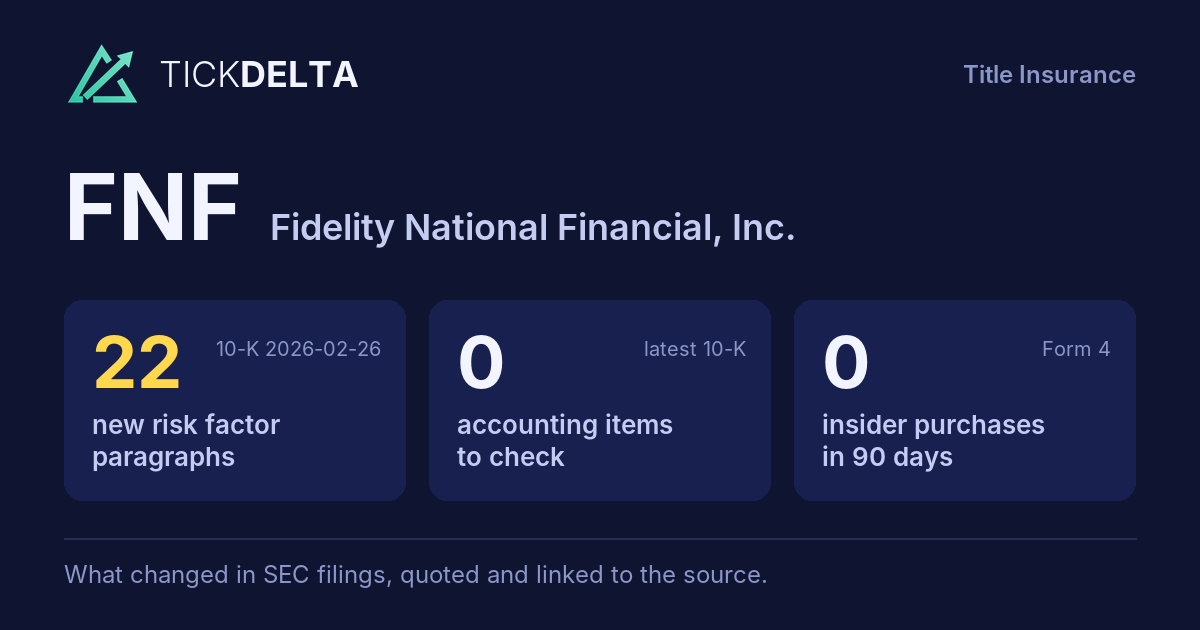
22 paragraphs in Risk Factors of the 10-K filed Feb 26, 2026 with nothing like them in the 10-K filed Feb 28, 2025. Quoted exactly. Paragraphs that were only edited are under 10-K change.
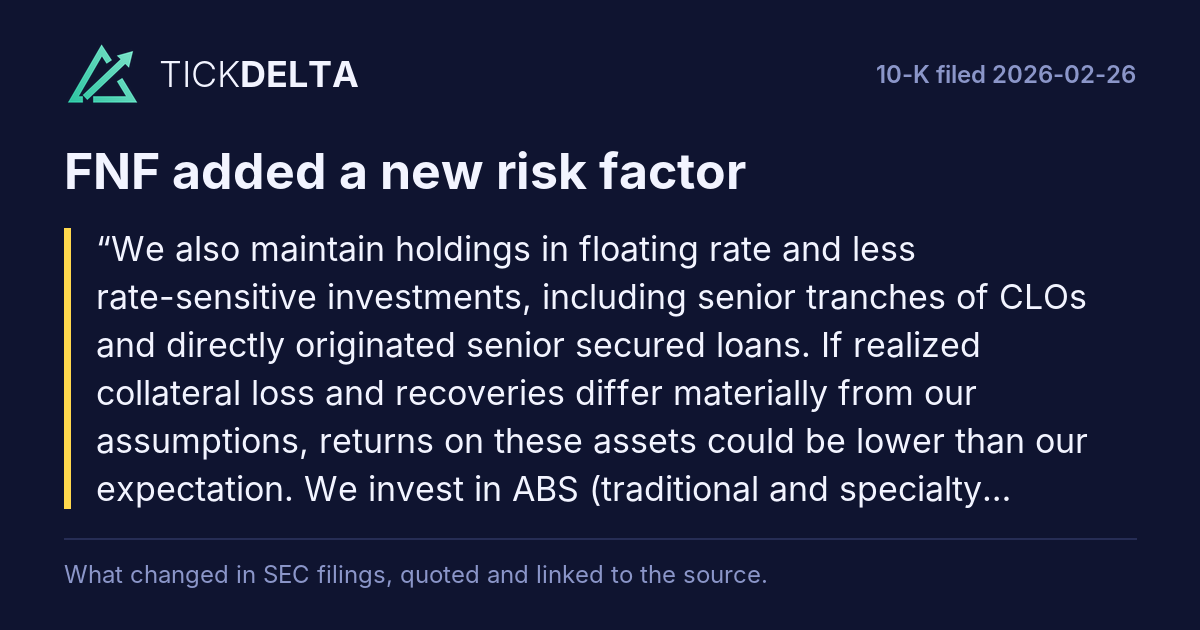
We also maintain holdings in floating rate and less rate-sensitive investments, including senior tranches of CLOs and directly originated senior secured loans. If realized collateral loss and recoveries differ materially from our assumptions, returns on these assets could be lower than our expectation.
We invest in ABS (traditional and specialty finance) and asset-backed and consumer whole loans. Consumer balance sheets are healthy and underwriting standards have become more conservative following the 2008 global financial crisis. However, high inflation rates have been a headwind for consumers, and efforts by the Federal Reserve to stem inflation could induce a recession which would have an adverse impact on consumers and potentially increase delinquencies to a higher level than what is assumed in our underwriting.
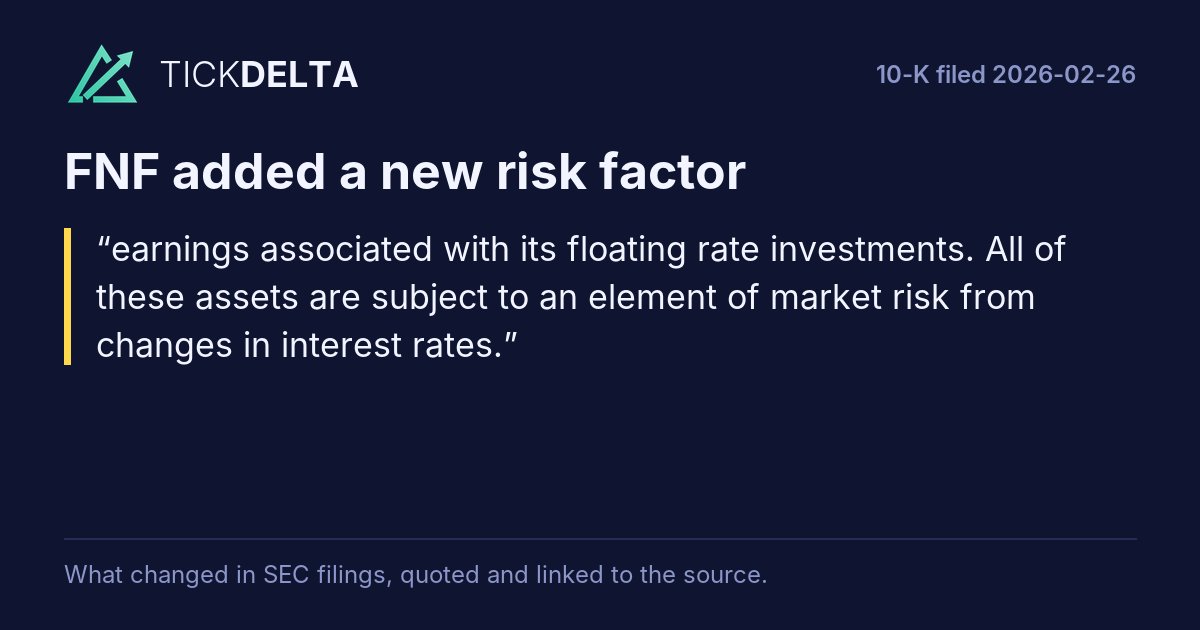
earnings associated with its floating rate investments. All of these assets are subject to an element of market risk from changes in interest rates.
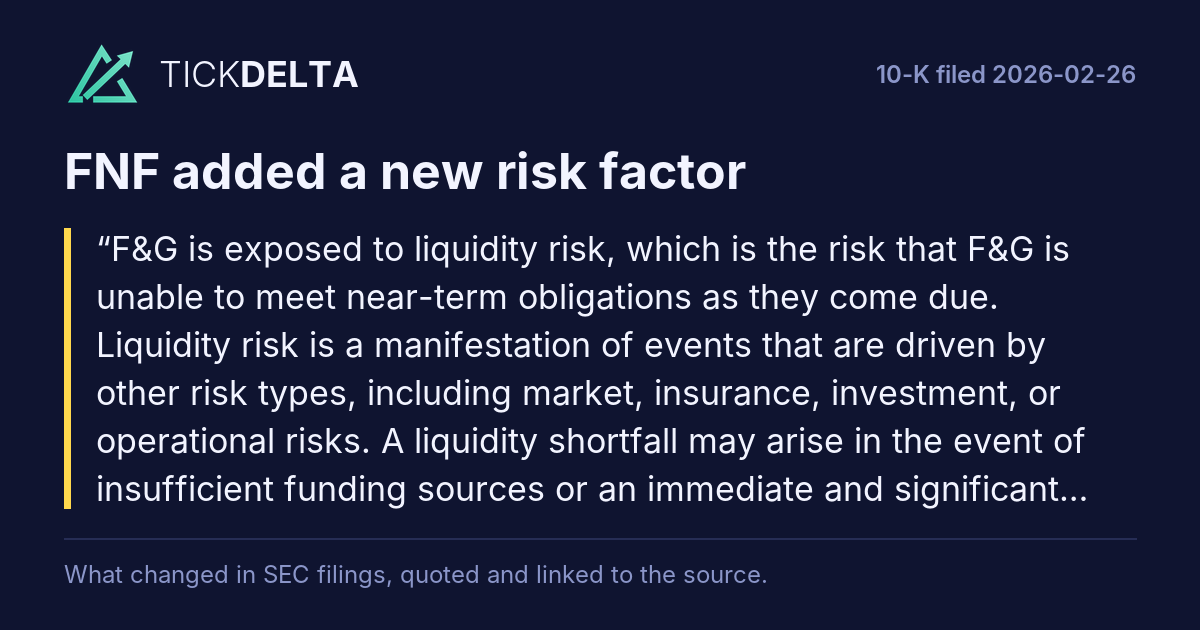
F&G is exposed to liquidity risk, which is the risk that F&G is unable to meet near-term obligations as they come due.
Liquidity risk is a manifestation of events that are driven by other risk types, including market, insurance, investment, or operational risks. A liquidity shortfall may arise in the event of insufficient funding sources or an immediate and significant need for cash or collateral. In addition, it is possible that expected liquidity sources, such F&G's minimum cash buffers, funding
agreements through the FHLB or other credit facilities, may be unavailable or inadequate to satisfy the liquidity demands described below.
F&G has the following sources of liquidity exposure and associated drivers that trigger material liquidity demand. Those sources are:
•Derivative collateral market exposure: abrupt changes to interest rate, equity, and/or currency markets may increase collateral requirements to counterparties and create liquidity risk for us.
•Asset liability mismatch: there are liquidity risks associated with liabilities coming due prior to the matching asset cash flows.
•Insurance cash flows: F&G faces potential liquidity risks from unexpected cash demands due to severe mortality calamity, customer withdrawals, policy loans or lapse events. If such events were to occur, F&G may face unexpectedly high levels of claim payments to policyholders.
•FHLB collateral: F&G issues funding agreements to the FHLB for which eligible securities collateral is posted. If the value of the eligible securities declines significantly, and there is no available eligible security collateral in the portfolio, F&G may need to supplement the collateral account with cash.
•Kubera NPA: F&G issued a variable note purchase agreement to Kubera for which it may be liable to fund any shortfall in Kubera’s ability to pay its obligations under the amended reinsurance agreement with FGL Insurance, assuring such principal up to $435 million is timely paid.
•Holding Company Liquidity: as a holding company, F&G is required to make interest and expense payments to satisfy obligations. The holding company’s cash position is targeted at the minimum of two times fixed charge coverage ratio on an annual basis.
Our valuation of investments and the determinations of the amounts of allowances and impairments taken on our investments may include methodologies, estimates and assumptions which are subject to differing interpretations and, if changed, could materially adversely affect our results of operations and financial condition.
The determination of current expected credit loss varies by investment type and is based upon our periodic evaluation and assessment of known and inherent risks associated with the respective asset class. Our management considers a wide range of factors about the instrument issuer (e.g., operations of the issuer and future earnings potential) and uses their best judgment in evaluating the cause of the decline in the estimated fair value of the instrument and in assessing the prospects for recovery. In addition, we conduct various quantitative credit screens on the investment portfolio to create a credit watchlist. The credit watchlist investments are then further analyzed by our portfolio managers for likelihood of loss of contractual principal and interest. Our portfolio managers also maintain a credit spotlight for investments that do not meet the quantitative screens. These investments have been identified as requiring a higher level of review and monitoring due to idiosyncratic risk. Such evaluations and assessments require significant judgment and are revised as conditions change and new information becomes available. Additional impairments may need to be taken in the future, and the ultimate loss may exceed management’s current estimate of impairment amounts.
F&G's insurance businesses are subject to extensive regulation by state insurance authorities in each state in which they operate. Most states also regulate insurance holding companies like us with respect to acquisitions, changes of control and the terms of transactions with our affiliates. In addition, we may incur significant costs in the course of complying with regulatory requirements.
F&G's business is subject to government regulation in each of the jurisdictions in which we conduct business and regulators have broad administrative and discretionary authority over our business and business practices.
F&G's business in the United States is regulated by the National Association of Insurance Commissioners (“NAIC”), which continues to consider reforms including relating to cybersecurity regulations, best interest standards, risk-based capital (“RBC”) and life insurance reserves.
to work to reform state regulation in various areas, including comprehensive reforms relating to cybersecurity regulations, best interest standards, RBC and life insurance reserves.
Current and emerging developments relating to market conduct standards for the financial industry emerging from the United States Department of Labor’s (“DOL”) implementation of the “fiduciary rule” may over time materially affect our business.
Changes to regulations under ERISA could adversely affect the Company by increasing the Company’s regulatory and compliance burden.
The prohibited transaction rules of ERISA and the Code generally restrict the provision of investment advice to ERISA plans and participants and IRA owners, if the investment recommendation results in fees paid to the individual advisor, his or her firm, or their affiliates, which vary according to the investment recommendation chosen. The 2020 PTE, which took effect on February 16, 2021, was expected to ease some of the investment advice restrictions under ERISA. However, this expectation may change if the New Fiduciary Rule, discussed earlier, becomes law. Currently, the New Fiduciary Rule’s effective date has been stayed from going into effect. In recent years, the DOL has issued or proposed several regulations that increase the level of disclosure that must be provided to plan sponsors and participants. These ERISA disclosure requirements will increase the Company’s regulatory and compliance burden, resulting in increased costs.
New in the latest 10-Q
8 paragraphs in the 10-Q filed Nov 6, 2026 with nothing like them in the 10-Q filed Aug 6, 2026 (at least half the words must differ; new numbers alone do not count). Quoted exactly, grouped by the item heading above them. This is text that changed, not a judgement of how serious it is.
Three months ended September 30, Nine months ended September 30, 2026 2025 2026 2025 (In millions) (In millions) ──────────────────────────────────────────────────────────────────────────────────────────────────────────────────────────────────────────────────────────────────────────────────────────────────────── Net realized losses on fixed maturity securities $ (61) $ (10) $ (224) $ (11) Net realized/unrealized losses on equity securities (1) (57) (39) (71) (111) Net realized/unrealized (losses) gains on preferred securities (2) (15) 9 (20) 6 Net realized/unrealized (losses) gains on other invested assets (12) (5) (11) 68 Change in allowance for expected credit losses (5) 1 5 (44) Net realized (loss) gain on sale of F&G Life Re (7) — 7 — Derivatives and embedded derivatives: Realized gains and losses on certain derivative instruments 85 (49) 249 (124) Unrealized (losses) gains on certain derivative instruments (432) 326 (365) 358 Change in fair value of reinsurance related embedded derivatives (3) 533 (60) 711 (162) Change in fair value of other derivatives and embedded derivatives — 3 3 7 Net realized/unrealized gains on derivatives and embedded derivatives 186 220 598 79 Recognized gains and losses, net $ 29 $ 176 $ 284 $ (13)
Read in the 10-Q
residential mortgage-backed securities included in fixed maturity securities available for sale on our unaudited Condensed Consolidated Balance Sheets.
Read in the 10-Q
defendants moved to dismiss the complaint on several grounds. On June 15, 2026, the court entered an order dismissing all claims relating to the Chairman of the Board’s 2024 stock award. However, the court held that the breach of fiduciary duty claims against the Compensation Committee members who approved the non-employee directors’ compensation for 2022, 2023, and 2024, and the unjust enrichment claims against all director defendants who received such compensation, survived the motion to dismiss. On October 27, 2026, the parties reached an agreement in principle to settle the action, subject to various terms and conditions. Upon execution of a definitive settlement agreement, the settlement will be submitted to the court for approval.
Read in the 10-Q
Certain of our insurance subsidiaries are subject to statutory accounting and regulatory requirements prescribed or permitted by their respective insurance regulatory authorities. Statutory accounting principles differ in certain respects from U.S. generally accepted accounting principles.
Read in the 10-Q
F&G's U.S. insurance subsidiaries are subject to statutory capital requirements and restrictions on the payment of dividends. For the nine months ended September 30, 2026, FGL Insurance did not pay any ordinary dividends to its parent, Fidelity & Guaranty Life Holdings, Inc. (“FGLH”), and FGL Insurance’s maximum ordinary dividend capacity for 2026 is $ 0. During the third quarter of 2026, upon approval by the Iowa Insurance Division, FGL Insurance paid $ 250 million in cash to FGLH as a return of capital, approximately $ 249 million of which was ultimately received by FGAL.
Read in the 10-Q
As of October 11, 2026, the MBA's most recent forecast projects total U.S. residential mortgage originations of $2.1 trillion in 2026, reflecting the impact of the September 2026 federal funds rate increase and the associated rise in long-term mortgage rates. Within that total, purchase originations are projected at $1.4 trillion and refinance originations at $700 billion. Purchase originations are projected to remain relatively flat year-over-year, consistent with the continued inventory constraints and
Read in the 10-Q
affordability challenges described below. The MBA projects originations of $2.1 trillion in 2027 and $2.2 trillion in 2028 as rates are expected to gradually ease from current levels.
Read in the 10-Q
Form 10-K for the year ended December 31, 2025, which was filed with the SEC on February 26, 2026, for further discussion of risk factors that could affect market conditions.
Read in the 10-Q
Item 1A of the 10-Q filed Nov 6, 2026 against Item 1A of the 10-K filed Feb 26, 2026.
A 10-Q repeats only the risks that changed, so a 10-K paragraph that is missing from it is not counted as removed.
Added is a paragraph with nothing like it in the 10-K, Reworded a sentence that is in both with several words changed,
Quiet changes a sentence in both where one to four words changed and one is a hedge or a modal
(cut words struck through, new words highlighted).
Text on the page, not a score; each links to the filing at sec.gov.
What the 10-Q itself says about its risk factors:There have been no material changes as of the date of this Quarterly Report on Form 10-Q to the risk factors disclosed in “Item 1A. Risk Factors” included in our Annual Report on Form 10-K for the year ended December 31, 2025.
Read in the 10-Q
Two-word phrases in Risk Factors of the 10-K filed Feb 26, 2026 that are in none of the 1 earlier 10-Ks stored, back to Feb 28, 2025
Used at least twice, small words left out. Counted, not picked: a phrase can be new because the company renamed something.
3 paragraphs of last year's Risk Factors with nothing like them now. The longest are quoted.
Item 1A of each 10-K and 10-Q on EDGAR, quoted exactly. Each paragraph links to the filing at sec.gov.
10-K change: what was reworded or cut, section by section.
Excel workbook · CSV. Google Sheet that stays up to date: paste =IMPORTDATA("https://tickdelta.com/company/FNF/export.csv") into a cell.