Paragraph 90 · 45% changed
Every version of it
Screener
/
SEC EDGAR
/CIK 0001039399
/10-K filed Feb 20, 2026, compared with Feb 21, 2025
/Numbers from the XBRL of the 10-Ks
Nasdaq
Technology · Semiconductors
Formfactor Inc FORM
The 10-K against last year's
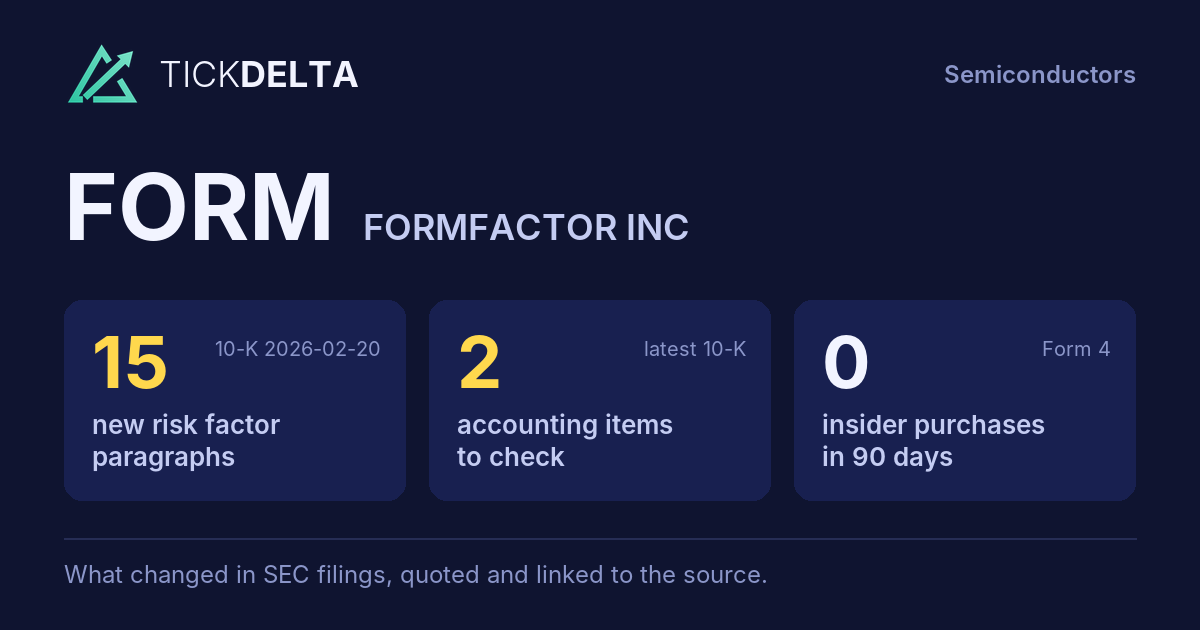
107 changes: 32 added, 15 removed, 58 reworded, 2 quiet changes
10-K Feb 20, 2026 vs Feb 21, 2025
Risk Factors
18.0%
of the text changed · 9,016 words now · 15 new paragraphs, 5 gone
MD&A
32.3%
of the text changed · 6,184 words now · 17 new paragraphs, 10 gone
Legal Proceedings
7.4%
of the text changed · 606 words now
Accounting Policies
10.3%
of the text changed · 5,301 words now
10-K 0001039399-26-000009 (Feb 20, 2026) vs 10-K 0001039399-25-000023 (Feb 21, 2025)
Every paragraph, and how much of it changed
One bar per paragraph, in the order of the 10-K. Height and colour show the share of its words not in the closest paragraph a year earlier; the tallest bars are new paragraphs.
Risk Factors
134 paragraphs · 15 new · 18 reworded · 5 gone · 10-K Feb 20, 2026 against Feb 21, 2025
New paragraph
Reworded (5% of its words or more)
Same or nearly
Paragraph 116 · 38% changed
Every version of it
Paragraph 19 · 35% changed
Every version of it
A relatively small number of customers account for a significant portion of our revenues. Two One customer represented 22.9% of total revenues in fiscal 2025, two customers represented a combined 33.5% of total revenues in fiscal 2024, 2024 and one customer represented 17.1% of total revenues in fiscal 2023 and one customer represented 19.0% of total revenues in fiscal 2022. 2023. We anticipate that sales of our products to a relatively small number of customers will continue to account for a significant portion of our revenues, which can drive material fluctuations in sales volume, gross margins due to changes in mix, and leverage on fixed costs. Consolidation in the semiconductor industry may increase this concentration. In the future, the loss of any of these customers, or cancellation, reduction or deferral of even a small number of purchases of our products by these customers, could significantly reduce our revenues. A decline in our customers' market share and commercial success, including their ability to compete favorably within their respective end markets, could significantly impact demand for our products and reduce our revenues. Cancellations, reductions, deferrals or non-payment of invoices could result from downturns in the semiconductor industry, including the cyclical downturn we have been experiencing, manufacturing delays, quality or reliability issues with our products, or from interruptions to our customers’ operations due to fire, natural disasters or other events, or other issues with the financial stability of our customers. Furthermore, because our probe cards are custom products designed for our customers’ unique wafer designs, any cancellations, reductions or delays can result in significant non-recoverable costs, including but not limited to the potential for impairment of inventories. In some situations, our customers might be able to cancel or reduce orders without a significant penalty.
Paragraph 30 · 34% changed
Every version of it
The semiconductor industry has historically been cyclical and is characterized by wide fluctuations in product supply and demand. From time to time, this industry has experienced significant downturns, often in connection with, or in anticipation of, maturing product and technology cycles, excess inventories, and declines in general economic conditions. The global economic and semiconductor downturns have caused and may in the future cause our operating results to decline dramatically from one period to the next. For example, the semiconductor industry in general experienced a cyclical downturn beginning the second half of fiscal 2022 that extended through at least fiscal 2024, resulting in a significant decline in demand for foundry & logic and DRAM products over the same period. Global economic stability can be negatively affected by a variety of factors and interrelationships, including the impacts of epidemics and pandemics, military conflicts or regional tensions, climate change, trade tensions, barriers and conflicts (such as the U.S.-China trade restrictions implemented since fiscal 2022 and those proposed to be implemented by the new U.S. presidential administration) restrictions) and other factors acting alone or in combination. Some of these factors can also have a more direct adverse impact upon our operations to varying degrees. Our business depends heavily upon the development and manufacture of new semiconductors, the rate at which semiconductor manufacturers make transitions to smaller nanometer technology nodes and implement tooling cycles, the volume of production by semiconductor manufacturers, and the overall financial strength of our customers, which, in turn, depend upon the current and anticipated market demand for semiconductors and products that use semiconductors, such as servers, personal computers, automobiles and cell phones. During industry downturns, semiconductor manufacturers sharply curtail their spending, including their spending on our products, which may adversely impact our revenues, gross margins and results of operations. Further, a protracted downturn could cause one or more of our customers to become insolvent, resulting in a loss of revenue and impacting our ability to collect on accounts receivable. The timing, length and severity of these cyclical downturns are difficult to predict, and our business depends on our ability to plan for and react to these cyclical changes.
Paragraph 31 · 32% changed
Every version of it
Paragraph 20 · 24% changed
Every version of it
Paragraph 39 · 18% changed
Every version of it
Paragraph 33 · 16% changed
Every version of it
Our revenues are difficult to forecast because we generally do not have sufficient backlog of unfilled orders to meet our quarterly revenue targets at the beginning of a quarter. Rather, a substantial percentage of our revenues in any quarter depend upon customer orders for our products that we receive and fulfill in that quarter. Because our expense levels are based in part on our expectations as to future revenues and to a large extent are fixed in the short term, we might be unable to adjust spending in time to compensate for any unexpected shortfall in revenues.
Paragraph 90 · 45% changed
Every version of it
10-K Feb 21, 2025Sales of our products to customers outside of the United States represent a significant part of our past and anticipated revenues, including sales involving exports from the United States to China. Geopolitical and trade tensions between the United States and China, one of our largest markets, have led to increased tariffs and trade restrictions and have affected customer ordering patterns, and this dynamic between the countries may persist or increase for the foreseeable future. For example, the U.S. Department of Commerce, Bureau of Industry and Security (“BIS”), has amended the U.S. Export Administration Regulations to expand license requirements on exports to entities in China that may support military end uses. These rules expand export license requirements on a broader set of items from the U.S., including many of our products, and for a broader set of customers in China and elsewhere. The BIS has also broadened the application of U.S. export controls to certain items which may be subject to Foreign Direct Product Rules (“FDPR”). There is no assurance that we will obtain any export licenses on a timely basis or at all. There also remains considerable uncertainty regarding the interpretation and implementation of new regulations. In reaction to U.S. trade regulations, governments and private businesses outside the United States, particularly in China, may implement retaliatory controls and preferences for non-U.S. or local suppliers, which can increase our manufacturing costs, make our products less competitive, reduce demand for our products, limit our ability to sell to certain customers, limit our ability to procure components or raw materials, or impede or slow the movement of our goods across borders. For example, China has restricted U.S. access to certain minerals and has blocked certain companies that provide products to Taiwan's military from selling products in China. Also, in China, we are observing stronger preferences for non-U.S. suppliers in general, and in favor of new and existing local suppliers in particular. These and other regulatory and policy changes, and the reactions of customers to such changes, in the U.S. and elsewhere, could materially and negatively affect our future sales and operating results.
10-K Feb 20, 2026
In reaction to U.S. trade regulations, governments and private businesses outside the United States may implement retaliatory controls and preferences for non-U.S. or local suppliers, which can increase our manufacturing and transaction costs, make our products less competitive, reduce demand for our products, limit our ability to sell to certain customers, limit our ability to procure components or raw materials, or impede or slow the movement of our goods across borders. These and other regulatory and policy changes, and the reactions of customers to such changes, in the United States and elsewhere, could materially and negatively affect our future sales and operating results.
Paragraph 116 · 38% changed
Every version of it
10-K Feb 21, 2025The trading prices of the securities of technology companies have been highly volatile. During fiscal 2024, our stock price (Nasdaq Global Select Market close price) ranged from $37.66 per share to $62.22 per share. The trading price of our common stock is likely to continue to be subject to wide fluctuations. Factors affecting the trading price of our common stock could include:
10-K Feb 20, 2026
stock is likely to continue to be subject to wide fluctuations. Factors affecting the trading price of our common stock could include:
Paragraph 19 · 35% changed
Every version of it
10-K Feb 21, 2025
A relatively small number of customers account for a significant portion of our revenues. Two customers represented a combined 33.5% of total revenues in fiscal 2024, one customer represented 17.1% of total revenues in fiscal 2023 and one customer represented 19.0% of total revenues in fiscal 2022. We anticipate that sales of our products to a relatively small number of customers will continue to account for a significant portion of our revenues, which can drive material fluctuations in sales volume, gross margins due to changes in mix, and leverage on fixed costs. Consolidation in the semiconductor industry may increase this concentration. In the future, the loss of any of these customers, or cancellation, reduction or deferral of even a small number of purchases of our products by these customers, could significantly reduce our revenues. A decline in our customers' market share and commercial success, including their ability to compete favorably within their respective end markets, could significantly impact demand for our products and reduce our revenues. Cancellations, reductions, deferrals or non-payment of invoices could result from downturns in the semiconductor industry, including the cyclical downturn we have been experiencing, manufacturing delays, quality or reliability issues with our products, or from interruptions to our customers’ operations due to fire, natural disasters or other events, or other issues with the financial stability of our customers. Furthermore, because our probe cards are custom products designed for our customers’ unique wafer designs, any cancellations, reductions or delays can result in significant non-recoverable costs, including but not limited to the potential for impairment of inventories. In some situations, our customers might be able to cancel or reduce orders without a significant penalty.
10-K Feb 20, 2026
A relatively small number of customers account for a significant portion of our revenues. One customer represented 22.9% of total revenues in fiscal 2025, two customers represented a combined 33.5% of total revenues in fiscal 2024 and one customer represented 17.1% of total revenues in fiscal 2023. We anticipate that sales of our products to a relatively small number of customers will continue to account for a significant portion of our revenues, which can drive material fluctuations in sales volume, gross margins due to changes in mix, and leverage on fixed costs. Consolidation in the semiconductor industry may increase this concentration. In the future, the loss of any of these customers, or cancellation, reduction or deferral of even a small number of purchases of our products by these customers, could significantly reduce our revenues. A decline in our
Paragraph 30 · 34% changed
Every version of it
10-K Feb 21, 2025
The semiconductor industry has historically been cyclical and is characterized by wide fluctuations in product supply and demand. From time to time, this industry has experienced significant downturns, often in connection with, or in anticipation of, maturing product and technology cycles, excess inventories, and declines in general economic conditions. The global economic and semiconductor downturns have caused and may in the future cause our operating results to decline dramatically from one period to the next. For example, the semiconductor industry in general experienced a cyclical downturn beginning the second half of fiscal 2022 that extended through at least fiscal 2024, resulting in a significant decline in demand for foundry & logic and DRAM products over the same period. Global economic stability can be negatively affected by a variety of factors and interrelationships, including the impacts of epidemics and pandemics, military conflicts or regional tensions, climate change, trade tensions, barriers and conflicts (such as the U.S.-China trade restrictions implemented since fiscal 2022 and those proposed to be implemented by the new U.S. presidential administration) and other factors acting alone or in combination. Some of these factors can also have a more direct adverse impact upon our operations to varying degrees. Our business depends heavily upon the development and manufacture of new semiconductors, the rate at which semiconductor manufacturers make transitions to smaller nanometer technology nodes and implement tooling cycles, the volume of production by semiconductor manufacturers, and the overall financial strength of our customers, which, in turn, depend upon the current and anticipated market demand for semiconductors and products that use semiconductors, such as servers, personal computers, automobiles and cell phones. During industry downturns, semiconductor manufacturers sharply curtail their spending, including their spending on our products, which may adversely impact our revenues, gross margins and results of operations. Further, a protracted downturn could cause one or more of our customers to become insolvent, resulting in a loss of revenue and impacting our ability to collect on accounts receivable. The timing, length and severity of these cyclical downturns are difficult to predict, and our business depends on our ability to plan for and react to these cyclical changes.
10-K Feb 20, 2026
The semiconductor industry has historically been cyclical and is characterized by wide fluctuations in product supply and demand. From time to time, this industry has experienced significant downturns, often in connection with, or in anticipation of, maturing product and technology cycles, excess inventories, and declines in general economic conditions. The global economic and semiconductor downturns have caused and may in the future cause our operating results to decline dramatically from one period to the next. Global economic stability can be negatively affected by a variety of factors and interrelationships, including the impacts of epidemics and pandemics, military conflicts or regional tensions, climate change, trade tensions, barriers and conflicts (such as U.S.-China trade restrictions) and other factors acting alone or in combination. Some of these factors can also have a more direct adverse impact upon our operations to varying degrees. Our business depends heavily upon the development
Paragraph 31 · 32% changed
Every version of it
10-K Feb 21, 2025The semiconductor industry has historically been cyclical and is characterized by wide fluctuations in product supply and demand. From time to time, this industry has experienced significant downturns, often in connection with, or in anticipation of, maturing product and technology cycles, excess inventories, and declines in general economic conditions. The global economic and semiconductor downturns have caused and may in the future cause our operating results to decline dramatically from one period to the next. For example, the semiconductor industry in general experienced a cyclical downturn beginning the second half of fiscal 2022 that extended through at least fiscal 2024, resulting in a significant decline in demand for foundry & logic and DRAM products over the same period. Global economic stability can be negatively affected by a variety of factors and interrelationships, including the impacts of epidemics and pandemics, military conflicts or regional tensions, climate change, trade tensions, barriers and conflicts (such as the U.S.-China trade restrictions implemented since fiscal 2022 and those proposed to be implemented by the new U.S. presidential administration) and other factors acting alone or in combination. Some of these factors can also have a more direct adverse impact upon our operations to varying degrees. Our business depends heavily upon the development and manufacture of new semiconductors, the rate at which semiconductor manufacturers make transitions to smaller nanometer technology nodes and implement tooling cycles, the volume of production by semiconductor manufacturers, and the overall financial strength of our customers, which, in turn, depend upon the current and anticipated market demand for semiconductors and products that use semiconductors, such as servers, personal computers, automobiles and cell phones. During industry downturns, semiconductor manufacturers sharply curtail their spending, including their spending on our products, which may adversely impact our revenues, gross margins and results of operations. Further, a protracted downturn could cause one or more of our customers to become insolvent, resulting in a loss of revenue and impacting our ability to collect on accounts receivable. The timing, length and severity of these cyclical downturns are difficult to predict, and our business depends on our ability to plan for and react to these cyclical changes.
10-K Feb 20, 2026
and manufacture of new semiconductors, the rate at which semiconductor manufacturers make transitions to smaller nanometer technology nodes and implement tooling cycles, the volume of production by semiconductor manufacturers, and the overall financial strength of our customers, which, in turn, depend upon the current and anticipated market demand for semiconductors and products that use semiconductors, such as servers, artificial intelligence, personal computers, automobiles and cell phones. During industry downturns, semiconductor manufacturers sharply curtail their spending, including their spending on our products, which may adversely impact our revenues, gross margins and results of operations. Further, a protracted downturn could cause one or more of our customers to become insolvent, resulting in a loss of revenue and impacting our ability to collect on accounts receivable. The timing, length and severity of these cyclical downturns are difficult to predict, and our business depends on our ability to plan for and react to these cyclical changes.
Paragraph 20 · 24% changed
Every version of it
10-K Feb 21, 2025A relatively small number of customers account for a significant portion of our revenues. Two customers represented a combined 33.5% of total revenues in fiscal 2024, one customer represented 17.1% of total revenues in fiscal 2023 and one customer represented 19.0% of total revenues in fiscal 2022. We anticipate that sales of our products to a relatively small number of customers will continue to account for a significant portion of our revenues, which can drive material fluctuations in sales volume, gross margins due to changes in mix, and leverage on fixed costs. Consolidation in the semiconductor industry may increase this concentration. In the future, the loss of any of these customers, or cancellation, reduction or deferral of even a small number of purchases of our products by these customers, could significantly reduce our revenues. A decline in our customers' market share and commercial success, including their ability to compete favorably within their respective end markets, could significantly impact demand for our products and reduce our revenues. Cancellations, reductions, deferrals or non-payment of invoices could result from downturns in the semiconductor industry, including the cyclical downturn we have been experiencing, manufacturing delays, quality or reliability issues with our products, or from interruptions to our customers’ operations due to fire, natural disasters or other events, or other issues with the financial stability of our customers. Furthermore, because our probe cards are custom products designed for our customers’ unique wafer designs, any cancellations, reductions or delays can result in significant non-recoverable costs, including but not limited to the potential for impairment of inventories. In some situations, our customers might be able to cancel or reduce orders without a significant penalty.
10-K Feb 20, 2026
customers' market share and commercial success, including their ability to compete favorably within their respective end markets, could significantly impact demand for our products and reduce our revenues. Cancellations, reductions, deferrals or non-payment of invoices could result from downturns in the semiconductor industry, manufacturing delays, quality or reliability issues with our products, or from interruptions to our customers’ operations due to fire, natural disasters or other events, or other issues with the financial stability of our customers. Furthermore, because our probe cards are custom products designed for our customers’ unique wafer designs, any cancellations, reductions or delays can result in significant non-recoverable costs, including but not limited to the potential for impairment of inventories. In some situations, our customers might be able to cancel or reduce orders without a significant penalty.
Paragraph 39 · 18% changed
Every version of it
10-K Feb 21, 2025To improve our manufacturing processes, we have incurred, and may incur in the future, substantial costs in an effort to optimize capacity and yields, open new manufacturing facilities, implement new manufacturing technologies, methods and processes, purchase new equipment, upgrade existing equipment, and train technical personnel. We have experienced, and may experience in the future, manufacturing delays and other inefficiencies in connection with implementation of these improvements and customer qualifications of new processes or products. These delays and other inefficiencies may arise from a variety of factors. Further, these investments may consume available cash in the short term for anticipated benefit that may or may not occur. Our operating results and liquidity have been and may in the future be negatively impacted by these factors.
10-K Feb 20, 2026
We have experienced, and may experience in the future, manufacturing delays and other inefficiencies in connection with implementation of these improvements and customer qualifications of new processes or products. These delays and other inefficiencies may arise from a variety of factors. Further, these investments may consume available cash in the short term for anticipated benefit that may or may not occur. Our operating results and liquidity have been and may in the future be negatively impacted by these factors.
Paragraph 33 · 16% changed
Every version of it
10-K Feb 21, 2025
Our revenues are difficult to forecast because we generally do not have sufficient backlog of unfilled orders to meet our quarterly revenue targets at the beginning of a quarter. Rather, a substantial percentage of our revenues in any quarter depend upon customer orders for our products that we receive and fulfill in that quarter. Because our expense levels are based in part on
10-K Feb 20, 2026
Our revenues are difficult to forecast because we generally do not have sufficient backlog of unfilled orders to meet our quarterly revenue targets at the beginning of a quarter. Rather, a substantial percentage of our revenues in any quarter depend upon customer orders for our products that we receive and fulfill in that quarter. Because our expense levels are based in part on our expectations as to future revenues and to a large extent are fixed in the short term, we might be unable to adjust spending in time to compensate for any unexpected shortfall in revenues.
MD&A
90 paragraphs · 17 new · 45 reworded · 10 gone · 10-K Feb 20, 2026 against Feb 21, 2025
New paragraph
Reworded (5% of its words or more)
Same or nearly
Paragraph 73 · 50% changed
Net cash used in investing activities in fiscal 2024 2025 was primarily related attributable to $38.4 $103.7 million in capital expenditures for property, plant and equipment purchases and $15.1 equipment. Of this amount, $55.0 million related to our new Farmers Branch manufacturing facility in Farmers Branch, Texas. Investing cash outflows also included $20.6 million used for to acquire shares of Keystone Photonics and $67.2 million related to the purchase of marketable securities, net of maturities, partially offset by the $21.6 million cash provided by the sale of businesses. Company's equity investment in FICT.
Paragraph 10 · 49% changed
Paragraph 53 · 47% changed
The increase decrease in selling, general and administrative expense in fiscal 2024 2025 compared to fiscal 2023 2024 was primarily driven by increased initiatives to further control operating expenses, resulting in lower general operating costs. These reductions included decreased employee compensation from higher performance-based compensation and increased commissions expense from increased revenues, due to lower performance‑based compensation, partially offset by higher employee‑related costs from annual pay increases, as well as lower consulting fees. In addition, we incurred lower stock‑based compensation expense, commission expense, and amortization of intangibles. intangible assets, partially offset by higher restructuring charges related to operating efficiency initiatives.
Paragraph 59 · 46% changed
Interest expense primarily includes interest on our term loan, interest rate swap derivative contract, and commitment fee on our revolving credit facility, term loan issuance costs amortization charges. The interest expense for fiscal 2024 compared to fiscal 2023 was relatively flat. This stability is due to charges, and our interest rate swap, which converted the interest rate on our long-term debt to a fixed rate. revolving credit facility issuance costs
Paragraph 45 · 46% changed
Systems—Gross profit and gross margin in the Systems segment increased while gross margin decreased in fiscal 2024 2025 compared to fiscal 2023, 2024, primarily as a result of greater revenues that was offset by an increase in manufacturing spending and an unfavorable product mix as a greater percentage of Systems segment revenues were from lower revenues, less favorable absorption of costs on lower production volumes, and a less favorable product mix, in part related to the divestiture of the FRT Metrology business, which was completed during the fourth quarter of fiscal 2023. margin products.
Paragraph 61 · 44% changed
Other income (expense), net, primarily includes the effects of foreign currency and various other gains and losses. The increase in Other income (expense), net, in fiscal 2024 compared to fiscal 2023 was primarily attributable to an other than temporary impairment on a debt receivable for $1.1 million in fiscal 2023 that did not recur in fiscal 2024 and an increase in We partially mitigate our risk from currency movements by hedging certain balance sheet exposures, which minimizes the impacts during periods of foreign exchange gains. volatility. Foreign exchange gains for fiscal 2024 2025 and fiscal 2023 2024 were $1.0 $1.8 million and $0.6 $1.0 million, respectively.
Paragraph 15 · 42% changed
Investment Acquisition — In February 2025, we, together with MBK Partners, a private equity firm, we acquired FICT Limited (“FICT”) from Advantage Partners Inc. In connection with the acquisition, we obtained a 20% equity interest in FICT, in exchange for funding $59.6 million of the purchase price. FICT Limited (“FICT”). Headquartered in Nagano, Japan, FICT is a provider of semiconductor test and high-performance computing industries with complex multi-layer organic substrates, printed circuit boards, and related leading-edge technologies and services. Under the equity method, upon closing this investment, the investment will be included as a separate item in our Consolidated Balance Sheets and we will record our proportionate share of FICT’s net income or loss as a separate item in our Consolidated Statements of Operations.
Paragraph 36 · 40% changed
Paragraph 73 · 50% changed
10-K Feb 21, 2025
Net cash used in investing activities in fiscal 2024 primarily related to $38.4 million in property, plant and equipment purchases and $15.1 million used for the purchase of marketable securities, net of maturities, partially offset by the $21.6 million cash provided by the sale of businesses.
10-K Feb 20, 2026
Net cash used in investing activities in fiscal 2025 was primarily attributable to $103.7 million in capital expenditures for property, plant and equipment. Of this amount, $55.0 million related to our new Farmers Branch manufacturing facility in Farmers Branch, Texas. Investing cash outflows also included $20.6 million used to acquire shares of Keystone Photonics and $67.2 million related to the Company's equity investment in FICT.
Paragraph 10 · 49% changed
10-K Feb 21, 2025We generated net income of $69.6 million in fiscal 2024 compared to net income of $82.4 million in fiscal 2023 and net income of $50.7 million in fiscal 2022. The decrease in net income in fiscal 2024 compared to fiscal 2023 was primarily due to a reduced gain on sale of business with the fiscal 2024 gain from the China Transaction being less than the fiscal 2023 gain from the sale of our FRT business further described below. Excluding the impact of gains in each period, our financial performance was driven by the strengthening of certain areas of the semiconductor industry, which increased demand in some markets within our Probe Cards segment, particularly with demand for HBM chips utilized in generative artificial intelligence applications and the ramp of new mobile application processor designs. While we experienced growth in total revenues year over year, the Systems segment was negatively impacted due to the absence of metrology system sales as a result of the sale of our FRT Metrology business in the fourth quarter of fiscal 2023.
10-K Feb 20, 2026
The decrease in net income in fiscal 2025 compared to fiscal 2024 was primarily due to the gain on sale of business recognized in fiscal 2024 from the sale of our China operations that did not repeat in fiscal 2025. Excluding the impact from the fiscal 2024 gain, our financial performance was driven by record revenue levels led by strong growth in our DRAM product segment, particularly with demand for HBM chips utilized in generative artificial intelligence applications. Despite this revenue growth, gross margins declined year over year, though third and fourth quarters have shown meaningful improvement in gross margins compared to the first half of fiscal 2025 and second half of fiscal 2024.
Paragraph 53 · 47% changed
10-K Feb 21, 2025
The increase in selling, general and administrative expense in fiscal 2024 compared to fiscal 2023 was primarily driven by increased employee compensation from higher performance-based compensation and increased commissions expense from increased revenues, partially offset by lower amortization of intangibles.
10-K Feb 20, 2026
The decrease in selling, general and administrative expense in fiscal 2025 compared to fiscal 2024 was primarily driven by initiatives to further control operating expenses, resulting in lower general operating costs. These reductions included decreased employee compensation due to lower performance‑based compensation, partially offset by higher employee‑related costs from annual pay increases, as well as lower consulting fees. In addition, we incurred lower stock‑based compensation expense, commission expense, and amortization of intangible assets, partially offset by higher restructuring charges related to operating efficiency initiatives.
Paragraph 59 · 46% changed
10-K Feb 21, 2025
Interest expense primarily includes interest on our term loan, interest rate swap derivative contract, and term loan issuance costs amortization charges. The interest expense for fiscal 2024 compared to fiscal 2023 was relatively flat. This stability is due to our interest rate swap, which converted the interest rate on our long-term debt to a fixed rate.
10-K Feb 20, 2026
Interest expense primarily includes interest on our term loan, interest rate swap derivative contract, commitment fee on our revolving credit facility, term loan issuance costs amortization charges, and our revolving credit facility issuance costs
Paragraph 45 · 46% changed
10-K Feb 21, 2025
Systems—Gross profit and gross margin in the Systems segment decreased fiscal 2024 compared to fiscal 2023, primarily as a result of lower revenues, less favorable absorption of costs on lower production volumes, and a less favorable product mix, in part related to the divestiture of the FRT Metrology business, which was completed during the fourth quarter of fiscal 2023.
10-K Feb 20, 2026
Systems—Gross profit in the Systems segment increased while gross margin decreased in fiscal 2025 compared to fiscal 2024, primarily as a result of greater revenues that was offset by an increase in manufacturing spending and an unfavorable product mix as a greater percentage of Systems segment revenues were from lower margin products.
Paragraph 61 · 44% changed
10-K Feb 21, 2025
Other income (expense), net, includes the effects of foreign currency and various other gains and losses. The increase in Other income (expense), net, in fiscal 2024 compared to fiscal 2023 was primarily attributable to an other than temporary impairment on a debt receivable for $1.1 million in fiscal 2023 that did not recur in fiscal 2024 and an increase in foreign exchange gains. Foreign exchange gains for fiscal 2024 and fiscal 2023 were $1.0 million and $0.6 million, respectively.
10-K Feb 20, 2026
Other income (expense), net, primarily includes the effects of foreign currency and various other gains and losses. We partially mitigate our risk from currency movements by hedging certain balance sheet exposures, which minimizes the impacts during periods of foreign exchange volatility. Foreign exchange gains for fiscal 2025 and fiscal 2024 were $1.8 million and $1.0 million, respectively.
Paragraph 15 · 42% changed
10-K Feb 21, 2025
In February 2025, we, together with MBK Partners, a private equity firm, acquired FICT Limited (“FICT”) from Advantage Partners Inc. In connection with the acquisition, we obtained a 20% equity interest in FICT, in exchange for funding $59.6 million of the purchase price. Headquartered in Nagano, Japan, FICT is a provider of semiconductor test and high-performance computing industries with complex multi-layer organic substrates, printed circuit boards, and related leading-edge technologies and services. Under the equity method, upon closing this investment, the investment will be included as a separate item in our Consolidated Balance Sheets and we will record our proportionate share of FICT’s net income or loss as a separate item in our Consolidated Statements of Operations.
10-K Feb 20, 2026
Investment Acquisition — In February 2025, we acquired a 20% equity interest in FICT Limited (“FICT”). Headquartered in Nagano, Japan, FICT is a provider of semiconductor test and high-performance computing industries with complex multi-layer organic substrates, printed circuit boards, and related leading-edge technologies and services.
Paragraph 36 · 40% changed
10-K Feb 21, 2025Foundry & Logic — The increase in Foundry & Logic product revenue in fiscal 2024 compared to fiscal 2023 was driven by the ramp of new mobile application processor designs.
10-K Feb 20, 2026
Systems — The increase in Systems product revenue in fiscal 2025 compared to fiscal 2024 was driven by increased sales of thermal systems, probe stations, and cryogenic systems.
A paragraph is matched with the one last year that shares the most of its words; under half in common makes it new. The paragraphs shown are the 8 reworded the most in each section.
The paragraph that changed most in each section
The redline
Marked against last year's 10-K: cut words struck through, new words highlighted.
Risk Factors256 words changed in this paragraph; it is 43% similar to last year's version.
Source: Item 1A, 10-K 0001039399-26-000009 vs Item 1A, 10-K 0001039399-25-000023
MD&A171 words changed in this paragraph; it is 41% similar to last year's version.
Source: Item 7, 10-K 0001039399-26-000009 vs Item 7, 10-K 0001039399-25-000023
Accounting Policies160 words changed in this paragraph; it is 49% similar to last year's version.
Advanced Manufacturing Investment Credit: The Creating Helpful Incentives to Produce Semiconductors and Science Act of 2022 (the “CHIPS Act”) was signed into law on August 9, 2022. The CHIPS Act provides for various incentives and tax credits, among other items, including the Advanced Manufacturing Investment Credit (“AMIC”), which equals 25% of qualified investments in an advanced manufacturing facility that is placed in service after December 31, 2022. The Company expects On July 4, 2025, the One Big Beautiful Bill Act (“OBBBA”) was signed into law. Among other changes, the OBBBA increased the AMIC rate from 25% to receive refundable federal investment tax credits through the CHIPS Act 35% for for qualified investments placed in connection with ongoing expansion projects. At least a portion of our capital expenditures qualify for this credit, which benefits us by allowing us to net the credit received against our costs. The AMIC credit is accounted as a reduction to the depreciable basis of the assets used in operations. The Company has offset the cost of property, plant, and equipment by the amount of the estimated credit of $7.3 million and $3.7 million for fiscal service after December 28, 2024 and December 30, 2023, respectively. The receivable recorded is an estimate based on the Company's interpretation of the Section 48D Advanced Manufacturing Investment Credit under the CHIPS Act, which may be refunded to us in cash to the extent it exceeds our outstanding income tax liabilities. 31, 2025.
Source: 10-K text, Note 2 – Summary of Significant Accounting Policies, 10-K 0001039399-26-000009 vs 10-K text, Note 2 – Summary of Significant Accounting Policies, 10-K 0001039399-25-000023
Legal Proceedings45 words changed in this paragraph; it is 61% similar to last year's version.
In January 2023, we received a $ 18.0 million Grant from the California Governor’s Office of Business and Economic Development. The Grant requires us to create and maintain full-time jobs and make significant infrastructure investments within California over a 5-year term. If we do not meet the requirements of the Grant, we will be required to repay all or a portion of the Grant. See Note 2, Summary of Significant Accounting Policies under the caption “Government Assistance,” for additional information.
Source: Item 3, via Note 12 – Commitments and Contingencies, 10-K 0001039399-26-000009 vs Item 3, via Note 11 – Commitments and Contingencies, 10-K 0001039399-25-000023
Sentences and paragraphs added, removed or reworded
Every change, by type
Sentences and paragraphs of FORM's Risk Factors and MD&A, 10-K Feb 20, 2026 against 10-K Feb 21, 2025. Each links to the text at sec.gov.
Quiet changes are sentences kept from last year with one to four words changed, at least one of them a hedge, a modal or a qualifier (may, could, will, not, significant, material…). A year or date rolling forward is not counted.
The full word list
adverse, adversely, all, although, anticipate, anticipates, any, approximately, believe, believes, can, cannot, certain, could, expect, expects, generally, however, if, intend, intends, largely, likely, many, material, materially, may, might, most, must, never, no, not, possible, primarily, probable, should, significant, significantly, some, substantial, substantially, unlikely, will, would
AddedRisk Factors
To improve our manufacturing processes, we have incurred, and may incur in the future, substantial costs in an effort to optimize capacity and yields, open new manufacturing facilities, implement new manufacturing technologies, methods and processes, purchase new equipment, upgrade existing equipment, and train technical personnel. For example, in June 2025, we purchased a manufacturing site in Farmers Branch, Texas, which is being built out for an expected production ramp beginning late in the fourth quarter of fiscal 2026. The successful ramp of this facility is subject to numerous risks and uncertainties, including delays in construction, equipment delivery or installation, challenges in achieving planned production capacity, yields or cost targets, difficulties recruiting, retaining and training qualified personnel, delays in obtaining customer qualifications or regulatory approvals, supply chain constraints, and integration challenges with our existing operations. If we are unable to increase capacity at our Farmers Branch site in a timely and cost-effective manner, or if the site does not perform as expected, we may be unable to meet customer demand, which could result in lost sales opportunities, reduced market share, damage to customer relationships and our reputation, and potential contractual penalties. In addition, if actual costs to build out and operate the facility exceed our estimates, or if production volumes or yields are lower than anticipated, our margins and operating results could be adversely affected. Further, rapid production ramps or process changes may negatively impact product quality, reliability or consistency, which could result in increased warranty claims, field failures, returns, rework costs or customer dissatisfaction.
Read it in 10-K Feb 20, 2026 at sec.gov
AddedRisk Factors
Our business is subject to complex and evolving data privacy and security laws, regulations, and industry standards, and our failure to comply could materially and adversely affect our business, financial condition, and results of operations.
Read it in 10-K Feb 20, 2026 at sec.gov
AddedRisk Factors
We collect, process, store, and transmit large amounts of sensitive and confidential data, including personal data of our customers, employees, and third parties. This activity subjects us to a complex and continually evolving landscape of U.S. federal and state laws, foreign laws, and industry standards regarding data privacy and security. These include, but are not limited to, the General Data Protection Regulation in the European Union, the California Consumer Privacy Act as amended by the California Privacy Rights Act, and other state-specific privacy laws in the United States, as well as contractual obligations and industry-specific requirements. These laws and standards are subject to varying interpretations and can be inconsistent across jurisdictions, creating compliance challenges and increasing our legal and operational exposure.
Read it in 10-K Feb 20, 2026 at sec.gov
AddedRisk Factors
Compliance with these laws and regulations requires significant investment in personnel, technology, and process changes, and these costs are likely to increase as new requirements emerge. Our efforts to comply may not be successful, and any failure or perceived failure to comply, whether intentional or inadvertent, could result in governmental investigations, inquiries, enforcement actions, fines, civil penalties, litigation, private rights of action, or other liabilities. Such events could lead to significant financial costs, reputational damage, loss of customer trust, and restrictions on our ability to process data, which could materially and adversely affect our business, financial condition, and results of operations.
Read it in 10-K Feb 20, 2026 at sec.gov
AddedRisk Factors
Failures in our information technology systems, including those incorporating artificial intelligence, or our inability to adapt to technological advancements, could disrupt our operations and harm our business.
Read it in 10-K Feb 20, 2026 at sec.gov
AddedRisk Factors
Our operations rely significantly on the continuous and secure operation of our information technology systems, networks, and infrastructure, including those of our third-party service providers. These systems are critical for managing our internal operations, processing transactions, communicating with customers and suppliers, and protecting sensitive data. Despite our efforts to maintain the security and integrity of our IT environment, our systems are subject to inherent risks, including natural disasters, power outages, telecommunications failures, malicious cyberattacks (such as ransomware, phishing, and denial-of-service attacks), computer viruses, or human error. Any significant disruption, security breach, or unauthorized access to or disclosure of confidential information could lead to significant financial losses, reputational damage, regulatory penalties, legal liabilities, and operational disruptions, which could materially and adversely affect our business.
Read it in 10-K Feb 20, 2026 at sec.gov
AddedRisk Factors
Furthermore, we utilize artificial intelligence (“AI”) technologies in various aspects of our operations, which introduces novel and evolving risks. AI models can produce inaccurate, biased, or unpredictable outputs, potentially leading to flawed decision-making, operational inefficiencies, or customer dissatisfaction. The use of AI also raises complex legal and ethical questions, including those related to intellectual property ownership of AI-generated content, the privacy and security of data used to train AI models, and accountability for AI system failures. The regulatory landscape governing AI is rapidly developing, and new laws or interpretations could impose significant compliance costs, restrict our use of AI, or expose us to unforeseen liabilities. These risks, individually or in the aggregate, could materially and adversely affect our business, financial condition, and results of operations.
Read it in 10-K Feb 20, 2026 at sec.gov
AddedRisk Factors
Our reliance on third-party data and open-source software components could expose us to intellectual property, security, and accuracy risks.
Read it in 10-K Feb 20, 2026 at sec.gov
Show the other 57
AddedRisk Factors
We incorporate research, published data, and open-source software components into our products, services, and internal operations. While these resources can enhance our capabilities and efficiency, they also introduce significant risks. The use of third-party data may expose us to risks of data inaccuracy, incompleteness, or misinterpretation, which could lead to flawed analyses, erroneous business decisions, and reputational harm. We may also inadvertently infringe upon the intellectual property rights of others if the data we use is not properly licensed or if its use violates existing copyrights, patents, or trade secrets.
Read it in 10-K Feb 20, 2026 at sec.gov
AddedRisk Factors
Moreover, the use of open-source software components carries inherent risks. Open-source licenses may contain terms that require us to disclose our proprietary source code, grant licenses to our intellectual property, or incur significant costs to re-engineer our solutions if we are unable to comply with such terms. Additionally, open-source software is often maintained by a community of developers and may not be subject to the same rigorous security and quality assurance processes as commercial software. This can result in undiscovered vulnerabilities, security flaws, or bugs that could be exploited by malicious actors, leading to data breaches, system outages, or other security incidents. Any of these risks could result in significant legal liabilities, enforcement actions, operational disruptions, and reputational damage, which could materially and adversely affect our business, financial condition, and results of operations.
Read it in 10-K Feb 20, 2026 at sec.gov
AddedRisk Factors
Geopolitical tensions, particularly between the U.S. and China, and the Chinese data regulatory regime, could materially and adversely affect our operations in China and globally.
Read it in 10-K Feb 20, 2026 at sec.gov
AddedRisk Factors
Our operations, including data processing and transfer activities, are subject to the evolving geopolitical landscape and the increasingly stringent regulatory environment in jurisdictions where we operate or from which we process data. Specifically, escalating trade tensions and policy divergence between the U.S. and China, including restrictions on technology transfers, cross-border data transfers, export controls, and investment limitations, could impact our ability to conduct business, access critical technologies, or operate effectively in the Chinese market. The sale of our products as a percentage of our revenues to customers inside of China represented 7%, 14%, and 14% of total revenue for fiscal 2025, 2024 and 2023, respectively.
Read it in 10-K Feb 20, 2026 at sec.gov
RemovedRisk Factors
RemovedRisk Factors
RemovedRisk Factors
RemovedRisk Factors
RemovedRisk Factors
RewordedRisk Factors
RewordedRisk Factors
Our efforts to mitigate the effects on us from interruptions in the availability of electric power, or other infrastructure, may not adequately prevent materially negative impacts on our operations, and in turn our financial results.
Read it in 10-K Feb 20, 2026 at sec.gov
RewordedRisk Factors
Global economic stability can be negatively affected by a variety of factors and interrelationships, including the impacts of epidemics and pandemics, military conflicts or regional tensions, climate change, trade tensions, barriers and conflicts (such as the U.S.-China trade restrictions implemented since fiscal 2022 and those proposed to be implemented by the new U.S. presidential administration) restrictions) and other factors acting alone or in combination.
Read it in 10-K Feb 20, 2026 at sec.gov
RewordedRisk Factors
RewordedRisk Factors
In addition, we might lose key employees or have difficulty finding adequate talent while integrating new organizations. organizations or expanding our business activities.
Read it in 10-K Feb 20, 2026 at sec.gov
RewordedRisk Factors
In fiscal years 2025, 2024 and 2023, we observed a continuing trend of increasing risks and challenges in the conduct of our international business activities, including expanded tariffs and other trade barriers affecting the United States and China, and currently there are rising trade tensions and conflicts (including proposed tariffs) between the United States and other countries, such as China. countries.
Read it in 10-K Feb 20, 2026 at sec.gov
RewordedRisk Factors
Cancellations, reductions, deferrals or non-payment of invoices could result from downturns in the semiconductor industry, including the cyclical downturn we have been experiencing, manufacturing delays, quality or reliability issues with our products, or from interruptions to our customers’ operations due to fire, natural disasters or other events, or other issues with the financial stability of our customers.
Read it in 10-K Feb 20, 2026 at sec.gov
RewordedRisk Factors
In reaction to U.S. trade regulations, governments and private businesses outside the United States, particularly in China, States may implement retaliatory controls and preferences for non-U.S. or local suppliers, which can increase our manufacturing and transaction costs, make our products less competitive, reduce demand for our products, limit our ability to sell to certain customers, limit our ability to procure components or raw materials, or impede or slow the movement of our goods across borders.
Read it in 10-K Feb 20, 2026 at sec.gov
RewordedRisk Factors
RewordedRisk Factors
RewordedRisk Factors
During fiscal 2024, 2025, our stock price (Nasdaq Global Select Market close price) ranged from $37.66 $23.18 per share to $62.22 $59.25 per share.
Read it in 10-K Feb 20, 2026 at sec.gov
RewordedRisk Factors
In addition, the Company has we have provided voluntary disclosures on ESG matters, including energy usage, greenhouse gas emissions, health and safety, diversity and inclusion, and labor and human rights.
Read it in 10-K Feb 20, 2026 at sec.gov
AddedMD&A
•Purchased a manufacturing site in Texas, which is expected to begin ramping production in late fiscal 2026.
Read it in 10-K Feb 20, 2026 at sec.gov
AddedMD&A
•Benefited from growth driven by exposure to end markets supporting artificial intelligence–related infrastructure, including HBM.
Read it in 10-K Feb 20, 2026 at sec.gov
AddedMD&A
•Made meaningful progress in establishing customer engagements to further diversify our customer base.
Read it in 10-K Feb 20, 2026 at sec.gov
AddedMD&A
We generated net income of $54.4 million in fiscal 2025 compared to net income of $69.6 million in fiscal 2024 and net income of $82.4 million in fiscal 2023.
Read it in 10-K Feb 20, 2026 at sec.gov
AddedMD&A
Restructure — In January 2026, we adopted restructuring plans that are intended to better align cost structure and support gross margin improvement to our target financial model, while also aligning manufacturing capabilities with current and anticipated business needs and our strategic priorities. As part of this restructuring plan, we are consolidating the manufacturing facilities located in Carlsbad and Baldwin Park, California to other sites. The Baldwin Park site manufactured through January 2026 and the Carlsbad site is expected to manufacture through December 2026.
Read it in 10-K Feb 20, 2026 at sec.gov
AddedMD&A
Acquisition — In December 2025, we acquired Keystone Photonics. This acquisition strengthened our position at the forefront of AI infrastructure demand, and strengthened our position at the forefront of the explosive market growth in silicon photonics (“SiPh”), extending our integrated test system leadership and leveraging our unique lab-to-fab position as SiPh and co-packaged optics manufacturers leap from concept to high-volume production.
Read it in 10-K Feb 20, 2026 at sec.gov
AddedMD&A
Factory Expansion — In June 2025, we purchased a manufacturing site in Farmers Branch, Texas, which comprises four structures and includes 50,000 square feet of existing clean room space. This manufacturing facility enabled us to acquire a scarce, fit-for-purpose asset that aligned with our strategic roadmap and provides significant operational flexibility. Located in a lower-operating cost region, it was one of a handful of existing available facilities in the U.S. that had a clean room and came equipped with the infrastructure to meet our future manufacturing needs.
Read it in 10-K Feb 20, 2026 at sec.gov
AddedMD&A
•Trade restrictions for the export of advanced U.S. semiconductor technology to China has caused decreasing demand from Chinese customers.
Read it in 10-K Feb 20, 2026 at sec.gov
AddedMD&A
Factory start-up costs are current year costs associated with our newly purchased manufacturing site in Farmers Branch, Texas. The start-up costs consist of utilities, employee compensation costs, taxes and licenses, facility maintenance, and other expenses being incurred while the site is being brought to its intended use. These costs are expected to increase as we continue the build-out, with an expected production ramp beginning late in the fourth quarter of fiscal 2026, and are expected to be between $20.0 million to $25.0 million over fiscal 2026. We expect that when the site begins revenue-generating production, the operating costs of that site previously expensed as factory start-up costs will instead be primarily expensed as part of the cost of the production in the Consolidated Statements of Income as a Cost of revenues.
Read it in 10-K Feb 20, 2026 at sec.gov
AddedMD&A
amortization charges. The increase in interest expense for fiscal 2025 compared to fiscal 2024 was due to fees for our undrawn revolving credit facility.
Read it in 10-K Feb 20, 2026 at sec.gov
AddedMD&A
On July 4, 2025, the OBBBA, which included a broad range of tax reform provisions that affected our financial results, was signed into law in the United States. Among other provisions, the OBBBA repealed the capitalization of domestic Research and Development (“R&D”) expenditures and included a reduced deduction rate on Foreign-derived Deduction Eligible Income and income from non-U.S. subsidiaries. We evaluated the impact of these provisions and implemented our current strategy, which, after considering the interplay of the various tax calculations affected by the OBBBA, resulted in a modest net increase to our effective tax rate.
Read it in 10-K Feb 20, 2026 at sec.gov
AddedMD&A
available on terms favorable to us. If we are unable to obtain sufficient cash or capital to meet our needs on a timely basis and on favorable terms, our business and operations could be materially and adversely affected.
Read it in 10-K Feb 20, 2026 at sec.gov
RemovedMD&A
RemovedMD&A
RemovedMD&A
RemovedMD&A
RemovedMD&A
RemovedMD&A
RemovedMD&A
RemovedMD&A
RemovedMD&A
RemovedMD&A
RewordedMD&A
Research and development 14.7 16.0 17.5 14.6 Selling, general and administrative 17.0 18.5 20.1 17.6 Factory start-up costs 0.4 — — Total operating expenses 32.1 34.5 37.6 32.2 Gain on sale of business — 2.7 11.0 — Operating income 7.2 8.5 12.4 7.4 Interest income income, net 1.3 1.8 1.1 0.3 Interest expense — (0.1) (0.1) Other income (expense), net 0.3 0.1 — 0.2 (0.1) Income before income taxes and equity investment 8.8 10.4 13.4 7.8 Provision for income taxes 1.6 1.3 1.0 1.0 Loss from equity investment 0.3 — — Net income 6.9 % 9.1 % 12.4 % 6.8% 12.4%
Read it in 10-K Feb 20, 2026 at sec.gov
RewordedMD&A
Excluding the impact of gains in each period, from the fiscal 2024 gain, our financial performance was driven by the strengthening of certain areas of the semiconductor industry, which increased demand record revenue levels led by strong growth in some markets within our Probe Cards DRAM product segment, particularly with demand for HBM chips utilized in generative artificial intelligence applications and the ramp of new mobile application processor designs. applications.
Read it in 10-K Feb 20, 2026 at sec.gov
RewordedMD&A
The increase in our effective tax rate for fiscal 2024, 2025, when compared to the corresponding period in the prior year, was primarily driven by the sale impact of our FRT business and implementing the related capital gain exclusion for German One Big Beautiful Bill Act (“OBBBA”) tax purposes that impacted fiscal year ended December 30, 2023, that did not repeat in the current year. law changes.
Read it in 10-K Feb 20, 2026 at sec.gov
RewordedMD&A
Probe Cards—Gross profit and gross margin in the Probe Cards segment increased decreased in fiscal 2024 2025 compared to fiscal 2023, 2024, despite the record revenue levels primarily due to greater revenues higher manufacturing costs, which included increased costs for tariffs, partially offset by a favorable product mix and more favorable absorption of costs on higher production factory utilization with the increased volumes.
Read it in 10-K Feb 20, 2026 at sec.gov
RewordedMD&A
The decrease in net income in fiscal 2024 2025 compared to fiscal 2023 2024 was primarily due to a reduced the gain on sale of business with the recognized in fiscal 2024 gain from the China Transaction being less than the fiscal 2023 gain from the sale of our FRT business further described below. China operations that did not repeat in fiscal 2025.
Read it in 10-K Feb 20, 2026 at sec.gov
RewordedMD&A
The non-cash expenses adjustments primarily consisted of depreciation, depreciation and amortization, stock-based compensation, and the compensation expense, provision for excess and obsolete inventories, partially offset by and the $20.6 million gain on sale reduction in the carrying amount of business and deferred income tax benefits. right-of-use-assets.
Read it in 10-K Feb 20, 2026 at sec.gov
RewordedMD&A
RewordedMD&A
During fiscal 2022, 2023 and 2024, we repurchased purchased and retired 676,408 32,020 shares of common stock for $26.0 $1.2 million and 1,309,635 shares of common stock for $53.3 million, utilizing the remaining shares available for repurchase under the program. respectively.
Read it in 10-K Feb 20, 2026 at sec.gov
RewordedMD&A
RewordedMD&A
The fiscal years ended December 27, 2025, December 28, 2024, 2024 and December 30, 2023 and December 31, 2022 each included 52 weeks, 52 weeks, and 53 weeks (with 14 weeks in the fourth quarter), respectively. weeks.
Read it in 10-K Feb 20, 2026 at sec.gov
RewordedMD&A
Changes in revenue by geographic region in fiscal 2024 2025 compared to fiscal 2023 2024 were primarily attributable to changes in customer demand, shifts in customer regional manufacturing strategies, particularly with our large multinational customers, product sales mix, and impacts from trade restrictions. restrictions, and product sales mix.
Read it in 10-K Feb 20, 2026 at sec.gov
RewordedMD&A
On October 30, 2023, April 24, 2025, our Board of Directors authorized an additional a new two-year program to repurchase up to $75 $75.0 million of outstanding common stock, also with the primary purpose of offsetting stock to offset potential dilution from issuance of common stock under our stock-based compensation programs.
Read it in 10-K Feb 20, 2026 at sec.gov
Quiet changesMD&A
Other income (expense), net, primarily includes the effects of foreign currency and various other gains and losses.
Read it in 10-K Feb 20, 2026 at sec.gov
Quiet changesMD&A
During fiscal 2022 and 2023, we repurchased and retired 1,700,893 shares of common stock for $56.4 million and 504,352 shares of common stock for $18.6 million, respectively, utilizing all of the remaining shares available for repurchase under the program.
Read it in 10-K Feb 20, 2026 at sec.gov
Sources
The two latest 10-Ks on EDGAR, section by section. Each change links to the text at sec.gov.
Also
New risk factors: paragraphs with nothing like them last year, quoted in full.
Work with it
Excel workbook · CSV. Google Sheet that stays up to date: paste =IMPORTDATA("https://tickdelta.com/company/FORM/export.csv") into a cell.