Form 10-K for the Fiscal Year Ended December 31, 2021
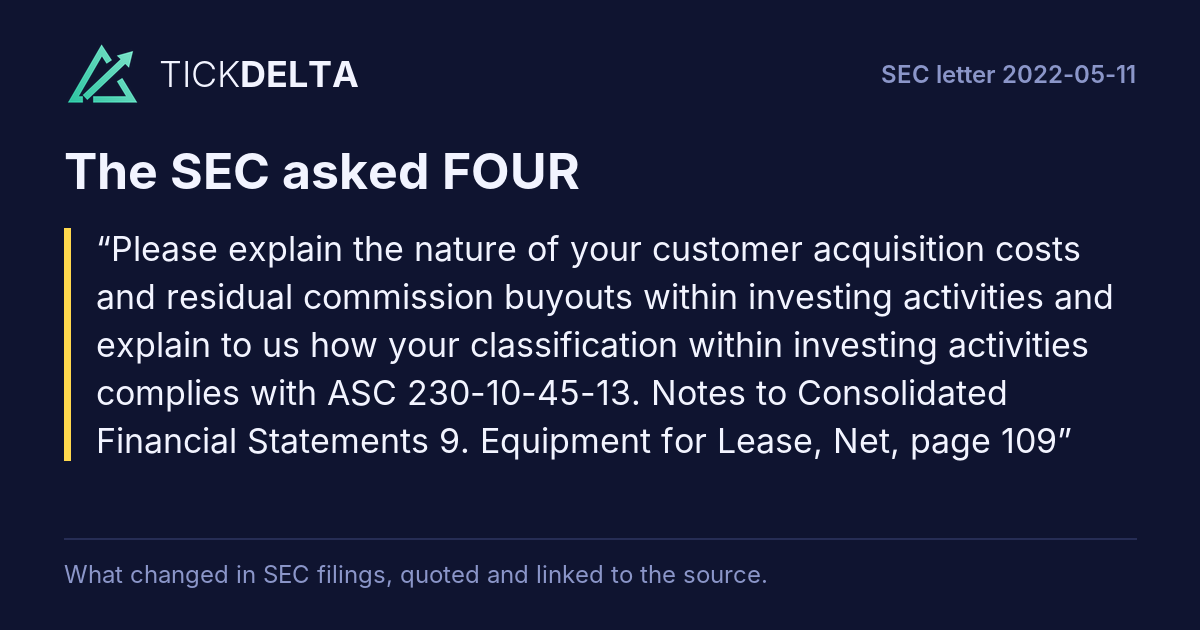
Please explain the nature of your customer acquisition costs and residual commission buyouts within investing activities and explain to us how your classification within investing activities complies with ASC 230-10-45-13. Notes to Consolidated Financial Statements 9. Equipment for Lease, Net, page 109
No reply letter found.
First report after the SEC's letter of May 11, 2022: 10-Q filed Aug 5, 2022 ↗, against the 10-Q filed May 6, 2022 ↗.
Tickdelta does not hold the text of both reports, so they are not compared here.
Please tell us your consideration of presenting depreciation of equipment under lease as cost of sales in your Statements of Operations. Refer to Rule 5-03.2 of Regulation S-X. Exhibit 99.1, page 4
No reply letter found.
First report after the SEC's letter of May 11, 2022: 10-Q filed Aug 5, 2022 ↗, against the 10-Q filed May 6, 2022 ↗.
Tickdelta does not hold the text of both reports, so they are not compared here.
Reference is made to your bullet point disclosure of gross revenue less network fees as well as your tabular presentation of Adjusted EBITDA and Adjusted Net Income (Loss). Please present the most directly comparable GAAP measure with equal or greater prominence in future filings. Refer to Item 10(e)(1)(i)(A) of Regulation S-K and Question 102.10 of the Division's Non-GAAP Compliance and Disclosure Interpretations.Rest of the question
In closing, we remind you that the company and its management are responsible for the accuracy and adequacy of their disclosures, notwithstanding any review, comments, action or absence of action by the staff.
No reply letter found.
First report after the SEC's letter of May 11, 2022: 10-Q filed Aug 5, 2022 ↗, against the 10-Q filed May 6, 2022 ↗.
Tickdelta does not hold the text of both reports, so they are not compared here.
We note your response to comment one. Please explain in greater detail why you consider capitalized acquisition costs and residual commission buyouts to represent productive assets. Notes to Consolidated Financial Statements 9. Equipment for Lease, Net, page 109
Shift4 respectfully notes that ASC 230 defines productive assets as “assets held for or used in the production of goods or services by the entity.”Read in the reply
Residual commission buyouts represent amounts paid to third-party distribution partners to acquire their ongoing merchant relationships and secure non-solicitation rights, which are also classified as intangible assets in our balance sheet.Rest of the answer
In connection with a buyout, Shift4 acquires all rights to remaining commissions for the applicable merchant arrangement and for a period of time, the third-party distribution partner agrees to not (i) solicit the merchant to provide any similar merchant services offered by Shift4, (ii) interfere with or disrupt the current merchant relationship, (iii) induce the merchant to terminate its arrangement with Shift4 or (iv) refer the merchant to another service provider. These intangible assets provide contractual rights to facilitate ongoing services given that the customers will continue to be subscribers to Shift4’s end-to-end processing platform over the remaining life of the customer arrangements. Shift4 believes these are reflective of productive assets given that the intangible assets are directly consumed over time in the provision of service. The assets are contractual, long-term and amortized over their useful lives.
Unlike residual commission buyouts that are classified as intangible assets in accordance with ASC 350, capitalized acquisition costs are accounted for as deferred costs under ASC 340-40. Nevertheless, Shift4 believes that the nature and substance of capitalized acquisition costs are consistent with that of merchant relationship intangible assets. These assets represent the future benefit the Company will receive from the costs of obtaining a contractual relationship with a new customer enabling the Company the right to service the customer over the specified relationship period. As such, these are also reflective of productive assets that are directly held for the provision of service.
Additionally, in the basis for conclusions of FAS 95, paragraph 84, the Financial Accounting Standards Board noted that grouping cash flows into operating, investing, and financing activities “links cash flows that are often perceived to be related…..Those relationships and trends in them provide information useful to investors and creditors.” Part of the reason that Shift4 acquires other companies is to provide greater, more meaningful services to its customers or acquire merchant portfolios or relationships. Shift4 believes that the acquisition of other companies, which are primarily comprised of productive assets as part of businesses acquired and classified as investing activities under ASC 230, should be classified similarly to the payment of residual commission buyouts and capitalized acquisition costs as the nature of these activities and the related assets are often directly linked to acquiring merchant relationships and securing end-to-end processing agreements.
Shift4 has also observed similar industry practice, whereby asset acquisitions involving the purchase of merchant portfolios and residual buyouts are classified as intangible assets and investing cash outflows. For example, a leading global provider of payments and financial services technology solutions classifies residual buyouts as intangible assets, which are defined as when the company “negotiate[s] to pay an independent sales organization (“ISO”) in exchange for the ISO’s surrender of its right to receive commission payments from the Company related to future transactions of the ISO’s referred merchants.” These residual buyouts are classified on the statements of cash flows as “Capital expenditures, including capitalized software and other intangibles” under investing activities.
Shift4 respectfully advises the Staff that it believes its capitalized acquisition costs and residual commission buyouts represent productive assets and are properly classified as investing activities on Shift4’s statements of cash flows.
9. Equipment for Lease, Net, page 109
First report after the company's reply of Aug 8, 2022: 10-Q filed Nov 8, 2022 ↗, against the 10-Q filed May 6, 2022 ↗.
Tickdelta does not hold the text of both reports, so they are not compared here.
We note your response to comment two, specifically that you considered ASC 840 and 842. However, your response did not address how you considered Rule 5-03.2 of Regulation S-X, as the equipment costs appear to relate directly to your products and services that generate revenue. Please explain.Rest of the question
Additionally, we note you intend to comply with SAB 11.B by revising future filings to indicate on the face of the statement of operations parenthetically, that cost of sales excludes depreciation of equipment under lease and refer to the footnote. Please note under SAB Topic 11.B, depreciation and amortization may be excluded from cost of sales if the line item clearly discloses its exclusion "and" the income statement does not include gross profit.
Shift4 respectfully acknowledges the Staff’s comment and advises the Staff that it anticipates revising its presentation of its consolidated statements of operations in future filings beginning with its quarterly report on Form 10-Q for the quarter ended September 30, 2022 to remove the “Gross profit” line item and re-label the “Cost of sales” line item to reflect the exclusion of depreciation of equipment under lease.Read in the reply
If you require additional information or have any questions about this letter, please call me at (516) 817-5207.
First report after the company's reply of Aug 8, 2022: 10-Q filed Nov 8, 2022 ↗, against the 10-Q filed May 6, 2022 ↗.
Tickdelta does not hold the text of both reports, so they are not compared here.
Also in this review: closing letter, 2022-11-14