Freedom Holding Corp. FRHC
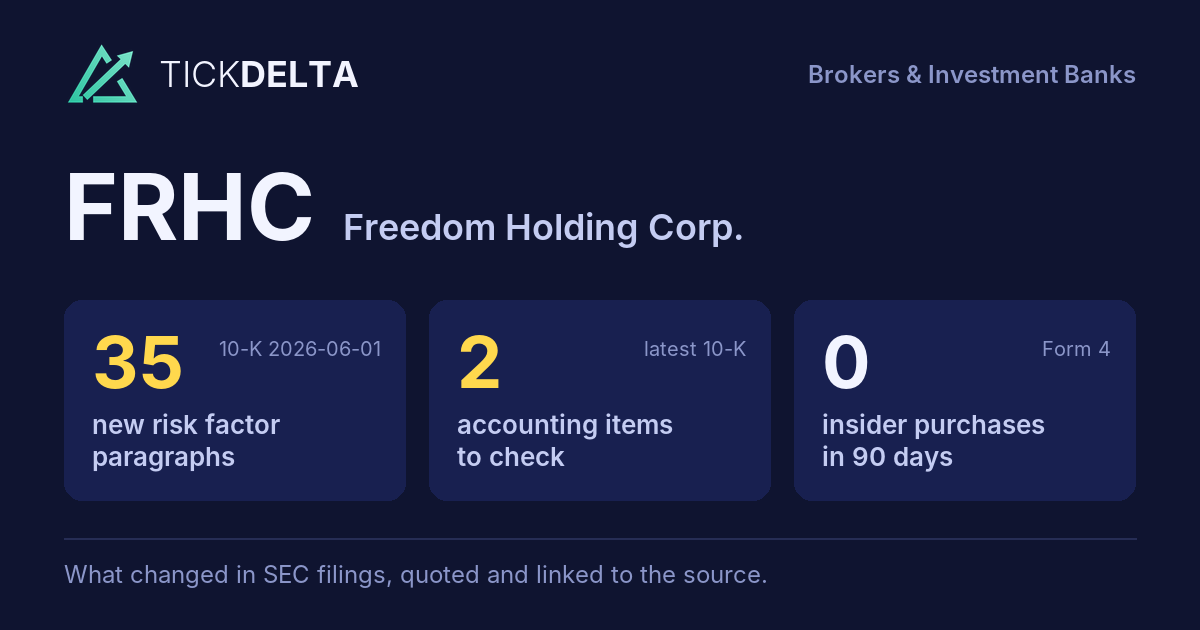
New risk paragraphs, branching off last year
Each branch is a paragraph in Risk Factors with nothing like it in the 10-K filed Jun 13, 2025. A box jumps to the paragraph as filed, below.
Paragraphs with nothing like them in last year's 10-K
35 paragraphs in Risk Factors of the 10-K filed Jun 1, 2026 with nothing like them in the 10-K filed Jun 13, 2025. Quoted exactly. Paragraphs that were only edited are under 10-K change.
•Our investments in AI data center infrastructure utilizing advanced graphics processing units (“GPUs”), including those supplied by NVIDIA Corporation, may not be successful and could materially adversely affect our business, financial condition, and results of operations.
•We are subject to risks related to litigation, arbitration and regulatory actions.
Further, as a result of the limited operating history of our business, and our rapid growth during sustained favorable market and economic conditions, we have limited historical data across different economic cycles that can be used to evaluate our future prospects, which subjects us to a number of uncertainties, including our ability to plan for, model and manage future growth and risks, including risks discussed elsewhere in this annual report. See also "The economies of Kazakhstan and other countries in which we operate are vulnerable to external shocks and fluctuations in the global economy." below.
may possess undiscovered IT security flaws, inadequate data protection practices, or legacy IT issues that, if not properly assessed and ring-fenced prior to network integration, could compromise our broader infrastructure.
For example, during the recent years we had an arrangement with microfinance organization Freedom Finance Credit ("FFIN Credit"), a company outside of the FRHC group which is controlled by Mr. Timur Turlov, through the purchase of right of claims of retail loans. Beginning in September 2025, Freedom Bank KZ transferred retail loan origination to its internal platform and ceased purchasing unsecured consumer loans from FFIN Credit. As of March 31, 2026, we do not use FFIN Credit as a source of retail loan origination. Loans previously acquired from FFIN Credit remain on our balance sheet and continue to expose us to credit and servicing risks until they are fully repaid or otherwise settled.
Show the other 17
Our investments in AI data center infrastructure utilizing advanced GPUs, including those supplied by NVIDIA Corporation, may not be successful and could materially adversely affect our business, financial condition, and results of operations.
We are evaluating the development of a large-scale AI data center in Kazakhstan based on a non-binding memorandum of understanding signed by FRHC with the Kazakhstan Ministry of AI and Digital Development and NVIDIA Corporation in November 2025. The project is expected to be implemented in phases and will require substantial capital expenditures. According to our preliminary internal estimate, which is subject to significant change based on the final scope and configuration, the initial investment in the project may be approximately $2 billion. The project remains subject to feasibility analysis. We may not finalize its scope, select a site, obtain required approvals, or complete
construction on expected timelines, within budget, or at all. Any definitive agreement(s) with NVIDIA Corporation or other partner(s) may include unfavorable commercial, supply, exclusivity or other terms, or may not be concluded at all, which could adversely affect the scope, timing and economics of the project. In addition, the evaluation, development and potential operation of this project may require significant attention from our senior management and allocation of internal resources, which could divert focus from our existing business activities.
We expect to seek debt and/or equity financing for a significant part of the funding for this project. However, we may not be able to secure financing on acceptable terms, or at all. If we are unable to obtain adequate financing, we may delay, scale back, or abandon the project.
If this project is developed, our ability to procure advanced GPUs may be limited by supply chain constraints, high global demand for equipment, export controls, sanctions, and licensing requirements. Among other requirements described above, the export of such products may require a license from the U.S. government. Such approvals may not be obtained on a timely basis or at all. We may also depend on a limited number of suppliers. This may increase our exposure to pricing volatility, allocation constraints, and supply disruptions. The cost of required equipment is significant, which increases the capital intensity of the project and the risk of loss.
The development and operation of an AI data center involve significant risks. These include complex engineering requirements, long lead times, and dependence on critical infrastructure, including power supply, cooling, and network connectivity. Site selection remains under evaluation and depends in part on the availability of reliable and cost-effective electricity. We may experience delays in permitting, construction, grid connection, or commissioning. Any such delays may increase costs and reduce or delay expected returns.
The project, if we proceed with development, is expected to involve coordination with governmental authorities. Such authorities may provide regulatory support but are not expected to provide direct funding. Any expected preferential conditions, such as infrastructure support or tax incentives, may not be available or may not be sufficient to achieve expected returns.
The market for AI and high-performance computing is rapidly evolving and highly competitive. Demand for our services, if we develop this AI data center, may not develop as anticipated. We may not achieve sufficient utilization rates or pricing to recover our investments. Technological developments, including more advanced or cost-efficient alternatives, may reduce the competitiveness or useful life of our infrastructure.
If any of these risks materialize, we may incur delays, cost overruns, reduced revenues, asset impairments, or losses. Any of these outcomes could materially adversely affect our business, financial condition, and results of operations.
Any difficulty in obtaining the required capital may prevent us from being able to execute our plans and strategy, at all or with considerable delay. In addition, any other business we may acquire or in which we may make an investment may require additional financing and may seek to raise debt or equity financing.
In the event that we or one or more of our subsidiaries requires capital, we may seek to address such needs by (i) utilizing cash on hand, (ii) issuing equity in the form of shares or convertible instruments, (iii) raising debt financing at the holding company level, (iv) using funds received from distributions from our subsidiaries, (v) selling part or all of our interest in any of our subsidiaries and using the proceeds from such sales, or (vi) providing guarantees or pledging collateral in support of the debt of our subsidiaries.
We may also seek to sell assets to fund our investments or meet our obligations, and our ability to sell assets may be limited. Any such asset sales may not be at attractive prices, particularly if such sales must be made quickly.
The conflict involving Iran that started in February 2026, together with escalating political and economic instability across the Middle East, has created, and may continue to create, significant uncertainty in global financial markets and supply chains and has contributed to increased volatility in commodity prices and capital markets. We recently obtained a brokerage license in the United Arab Emirates and are in the process of developing our presence in the region, which increases our exposure to geopolitical, regulatory and economic developments in the Middle East. In particular, disruptions to critical transit routes, including the Strait of Hormuz, through which a substantial portion of the world’s oil supply is transported, could materially constrain global oil exports and result in significant increases in crude oil prices, which can impact financial markets. Sustained increases in energy prices could contribute to heightened inflationary pressures globally by increasing transportation, manufacturing, and input costs, which may, in turn, lead to higher prices for commodities and consumer goods. In response to such inflationary pressures, central banks in the markets where we operate or have plans to operate may further tighten monetary policy, including by increasing base benchmark interest rates or maintaining elevated rates for extended periods. Such actions could reduce economic activity, increase borrowing costs, decrease liquidity in financial markets, and contribute to increased volatility across asset classes and may adversely affect capital flows, particularly in emerging markets. In addition, the conflict may result in the expansion of sanctions regimes, export controls or other regulatory measures, or increased compliance risks, which could affect our counterparties, customers or operations.
These developments could adversely affect investor confidence, trading volumes, and the valuation of financial assets, and could also impair the ability of market participants to access capital on favorable terms, or at all. They may also reduce client activity levels and demand for our services. As a result, our business, financial condition, results of operations, and cash flows could be materially adversely affected.
We have received inquiries from OFAC regarding transactions involving sanctioned individuals, including the use of certain clearing arrangements. We have responded to these inquiries and continue to cooperate with OFAC.
The war involving Iran, which unfolded in February 2026, has contributed to volatility in global energy markets, including constraints on oil supply and increases in oil prices. Further escalation, including potential disruptions to critical transportation routes, such as the Strait of Hormuz, could exacerbate pressures on the global economy, including by contributing to inflationary trends and broader economic instability.
business lines and may restrict our ability to centralize data processing, use shared services, rely on regional or global cloud infrastructure, or transfer data among affiliates, counterparties and third-party service providers.
From time to time, we have been, and in the future may be, subject to investigations, audits, inspections and subpoenas, as well as regulatory proceedings and fines and penalties brought by regulators. We are subject to regulation from numerous regulators, which include the NBK, the AFSA, the ARDFM, CySEC and the SEC. We have received, and are likely to continue to receive, various inquiries and formal requests for information on various matters from certain regulators, with which we have cooperated and will continue to do so. As previously disclosed, since 2021, the Company and certain officers and directors have received subpoenas for documents and testimony from the SEC. The requested information relates to a number of topics related to an investigation, including settlement practices and relationships with certain institutional market maker customers of certain of our non-U.S. broker-dealer subsidiaries, and has included our accounting practices related to internalized trades, disclosures and internal controls (the "Investigation"). In the context of certain of those requests, on March 11, 2026, the Company and the Company's controlling shareholder, chairman and chief executive officer, Timur Turlov received Wells Notice (the "Wells Notice") from the SEC staff in connection with the Investigation. The Wells Notice states that the SEC staff has made a "preliminary determination" to recommend that the SEC file a civil enforcement action against the recipients alleging violations of certain provisions of the U.S. federal securities laws. A Wells Notice is neither a formal charge of wrongdoing nor a final determination that the recipient has violated any law. The issuance of a Wells Notice may or may not result in such actions or proceedings, and in some cases where a Wells Notice has been issued the matter may be settled or dismissed. The Company and Mr. Turlov have challenged the SEC’s “preliminary determination.” We face risks and uncertainties in connection with the Investigation, including a civil enforcement action or administrative proceeding brought by the SEC or other resolution, including settlement, which could result in the imposition of monetary and non-monetary relief against the Company and/or Mr. Turlov, and the matter could result in additional legal and other professional expenses, and could adversely affect the Company’s business, financial condition, results of operations, reputation and cash flows.
Firms in the financial services industry operate in a highly regulated regulatory environment. The industry has experienced increased scrutiny from a variety of regulators, including the SEC and FINRA in the United States, U.S. state
We are subject to risks related to litigation, arbitration and regulatory actions.
These communications and transactions are accomplished primarily through electronic information technology systems that are comprised of a wide array of computer systems, software, server and network hardware, internet connectivity, encryption protocols, related trust services and underlying infrastructure that enable them to function.
The financial, accounting, or other data processing systems we or the firms that clear transactions on behalf of our customers use may fail to operate properly, become disabled, or otherwise become unavailable, as a result of events that are
The OECD/G20 Inclusive Framework on Base Erosion and Profit Shifting has developed a global minimum tax framework referred to as Pillar Two. Pillar Two generally applies to multinational enterprise groups with annual consolidated revenue of at least EUR 750 million in at least two of the four preceding fiscal years and is intended to impose a 15% minimum effective tax rate on a jurisdictional basis. Its principal mechanisms include the Income Inclusion Rule (“IIR”), the Undertaxed Profits Rule (“UTPR”), and the Qualified Domestic Minimum Top-up Tax (“QDMTT”).
On January 5, 2026, the OECD released the Side-by-Side (“SbS”) package, which provides relief from the Pillar Two IIR and UTPR for multinational groups whose ultimate parent entity is located in a jurisdiction with a Qualified SbS Regime, for fiscal years beginning on or after January 1, 2026. OECD guidance issued in January 2026 identifies the United States as an Eligible SbS Regime jurisdiction. Because FRHC, our ultimate parent entity, is located in the United States, we expect the Group to qualify for this relief for those fiscal years. Accordingly, we do not expect low-taxed income in the jurisdictions where we operate to be subject to additional top-up tax under the IIR or allocated under the UTPR in other jurisdictions for those years. The SbS safe harbour does not apply to QDMTTs, and we may continue to be subject to domestic minimum top-up taxes in jurisdictions that have enacted such rules.
Notwithstanding this expected relief, Pillar Two compliance remains complex and may require substantial data collection, calculations and judgment. The OECD has issued administrative guidance and simplification measures, including safe harbors, but variations in implementation and administration across jurisdictions may continue to create compliance burdens and tax risk. In addition, for fiscal years beginning before January 1, 2026, the Group may remain subject to the standard Pillar Two rule order, including potential UTPR exposure where applicable.
Transfer pricing rules in certain jurisdictions where we operate require related-party transactions to be conducted on arm’s-length terms and may require taxpayers to maintain contemporaneous documentation to support their transfer pricing positions. Under the OECD’s three-tier transfer pricing documentation framework, this documentation may include a master file, local file and country-by-country report. Our intragroup transactions are supported by transfer pricing benchmark studies and related documentation intended to support the arm’s-length nature of such transactions.
Tax authorities in the jurisdictions where we operate may challenge the pricing of our controlled transactions, the methodologies we apply, the characterization of such transactions or the sufficiency of our supporting documentation. In certain cases, tax authorities may also seek to apply transfer pricing concepts through other tax provisions or anti-avoidance principles. Our subsidiaries in Kazakhstan, Armenia, the UAE, Cyprus and the United States could become subject to transfer pricing reviews or audits. Any such challenge could result in transfer pricing adjustments, additional taxes, interest, penalties or double taxation, which could have a material adverse effect on our business, financial condition, results of operations and cash flows.
In addition, Kazakhstan introduced transitional tax provisions adopted in July 2025 with retroactive effect from January 1, 2025 to facilitate the gradual changes to the corporate income tax regime prior to the full enactment of the new Tax Code on January 1, 2026. These rules are applicable to calendar 2025 year only and address the corporate income tax treatment of specific types of financial and investment income, including income that was previously exempt from taxation. Specifically, the rules introduced a one-time (for year 2025 only) a 10% corporate income tax rate for certain categories of income, replacing prior exemptions for the following types of income: income derived from transactions with government-issued securities, short-term repo transactions, currency and interest rate swap operations, and short-term placements with the National Bank of the Republic of Kazakhstan. Apart of the above mentioned 10% taxation, these types of income are also included in the aggregate annual income for calculating the standard 20% corporate income tax (although, some of them subject to subsequent reductions or exemptions).
On April 9, 2026, we announced that we are considering an offering of our common stock in Kazakhstan. The offering, if we determine to proceed with such an offering, would be conducted outside the United States in reliance on Regulation S under the Securities Act of 1933. The shares offered in this offering will not be or have not been registered under the Securities Act of 1933 and may not be offered or sold in the United States absent registration or an applicable exemption from registration requirements. Any such offering, or any other offering we may announce in the future, could result in the sale of a substantial number of our common shares.
•war involving Iran, together with escalating political and economic instability across the Middle East, including disruptions to critical transit routes, significant increases in crude oil prices and inflationary pressure;
Paragraphs in the 10-Q filed Aug 10, 2026 that were not in the one before
New in the latest 10-Q
70 paragraphs in the 10-Q filed Aug 10, 2026 with nothing like them in the 10-Q filed Feb 9, 2026 (at least half the words must differ; new numbers alone do not count). Quoted exactly, grouped by the item heading above them. This is text that changed, not a judgement of how serious it is.
10-Q
Three Months Ended June 30, ──────────────────────────────────────────────────────────────────────────────────────────────────────────────────────────────────────────────────────────────────────────────────────────────────────────────────────────── 2026 2025 (Recasted) Revenue: Fee and commission income $ 156,734 $ 107,642 Net gain on trading securities 79,778 45,602 Interest income 295,106 198,571 Net insurance revenue 124,175 143,815 Net gain/(loss) on foreign exchange operations 13,726 (12,893) Net gain on derivatives 9,853 15,459 Sales of goods and services 41,510 17,224 Other income 11,645 8,561 TOTAL REVENUE, NET $ 732,527 $ 523,981 Expense: Fee and commission expense $ 31,289 $ 84,354 Interest expense 177,563 113,410 Insurance claims and policyholder benefits, net of reinsurance 131,582 64,996 Payroll and bonuses 153,127 92,505 Professional services 10,004 13,024 Stock compensation expense 23,235 23,054 Advertising and sponsorship expense (including for the three month ended $11,831 and $5,513 from related parties) 35,785 24,463 General and administrative expense 76,205 41,975 Allowance for expected credit losses 17,659 4,822 Cost of sales 35,244 13,903 TOTAL EXPENSE $ 691,693 $ 476,506 INCOME BEFORE INCOME TAX 40,834 47,475 Income tax expense (9,174) (10,119) NET INCOME $ 31,660 $ 37,356 Less: Net loss attributable to non-controlling interest in subsidiary — — NET INCOME ATTRIBUTABLE TO COMMON SHAREHOLDERS $ 31,660 $ 37,356 OTHER COMPREHENSIVE INCOME Change in unrealized (gain)/loss on investments available-for-sale, net of tax effect (1,141) 2,998 Reclassification adjustment for net realized (gain)/loss on available-for-sale investments disposed of in the period, net of tax effect (238) 174 Change in discount rate on liability for future policy benefits (3,350) (848) Foreign currency translation adjustments (4,400) (41,804) OTHER COMPREHENSIVE LOSS (9,129) (39,480) COMPREHENSIVE INCOME/(LOSS) BEFORE NON-CONTROLLING INTERESTS $ 22,531 $ (2,124)
Read in the 10-Q
The classification of subsidiaries under the heading "Business Area" does not constitute, imply, or represent that any such subsidiary holds, or is required to hold, any license, registration, consent, or other regulatory authorization in respect of the relevant business activities.
Read in the 10-Q
These consolidated financial statements should be read in conjunction with the consolidated financial statements, and related notes thereto, included in the Company’s Annual Report on Form 10-K for the fiscal year ended March 31, 2026 (the “2026 Annual Report on Form 10-K”). Note 2 to the consolidated financial statements in Company’s 2026 Annual Report on Form 10-K contains a summary of the Company’s significant accounting policies, except for the following amendments:
Read in the 10-Q
The Company may, at its sole discretion, declare and pay dividends to certain pension policyholders. Such dividends are not contractually guaranteed and are not legally or constructively obligated prior to declaration by the Company.
Read in the 10-Q
Previously, because the payment of these dividends was subject to the Company's discretionary approval and did not represent a present obligation as of the reporting date, no liability was recognized within future policy benefit reserves, deferred profit liabilities, or other policyholder benefit liabilities. These costs were expensed as incurred.
Read in the 10-Q
Show the other 65
Beginning in May 2026, the Company changed its policyholder dividend program. Instead of paying dividends directly to policyholders, declared dividends are automatically applied as premiums for an additional insurance contract under which the Company is contractually obligated to pay the policyholder an amount equal to the premium. Accordingly, the Company concluded that the related payment represents a future policy benefit of the integrated insurance arrangement rather than a discretionary policyholder dividend. As a result, the expected cash flows are included in the measurement of the liability for future policy benefits, and such amounts are no longer recognized as policyholder dividend expense.
Read in the 10-Q
Adoption of ASU 2018-12 - Targeted Improvements to the Accounting for Long-Duration Contracts
Read in the 10-Q
Effective for annual periods beginning April 1, 2025, the Company adopted ASU 2018-12, Financial Services - Insurance (Topic 944): Targeted Improvements to the Accounting for Long-Duration Contracts, as clarified and amended by ASU 2019-09 and ASU 2020-11 (collectively, "LDTI"), using the modified retrospective transition method with a transition date of April 1, 2023.
Read in the 10-Q
The Company applied the modified retrospective transition approach to all long-duration contracts in force as of the transition date. Under this approach, the carrying amount of the LFPB at April 1, 2023 was adjusted to remove any related amounts in accumulated other comprehensive income (AOCI), and the LFPB was remeasured using the current upper-medium grade discount rate as of the transition date. DAC balances at the transition date were not adjusted; however, subsequent amortization follows the new straight-line method. Prior comparative periods (fiscal years 2024 and 2025) have been recast to reflect the adoption of LDTI. The quantitative effects of adoption on the consolidated financial statements are disclosed in Note 3.
Read in the 10-Q
In connection with the adoption of LDTI, the Company renamed the following line items in its consolidated financial statements to accommodate the broader scope of LDTI-related activity: "Insurance underwriting income" was renamed to "Net insurance revenue"; "Insurance claims incurred, net of reinsurance" was renamed to "Insurance claims and policyholder benefits, net of reinsurance". A new line "Change in discount rate on liability for future policy benefits, net of tax" was added to the statement of other comprehensive income. Prior-period amounts have been conformed to the current-period presentation only and have no effect on previously reported total revenue, total expense, net income, total assets, or total liabilities.
Read in the 10-Q
Adoption of ASU 2025-05 - Financial instruments - Credit losses (Topic 326): Measurement of Credit Losses for Accounts Receivable and Contract Assets
Read in the 10-Q
Adoption of ASU 2025-08 - Financial instruments - Credit losses (Topic 326): Purchased loans
Read in the 10-Q
Effective April 1, 2025, the Company adopted Accounting Standards Update 2018-12, Financial Services - Insurance (Topic 944): Targeted Improvements to the Accounting for Long-Duration Contracts ("LDTI"), as amended by ASU 2019-09 and ASU 2020-11, using the modified retrospective transition method. The transition date is April 1, 2023, which is the beginning of the earliest period presented in the Company's consolidated financial statements included in its Annual Report on Form 10-K for the fiscal year ended March 31, 2026. The condensed consolidated balance sheets as of June 30, 2026 and March 31, 2026 are presented on the basis applied in the Company's Annual Report on Form 10-K for the fiscal year ended March 31, 2026 and have not been recast; the recast affects the comparative statements of operations, comprehensive income, changes in equity (including opening balances as of April 1, 2025) and cash flows.
Read in the 10-Q
The comparative financial statements for the three months ended June 30, 2025 have been recast to reflect the effects of LDTI adoption. The adoption affected only the measurement and presentation of long-duration insurance contracts (life insurance and annuity contracts written by Freedom Life); it did not change the accounting for the Group's short-duration insurance contracts or any non-insurance line items. In connection with the adoption, the Group renamed the following financial statement line items: "Insurance underwriting income" to "Net insurance revenue"; "Insurance claims incurred, net of reinsurance" to "Insurance claims and policyholder benefits, net of reinsurance"; and "Liabilities from insurance activity" to "Insurance contract liabilities". A new line "Change in discount rate on liability for future policy benefits" was added to other comprehensive income. Prior-period amounts have been conformed to the current-period presentation. The adoption of LDTI did not change net cash provided by or used in operating, investing, or financing activities for any period presented.
Read in the 10-Q
TOTAL EXPENSE $ 492,908 $ (16,402) $ 476,506 INCOME BEFORE INCOME TAX 40,515 6,960 47,475 Income tax expense (10,119) — (10,119) NET INCOME $ 30,396 $ 6,960 $ 37,356 Less: Net loss attributable to non-controlling interest in subsidiary — — — NET INCOME ATTRIBUTABLE TO COMMON SHAREHOLDERS $ 30,396 $ 6,960 $ 37,356 OTHER COMPREHENSIVE INCOME Change in unrealized loss on investments available-for-sale, net of tax effect 2,998 — 2,998 Reclassification adjustment for net realized loss on available-for-sale investments disposed of in the period, net of tax effect 174 — 174 Change in discount rate on liability for future policy benefits — (848) (848) Foreign currency translation adjustments (41,804) — (41,804) OTHER COMPREHENSIVE LOSS (38,632) (848) (39,480) COMPREHENSIVE (LOSS)/INCOME BEFORE NON-CONTROLLING INTERESTS $ (8,236) $ 6,112 $ (2,124) Less: Comprehensive loss attributable to non-controlling interest in subsidiary — — — COMPREHENSIVE (LOSS)/INCOME ATTRIBUTABLE TO COMMON SHAREHOLDERS $ (8,236) $ 6,112 $ (2,124)
Read in the 10-Q
(a) Liability for future policy benefits. The LFPB for the Group's long-duration life insurance and annuity contracts was remeasured under the net premium ratio approach of ASC 944-40 as amended by LDTI. At the transition date (April 1, 2023), the LFPB carrying amount was adjusted to remove amounts previously recorded in AOCI and was remeasured using the upper-medium grade discount rate. For recast periods after the transition date, the LFPB reflects annual cash flow assumption reviews (recognized within Insurance claims and policyholder benefits, net of reinsurance) and quarterly discount rate updates (recognized within Change in discount rate on liability for future policy benefits, net of tax in OCI). The LFPB is included within Insurance contract liabilities on the consolidated balance sheet.
Read in the 10-Q
(b) Deferred acquisition costs. Under LDTI, DAC on long-duration contracts is amortized on a straight-line basis over the expected contract term, replacing the Group's previous method of amortization over the coverage period of the related contracts. DAC balances at the transition date were not adjusted; the change in amortization method was applied prospectively from the transition date. DAC is included within Insurance contract assets.
Read in the 10-Q
(c) Accumulated other comprehensive income. AOCI was adjusted at the transition date to reflect the difference between the LFPB measured at the locked-in discount rate and at the current upper-medium grade discount rate at April 1, 2023.
Read in the 10-Q
Subsequent quarterly discount rate updates result in remeasurement gains or losses recognized within Change in discount rate on liability for future policy benefits, net of tax.
Read in the 10-Q
(d) Disaggregated presentation. Under LDTI, the Group disaggregates Insurance contract liabilities between long-duration contracts (LFPB) and short-duration claims reserves within Note 14. Comparative periods have been recast to reflect this disaggregation.
Read in the 10-Q
(e) Line item renames. The Group renamed certain financial statement line items in connection with LDTI adoption as described above and in Note 2.
Read in the 10-Q
The Freedom SPC bonds due 2029 were issued in March 2026 under the Group’s bond program. As of March 31, 2026, bonds with an aggregate nominal value $ 186.5 million had been placed. During the three months ended June 30, 2026, the Group placed the remaining portion of this issue with an aggregate nominal value of $ 213.5 million, bringing the total nominal value placed to $ 400.0 million as of June 30, 2026. The additional bonds during three months ended June 30, 2026 were placed under the same ISIN and on the same terms as those placed previously and form part of the same debt instrument.
Read in the 10-Q
accident, casualty, and civil liability lines, compulsory employer liability insurance
Read in the 10-Q
The Long-Duration Contracts represents the net present value of expected future benefit outflows less expected future net premium inflows for the Company's long-duration contracts, measured under ASC 944-40 as amended by LDTI. Measurement methodology is described in Note 2.
Read in the 10-Q
The table below presents the Long-Duration Contracts disaggregated into the present value of expected net premiums ("PVENP") and the present value of expected future policy benefits ("PVEFPB"). The net LFPB equals PVEFPB minus PVENP. All amounts are net of reinsurance.
Read in the 10-Q
The reserve for long‑duration insurance contracts is measured using best‑estimate cash flow assumptions without any provision for adverse deviation, in accordance with ASC 944‑40‑30‑7. The significant assumptions include mortality rates, lapse rates, policy maintenance expenses, and the discount rate.
Read in the 10-Q
• Mortality assumptions for retirement annuity products and employer liability annuities are based on local mortality tables established by the regulatory framework of the Republic of Kazakhstan, while for other portfolios they are based on the reinsurer’s mortality tables.
Read in the 10-Q
• Lapse rates are determined based on the Company’s historical experience, analyzed by portfolio and policy duration.
Read in the 10-Q
• Policy maintenance expenses reflect the current level of per‑policy costs, adjusted for the expected rate of inflation.
Read in the 10-Q
• Discount curves for KZT‑denominated liabilities are derived using the parametric Nelson - Siegel curve with parameters published by KASE, while discount curves for USD‑denominated liabilities are based on the HQMYC discount curve from the FED.
Read in the 10-Q
• Cash‑flow assumptions are reviewed at least annually, and the results of such reviews are recognized in net income in the period in which the review is performed.
Read in the 10-Q
The following table presents the rollforward of DAC attributable to long-duration contracts. Effective April 1, 2025, DAC is amortized on a straight-line basis over the expected contract term. DAC attributable to short-duration contracts continues to be amortized over the one-year policy period and is not presented separately.
Read in the 10-Q
Prior to LDTI adoption, DAC on traditional life contracts was amortized over the premium-paying period using the net level premium method; DAC on participating and interest-sensitive contracts was amortized on the basis of estimated gross profits (EGP). The transition to straight-line amortization has been reflected in the opening balance adjustment described in Note 2.
Read in the 10-Q
Prior year development for the three months ended June 30, 2026 was not significant, and reflected ordinary course re-estimation of reserves across lines of business. No material assumption changes or premium adjustments were recorded as a result.
Read in the 10-Q
During the three months ended June 30, 2026, the Group sold securities for a gain of $ 25,279 and recognized unrealized gain in the amount $ 54,499. During the three months ended June 30, 2025, the Group sold securities for a gain of $ 7,866 and recognized unrealized gain in the amount of $ 37,736.
Read in the 10-Q
Stock awards granted on: Units May 28, 2026, immediate stock grants 127 May 28, 2026, grants subject to vesting 300 May 29, 2026, immediate stock grants 109,044 May 29, 2026, grants subject to vesting 24,000 June 11, 2026, immediate stock grants 2,708
Read in the 10-Q
On June 1, 2026, the Company acquired 100 % interest in ChessBase GmbH. ChessBase GmbH. is one of the world’s oldest and largest platforms specializing in chess software, analytics and database solutions. ChessBase GmbH. develops and sells game databases, analytical software, training products and online services for chess players, and also operates its major chess news platform.
Read in the 10-Q
The purpose of the acquisition of ChessBase GmbH. was to strengthen our digital ecosystem and expand our technology offerings through the acquisition of a leading provider of chess software, databases, analytics, and online services.
Read in the 10-Q
As previously disclosed, since 2021, the Company and certain officers and directors have received subpoenas for documents and testimony from the SEC. The requested information relates to a number of topics related to an investigation, including settlement practices and relationships with certain institutional market maker customers of certain of our non-U.S. broker-dealer subsidiaries, and has included our accounting practices related to internalized trades, disclosures and internal controls (the "Investigation"). In the context of certain of those requests, on March 11, 2026, the Company and Company’s controlling shareholder, chairman and chief executive officer, Timur Turlov received a Wells Notice from the SEC staff in connection with the Investigation. The Wells Notice provides that the SEC staff has made a "preliminary determination" to recommend that the SEC file a civil enforcement action against the recipients alleging violations of certain provisions of the U.S. federal securities laws.
Read in the 10-Q
A Wells Notice is neither a formal charge of wrongdoing nor a final determination that the recipient has violated any law. The issuance of a Wells Notice may or may not result in such actions or proceedings, and in some cases where a Wells Notice has been issued the matter may be settled or dismissed. The Company and Mr. Turlov have challenged the SEC’s “preliminary determination.” We face risks and uncertainties in connection with the Investigation, including the risk of a civil enforcement action or administrative proceeding being brought by the SEC or other resolution, including settlement, which could result in the imposition of monetary and non-monetary relief against the Company and/or Mr. Turlov, and the matter could result in additional legal and other professional expenses, and could adversely affect the Company’s business, financial condition, results of operations, reputation and cash flows. However, we cannot reasonably estimate the reasonably possible loss (or range of loss), if any. In addition, the ultimate outcome of the Investigation involves judgments and inherent uncertainties and cannot be predicted with certainty. This assessment is based on the Group's current understanding of relevant facts and circumstances, and the Group's perspective on these matters may evolve with future developments.
Read in the 10-Q
As of June 30, 2026, loans secured by cash constituted 97 % of the unused commitments under lines of credit and guarantees.
Read in the 10-Q
On July 10, 2026, FRHC completed an offering and sale of 2,374,356 shares of its common stock, par value of $ 0.001 per share, for an aggregate offering price of $ 300,000. The securities were offered and sold pursuant to Regulation S of the Securities Act of 1933. The offering was made only to non-U.S. persons in offshore transactions outside the United States, in accordance with the requirements of Regulation S, including the provisions applicable to a Category 3 offering under Regulation S.
Read in the 10-Q
Subscription proceeds in respect of this offering were received from investors prior to June 30, 2026. Because completion of the offering was not assured and the shares had not been issued as of that date, the subscribers held no residual interest in the Company, and the proceeds received were recorded as “Unsettled liability arising from a private placement” as of June 30, 2026. Upon completion of the offering on July 10, 2026, that liability was settled through the issuance of the common shares and reclassified to stockholders’ equity.
Read in the 10-Q
On July 31, 2026, FRHC and its subsidiary, Freedom Finansial Hizmetler Anonim Şirketi, completed the acquisition of approximately 99.32 % of Turkish Bank A.Ş., a bank operating in Türkiye, for a total consideration of $ 33.4 million.
Read in the 10-Q
• the outcome and impact of legal and regulatory actions, proceedings, investigations and disputes;
Read in the 10-Q
• our ability to secure financing and develop an AI data center infrastructure in Kazakhstan, including procurement of financing as well as advanced graphics processing units;
Read in the 10-Q
Freedom Bank TJ, a closed joint-stock company organized under the laws of the Republic of Tajikistan, obtained its banking license from the National Bank of Tajikistan on October 15, 2024, which permits it to conduct banking operations in both national and foreign currencies. The bank is being developed as a digitally led retail and commercial bank intended to extend our digital fintech ecosystem to the Tajikistan market, with a target product set covering current and savings accounts, multi‑currency payment cards, money transfers, and consumer and small and medium enterprise (SME) lending, delivered primarily through digital channels. Freedom Bank TJ conducts its activities through its office in Tajikistan and continues the phased build‑out of its branch network and digital service channels.
Read in the 10-Q
In addition, we are expanding our digital banking presence into Georgia through FBG Company JSC, an entity organized under the laws of Georgia. FBG Company JSC's application for the required banking license remains pending. Subject to receipt of the banking license and satisfaction of applicable regulatory requirements, FBG Company JSC is expected to operate as Freedom Bank Georgia. As of June 30, 2026, FBG Company JSC had not commenced banking operations.
Read in the 10-Q
The Company continues considering expansion of its banking segment into other jurisdictions. In March 2026, FRHC and its subsidiary Freedom Finansial Hizmetler Anonim Şirketi entered into an agreement to purchase approximately 99.32% of Turkish Bank A.S., a bank operating in Türkiye. The transaction was completed on July 31, 2026.
Read in the 10-Q
In Kazakhstan, the Kazakhstan Deposit Insurance Fund ("KDIF") administers the deposit insurance system. The KDIF insures deposits in the case of liquidation of a bank-member of the KDIF fund. Kazakhstan law provides for certain maximum deposit insurance coverage limits applicable to each type of insured deposit. However, if a customer maintains multiple types of insured deposits with the same participating bank, the aggregate deposit insurance compensation in respect of such deposits, subject to the maximum coverage limit applicable to each type of deposit, may not exceed 20 million Kazakhstan tenge (approximately $40,000 as of June 30, 2026) per customer.
Read in the 10-Q
FRHC owns two insurance companies, both in Kazakhstan: Freedom Life and Freedom Insurance.
Read in the 10-Q
We believe incorporating the offerings of these insurance companies with our brokerage and banking product and service lines, along with our developing fintech ecosystem in Kazakhstan, allows us to offer an integrated, efficient and convenient single source for financial services in Kazakhstan.
Read in the 10-Q
According to our growth model, we add new capabilities in two ways. First, we develop products in‑house, using common technology and process for compliance with applicable laws, regulatory requirements, industry standards and internal regulations. Second, we acquire focused businesses that either deepen an existing service or introduce a complementary one. Acquired platforms are migrated to the common architecture and made available through the same front end, which preserves a seamless user experience.
Read in the 10-Q
The SuperApp supports accounts and payments in KZT, multiple foreign currencies and Freedom Currency, an exchange‑traded note linked to the performance of FRHC common stock. Our app provides our customers with a loyalty
Read in the 10-Q
During fiscal 2024, we established Freedom Media as a subsidiary of Freedom Telecom. Freedom Media is intended to develop into a national media platform in Kazakhstan, offering streaming services to customers in Kazakhstan and the broader Central Asia region. The platform provides access to a library of more than 5,000 titles, including television series, films, documentaries from major international studios and in-house produced original content, as well as more than 100 television channels and a dedicated children’s section. Its sports offering includes regular broadcasts of football, UFC, tennis, basketball and hockey, and live streaming of major events, including the UEFA Champions League and other global competitions. Freedom Media also develops proprietary content, including original series and special projects, and is integrated within the Freedom SuperApp ecosystem.
Read in the 10-Q
Fee and commission income from agency services increased by $2.5 million, or 56%, primarily driven by higher transaction volumes across travel and event-related services.
Read in the 10-Q
For the three months ended June 30, 2026, we had net insurance revenue of $124.2 million, a decrease of $19.6 million, or 14%, as compared to the three months ended June 30, 2025. Effective April 1, 2025, we adopted ASU 2018-12, Targeted Improvements to the Accounting for Long-Duration Contracts ("LDTI"), using the modified retrospective transition method. In connection with adoption, the caption previously presented as "Insurance underwriting income" was renamed "Net insurance revenue," and three new components - deferred profit liability issuance expense, deferred profit liability remeasurement gain (loss), and deferred profit liability amortization / release.
Read in the 10-Q
Deferred profit liability issuance expense increased by a $31.9 million, or 457% to $38.9 million, reflecting higher gross premiums collected on Limited Payment long term contracts issued by Freedom Life during the three months ended June 30, 2026. Under LDTI, the excess of gross premium over the net premium required to fund expected future benefits is deferred and reсognized in revenue over the period insurance remains in force.
Read in the 10-Q
Deferred profit liability amortization / release increased by $15.6 million to $11.5 million, which was primarily attributable to higher pension annuity sales.
Read in the 10-Q
Interest expense on margin lending payable decreased by $6.5 million, or 48%, as the average balance of margin lending payable declined 43%, from $810.7 million to $465.1 million, and the average rate decreased from 6.8% to 6.1%.
Read in the 10-Q
increase was driven primarily by the continued growth of the pension annuity business of our life insurance subsidiary and the resulting expansion of the in-force long-duration contract block. The principal unfavorable drivers were a $25.3 million, or 145%, increase in claims paid to $42.8 million, reflecting higher annuity payments consistent with the growth of the in-force book of business of our life insurance subsidiary, as well as higher claims paid by our general insurance subsidiary, primarily under the compulsory motor third party liability, health insurance and property insurance classes, a $21.0 million, or 80%, increase in interest accretion on the liability for future policy benefits to $47.2 million, reflecting growth of the in-force long-duration block, a $1.4 million unfavorable change in liability remeasurement on long-duration contracts, as the remeasurement gain decreased to $35.3 million from $36.7 million, reflecting experience adjustments arising during the period, and a $4.8 million, or 21%, increase in other insurance net expense to $27.7 million. These were partially offset by a $16.0 million favorable movement in benefit payments, which increased to $18.5 million from $2.5 million in line with the higher annuity payments described above, and by a $9.0 million favorable change in insurance reserves, as the movement shifted from a $3.2 million build in the prior year period to a $5.8 million release for the three months ended June 30, 2026.
Read in the 10-Q
During the end of the fiscal year ended March 31, 2026, the Company transitioned to the use of internal historical credit data for estimating expected credit losses under ASC 326 for certain loan products, including auto loans, loans to SME, mortgage loans, and purchased retail loans originated by microfinance institutions. The transition was driven by the availability of sufficient internal loss experience for core products and observed inconsistencies in external credit bureau data, which limited the Company’s ability to reliably assess borrower behavior. Management believes that the use of internal statistics better reflects the risk characteristics of the Company’s portfolios and enhances the accuracy of CECL estimates.
Read in the 10-Q
Provisions on insurance receivables also increased, consistent with the growth of our insurance business. In addition, Freedom Global recognized a provision related to margin lending receivables of $0.1 million during the three months ended June 30, 2026, compared with a recovery of provisions of $3.3 million recognized in the prior-year period.
Read in the 10-Q
We had cost of sales $35.2 million and $13.9 million for the three months ended June 30, 2026, and June 30, 2025, respectively. The increase primarily reflects the growth in sales of goods and services attributable to our expansion in the telecommunications sector following the acquisition of Freedom Cloud Holding and increased customer activity and order volume from Arbuz.
Read in the 10-Q
• In the three months ended June 30, 2026, total expenses, net in our insurance segment increased mainly due to a $66.6 million increase in insurance claims and policyholder benefits net of reinsurance, due to higher annuity and benefit payments of our life insurance subsidiary, consistent with the growth of its pension annuity portfolio, $4.3 million increase in stock compensation expense due to new stock grants, the majority of which vested on the date of issuance as well as the partial amortization of stock grants, $3.0 million increase in payroll and bonuses expense due to the increase in headcount and overall insurance operations, along with the annual increase of base salaries in line with market levels, resulted in higher personnel expenses, $2.4 million increase in provisions for credit losses primarily driven by higher premium receivables, reflecting growth in written premiums during the period. The increase was partially offset by a $63.1 million decrease in fee and commission expense, primarily as a result of the amendments to the Law on Insurance Activities effective September 2025, which significantly
Read in the 10-Q
reduced the volume of business generated through the agent and, correspondingly, the commissions payable to the agent.
Read in the 10-Q
million, purchase of held-to-maturity securities in amount of $85.6 million, purchase of fixed assets in the amount of 79.1 million.
Read in the 10-Q
Freedom Bank KZ entered into multiple KZT-denominated loan agreements with "Damu" Entrepreneurship Development Fund during the period from May 2025 through November 2025. The loans carry fixed annual interest rates ranging from 2.0% to 3.5%, with maturity dates ranging from December 2031 to May 2040. As of June 30, 2026, the outstanding aggregate principal amount under these loans was $32.47 million. The purpose of obtaining these loans was to support small and medium-sized businesses through subsequent lending on preferential terms, aiming to stimulate entrepreneurship and promote economic development. These loans do not impose any financial covenants.
Read in the 10-Q
Market risk
We have established and continue to enhance procedures designed to ensure compliance with applicable statutory and regulatory requirements, such as public company reporting obligations, regulatory net capital and capital adequacy requirements, sales and trading practices, potential conflicts of interest, anti-money laundering, privacy, sanctions and
Read in the 10-Q
recordkeeping. The legal and regulatory focus on the financial services industry presents a continuing business challenge for us.
Read in the 10-Q
The 10-Q's risk factors against the 10-K
Item 1A of the 10-Q filed Aug 10, 2026 against Item 1A of the 10-K filed Jun 1, 2026.
A 10-Q repeats only the risks that changed, so a 10-K paragraph that is missing from it is not counted as removed.
Added is a paragraph with nothing like it in the 10-K, Reworded a sentence that is in both with several words changed,
Quiet changes a sentence in both where one to four words changed and one is a hedge or a modal
(cut words struck through, new words highlighted).
Text on the page, not a score; each links to the filing at sec.gov.
What the 10-Q itself says about its risk factors:As of June 30, 2026, there have been no material changes from the risk factors previously disclosed in response to Item 1A of Part I of our 2026 Form 10-K.
Read in the 10-Q
1 paragraph in the 10-Q's Item 1A, and none of them adds, rewords or quietly edits a paragraph of the 10-K's.
Phrases used for the first time
Two-word phrases in Risk Factors of the 10-K filed Jun 1, 2026 that are in none of the 1 earlier 10-Ks stored, back to Jun 13, 2025
Where each one is used
- involving iran: •Our business and operations may be materially adversely affected by the ongoing Russia-Ukraine conflict, the war involving Iran and corresponding political and economic instability in the Middle East.
- war involving: •Our business and operations may be materially adversely affected by the ongoing Russia-Ukraine conflict, the war involving Iran and corresponding political and economic instability in the Middle East.
- data center: •Our investments in AI data center infrastructure utilizing advanced graphics processing units (“GPUs”), including those supplied by NVIDIA Corporation, may not be successful and could materially adversely affect our business, financial condition, and results of operations.
- middle east: •Our business and operations may be materially adversely affected by the ongoing Russia-Ukraine conflict, the war involving Iran and corresponding political and economic instability in the Middle East.
- wells notice: From time to time, we have been, and in the future may be, subject to investigations, audits, inspections and subpoenas, as well as regulatory proceedings and fines and penalties brought by regulators. We are subject to regulation from numerous regulators, which include the NBK, the AFSA, the ARDFM, CySEC and the...
- economic instability: •Our business and operations may be materially adversely affected by the ongoing Russia-Ukraine conflict, the war involving Iran and corresponding political and economic instability in the Middle East.
- nvidia corporation: •Our investments in AI data center infrastructure utilizing advanced graphics processing units (“GPUs”), including those supplied by NVIDIA Corporation, may not be successful and could materially adversely affect our business, financial condition, and results of operations.
- ffin credit: For example, during the recent years we had an arrangement with microfinance organization Freedom Finance Credit ("FFIN Credit"), a company outside of the FRHC group which is controlled by Mr. Timur Turlov, through the purchase of right of claims of retail loans. Beginning in September 2025, Freedom Bank KZ...
Used at least twice, small words left out. Counted, not picked: a phrase can be new because the company renamed something.
What was taken out
26 paragraphs of last year's Risk Factors with nothing like them now. The longest are quoted.
Sources
Item 1A of each 10-K and 10-Q on EDGAR, quoted exactly. Each paragraph links to the filing at sec.gov.
Also
10-K change: what was reworded or cut, section by section.
Work with it
Excel workbook · CSV. Google Sheet that stays up to date: paste =IMPORTDATA("https://tickdelta.com/company/FRHC/export.csv") into a cell.