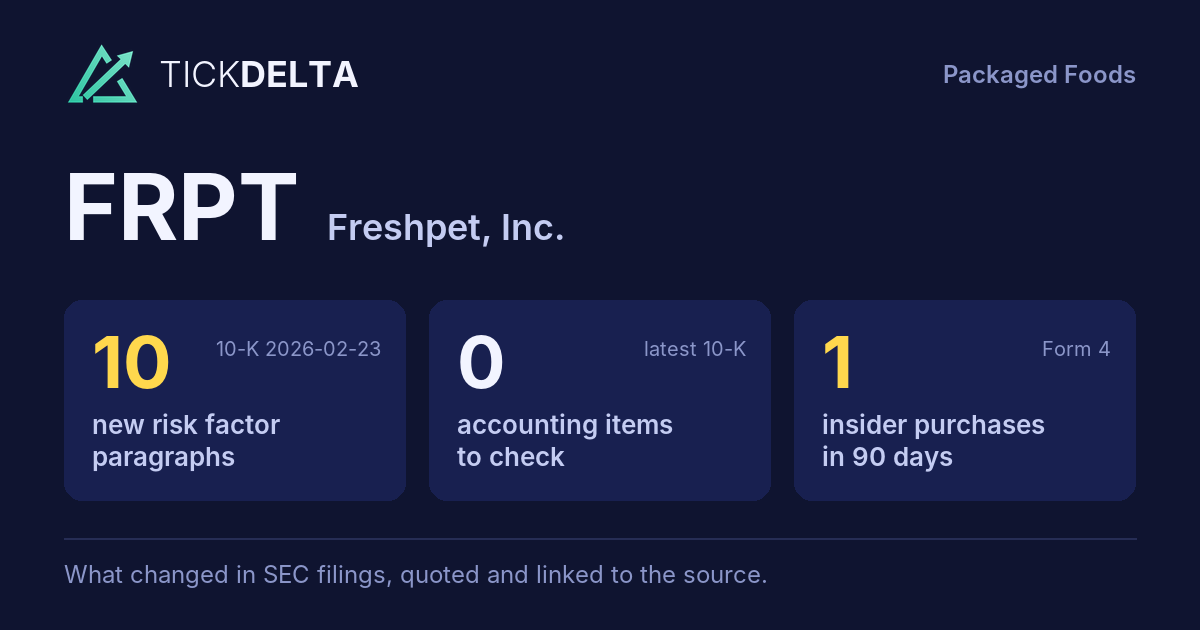
Paragraph 36 · 26% changed
Every version of it
Screener
/
SEC EDGAR
/CIK 0001611647
/10-K filed Feb 23, 2026, compared with Feb 20, 2025
/Numbers from the XBRL of the 10-Ks
Nasdaq
Consumer staples · Packaged Foods
Freshpet, Inc. FRPT
The 10-K against last year's
82 changes: 19 added, 10 removed, 50 reworded, 3 quiet changes
10-K Feb 23, 2026 vs Feb 20, 2025
Risk Factors
8.7%
of the text changed · 10,031 words now · 10 new paragraphs, 4 gone
MD&A
26.4%
of the text changed · 5,836 words now · 9 new paragraphs, 6 gone
Legal Proceedings
32.2%
of the text changed · 591 words now
Accounting Policies
12.7%
of the text changed · 3,742 words now
10-K 0001611647-26-000006 (Feb 23, 2026) vs 10-K 0001611647-25-000007 (Feb 20, 2025)
Every paragraph, and how much of it changed
One bar per paragraph, in the order of the 10-K. Height and colour show the share of its words not in the closest paragraph a year earlier; the tallest bars are new paragraphs.
Risk Factors
102 paragraphs · 10 new · 22 reworded · 4 gone · 10-K Feb 23, 2026 against Feb 20, 2025
New paragraph
Reworded (5% of its words or more)
Same or nearly
Paragraph 31 · 17% changed
Every version of it
Our ability to introduce new products and execute our growth strategy depends, in part, on our ability to successfully launch new proprietary technologies. If these technologies fail to perform as expected, we encounter unexpected difficulty training employees on use of these technologies, or we or our business partners are unable to implement these technologies in the time frame, at the cost, or with anticipated efficiencies and beneficial impact on product quality, our results of operations could be adversely affected. Because our ability to effectively implement price increases for our products can be affected by factors outside of our control, our profitability and growth depend significantly on our efforts to control our operating costs. Because As many of our costs, such as energy and logistics costs, packaging costs and ingredient, ingredients, commodity and raw product costs, are affected by factors outside or substantially outside our control, we generally must seek to control or reduce costs through operating efficiency or other initiatives. If we are not able to identify and complete initiatives designed to control or reduce costs and increase operating efficiency on time or within budget, our results of operations could be adversely impacted. In addition, if the cost savings initiatives we have implemented to date, or any future cost-savings initiatives, do not generate expected efficiencies and cost savings, our business, financial condition and results of operations could be adversely affected.
Paragraph 75 · 12% changed
Every version of it
Paragraph 73 · 11% changed
Every version of it
We are subject to environmental regulation and environmental risks, which may adversely affect our business. Climate change or evolving views or concerns regarding climate change may increase environmental regulation risks and environmental regulation of such risks.
Paragraph 27 · 9% changed
Every version of it
We have in the past and may in the future be exposed to product recalls, including voluntary recalls or withdrawals, and adverse public relations if our products are alleged to cause injury or illness or if we are alleged to have mislabeled or misbranded our products or otherwise violated governmental regulations. We may also voluntarily recall or withdraw products that we consider below our standards, whether for taste, appearance or otherwise, in order to protect our brand reputation. Consumer or customer concerns (whether justified or not) regarding the quality or safety of our products could adversely affect our business. Product recalls or withdrawals can result in substantial and unexpected expenditures, destruction of product inventory, and lost sales due to the unavailability of the product for a period of time, which could reduce profitability and cash flow. In addition, a product recall or withdrawal may require significant management attention. As an example, attention and result in June 2022 we initiated production delays, as was the case with a voluntary recall of a single lot of a particular brand due to potential salmonella contamination. Although product that we received no reports of harm to pets or their owners as a result of this potential contamination, this recall resulted initiated in production delays and significant diversion of management time to identify and remediate the issue. June 2022. Product recalls, product liability claims (even if unmerited or unsuccessful), or any other events that cause consumers to no longer associate our brands with high quality and safe products may also result in adverse publicity or legal challenges, hurt the value of our brands, lead to a decline in consumer confidence in and demand for our products, and lead to increased scrutiny, fines, or other penalties by federal and state regulatory agencies of our operations, which could have a material adverse effect on our business, financial condition and results of operations.
Paragraph 68 · 8% changed
Every version of it
We rely on unpatented proprietary know-how in the areas of recipes, ingredients sourcing, cooking techniques, packaging, transportation and delivery. It is possible that others will independently develop the same or similar know-how or otherwise obtain access to our proprietary know-how. To protect our trade secrets and other proprietary know-how, we require employees, consultants, advisors and collaborators to enter into confidentiality agreements. We cannot assure you that If these agreements will fail to provide meaningful protection in the event of any unauthorized use, misappropriation or disclosure of our trade secrets, know-how or other proprietary information. If we are unable to maintain the proprietary nature of information, our recipes, methods and other know-how, we business could be materially adversely affected.
Paragraph 61 · 8% changed
Every version of it
Manufacturing, processing, labeling, packaging, storing and distributing pet products are activities subject to extensive federal, state and local regulation, as well as foreign regulation. In the United States, these aspects of our operations are regulated by the FDA, and various state and local public health and agricultural agencies. The FDA Food Safety Modernization Act of 2011 provides direct recall authority to the FDA and includes a number of other provisions designed to enhance food safety, including increased inspections by the FDA of domestic and foreign food facilities and increased review of food products imported into the United States. In addition, many states have adopted the Association of American Feed Control Officials’ (AAFCO) model pet food regulations or variations thereof, which generally regulate the information manufacturers provide about pet food. Complying with government regulation regulation, including state by state adoption of AAFCO guidelines, can be costly or may otherwise adversely affect our business. Regulatory delays or uncertainty, including as a result of any government or regulator shutdown or defunding could impede our ability to manufacture and timely deliver our products. In addition, failure to comply with applicable laws and regulations could subject us to civil remedies, including fines, injunctions, recalls or seizures, as well as potential criminal sanctions, which could have a material adverse effect on our business, financial condition and results of operations. Both international regulations and state regulations have Extended Producer Responsibility (EPR) laws which do, and in the future, may impact our business. These EPR regulations require annual reporting and fees. Failure to pay these authorities in a timely manner can result in large penalties.
Paragraph 30 · 7% changed
Every version of it
We may not be able to successfully implement initiatives to improve productivity and product quality, to streamline operations operations, or to control or reduce costs. Failure to successfully implement such initiatives could adversely affect our results of operations.
Paragraph 36 · 26% changed
Every version of it
10-K Feb 20, 2025In February 2025, the new U.S. presidential administration announced the imposition of tariffs on imports from Canada, Mexico and China, and those countries subsequently announced retaliatory tariffs in response. Although the imposition of certain of these tariffs was temporarily stayed, the situation is dynamic, rapidly evolving and uncertain. If allowed to become or remain effective, these or any new or increased tariffs or resultant trade wars could have an adverse effect on us or on our suppliers, which could lead to significant increases in the costs of materials, and as a result could negatively impact our results of operations, cash flow and financial condition. New or increased tariffs could also negatively affect U.S national or regional economies or lead to increased inflation or a recession, which also could negatively impact our sales growth, and our business and results of operations.
10-K Feb 23, 2026
The U.S. presidential administration has in the past year announced the imposition of tariffs on imports from many countries, including but not limited to Canada, Mexico and China, and certain of those countries subsequently announced retaliatory tariffs in response, with citizens of several countries calling for boycotts of U.S. products. Although to date Freshpet has not experienced a material adverse impact on our business and results of operations as a result of such tariffs and foreign trade relations, we continue to monitor and assess their potential impact. These or any new or increased tariffs or resultant trade wars could have an adverse effect on us or on our suppliers, which could lead to significant increases in the costs of materials, and as a result could negatively impact our results of operations, cash flow and financial condition. New or increased tariffs could also negatively affect U.S national or regional economies or lead to increased inflation or a recession, which also could negatively impact our sales growth, and our business and results of operations.
Paragraph 31 · 17% changed
Every version of it
10-K Feb 20, 2025
Because our ability to effectively implement price increases for our products can be affected by factors outside of our control, our profitability and growth depend significantly on our efforts to control our operating costs. Because many of our costs, such as energy and logistics costs, packaging costs and ingredient, commodity and raw product costs, are affected by factors outside or substantially outside our control, we generally must seek to control or reduce costs through operating efficiency or other initiatives. If we are not able to identify and complete initiatives designed to control or reduce costs and increase operating efficiency on time or within budget, our results of operations could be adversely impacted. In addition, if the cost savings initiatives we have implemented to date, or any future cost-savings initiatives, do not generate expected cost savings, our business, financial condition and results of operations could be adversely affected.
10-K Feb 23, 2026
Our ability to introduce new products and execute our growth strategy depends, in part, on our ability to successfully launch new proprietary technologies. If these technologies fail to perform as expected, we encounter unexpected difficulty training employees on use of these technologies, or we or our business partners are unable to implement these technologies in the time frame, at the cost, or with anticipated efficiencies and beneficial impact on product quality, our results of operations could be adversely affected. Because our ability to effectively implement price increases for our products can be affected by factors outside of our control, our profitability and growth depend significantly on our efforts to control our operating costs. As many of our costs, such as energy and logistics costs, packaging costs and ingredients, commodity and raw product costs, are affected by factors outside or substantially outside our control, we generally must seek to control or reduce costs through operating efficiency or other initiatives. If we are not able to identify and complete initiatives designed to control or reduce costs and increase operating efficiency on time or within budget, our results of operations could be adversely impacted. In addition, if the cost savings initiatives we have implemented to date, or any future cost-savings initiatives, do not generate expected efficiencies and cost savings, our business, financial condition and results of operations could be adversely affected.
Paragraph 75 · 12% changed
Every version of it
10-K Feb 20, 2025For example, the long-term effects of global climate change present both physical risks (such as extreme weather conditions or rising sea levels) and transition risks (such as regulatory or technology changes), which are expected to be widespread and unpredictable. These changes could over time affect, for example, the availability and cost of products, commodities, including our ingredients, and energy (including utilities), which in turn may impact our ability to procure goods or services required for the operation of our business at the quantities and levels we require. Regulations limiting greenhouse gas emissions and energy inputs may also increase in coming years, which may increase our costs associated with compliance.
10-K Feb 23, 2026
The long-term effects of global climate change present both physical risks (such as extreme weather conditions or rising sea levels) and transition risks (such as regulatory or technology changes), which are expected to be widespread and unpredictable. These changes could over time affect, for example, the availability and cost of products, commodities, including our ingredients, and energy (including utilities), which in turn may impact our ability to procure goods or services required for the operation of our business at the quantities and levels we require. Although the current presidential administration has taken steps to reassess and scale back existing environmental regulation, future presidential administrations could adopt a different policy, in which case federal regulations limiting greenhouse gas emissions and energy inputs could increase in coming years, which may increase our costs associated with compliance.
Paragraph 73 · 11% changed
Every version of it
10-K Feb 20, 2025
We are subject to environmental regulation and environmental risks, which may adversely affect our business. Climate change or concerns regarding climate change may increase environmental regulation and environmental risks.
10-K Feb 23, 2026
We are subject to environmental regulation and environmental risks, which may adversely affect our business. Climate change or evolving views or concerns regarding climate change may increase environmental risks and environmental regulation of such risks.
Paragraph 27 · 9% changed
Every version of it
10-K Feb 20, 2025
We have in the past and may in the future be exposed to product recalls, including voluntary recalls or withdrawals, and adverse public relations if our products are alleged to cause injury or illness or if we are alleged to have mislabeled or misbranded our products or otherwise violated governmental regulations. We may also voluntarily recall or withdraw products that we consider below our standards, whether for taste, appearance or otherwise, in order to protect our brand reputation. Consumer or customer concerns (whether justified or not) regarding the quality or safety of our products could adversely affect our business. Product recalls or withdrawals can result in substantial and unexpected expenditures, destruction of product inventory, and lost sales due to the unavailability of the product for a period of time, which could reduce profitability and cash flow. In addition, a product recall or withdrawal may require significant management attention. As an example, in June 2022 we initiated a voluntary recall of a single lot of a particular brand due to potential salmonella contamination. Although we received no reports of harm to pets or their owners as a result of this potential contamination, this recall resulted in production delays and significant diversion of management time to identify and remediate the issue. Product recalls, product liability claims (even if unmerited or unsuccessful), or any other events that cause consumers to no longer associate our brands with high quality and safe products may also result in adverse publicity or legal challenges, hurt the value of our brands, lead to a decline in consumer confidence in and demand for our products, and lead to increased scrutiny, fines, or other penalties by federal and state regulatory agencies of our operations, which could have a material adverse effect on our business, financial condition and results of operations.
10-K Feb 23, 2026
We have in the past and may in the future be exposed to product recalls, including voluntary recalls or withdrawals, and adverse public relations if our products are alleged to cause injury or illness or if we are alleged to have mislabeled or misbranded our products or otherwise violated governmental regulations. We may also voluntarily recall or withdraw products that we consider below our standards, whether for taste, appearance or otherwise, in order to protect our brand reputation. Consumer or customer concerns (whether justified or not) regarding the quality or safety of our products could adversely affect our business. Product recalls or withdrawals can result in substantial and unexpected expenditures, destruction of product inventory, and lost sales due to the unavailability of the product for a period of time, which could reduce profitability and cash flow. In addition, a product recall or withdrawal may require significant management attention and result in production delays, as was the case with a voluntary recall of a single lot of product that we initiated in June 2022. Product recalls, product liability claims (even if unmerited or unsuccessful), or any other events that cause consumers to no longer associate our brands with high quality and safe products may also result in adverse publicity or legal challenges, hurt the value of our brands, lead to a decline in consumer confidence in and demand for our products, and lead to increased scrutiny, fines, or other penalties by federal and state regulatory agencies of our operations, which could have a material adverse effect on our business, financial condition and results of operations.
Paragraph 68 · 8% changed
Every version of it
10-K Feb 20, 2025
We rely on unpatented proprietary know-how in the areas of recipes, ingredients sourcing, cooking techniques, packaging, transportation and delivery. It is possible that others will independently develop the same or similar know-how or otherwise obtain access to our proprietary know-how. To protect our trade secrets and other proprietary know-how, we require employees, consultants, advisors and collaborators to enter into confidentiality agreements. We cannot assure you that these agreements will provide meaningful protection in the event of any unauthorized use, misappropriation or disclosure of our trade secrets, know-how or other proprietary information. If we are unable to maintain the proprietary nature of our recipes, methods and other know-how, we could be materially adversely affected.
10-K Feb 23, 2026
We rely on unpatented proprietary know-how in the areas of recipes, ingredients sourcing, cooking techniques, packaging, transportation and delivery. It is possible that others will independently develop the same or similar know-how or otherwise obtain access to our proprietary know-how. To protect our trade secrets and other proprietary know-how, we require employees, consultants, advisors and collaborators to enter into confidentiality agreements. If these agreements fail to provide meaningful protection in the event of any unauthorized use, misappropriation or disclosure of our trade secrets, know-how or other proprietary information, our business could be materially adversely affected.
Paragraph 61 · 8% changed
Every version of it
10-K Feb 20, 2025
Manufacturing, processing, labeling, packaging, storing and distributing pet products are activities subject to extensive federal, state and local regulation, as well as foreign regulation. In the United States, these aspects of our operations are regulated by the FDA, and various state and local public health and agricultural agencies. The FDA Food Safety Modernization Act of 2011 provides direct recall authority to the FDA and includes a number of other provisions designed to enhance food safety, including increased inspections by the FDA of domestic and foreign food facilities and increased review of food products imported into the United States. In addition, many states have adopted the Association of American Feed Control Officials’ model pet food regulations or variations thereof, which generally regulate the information manufacturers provide about pet food. Complying with government regulation can be costly or may otherwise adversely affect our business. Regulatory delays or uncertainty, including as a result of any government or regulator shutdown or defunding could impede our ability to manufacture and timely deliver our products. In addition, failure to comply with applicable laws and regulations could subject us to civil remedies, including fines, injunctions, recalls or seizures, as well as potential criminal sanctions, which could have a material adverse effect on our business, financial condition and results of operations.
10-K Feb 23, 2026
Manufacturing, processing, labeling, packaging, storing and distributing pet products are activities subject to extensive federal, state and local regulation, as well as foreign regulation. In the United States, these aspects of our operations are regulated by the FDA, and various state and local public health and agricultural agencies. The FDA Food Safety Modernization Act of 2011 provides direct recall authority to the FDA and includes a number of other provisions designed to enhance food safety, including increased inspections by the FDA of domestic and foreign food facilities and increased review of food products imported into the United States. In addition, many states have adopted the Association of American Feed Control Officials’ (AAFCO) model pet food regulations or variations thereof, which generally regulate the information manufacturers provide about pet food. Complying with government regulation, including state by state adoption of AAFCO guidelines, can be costly or may otherwise adversely affect our business. Regulatory delays or uncertainty, including as a result of any government or regulator shutdown or defunding could impede our ability to manufacture and timely deliver our products. In addition, failure to comply with applicable laws and regulations could subject us to civil remedies, including fines, injunctions, recalls or seizures, as well as potential criminal sanctions, which could have a material adverse effect on our business, financial condition and results of operations. Both international regulations and state regulations have Extended Producer Responsibility (EPR) laws which do, and in the future, may impact our business. These EPR regulations require annual reporting and fees. Failure to pay these authorities in a timely manner can result in large penalties.
Paragraph 30 · 7% changed
Every version of it
10-K Feb 20, 2025
We may not be able to successfully implement initiatives to improve productivity and streamline operations to control or reduce costs. Failure to implement such initiatives could adversely affect our results of operations.
10-K Feb 23, 2026
We may not be able to successfully implement initiatives to improve productivity and product quality, to streamline operations, or to control or reduce costs. Failure to successfully implement such initiatives could adversely affect our results of operations.
MD&A
98 paragraphs · 9 new · 37 reworded · 6 gone · 10-K Feb 23, 2026 against Feb 20, 2025
New paragraph
Reworded (5% of its words or more)
Same or nearly
Paragraph 58 · 43% changed
Our primary cash needs, in addition to our plant expansions, are for purchasing ingredients, operating expenses, marketing expenses and capital expenditures to procure Freshpet Fridges. We believe that cash and cash equivalents, expected cash flow from operations, amounts previously raised through the issuance of the Convertible Notes and our ability to access the capital markets, if appropriate, are adequate to fund our debt service requirements, operating and finance lease obligations, capital expenditures and working capital obligations for the foreseeable future. We believe our sources of liquidity and capital will be sufficient to finance our continued operations, growth strategy and additional expenses we expect to incur for at least the next twelve months. However, our ability to continue to meet these requirements and obligations will depend on, among other things, our ability to achieve anticipated levels of revenue and cash flow from operations and our ability to manage costs and working capital successfully. Additionally, our cash flow generation ability is subject to general economic factors at the international, national and regional levels, including but not limited to increased interest rates and inflation, tariffs, trade wars, recession, financial, competitive, legislative and regulatory factors and other factors that are beyond our control, including government or regulatory shutdowns or defunding, or disruptions with or increased costs imposed by our key suppliers or others within our supply chain. We cannot assure you that our business will generate cash flow from operations in an amount sufficient to enable us to fund our liquidity needs. Expanding certain of our Freshpet Kitchens primarily comprises our material future cash requirement. However, our capital requirements, including our cash requirements, may vary materially from those currently planned if, for example, our revenues do not reach expected levels, or we have to incur unforeseen capital expenditures and make investments to maintain our competitive position. If this is the case, we may seek alternative financing, such as issuing additional debt or equity securities, and we cannot assure you that we will be able to do so on favorable terms, if at all. Moreover, if we issue new debt securities, the debt holders would have rights senior to common stockholders to make claims on our assets, and the terms of any debt could restrict our operations, including our ability to pay dividends on our common stock. If we issue additional equity or if the Convertible Notes are converted to common shares, existing stockholders may experience dilution, and such new securities could have rights senior to those of our common stock. These factors may make the timing, amount, terms and conditions of additional financing unattractive. Our inability to raise capital could impede our growth or otherwise require us to forego growth opportunities and could materially adversely affect our business, financial condition and results of operations.
Paragraph 13 · 42% changed
Marketing & advertising. Our marketing and advertising expenses primarily consist of national television media, digital marketing, advertising, digital, and social media channels. Our digital efforts span a range of platforms and grass roots marketing to drive brand awareness. environments, including company and retail websites, retail media networks, search engines, blogs, and online reviews. These expenses may vary from quarter to quarter depending on the timing of our marketing and advertising campaigns. Our Feed the Growth initiative focuses on growing the business through increased marketing investments.
Paragraph 29 · 39% changed
Paragraph 60 · 39% changed
Paragraph 27 · 37% changed
Paragraph 30 · 35% changed
Net income increased $80.5 $92.2 million to net income of $46.9 $139.1 million for the year ended December 31, 2024 2025 as compared to a net loss income of $33.6 $46.9 million in the prior year, primarily due to contribution the deferred income tax benefit resulting from the release of the valuation allowance as a result of sustained profitability and the expected future profitability, and contributions from higher sales, improved gross margin, reduced logistics costs as a percentage of net sales, and gain on equity investment, partially offset by increased SG&A expenses. expenses, including increased media spend of $29.2 million and $17.7 million of non-recurring charges in 2025, compared to a $9.9 million gain on equity investment in the prior year.
Paragraph 54 · 31% changed
To meet our capital needs, we issued approximately $402.5 million in convertible notes in March 2023 (the "Convertible Notes"), used $66.2 million of the proceeds to enter into capped call transactions, and used $11.0 million of the proceeds on debt issuance related costs. Further, on March 13, 2023, in connection with the proposed offering of the Convertible Notes, the Company notified City National Bank of Freshpet's intent to terminate the Credit Agreement, and such termination became effective as of March 15, 2023 (the "Termination Date"). The Company had no borrowings outstanding under the Credit Agreement as of the Termination Date.
Paragraph 63 · 30% changed
Working capital consists of current assets net of current liabilities. Working capital remained consistent at increased $19.0 million to $357.1 for the year ended December 31, 2025 compared to working capital of $338.1 million at both for the year ended December 31, 2024 and 2023. Working capital remained consistent 2024, primarily as the increases consisting a result of an increase of $17.6 million in inventories, net, an increase of $11.7 million in accounts receivable, and an increase of $8.4 million in prepaid expenses were fully offset by a decrease of $28.2 $9.3 million in cash and cash equivalents, an increase of $6.4 $4.3 million in other current assets, and a decrease of $24.7 million in accrued expenses due to timing, as a result of decreased variable compensation accrual. The increase was partially offset by a decrease of $4.7 million in accounts receivable, a decrease of $4.0 million in inventories, net, a decrease of $6.2 million in prepaid expenses, an increase of $3.3 million in accounts payable, and an increase of $3.1 $1.1 million in accounts payable as a result of timing. lease liabilities.
Paragraph 58 · 43% changed
10-K Feb 20, 2025
Our primary cash needs, in addition to our plant expansions, are for purchasing ingredients, operating expenses, marketing expenses and capital expenditures to procure Freshpet Fridges. We believe that cash and cash equivalents, expected cash flow from operations, amounts previously raised through the issuance of the Convertible Notes and our ability to access the capital markets, if appropriate, are adequate to fund our debt service requirements, operating and finance lease obligations, capital expenditures and working capital obligations for the foreseeable future. We believe our sources of liquidity and capital will be sufficient to finance our continued operations, growth strategy and additional expenses we expect to incur for at least the next twelve months. However, our ability to continue to meet these requirements and obligations will depend on, among other things, our ability to achieve anticipated levels of revenue and cash flow from operations and our ability to manage costs and working capital successfully. Additionally, our cash flow generation ability is subject to general economic factors at the international, national and regional levels, including but not limited to increased interest rates and inflation, tariffs, trade wars, recession, financial, competitive, legislative and regulatory factors and other factors that are beyond our control, including government or regulatory shutdowns or defunding, or disruptions with or increased costs imposed by our key suppliers or others within our supply chain. We cannot assure you that our business will generate cash flow from operations in an amount sufficient to enable us to fund our liquidity needs. Expanding certain of our Freshpet Kitchens primarily comprises our material future cash requirement. However, our capital requirements, including our cash requirements, may vary materially from those currently planned if, for example, our revenues do not reach expected levels, or we have to incur unforeseen capital expenditures and make investments to maintain our competitive position. If this is the case, we may seek alternative financing, such as issuing additional debt or equity securities, and we cannot assure you that we will be able to do so on favorable terms, if at all. Moreover, if we issue new debt securities, the debt holders would have rights senior to common stockholders to make claims on our assets, and the terms of any debt could restrict our operations, including our ability to pay dividends on our common stock. If we issue additional equity or if the Convertible Notes are converted to common shares, existing stockholders may experience dilution, and such new securities could have rights senior to those of our common stock. These factors may make the timing, amount, terms and conditions of additional financing unattractive. Our inability to raise capital could impede our growth or otherwise require us to forego growth opportunities and could materially adversely affect our business, financial condition and results of operations.
10-K Feb 23, 2026
Our primary cash needs, in addition to our plant expansions, are for purchasing ingredients, operating expenses, marketing expenses and capital expenditures to procure Freshpet Fridges. We believe that cash and cash equivalents, expected cash flow from operations, amounts previously raised through the issuance of the Convertible Notes and our ability to access the capital markets, if appropriate, are adequate to fund our debt service requirements, operating and finance lease obligations, capital expenditures and working capital obligations for the foreseeable future. We believe our sources of liquidity and capital will be sufficient to finance our continued operations, growth strategy and additional expenses we expect to incur for at least the next twelve months. However, our ability to continue to meet these requirements and obligations will depend on, among other things, our ability to achieve anticipated levels of revenue and cash flow from operations and our ability to manage costs and working capital successfully.
Paragraph 13 · 42% changed
10-K Feb 20, 2025
Marketing & advertising. Our marketing and advertising expenses primarily consist of national television media, digital marketing, social media and grass roots marketing to drive brand awareness. These expenses may vary from quarter to quarter depending on the timing of our marketing and advertising campaigns. Our Feed the Growth initiative focuses on growing the business through increased marketing investments.
10-K Feb 23, 2026
Marketing & advertising. Our marketing and advertising expenses primarily consist of television advertising, digital, and social media channels. Our digital efforts span a range of platforms and environments, including company and retail websites, retail media networks, search engines, blogs, and online reviews. These expenses may vary from quarter to quarter depending on the timing of marketing and advertising campaigns.
Paragraph 29 · 39% changed
10-K Feb 20, 2025As a result of the factors discussed above, income from operations increased by $68.4 million to income from operations of $38.0 million for the year ended December 31, 2024 as compared to a loss from operations of $30.4 million for the prior year.
10-K Feb 23, 2026
Income tax benefit increased $69.0 million to $68.4 million for the year ended December 31, 2025 as compared to income tax expense of $0.6 million in the prior year. The increase is primarily due to the deferred income tax benefit resulting from the release of the valuation allowance in 2025, partially offset by deferred income tax expense.
Paragraph 60 · 39% changed
10-K Feb 20, 2025Our primary cash needs, in addition to our plant expansions, are for purchasing ingredients, operating expenses, marketing expenses and capital expenditures to procure Freshpet Fridges. We believe that cash and cash equivalents, expected cash flow from operations, amounts previously raised through the issuance of the Convertible Notes and our ability to access the capital markets, if appropriate, are adequate to fund our debt service requirements, operating and finance lease obligations, capital expenditures and working capital obligations for the foreseeable future. We believe our sources of liquidity and capital will be sufficient to finance our continued operations, growth strategy and additional expenses we expect to incur for at least the next twelve months. However, our ability to continue to meet these requirements and obligations will depend on, among other things, our ability to achieve anticipated levels of revenue and cash flow from operations and our ability to manage costs and working capital successfully. Additionally, our cash flow generation ability is subject to general economic factors at the international, national and regional levels, including but not limited to increased interest rates and inflation, tariffs, trade wars, recession, financial, competitive, legislative and regulatory factors and other factors that are beyond our control, including government or regulatory shutdowns or defunding, or disruptions with or increased costs imposed by our key suppliers or others within our supply chain. We cannot assure you that our business will generate cash flow from operations in an amount sufficient to enable us to fund our liquidity needs. Expanding certain of our Freshpet Kitchens primarily comprises our material future cash requirement. However, our capital requirements, including our cash requirements, may vary materially from those currently planned if, for example, our revenues do not reach expected levels, or we have to incur unforeseen capital expenditures and make investments to maintain our competitive position. If this is the case, we may seek alternative financing, such as issuing additional debt or equity securities, and we cannot assure you that we will be able to do so on favorable terms, if at all. Moreover, if we issue new debt securities, the debt holders would have rights senior to common stockholders to make claims on our assets, and the terms of any debt could restrict our operations, including our ability to pay dividends on our common stock. If we issue additional equity or if the Convertible Notes are converted to common shares, existing stockholders may experience dilution, and such new securities could have rights senior to those of our common stock. These factors may make the timing, amount, terms and conditions of additional financing unattractive. Our inability to raise capital could impede our growth or otherwise require us to forego growth opportunities and could materially adversely affect our business, financial condition and results of operations.
10-K Feb 23, 2026
Expanding certain of our Freshpet Kitchens primarily comprises our material future cash requirement. The Company reduced its capital expenditures for manufacturing expansion during 2025, reflecting both a moderation in demand and significant operational efficiencies. These changes are expected to materially improve near-term cash flow and reduce the capital intensity of the business, while maintaining flexibility to scale as market conditions evolve. However, our capital requirements, including our cash requirements, may vary materially from those currently planned if, for example, our revenues do not reach expected levels, or we have to incur unforeseen capital expenditures and make investments to maintain our competitive position. If this is the case, we may seek alternative financing, such as issuing additional debt or equity securities, and we cannot assure you that we will be able to do so on favorable terms, if at all. Moreover, if we issue new debt securities, the debt holders would have rights senior to common stockholders to make claims on our assets, and the terms of any debt could restrict our operations, including our ability to pay dividends on our common stock. If we issue additional equity or if the Convertible Notes are converted to common shares, existing stockholders may experience dilution, and such new securities could have rights senior to those of our common stock. These factors may make the timing, amount, terms and conditions of additional financing unattractive.
Paragraph 27 · 37% changed
10-K Feb 20, 2025As a result of the factors discussed above, income from operations increased by $68.4 million to income from operations of $38.0 million for the year ended December 31, 2024 as compared to a loss from operations of $30.4 million for the prior year.
10-K Feb 23, 2026
Interest expense increased $1.9 million to $14.1 million for the year ended December 31, 2025 as compared to $12.3 million in the prior year. The increase was primarily driven by a $1.6 million decrease in capitalized interest compared to the prior year period as a result of assets placed into service.
Paragraph 30 · 35% changed
10-K Feb 20, 2025
Net income increased $80.5 million to net income of $46.9 million for the year ended December 31, 2024 as compared to a net loss of $33.6 million in the prior year, primarily due to contribution from higher sales, improved gross margin, reduced logistics costs as a percentage of net sales, and gain on equity investment, partially offset by increased SG&A expenses.
10-K Feb 23, 2026
Net income increased $92.2 million to net income of $139.1 million for the year ended December 31, 2025 as compared to net income of $46.9 million in the prior year, due to the deferred income tax benefit resulting from the release of the valuation allowance as a result of sustained profitability and the expected future profitability, and contributions from higher sales, partially offset by increased SG&A expenses, including increased media spend of $29.2 million and $17.7 million of non-recurring charges in 2025, compared to a $9.9 million gain on equity investment in the prior year.
Paragraph 54 · 31% changed
10-K Feb 20, 2025
To meet our capital needs, we issued approximately $402.5 million in convertible notes in March 2023 (the "Convertible Notes"), used $66.2 million of the proceeds to enter into capped call transactions, and used $11.0 million of the proceeds on debt issuance related costs. Further, on March 13, 2023, in connection with the proposed offering of the Convertible Notes, the Company notified City National Bank of Freshpet's intent to terminate the Credit Agreement, and such termination became effective as of March 15, 2023 (the "Termination Date"). The Company had no borrowings outstanding under the Credit Agreement as of the Termination Date.
10-K Feb 23, 2026
To meet our capital needs, we issued approximately $402.5 million in convertible notes in March 2023 (the "Convertible Notes"), used $66.2 million of the proceeds to enter into capped call transactions, and used $11.0 million of the proceeds on debt issuance related costs.
Paragraph 63 · 30% changed
10-K Feb 20, 2025
Working capital consists of current assets net of current liabilities. Working capital remained consistent at $338.1 million at both December 31, 2024 and 2023. Working capital remained consistent as the increases consisting of an increase of $17.6 million in inventories, net, an increase of $11.7 million in accounts receivable, and an increase of $8.4 million in prepaid expenses were fully offset by a decrease of $28.2 million in cash and cash equivalents, an increase of $6.4 million in accrued expenses due to timing, and an increase of $3.1 million in accounts payable as a result of timing.
10-K Feb 23, 2026
Working capital consists of current assets net of current liabilities. Working capital increased $19.0 million to $357.1 for the year ended December 31, 2025 compared to working capital of $338.1 million for the year ended December 31, 2024, primarily as a result of an increase of $9.3 million in cash and cash equivalents, an increase of $4.3 million in other current assets, and a decrease of $24.7 million in accrued expenses as a result of decreased variable compensation accrual. The increase was partially offset by a decrease of $4.7 million in accounts receivable, a decrease of $4.0 million in inventories, net, a decrease of $6.2 million in prepaid expenses, an increase of $3.3 million in accounts payable, and an increase of $1.1 million in lease liabilities.
A paragraph is matched with the one last year that shares the most of its words; under half in common makes it new. The paragraphs shown are the 8 reworded the most in each section.
The paragraph that changed most in each section
The redline
Marked against last year's 10-K: cut words struck through, new words highlighted.
MD&A308 words changed in this paragraph; it is 50% similar to last year's version.
Our primary cash needs, in addition to our plant expansions, are for purchasing ingredients, operating expenses, marketing expenses and capital expenditures to procure Freshpet Fridges. We believe that cash and cash equivalents, expected cash flow from operations, amounts previously raised through the issuance of the Convertible Notes and our ability to access the capital markets, if appropriate, are adequate to fund our debt service requirements, operating and finance lease obligations, capital expenditures and working capital obligations for the foreseeable future. We believe our sources of liquidity and capital will be sufficient to finance our continued operations, growth strategy and additional expenses we expect to incur for at least the next twelve months. However, our ability to continue to meet these requirements and obligations will depend on, among other things, our ability to achieve anticipated levels of revenue and cash flow from operations and our ability to manage costs and working capital successfully. Additionally, our cash flow generation ability is subject to general economic factors at the international, national and regional levels, including but not limited to increased interest rates and inflation, tariffs, trade wars, recession, financial, competitive, legislative and regulatory factors and other factors that are beyond our control, including government or regulatory shutdowns or defunding, or disruptions with or increased costs imposed by our key suppliers or others within our supply chain. We cannot assure you that our business will generate cash flow from operations in an amount sufficient to enable us to fund our liquidity needs. Expanding certain of our Freshpet Kitchens primarily comprises our material future cash requirement. However, our capital requirements, including our cash requirements, may vary materially from those currently planned if, for example, our revenues do not reach expected levels, or we have to incur unforeseen capital expenditures and make investments to maintain our competitive position. If this is the case, we may seek alternative financing, such as issuing additional debt or equity securities, and we cannot assure you that we will be able to do so on favorable terms, if at all. Moreover, if we issue new debt securities, the debt holders would have rights senior to common stockholders to make claims on our assets, and the terms of any debt could restrict our operations, including our ability to pay dividends on our common stock. If we issue additional equity or if the Convertible Notes are converted to common shares, existing stockholders may experience dilution, and such new securities could have rights senior to those of our common stock. These factors may make the timing, amount, terms and conditions of additional financing unattractive. Our inability to raise capital could impede our growth or otherwise require us to forego growth opportunities and could materially adversely affect our business, financial condition and results of operations.
Source: Item 7, 10-K 0001611647-26-000006 vs Item 7, 10-K 0001611647-25-000007
Accounting Policies152 words changed in this paragraph; it is 30% similar to last year's version.
In November 2023, September 2025, the Financial Accounting Standards Board ("FASB") FASB issued ASU 2023-07, Segment Reporting (Topic 280): 2025-06, Intangibles—Goodwill and Other—Internal-Use Software (Subtopic 350-40): Targeted Improvements to Reportable Segment Disclosures the Accounting for Internal-Use Software, which amends certain aspects of the accounting for software costs, including removing software development project stages and requiring companies to improve reportable segment disclosure requirements, primarily through enhanced disclosures about significant segment expenses. capitalize software costs when both of the following occur: (1) management authorizes or commits to funding a software project and (2) it is probable that the project will be completed and the software will be used to perform the function intended. This guidance is will be effective for the Company for the current annual report for the fiscal year ending December 31, 2024 and subsequent 2028, including the interim periods within that fiscal year, with early adoption permitted. The guidance can be applied prospectively, retrospectively, or utilizing a modified transition approach. The Company is currently evaluating the provisions of this guidance and the Company has adopted the guidance as of the effective date. its effect on its future consolidated financial statements.
Source: Item 8, Note 1 – Summary of Significant Accounting Policies:, 10-K 0001611647-26-000006 vs Item 8, Note 1 – Summary of Significant Accounting Policies:, 10-K 0001611647-25-000007
Risk Factors85 words changed in this paragraph; it is 77% similar to last year's version.
Our ability to introduce new products and execute our growth strategy depends, in part, on our ability to successfully launch new proprietary technologies. If these technologies fail to perform as expected, we encounter unexpected difficulty training employees on use of these technologies, or we or our business partners are unable to implement these technologies in the time frame, at the cost, or with anticipated efficiencies and beneficial impact on product quality, our results of operations could be adversely affected. Because our ability to effectively implement price increases for our products can be affected by factors outside of our control, our profitability and growth depend significantly on our efforts to control our operating costs. Because As many of our costs, such as energy and logistics costs, packaging costs and ingredient, ingredients, commodity and raw product costs, are affected by factors outside or substantially outside our control, we generally must seek to control or reduce costs through operating efficiency or other initiatives. If we are not able to identify and complete initiatives designed to control or reduce costs and increase operating efficiency on time or within budget, our results of operations could be adversely impacted. In addition, if the cost savings initiatives we have implemented to date, or any future cost-savings initiatives, do not generate expected efficiencies and cost savings, our business, financial condition and results of operations could be adversely affected.
Source: Item 1A, 10-K 0001611647-26-000006 vs Item 1A, 10-K 0001611647-25-000007
Legal Proceedings63 words changed in this paragraph; it is 39% similar to last year's version.
Discovery in this action has closed. The parties are currently waiting for a new trial date and a ruling A hearing was held on Phillips December 4, 2024 with respect to Phillips' Motion for Partial Summary Judgment ("MSJ") following the reassignment of the case to a new judge on October 2, 2024. A joint status report was submitted to the new Judge on October 25, 2024 and a hearing on the MSJ and the Company's Response in Opposition was held December 4, 2024. thereto.
Source: Item 3, via Note 10 – Commitments and Contingencies:, 10-K 0001611647-26-000006 vs Item 3, via Note 10 – Commitments and Contingencies, 10-K 0001611647-25-000007
Sentences and paragraphs added, removed or reworded
Every change, by type
Sentences and paragraphs of FRPT's Risk Factors and MD&A, 10-K Feb 23, 2026 against 10-K Feb 20, 2025. Each links to the text at sec.gov.
Quiet changes are sentences kept from last year with one to four words changed, at least one of them a hedge, a modal or a qualifier (may, could, will, not, significant, material…). A year or date rolling forward is not counted.
The full word list
adverse, adversely, all, although, anticipate, anticipates, any, approximately, believe, believes, can, cannot, certain, could, expect, expects, generally, however, if, intend, intends, largely, likely, many, material, materially, may, might, most, must, never, no, not, possible, primarily, probable, should, significant, significantly, some, substantial, substantially, unlikely, will, would
AddedRisk Factors
Our increasing use of artificial intelligence ("AI") technologies presents operations, legal, ethical and reputational risks that could adversely affect our business.
Read it in 10-K Feb 23, 2026 at sec.gov
AddedRisk Factors
We use and plan to increase our use of AI across multiple parts of the business, including in our manufacturing process. While AI technologies offer efficiencies and performance improvements, their adoption can present significant risks with respect to data quality, reliability and bias, cybersecurity and data security, intellectual property, regulatory and reputational risk.
Read it in 10-K Feb 23, 2026 at sec.gov
AddedRisk Factors
AI outputs depend on the quality, representativeness and timeliness of the training data and prompts. Errors, 'hallucinations', model drift or degraded performance can lead to faulty decisions, product defects or inaccurate consumer-facing content. Detection and remediation can be costly and time-consuming and may not be successful. Additionally, any outputs or efficiencies generated by AI, including with respect to our manufacturing process, could potentially infringe third party intellectual property or create inventions or content that is not capable of protection under intellectual property laws. AI systems can also produce biased or discriminatory outcomes which may be inconsistent with applicable laws, intent or expectations, or be otherwise inconsistent with our stated policies.
Read it in 10-K Feb 23, 2026 at sec.gov
AddedRisk Factors
Increased adoption of AI within Freshpet's operations can amplify cyber risk across our systems and create new opportunities for bad actors to test and exploit system vulnerabilities, which could result in a cyber security incident or otherwise compromise data security. A security incident involving AI inputs, outputs or model artifacts could result in regulatory scrutiny, litigation and reputational harm. Training or deploying AI within our systems may involve the collection or processing of personal information. If our controls are ineffective or insufficient, we could face regulatory investigations, fines, private litigation or loss of public trust. Furthermore, the legal framework governing AI is rapidly evolving across international, federal and state jurisdictions and such regulations may impose restrictions relating to risk assessments, documentation, human oversight and use. New or expanded obligations or limitations on our ability to use AI could increase costs, limit certain features or necessitate changes in our data practices or supply chain, and any violation of such regulations could adversely affect our business, reputation, and results of operations.
Read it in 10-K Feb 23, 2026 at sec.gov
AddedRisk Factors
These and similar risks related to rapidly evolving adoption of AI technology by us or third parties on whom we rely could result in litigation and remediation may require costly re-engineering, additional human review or curtailing certain uses, which could result in decreased operational efficiencies and increased costs.
Read it in 10-K Feb 23, 2026 at sec.gov
AddedRisk Factors
As of December 31, 2025, we had federal net operating loss (“NOLs”) carryforwards of approximately $391.1 million and state NOLs of approximately $275.4 million available to offset future taxable income. Our ability to utilize these NOLs may be limited under Section 382 ("Section 382") of the U.S. Internal Revenue Code of 1986, as amended (the "Code"), which restricts the use of pre-change NOLs following an "ownership change." An ownership change generally occurs when the ownership of 5% shareholders increases by more than 50 percentage points over a three‑year testing period. The annual limitation is determined, in part, by the value of the company immediately prior to the ownership change and the applicable federal long‑term tax‑exempt rate.
Read it in 10-K Feb 23, 2026 at sec.gov
AddedRisk Factors
We have completed several Section 382 analyses in prior years, which concluded that limitations apply. We have incorporated those limitations into the NOL carryforwards we expect to utilize in future periods. However, additional ownership changes can occur based on market trading activity outside our control, and future transactions or fluctuations in the ownership of 5% shareholders could trigger additional limitations. Such limitations may materially restrict our ability to use our NOLs and could cause some NOLs to expire unused, adversely affecting our financial condition.
Read it in 10-K Feb 23, 2026 at sec.gov
AddedRisk Factors
Section 382 calculations are inherently complex and require ongoing monitoring, including periodic analysis of testing dates, movements in 5% shareholders, and constructive‑ownership rules. Future analyses may differ from prior conclusions.
Read it in 10-K Feb 23, 2026 at sec.gov
Show the other 48
AddedRisk Factors
In addition, (i) NOLs generated in taxable years beginning after December 31, 2017 are limited to offsetting 80% of taxable income in taxable years beginning after December 31, 2020, and (ii) NOLs generated in taxable years beginning after December 31, 2020 may not be carried back to prior taxable years. State NOLs are also subject to separate limitations and may not be available to offset income in other jurisdictions.
Read it in 10-K Feb 23, 2026 at sec.gov
AddedRisk Factors
If these limitations apply, we may not be able to realize the full value of our NOLs, which could result in increased tax liabilities and potential valuation allowances in future periods.
Read it in 10-K Feb 23, 2026 at sec.gov
RemovedRisk Factors
RemovedRisk Factors
RemovedRisk Factors
RemovedRisk Factors
RewordedRisk Factors
RewordedRisk Factors
RewordedRisk Factors
RewordedRisk Factors
Additionally, the growth of crops, as well as the manufacture raising of cattle, and the manufacturing and processing of our products, requires all require significant amounts of water.
Read it in 10-K Feb 23, 2026 at sec.gov
RewordedRisk Factors
Our brand names and trademarks are important to our business, and we have registered or applied to register many of these trademarks. trademarks, but have no assurance that our trademark applications will be approved.
Read it in 10-K Feb 23, 2026 at sec.gov
RewordedRisk Factors
Prices for these and other items we use may be volatile, and we may experience shortages in these items due to factors beyond our control, such as commodity market, market pricing, availability of supply, increased demand (whether for the item we require or for other items, which in turn impacts the item we require), shortages of agricultural workers (including due to U.S. immigration policies); weather conditions, natural disasters, animal disease outbreaks (such as HPAI), pestilence, operational disruption, financial distress or insolvency of key suppliers or other third parties on whom we or they rely, the effects of climate change, currency fluctuations, tariffs or trade wars, inflationary and/or interest rate pressures, governmental regulations (including import restrictions), sustained government or regulatory shutdowns, regulatory uncertainty or delays, agricultural programs or issues, energy programs, geopolitical concerns, including the ongoing conflict between Ukraine and Russia, global geopolitical conflict, labor strikes and the financial health of our suppliers.
Read it in 10-K Feb 23, 2026 at sec.gov
RewordedRisk Factors
The ingredients that we use in the production of our products (including, among others, (such as meat and poultry products, vegetables, fruits, carrageenans, and whole grains, vitamins and minerals) grains) are vulnerable to adverse weather conditions and natural disasters, such as floods, droughts, frosts, fires, earthquakes, tornadoes, livestock disease such as avian influenza and pestilences.
Read it in 10-K Feb 23, 2026 at sec.gov
RewordedRisk Factors
Drought or other causes of a reduction of water in aquifers may affect availability of water, which in turn may adversely affect the cost of beef, vegetables and fruits, as well as our results of operations.
Read it in 10-K Feb 23, 2026 at sec.gov
RewordedRisk Factors
Complying with government regulation regulation, including state by state adoption of AAFCO guidelines, can be costly or may otherwise adversely affect our business.
Read it in 10-K Feb 23, 2026 at sec.gov
RewordedRisk Factors
RewordedRisk Factors
Climate change or evolving views or concerns regarding climate change may increase environmental regulation risks and environmental regulation of such risks.
Read it in 10-K Feb 23, 2026 at sec.gov
RewordedRisk Factors
Customers may become more conservative in response to these conditions and seek to reduce their inventories. inventories in response to consumer behavior.
Read it in 10-K Feb 23, 2026 at sec.gov
Quiet changesRisk Factors
In addition, any tariffs imposed by the new U.S. presidential administration or retaliatory tariffs announced by other countries could result in a trade war.
Read it in 10-K Feb 23, 2026 at sec.gov
Quiet changesRisk Factors
AddedMD&A
At December 31, 2024, the Company determined that a full valuation allowance against its $98.5 million of net deferred tax assets was appropriate. At December 31, 2025, the Company concluded that it was appropriate to release a majority of the valuation allowance against the $71.4 million of deferred tax assets recorded as of that date based on the weight of available evidence, which now supports the conclusion that it is more likely than not that the majority of deferred tax assets will be realized. Based on sustained profitability, including three-year cumulative income before taxes of $76.9 million, excluding the prior year gain on our equity investment, the significant deferred tax liabilities expected to reverse in future periods, and the projections of future taxable income sufficient to fully utilize the Company's federal and state NOLs, the positive evidence supporting the release of most of the valuation allowance outweighed the negative evidence supporting a full valuation allowance. As a result, we recognized a deferred income tax benefit of $68.8 million for the year ended December 31, 2025.
Read it in 10-K Feb 23, 2026 at sec.gov
AddedMD&A
(b)Represents a non-recurring loss as a result of an accounts receivable write-off in connection with the liquidation of one of our pet specialty distributors. Concurrent with its liquidation, we transitioned to a new distribution partner, who is a leading pet specialty distributor and who we anticipate will facilitate sales to pet specialty stores. Thus, despite the transitory impact during the first quarter of 2025, our ability to continue to generate sales is consistent with what we would expect to generate within the pet specialty channel.
Read it in 10-K Feb 23, 2026 at sec.gov
AddedMD&A
(c)Represents the net settlement charges for all claims related to the litigation with Phillips.
Read it in 10-K Feb 23, 2026 at sec.gov
AddedMD&A
(d)Represents termination costs due to a business change in our international go-to-market strategy.
Read it in 10-K Feb 23, 2026 at sec.gov
AddedMD&A
Additionally, our cash flow generation ability is subject to general economic factors at the international, national and regional levels, including but not limited to increased interest rates and inflation, tariffs, trade wars, recession, financial, competitive, legislative and regulatory factors and other factors that are beyond our control, including government or regulatory shutdowns or defunding, or disruptions with or increased costs imposed by our key suppliers or others within our supply chain. Further, such macroeconomic factors could negatively impact consumer sentiment, resulting in reduced demand and changes in purchasing behaviors for some or all of our products and other relevant factors, such as consumer hesitancy to trade up in pet food, deferral of pet-related expenses, and reduced pet adoption rates. While these factors are expected to persist in the near term, the Company has implemented strategic initiatives, including targeted marketing, value-focused product innovation, and expanded distribution in club and mass channels, to mitigate their impact. Management believes these actions will support continued growth and margin expansion, even if the current economic environment remains unchanged. We cannot assure you that our business will generate cash flow from operations in an amount sufficient to enable us to fund our liquidity needs.
Read it in 10-K Feb 23, 2026 at sec.gov
AddedMD&A
Our inability to raise capital could impede our growth or otherwise require us to forego growth opportunities and could materially adversely affect our business, financial condition and results of operations.
Read it in 10-K Feb 23, 2026 at sec.gov
RemovedMD&A
RemovedMD&A
RemovedMD&A
RemovedMD&A
RemovedMD&A
RemovedMD&A
RewordedMD&A
Year Ended December 31, 2025 2024 2023 2022 (Dollars in thousands) Net income (loss) $ 139,137 $ 46,925 $ (33,614) $ (59,494) Depreciation and amortization 86,872 70,803 57,058 34,555 Interest expense, net of interest income 4,887 335 1,069 5,208 Income tax (benefit) expense (68,364) 598 210 282 EBITDA 162,532 118,661 24,723 (19,449) Gain on equity investment (9,918) — — Non-cash share-based compensation (a) 13,883 51,807 24,936 Loss on disposal of property, plant and equipment 1,630 1,284 4,321 396 Non-cash share-based compensation (a) 51,807 24,936 26,092 Distributor transition costs (b) 10,680 — — Legal obligation (c) 5,703 — — International business charges (d) 1,273 — — Gain on equity investment — (9,918) — Loss on equity method investment — — 1,890 3,731 Enterprise Resource Planning (b) — — 2,457 8,558 Capped Call Transactions fees (c) — — 113 — Shareholder activism defense engagement (d) — — 8,177 — Organization changes (e) — — (67) 734 Adjusted EBITDA $ 195,701 $ 161,834 $ 66,550 $ 20,062 Adjusted EBITDA as a % of Net Sales 17.8 % 16.6 % 8.7 % 3.4 %
Read it in 10-K Feb 23, 2026 at sec.gov
RewordedMD&A
Year Ended December 31, 2025 2024 2023 2022 (Dollars in thousands) SG&A expenses $ 373,954 $ 357,957 $ 281,318 $ 238,016 Depreciation and amortization expense 25,446 21,747 15,849 13,781 Non-cash share-based compensation (a) 10,805 44,046 13,941 18,799 Loss on disposal of equipment 610 588 774 396 Distributor transition costs (b) 10,680 — — Legal obligation (c) 5,703 — — International business charges (d) 1,273 — — Enterprise Resource Planning (b) — — 2,457 8,558 Capped Call Transactions fees (c) — — 113 — Shareholder activism defense engagement (d) — — 8,177 — Organization changes (e) — — (67) 734 Adjusted SG&A Expenses $ 319,437 $ 291,576 $ 240,074 $ 195,748 Adjusted SG&A Expenses as a % of Net Sales 29.0 % 29.9 % 31.3 % 32.9 %
Read it in 10-K Feb 23, 2026 at sec.gov
RewordedMD&A
Adjusted EBITDA represents EBITDA less gain on equity investment, plus loss on equity method investment, non-cash share-based compensation expense, implementation and other costs associated with the implementation of an ERP system, loss on disposal of property, plant and equipment, fees related to the Capped Call Transactions, advisory fees related to activism engagement, distributor transition costs, legal obligation, and organizational changes. international business charges.
Read it in 10-K Feb 23, 2026 at sec.gov
RewordedMD&A
RewordedMD&A
RewordedMD&A
RewordedMD&A
Adjusted SG&A for the year ended December 31, 2024, 2025, was $319.4 million, or 29.0% as a percentage of net sales, compared to $291.6 million, or 29.9% as a percentage of net sales, compared to $240.1 million, or 31.3% as a percentage of net sales, for in the prior year.
Read it in 10-K Feb 23, 2026 at sec.gov
RewordedMD&A
RewordedMD&A
RewordedMD&A
RewordedMD&A
Adjusted EBITDA was $161.8 million, or 16.6% as a percentage of net sales, $195.7 million for the year ended December 31, 2024, 2025, compared to $66.6 $161.8 million, or 8.7% as a percentage of net sales, in the prior year.
Read it in 10-K Feb 23, 2026 at sec.gov
RewordedMD&A
The $126.8 million increase in net sales increases were was driven by year-over-year growth in the Grocery, Mass, International International, and Digital channel of $158.5 million and $138.6 million in 2024 and 2023, respectively, $92.2 million, with the remaining growth in the Pet Specialty and Club channel.
Read it in 10-K Feb 23, 2026 at sec.gov
Quiet changesMD&A
Our products are primarily sold to consumers through a fast-growing network of company-owned branded refrigerators, known as Freshpet Fridges, located in our customers’ stores.
Read it in 10-K Feb 23, 2026 at sec.gov
Sources
The two latest 10-Ks on EDGAR, section by section. Each change links to the text at sec.gov.
Also
New risk factors: paragraphs with nothing like them last year, quoted in full.
Work with it
Excel workbook · CSV. Google Sheet that stays up to date: paste =IMPORTDATA("https://tickdelta.com/company/FRPT/export.csv") into a cell.