tickdelta
Sign in

Tickdelta is free for now. Sign up and get Pro free

← Screener

FRTFederal Realty Investment Trust

Real estate · REIT · NYSE
Compare with peers → Embed
SEC comment letters, last 20 years

4 reviews of FRT's filings by SEC staff

UPLOAD and CORRESP
ReviewsRead ↓
4
latest letter 2013-04-15
Questions asked
34
each answered in the company's own letter
No closing letter
0
reviews without a letter saying the staff completed it

When the SEC's staff reviews a filing, it writes to the company with numbered questions, and the company answers each one in a letter. SEC publishes the exchange once the review is over, at least 20 business days later. A question is not an accusation; most reviews end with the company adding detail to its next filing.

Form 10-K for the year ended December 31, 2012

2013-04-15 to 2013-05-13 · 4 questions · 1 letter from the SEC, 1 from the company
Review closed 2013-05-13
LeasesResults discussion (MD&A)DebtRevenueLegal and contingencies
Item 2. Properties · Lease Rollovers, page 17
SEC asked (1)
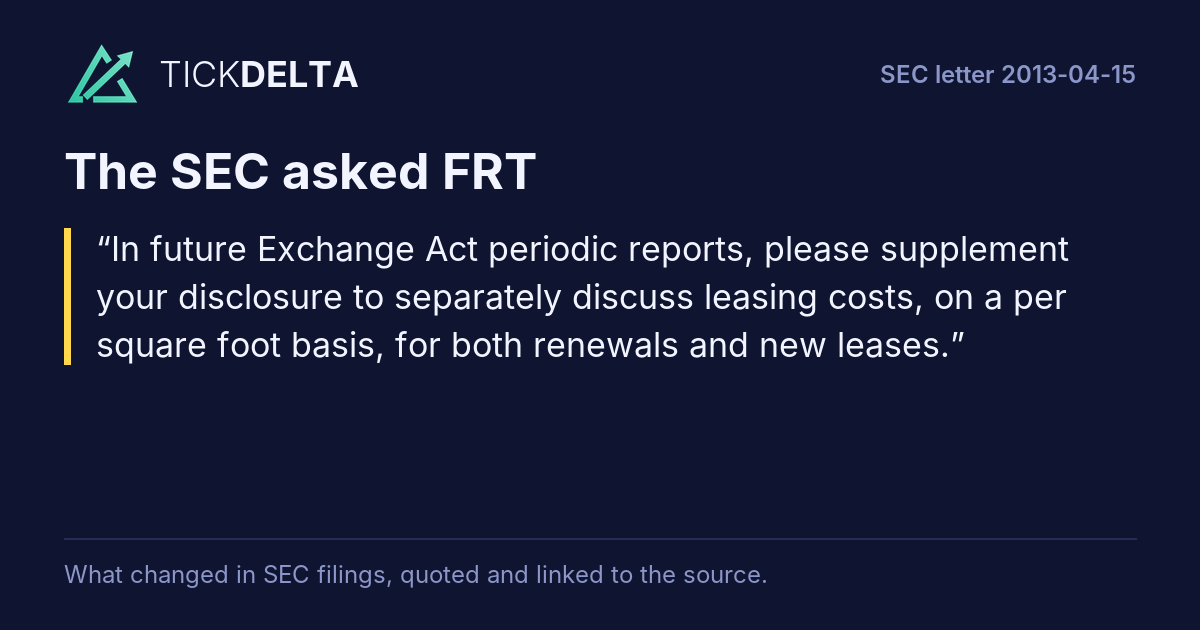
In future Exchange Act periodic reports, please supplement your disclosure to separately discuss leasing costs, on a per square foot basis, for both renewals and new leases.
FRT answered
In future filings, we will include disclosure regarding leasing costs, on a per square foot basis, for both renewals and new leases. Read in the reply ↗
In its next report

First report after the company's reply of 2013-04-19: 10-Q filed 2013-05-01 ↗, against the 10-Q filed 2012-11-01 ↗.

Tickdelta does not hold the text of both reports, so they are not compared here.

Item 7. Management’s Discussion and Analysis of Financial Condition.., page 28 · 2012 Significant Equity and Debt Transactions and Subsequent Event, page 32
SEC asked (2)
We note that your ATM offering program generated $104.46 million in net proceeds. In addition to this information, please also disclose in future Exchange Act periodic reports any additional offering expenses.
FRT answered
In future filings, we will disclose additional offering expenses of our ATM program. Read in the reply ↗
In its next report

First report after the company's reply of 2013-04-19: 10-Q filed 2013-05-01 ↗, against the 10-Q filed 2012-11-01 ↗.

Tickdelta does not hold the text of both reports, so they are not compared here.

Year Ended December 31, 2012 Compared to Year Ended December 31, 2011 · Property Revenues, page 35
SEC asked (3)
In future Exchange Act periodic reports, please expand your disclosure regarding period to period changes in property revenues to disaggregate the relative impact of occupancy changes and rental rent changes.
FRT answered
In future filings, we will expand our disclosure to disaggregate between relative occupancy and rental rate change impacts. Read in the reply ↗
In its next report

First report after the company's reply of 2013-04-19: 10-Q filed 2013-05-01 ↗, against the 10-Q filed 2012-11-01 ↗.

Tickdelta does not hold the text of both reports, so they are not compared here.

Financial Statements · Note 9. Commitments and Contingencies, page F-23
SEC asked (4)
We note your disclosure relating to your obligation under certain put option agreements. Please tell us where these obligations have been recorded in your consolidated financial statements and the amounts recorded.
FRT answered
At December 31, 2012, the obligations under our put option agreements are recorded in Capital Lease Obligations for $55.8 million and Redeemable Noncontrolling Interests for $94.4 million.

The Company acknowledges that:

— the Company is responsible for the adequacy and accuracy of the disclosure in the filing;

staff comments or changes to disclosure in response to staff comments do not foreclose the Commission from taking any action with respect to the filing; and the Company may not assert staff comments as a defense in any proceeding initiated by the Commission or any person under the
Rest of the answer

federal securities laws of the United States.

If you have any further questions or require additional information, please do not hesitate to contact me at (301) 998-8232.

Read in the reply ↗
In its next report

First report after the company's reply of 2013-04-19: 10-Q filed 2013-05-01 ↗, against the 10-Q filed 2012-11-01 ↗.

Tickdelta does not hold the text of both reports, so they are not compared here.

Also in this review: closing letter, 2013-05-13

Form 10-K

2011-03-25 to 2011-05-16 · 7 questions · 2 letters from the SEC, 2 from the company
Review closed 2011-05-16
LeasesCritical estimatesLiquidity and cashDebt
Item 2. Properties, page 20 · Lease, Lease Terms and Lease Expirations, page 20
SEC asked (1)
We note your disclosure of annualized base rent based on expiring commercial leases. In future periodic filings, please expand your disclosure to discuss the relationship between market/current asking rents and leases expected to expire in the next period, as well as the relationship between rents on leases that expired in the current reporting period and rents on executed renewals or new leases.
FRT answered
This letter responds to your letter dated March 25, 2011, providing comments relating to the Company’s Form 10-K for the fiscal year ended December 31, 2010. In order to facilitate the Staff’s review of this letter, we have restated each of your numbered comments which required a response below and have included the Company’s response underneath each comment. Form 10-K for the year ended December 31, 2010 Lease, Lease Terms and Lease Expirations, page 20 We note your disclosure of annualized base rent based on expiring commercial leases.
Rest of the letter

In future periodic filings please expand your disclosure to discuss the relationship between market/current asking rents and leases expected to expire in the next period, as well as the relationship between rents on leases that expired in the current reporting period and rents on executed renewals or new leases. In future periodic filings, we will expand our disclosure related to these matters. Item 7. Management’s Discussion and Analysis of Financial Condition and Results of Operations Please tell us and disclose separately the amount of external and internal costs capitalized for each year presented. Within your response please further disaggregate the amounts between development, redevelopment and leasing of real estate. Lastly, please specifically quantified the amount of salaries capitalized in each of the categories. Below is the information you requested. We have provided development and redevelopment costs together which is consistent with our internal and external reporting. We capitalized external and internal costs related to development and redevelopment activities of $54 million and $3 million, respectively, in 2010 and $62 million and $5 million, respectively, in 2009. We capitalized external and internal costs related to other property improvements of $39 million and $1 million, respectively, in 2010 and $25 million and $1 million, respectively, in 2009. We capitalized external and internal costs related to leasing activities of $7 million and $4 million, respectively, in 2010 and $5 million and $4 million, respectively, in 2009. The amount of capitalized internal costs for salaries and related benefits for development and redevelopment activities, other property improvements, and leasing activities were $3 million, $1 million, and $4 million, respectively, in 2010 and $4 million, $1 million, and $4 million, respectively, in 2009. We note your disclosure within your financial statements regarding your share of unconsolidated debt. Please disclose the estimated maturity and payment obligations for such debt. In future filings, we will include our share of unconsolidated debt in the contractual commitments table. As of December 31, 2010, our share of unconsolidated debt, including interest payments, is as follows: Notes to Consolidated Financial Statements Note 4. Real Estate Partnerships, page F-17 For your investments in real estate partnerships, please tell us and disclose whether the accounting policies of such investments are similar to your own. If not, please provide discussion highlighting such differences. The accounting policies of our investments in real estate partnerships are similar to our own. We will include this statement in future filings. Note 5. Acquired In-Place Leases, page F-20 Please tell us and separately disclose the amortization from acquired above market leases and acquired below market leases included in rental income for all period presented. Additionally, please tell us how you have assessed the likelihood of tenant’s exercising below market lease renewal options. We currently disclose the net amortization of acquired above and below market leases for all periods presented. Amortization of acquired above market leases was $2.0 million, $2.5 million, and $2.7 million in 2010, 2009, and 2008, respectively. Amortization of acquired below market leases was $3.6 million, $4.2 million, and $4.8 million in 2010, 2009, and 2008, respectively. We will include this additional separate disclosure of amortization for acquired above and below market leases in future filings. In assessing the likelihood of the tenant exercising renewal options for acquired below market leases, we consider many factors including the percentage and absolute dollar amount by which the renewal option is below market, the time frame until the option can be exercised, current market conditions, any economic penalty for not exercising the option, and certain lease provisions such as assignment rights. If the value of below market lease intangibles includes renewal option periods, we include such renewal periods in the amortization period utilized. • the Company is responsible for the adequacy and accuracy of the disclosure in the filings; Staff comments or changes to disclosure in response to Staff comments do not foreclose the Commission from taking any action with respect to the filing; and the Company may not assert Staff comments as a defense in any proceeding initiated by the Commission or any person under the federal securities laws of the United States. If you have any further questions or require additional information, please do not hesitate to contact me at (301) 998-8166.

One letter for all the questions, without numbered answers. Read the reply ↗
In its next report

First report after the company's reply of 2011-04-06: 10-Q filed 2011-05-05 ↗, against the 10-Q filed 2010-11-03 ↗.

Tickdelta does not hold the text of both reports, so they are not compared here.

Critical Accounting Policies · Real Estate, page 35
SEC asked (2)
Please tell us and disclose separately the amount of external and internal costs capitalized for each year presented. Within your response please further disaggregate the amounts between development, redevelopment and leasing of real estate. Lastly, please specifically quantified the amounts of salaries capitalized in each of the categories.
FRT answered

See the reply above.

In its next report

First report after the company's reply of 2011-04-06: 10-Q filed 2011-05-05 ↗, against the 10-Q filed 2010-11-03 ↗.

Tickdelta does not hold the text of both reports, so they are not compared here.

Liquidity and Capital Resources · Contractual Commitments, page 52
SEC asked (3)
We note your disclosure within your financial statements regarding your share of unconsolidated debt. Please disclose the estimated maturity and payment obligations for such debt.
FRT answered

See the reply above.

In its next report

First report after the company's reply of 2011-04-06: 10-Q filed 2011-05-05 ↗, against the 10-Q filed 2010-11-03 ↗.

Tickdelta does not hold the text of both reports, so they are not compared here.

Notes to Consolidated Financial Statements · Note 4. Real Estate Partnerships, page F-17
SEC asked (4)
For your investments in real estate partnerships, please tell us and disclose whether the accounting policies of such investments are similar to your own. If not, please provide discussion highlighting such differences.
FRT answered

See the reply above.

In its next report

First report after the company's reply of 2011-04-06: 10-Q filed 2011-05-05 ↗, against the 10-Q filed 2010-11-03 ↗.

Tickdelta does not hold the text of both reports, so they are not compared here.

Note 5. Acquired In-Please Leases, page F-20
SEC asked (5)
Please tell us and separately disclose the amortization from acquired above market leases and acquired below market leases included in rental income for all period presented. Additionally, please tell us how you have assessed the likelihood of tenant’s exercising below market lease renewal options.
FRT answered

See the reply above.

In its next report

First report after the company's reply of 2011-04-06: 10-Q filed 2011-05-05 ↗, against the 10-Q filed 2010-11-03 ↗.

Tickdelta does not hold the text of both reports, so they are not compared here.

Critical Accounting Policies · Real Estate, page 35
SEC asked (1)
We note your response to prior comment two. Please include such financial information regarding capitalized external and internal costs associated with your development/ redevelopment activities, other property improvements, and salaries related to such activities as well as your leasing activities in your future periodic filings.
FRT answered
We will include this information in the discussion of critical accounting policies in future annual filings. Read in the reply ↗
In its next report

First report after the company's reply of 2011-04-29: 10-Q filed 2011-05-05 ↗, against the 10-Q filed 2010-11-03 ↗.

Tickdelta does not hold the text of both reports, so they are not compared here.

Notes to Consolidated Financial Statements · Note 5. Acquired In-Please Leases, page F-20
SEC asked (2)
We note your response to prior comment five. Please provide additional details regarding your consideration of below market lease renewals and how your policy complies with authoritative accounting literature. Within your response, please tell us how management assesses the likelihood of a tenant exercising a below-market renewal option and what percentage or absolute value below market is considered bargain for
Rest of the question

renewal purposes.

FRT answered
We noted in our prior response that in assessing the likelihood of a tenant exercising renewal options for acquired below market leases, we consider many factors including the percentage and absolute dollar amount by which the renewal option is below market, the time frame until the option can be exercised, current market conditions, any economic penalty for not exercising the option, and certain lease provisions such as assignment rights.

The primary authoritative literature we apply to our consideration of below market lease renewals is ASC 805 Business Combinations.
Rest of the answer

ASC

805-20-25-1 states the acquirer shall recognize, “identifiable assets acquired, the liabilities assumed, and any noncontrolling interest in the acquiree.” ASC 805-20-25-2 further clarifies that “the identifiable assets acquired and liabilities assumed must meet the definitions of assets and liabilities in FASB Concepts Statement No. 6, Elements of Financial Statements, at the acquisition date.” Liabilities are defined in Concepts Statement No. 6. as

“probable future sacrifices of economic benefits arising from present obligations of a particular entity to transfer assets or provide services to other entities in the future as a result of past transactions or events.” More specifically related to leases, ASC 805-20-25-12 provides “the acquirer shall determine whether the terms of each of an acquiree’s operating leases are favorable or unfavorable compared to market terms of leases…. The acquirer shall recognize an intangible asset if the terms of an operating lease are favorable to market terms and a liability if the terms are unfavorable relative to market terms.”

Accordingly, we record an intangible liability for acquired below market leases. Further, all fixed rate bargain renewal options are included in the computation of the fair value of below market leases.

We do not have a single specific dollar amount or percentage that we consider to be a bargain renewal option, but rather review each lease separately and consider the related specific economics and facts as they exist on the acquisition date. The fair value of acquired below market leases is computed as the discounted difference between the contractual and expected market rents including fixed rate bargain renewal options. Additionally, if the fair value of a below market lease includes renewal option periods, we include such periods in the amortization period utilized.

In future filings, we will include disclosure regarding our treatment of fixed rate renewal options in determining the fair value of acquired below market leases.

The Company acknowledges that:

• the Company is responsible for the adequacy and accuracy of the disclosure in the filings;

Staff comments or changes to disclosure in response to Staff comments do not foreclose the Commission from taking any action with respect to the filing; and the Company may not assert Staff comments as a defense in any proceeding initiated by the Commission or any person under the federal securities laws of the United States.

If you have any further questions or require additional information, please do not hesitate to contact me at (301) 998-8166.

Read in the reply ↗
In its next report

First report after the company's reply of 2011-04-29: 10-Q filed 2011-05-05 ↗, against the 10-Q filed 2010-11-03 ↗.

Tickdelta does not hold the text of both reports, so they are not compared here.

Also in this review: closing letter, 2011-05-16

Form 10-K

2009-03-18 to 2009-04-16 · 14 questions · 2 letters from the SEC, 2 from the company
Review closed 2009-04-16
Liquidity and cashDebtLegal and contingenciesReserves and insuranceNon-GAAP measuresCritical estimatesSegmentsLeases
Form 10-K for the fiscal year ended December 31, 2008 · Item 6. Selected Financial Data
SEC asked (1)
It appears that you have presented a non-GAAP financial measure, Property operating income, within your selected financial data. We are aware of management’s use of Property operating income as a segment measure, yet the presentation of a consolidated segment measure outside the required SFAS 131 reconciliation would appear to be considered the presentation of a non-GAAP financial measure.
Rest of the question

Please tell us how you have met the disclosure requirements within Item 10(e) of Regulation S-K in regards to this measure.

FRT answered
On behalf of our client, Federal Realty Investment Trust, a Maryland real estate investment trust (the “Company”), this letter responds to your letter dated March 18, 2009, providing comments relating to the Company’s Form 10-K for the fiscal year ended December 31, 2008 (the “Form 10-K”). In order to facilitate the Staff’s review of this letter, we have restated each of your numbered comments below and have included the Company’s response underneath each comment. Form 10-K for the year ended December 31, 2008 It appears that you have presented a non-GAAP financial measure, Property operating income, within your selected financial data.
Rest of the letter

We are aware of management’s use of Property operating income as a segment measure, yet the presentation of a consolidated segment measure outside the required SFAS 131 reconciliation would appear to be considered the presentation of a non-GAAP financial measure. Please tell us how you have met the disclosure requirements within Item 10 (e) of Regulation S-K in regards to this measure. The Company believes it has met the requirements within Item 10 (e) of Regulations S-K as follows: Income from continuing operations and net income have been presented with equal prominence. Footnote 1 provides the income statement line items that are simply summed to arrive at property operating income. All of these line items can be taken directly from the face of the income statement without adjustment. This note provides a clearly understandable method by which the users of the financial statements can understand the relationship of property operating income to various GAAP measures without unreasonable efforts. Footnote 1 explains that property operating income is presented because it is a measure used internally to evaluate the performance of the Company’s property operations. For further clarity, the Company will revise footnote 1 to the Selected Financial Data in future filings as follows: “Property operating income is a non-GAAP measure which consists of rental income, other property income, and mortgage interest income, less rental expenses and real estate taxes. This measure is used internally to evaluate the performance of our property operations. Property operating income should not be considered an alternative measure of operating results or cash flow from operations as determined in accordance with GAAP.” Please tell us management’s basis for reconciling the non-GAAP financial measures, EBITDA and Adjusted EBITDA, to net income. Given management’s disclosure regarding the usefulness of these measures in assessing the registrant’s ability to service debt, it would appear that these are liquidity measures where the most directly comparable GAAP financial measure would be cash flow from operations. The Company presents Adjusted EBITDA because it approximates a key performance measure in its debt covenants. A reconciliation of EBITDA and Adjusted EBITDA to net income is more consistent with the computations required by such covenants than a reconciliation to cash flow from operations. If a reconciliation to cash flow from operations was provided, it would include many of the same reconciling items plus various other items including changes in working capital and noncash items such as minority interest, equity in earnings and impairments. The Company’s covenant does not permit it to include minority interest or equity earnings on a cash basis, consider changes in working capital or permit it to add back noncash items such as impairments. Accordingly, a reconciliation to cash flow from operations would provide no more clarity and require additional effort for the users of the financial statements. Footnote 7 to Selected Financial Data states: “Adjusted EBITDA is presented because we believe that it provides useful information to investors regarding our ability to service debt and because it approximates a key covenant in material notes. Adjusted EBITDA should not be considered an alternative measure of operating results or cash flow from operations as determined in accordance with GAAP.” The Company will delete the reference to debt service in future filings to clarify that the presentation of Adjusted EBITDA is not intended to be a liquidity measurement. Accordingly, footnote 7 in future filings will state: “Adjusted EBITDA is presented because it approximates a key performance measure in our debt covenants, but it should not be considered an alternative measure of operating results or cash flow from operations as determined in accordance with GAAP.” Item 7. Management’s Discussion and Analysis of Financial Condition and Results of Operations Please provide to us and disclose additional information regarding your policy for establishing and releasing warranty reserves. Within your response, please specifically address the establishment of $5.1 million in reserves during 2007 that was subsequently released in 2008 and management’s consideration as to whether this constituted an error in the 2007 financial statements. The Company reserves for estimated losses, if any, associated with warranties given to a buyer at the time real estate is sold or other potential liabilities relating to that sale, taking into account any related insurance policies. These warranties may extend up to ten years and determining the related reserves requires significant judgment. If changes in facts and circumstances indicate that warranty reserves are understated, the Company accrues additional reserves at such time as a liability has been incurred and the costs can be reasonably estimated. Warranty reserves are released once the legal liability period has expired or all related work has been substantially completed. In 2005 and 2006, the Company sold condominium units at one of its properties. During this time, warranty reserves were accrued to cover the related 10-year latent defect warranty as well as approximately $2.5 million related to certain defective work performed by third party contractors. During 2007, a sample of the condominium units with defective work was evaluated and remediated. Based on the results of remediating this first group of condominium units, the Company determined that the expected remediation efforts would be in excess of that originally expected. As part of this evaluation, management included environmental consultants, third party contractors and outside legal counsel to assist in addressing the remediation issues as well as estimating future costs. At December 31, 2007, there were multiple unknown variables including the number of condominium units with defective work, the extent and type of work needed to remediate such units and the cost to perform such remediation. Since there were significant outstanding issues, there was not enough data to support an exact estimate but management did believe it had enough information to estimate a reasonable range of outcomes. Therefore, consistent with paragraph 8 of SFAS 5, the Company determined it was both probable that a liability had been incurred and given the current information available, the amount of the loss could be reasonably estimated within a range of potential outcomes. Therefore, an accrual for the expected losses was recorded in 2007 based on the best information available to management at that time. During 2008, the Company continued to test condominium units and refine the process for evaluating and remediating units. During this process, it was determined that the number of units requiring remediation and the scope and type of work needed on those units would result in costs that were less than previously expected. By the end of the third quarter of 2008, substantially all units with defective work were remediated and the related reserve was adjusted to actual costs incurred. Each quarter, management reviewed the results of additional inspections, the cost of units fully remediated and any other new information available and made reasonable estimates as to the future costs to be incurred based on the best and most current information available. Inherent in financial statements are estimates and the Company clearly discloses that actual results may differ from its estimates. While there were multiple unknown factors that could affect its estimate, the Company had both incurred a liability and management believed it could reasonably estimate the potential loss consistent with SFAS 5. Therefore, consistent with the disclosures in the Form 10-K, the Company believes this was a change in estimate and not an error. The Company’s current disclosure regarding warranty reserves addresses the establishment of reserves. For further clarity related to releasing reserves, the Company will add the following disclosure: “If changes in facts and circumstances indicate that warranty reserves are understated, the Company accrues additional reserves at such time a liability has been incurred and the costs can be reasonably estimated. Warranty reserves are released once the legal liability period has expired or all related work has been substantially completed.” Please tell us and disclose your accounting policy for recording litigation reserves in accordance with SFAS 5. Within your response, please tell us and disclose how your non accrual of a loss contingency concerning the “Final Proposal” litigation complies with that policy. In accordance with SFAS 5, the Company accrues a charge to income if an unfavorable outcome is probable and the amount of loss can be reasonably estimated. The Company does not delay accrual of a reserve until only a single amount can be reasonably estimated. If an unfavorable outcome is probable and a reasonable estimate of the loss is a range, the Company accrues the best estimate within the range. If no amount within the range is a better estimate than any other amount, the minimum within the range is accrued. At December 31, 2008, the Company disclosed the “Final Proposal” litigation could result in potential damages ranging from $600,000 to $24 million. Although not specifically disclosed, $750,000 was accrued for this matter as of December 31, 2008. This matter is still unresolved, the $750,000 is not materially different from the low end of the range, and the amount is within the range estimated at December 31, 2008. In future filings, the Company will disclose the amount accrued related to this loss contingency. Year Ended December 31, 2008 Compared to Year Ended December 31, 2007 Please tell us and disclose additional details regarding management’s disclosure of a lower overall weighted average borrowing rate and lower borrowings, as these appear to be contradictory to the financial statements presented. Specifically, it appears that the vast majority of your outstanding debt has a fixed rate and that you have increased the level of borrowing in 2008. The Company computes the impact of changes in interest rates and the amount of borrowings outstanding based on the weighted average of such items. Accordingly, the impact of changes in interest rates does not only consider changes in variable rate debt, it also includes the change in the weighted average interest rate resulting from new fixed rate borrowings and fixed rate debt maturities. Additionally, only considering the debt outstanding at the end of the year, as presented in the table of outstanding debt on pages 52 and F-22 of our Form 10-K, does not consider the changes in the Company’s revolving credit facility that occur during the year and the timing of new borrowings and when debt was retired. For example, the outstanding balance on the revolving credit facility was $123.5 million and $0 at December 31, 2008 and 2007, respectively; however, the weighted average balance outstanding on the revolving credit facility of $ 154.3 million in 2007 was actually higher than the weighted average balance of $61.4 million outstanding in 2008. In addition to the Debt Financing Arrangements table on page 52 of the Form 10-K, the Company currently discloses in Liquidity and Capital Resources the maximum amount outstanding, the weighted average borrowing rate, and the weighted average amount outstanding for 2008 related to the credit facility. Further, in Note 6 to the audited financial statements, the Company discloses a summary of total debt outstanding at December 31, 2008 and 2007, as well as the maximum amount outstanding on the credit facility, the weighted average borrowing rate on the credit facility, and the weighted average amount outstanding on the credit facility for 2008, 2007, and 2006. We note your disclosure of total debt outstanding, including the applicable stated interest rates as of December 31, 2008 within Debt Financing Arrangements. However, within your contractual commitments tables it appears that the amount of Current and long-term debt represents principal payments. Please tell us why you have not disclosed interest related to your Current and long-term debt. Refer to footnote 46 in SEC Interpretive Release 33-8350. Footnote 46 of SEC Interpretive Release 33-8350 provides that within Liquidity and Capital Resources, one starting point for a company’s discussion and analysis of cash requirements is the tabular disclosure of contractual obligations, supplemented with additional information that is material to an understanding of the company’s cash requirements such as the cash requirements for interest. The Company believes that its disclosure and discussion of cash requirements and interest within Liquidity and Capital Resources, taken as a whole, is appropriate and adequate. The Debt Financing Arrangement table does provide the outstanding balance, maturity date and stated interest rate applicable to debt obligations. It should be noted that at December 31, 2008, eighty-one percent of the Company’s debt outstanding is fixed-rate debt. However, the Company does have approximately $380 million of debt maturities in 2009. Accordingly, within Liquidity and Capital Resources, the Company discloses and discusses various items related to these maturities including: • debt financing alternatives available to refinance the $380 million of debt maturities, the current recession and dislocation in the capital markets has resulted in less favorable interest rates, management’s intention to address these maturities several months in advance could cause a temporary increase in the Company’s outstanding debt until the proceeds can be used to retire maturing debt, and if the Company is unable to access the debt markets on acceptable terms, it may elect to issue common equity, utilize its revolving credit facility and cash flows from operations along with delaying capital expenditures and re-evaluating its dividend policy to meet cash needs. As the ultimate refinancing alternative executed for the $380 million of debt maturing in 2009 will have such a significant affect on future interest, the Company does not believe any additional disclosure of interest based solely on the terms of debt outstanding at December 31, 2008, would be meaningful. As the Company executes a refinancing alternative or obtains more clarity of the alternative to be executed along with such timing, it will provide additional information and disclosures related to interest in future filings. Consolidated Statements of Cash Flows, page F-8 We note that you have classified Leasing costs as an investing activity. As it appears that leasing is a primary business activity, please tell us the accounting literature relied upon in determining that such leasing costs should be included as investing activities as opposed to an operating activity. SFAS 95 provides guidance for the classification of cash flows as operating, investing or financing. As noted in paragraph 24 of SFAS 95, certain items may have the aspects of more than one class of cash flows and that for these items, the appropriate classification shall depend on the predominant source of cash flow for the item. Items with aspects of more than one class of cash flows tend to occur more often within industries such as real estate for which the primary activities and assets generally are of such a long-term nature that a classified balance sheet is not required. The Company views leasing costs as part of the up-front initial investment cost to obtain a long-term cash inflow. In accordance with SFAS 91, initial leasing costs are deferred and amortized over the life of the related lease. The Company’s lease terms generally range from three to ten years, although certain leases with anchor tenants may be longer. Management considers both leasing costs and tenant improvements in evaluating a prospective lease and determining the return and payback period that it believes is appropriate based on its assessment of a tenant’s credit risk. Further, management’s view of leasing costs as an investment activity is generally consistent with the view of the Company’s debt and equity holders. The Company’s debt holders generally exclude leasing costs from its debt covenants. Additionally, management understands that many of the Company’s equity holders exclude lease costs when evaluating the Company’s operating performance, share price and ability to pay dividends relative to its competitors. Accordingly, based on the long-term nature of the Company’s leases, management’s process for evaluating prospective investment in leases and the manner in which the Company’s debt and equity holders view leasing costs, the most appropriate classification for leasing costs is as an investing activity. Notes to Consolidated Financial Statements Note 4. Real Estate Partnership, page F-19 Please tell us and disclose management’s basis for using the equity method to account for interest in this partnership. Within your response, please tell us who is considered the general partner and your consideration of EITF 04-5. In addition, please tell us and disclose whether you have eliminated intercompany profit generated from fees earned from this partnership and the amount eliminated. EITF 04-5 states that the general partners in a limited partnership are presumed to control that limited partnership regardless of the extent of the general partners’ ownership interest in the limited partnership. However, EITF 04-5 also states that this presumption can be overcome if the limited partners have substantive participating rights and that such assessment is a matter of judgment that depends on facts and circumstances. The Company and its partner, a discretionary fund created and advised by ING Clarion Partners (“Clarion”), are both general partners in the real estate partnership (“the Partnership”) as each holds a 0.1% general partnership interest. In addition, the Company holds a 29.9% limited partnership interest and Clarion holds a 69.9% limited partnership interest. The Company is currently the managing general partner. However, as the managing general partner, the Company can only make decisions that are not significant without Clarion’s approval. Significant decisions that require Clarion’s approval include: acquiring by purchase, exchange or otherwise any real property, disposing by sale, lease, exchange or otherwise any real property, incurring any indebtedness, constructing, altering, improving, repairing or replacing any buildings, making of any capital improvements, replacements, repairs or alterations to existing properties, and entering into, amending, extending, renewing or terminating any lease. Accordingly, in accordance with EITF 04-5, Clarion has substantive participating rights. Therefore, the Company accounts for the Partnership under the equity method of accounting and eliminates all profit generated from fees earned from the Partnership. During 2008, 2007 and 2006, intercompany profits eliminated were $0.2 million, $0.2 million, and $0.1 million, respectively. In future filings, the Company will disclose the following: “We hold a general partnership interest. However, Clarion has substantive participating rights and we cannot make significant decisions without Clarion’s approval. Accordingly, we account for our interest in the Partnership using the equity method.” Note 5. Acquired In-Place Leases, page F-20 Please tell us and disclose whether management has taken into account below market renewal options in determining the amortization period of the below market lease intangibles. If the value of below market lease intangibles includes renewal option periods, the Company includes such renewal periods in the amortization period utilized. The Company will disclose this in future filings. Note 8. Commitments and Contingencies, page F-25 We note that the company is self-insured and has disclosed the reserve for warranties and general liability costs, as well as payments on such reserves. Please disclose the amount of reserves established for claims filed separately from those reserves established for claims incurred but not yet reported. Further, please provide a roll forward of the insurance reserves similar to the one required by SOP 94-5. In Note 8, the Company discloses the combined total of reserves related to warranties and general liabilities of $8.6 million and $16.0 million at December 31, 2008 and 2007, respectively. The amount of reserves related to insurance is approximately $3.5 million and $3.6 million at December 31, 2008 and 2007, respectively. The decrease in combined total reserves is primarily related to changes in warranty reserves as discussed in detail in Note 8. As the Company is only partially self-insured related to certain matters and such reserves represent approximately 0.2% of total liabilities and 0.1% of total assets, the Company does not believe that SOP 94-5 related to disclosure in financial statements of insurance enterprises is directly or indirectly applicable or that such disclosures would provide meaningful information to the users of the financial statements. We note your disclosure of the operating units outstanding as of December 31, 2008 that certain partners can exchange for cash or an equal number of shares at your option. Please disclose the fair value of such operating units if the settlement of such units were to occur at the reporting date. As of December 31, 2008, a total of 373,260 operating units were outstanding as disclosed in Note 8 to the financial statements. Using the closing price of $62.08 per common share on December 31, 2008, these units would have a total fair value of $23.2 million. The Company will include this disclosure in future filings. the Company is responsible for the adequacy and accuracy of the disclosure in the filings; Staff comments or changes to disclosure in response to Staff comments do not foreclose the Commission from taking any action with respect to the filings; and the Company may not assert Staff comments as a defense in any proceeding initiated by the Commission or any person under the federal securities laws of the United If you have any further questions or require additional information, please do not hesitate to contact me at

One letter for all the questions, without numbered answers. Read the reply ↗
In its next report

First report after the company's reply of 2009-03-31: 10-Q filed 2009-05-06 ↗, against the 10-Q filed 2008-10-29 ↗.

Tickdelta does not hold the text of both reports, so they are not compared here.

Form 10-K for the fiscal year ended December 31, 2008 · Item 6. Selected Financial Data
SEC asked (2)
Please tell us management’s basis for reconciling the non-GAAP financial measures, EBITDA and Adjusted EBITDA, to net income. Given management’s disclosure regarding the usefulness of these measures in assessing the registrant’s ability to service debt, it would appear that these are liquidity measures where the most directly comparable GAAP financial measure would be cash flow from operations.
FRT answered

See the reply above.

In its next report

First report after the company's reply of 2009-03-31: 10-Q filed 2009-05-06 ↗, against the 10-Q filed 2008-10-29 ↗.

Tickdelta does not hold the text of both reports, so they are not compared here.

Critical Accounting Policies · Contingencies, page 33
SEC asked (3)
Please provide to us and disclose additional information regarding your policy for establishing and releasing warranty reserves. Within your response, please specifically address the establishment of $5.1 million in reserves during 2007 that was subsequently released in 2008 and management’s consideration as to whether this constituted an error in the 2007 financial statements.
FRT answered

See the reply above.

Critical Accounting Policies · Contingencies, page 33
SEC asked (4)
Please tell us and disclose your accounting policy for recording litigation reserves in accordance with SFAS 5. Within your response, please tell us and disclose how your non accrual of a loss contingency concerning the “Final Proposal” litigation complies with that policy.
FRT answered

See the reply above.

Other · Interest Expense, page 42
SEC asked (5)
Please tell us and disclose additional details regarding management’s disclosure of a lower overall weighted average borrowing rate and lower borrowings, as these appear to be contradictory to the financial statements presented. Specifically, it appears that the vast majority of your outstanding debt has a fixed rate and that you have increased the level of borrowing in 2008.
FRT answered

See the reply above.

In its next report

First report after the company's reply of 2009-03-31: 10-Q filed 2009-05-06 ↗, against the 10-Q filed 2008-10-29 ↗.

Tickdelta does not hold the text of both reports, so they are not compared here.

Liquidity and Capital Resources · Contractual Commitments, page 51
SEC asked (6)
We note your disclosure of total debt outstanding, including the applicable stated interest rates as of December 31, 2008 within Debt Financing Arrangements. However, within your contractual commitments tables it appears that the amount of Current and long-term debt represents principal payments. Please tell us why you have not disclosed interest related to your Current and long-term debt.
Rest of the question

Refer to footnote 46 in SEC Interpretive Release 33-8350.

FRT answered

See the reply above.

In its next report

First report after the company's reply of 2009-03-31: 10-Q filed 2009-05-06 ↗, against the 10-Q filed 2008-10-29 ↗.

Tickdelta does not hold the text of both reports, so they are not compared here.

Consolidated Financial Statements · Consolidated Statements of Cash Flows, page F-8
SEC asked (7)
We note that you have classified Leasing costs as an investing activity. As it appears that leasing is a primary business activity, please tell us the accounting literature relied upon in determining that such leasing costs should be included as investing activities as opposed to an operating activity.
FRT answered

See the reply above.

In its next report

First report after the company's reply of 2009-03-31: 10-Q filed 2009-05-06 ↗, against the 10-Q filed 2008-10-29 ↗.

Tickdelta does not hold the text of both reports, so they are not compared here.

Notes to Consolidated Financial Statements · Note 4. Real Estate Partnership, page F-19
SEC asked (8)
Please tell us and disclose management’s basis for using the equity method to account for your interest in this partnership. Within your response, please tell us who is considered the general partner and your consideration of EITF 04-5. In addition, please tell us and disclose whether you have eliminated intercompany profit generated from fees earned from this partnership and the amount eliminated.
FRT answered

See the reply above.

In its next report

First report after the company's reply of 2009-03-31: 10-Q filed 2009-05-06 ↗, against the 10-Q filed 2008-10-29 ↗.

Tickdelta does not hold the text of both reports, so they are not compared here.

Note 5. Acquired In-Place Leases, page F-20
SEC asked (9)
Please tell us and disclose whether management has taken into account below market renewal options in determining the amortization period of the below market lease intangibles.
FRT answered

See the reply above.

In its next report

First report after the company's reply of 2009-03-31: 10-Q filed 2009-05-06 ↗, against the 10-Q filed 2008-10-29 ↗.

Tickdelta does not hold the text of both reports, so they are not compared here.

Note 8. Commitments and Contingencies, page F-25
SEC asked (10)
We note that the company is self-insured and has disclosed the reserve for warranties and general liability costs, as well as payments on such reserves. Please disclose the amount of reserves established for claims filed separately from those reserves established for claims incurred but not yet reported. Further, please provide a roll forward of the insurance reserves similar to the one required by SOP 94-5.
FRT answered

See the reply above.

In its next report

First report after the company's reply of 2009-03-31: 10-Q filed 2009-05-06 ↗, against the 10-Q filed 2008-10-29 ↗.

Tickdelta does not hold the text of both reports, so they are not compared here.

Note 8. Commitments and Contingencies, page F-25
SEC asked (11)
We note your disclosure of the operating units outstanding as of December 31, 2008 that certain partners can exchange for cash or an equal number of shares at your option. Please disclose the fair value of such operating units if the settlement of such units were to occur at the reporting date.
Rest of the question

* * * * As appropriate, please respond to these comments within 10 business days or tell us when you will provide us with a response. Please submit a response letter on EDGAR that keys your response to our comments and provides any requested information. Detailed cover letters greatly facilitate our review. Please understand that we may have additional comments after reviewing your response to our comments.

FRT answered

See the reply above.

In its next report

First report after the company's reply of 2009-03-31: 10-Q filed 2009-05-06 ↗, against the 10-Q filed 2008-10-29 ↗.

Tickdelta does not hold the text of both reports, so they are not compared here.

Form 10-K for the fiscal year ended December 31, 2008 · General
SEC asked (1)
We note general counsel’s affirmation regarding the company’s awareness of its obligations under the Securities Act of 1933 and the Exchange Act of 1934 and the representations which followed. Please provide to us the same representations from the company, signed by an appropriate officer of the company.
FRT answered
This letter responds to your letter dated April 6, 2009, providing comments relating to the Company’s Form 10-K for the fiscal year ended December 31, 2008. In order to facilitate the Staff’s review of this letter, we have restated each of your numbered comments below and have included the Company’s response underneath each comment. Form 10-K for the year ended December 31, 2008 We note general counsel’s affirmation regarding the company’s awareness of its obligations under the Securities Act of 1933 and the Exchange Act of 1934 and the representations which followed. Please provide to us the same representations from the company, signed by an appropriate officer of the company.
Rest of the letter

The requested representations are included at the end of this letter. Item 7. Management’s Discussion and Analysis of Financial Condition and Results of Operations We have reviewed your response to comment number six. We continue to believe that interest payments related to your fixed rate debt is a contractual obligation of the company that should be included within the table of contractual obligations. In future filings, please revise your table to appropriately include these amounts. In future filings, the Company will include interest payments related to fixed rate debt within the table of contractual obligations. Consolidated Statements of Cash Flows, page F-8 We note your response to prior comment seven. In future filings, please expand the disclosures within your Summary of Significant Accounting Policies to include a separate accounting policy noting the classification of leasing costs in your consolidated statements of cash flows and specifically identify the nature and types of leasing costs included in investing cash flows. In future filings, the Company will expand its disclosures within Summary of Significant Accounting Policies to include a discussion of the classification of leasing costs as an investment activity in the consolidated statements of cash flows and identify the nature and types of costs classified as leasing costs. • the Company is responsible for the adequacy and accuracy of the disclosure in the filings; Staff comments or changes to disclosure in response to Staff comments do not foreclose the Commission from taking any action with respect to the filings; and the Company may not assert Staff comments as a defense in any proceeding initiated by the Commission or any person under the federal securities laws of the United If you have any further questions or require additional information, please do not hesitate to contact me at

One letter for all the questions, without numbered answers. Read the reply ↗
Liquidity and Capital Resources · Contractual Commitments, page 51
SEC asked (2)
We have reviewed your response to comment number six. We continue to believe that interest payments related to your fixed rate debt is a contractual obligation of the company that should be included within the table of contractual obligations. In future filings, please revise your table to appropriately include these amounts.
FRT answered

See the reply above.

In its next report

First report after the company's reply of 2009-04-07: 10-Q filed 2009-05-06 ↗, against the 10-Q filed 2008-10-29 ↗.

Tickdelta does not hold the text of both reports, so they are not compared here.

Consolidated Financial Statements · Consolidated Statements of Cash Flows, page F-8
SEC asked (3)
We note your response to prior comment seven. In future filings, please expand the disclosures within your Summary of Significant Accounting Policies to include a separate accounting policy noting the classification of leasing costs in your consolidated statements of cash flows and specifically identify the nature and types of leasing costs included in investing cash flows.
Rest of the question

* * * * As appropriate, please respond to these comments within 10 business days or tell us when you will provide us with a response. Please submit a response letter on EDGAR that keys your response to our comments and provides any requested information. Detailed cover letters greatly facilitate our review. Please understand that we may have additional comments after reviewing your response to our comments.

FRT answered

See the reply above.

In its next report

First report after the company's reply of 2009-04-07: 10-Q filed 2009-05-06 ↗, against the 10-Q filed 2008-10-29 ↗.

Tickdelta does not hold the text of both reports, so they are not compared here.

Also in this review: closing letter, 2009-04-16

Form 10-K

2007-05-15 to 2007-09-17 · 9 questions · 3 letters from the SEC, 4 from the company
Review closed 2007-09-17
DebtNon-GAAP measuresRevenue
Form 10-K for the year ended December 31, 2006 · Selected Financial Data, page 29
SEC asked (1)
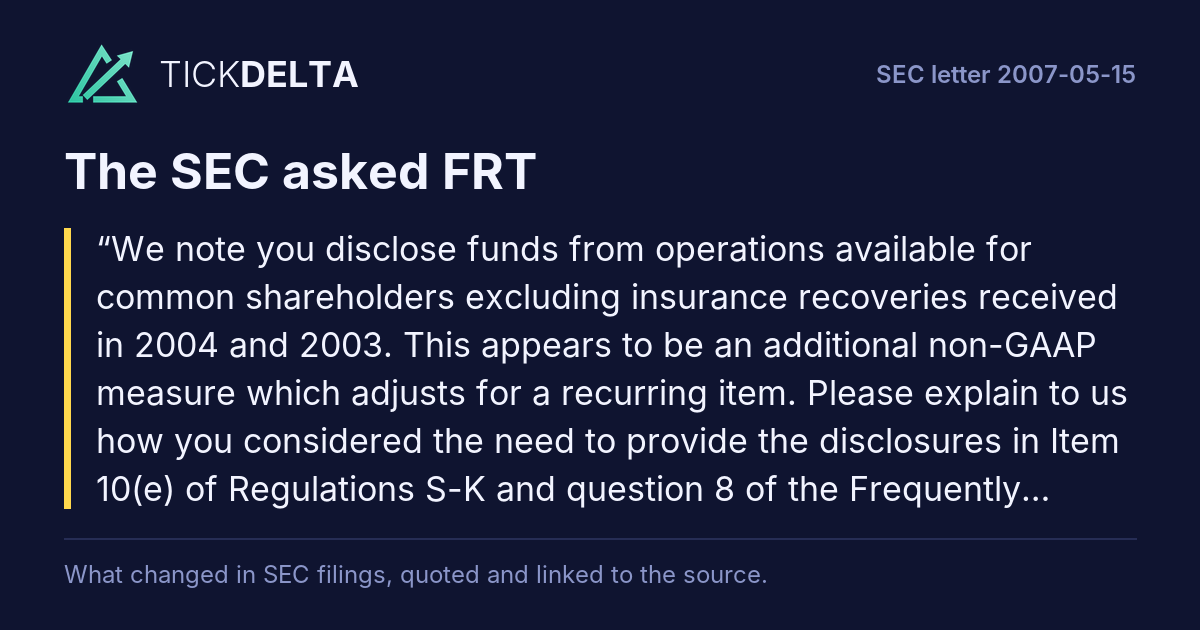
We note you disclose funds from operations available for common shareholders excluding insurance recoveries received in 2004 and 2003. This appears to be an additional non-GAAP measure which adjusts for a recurring item.
Rest of the question

Please explain to us how you considered the need to provide the disclosures in Item 10(e) of Regulations S-K and question 8 of the Frequently Asked Questions Regarding the Use of Non-GAAP Financial Measures for this measure.

FRT answered
On behalf of our client, Federal Realty Investment Trust, a Maryland real estate investment trust (the “Company”), this letter responds to your letter dated May 15, 2007, providing comments relating to the Company’s Form 10-K for the fiscal year ended December 31, 2006. In order to facilitate the Staff’s review of this letter, we have restated each of your numbered comments below and have included the Company’s response underneath each comment. Form 10-K for the year ended December 31, 2006 We note you disclose funds from operations available for common shareholders excluding insurance recoveries received in 2004 and 2003.
Rest of the letter

This appears to be an additional non-GAAP measure which adjusts for a recurring item. Please explain to us how you considered the need to provide the disclosures in Item 10(e) of Regulation S-K and question 8 of the Frequently Asked Questions Regarding the Use of Non-GAAP Financial Measures for this measure. The insurance proceeds which are referred to in footnote 4 to the Selected Financial Data relate to a significant fire which occurred in 2002 at Santana Row, one of the Company’s properties located in San Jose, California. Due to the nature and significant dollar amount of the insurance proceeds, the Company determined it was important to the reader to disclose this matter in order for the reader to fully evaluate reported Funds from Operations (FFO). As indicated in question 8 of the Frequently Asked Questions Regarding the Use of Non-GAAP Financial Measures, excluding an item from a non-GAAP measure “would be permissible if management reasonably believes it is probable that the financial impact of the item will disappear or become immaterial within a near term finite period.” While the Company understands that fires may be considered recurring, the fire at Santana Row was of such magnitude and impact to the property and the consolidated company, the Company determined disclosure was merited of FFO excluding the related insurance proceeds. The Company has not experienced another fire of this magnitude in its 45-year history. Furthermore, this fire remains the largest structural fire in the history of San Jose, California. Thus, the Company believed it was probable that the significant financial impact of the insurance proceeds would disappear in a near finite term and this, in fact, has been the case. The Company provided the disclosures required under Item 10 (e) of Regulation S-K for FFO in footnote 3 to the Selected Financial Data. The Company also provided the amount of the insurance recovery proceeds in footnote 4. The Company does not consider the additional mathematical calculation and disclosure of FFO excluding these insurance proceeds to be an additional Non-GAAP measure but rather supplemental information that enables a reader to fully evaluate reported FFO. However, the Company understands that this item could be viewed differently and will remove the following disclosure in future filings: “Excluding these items, fund from operations available for common shareholders in 2004 and 2003 would have been $145.6 million and $123.3 million, respectively.” Consolidated Statements of Operations, page F-6 We note that you omit the line item income before minority interests. Tell us how you considered Rule 5-03 of Regulation S-X in determining it was not necessary to disclose this amount. discloses minority interests on the face of the Consolidated Statements of Operations. In omitting the line item income before minority interests, the Company considered the requirements of Rule 5-03 of Regulation S-X, the materiality of the line item, and the overall additional benefit to the reader of including the line item. Income after minority interests was $95.1 million, $84.4 million, and $64.0 million for the years ended December 31, 2006, 2005, and 2004, respectively, which represents approximately 96%, 94%, and 94%, respectively, of income before minority interests. Thus, the Company concluded including this line item, which is a subtotal, would not provide additional material information to the reader. However, the Company understands this could be viewed differently and will add the line item “income before minority interests” to the Consolidated Statements of Operations in future filings. It appears that you have classified the gain on sale of Greenlawn Plaza as discontinued operations despite that fact that you have 30% interest in the partnership that purchased the property. Explain to us how you considered the guidance in paragraph 42 of SFAS 144 and EITF 03-13 in determining the appropriate classification of the gain. The Company considered the guidance in paragraph 42 of SFAS 144 and EITF 03-13 in considering whether it was appropriate to include the gain on sale of Greenlawn Plaza in discontinued operations. On the face of the Consolidated Statements of Operations, the Company included a line item in discontinued operations titled “Gain on sale of real estate, net of taxes” which includes the gains on all properties sold, including Greenlawn Plaza, during 2006, 2005, and 2004. In Note 2 to the Consolidated Financial Statements, the Company discloses the properties sold and their related gains. Additionally, the Company clearly discloses the fact that Greenlawn Plaza was sold to their 30% owned real estate partnership. The gain on sale of Greenlawn Plaza of $7.4 million represents 6% of net income. While the Company maintained continuing involvement in the property, the Company concluded that adding a second line item outside of discontinued operations solely related to the gain on the sale of Greenlawn Plaza would not provide significant additional information to the reader as the transaction was clearly disclosed in Note 2. The Company evaluated the Consolidated Financial Statements including the related notes taken as a whole and concluded the reader was appropriately informed of the amount of the gain and the continuing involvement in this property without including an additional line item on the face of the Consolidated Statements of Operations. Note 3. Mortgage Notes Receivable, page F-17 We note that you amended a $17.7 million note receivable on August 4, 2006. Explain to us whether this transaction was accounted for as an extinguishment of the existing note and issuance of new debt or as a modification. In your response, tell us how you considered paragraphs 12 and 13 of SFAS 91 and EITF 01-07 in determining the appropriate accounting. Consistent with the guidance in paragraphs 12 and 13 of SFAS 91 and EITF 01-07, the Company accounted for the restructuring as a modification. There were no unamortized net fees or costs or prepayment penalties on the original loan. Note 4. Real Estate Partnership, page F-18 We note you guarantee $36.7 million in mortgage notes of some of your subsidiaries. Please explain to us how you considered paragraph 13 of FIN 45 in determining whether the term of the guarantee should be disclosed. As disclosed in Note 4 of the Consolidated Financial Statements, the guaranties are for the benefit of a subsidiary partnership that indemnifies the Company for any loss. Given the nature of these guaranties, the Company did not believe it was necessary to disclose the term of the guaranties. These guaranties are typical of the types of guaranties generally used in connection with property secured lending and cover loss to the lender arising from certain bad acts by the borrowing entity (such as fraud and misapplication of funds, among other things) as well as potential loss to the lender from environmental liability with respect to the secured property. The guaranties do not have a finite term; however, once the lenders have been repaid in accordance with the loan documents, the only likely source for a claim on the guaranty is for loss to the lender as a result of potential future environmental liability at the properties to which the loans relate. In order to provide further information on the guaranties, the Company will include the following disclosure in future filings: “The guaranties do not have a finite term; however, once the lenders have been repaid in accordance with the loan documents, the only likely source for a claim on the guaranty is for loss to the lender as a result of potential future environmental liability at the properties to which the loans relate.” Note 12. Components of Rental Income and Expense, page F-21 We note that you recorded $1.2 million of additional straight-line rental income during 2005 due to a change in estimate of collectibility of certain long-term receivables. Please explain to use in detail management’s process for recording straight line revenue, and the related the process of determining the collectibility of straight-line rent receivables and recording the allowance. In your response, include an explanation of when the allowance is recorded by the Company and tell us where the related bad debt expense is recorded on the Company’s process for recording straight-line rental income is primarily based on Statement of Financial Accounting Standards No. 13, “Accounting for Leases” (SFAS 13) and Staff Accounting Bulletin No. 104, Topic 13: Revenue Recognition (SAB 104). SFAS 13 requires minimum rents to be recorded on a straight-line basis unless another systematic and rational basis is more representative of the time pattern in which use benefit is derived from the leased property. SAB 104 states that revenue generally is realized or realizable and earned when four criteria are met including that collectibility is reasonably assured. Accordingly, the Company’s process for recording straight-line rental income generally consists of: (1) computing straight-line rental income for minimum rents provided for in each lease and (2) recognizing rental income on a straight-line basis to the extent that the criteria of SAB 104 are met including assessing whether the collectibility of minimum rents is reasonably assured. This process is applied on a lease by lease basis. The following discussion provides additional background and details regarding this process. The Company primarily owns and operates retail properties. Accordingly, the Company’s long-term leases are with tenants that operate in the retail sector which is a very competitive sector that is subject to down-swings in the economy, changes in consumer tastes, changes in technology and has short life cycles for many retail products. Additionally, retail sector developments such as the increase in internet purchasing, the emergence of big-box national retailers (such as Wal-Mart and Target) and the increased number and types of retailers selling various goods (big-box retailers, dollar stores, fast casual dining, etc.) have further increased competition within the retail sector. As the Company has long-term leases with tenants operating in this very competitive retail sector, assessing the collectibility of minimum rents is an important part of the process to ensure the Company appropriately records rental income. Straight-line rental income for long-term leases for which collectibility of all minimum rents is reasonably assured is recognized on a straight-line basis over the non-cancellable term of the lease and includes the effects of rent steps and rent abatements. The Company begins recognizing straight-line rental income when the tenant takes possession of the leased space and the leased space is substantially ready for its intended use. Straight-line rental income for long-term leases for which collectibility of minimum rents is not reasonably assured is recognized only to the extent collectibility is reasonably assured. These instances represent specific leases for which management has concluded the collectibility of all minimum rents is not reasonably assured based on the specific facts and circumstances surrounding the tenant and lease. In assessing collectibility of minimum rents, management’s consideration includes one or more of the following factors: the tenant’s current financial position, trends in the tenant’s sales and operating income, tenant’s long-term debt rating, tenant’s business strategy, length of the tenant’s lease, nature of the tenant’s business, competition facing the tenant, tenant’s ownership structure and media information available (i.e. press releases announcing the closing of stores, substantial changes in operating model or the potential need to file bankruptcy). If collectibility of all minimum rents is not reasonably assured and the Company recognizes rental income that is less than that which would have been computed under the straight-line basis assuming collection of all minimum rents, the Company does not believe the difference represents a reserve or valuation allowance. For these specific leases, the Company only recognizes revenue to the extent that collectibility is reasonably assured. The Company believes it would be inappropriate to initially recognize straight-line rental income for which collectibility is not reasonably assured by recording revenue and immediately recording bad debt expense. The Company believes this would overstate straight-line rental income by recording revenue that did not meet the criterion for recognition under SFAS 13 and SAB 104. On a quarterly basis, the Company updates its evaluation of both the collectibility of unrecognized straight-line rental income related to long-term leases and the collectibility of rental income previously recognized. If a change in a tenant’s financial condition and operating performance indicates that more straight-line revenue is reasonably collectible than previously estimated and realized, the additional straight-line rental income is recognized as revenue. A reserve or valuation allowance and bad debt expense is not recorded until after rental income has been recognized and subsequent factors cause management to conclude that such amount is no longer collectible. Bad debt expense is included in rental expense in the Consolidated Statements of Operations. Note 1 to the Consolidated Financial Statements contains the following disclosure regarding the Company’s collectibility analysis for straight-line rent: “We make estimates of the collectibility of our accounts receivable related to minimum rents, straight-line rents, expense reimbursements and other revenue or income. In some cases, primarily relating to straight-line rents, the collection of these amounts extends beyond one year. Our experience relative to unbilled straight-line rents is that a certain portion of the amounts otherwise recognizable as revenue is never billed to or collected from tenants due to early lease terminations, lease modifications, bankruptcies and other factors. Accordingly, the extended collection period for straight-line rents along with our evaluation of tenant credit risk may result in the non-recognition of a portion of straight-line rental income until the collection of such income is reasonably assured.” Upon further review of the disclosures, the Company believes the policy footnote could be further enhanced to clarify the accounting for changes in collectibility evaluations. The Company will add the following to the accounting policy for Revenue Recognition and Accounts Receivable in future filings as follows: “If our evaluation of tenant credit risk changes indicating more straight-line revenue is reasonably collectible than previously estimated and realized, the additional straight-line rental income is recognized as revenue. If our evaluation of tenant credit risk changes indicating a portion of realized straight-line rental income is no longer collectible, a reserve and bad debt expense is recorded.” We note that you deleted the language “(the registrant’s fourth fiscal quarter in the case of an annual report)” from paragraph 4(d). Please revise your certifications in future filings to include the disclosure. Paragraph 4(d) of the certifications indicates “the most recent fiscal quarter.” Since this was filed in the annual report, the Company felt it was self-explanatory that this referred to the fourth fiscal quarter. The Company will, however, revise the certifications in future filings to include the disclosure. - the Company is responsible for the adequacy and accuracy of the disclosure in the filings; Staff comments or changes to disclosure in response to Staff comments do not foreclose the Commission from taking any action with respect to the filings; and the Company may not assert Staff comments as a defense in any proceeding initiated by the Commission or any person under the federal securities laws of the United States. If you have any further questions or require additional information, please do not hesitate to contact me at (202) 663-8326.
One letter for all the questions, without numbered answers. Read the reply ↗
In its next report

First report after the company's reply of 2007-05-29: 10-Q filed 2007-08-01 ↗, against the 10-Q filed 2007-05-02 ↗.

Tickdelta does not hold the text of both reports, so they are not compared here.

Financial Statements · Consolidated Statements of Operations, page F-6
SEC asked (2)
We note that you omit the line item income before minority interests. Tell us how you considered Rule 5-03 of Regulation S-X in determining it was not necessary to disclose this amount.
FRT answered

See the reply above.

In its next report

First report after the company's reply of 2007-05-29: 10-Q filed 2007-08-01 ↗, against the 10-Q filed 2007-05-02 ↗.

Tickdelta does not hold the text of both reports, so they are not compared here.

Note 2. Real Estate, page F-16
SEC asked (3)
It appears that you have classified the gain on sale of Greenlawn Plaza as discontinued operations despite that fact that you have 30% interest in the partnership that purchased the property. Explain to us how you considered the guidance in paragraph 42 of SFAS 144 and EITF 03-13 in determining the appropriate classification of the gain.
FRT answered

See the reply above.

In its next report

First report after the company's reply of 2007-05-29: 10-Q filed 2007-08-01 ↗, against the 10-Q filed 2007-05-02 ↗.

Tickdelta does not hold the text of both reports, so they are not compared here.

Note 3. Mortgage Notes Receivable, page F-17
SEC asked (4)
We note that you amended a $17.7 million note receivable on August 4, 2006. Explain to us whether this transaction was accounted for as an extinguishment of the existing note and issuance of new debt or as a modification. In your response, tell us how you considered paragraphs 12 and 13 of SFAS 91 and EITF 01-07 in determining the appropriate accounting.
FRT answered

See the reply above.

In its next report

First report after the company's reply of 2007-05-29: 10-Q filed 2007-08-01 ↗, against the 10-Q filed 2007-05-02 ↗.

Tickdelta does not hold the text of both reports, so they are not compared here.

Note 4. Real Estate Partnership, page F-18
SEC asked (5)
We note you guarantee $36.7 million in mortgage notes of some of your subsidiaries. Please explain to us how you considered paragraph 13 of FIN 45 in determining whether the term of the guarantee should be disclosed.
FRT answered

See the reply above.

In its next report

First report after the company's reply of 2007-05-29: 10-Q filed 2007-08-01 ↗, against the 10-Q filed 2007-05-02 ↗.

Tickdelta does not hold the text of both reports, so they are not compared here.

Note 12. Components of Rental Income and Expense, page F-21
SEC asked (6)
We note that you recorded $1.2 million of additional straight-line rental income during 2005 due to a change in estimate of collectibility of certain long-term receivables. Please explain to us in detail management’s process for recording straight line revenue, and the related the process of determining the collectibility of straight-line rent receivables and recording the allowance.
Rest of the question

In your response, include an explanation of when the allowance is recorded by the Company, and tell us where the related bad debt expense is recorded on the Consolidated Statements of Income.

FRT answered

See the reply above.

In its next report

First report after the company's reply of 2007-05-29: 10-Q filed 2007-08-01 ↗, against the 10-Q filed 2007-05-02 ↗.

Tickdelta does not hold the text of both reports, so they are not compared here.

Exhibit 31.1 and Exhibit 31.2
SEC asked (7)
We note that you deleted the language “(the registrant’s fourth fiscal quarter in the case of an annual report)” from paragraph 4(d). Please revise your certifications in future filings to include this disclosure. * * * * Please respond to this comment within 10 business days or tell us when you will provide us with a response. Please file your response letter on EDGAR.
Rest of the question

Please understand that we may have additional comments after reviewing your response to our comments.

FRT answered

See the reply above.

In its next report

First report after the company's reply of 2007-05-29: 10-Q filed 2007-08-01 ↗, against the 10-Q filed 2007-05-02 ↗.

Tickdelta does not hold the text of both reports, so they are not compared here.

Form 10-K for the year ended December 31, 2006 · Note 2. Real Estate, page F-16
SEC asked
We have considered your response to our prior comment three. In view of the continuing involvement, we believe the gain related to the sale of Greenlawn Plaza as well as its operating results prior to sale should be classified as continuing operations in accordance with paragraph 42 of SFAS 144 and EITF 03-13.
Rest of the question

Please revise accordingly or provide us with support for a conclusion that the effect would be immaterial based on SAB 99. Please respond to this comment within 10 business days or tell us when you will provide us with a response. Please file your response letter on EDGAR. You may contact Robert Telewicz, Senior Staff Accountant at (202) 551-3438, Jennifer Monick, Staff Accountant at (202) 551-3295, or the undersigned at (202) 551-3780 if you have questions. S i n c e r e l y ,

FRT answered
On behalf of our client, Federal Realty Investment Trust, a Maryland real estate investment trust

(the “Company”), this letter responds to your letter dated June 6, 2007, providing comments relating to the Company’s Form 10-K for the fiscal year ended December 31, 2006. In order to facilitate the Staff’s review of this letter, we have restated each of your numbered comments below and have included the Company’s response underneath each comment.

Form 10-K for the year ended December 31, 2006

Note 2. Real Estate, page F-16

We have considered your response to our prior comment three.
Rest of the answer

In view of the continuing involvement, we believe the gain related to Greenlawn Plaza as well as its operating results prior to sale should be classified as continuing operations in accordance with paragraph 42 of SFAS 144 and EITF 03-13. Please revise accordingly or provide us with support for a conclusion that the effect would be immaterial based on SAB 99.

The Company understands your comment that due to the continuing involvement in Greenlawn Plaza, the gain on sale and the resulting operations should be classified as continuing operations. However, the Company believes the effect of this reclassification is immaterial to the consolidated financial statements taken as a whole. SAB 99 states: “the omission or misstatement of an item in a financial report is material if, in the light of surrounding circumstances, the magnitude of the item is such that it is probable that the judgment of a reasonable person relying upon the report would have been changed or influenced by the inclusion or correction of the item”. Thus, the Company has considered both the quantitative and qualitative factors surrounding the materiality of this item.

Quantitative and Qualitative Analysis

The below charts detail the significant line items in our consolidated financial statements and includes the amounts as filed in our 2006 Form 10-K, the amounts assuming the Company reclassified Greenlawn Plaza to continuing operations, and the percentage change in order to evaluate the quantitative materiality.

(In thousands)

2006 Statement of Operations

As Filed

Including Greenlawn

Plaza in Continuing

Operations

Percentage

Change

Total Revenues

451,022

451,849

0.2

%

Total Expenses

251,986

252,543

Operating Income

199,036

199,306

0.1

Income from Continuing Operations

95,076

102,793

8.1

Income from Discontinued Operations

23,636

15,919

-32.6

Net Income

118,712

0.0

2005 Statement of Operations

408,469

410,331

0.5

232,944

234,017

175,525

176,314

0.4

84,433

85,222

0.9

30,179

29,390

-2.6

114,162

2004 Statement of Operations

383,612

385,386

232,052

233,009

151,560

152,377

64,041

64,858

1.3

20,115

19,298

-4.1

84,156

The reclassification is clearly immaterial from a quantitative standpoint for all line items for the years ended

December 31, 2005 and 2004 and for total revenues, total expenses, and operating income for 2006. While the 2006 impact to income from continuing operations and income from discontinued operations is a change of 8.1% and 32.6%, respectively, there is no impact to net income. There is also no impact to the statement of cash flows for 2006, 2005, or 2004. As stated in SAB 99, “magnitude by itself, without regard to the nature of the item and the circumstances in which the judgment has to be made, will not generally be a sufficient basis for a materiality judgment.” Accordingly, the Company further considered the qualitative factors related to the reclassification as follows:

•

The change would be a Statement of Operations reclassification from discontinued operations to continuing operations and net income would not be impacted.

The Company is generally evaluated by analysts based on funds from operations (FFO) which excludes gains on sale of real estate. Thus, the geography of the gain on sale of Greenlawn Plaza on the statement of operations would not impact FFO.

The reclassification would have no effect on net income and thus, would not result in a change from a loss to income or vice versa.

Greenlawn Plaza does not play a significant role in the Company’s operations or profitability. Greenlawn Plaza’s net income excluding gain on sale while it was owned by the Company during 2006, 2005, and 2004 was $0.3 million, $0.8 million, and $0.8 million, respectively. This is not considered a significant part of the operations.

The classification of Greenlawn Plaza in continuing operations would have no effect on compliance with loan covenants, regulatory requirements, or other contractual requirements.

The classification of Greenlawn Plaza would not impact management’s compensation.

The classification of Greenlawn Plaza does not involve concealment of an unlawful transaction.

The classification is clearly not a situation whereby management intentionally misstated the financial statements to manage earnings.

The Company would not expect the market to react positively or negatively based on the classification of Greenlawn Plaza.

The sale of Greenlawn Plaza is a distinct event that is clearly disclosed in Note 2 to the Consolidated Financial Statements. Additionally, the Company clearly discloses the fact that Greenlawn Plaza was sold to their 30% owned real estate partnership.

SAB 99 Conclusion

Based on the above quantitative and qualitative analysis, the Company does not believe that the magnitude of the item is such that it is probable that the judgment of a reasonable person relying upon its Form 10-K would have been changed or influenced by the reclassification of Greenlawn Plaza from discontinued operations to continuing operations. Accordingly, we do not believe a revision is required.

The Company acknowledges that:

- the Company is responsible for the adequacy and accuracy of the disclosure in the filings;

Staff comments or changes to disclosure in response to Staff comments do not foreclose the Commission from taking any action with respect to the filings; and the Company may not assert Staff comments as a defense in any proceeding initiated by the Commission or any person under the federal securities laws of the United States.

If you have any further questions or require additional information, please do not hesitate to contact me at (202) 663-8326.
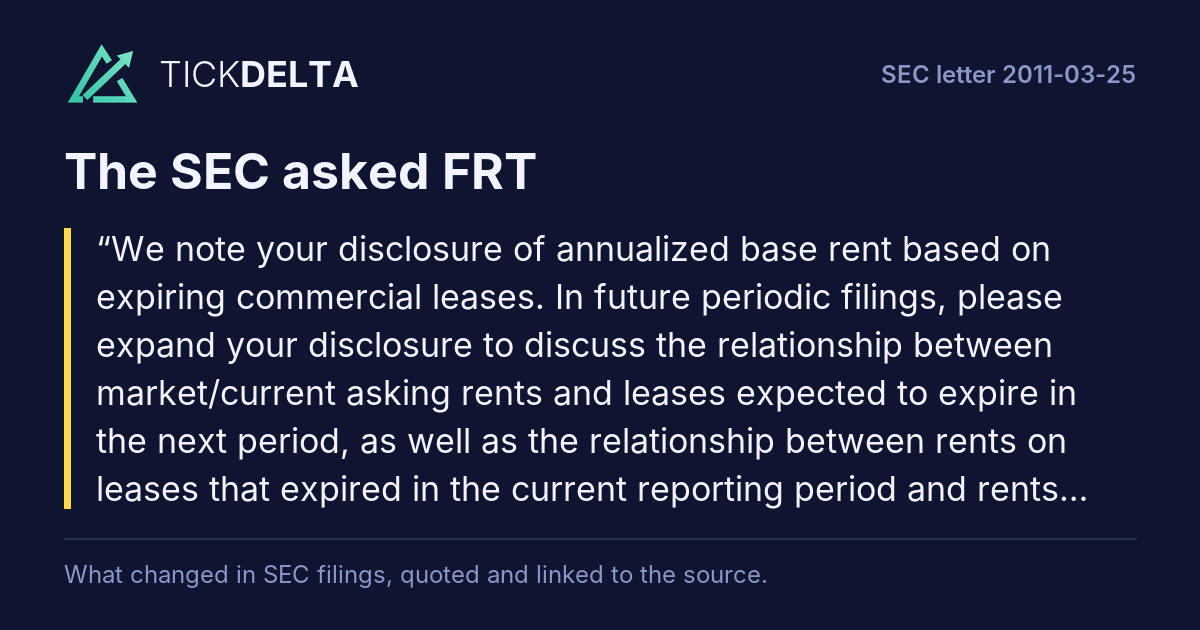
Read in the reply ↗
In its next report

First report after the company's reply of 2007-06-19: 10-Q filed 2007-08-01 ↗, against the 10-Q filed 2007-05-02 ↗.

Tickdelta does not hold the text of both reports, so they are not compared here.

Form 10-K for the year ended December 31, 2006 · Note 2. Real Estate, page F-16
SEC asked
We have considered your response to our prior comment one. After reviewing your SAB 99 analysis, we continue to believe that the operations and gain from sale of Greenlawn Plaza should be classified as continuing operations.
Rest of the question

Please revise your Form 10-K for the year ended December 31, 2006 to reflect the classification of the gain related to the sale of Greenlawn Plaza as well as its operating results prior to sale as continuing operations in accordance with paragraph 42 of SFAS 144 and EITF 03-13. Please respond to this comment within 10 business days or tell us when you will provide us with a response. Please file your response letter on EDGAR. You may contact Robert Telewicz, Senior Staff Accountant at (202) 551-3438, Jennifer Monick, Staff Accountant at (202) 551-3295, or the undersigned at (202) 551-3780 if you have questions. S i n c e r e l y ,

FRT answered
, the Company is expanding its discussion related to Greenlawn Plaza to include a discussion of the special provision relating to real estate investment trusts provided for in Rule 3-15 of Regulation S-X and some additional quantitative and qualitative support for the Company’s conclusion to not include the gain on sale of Greenlawn Plaza and its operating results prior to sale in continuing operations.

Rule

5-03 indicates the various captions which, if applicable, and except as otherwise permitted should appear on the face of the income statement.
Rest of the answer

Rule 3-15, Special Provision as to Real Estate Investment Trusts states the following:

“(a)(1) The income statement prepared pursuant to Rule 5-03 shall include the following additional captions between those required by Rule 5-03.15 and 16: (i) Income or loss before gain or loss on sale of properties, extraordinary items and cumulative effects of accounting changes, and (ii) gain or loss on sale of properties, less applicable income tax.”

Accordingly, Rule 3-15, specifically requires real estate investment trusts such as the Company to include gain on the sale of properties between the captions discontinued operations (Rule 5-03.15) and extraordinary items and cumulative effect of changes in accounting principles (Rule 5-03.16). The classification of gain on sale of properties presented as a separate caption in accordance with Rule 3-15 due to continuing involvement can be seen in the filings of numerous real estate investment trusts. Though their presentation is not consistent with the Staff’s request to include the gain on sale of

Greenlawn Plaza in continuing operations, this presentation is consistent with Rule 3-15 and prevalent reporting of such gains within the real estate investment trust industry and other registrants within the Company’s Standard Industry Code.

Therefore, the Company believes the appropriate quantitative analysis under SAB 99 should not be prepared based on classifying both the gain on sale of

Greenlawn Plaza and its operating results prior to sale in continuing operations. The appropriate quantitative analysis should be prepared based on only classifying the operating results of Greenlawn Plaza prior to sale in continuing operations and classifying the gain on sale of Greenlawn Plaza as a separate caption after discontinued operations as required of real estate investment trusts by Rule 3-15.

The charts below detail the significant captions in the Company’s income statements and includes the amounts as filed in the Company’s 2006 Form 10-K compared to the amounts assuming the operating results of Greenlawn Plaza prior to sale were included in continuing operations and the gain on the sale of Greenlawn Plaza was presented as a separate caption in accordance with Rule 3-15. Additionally, the percentage change between these two presentations is presented in order to assist with the evaluation of materiality.

(In thousands)

2006 Statement of Operations

As Filed

As Required by

Rule 3-15

Percentage

Change

Total Revenues

451,022

451,849

0.2

%

Total Expenses

251,986

252,543

Operating Income

199,036

199,306

0.1

Income from Continuing Operations

95,076

95,346

0.3

Income from Discontinued Operations

23,636

15,925

-32.6

Gain on the Sale of Real Estate

—

7,441

100.0

Net Income

118,712

0.0

2005 Statement of Operations

408,469

410,330

0.5

232,944

234,016

175,525

176,314

0.4

84,433

85,222

0.9

30,179

29,390

-2.6

114,162

2004 Statement of Operations

383,612

385,387

232,052

233,010

151,560

152,377

64,041

64,858

1.3

20,115

19,298

-4.1

84,156

This reclassification is clearly immaterial for all captions except for income from discontinued operations and gain on sale of real estate for 2006. While the impact to income from discontinued operations and gain on sale of real estate for 2006 is 32.6% and 100%, respectively, there is no impact to net income and the impact to continuing operations is between 0.3% and 1.3% for all years presented. Rule 3-15 segregates out gains on the sale of real estate for real estate investment trusts in order to provide transparency in operating results versus sales of real estate. The Company believes it has achieved this transparency with its income statement presentation as income from continuing operations is clearly not significantly misstated and the users of the Company’s financial statements would place little emphasis on a distinction between discontinued operations and a separate caption for gain on sale of real estate.

The Company has also provided transparency about the amount and nature of the gain on sale of Greenlawn Plaza with its footnote disclosures. Accordingly, the Company does not believe separate presentation of the gain on sale of Greenlawn Plaza is required and that it may be combined with the next most appropriate caption. Furthermore, the Company believes the next most appropriate caption is income from discontinued operations for the following qualitative reasons:

•

The gain on sale of real estate can be a significant amount for many real estate investment trusts, but such gain is not typically meaningful to the users of their financial statements (see FFO discussion below). Again, the Company believes that Rule 3-15 specifically responds to this point and as such, requires gain on the sale of real estate to be classified outside of continuing operations.

The company has sold a majority interest in Greenlawn Plaza to an unconsolidated partnership and its continuing interest in Greenlawn Plaza is not expected to play a significant role in the Company’s ongoing operations or profitability.

This is the only gain on sale of real estate resulting from the Company selling a property to its 30% owned real estate partnership since the inception of the partnership in 2004. Property sales to this unconsolidated real estate partnership are not a core part of the Company’s current or planned continuing operations.

Income from continuing operations for the last several years generally provides a trend that is meaningful to a user of financial statements and including the gain on sale of Greenlawn Plaza in continuing operations would misstate this trend. Excluding the gain on sale of Greenlawn Plaza from continued operations assists the users of the Company’s financial statements with assessing its “go forward” performance.

Rule 4-02 provides that is an amount which would otherwise be required to be shown with respect to any item is immaterial, it need not be separately set forth.

If the gain on sale of Greenlawn Plaza is not material enough to be presented as a separate caption in the Company’s income statement, classifying it as discontinued operations supported by adequate and appropriate disclosure (see Note 2 to the Company’s financial statements) provides consistency and clarity in reporting to the users of the Company’s financial statements.

Additionally, SAB 99 states, “magnitude by itself, without regard to the nature of the item and the circumstances in which judgment has to be made, will not generally be sufficient basis for a materiality judgment.” Accordingly, the Company believes the following additional qualitative factors are also relevant to considering if the Company’s income statement as filed in its 2006 Form 10-K should be restated for the classification of the gain on sale of Greenlawn Plaza and its operating results prior to sale:

The Company is generally evaluated by analysts based on funds from operations (FFO) a non-GAAP measure that excludes gains on sale of real estate. Thus, the geography of the gain on sale of Greenlawn Plaza on the statement of operations would not impact FFO.

The reclassification would have no effect on net income and thus, would not result in a change from a loss to income or vice versa.

The reclassification has no effect on cash flows.

The classification of Greenlawn Plaza in continuing operations would have no effect on compliance with loan covenants, regulatory requirements, or other contractual requirements. In fact, gain on the sale of real estate is excluded from all of the Company’s debt covenants.

The classification of Greenlawn Plaza would not impact management’s compensation.

The classification of Greenlawn Plaza does not involve concealment of an unlawful transaction.

The classification is clearly not a situation whereby management intentionally misstated the financial statements to manage earnings as earnings are unaffected by the classification.

The Company would not expect the market to react positively or negatively based on the classification of Greenlawn Plaza.

The sale of Greenlawn Plaza is a distinct event that is clearly disclosed in Note 2 to the Company’s Consolidated Financial Statements. Additionally, the

Company clearly discloses the fact that Greenlawn Plaza was sold to its 30% owned unconsolidated real estate partnership.

Accordingly, based on Rule 3-15 and the above quantitative and qualitative discussion, the Company believes its presentation of the gain on sale of Greenlawn Plaza and its operating results prior to sale is appropriate, and it does not believe that reclassification of these items in its 2006 Form 10-K is warranted.

On August 1, 2007, the Company plans to file its Form 10-Q for the quarter ended

June 30, 2007. Because the sale of Greenlawn Plaza occurred in the quarter ended June 30, 2006, this Form 10-Q will include an income statement for the period during which the sale occurred. The Company’s preference is to continue to classify the gain on sale of Greenlawn and its operating results prior to sale as discontinued operations. The Company believes its current presentation is inline with the interests of the users of its financial statements and their evaluation of the Company’s operating results. The Company also believes the Staff’s requested reclassification is inconsistent with Rule 3-15 and would result in its financial statements being less useful to the readers rather than more useful.

The Company acknowledges that:

- the Company is responsible for the adequacy and accuracy of the disclosure in the filings;

Staff comments or changes to disclosure in response to Staff comments do not foreclose the Commission from taking any action with respect to the filings; and the Company may not assert Staff comments as a defense in any proceeding initiated by the Commission or any person under the federal securities laws of the United States.

If you have any further questions or require additional information, please do not hesitate to contact me at (202) 663-8326.
Read in the reply ↗
In its next report

First report after the company's reply of 2007-07-20: 10-Q filed 2007-08-01 ↗, against the 10-Q filed 2007-05-02 ↗.

Tickdelta does not hold the text of both reports, so they are not compared here.

Also in this review: company letter, 2007-09-06, closing letter, 2007-09-17

From the SEC's correspondence on EDGAR: staff letters (form UPLOAD) and company letters (form CORRESP), 40 letters filed since 2007-05-15. Questions and answers are matched by their numbers; topics come from words in each question. The reports are compared word for word (same form, before the first SEC letter against the first report after the company's reply). No AI.

Next in Owners and insiders Insider trades →